
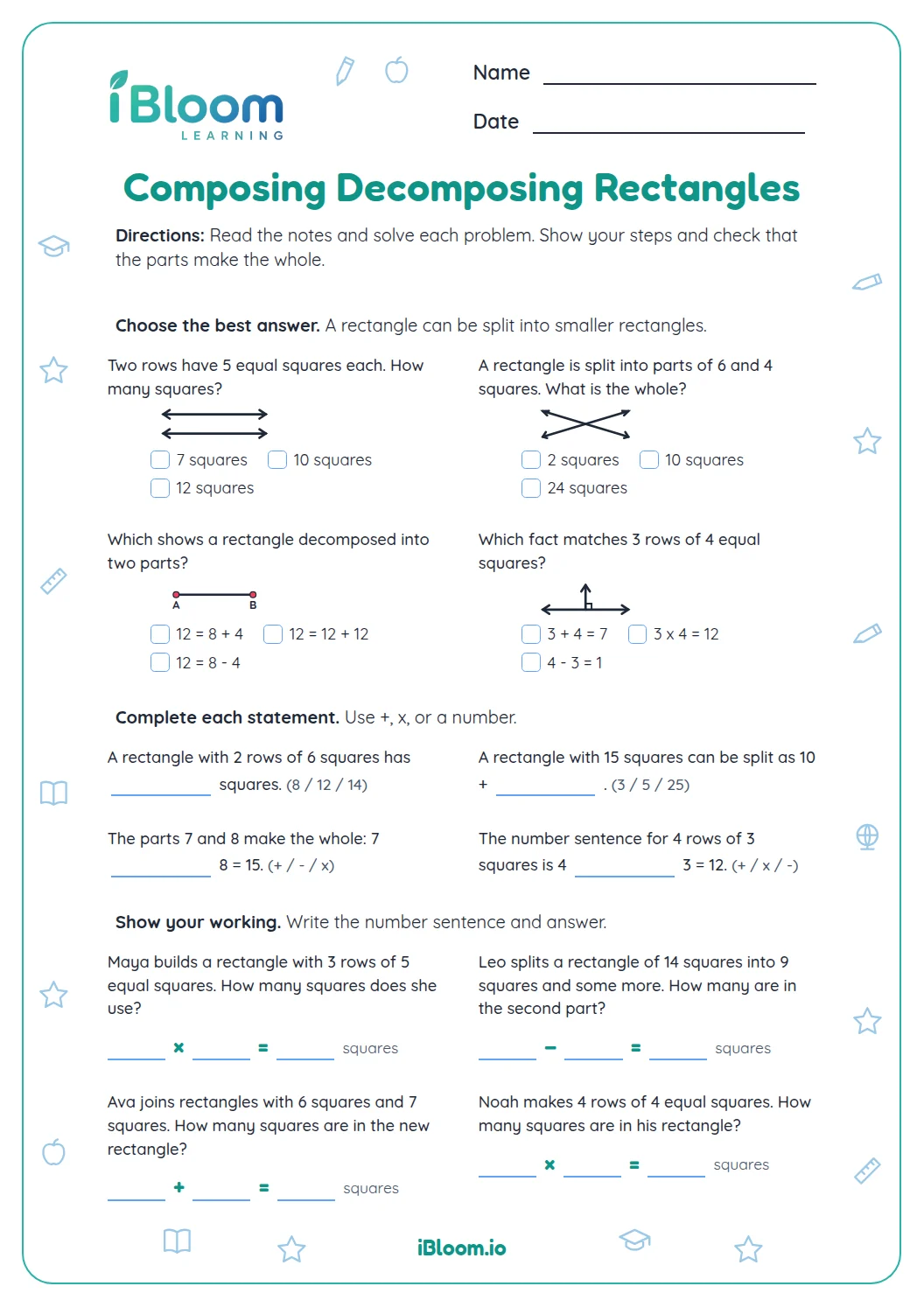
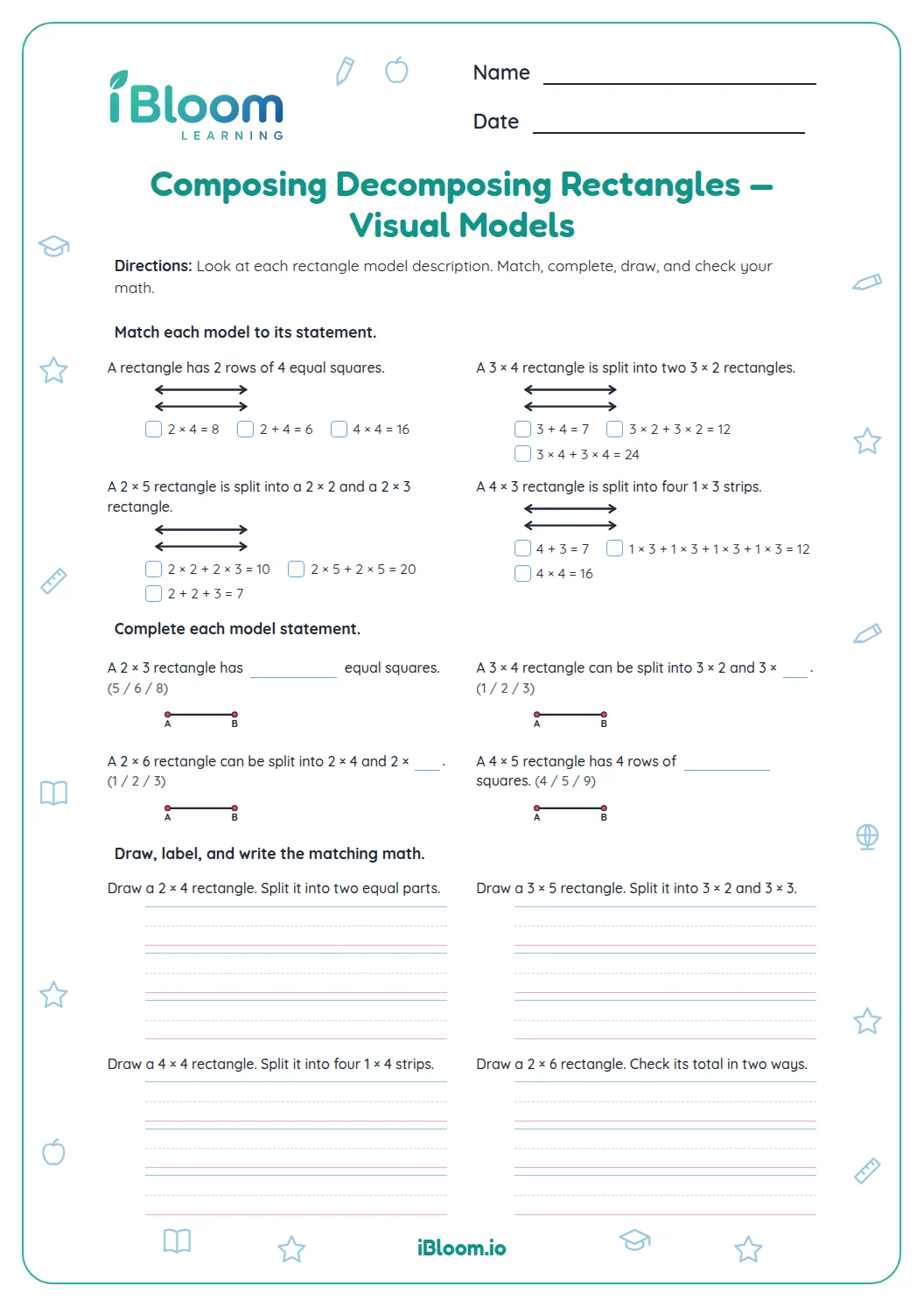
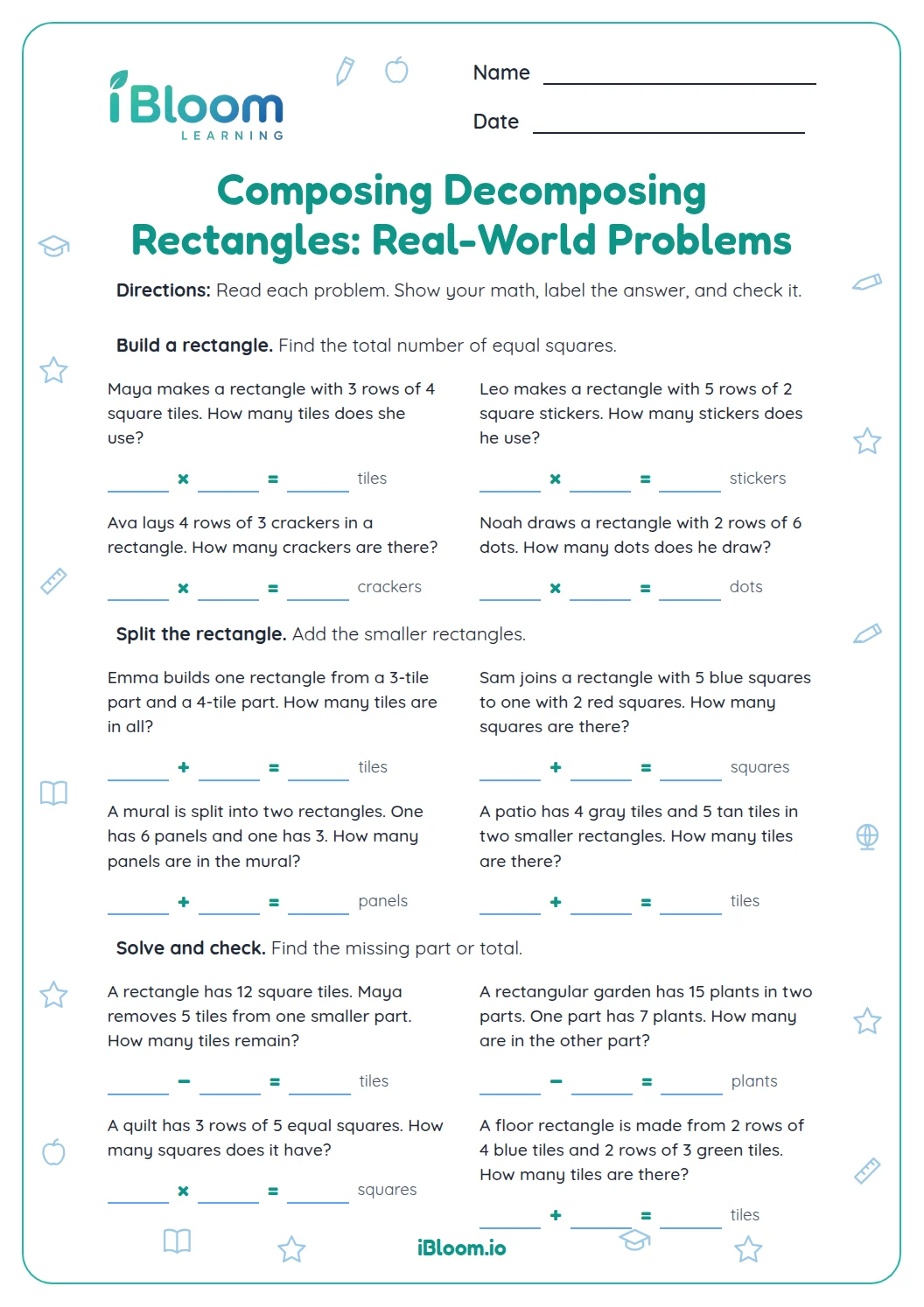
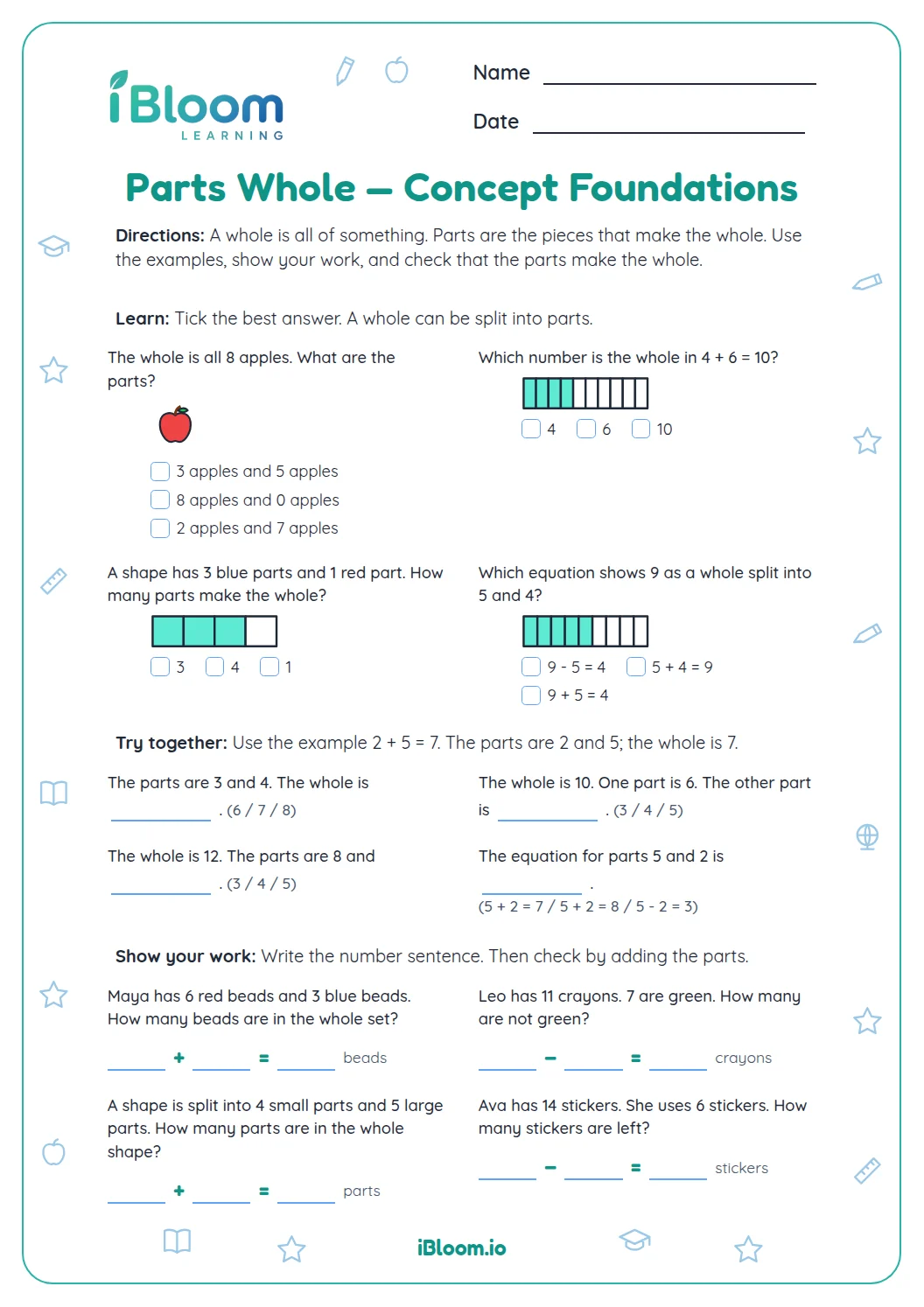
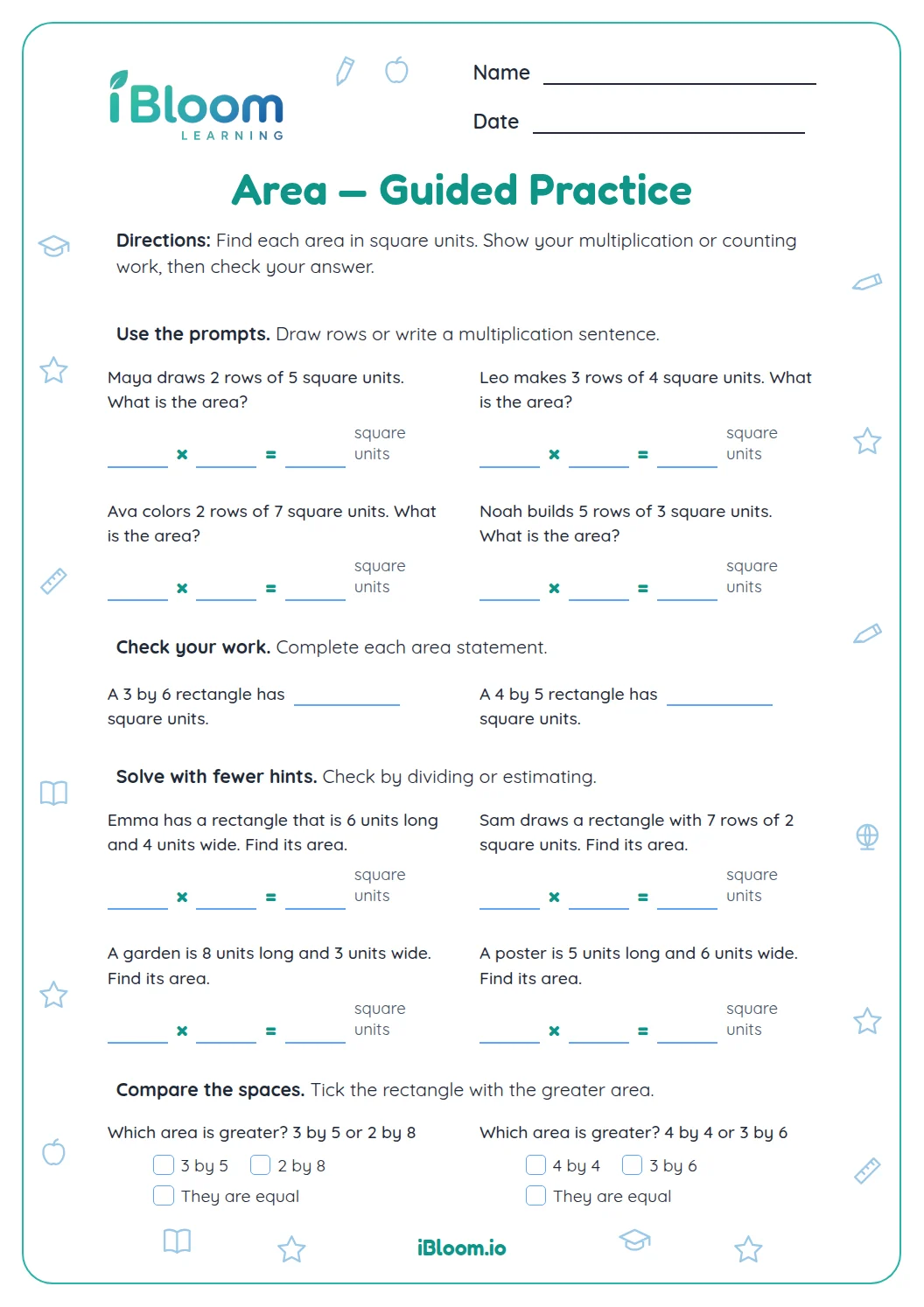
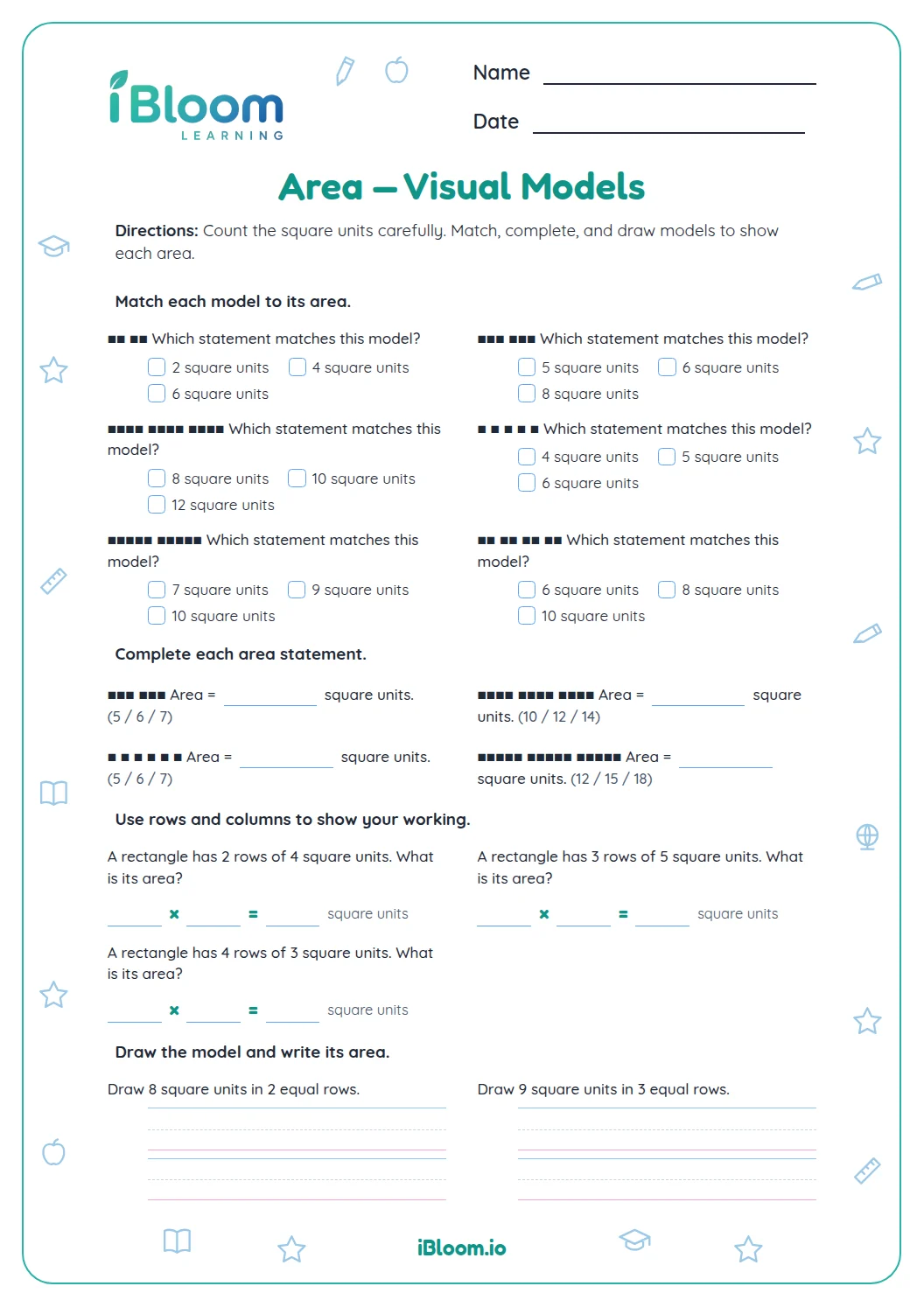
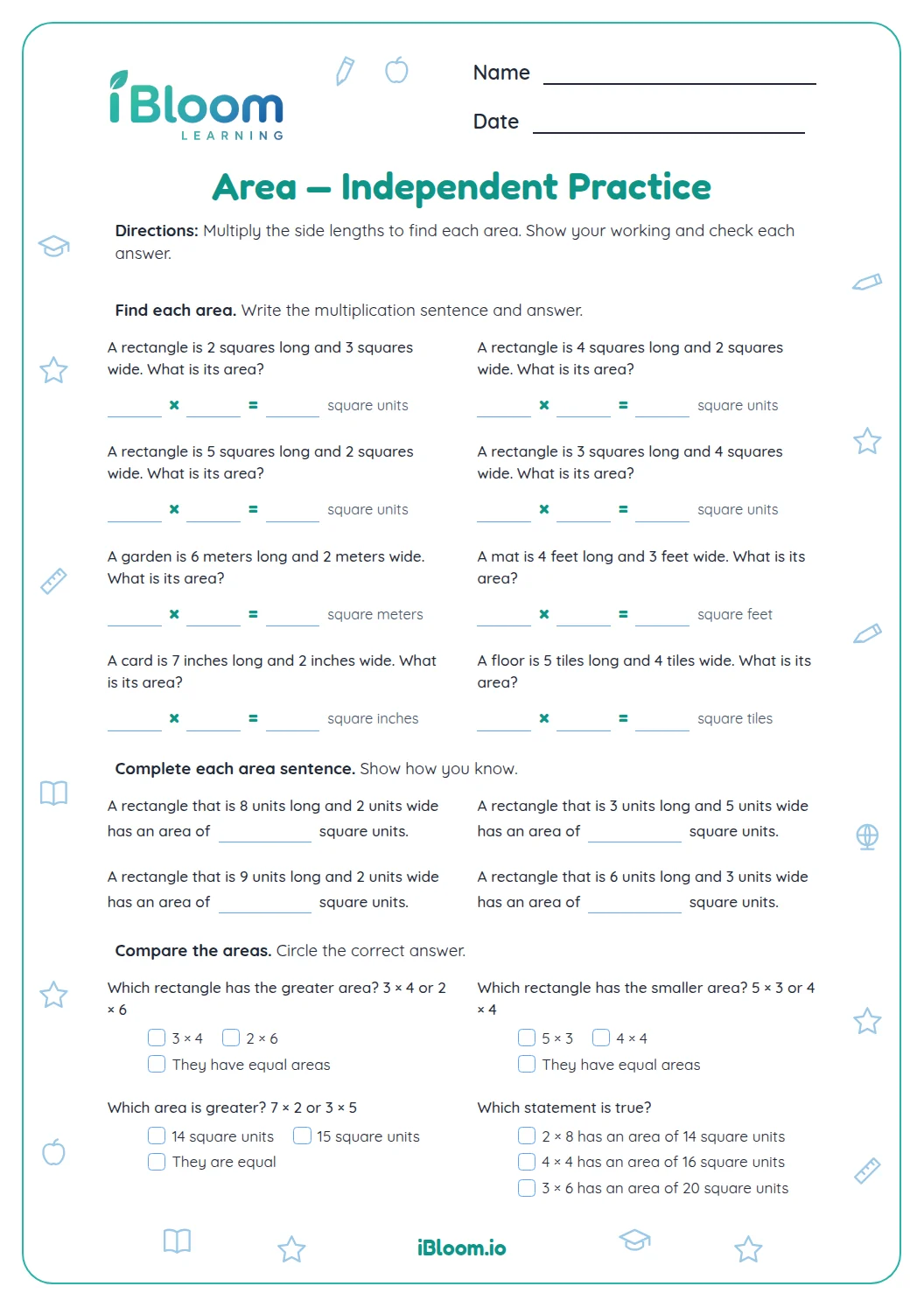
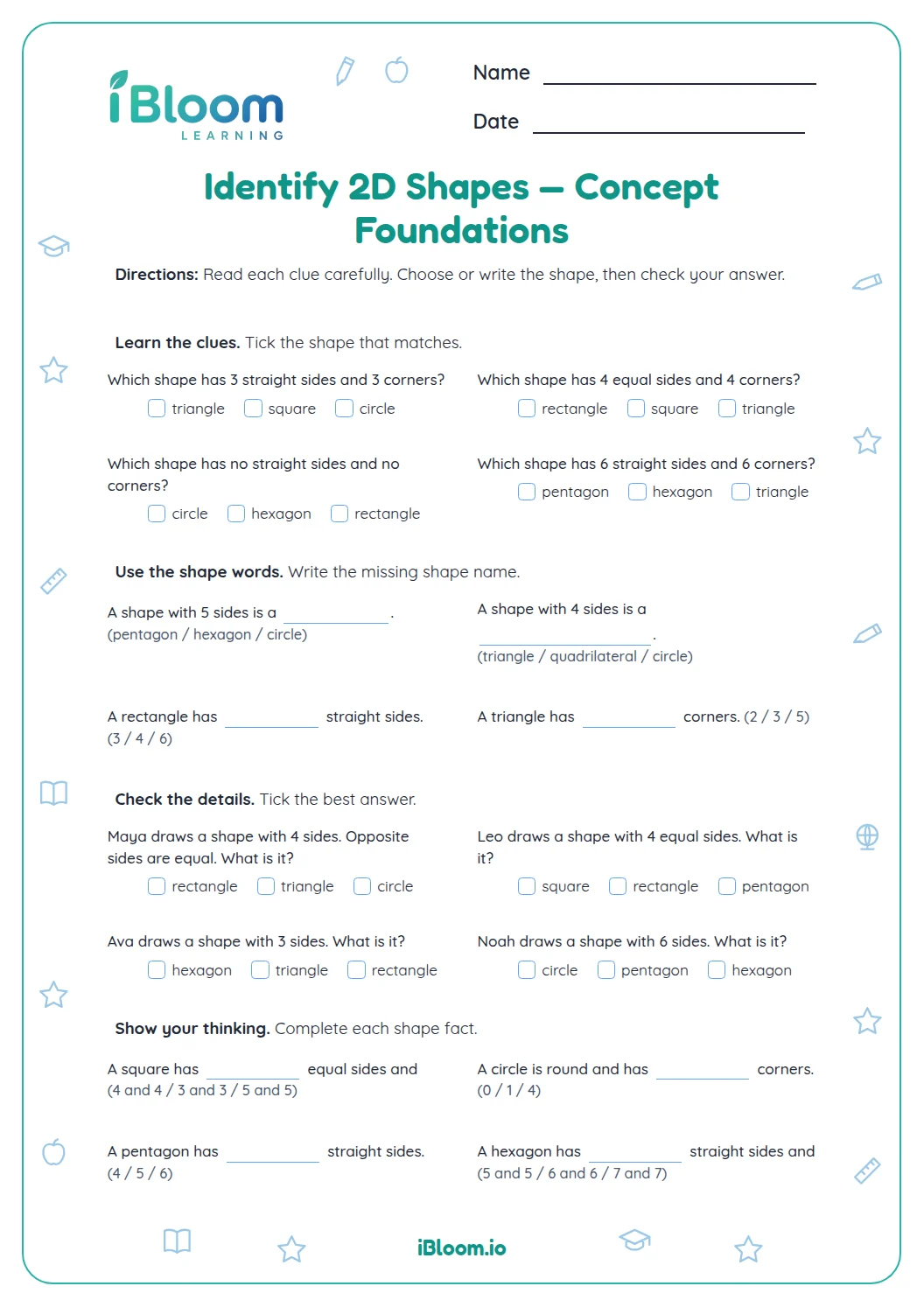
About this worksheet
This free printable worksheet gives Grade 2 children a reasoning challenge about rectangles made of equal rows and columns. Each question shows a rectangle of dots. In Part A, children match an equation to the rows or the columns. In Part B, they split a rectangle between rows, or join two rectangles, to find a missing number. In Part C, they find the mistake in what a classmate wrote. It practices Common Core 2.OA.C.4, writing the total of an array as a sum of equal addends, and the answer key is printed separately.
Aligned to 2.OA.C.4
What does it mean to compose and decompose a rectangle?
To decompose a rectangle means to split it into smaller rectangles. To compose means to put smaller rectangles together to make a bigger one. A rectangle of dots in 4 rows of 5 can be split after the second row into two rectangles of 2 rows of 5. Each part has 10 dots, and together they make 20.
Splitting and joining rectangles is how children later make sense of area and multiplication. At Grade 2 it is about seeing rows and columns and adding equal groups, so the dots can be totaled by adding, not counted one at a time.
How do children reason about rows and columns?
Ask two questions about every rectangle: how many rows, and how many in each row? Equal rows give an equation of equal addends, such as 4 + 4 + 4 for 3 rows of 4. Turning the rectangle on its side shows the columns, which give a different equation with the same total.
Part A makes children say which one they are adding, rows or columns, so they cannot just match the total. In question 2, a wrong choice has the right total of 20 on purpose.
- 1The dots make 4 rows with 5 dots in each row.
- 2Which equation adds the columns? There are 5 columns with 4 dots in each.
- 3So add 4 five times: 4 + 4 + 4 + 4 + 4 = 20.
- 45 + 5 + 5 + 5 = 20 adds the rows. It has the same total, but it adds the wrong way.
What is on this worksheet?
Part A shows a rectangle of dots and asks which equation adds the rows or the columns. Part B shows a rectangle and asks for a missing number: a 4-row rectangle cut after two rows, a 3-row rectangle with its top row cut off, and two rectangles joined into one with 5 rows. Part C describes a rectangle in words and gives a classmate's wrong equation or total to check.
- Part A: 2 questions, pick the equation that adds rows or columns
- Part B: 3 questions, split a rectangle or join two and find the missing number
- Part C: 2 questions, find what a classmate got wrong
- Rectangles of 2 to 5 rows and 3 to 5 columns
How to use this worksheet at home or in class
- 1Warm up with muffin tins, egg cartons or a sheet of stickers: ask how many rows, how many in each row, and how many in all.
- 2Do question 1 together. Run a finger along each row and say the equation aloud: 4 plus 4 plus 4.
- 3Let your child finish Part A alone, then turn the page sideways and ask what the rows would be if the columns became rows.
- 4In Part B, have your child draw a line between the rows with a pencil to show where the rectangle is split.
- 5In Part C, ask your child to explain the mistake in their own words before filling in a bubble.
- 6Check with the answer key and redo any missed question with counters in rows.
Common mistakes and quick fixes
The mistake
Adding the number of rows and the number of columns, such as 3 + 4 = 7 for a 3-by-4 rectangle.
The fix
Count the dots in one row, then add that number once for every row. Repeated groups, not the two counts, give the total.
The mistake
Mixing up rows and columns, so the child writes 5 + 5 + 5 + 5 for the columns of a 4-row, 5-column rectangle.
The fix
Rows go across and columns go down. Have the child run a finger across one row, then down one column, to see the difference.
The mistake
Splitting into parts that do not add up to the whole, such as cutting a 4-row rectangle into 3 rows and 2 rows.
The fix
Count the rows in each part and check that the parts add up to the rows in the whole rectangle.
Common Core alignment
Most US states use the Common Core Mathematics standards or a close state version. This sheet practices the standard below.
Add equal rows to find the total in a rectangle of up to 5 by 5.
On this sheet: Every question uses a rectangle of dots with 2 to 5 rows and 3 to 5 columns, and an equation of equal addends.
Show the official wordingHide the official wording
Use addition to find the total number of objects arranged in rectangular arrays with up to 5 rows and up to 5 columns; write an equation to express the total as a sum of equal addends.
What to practice next
Make more practice
Further reading
Questions parents and teachers ask
What is an array in Grade 2 math?
An array is a set of objects arranged in equal rows and equal columns, like the dots on this sheet. Children use it to find a total by adding the same number again and again. A 3-row array with 4 in each row has 4 + 4 + 4 = 12 objects.
What is the difference between a row and a column?
A row goes across, from left to right. A column goes up and down. The same rectangle of dots can be added by rows or by columns, and both ways give the same total. Part A asks which one an equation adds, so children practice telling them apart.
Why do some wrong answers in Part A have the right total?
On purpose, in question 2. For the 4-row, 5-column rectangle, both 5 + 5 + 5 + 5 and 4 + 4 + 4 + 4 + 4 equal 20, but only one adds the columns. That makes children look at the groups, not only the total, which is the reasoning this challenge sheet is built to practice.
Is this the same as multiplication?
It is the groundwork for it. Grade 2 children write repeated addition, like 5 + 5 + 5 = 15, and do not need times signs yet. In Grade 3 the same rectangles are written as 3 × 5, so time spent on equal rows now makes multiplication easier to understand later.
How do I help if my child counts the dots one at a time?
Counting one by one is fine at first. Next ask your child to touch the first row and say how many, then say that number again for each new row. Moving a finger along the rows shows how addition can be quicker than counting every dot.
Is there an answer key, and how long does it take?
Yes, the answer key is printed separately and shows the correct choice or number for all 7 questions. Plan on about 15 minutes. Part C takes longest, since children must work out what a classmate did wrong from a description, so you may want to read those two questions aloud together.