

About this worksheet
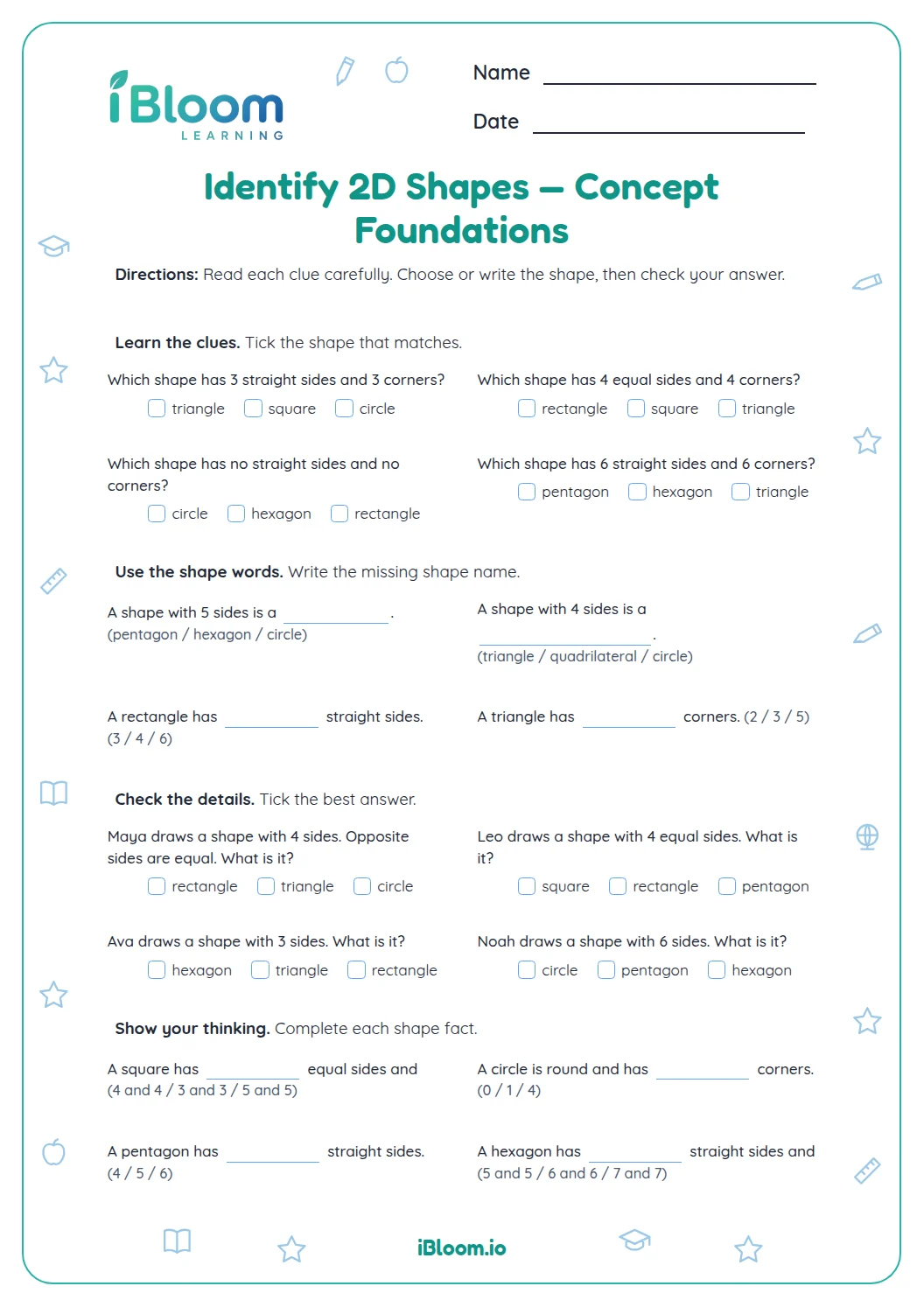
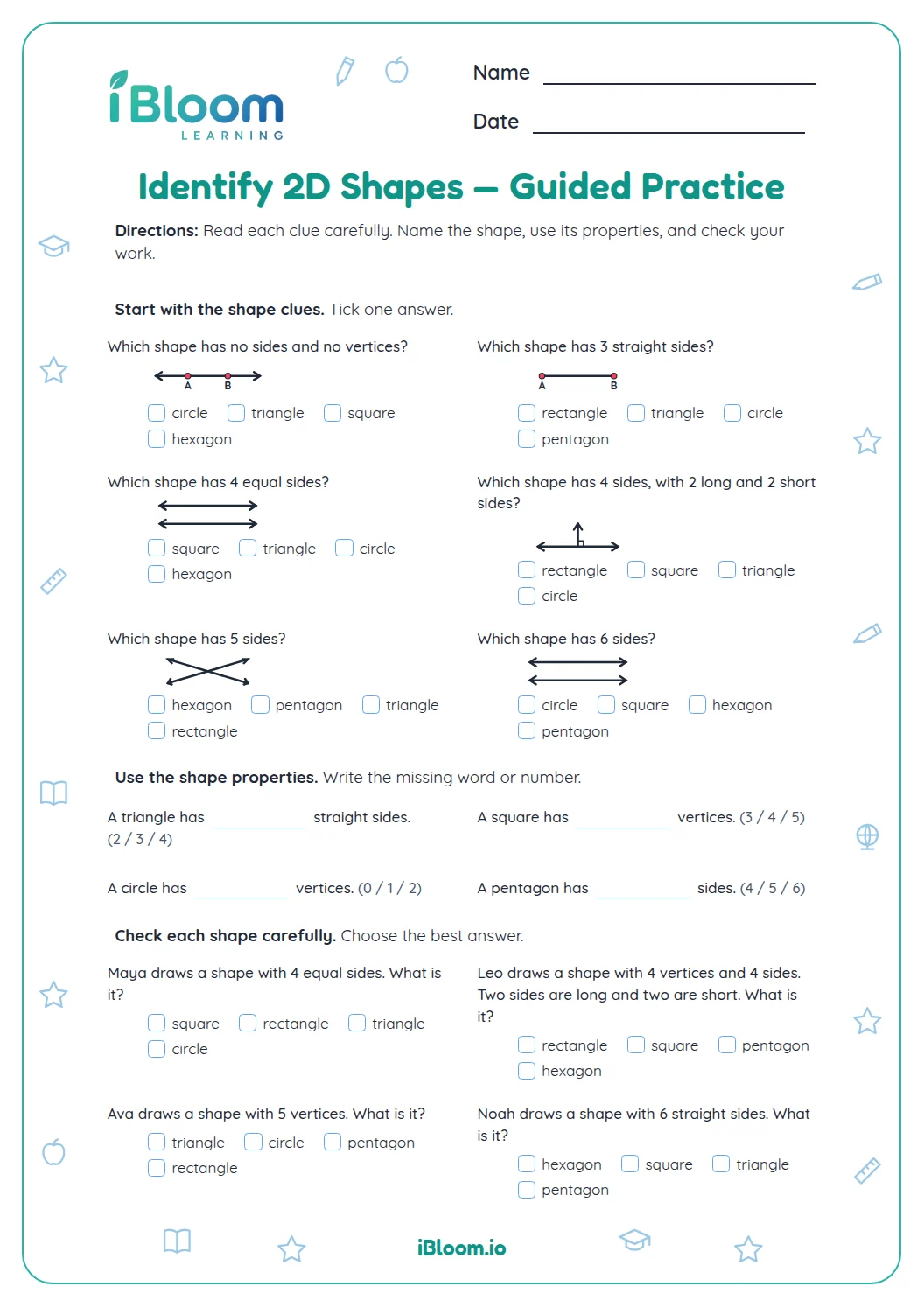
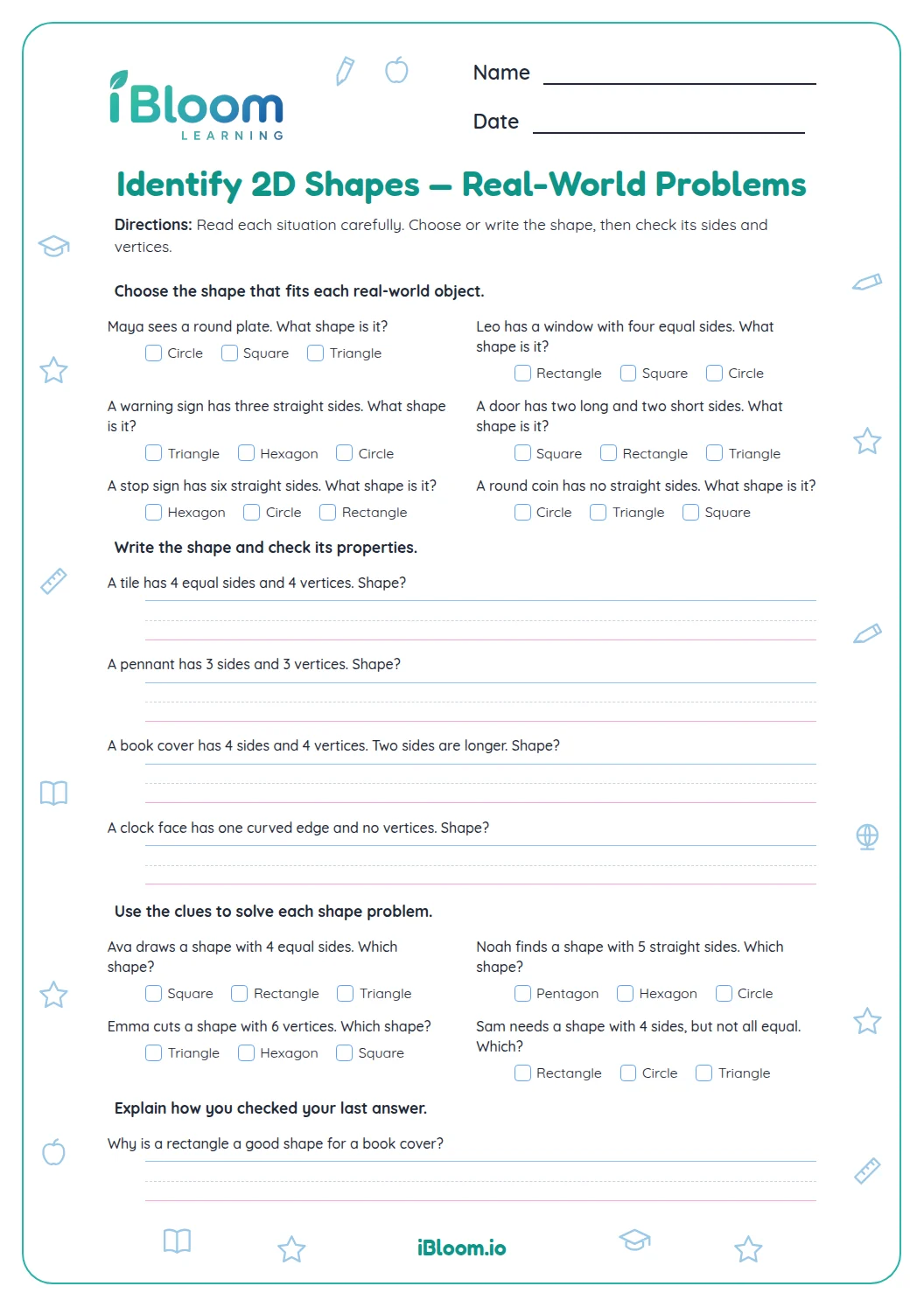
This free Grade 2 geometry worksheet gives students independent practice recognizing and describing two-dimensional shapes. A lettered drawing supports the first identification question; later items ask students to name shapes from their sides and corners, count those attributes, and use them to classify shapes. Students work with triangles, squares, rectangles, pentagons, hexagons and circles. It aligns with CCSS 2.G.A.1 and includes a separate answer key.
Aligned to 2.G.A.1
How can you name a two-dimensional shape?
Look at the whole outline, then count the straight sides and corners. A square has four sides and four corners, with all sides equal; a rectangle also has four sides and four corners. A circle has a curved edge and no corners.
In question 4, the clue gives a shape with five straight sides and five corners. That describes a pentagon, which has one more side than a four-sided shape.
- 1The clue gives 5 straight sides and 5 corners.
- 2A polygon with 5 sides is a pentagon.
- 3The five corners confirm the count.
- 4Answer: pentagon
What should students count?
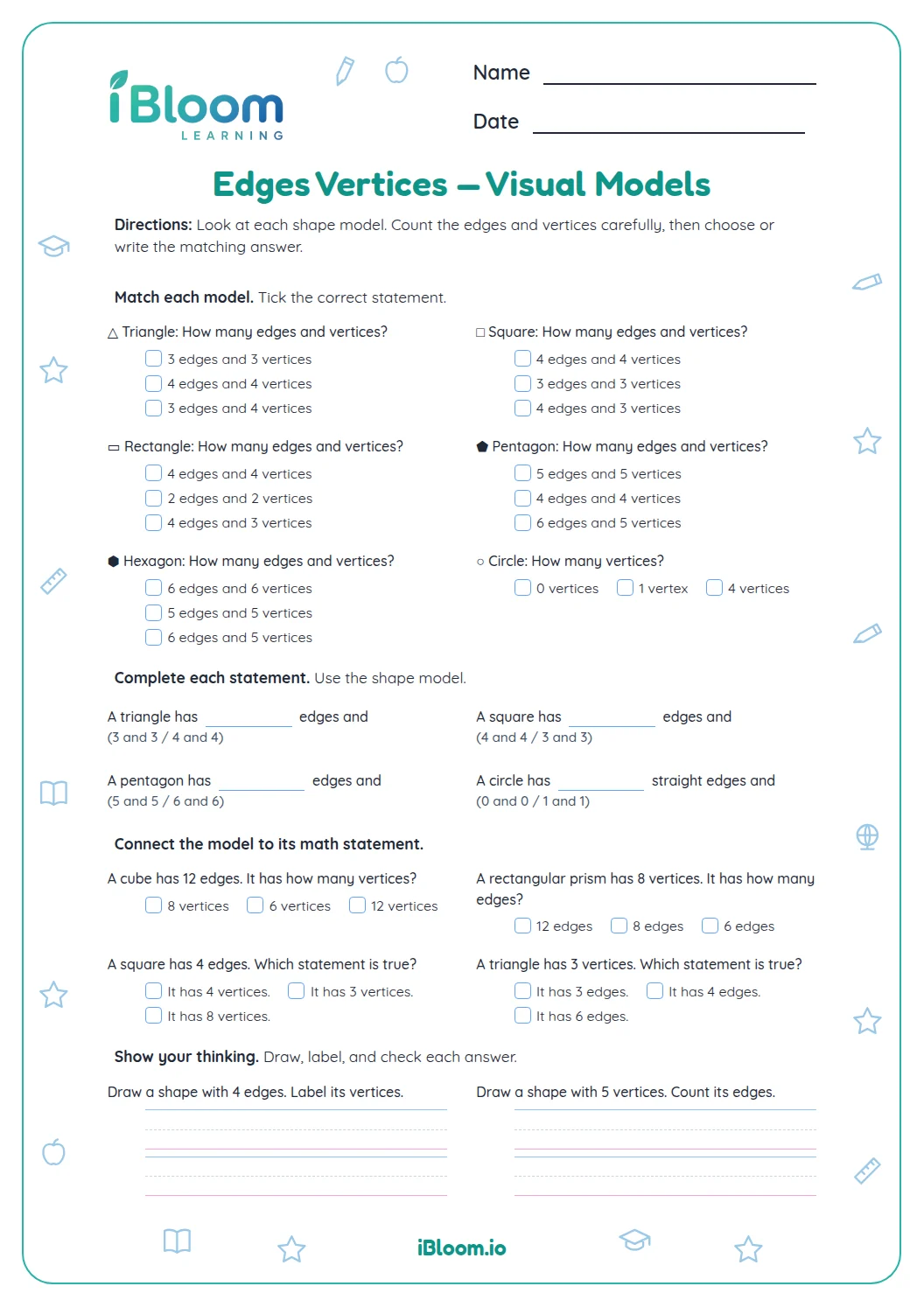
Count each side once as you move around the outline. A corner is where two straight sides meet. Question 9 asks for the corners of a hexagon: there are six. Question 11 checks a circle, which has no corners.
How do attributes help classify a shape?
The number of sides narrows down the name. Three straight sides make a triangle, five make a pentagon and six make a hexagon. Question 13 asks for one possible shape with four sides and four corners, so square is a valid example.
What is in the practice set?
The set begins with a lettered shape drawing and written shape clues, then moves to side and corner counts and attribute-based classifications. The answer key is on separate pages.
- Part A: four shape names from drawings and clues
- Part B: five side and corner counts
- Part C: five attribute-based classifications
How can a student describe each shape?
- 1Trace the outline with a finger or pencil tip.
- 2Count each straight side once.
- 3Count each place where two sides meet.
- 4Use both counts to decide which shape name fits.
- 5For a multiple-choice item, cross out shapes with a different number of sides.
- 6Check the name and counts with the answer key.
Common shape-counting mistakes
The mistake
Counting the same side twice while moving around the outline.
The fix
Start at one corner and move in one direction, marking each side mentally as you pass it.
The mistake
Calling every four-sided shape a square.
The fix
Use the full outline: rectangles and squares both have four sides, but their side lengths differ.
The mistake
Counting a rounded part of a circle as a straight side or corner.
The fix
A circle has a curved edge and no corners; count only straight edges when counting sides.
Common Core alignment
This worksheet practices the skill described in the standard below.
Students recognize and describe the shapes shown by counting their sides and angles.
On this sheet: Students identify named polygons and describe shapes using side and corner counts.
Show the official wordingHide the official wording
Recognize and draw shapes having specified attributes, such as a given number of angles or a given number of equal faces.^1 Identify triangles, quadrilaterals, pentagons, hexagons, and cubes.
What to practice next
Make more practice
Further reading
Questions parents and teachers ask
Which shapes are on this worksheet?
The worksheet includes a lettered drawing of a square, rectangle, triangle and pentagon. Other questions ask students to name or classify triangles, squares, rectangles, pentagons, hexagons and circles, then count sides and corners. A separate key lists the names and counts.
How many questions are included?
There are 14 questions in three parts. Students identify four shapes from letters and clues, answer five side-or-corner count questions, and complete five classifications using attributes. The parts move from recognition to description and use. The separate key supports a quick self-check.
What is the difference between a side and a corner?
A side is a straight edge of a polygon. A corner is where two sides meet. Counting both helps distinguish a triangle with three sides from a pentagon with five, and it makes the naming clues easier to check. A circle has neither straight sides nor corners.
Can a shape with four sides have more than one name?
Yes. Squares and rectangles both have four sides and four corners, though their side-length properties differ. Question 13 asks for one possible name when the clue allows more than one, so a square is a valid example. The prompt says one possible shape, so other valid answers may also fit.
Is the answer key included?
Yes. A separate answer key page gives the shape names, counts and classification choices. Students can point to the sides and corners they counted when checking their work and explain how those attributes support a shape name. This makes the key useful for verbal checking, too.