
About this worksheet
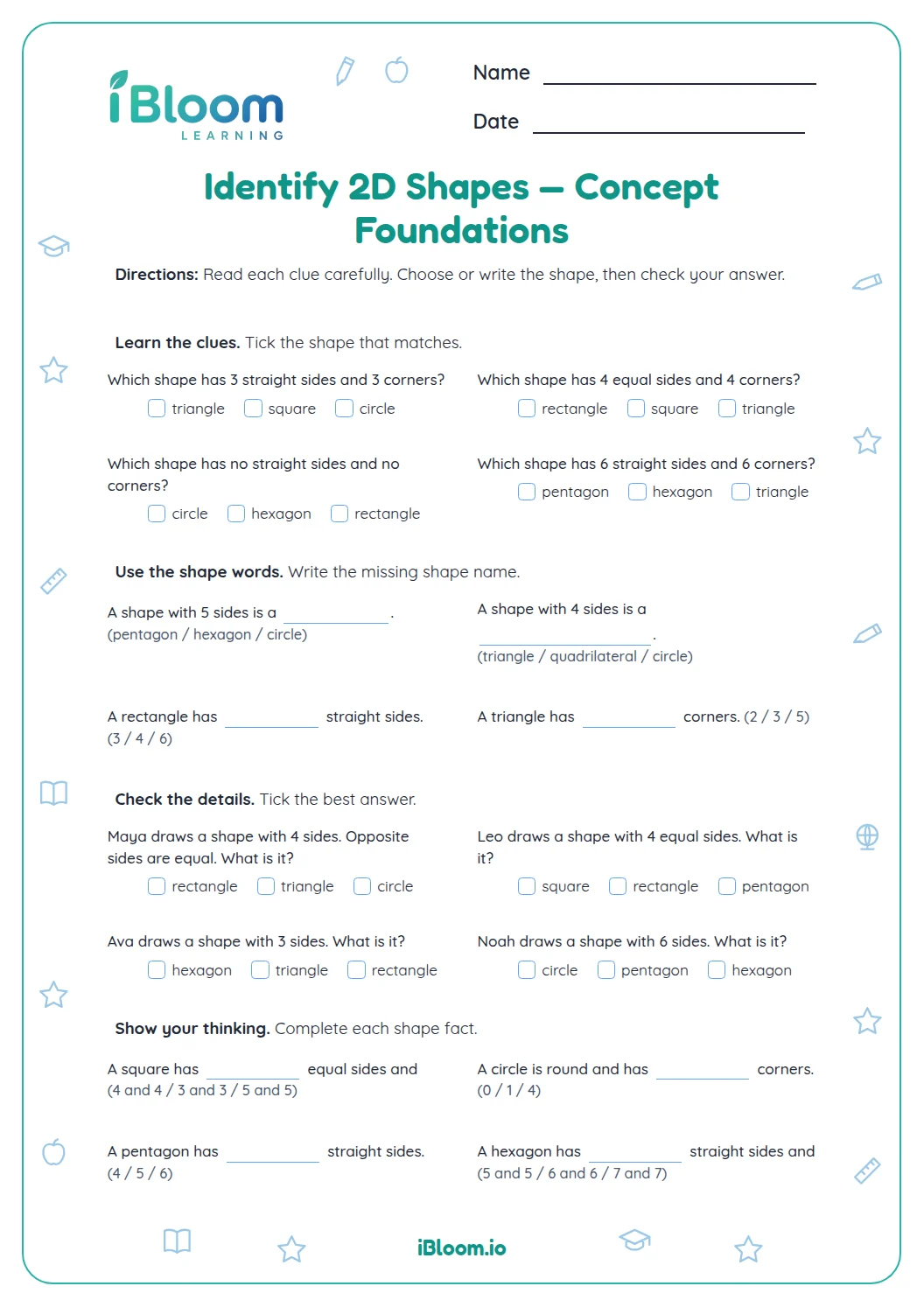
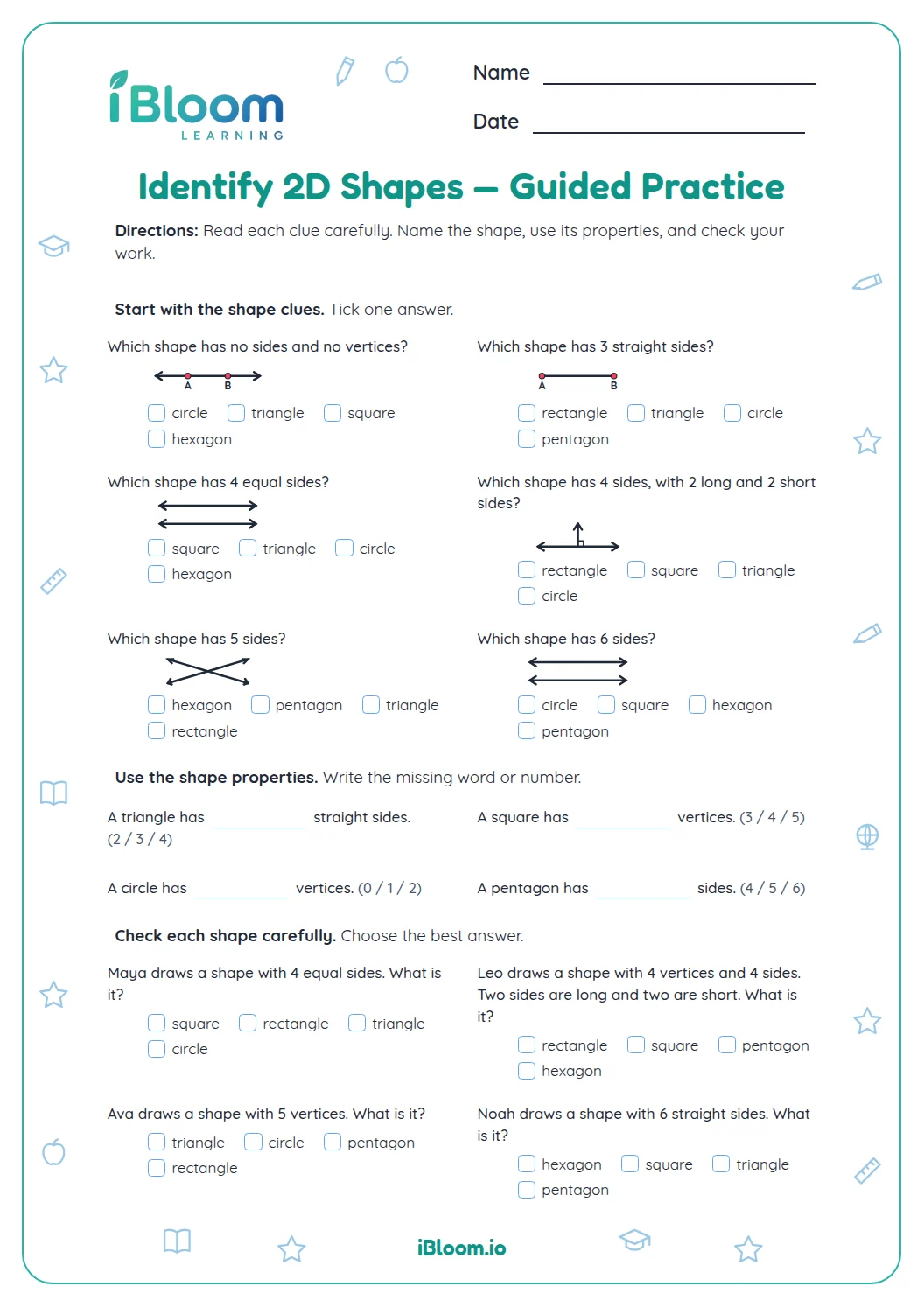
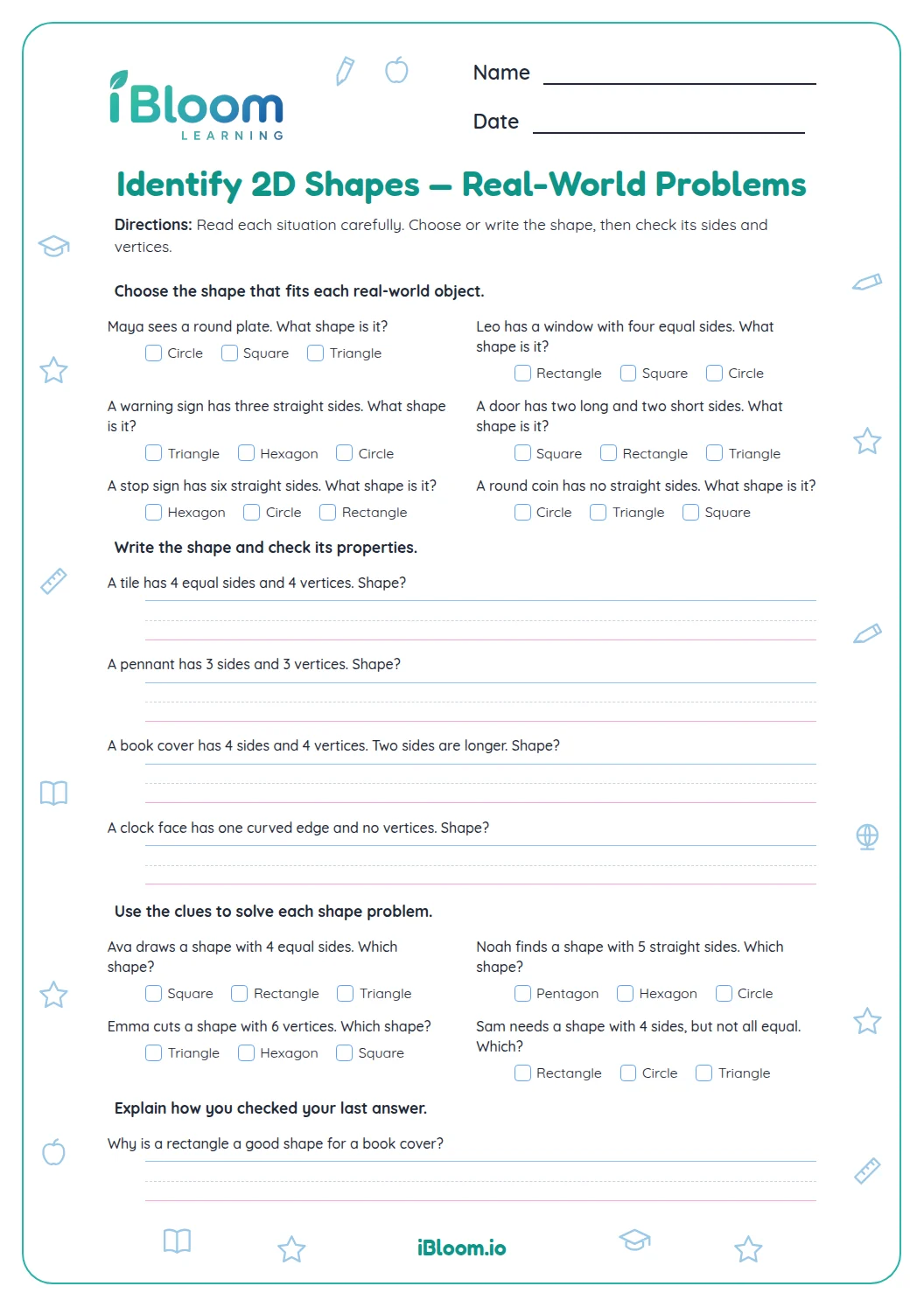
This free printable gives Grade 2 students 14 questions about identifying two-dimensional shapes. Two questions include shape drawings; the rest use clear written clues about sides, corners, and curved edges. Students name triangles, quadrilaterals, pentagons, hexagons, circles, squares, and rectangles, then choose reasons that fit each name. A separate answer key lists the correct choice for every question.
Aligned to 2.G.A.1
How do sides and corners identify a shape?
Part A names shapes using side counts and the worksheet’s labeled models. In question 1, shape A is the triangle because it has three straight sides.
Which attributes distinguish common shapes?
Part B matches names to properties. A square has four corners and four equal sides; a rectangle has four corners and opposite sides equal. Both have four straight sides.
How can a property explain a shape group?
Part C selects a defining clue. Question 11 groups squares and rectangles as quadrilaterals because each has four straight sides.
How to work through the page
- 1Trace the outline with a finger or look from corner to corner.
- 2Count only straight sides when identifying a polygon.
- 3Count corners where two sides meet.
- 4Use the whole clue: four sides alone does not make a shape a square.
Common mistakes and quick fixes
The mistake
Calling a shape by its orientation.
The fix
Turn the page or imagine rotating the shape; its sides and corners do not change.
The mistake
Counting a curved edge as a straight side.
The fix
Separate curved outlines from polygons with straight sides.
The mistake
Calling every four-sided shape a square.
The fix
Check whether the clue also says all four sides are equal.
Common Core alignment
This practice connects shape attributes to the listed Grade-level standard.
Recognize shapes by attributes such as sides and angles; identify common polygons.
On this sheet:
Show the official wordingHide the official wording
Recognize and draw shapes having specified attributes, such as a given number of angles or a given number of equal faces. Identify triangles, quadrilaterals, pentagons, hexagons, and cubes.
What to practice next
Make more practice
Further reading
Questions parents and teachers ask
How many questions are on the shape worksheet?
There are 14 questions in three compact parts. Two include labeled shape models, and the others ask students to use side counts, corners, curves, and familiar shape properties. The separate key lists one correct choice for each question.
Which shapes do students identify?
The questions include triangles, quadrilaterals, pentagons, hexagons, circles, squares, and rectangles. Students identify a shape by its straight sides, corners, curved edge, or equal side lengths. The labeled models in two questions make the picture based tasks self contained.
What makes a square a quadrilateral?
A quadrilateral is a shape with four straight sides. A square has four straight sides, so it belongs to that group; it also has four corners and four equal sides. The worksheet asks students to connect the group name with the shared property.
Do students need to draw shapes?
No drawing is required. The worksheet includes two labeled shape models for visual identification, while the other questions provide written clues about sides and corners. Students select answers, which keeps the practice short enough to fit two worksheet pages.
What is the difference between a side and a corner?
A side is a straight segment along a polygon’s boundary. A corner is where two sides meet. Counting both helps students name polygons: a triangle has three sides and three corners, while a hexagon has six of each.