


About this worksheet
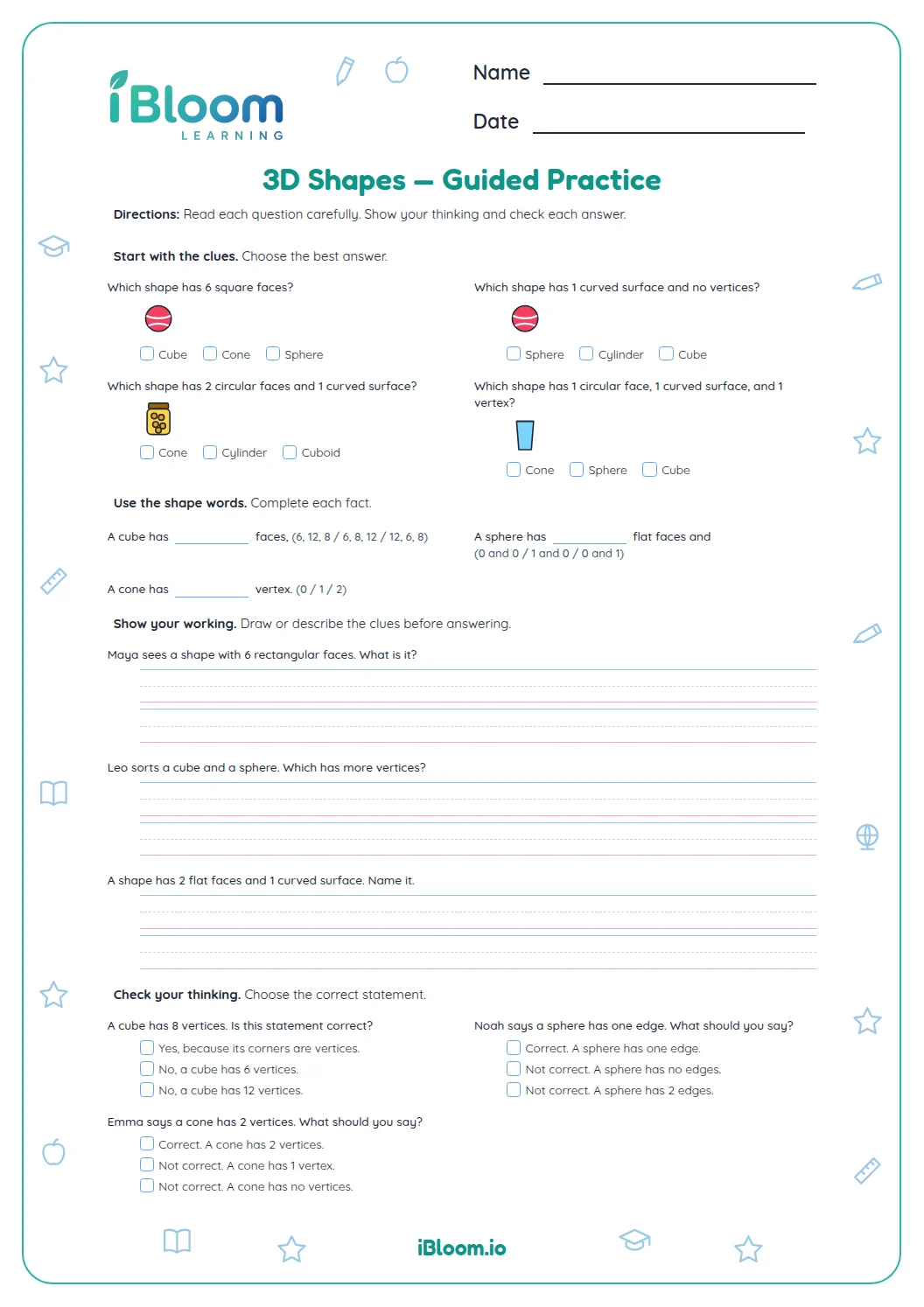
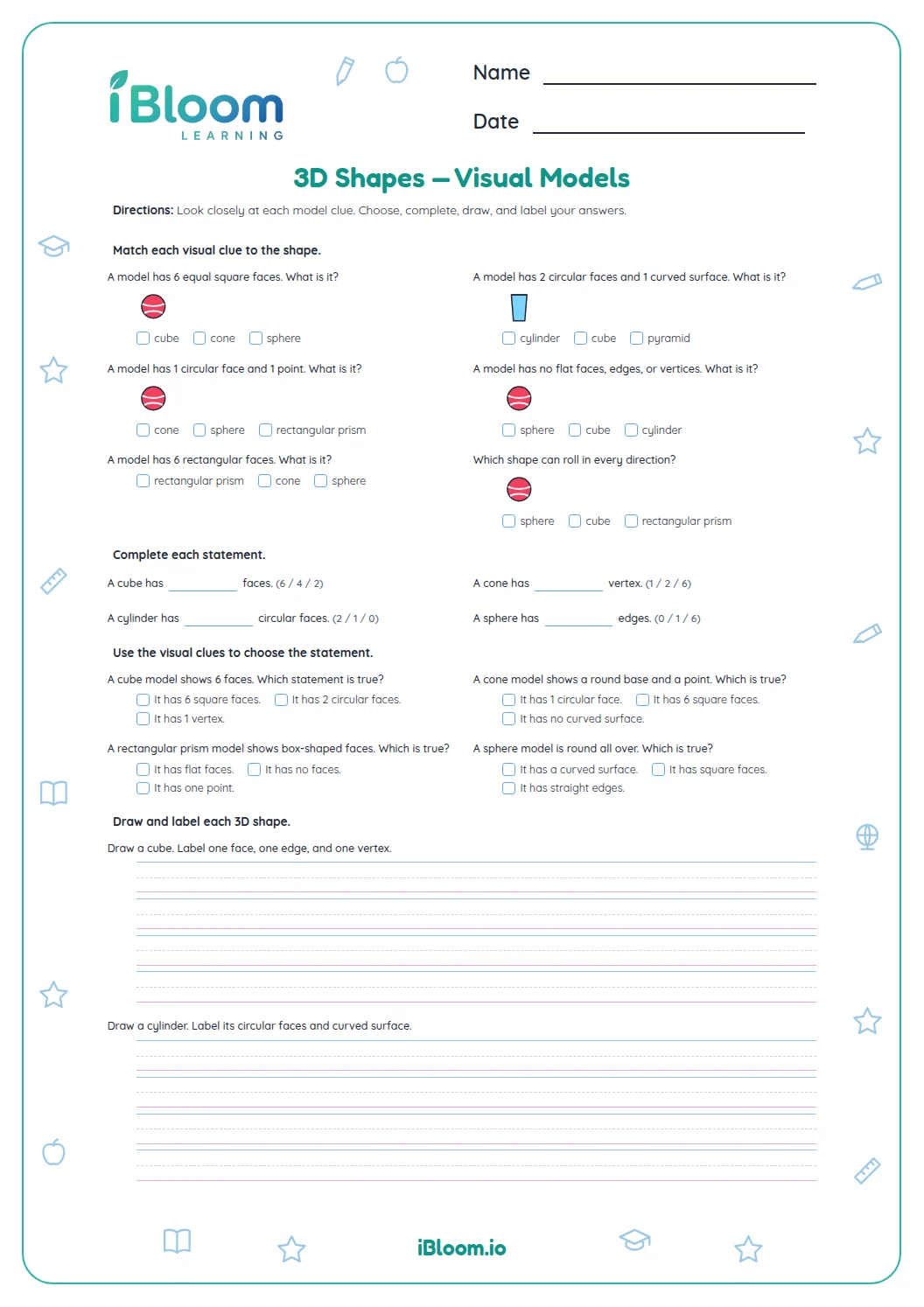
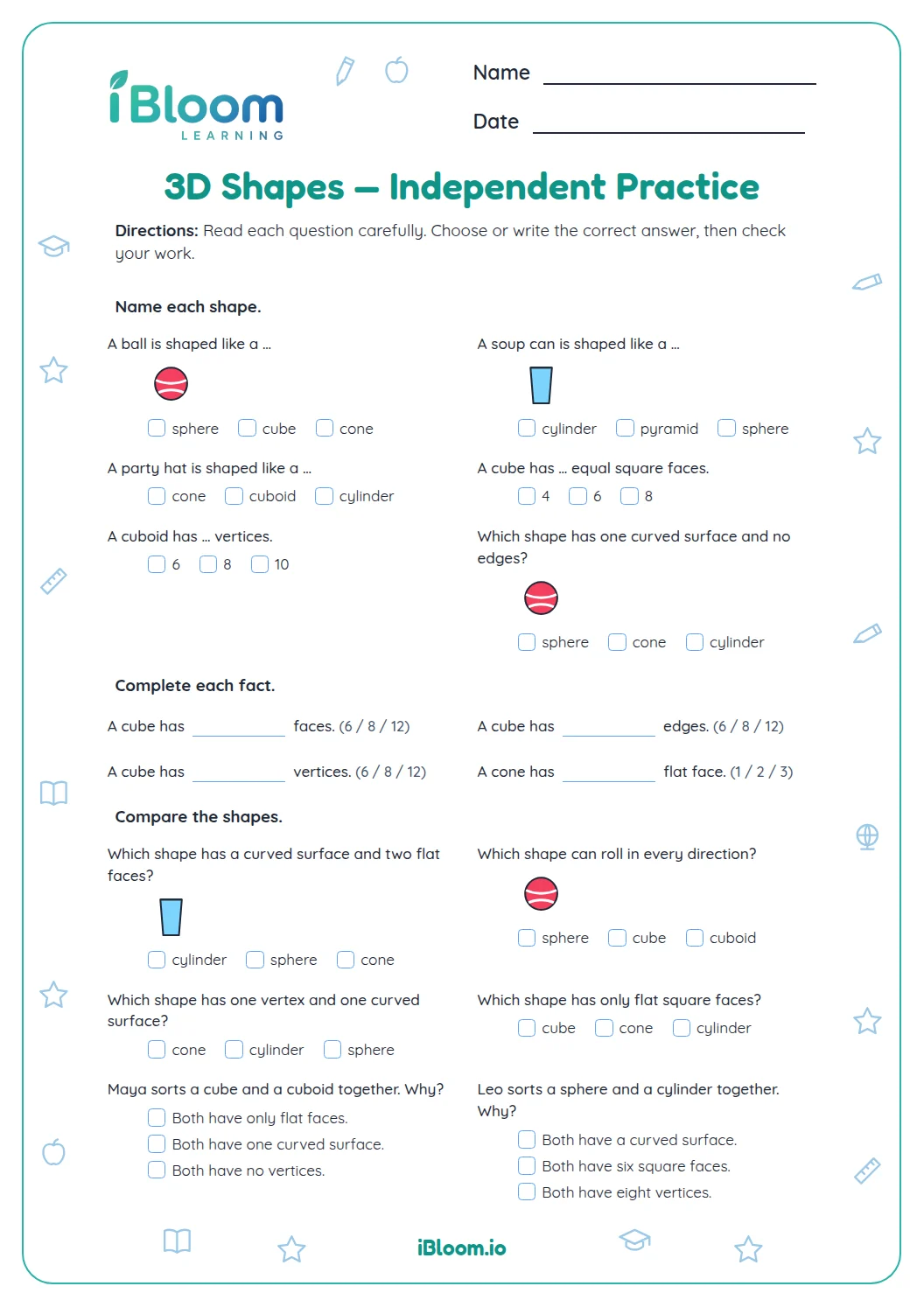
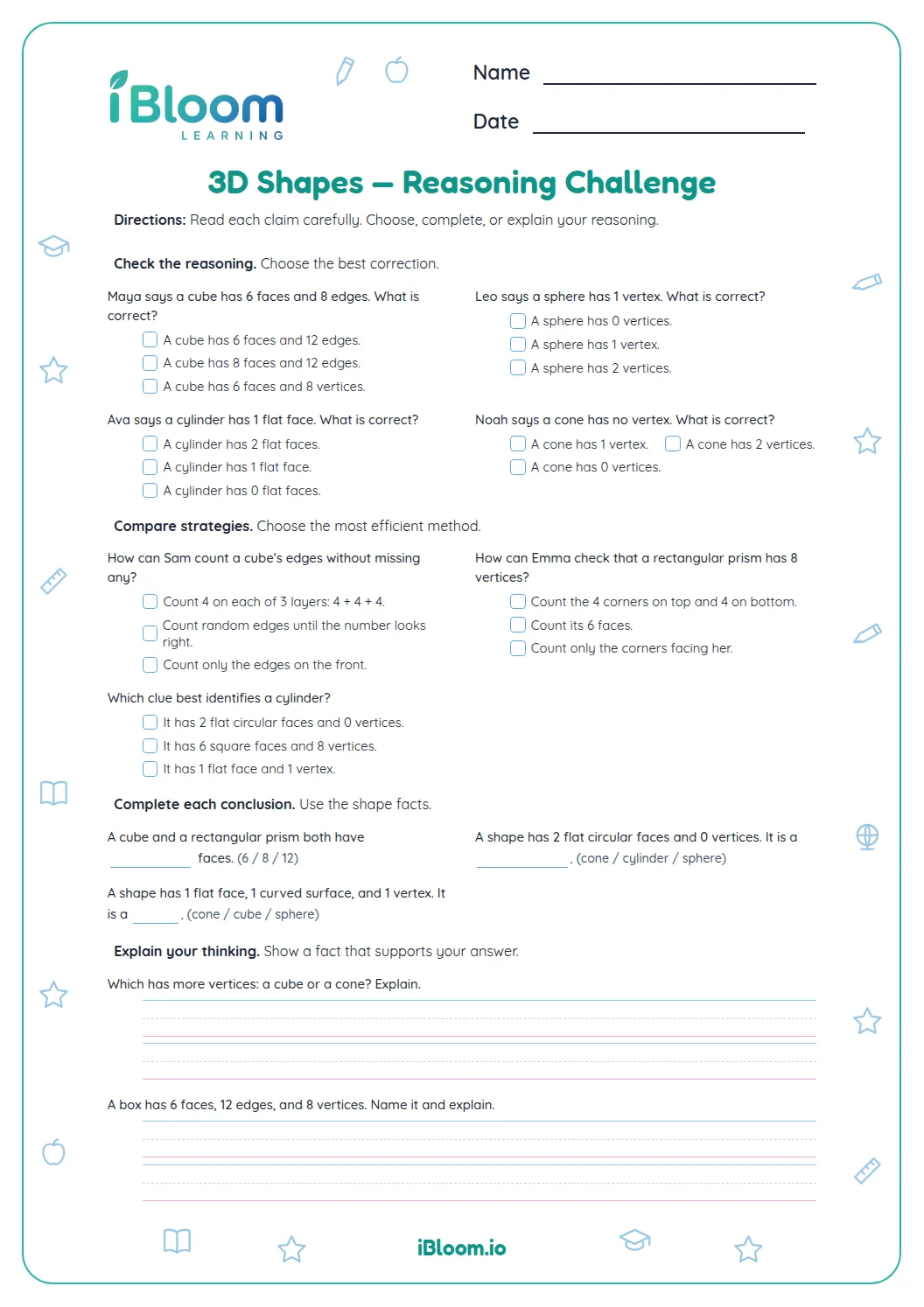
Children identify cubes, spheres, cones, cylinders, and rectangular prisms from their attributes, then connect solids with square, circle, and rectangle faces.
Aligned to 2.G.A.1
What does this 3D shapes worksheet practice?
Four opening clues name a sphere, cube, cylinder, or cone. The next four items practice face, edge, and vertex vocabulary; the final six apply those facts to a labeled flat-shape drawing, solids, and familiar objects.
- Five solids: cube, sphere, cone, cylinder, rectangular prism
- A visual question identifies a flat face shape
- No measuring or advanced geometry vocabulary
A helpful way to think it through
For example, q3 describes two flat circular faces and a curved surface. A cylinder has those features; a cone has one flat circular face and a vertex.
How do the flat shapes help with the solid clues?
Question 9 uses a square, circle, and rectangle labeled A, B, and C. The square is A, and that flat-face clue can help connect a cube to its faces. The remaining items ask about counts for rectangular prisms and cubes, then match a cylinder and sphere with familiar objects.
Use the worksheet together
- 1Start by naming a familiar object, such as a ball or cereal box, and describe its shape.
- 2In Part A, point out the clue words before selecting a solid name.
- 3In Part B, connect a solid with a flat face shape; some solids also have curved surfaces.
- 4In Part C, read every clue before writing a name. Check the key after the learner explains the choice.
Common mix-ups
The mistake
Calling a cylinder a cone because both can have a circular face.
The fix
Check the number of circular faces: a cylinder has two, while a cone has one and a point.
The mistake
Calling every box a cube.
The fix
A cube has six square faces. A rectangular prism may have rectangles that are not all squares.
The mistake
Saying a sphere has a flat circular face.
The fix
A sphere has a curved surface all around and no flat face.
Common Core alignment
Learners use shape attributes, including the number and shape of cube faces.
Recognize and draw shapes with specified attributes.
On this sheet: The worksheet compares shapes by faces and other attributes, with a focus on naming common solids.
Show the official wordingHide the official wording
Recognize and draw shapes having specified attributes, such as a given number of angles or a given number of equal faces. Identify triangles, quadrilaterals, pentagons, hexagons, and cubes.
What to practice next
Make more practice
Questions parents and teachers ask
What solid shapes does this worksheet cover?
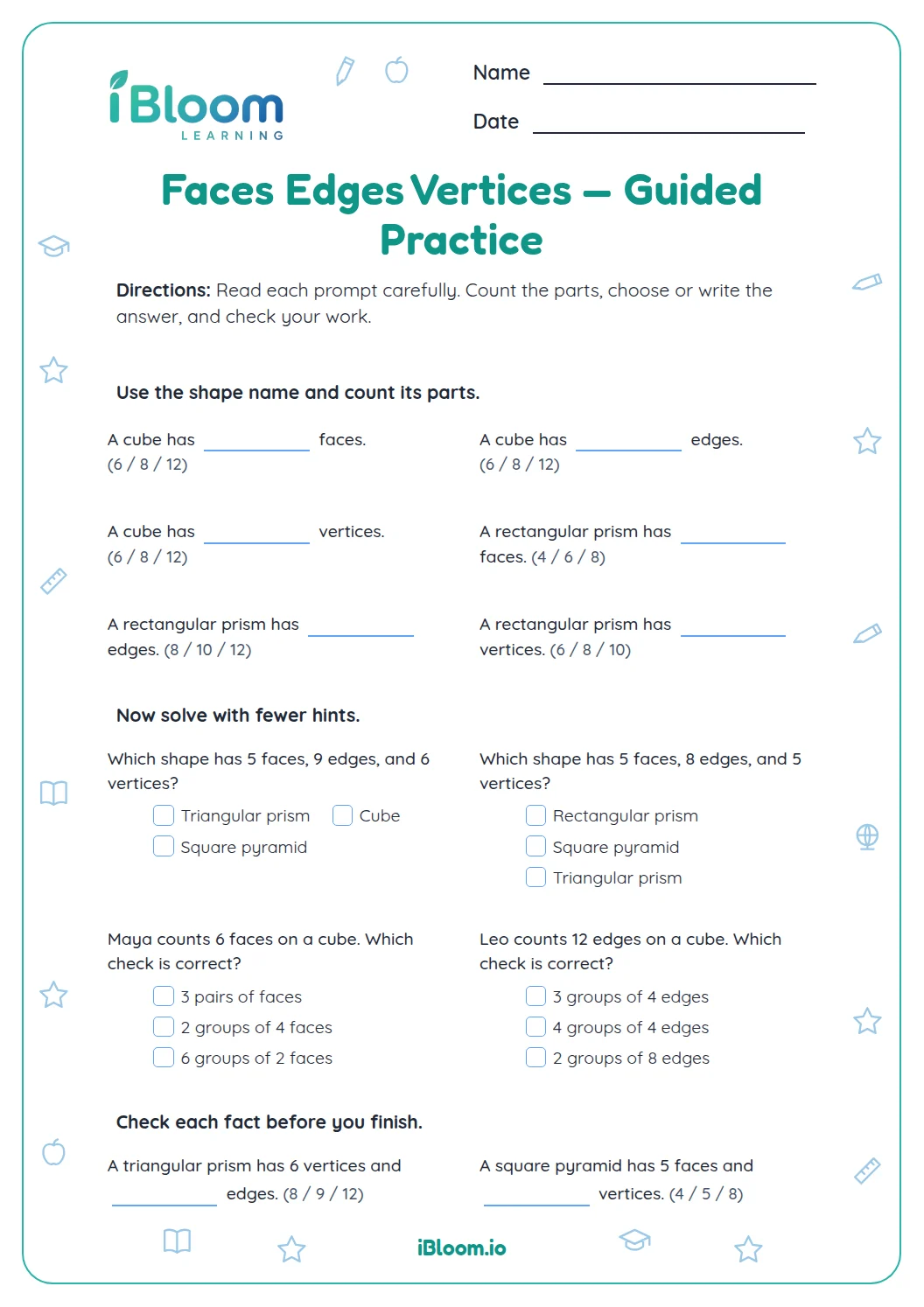
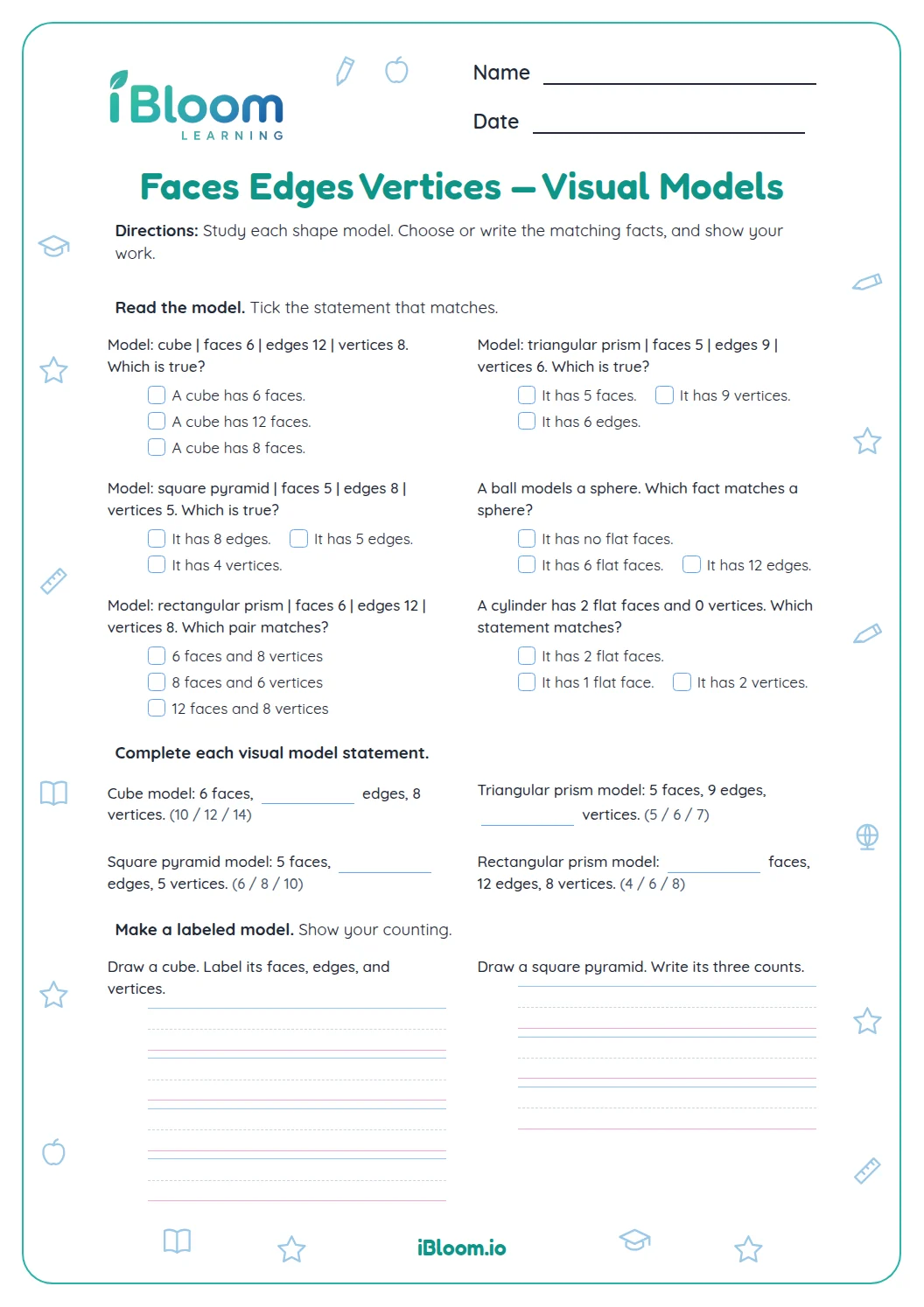
The page practices cubes, spheres, cones, cylinders, and rectangular prisms. It also introduces the words face, edge, and vertex, then asks learners to apply those words to familiar solid-shape facts. The examples include both object clues and shape attributes.
What is the difference between a face and an edge?
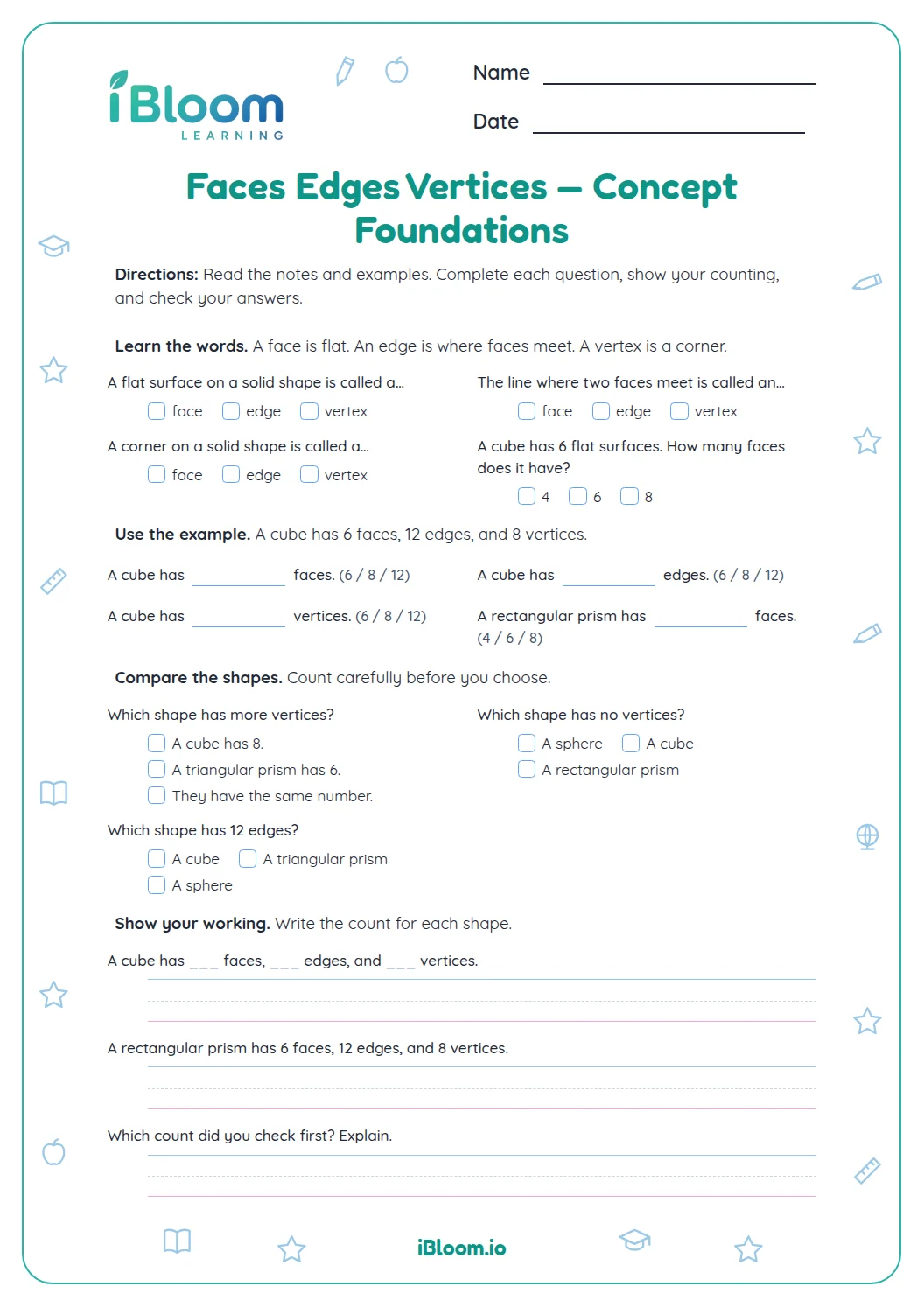
A face is a flat surface on a solid. An edge is the line where two faces meet. A vertex is a corner where edges meet. Looking at a box can help a child find all three parts and explain each one in their own words.
How can I explain a sphere to a child?
Compare it with a ball. A sphere has a curved surface all around and no flat faces, edges, or vertices. Ask the learner to roll a ball and notice that it has no corner or flat end. That familiar object makes the solid easier to imagine.
What grade is this 3D shapes worksheet for?
It is designed for Grade 2 geometry vocabulary. Children name common solids, connect them with attributes, and practice cube facts. An answer key is included on a separate page for quick checking. Ask your learner to explain which clue helped with each answer.
How many questions are on this page?
There are 14 questions in three parts. Four questions name solids from clues, four complete face, edge, or vertex facts, and six use a labeled flat-shape drawing or solid attributes and familiar objects. The separate answer key follows the same question order.
How can a learner tell a cylinder from a cone?
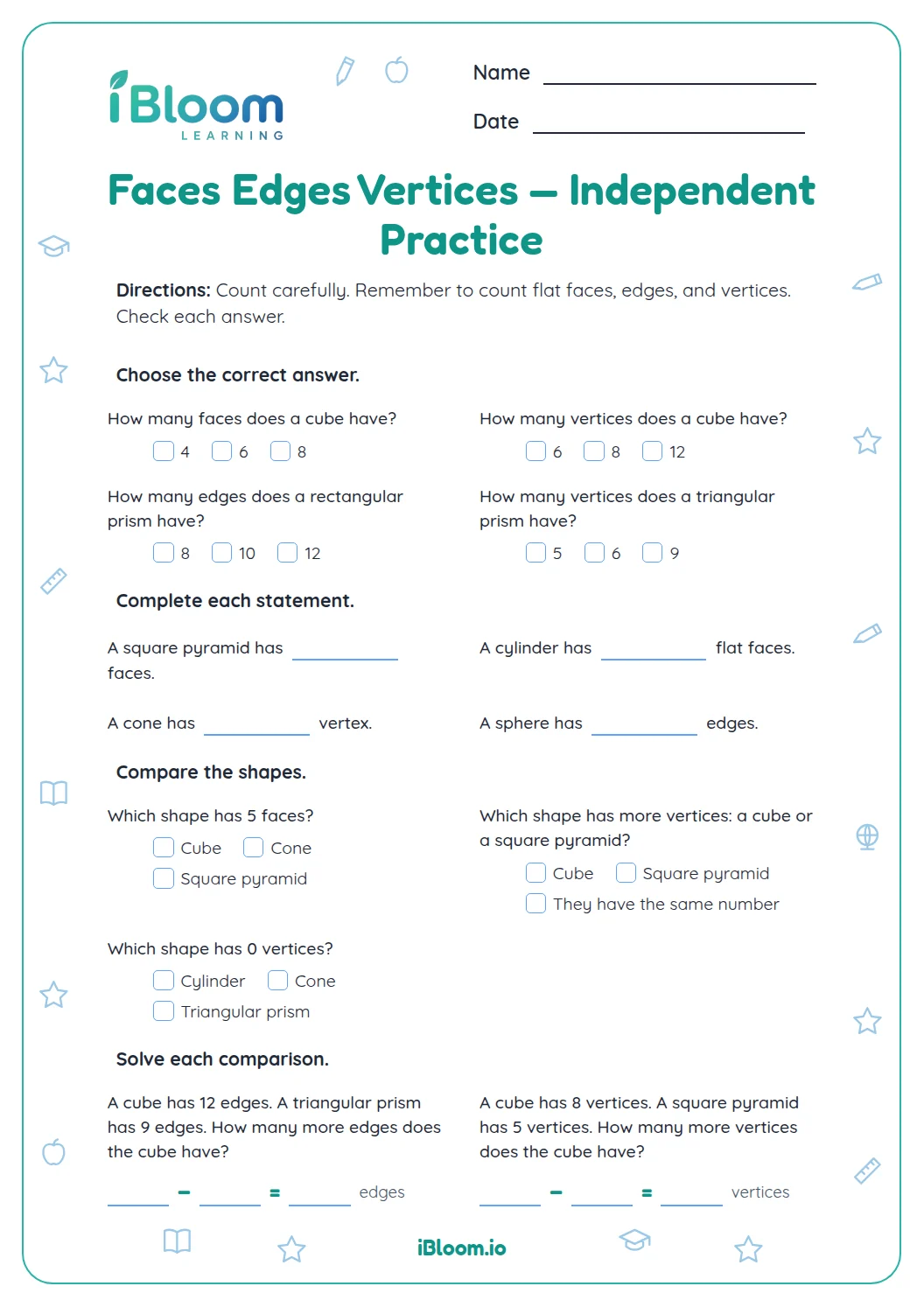
A cylinder has two flat circular faces and a curved surface. A cone has one flat circular face and one vertex. Ask the learner to count the flat circular faces and look for a point before choosing a name.