

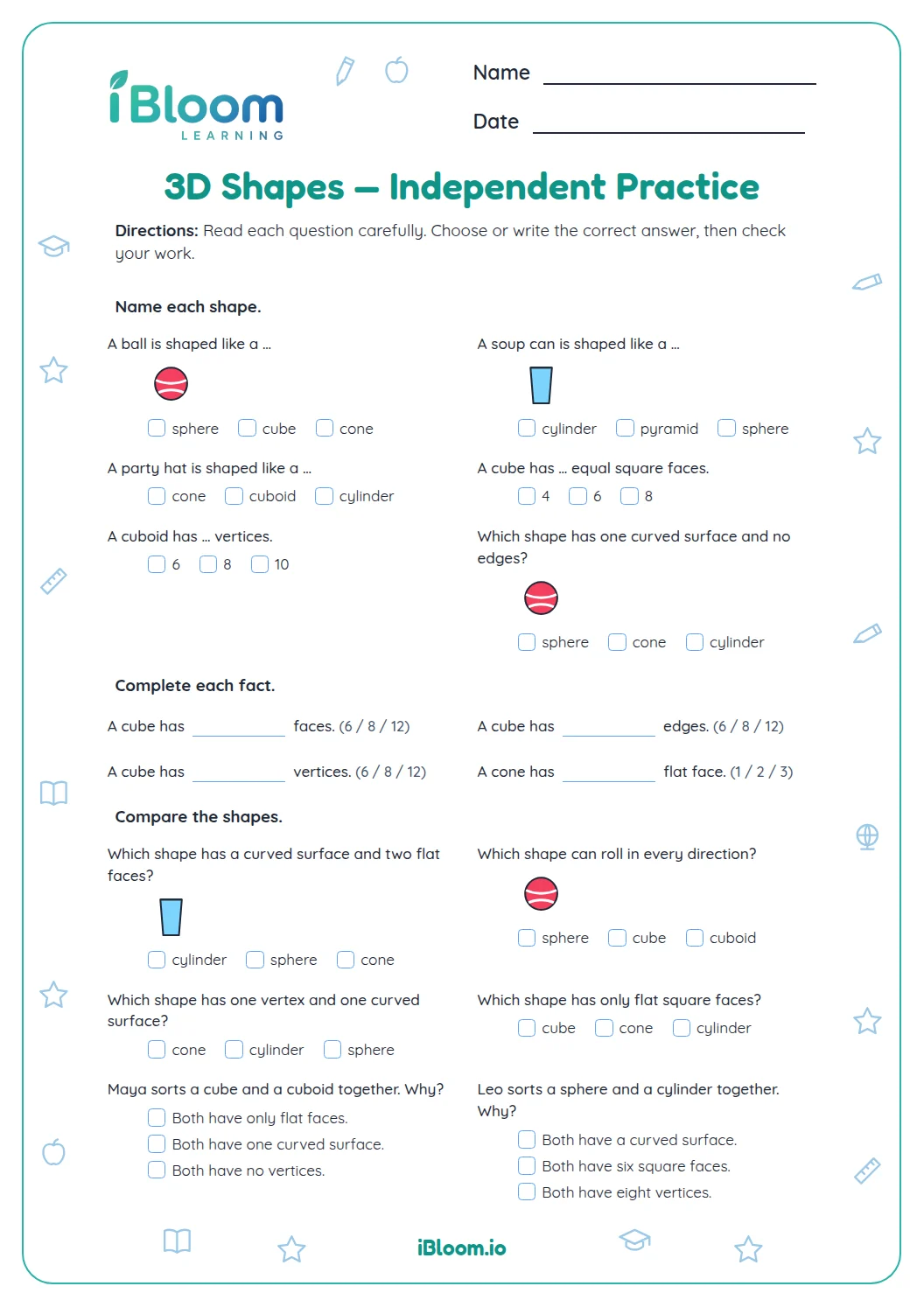
About this worksheet
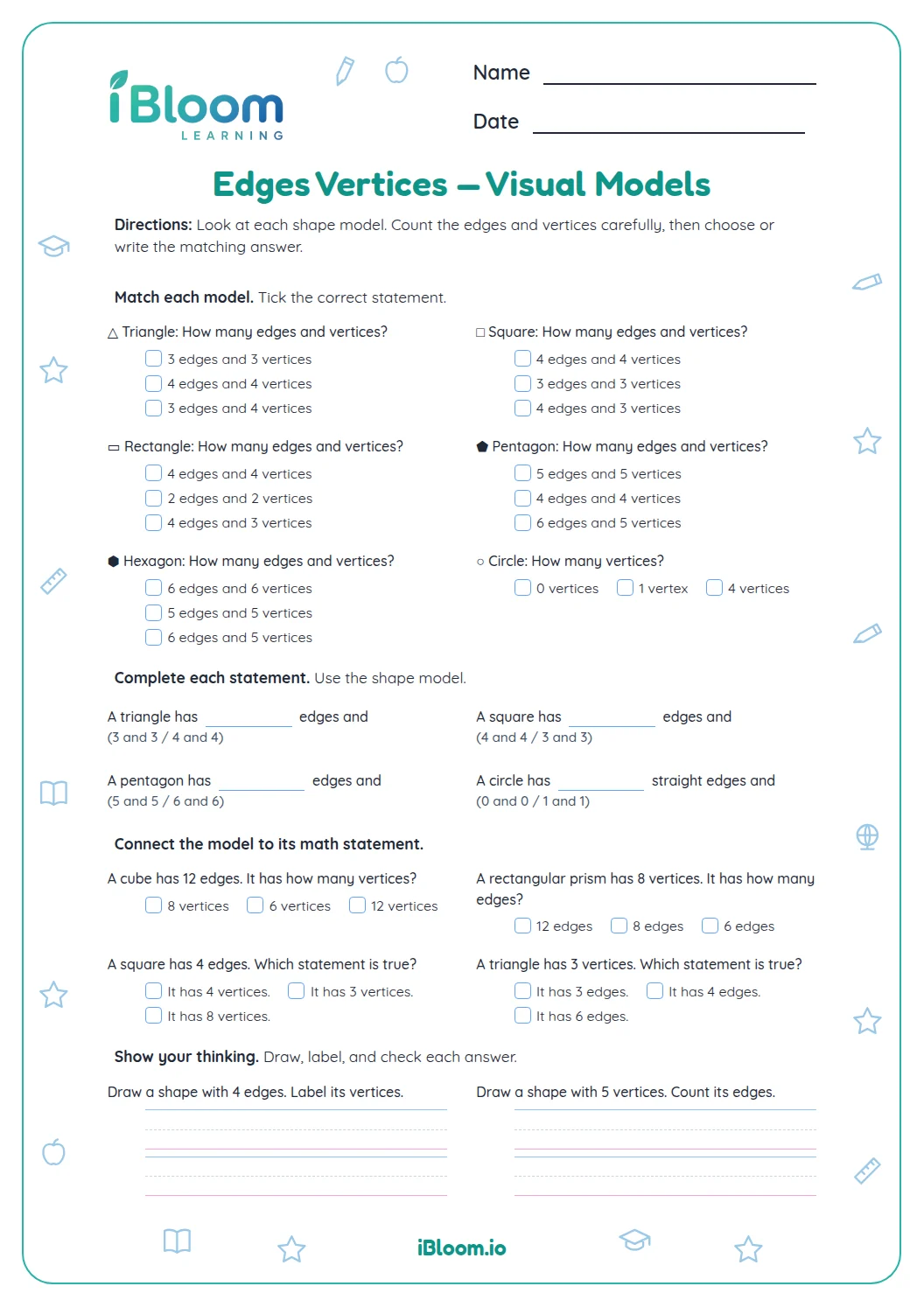
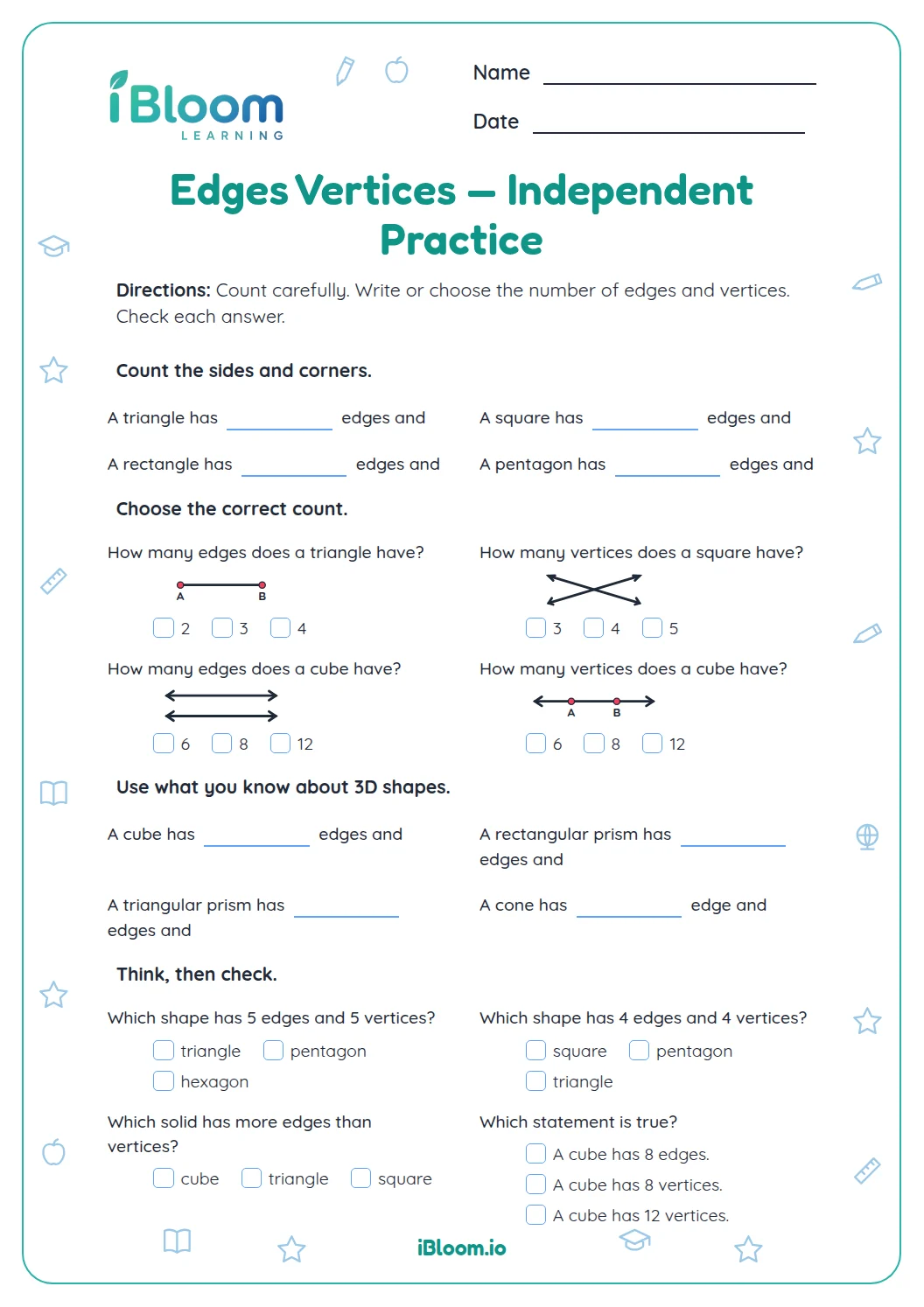
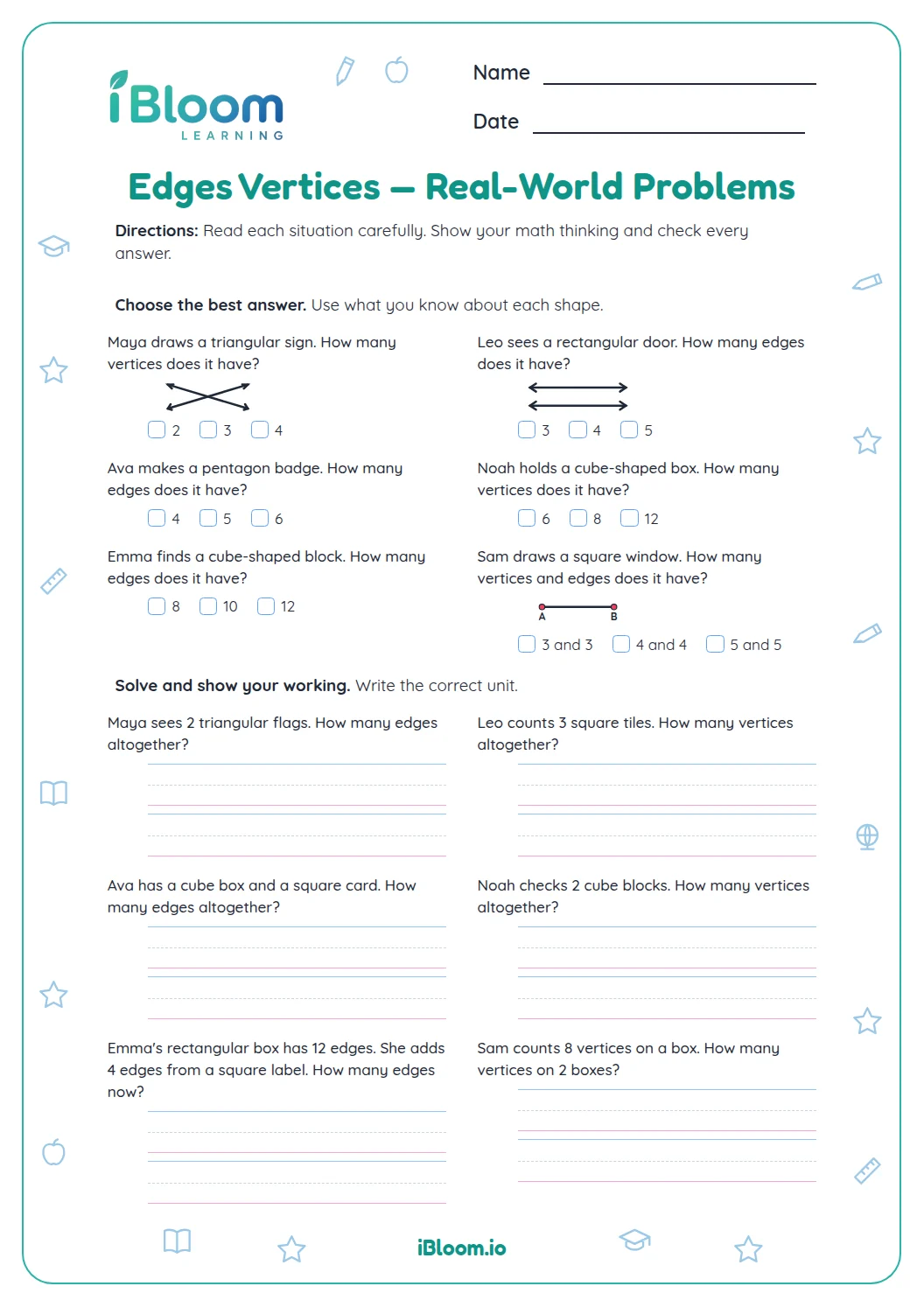
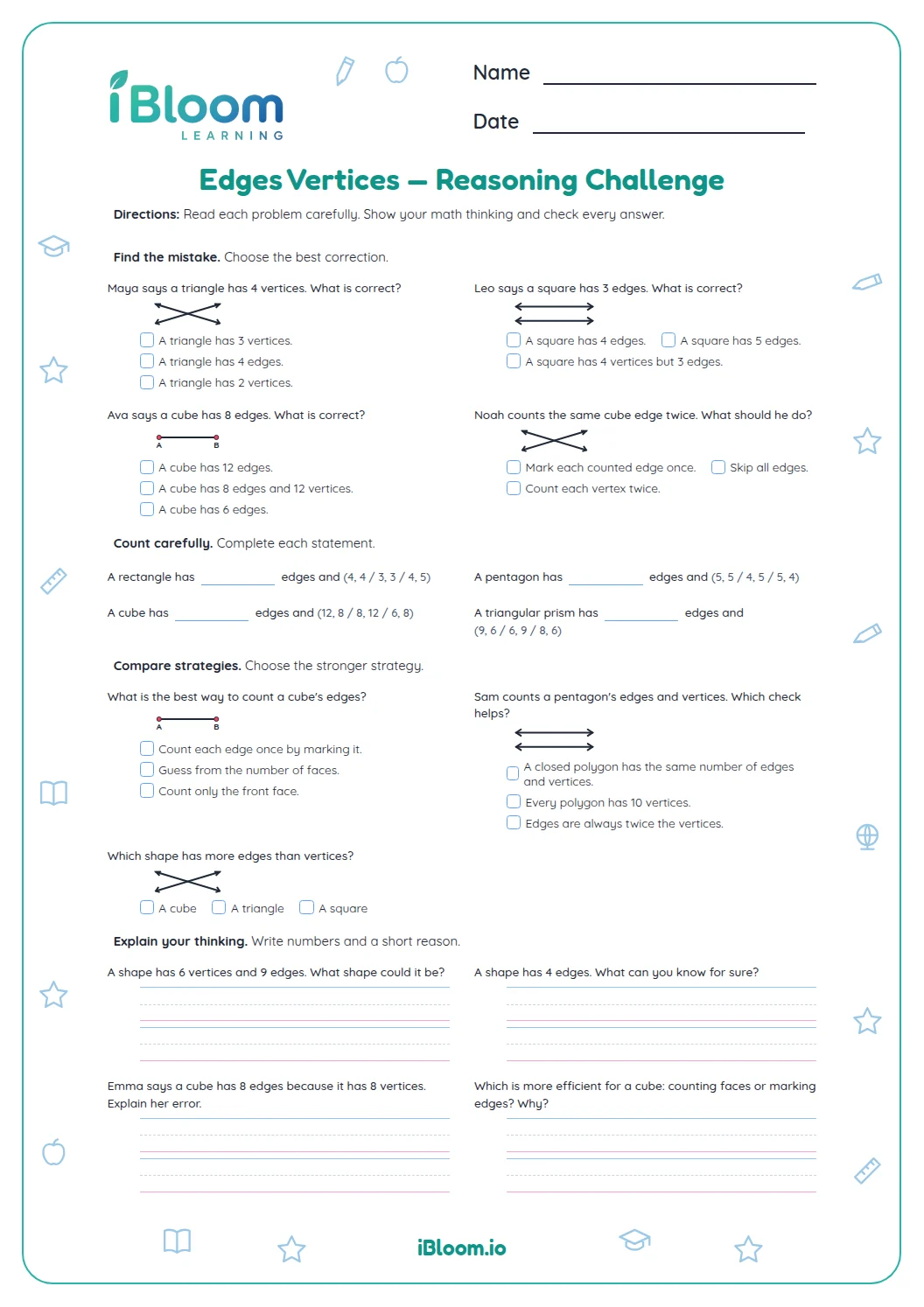
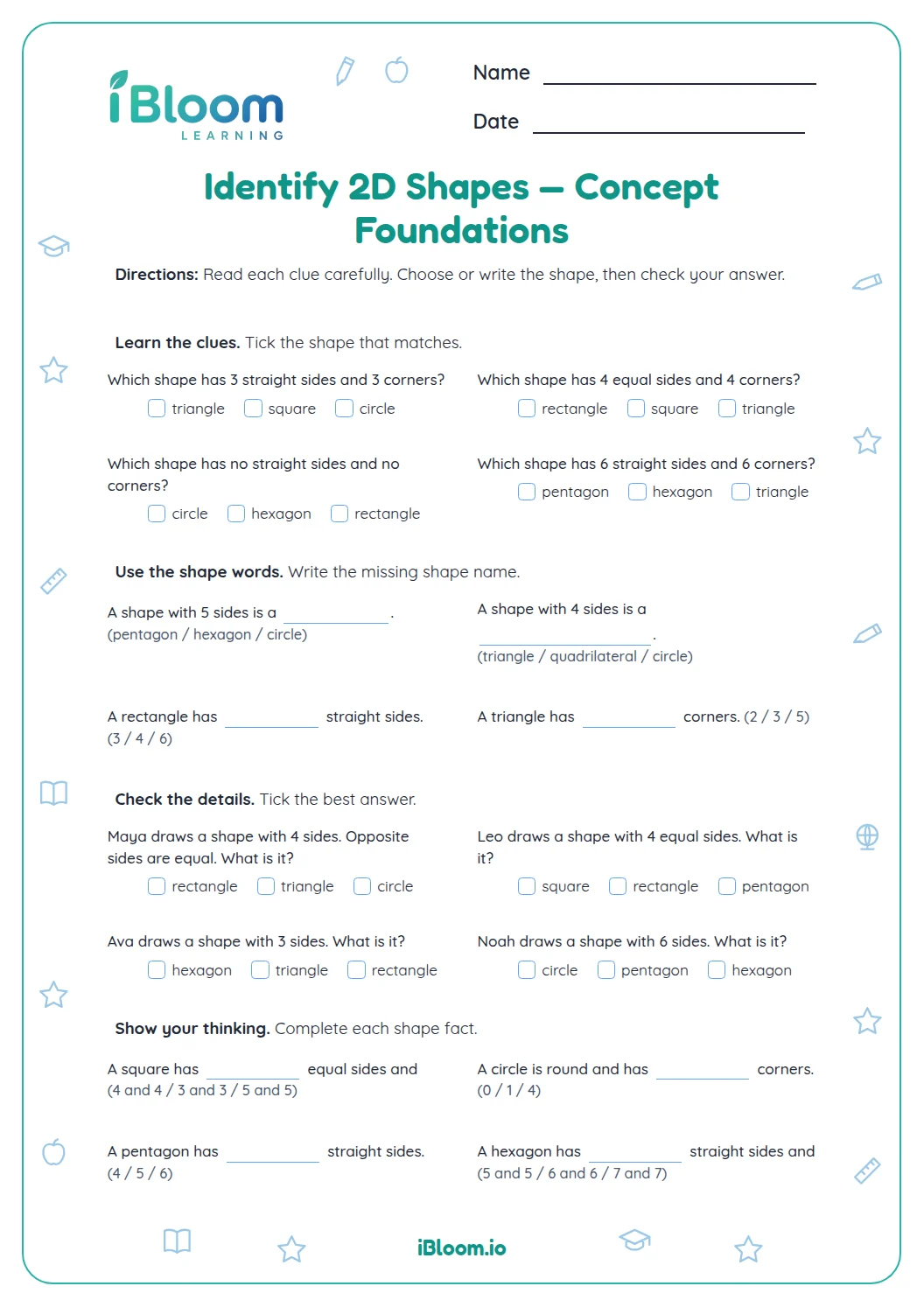
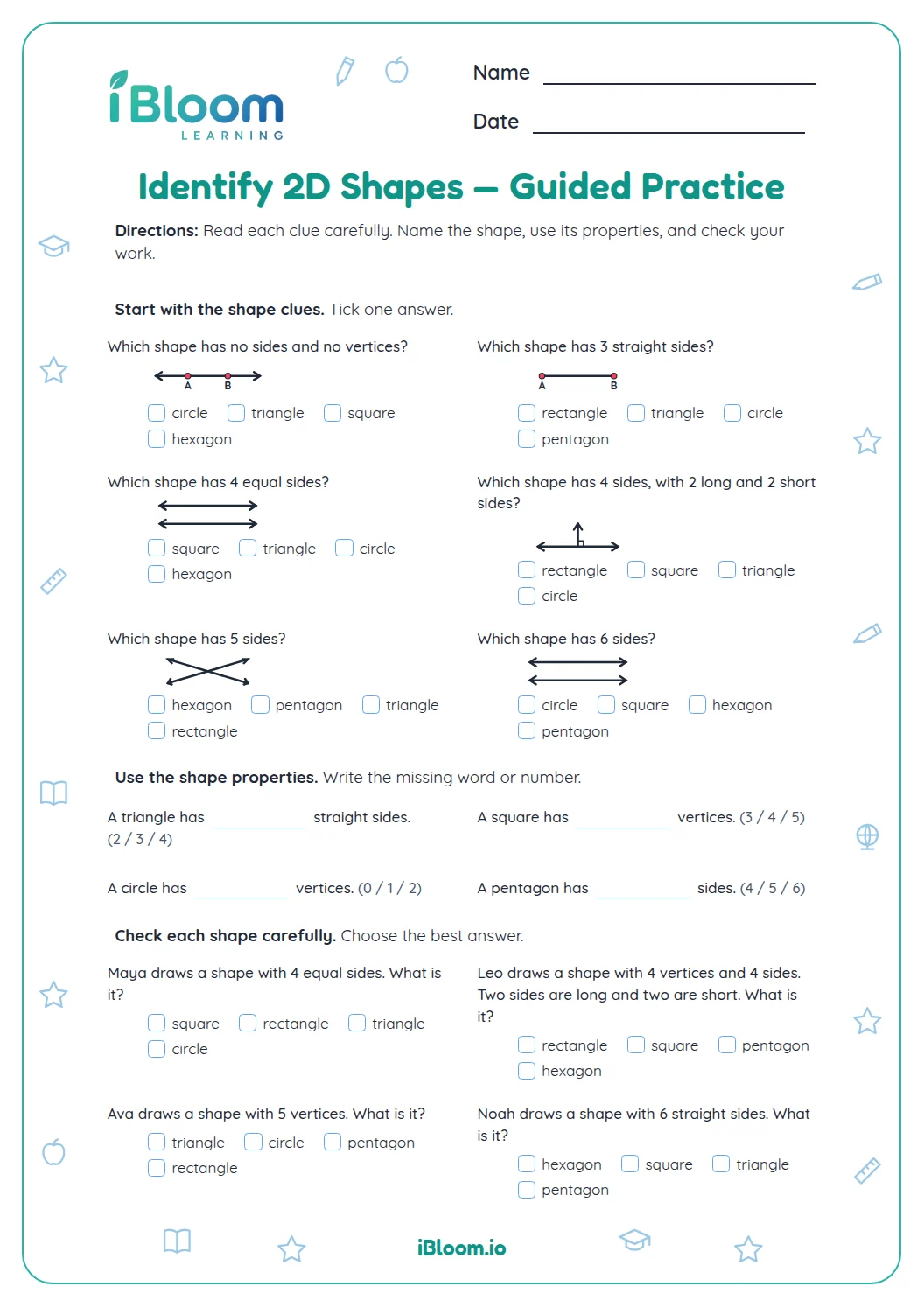
This Grade 2 geometry worksheet puts a polygon beside every question so students can trace and count its straight sides and vertices. The 14 items include familiar polygons, a comparison, and figure identification. It practices CCSS 2.G.A.1 by recognizing shapes through attributes such as their numbers of angles and sides. A separate answer key is included.
Aligned to 2.G.A.1
What are an edge and a vertex on a polygon?
On a flat polygon, a side is one straight boundary segment. A vertex is the corner where two sides meet. Question 3 shows a pentagon; trace its outline to count five sides and five vertices.
- 1Start at one corner of the pentagon.
- 2Trace five straight sides.
- 3The five meeting points are its vertices.
How can you count without skipping a corner?
Choose one corner, trace each side in order, and stop when you reach that starting corner again. Count the starting corner once. In the final question, trace the labeled octagon to check its side and corner counts.
How does a polygon name help?
The name often tells how many sides the polygon has: a pentagon has five and a hexagon has six. Use the name to predict the count, then verify by tracing the shape.
Count a polygon
- 1Find one corner as your starting point.
- 2Trace one straight side at a time.
- 3Count each corner where two sides meet.
- 4Return to the starting point without counting it twice.
- 5Use the polygon name to check your total.
Common geometry counting slips
The mistake
Counting the starting corner again after tracing the full shape.
The fix
Stop when you return to the first corner; do not count it twice.
The mistake
Counting a side as a vertex.
The fix
A side is a straight line on the outline; a vertex is the corner where two sides meet.
The mistake
Skipping a side while moving around a polygon.
The fix
Trace the outline continuously and mark each side once as you count.
Common Core alignment
This page connects the listed standard to the reading and practice on the sheet.
Recognize and draw polygons by their number of angles and sides.
On this sheet: Recognize and draw polygons by their number of angles and sides.
Show the official wordingHide the official wording
Recognize and draw shapes having specified attributes, such as a given number of angles or a given number of equal faces. Identify triangles, quadrilaterals, pentagons, hexagons, and cubes.
What to practice next
Make more practice
Further reading
Questions parents and teachers ask
What is the difference between an edge and a vertex?
A side is one straight line on a polygon’s outline. A vertex is a corner where two sides meet. Most questions name the polygon directly, while the final item also gives a drawing to trace. Count each side and meeting point once.
How does the octagon drawing help?
The final question includes a labeled octagon, so students can connect the words sides and corners with a pictured polygon. The other prompts name familiar shapes directly and stand on their own. A student can trace a shape mentally and count each part once.
Do sides and vertices have the same count?
For every polygon on this page, the number of sides equals the number of vertices. Each side runs between two corners, and the outline closes back at its starting point. Trace the shape once to count each part without counting the starting vertex twice. That gives a reliable check.
How many sides does a hexagon have?
A hexagon has six straight sides and six corners. The worksheet names a hexagon in its count question, so students can use the polygon name to predict six and check that each corner is counted once as they trace the outline mentally.
What does the answer key show?
The answer key lists the side or vertex count for each of the 17 questions. Learners can compare their count, then retrace the polygon if it differs. Ask them to explain which straight lines are sides and which meeting points are vertices.