Free printable practice
Edges Vertices Practice Activities
Grade 2 geometry worksheets for counting and identifying edges and vertices on familiar 2D and 3D shapes.
Free printable worksheet PDFs
Preview every available page, then download the free worksheet PDF for home, homeschool, tutoring, or classroom practice.
Preview the exact activity before downloading it.
 Edges Vertices — Concept FoundationsGrade 2 geometry worksheets for counting and identifying edges and vertices on familiar 2D and 3D shapes. This Grade 2 foundations worksheet adds concise teaching notes, worked examples, and supported first attempts.Grade 2Free PDF preview4 pages
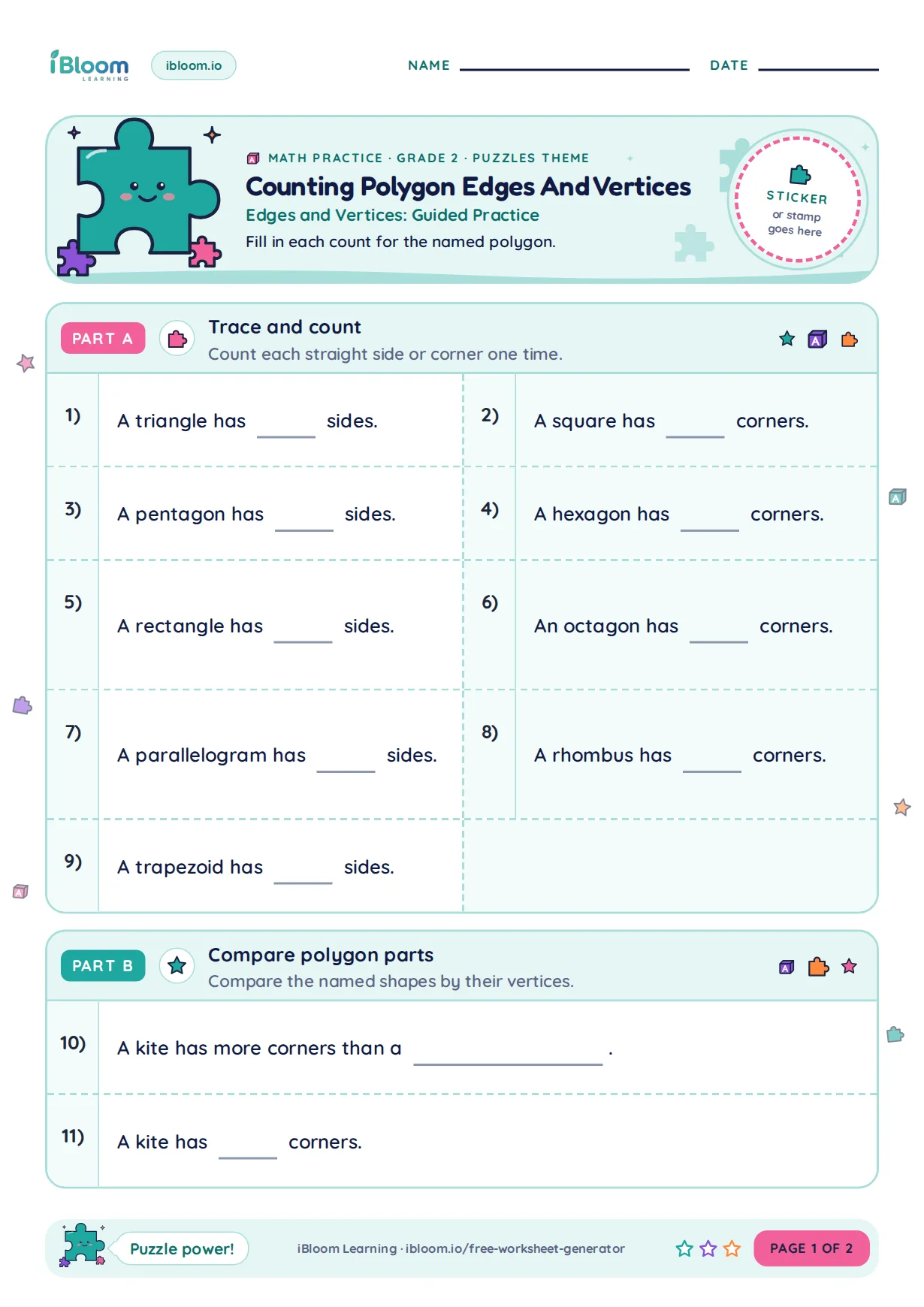 Edges Vertices — Guided PracticeGrade 2 geometry worksheets for counting and identifying edges and vertices on familiar 2D and 3D shapes. This Grade 2 guided-practice worksheet progresses from prompts and checkpoints to independent questions.Grade 2Free PDF preview
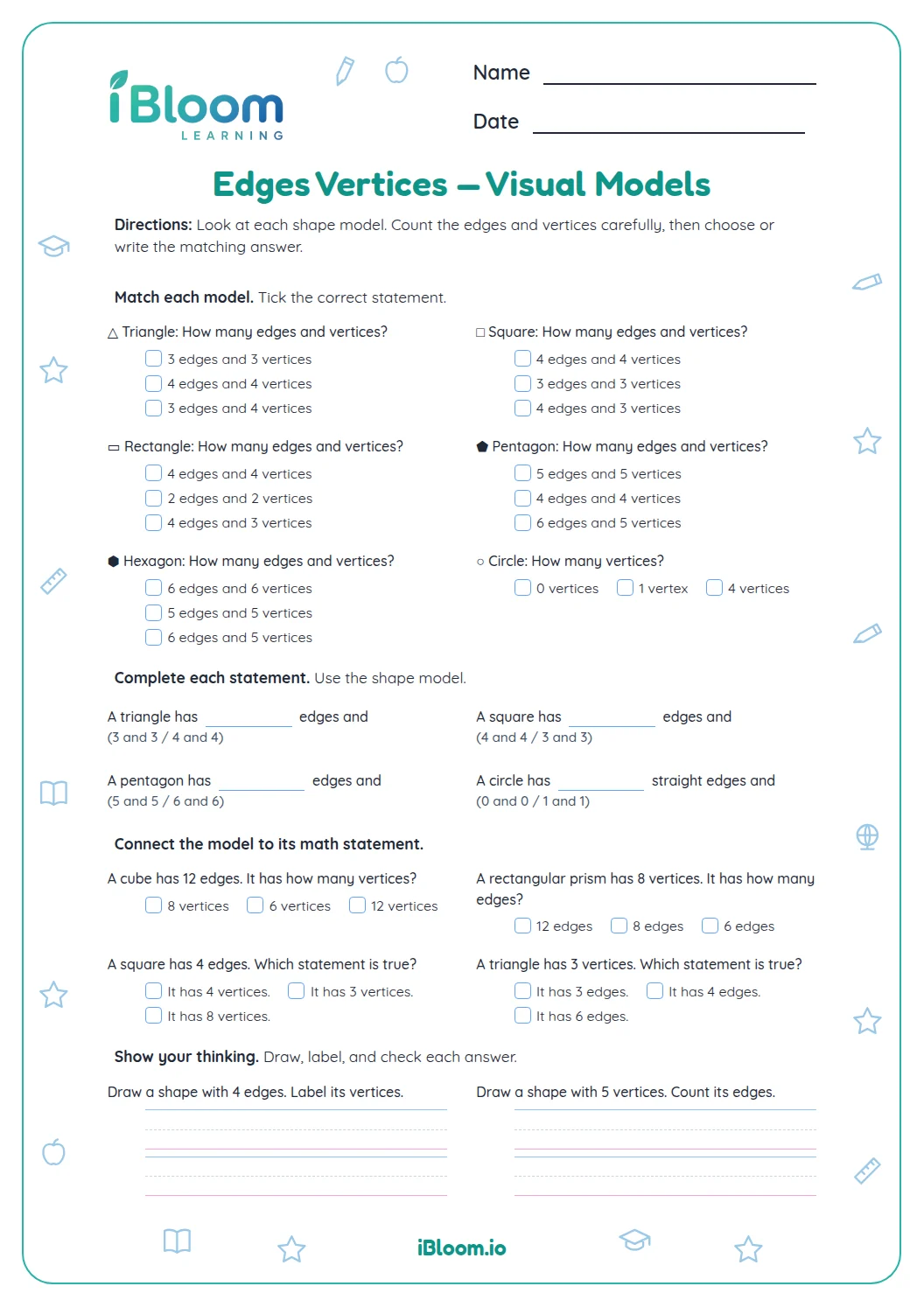 Edges Vertices — Visual ModelsGrade 2 geometry worksheets for counting and identifying edges and vertices on familiar 2D and 3D shapes. This Grade 2 visual-model worksheet connects suitable diagrams, tables, number lines, or place-value models to mathematical notation.Grade 2Free PDF preview
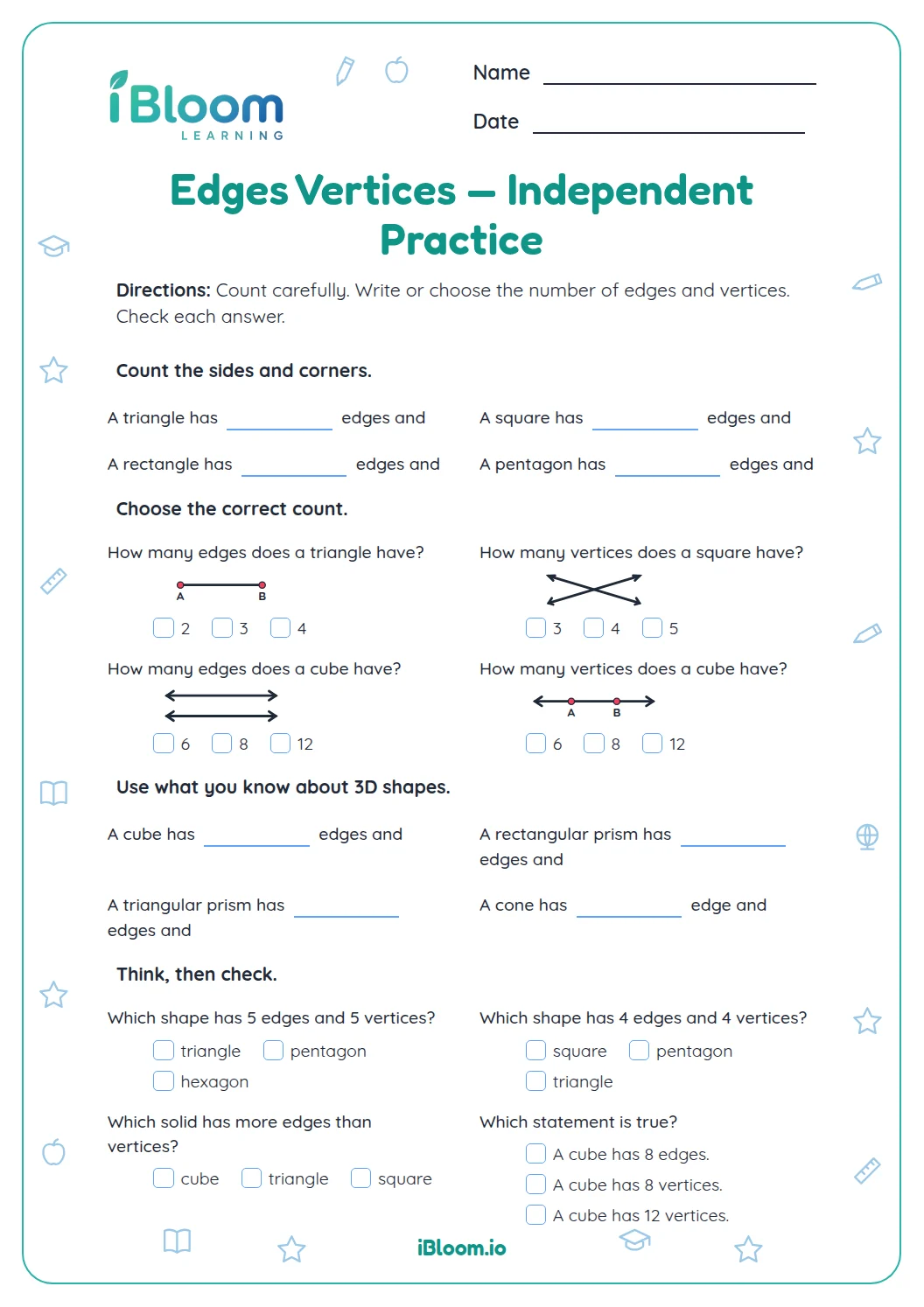 Edges Vertices — Independent PracticeGrade 2 geometry worksheets for counting and identifying edges and vertices on familiar 2D and 3D shapes. This Grade 2 independent-practice worksheet provides a balanced sequence of accurate, grade-level exercises.Grade 2Free PDF preview
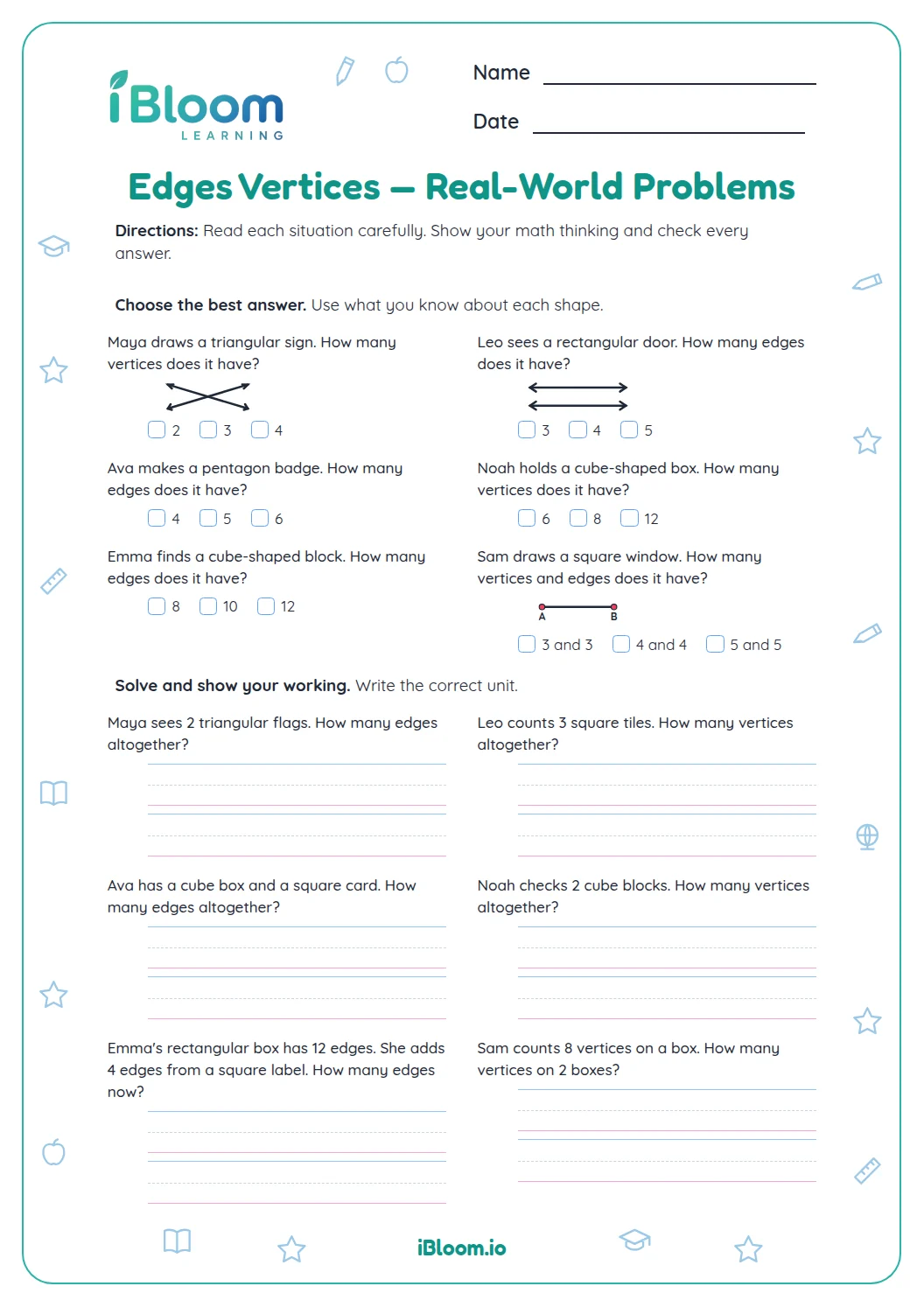 Edges Vertices — Real-World ProblemsGrade 2 geometry worksheets for counting and identifying edges and vertices on familiar 2D and 3D shapes. This Grade 2 application worksheet uses realistic one-step and multi-step situations with room to model and solve.Grade 2Free PDF preview
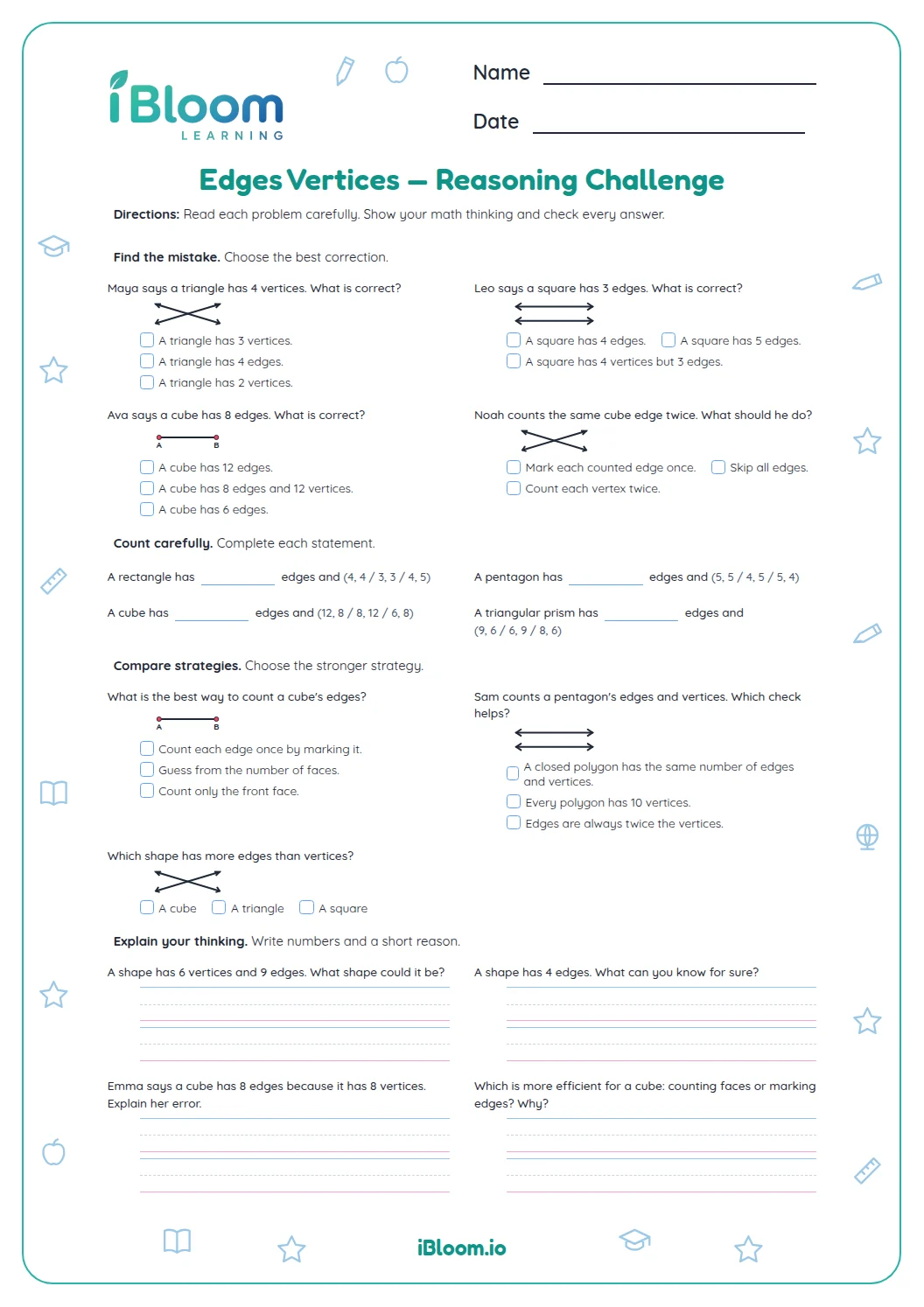 Edges Vertices — Reasoning ChallengeGrade 2 geometry worksheets for counting and identifying edges and vertices on familiar 2D and 3D shapes. This Grade 2 reasoning worksheet combines error analysis, strategy comparison, missing information, and a gentle extension.Grade 2Free PDF preview
Practice that builds confidence
Understanding edges and vertices
These Grade 2 geometry worksheets help children practise spotting vertices, counting edges, and using shape vocabulary with confidence. Students learn that a vertex is a corner point and an edge is a straight boundary or meeting line, depending on the shape being studied.
The printable activities include visual shape tasks, count-and-record exercises, matching questions, and simple reasoning prompts. Children work with familiar shapes such as triangles, rectangles, squares, cubes, and rectangular prisms while building careful observation habits.
Edges and vertices can feel abstract until children connect the words to what they can see and touch. In these worksheets, Grade 2 learners look closely at flat shapes and solid shapes, then identify corners and straight boundaries. A triangle has 3 vertices, a rectangle has 4 vertices, and a cube has edges where its flat faces meet. The goal is not just to memorize counts, but to explain what was counted.

A clear learning progression
The practice begins with obvious corners on simple 2D shapes before moving to shapes that may be turned, stretched, or shown in different sizes. Children then record the number of edges and vertices, compare shapes, and answer short questions such as which shape has more vertices. This progression helps students separate the shape’s properties from its color, position, or size.
Parent routine for home practice
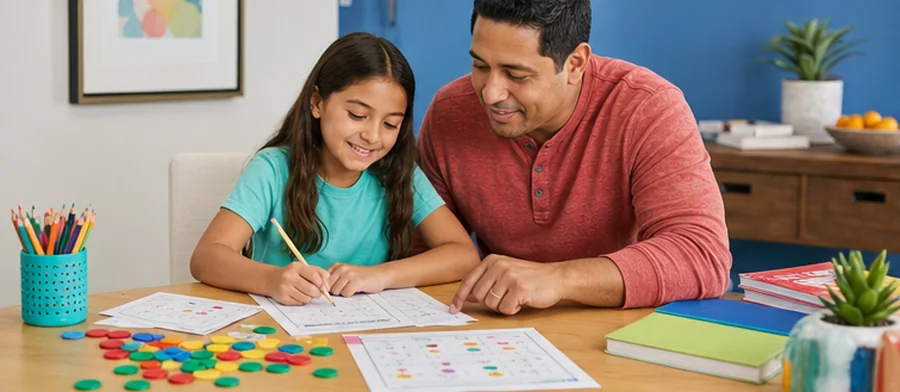
Choose one worksheet page and sit with your child as they point before they count. Ask, “Where will you start?” and have them mark each vertex lightly with a small dot. Then let them trace each edge with a finger or pencil. After the page, look around the room for examples: a book cover, table top, cereal box, or block. Keep the focus on careful counting and the words edge and vertex.
Classroom uses for teachers
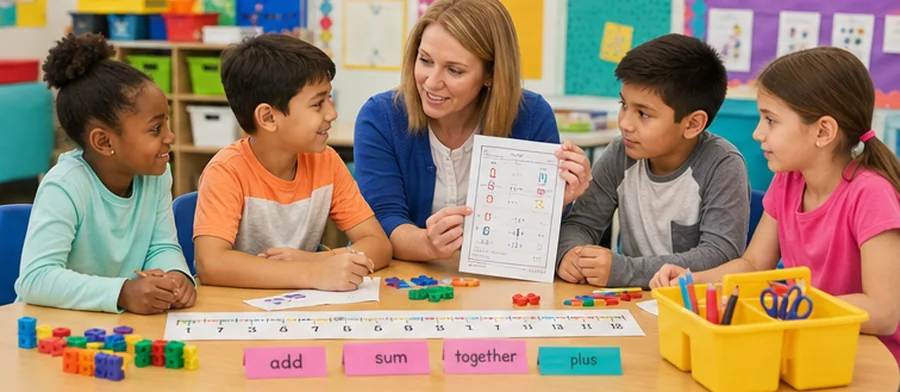
Teachers can use these printables for geometry centers, small-group review, morning work, or quick checks after introducing shape attributes. The pages also work well with manipulatives: students can build a shape with craft sticks, count its vertices, and then complete the matching worksheet task. For partner work, one child can describe a shape by its number of edges and vertices while the other identifies it.
Common errors to watch for
Many children count the same corner twice, skip a hidden-looking corner in a drawing, or call a curved side an edge without noticing that the worksheet is asking for straight edges. Some also confuse faces, edges, and vertices on solid shapes. Encourage students to slow down, mark each counted part, and say the full sentence: “This shape has ___ vertices and ___ edges.”
Free printable PDF download
Use this grade 2 edges vertices worksheet page to preview the activity, print it, or download it as a PDF for quick practice. It works well for homework, homeschool lessons, tutoring, morning work, revision, and classroom centers.
Answers and answer key support
After the child completes the worksheet independently, parents and teachers can use the answer support or answer key information to check the work, review mistakes, and choose the next practice step.
Why iBloom worksheets help
The activities give children repeated, visual practice without overwhelming the page. Diagrams are chosen to make counting purposeful, and the questions prompt students to notice attributes rather than guess from memory. A useful child-friendly strategy is: “Dot the corners, trace the edges, then count again.”
Helpful answers
Frequently asked questions
What is the difference between an edge and a vertex?
A vertex is a corner point where sides or edges meet. An edge is a straight boundary of a shape, or on a solid shape, the line where two faces meet.
Are these worksheets for 2D shapes, 3D shapes, or both?
They focus on counting and identifying edges and vertices using familiar 2D and 3D shapes, so children can compare how the same vocabulary appears in different geometry situations.
How can I help my child stop counting a vertex twice?
Have your child place a small dot on each vertex as it is counted. After all dots are marked, they can count the dots again to check their answer.
Why does my child confuse edges with sides?
In Grade 2, children often use side for flat shapes and edge for solid shapes, but worksheets may use edge to mean a straight boundary. Tracing the line being counted helps clarify the idea.
How can teachers use these pages in a geometry lesson?
Teachers can use them after a hands-on shape exploration, in math centers, as partner practice, or as a quick check to see whether students can identify and count vertices and edges accurately.
Is this grade 2 edges vertices worksheet free?
Yes. You can preview it for free and use the printable worksheet for home or classroom practice.
Can I download this grade 2 edges vertices worksheet as a PDF?
Yes. Use the worksheet download option to save a printable PDF, or print the worksheet directly from the page.
Does this grade 2 edges vertices worksheet include answers or an answer key?
When the activity has fixed answers, iBloom includes answer support so parents and teachers can check the completed worksheet.