


About this worksheet
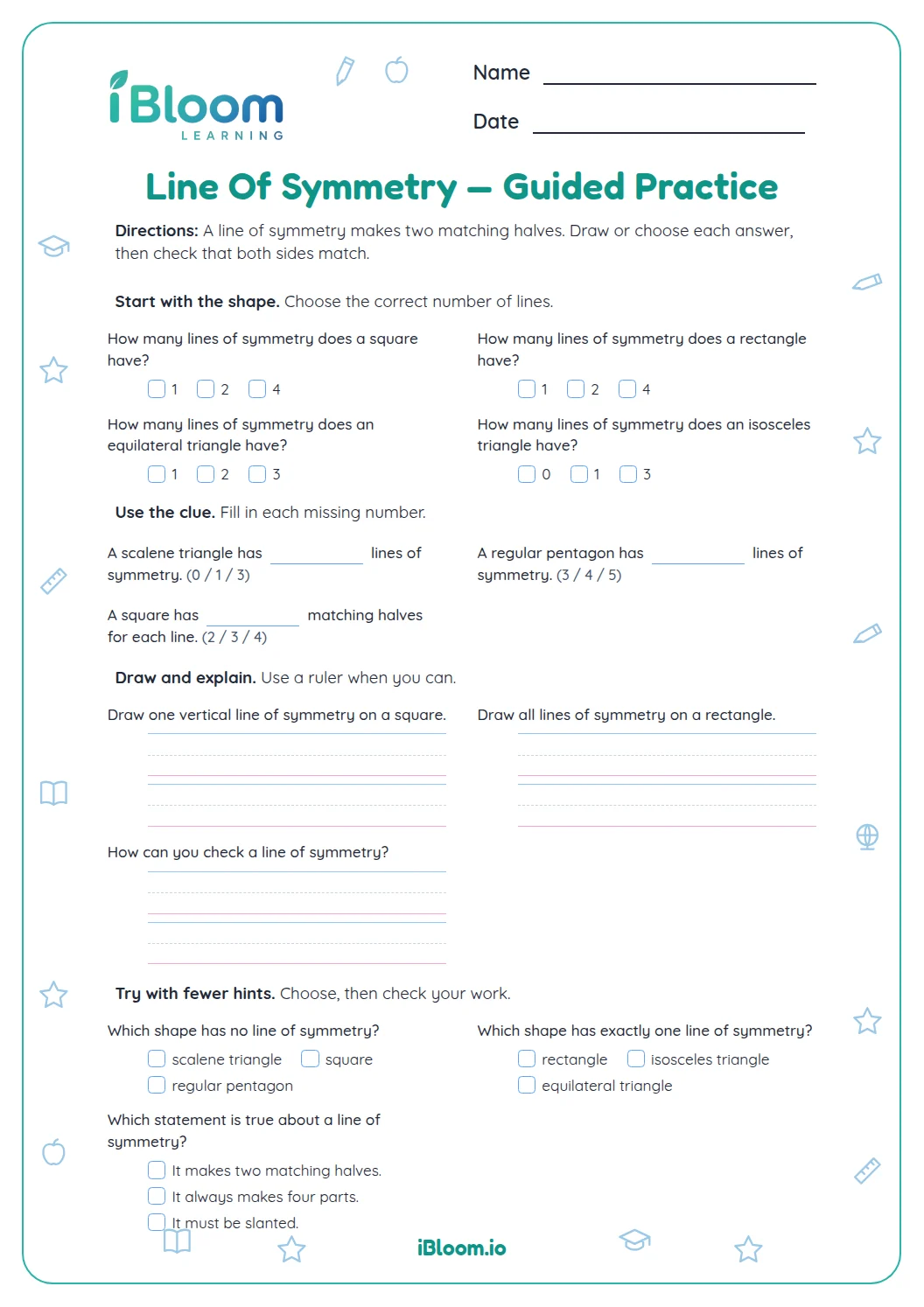
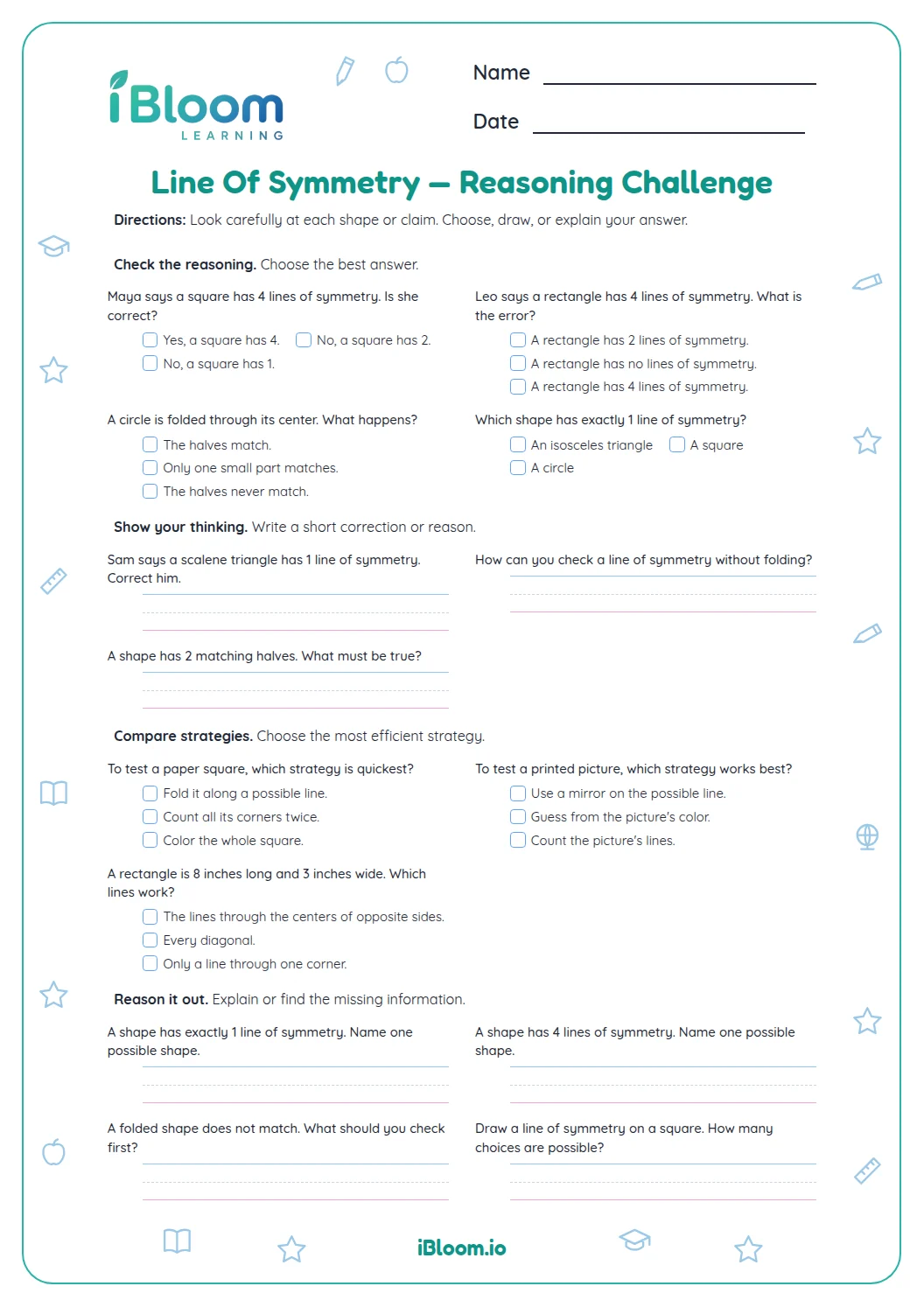
This geometry printable introduces line symmetry through pictured squares, rectangles, and triangles. Children decide whether a described fold would make matching halves, then answer short questions about testing a fold and comparing shape parts. The 14 questions practice identifying line-symmetric figures in CCSS 4.G.A.3, with a separate answer key.
Aligned to 4.G.A.3
How can you test for symmetry?
Imagine folding the shape along a line. If the edges and corners on one side line up with the other side, the fold makes matching halves. A square has several possible symmetry lines; the question only asks whether at least one exists.
- 1Imagine folding from top to bottom.
- 2The left and right halves match.
- 3Answer: Yes, it has a line of symmetry.
What should children look at?
Look at the outline, including its corners and slanted sides. A scalene triangle has sides of different lengths, so its halves cannot match across a fold.
What is on this practice page?
The worksheet has six pictured shape-fold questions followed by eight concept checks. Students decide if a described fold makes matching halves, then apply the same idea to fold testing and shape properties. The separate answer key gives the choices.
How can I use this page?
- 1Name the shape, then inspect its outline.
- 2Imagine a fold through the middle.
- 3Ask whether every edge and corner would match.
- 4Choose yes or no and check with the key.
Common mix-ups and helpful fixes
The mistake
Assume every shape has symmetry because it looks balanced.
The fix
Compare the exact sides and corners on both sides of a possible fold.
The mistake
Think a slanted side automatically means no symmetry.
The fix
Test a possible fold; an equilateral triangle has matching halves.
The mistake
Expect only one possible symmetry line.
The fix
The question asks whether at least one fold works, even if more are possible.
Common Core alignment
Students identify shapes whose folds divide them into matching parts.
Identify when a fold divides a two-dimensional shape into matching parts.
On this sheet: Students decide whether folds through pictured shapes make matching halves and identify the symmetry idea.
Show the official wordingHide the official wording
Recognize a line of symmetry for a two-dimensional figure as a line across the figure such that the figure can be folded along the line into matching parts. Identify line-symmetric figures and draw lines of symmetry.
What to practice next
Make more practice
Further reading
Questions parents and teachers ask
What does line symmetry mean?
A shape has line symmetry when it can be folded along a line so the two sides match exactly. Six pictured examples and eight short concept checks practice finding or describing that fold. Children compare the outlines or reason about the fold idea.
Why are there no drawn symmetry lines on the shapes?
The page uses pictured shapes with prompts that name a possible fold direction or path, so children decide whether the halves would match. It replaces drawing exact symmetry lines with fold-and-match decisions supported by the available shape drawings. A paper cutout can make the fold test concrete.
Which shapes appear on the page?
The pictured questions use squares, rectangles, an equilateral triangle, and a scalene triangle. The prompts ask students to test vertical, horizontal, diagonal, or top-to-base folds. The later questions focus on what matching halves mean and how to check a possible fold.
Is there an answer key?
Yes. Three separate answer-key pages give a yes-or-no response for the six pictured shapes and the correct choices for eight concept questions. Keep the key aside while the child works, then review any missed folds together. Review the fold reasoning together.
How can a child check an answer without folding paper?
Have the child point to a possible fold and compare corners and edges on each side. If every part lines up with its partner, that fold makes matching halves. Trying a paper fold can make the idea even clearer. Try it with a paper shape.