

About this worksheet
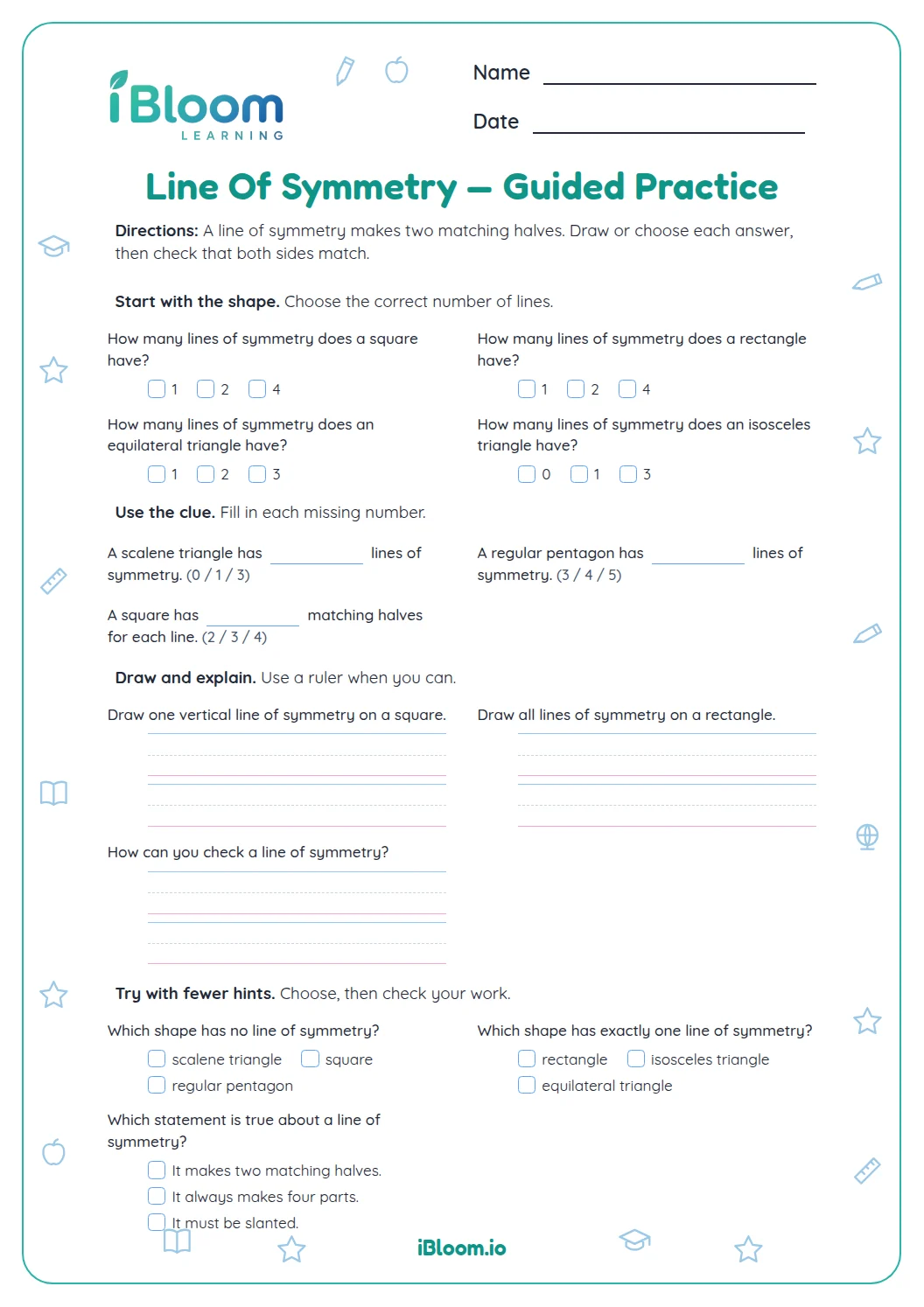
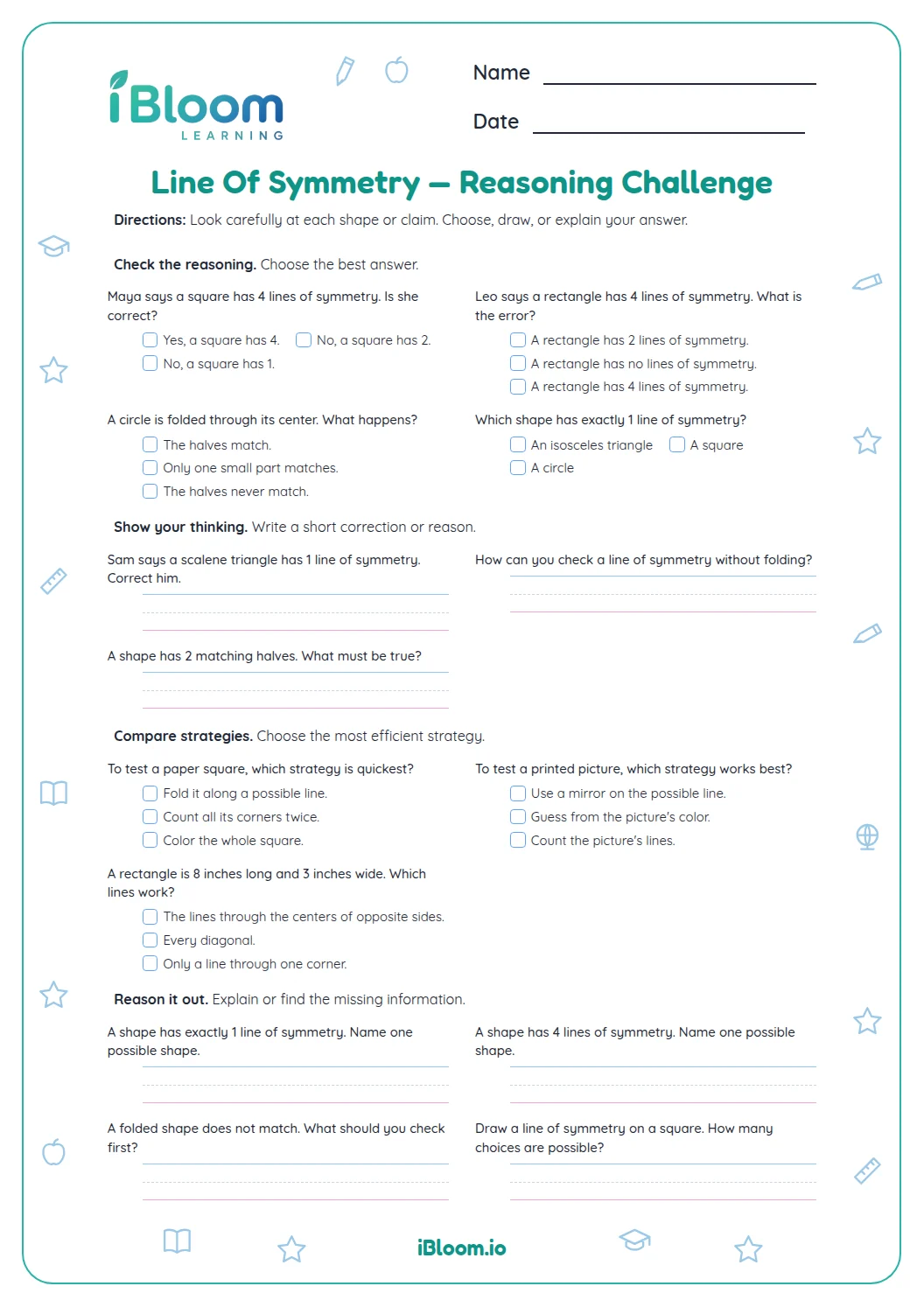
This Grade 2 worksheet introduces lines of symmetry through familiar shapes and everyday examples such as a folded heart, butterfly wings, a tile, and a window. Learners count symmetry lines or decide whether a described fold makes matching halves. The sheet uses short multiple-choice responses and includes a separate key. Its shape and folding work practices CCSS 4.G.A.3 at an introductory level.
Aligned to 4.G.A.3
How can you test a symmetry line?
Imagine folding along the line so one side lands on the other. Question 1 uses a square: its vertical, horizontal, and two diagonal lines divide it into matching halves.
- 1A square has a vertical and a horizontal symmetry line.
- 2Its two diagonals also make matching halves.
- 3It has 4 lines of symmetry.
Where can symmetry appear in real life?
A fold in a paper heart or a line between matching window panes can divide an object into two matching parts. The details in each prompt tell you what the two sides look like.
How can you check an answer?
For a shape, count each distinct line that makes matching halves. For an object, check the side-to-side details before deciding whether the proposed line works.
How to use this worksheet
- 1Look for a line that divides a figure into matching halves.
- 2For a named regular shape, count each line that makes matching parts.
- 3Check a fold by imagining one half placed over the other.
- 4For everyday objects, follow the details given in the prompt.
- 5Use the key to review which lines make matching parts.
Mistakes to watch for
The mistake
Calling any line through a shape a symmetry line.
The fix
The two sides must match when folded.
The mistake
Counting only vertical and horizontal lines on a square.
The fix
A square also has diagonal symmetry lines.
The mistake
Assuming a natural object is symmetric because it has a center.
The fix
Compare the left and right sides described in the question.
Common Core alignment
Recognize and identify lines that divide figures into matching parts.
On this sheet: The questions directly practice this skill.
Show the official wordingHide the official wording
Recognize a line of symmetry for a two-dimensional figure as a line across the figure such that the figure can be folded along the line into matching parts. Identify line-symmetric figures and draw lines of symmetry.
What to practice next
Make more practice
Further reading
Questions parents and teachers ask
What does a line of symmetry mean?
A line of symmetry divides a figure into two matching parts. If the figure could be folded along that line, one side would fit the other. The worksheet asks learners to recognize this idea in common shapes and familiar objects.
Which shapes appear in the questions?
The first five questions ask about a square, a non-square rectangle, an equilateral triangle, a circle, and a regular hexagon. Several later questions use folds and familiar objects to connect the same idea to real situations. Each response is checked against the described shape or fold. The shape names and details are stated directly in each question.
Are pictures included for the shape questions?
Yes. The named shapes are drawn on the worksheet for the counting questions. The everyday examples describe the important features in words, such as matching butterfly wings or uneven sides on a leaf. Each response is checked against the described shape or fold. The prompt also supplies the relevant details for each real-world object.
Is an answer key included?
Yes. The separate answer key gives one response for each of the 14 questions. It can help an adult and learner discuss why a line makes matching halves, especially for shapes with more than one symmetry line. Each response is checked against the described shape or fold. The prompts describe the sides or folds that learners need to consider.
How long should the practice take?
About 20 minutes is a useful estimate for 14 short questions. Learners can also sketch or fold a piece of paper to test a possible symmetry line after completing the worksheet. Each response is checked against the described shape or fold. The key is separate, so an adult can review answers after practice.