

About this worksheet
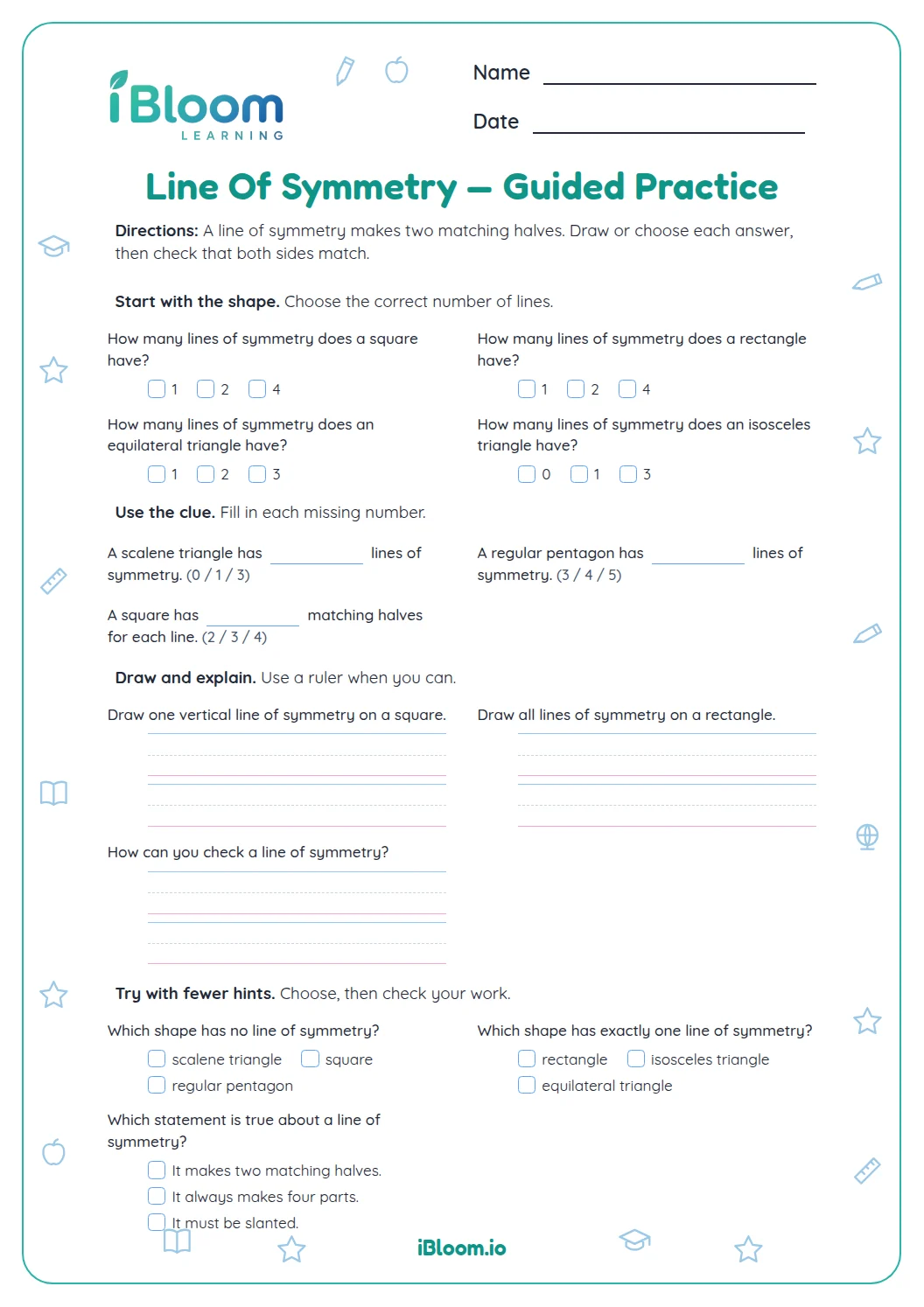
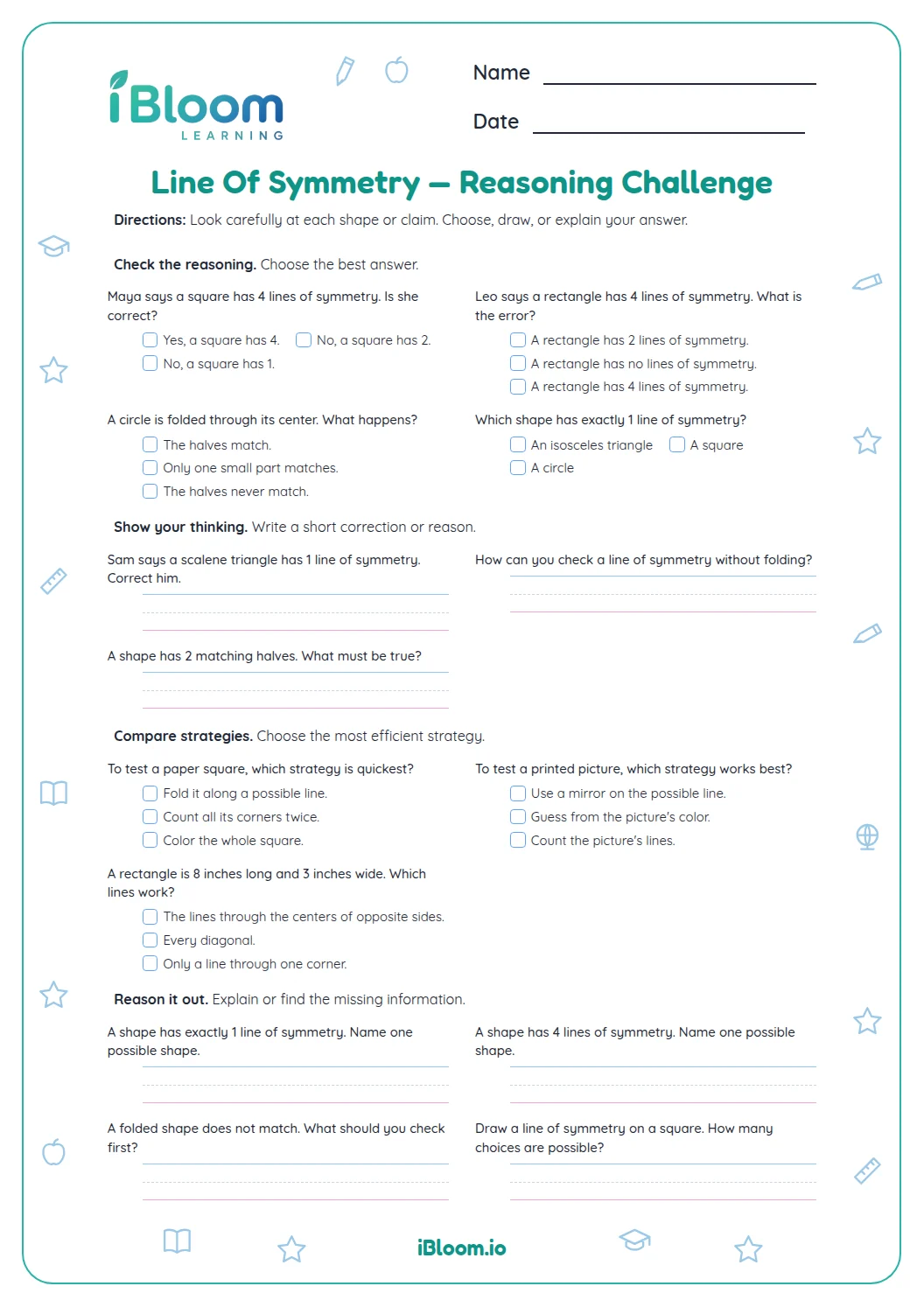
This worksheet gives students 14 illustrated questions about lines of symmetry. They count and identify symmetry lines on drawn shapes, compare triangles, and draw a line through a square. It practices CCSS 4.G.A.3: recognizing line-symmetric figures and drawing lines of symmetry. A separate answer key includes the accepted drawing.
Aligned to 4.G.A.3
What do the shape drawings help students notice?
The sheet uses drawn squares and rectangles to practice lines of symmetry. Students also answer facts about triangle and polygon symmetry, then draw directly on a square at the end.
How can a fold test a line of symmetry?
A fold along a symmetry line makes the two parts match. In question 2, count the four possible fold lines on the square: vertical, horizontal, and two diagonal.
- 1Check vertical and horizontal folds.
- 2Check both diagonal folds.
- 3A square has 4 lines of symmetry.
Why must a symmetry line match both sides?
A line must pass through the shape so its two sides match. A non-square rectangle has vertical and horizontal symmetry, but its diagonals do not match.
How should students draw the last answer?
Question 14 shows a square with room to draw directly on the model. Mark one straight line through its center so the two parts match; a vertical or horizontal line is one correct choice.
How to use this worksheet
- 1Read whether the prompt asks about a line, a fold, or a count.
- 2Check that a proposed line passes through the shape as described.
- 3Imagine folding along that line and compare the two halves.
- 4Use the specified orientation when the prompt names vertical or diagonal.
- 5For the final square, draw a straight centered line that creates matching halves.
Common mistakes and quick fixes
The mistake
Thinking every line through the center is a symmetry line.
The fix
Check whether folding along it makes the two halves match.
The mistake
Counting only vertical and horizontal symmetry lines on a square.
The fix
Remember that both diagonals also divide a square into matching halves.
The mistake
Calling a non-square rectangle’s diagonal a symmetry line.
The fix
Compare the folded halves; the rectangle’s diagonal halves do not match.
Common Core alignment
Identify line-symmetric figures and draw lines that divide them into matching parts.
On this sheet: Identify line-symmetric figures and draw lines of symmetry.
Show the official wordingHide the official wording
Recognize a line of symmetry for a two-dimensional figure as a line across the figure such that the figure can be folded along the line into matching parts. Identify line-symmetric figures and draw lines of symmetry.
What to practice next
Make more practice
Further reading
Questions parents and teachers ask
How many questions are included?
There are 14 questions, followed by a separate answer key. Students inspect several shape drawings, count symmetry lines, compare two triangles, answer facts about matching halves, and draw one valid line on a square. The key accepts any correct centered line.
What does a line of symmetry do?
It divides a two-dimensional shape into two matching parts. If the shape is folded along that line, the two parts fit on top of each other. This gives children a concrete chance to practice the idea and explain their choices.
How many symmetry lines does a square have?
A square has four lines of symmetry: one vertical, one horizontal, and two diagonals through its center. Students count each direction that divides the square into matching halves, using the square drawing on the worksheet to check their answer.
Does a rectangle have diagonal symmetry?
A non-square rectangle does not have diagonal lines of symmetry. Its vertical and horizontal center lines divide it into matching halves, but a diagonal fold does not. This gives children a concrete chance to practice the idea and explain their choices.
What can count as the last answer?
Question 14 shows a square and asks students to draw one symmetry line through its center. A vertical, horizontal, or either diagonal line is correct because each divides the square into matching halves. The answer key accepts any of these lines.