


About this worksheet
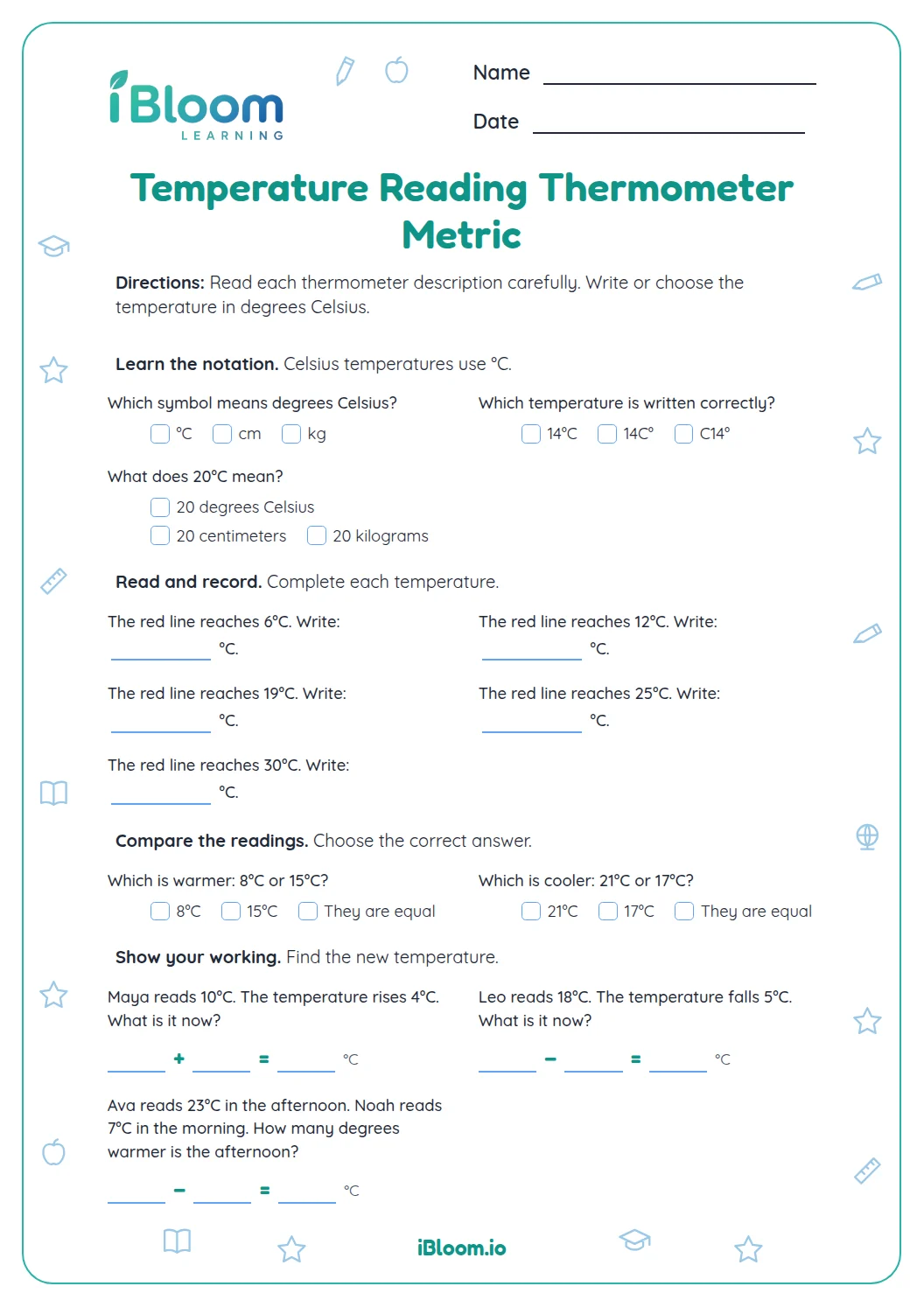
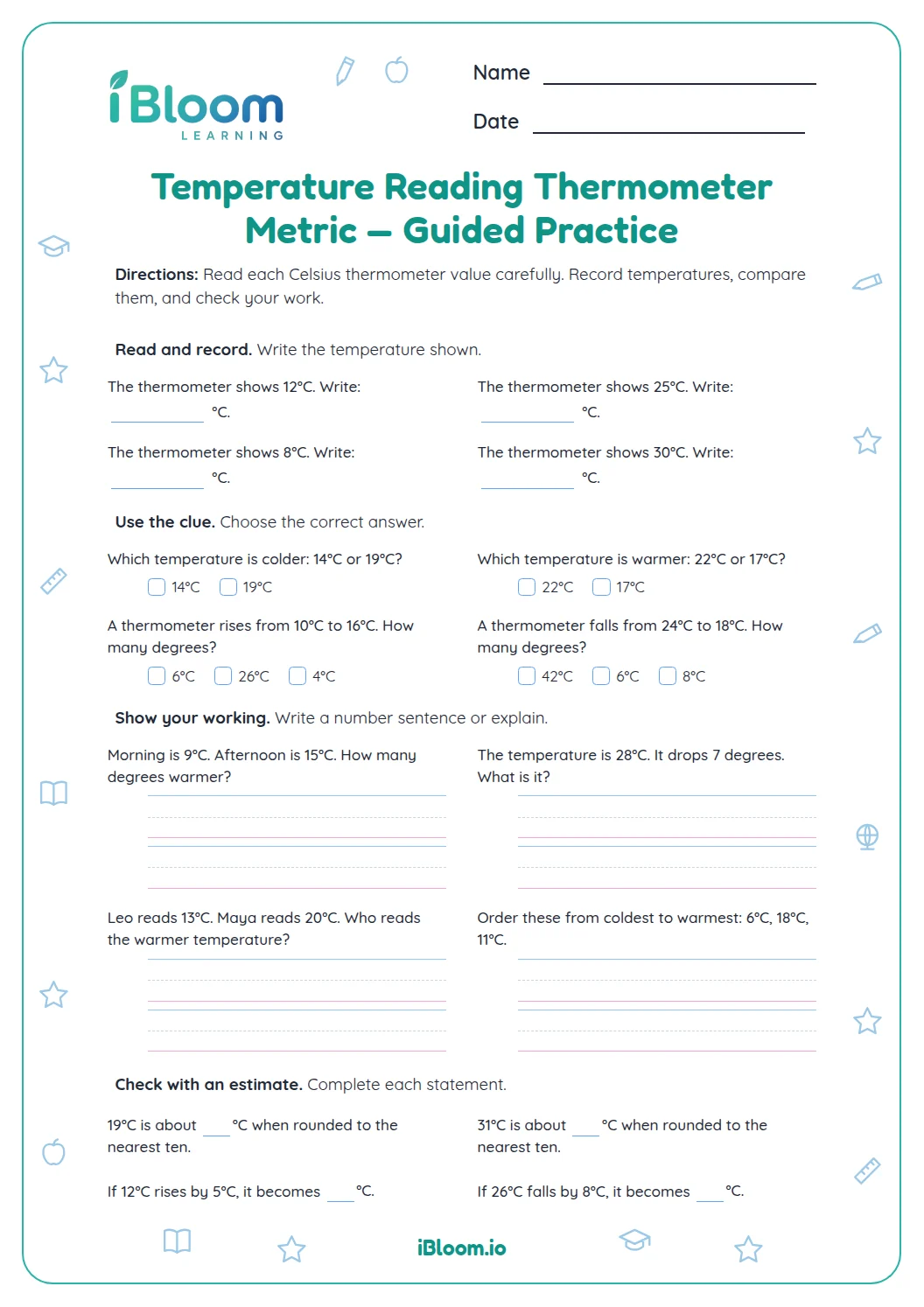
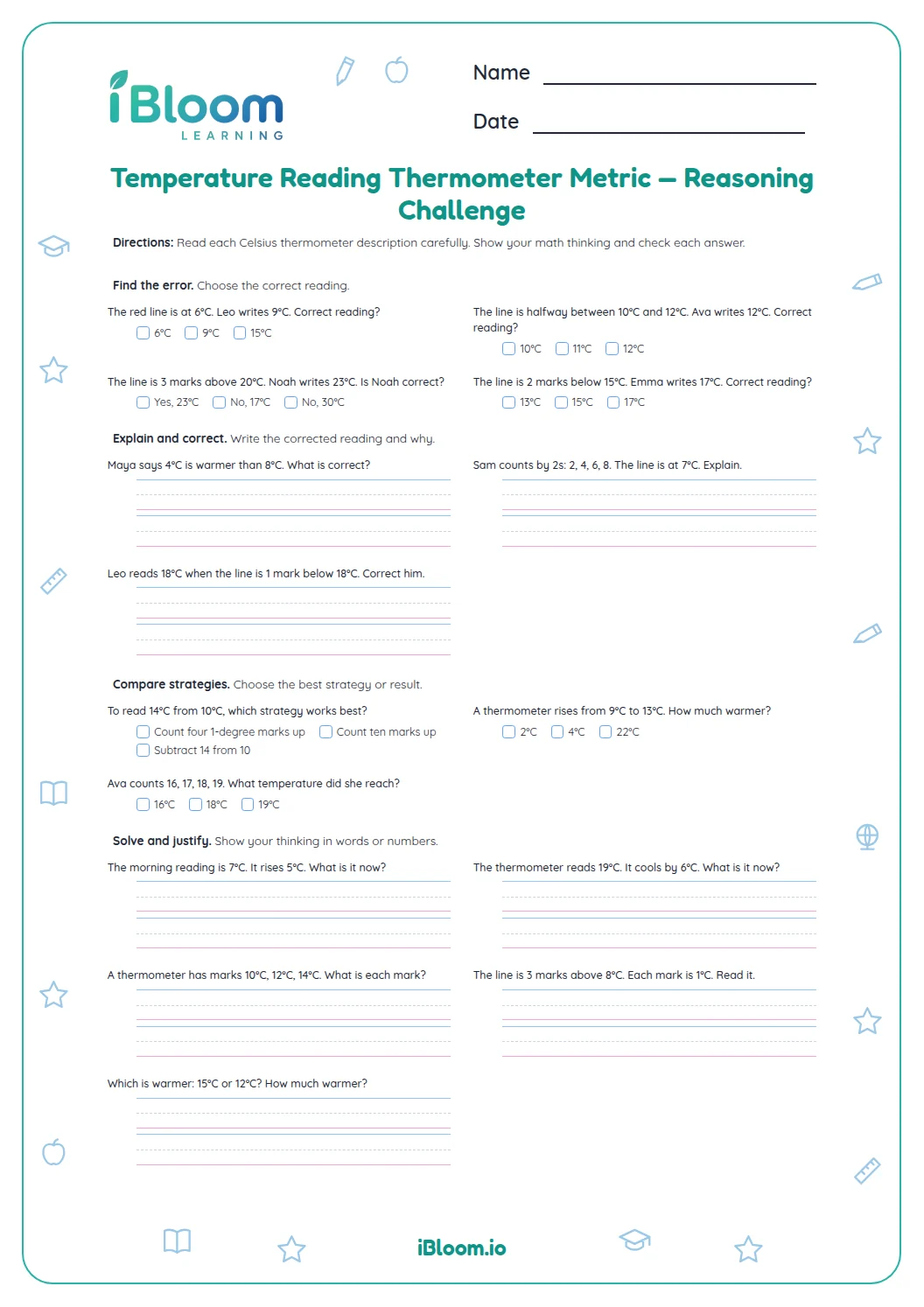
This Grade 2 printable practices reading Celsius values and solving simple temperature changes. Students read a labeled number line, find warmer and cooler temperatures, and compare two readings by finding the rise or drop. The separate answer key gives all 14 results.
Aligned to 2.OA.B.2
How do you read a Celsius value?
Use the number line’s labeled ticks to locate a point. In question 1, point A is on the 10 °C tick, so its value is 10 °C.
- 1Find point A on the number line.
- 2Read the labeled tick at 10.
- 3Point A is 10 °C.
How do you find a warmer or cooler temperature?
Add the change when the air warms and subtract it when the air cools. For example, 16 °C cooled by 5 °C becomes 11 °C.
How do you find a rise or drop?
Compare the starting and ending readings and count the degrees between them. From 8 °C to 14 °C is a rise of 6 °C.
What is included on these pages?
There are 14 questions: one number-line reading, one temperature situation, and 12 change or rise-and-drop problems. The answer key lists each Celsius result.
How to use this worksheet
- 1Read each number line from left to right.
- 2Write the value at the labeled point for Part A.
- 3For warming, add the change to the starting temperature.
- 4For cooling, subtract the change from the starting temperature.
- 5For two readings, find their difference and state warmer or cooler.
Common mistakes and quick fixes
The mistake
Adding when the story says the temperature cools.
The fix
Look for “cools,” “falls,” or “cooler” and subtract.
The mistake
Reporting the ending temperature when asked for the change.
The fix
Subtract the readings to find the size of the change.
The mistake
Dropping the Celsius unit.
The fix
Write °C after each temperature or temperature change.
Common Core alignment
Students practice adding and subtracting whole numbers within 20 in temperature situations.
Add and subtract within 20 to find new temperatures and differences.
On this sheet: Temperature changes and comparisons use addition and subtraction within 20.
Show the official wordingHide the official wording
Fluently add and subtract within 20 using mental strategies. By end of Grade 2, know from memory all sums of two one-digit numbers.
What to practice next
Make more practice
Questions parents and teachers ask
How do students read the number lines?
Each line has equal steps of 5 °C from 0 °C to 20 °C. Find the lettered point and read the number at the same position; point A, for example, is at 10 °C. One question uses this scale-reading model.
How do you find a new temperature after warming?
Add the amount of warming to the starting value. Question 3 begins at 4 °C and warms by 7 °C, so 4 + 7 = 11 °C. The cooling questions use subtraction to find the new value. The direction word distinguishes the two operations.
How do you find a temperature change?
Subtract the lower reading from the higher reading to find the size of the change. If a temperature rises from 7 °C to 14 °C, it rises 7 °C. Use warmer or cooler to describe its direction, then include °C in the answer.
Does the answer key come with the printable?
Yes. The separate answer key includes the number-line reading and answers to every warming, cooling, and comparison question. For example, the drop from 22 °C to 17 °C is 5 °C. Students can check the arithmetic and Celsius unit. All 14 responses are listed.
What math does this worksheet practice?
Students add or subtract whole numbers within 20 while working with Celsius values. The opening number-line section also gives practice matching a labeled point to its value on an evenly spaced scale. The other questions use stated temperatures and changes.