





About this worksheet
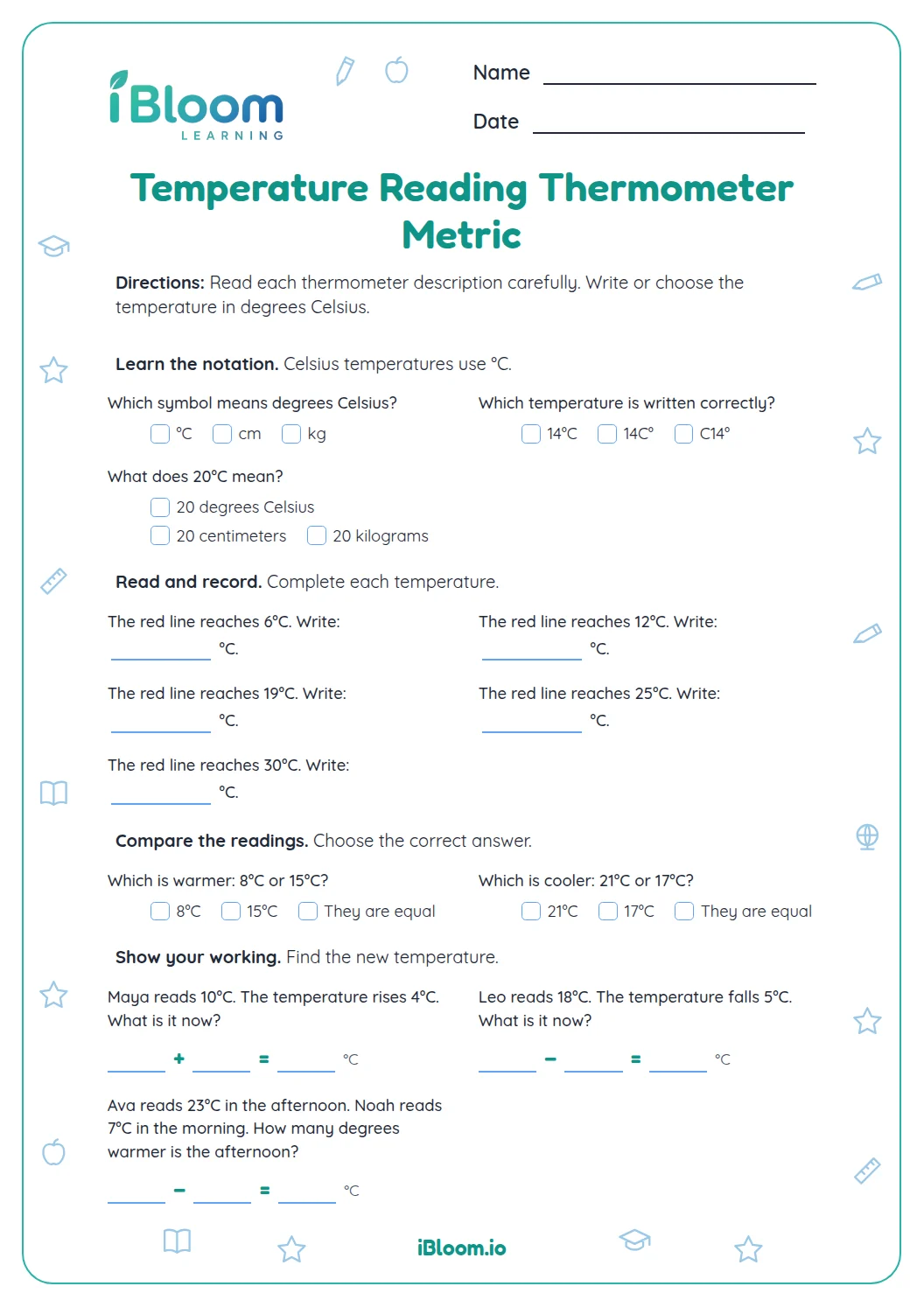
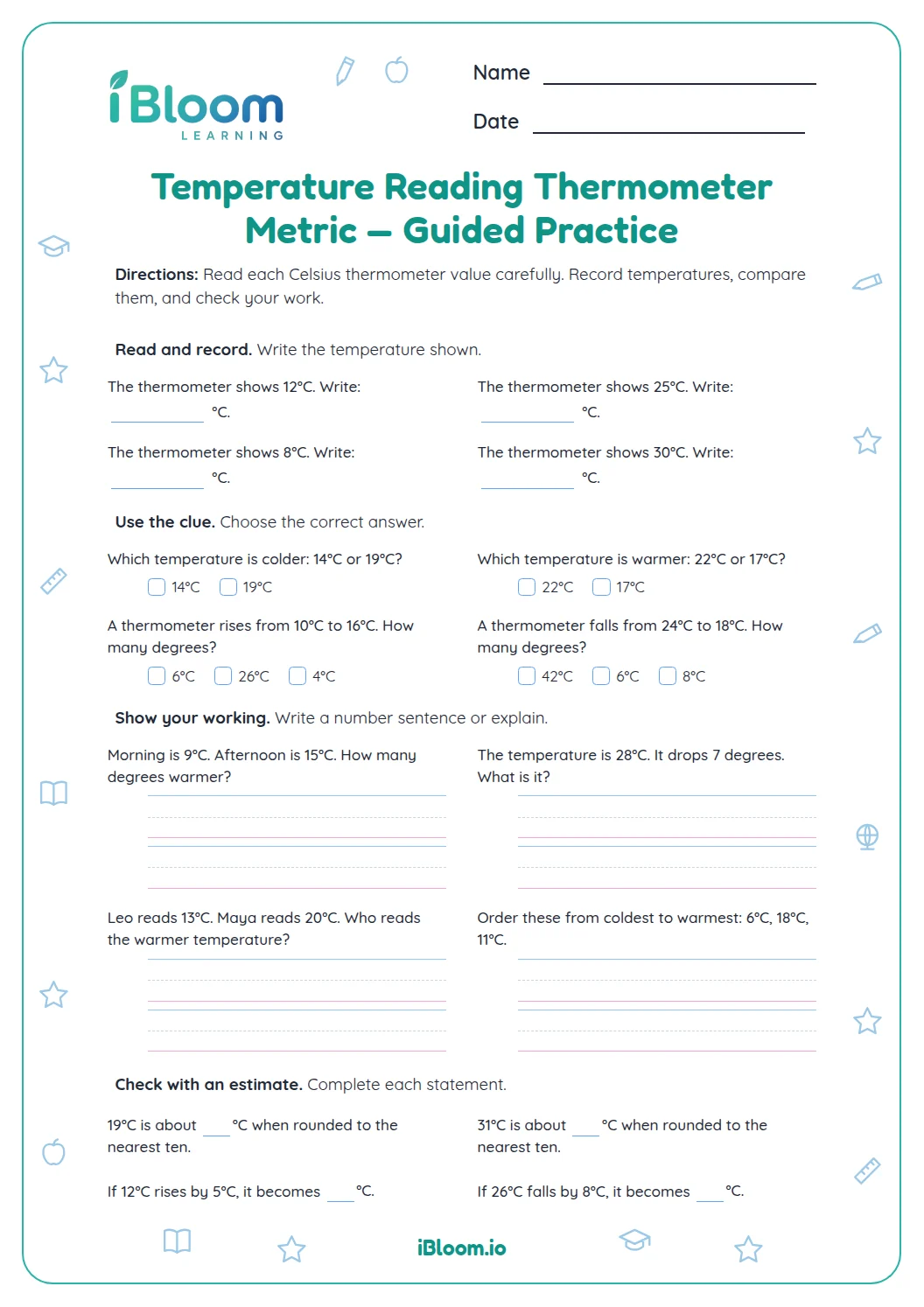
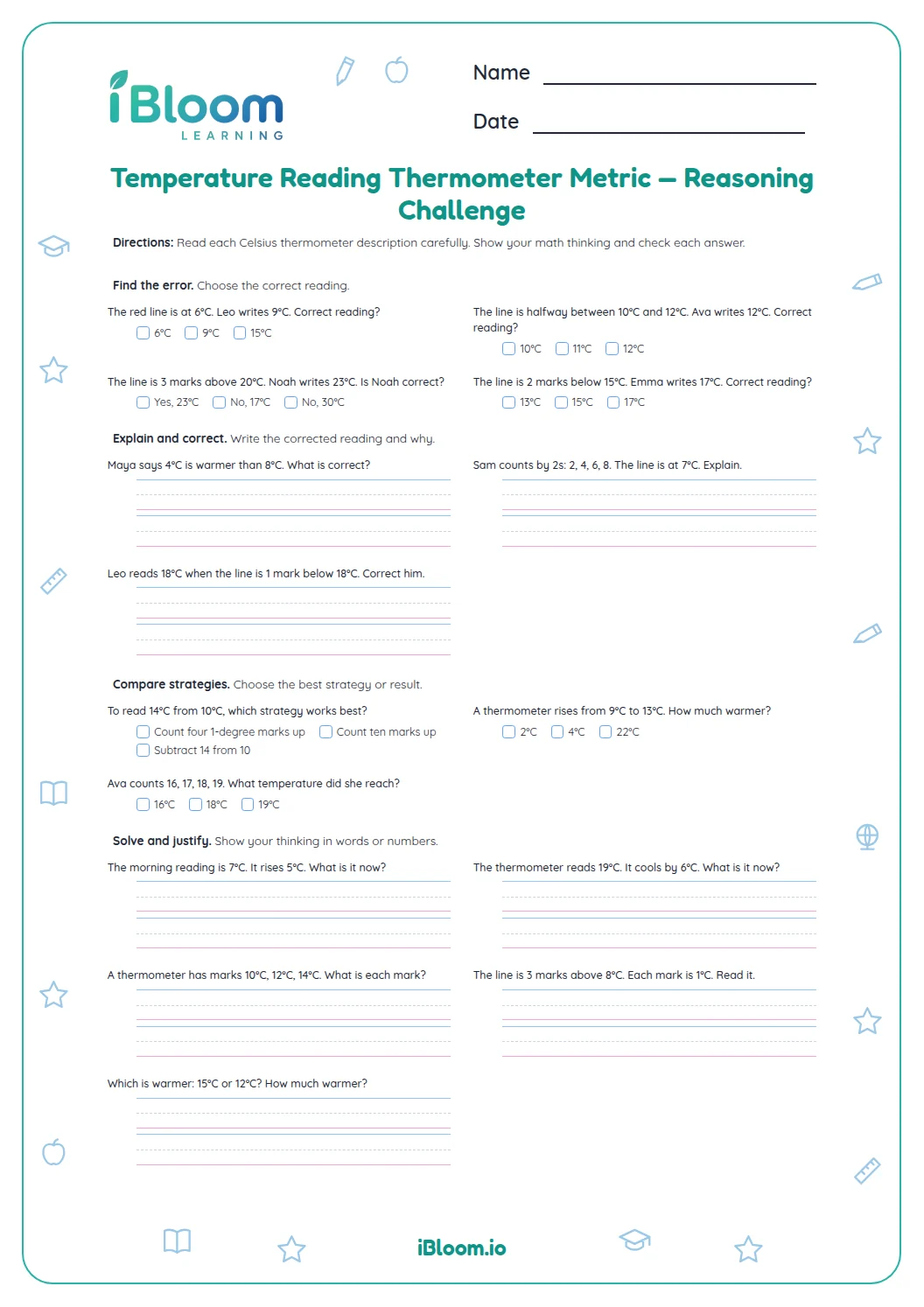
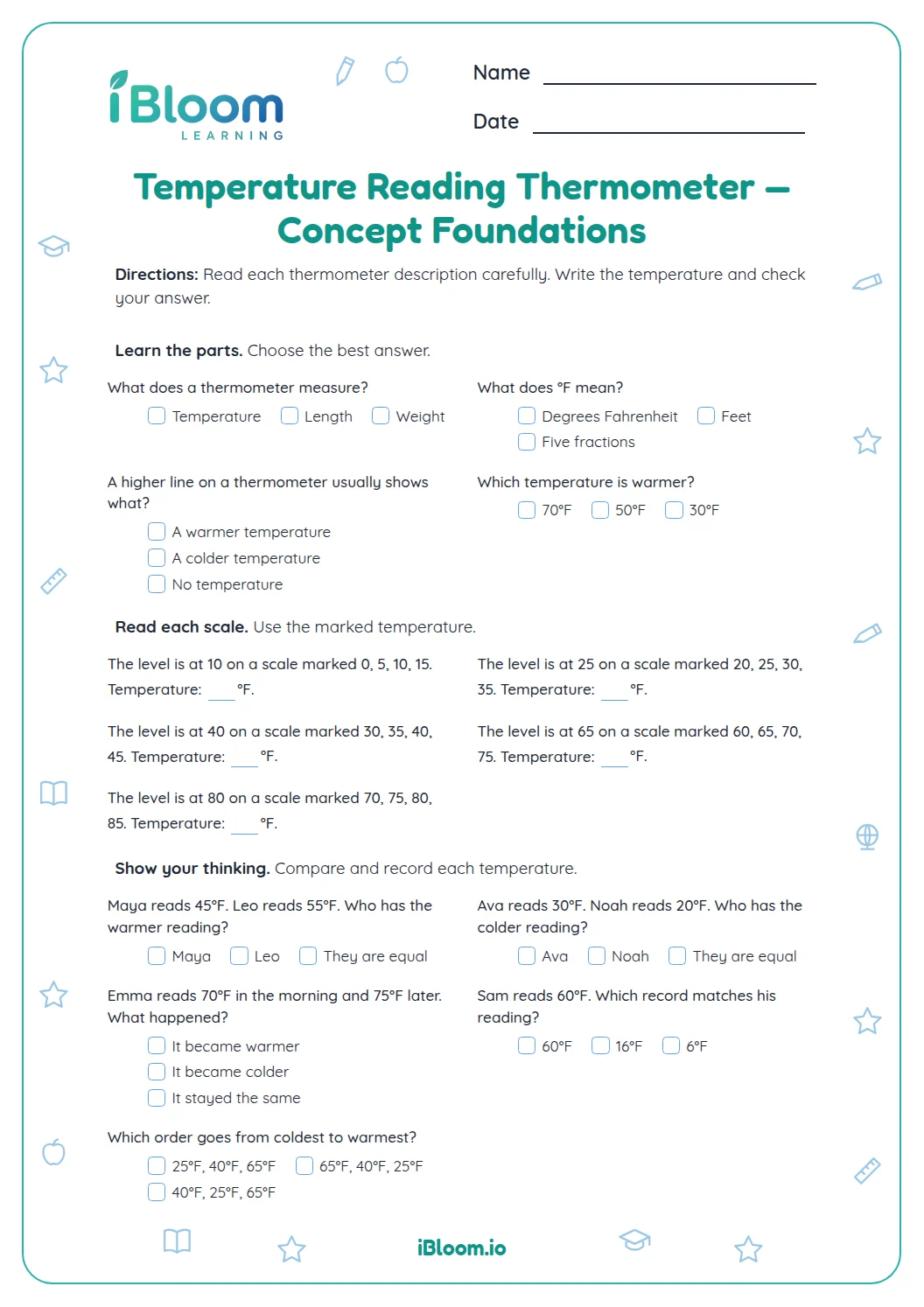
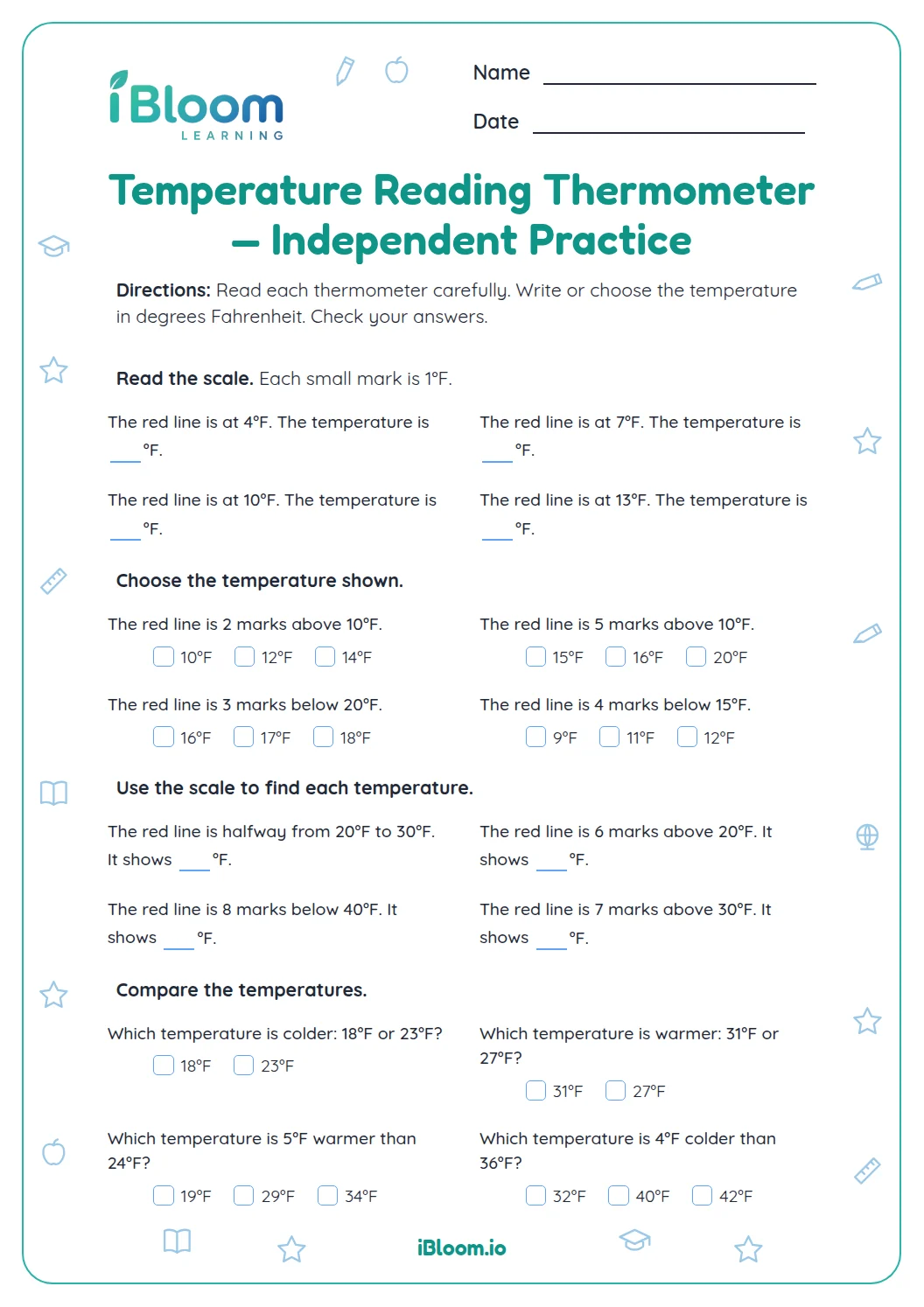
This Grade 2 printable practices reading marked temperatures in degrees Celsius and identifying the warmer of two readings. Twelve items ask children to read a value from a labeled scale, followed by six comparisons. The original thermometer artwork is replaced with Celsius number-line scales that preserve the scale-reading and comparison task, and a separate answer key is included.
What does this reading Celsius temperatures worksheet practice?
This five-page printable has twelve marked Celsius scales to read and six pairs of temperatures to compare. Each item uses a labeled number line with a point marking the reading.
The answer key lists the Celsius values or the warmer point for each question.
How can a child work through reading Celsius temperatures?
Read the labeled ticks, locate the marked point, and write its temperature with °C. For a pair, compare both values; the greater Celsius value is warmer.
- 1Point A is at 15 °C on the scale, so its temperature is 15 °C.
- 2Locate A on the labeled tick and write the value with the Celsius unit.
How can an adult help without giving the answer?
Ask the child to match each point to the nearest labeled tick before choosing. In a comparison, have them name both values and then decide which is greater.
How to use this worksheet
- 1Notice the Celsius unit in the direction.
- 2Find point A and read its value from the scale labels.
- 3Write the number with °C.
- 4In Part B, read both A and B before comparing.
- 5The point farther to the right on this increasing scale is warmer.
- 6Check the values and warmer choices with the answer key.
Temperature-reading mistakes and quick fixes
The mistake
Reading the scale label beside the point instead of the point’s location.
The fix
Trace a straight path from the point to the labeled tick mark.
The mistake
Choosing the cooler point as warmer because its number is lower.
The fix
On a Celsius scale, the greater temperature is warmer; compare the two values before choosing.
The mistake
Leaving the unit off the answer.
The fix
Write °C after each temperature so the metric unit is clear.
What to practice next
Make more practice
Further reading
Questions parents and teachers ask
What does °C mean?
The symbol °C means degrees Celsius, the metric unit used for temperature. Each scale-reading response should include the number and °C so the measurement and unit stay together. The printed direction also models the expected unit. Children should keep the unit with each numeric reading.
How do children read point A?
Find A on the scale and match its position to a labeled tick. For example, the point at 15 represents 15 °C. The twelve reading questions use marks placed directly at labeled values, so the child can trace from the point to its tick.
How can a child tell which point is warmer?
Compare both Celsius values; the greater value is warmer. If A is at 20 °C and B is at 15 °C, A is warmer. The six comparison items ask for the warmer labeled point, so read both marks before choosing.
Why are number lines used instead of thermometer pictures?
The page uses labeled Celsius number lines to practice reading scaled values and comparing temperatures. Marked points preserve the scale-reading task while using a drawing supported by the worksheet template. Children still read a visual scale and reason about warmer values.
Are negative temperatures included?
The marked temperatures on this page are above zero. Children can focus on matching each point to its labeled Celsius tick, then compare the values to decide which is warmer. They can explain that a point farther right has the greater temperature.
What can children practice after this page?
Try the linked thermometer-reading worksheet, then explore metric length or capacity. Children can keep practicing how to read a marked value and describe it with its unit. Ask them to name the measurement and unit before moving to a new scale.