




About this worksheet
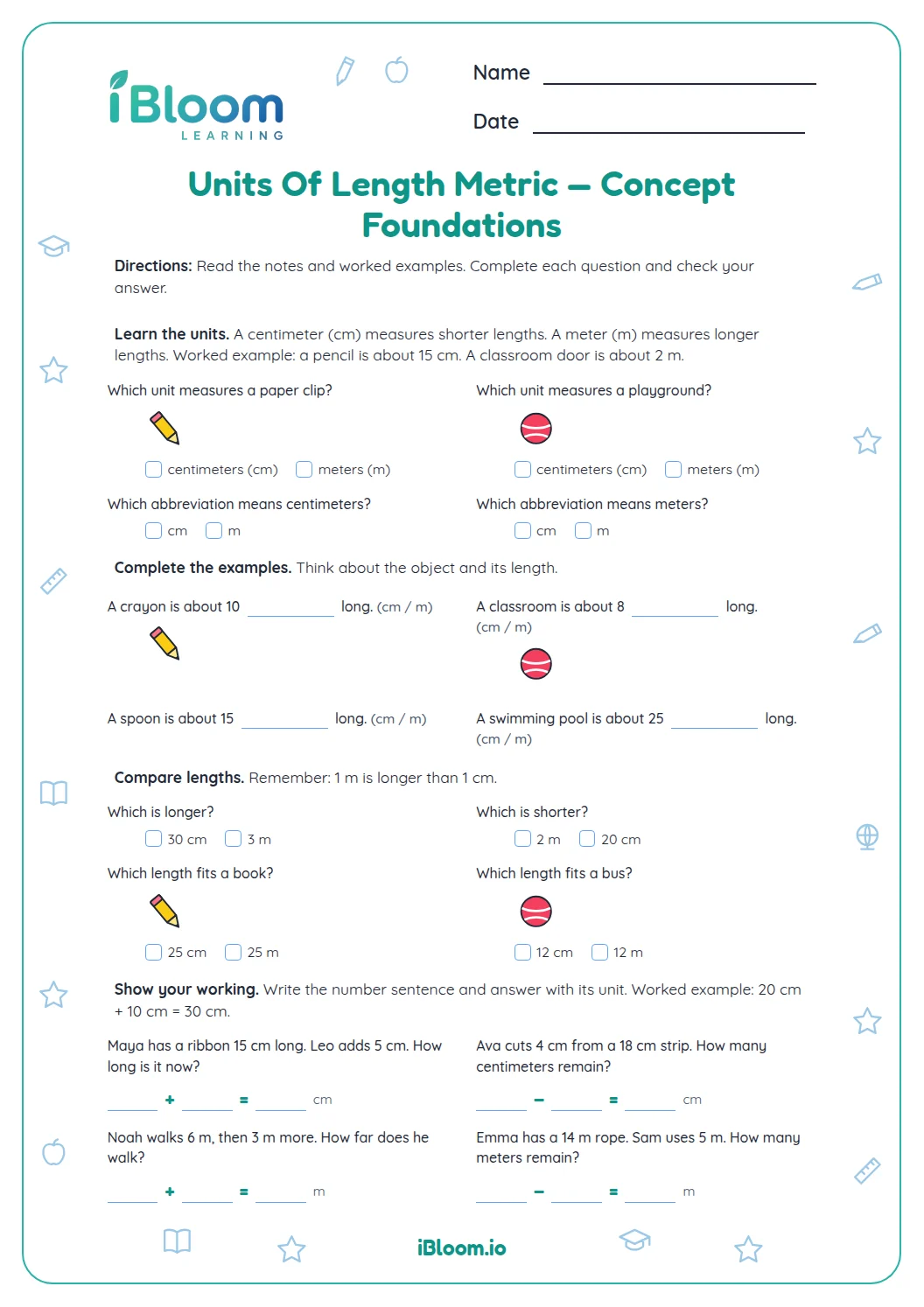
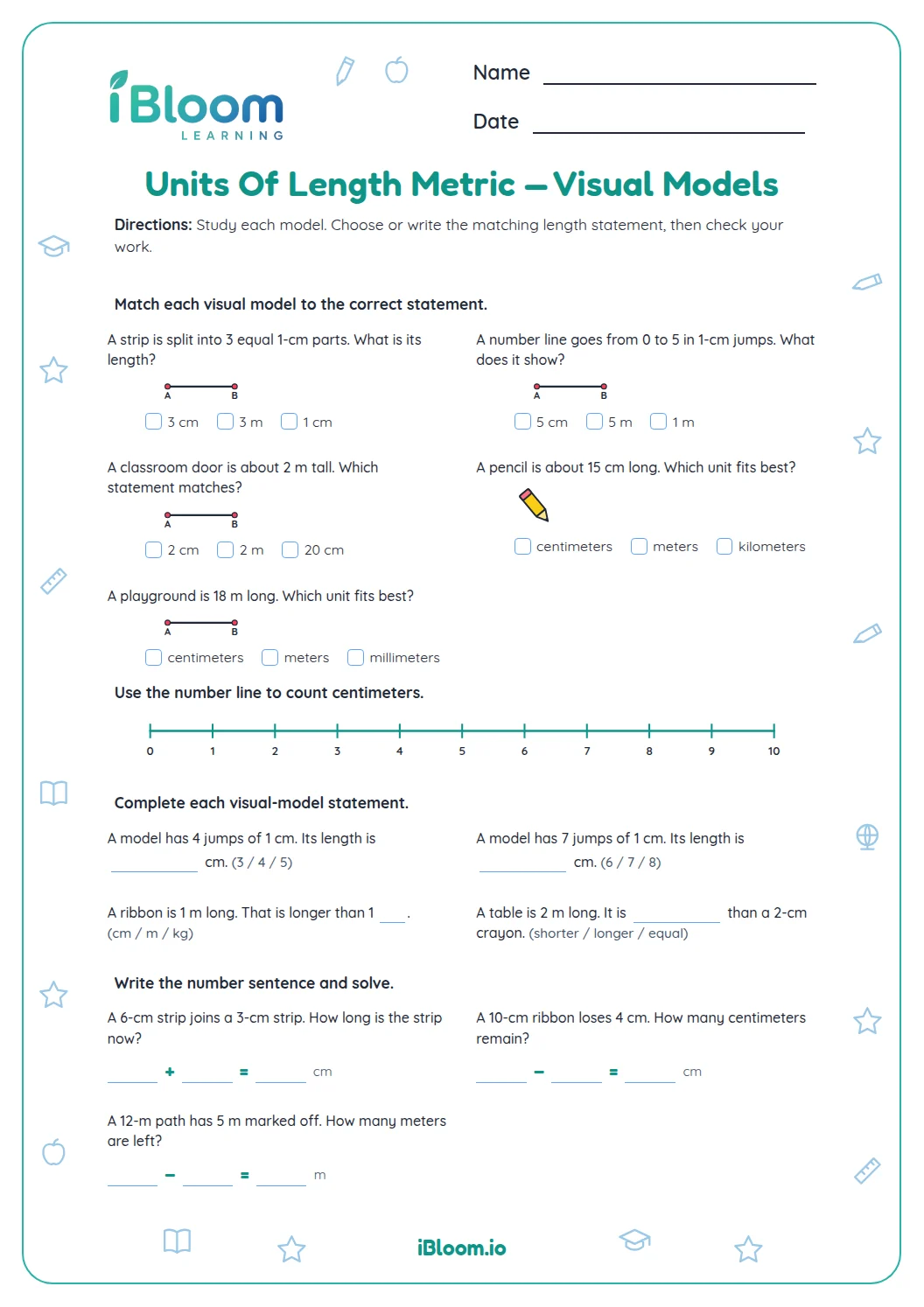
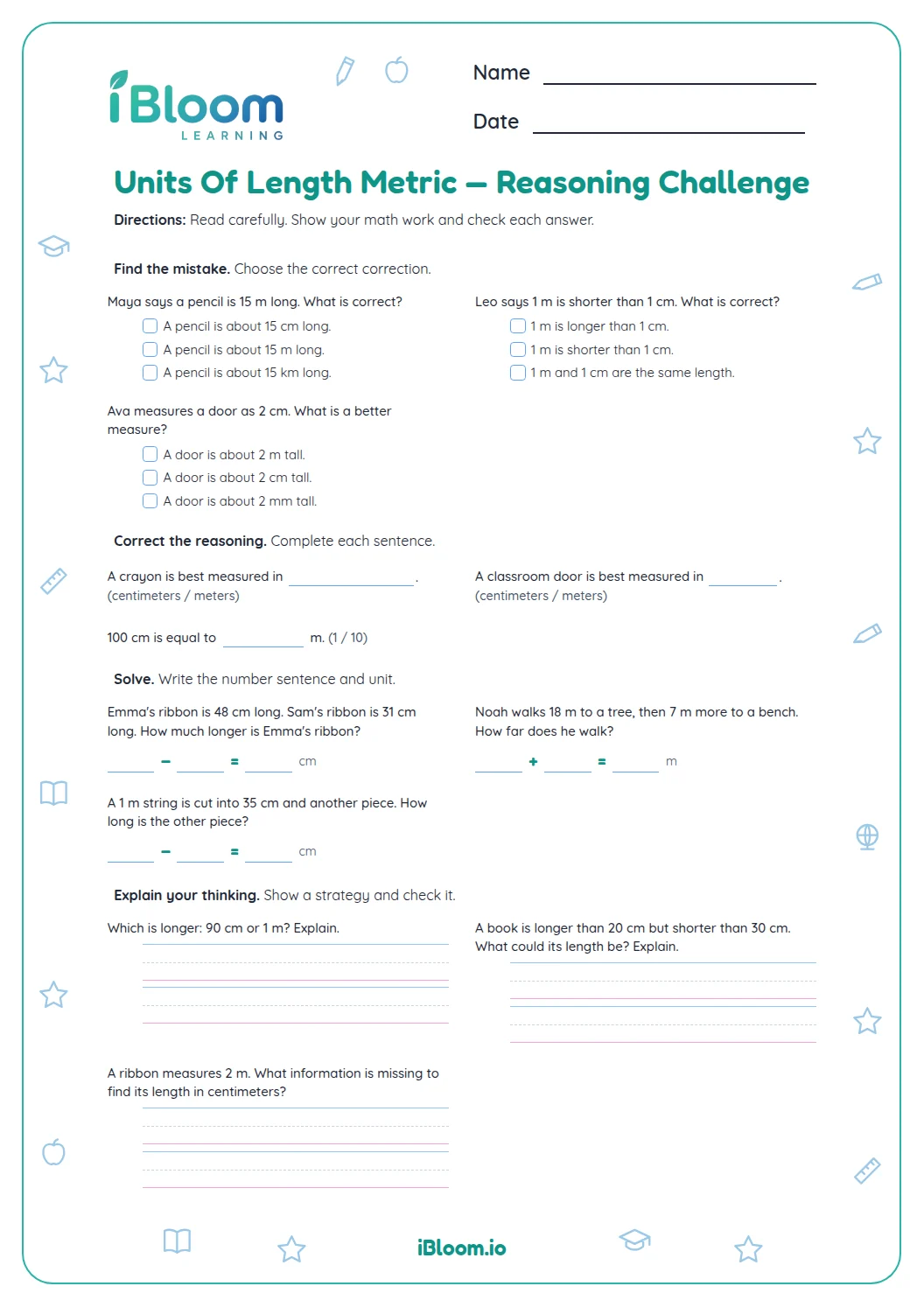
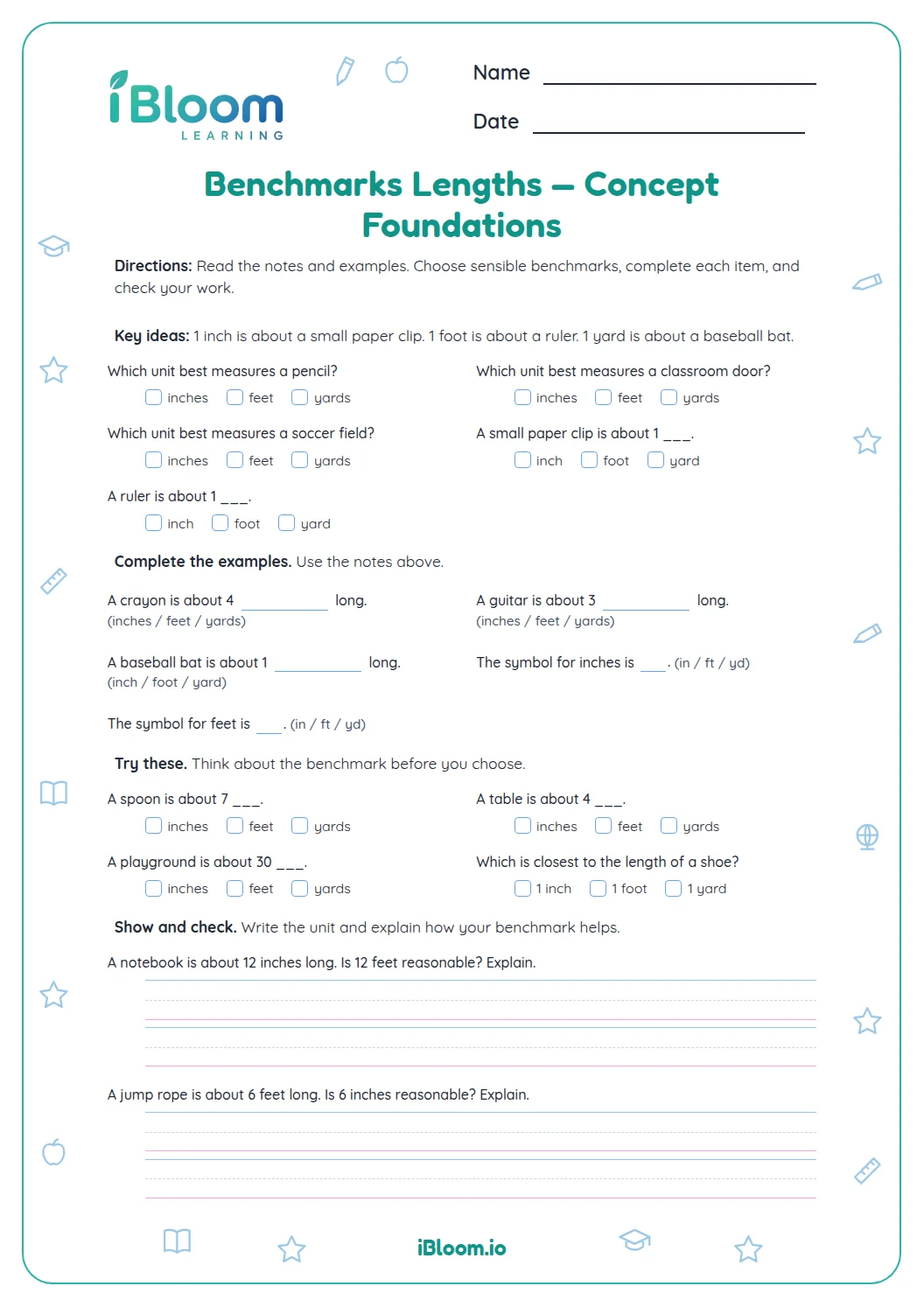
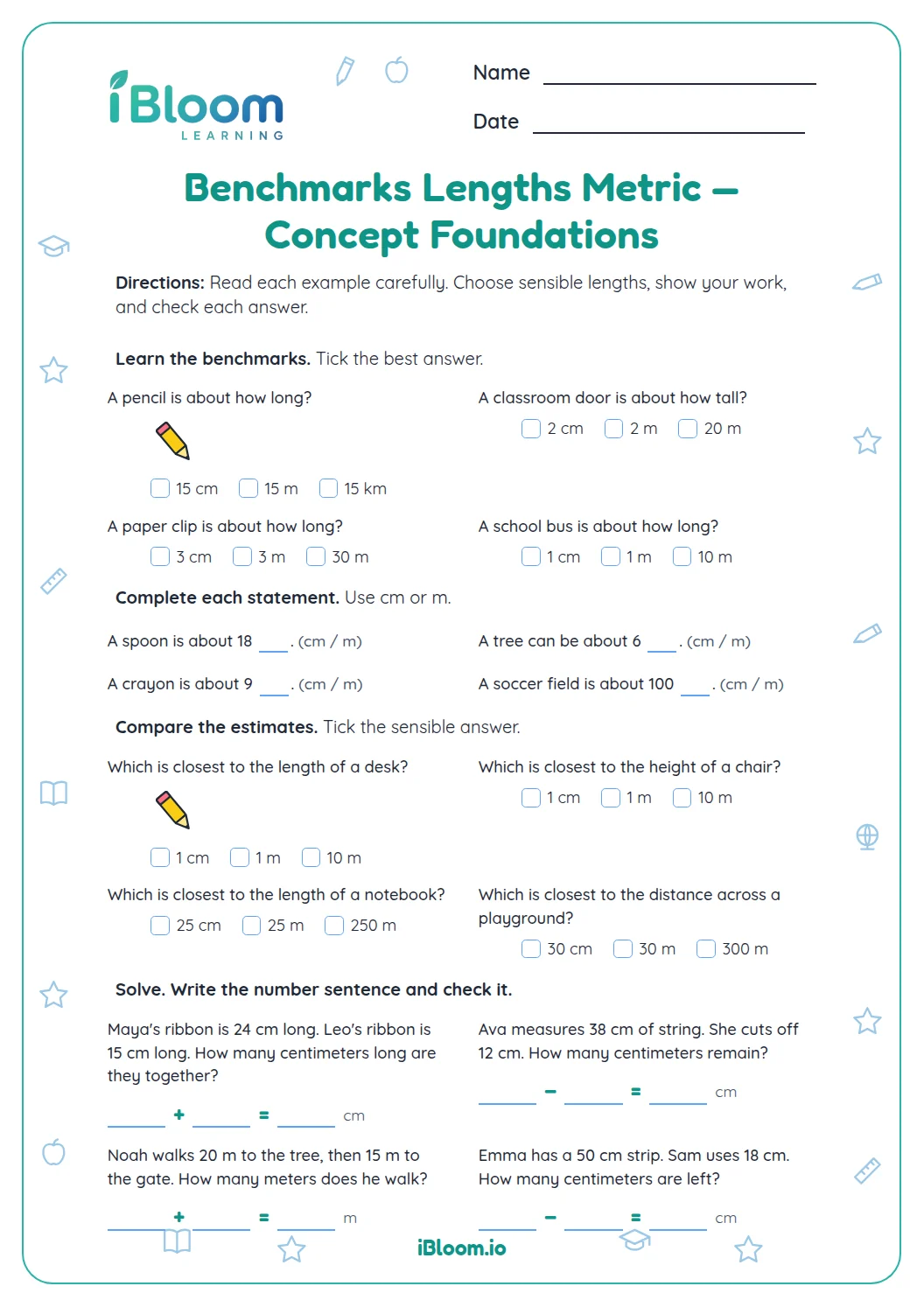
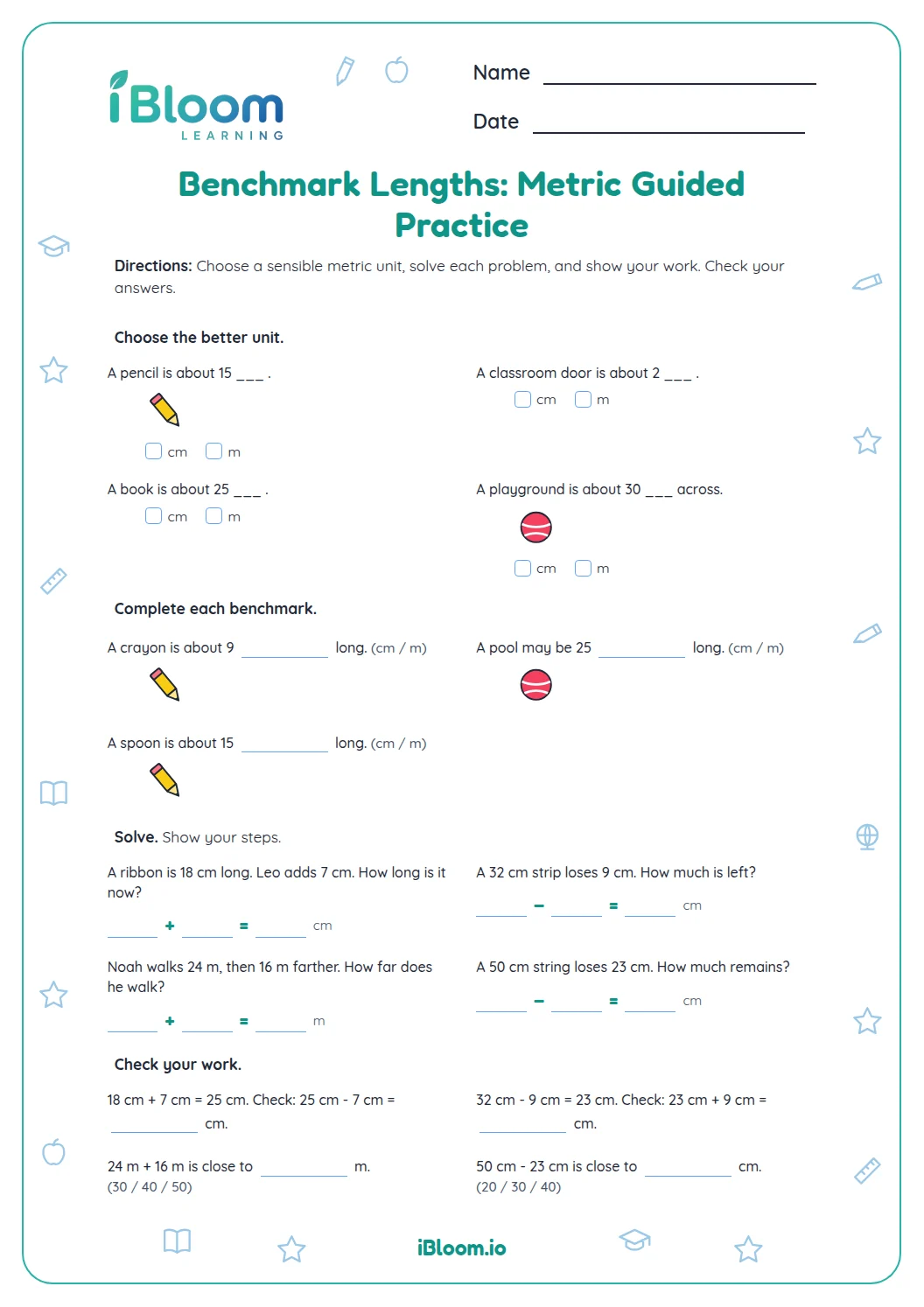
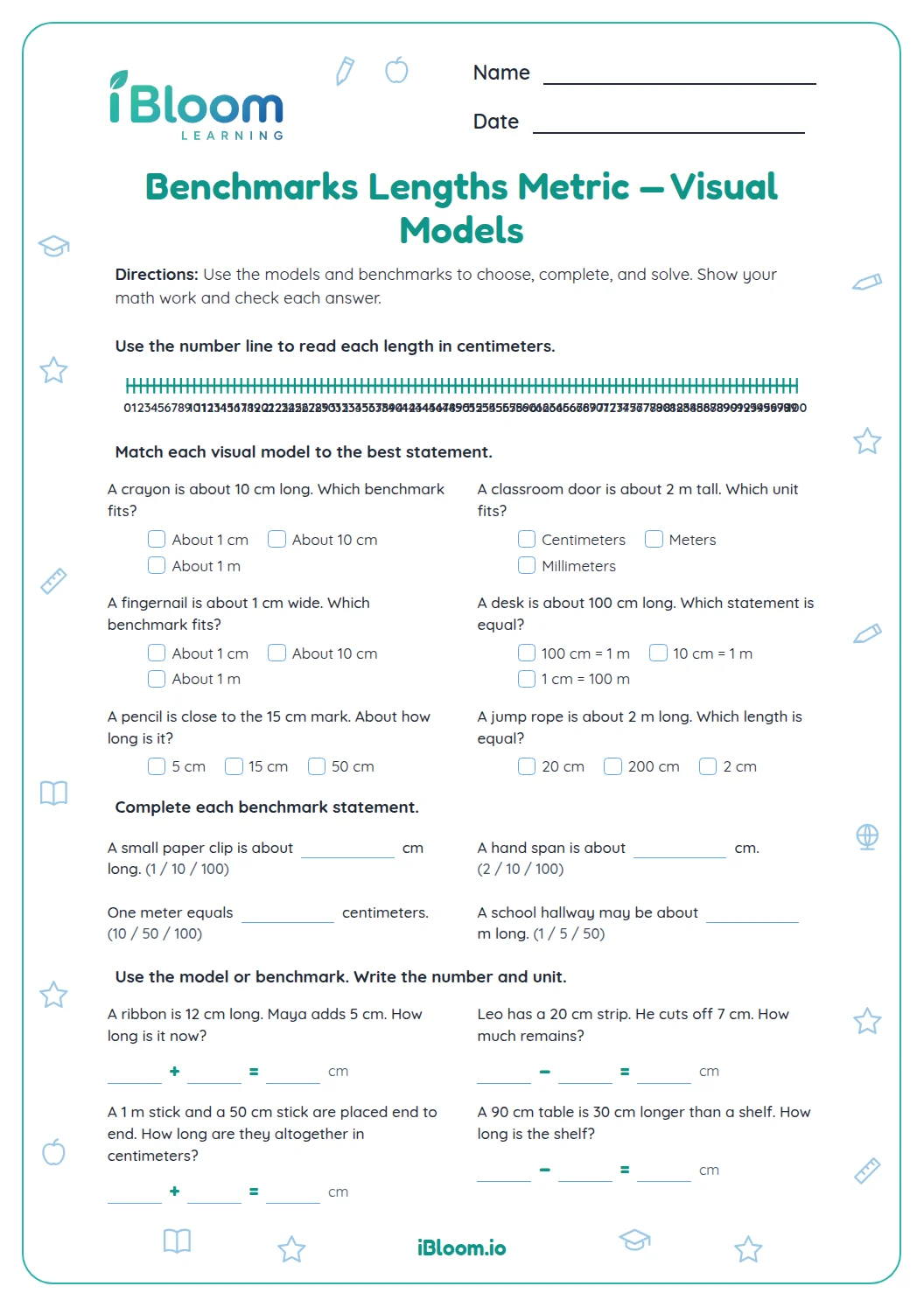
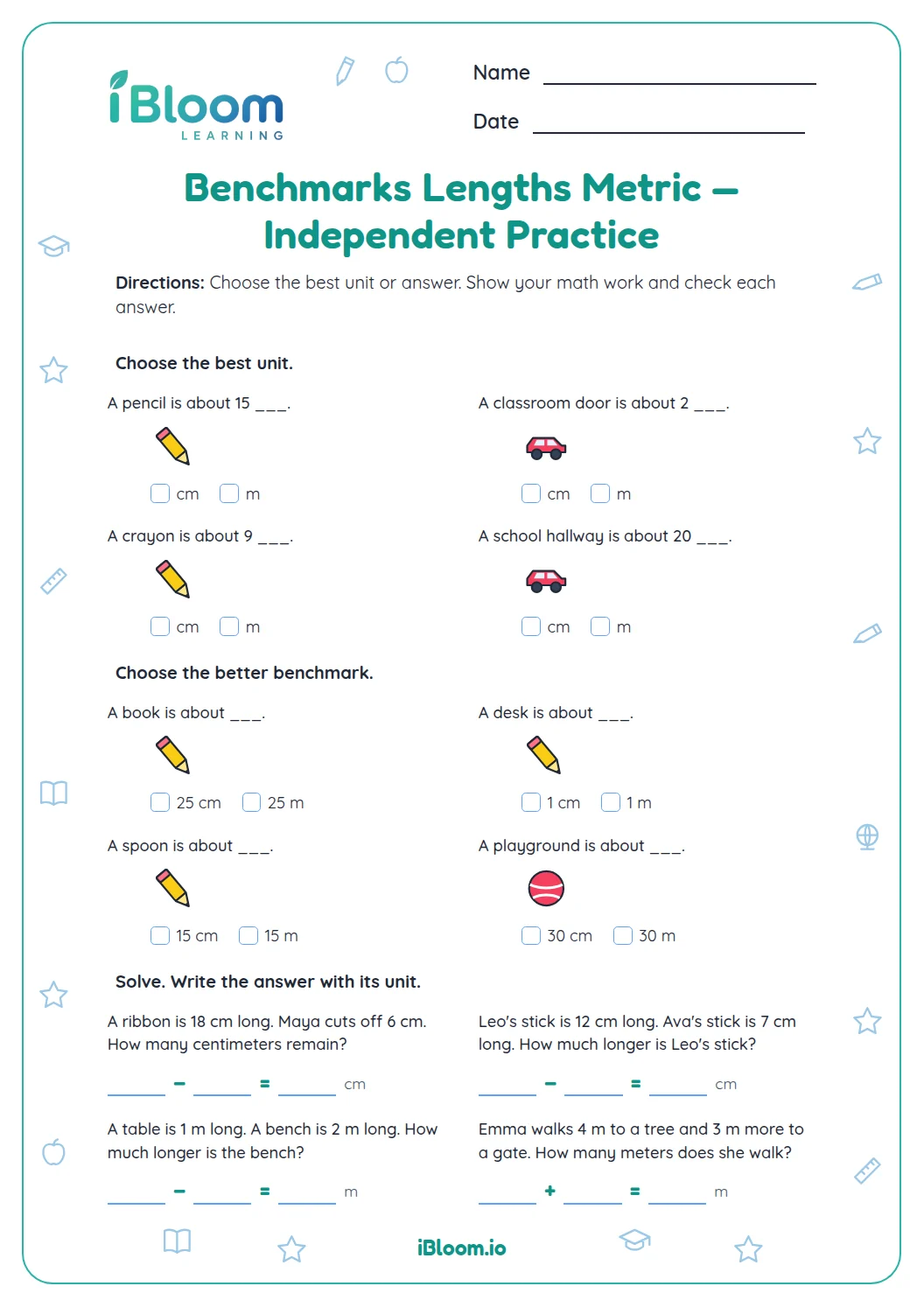
This free printable gives Grade 2 students 14 metric length questions. Four opening items ask students to estimate sensible lengths in centimeters or meters; the remaining items use supplied measurements in short addition, subtraction, comparison, and missing-part stories. All calculation values stay within 100, and each answer keeps its unit. A separate key lists every answer.
Aligned to 2.MD.B.5
How can students choose a sensible metric unit?
Part A estimates familiar objects using centimeters or meters. A pencil is about 18 cm long, while a doorway is about 2 m tall; the choices ask students to consider the scale.
How do students solve metric length stories?
Part B joins or removes lengths in matching units. For question 5, 24 cm + 15 cm = 39 cm, so Mia’s ribbons have a total length of 39 cm.
How can students find a difference or missing part?
Part C subtracts to compare lengths or find an unknown part. Two sticks total 60 cm, and one is 25 cm, so the other measures 35 cm.
How to work through the page
- 1Estimate the object before looking at the choices.
- 2Use centimeters for shorter objects and meters for longer distances or objects.
- 3For each story, identify the starting length and what changes.
- 4Add joined parts or subtract a removed part or difference.
- 5Keep the original unit in the answer.
Common mistakes and quick fixes
The mistake
Choosing 10 cm for a school bus.
The fix
Picture the object’s real scale; a bus is measured in meters.
The mistake
Adding when the problem asks what remains.
The fix
A cut or walked portion is removed from the starting length.
The mistake
Dropping the unit from the answer.
The fix
Write cm or m to match the quantities in the story.
Common Core alignment
This practice connects metric length estimates and same-unit stories to the listed Grade-level standard.
Solve same-unit length word problems with addition and subtraction within 100.
On this sheet:
Show the official wordingHide the official wording
Use addition and subtraction within 100 to solve word problems involving lengths that are given in the same units, e.g., by using drawings (such as drawings of rulers) and equations with a symbol for the unknown number to represent the problem.
What to practice next
Make more practice
Further reading
Questions parents and teachers ask
How many questions are on this metric worksheet?
There are 14 questions in three compact parts. Students estimate whether familiar objects are measured in centimeters or meters, then solve addition, subtraction, comparison, and missing part stories. The answer key gives a matching metric unit with each length answer.
Do students measure objects themselves?
No. The worksheet supplies all measurements used in the calculations. Students estimate the scale of familiar objects in the first part, then use stated centimeter or meter values in the stories. No ruler or picture is needed to find an answer.
What kinds of calculations appear?
The stories ask students to join lengths, subtract a cut or walked portion, compare two lengths, or find a missing part of a total. For example, two cords measuring 26 cm and 18 cm join to make 44 cm. Each story keeps one unit.
Why do the stories use matching units?
Adding or subtracting measurements directly works when both lengths use the same unit. This worksheet gives each story in centimeters or meters, so students can calculate with the numbers as stated and include that unit in the answer.
What is the difference between centimeters and meters here?
Centimeters suit smaller lengths such as a pencil or eraser, while meters suit larger objects such as a doorway or school bus. The estimate choices ask students to notice scale before they begin calculating with a stated measurement.