








About this worksheet
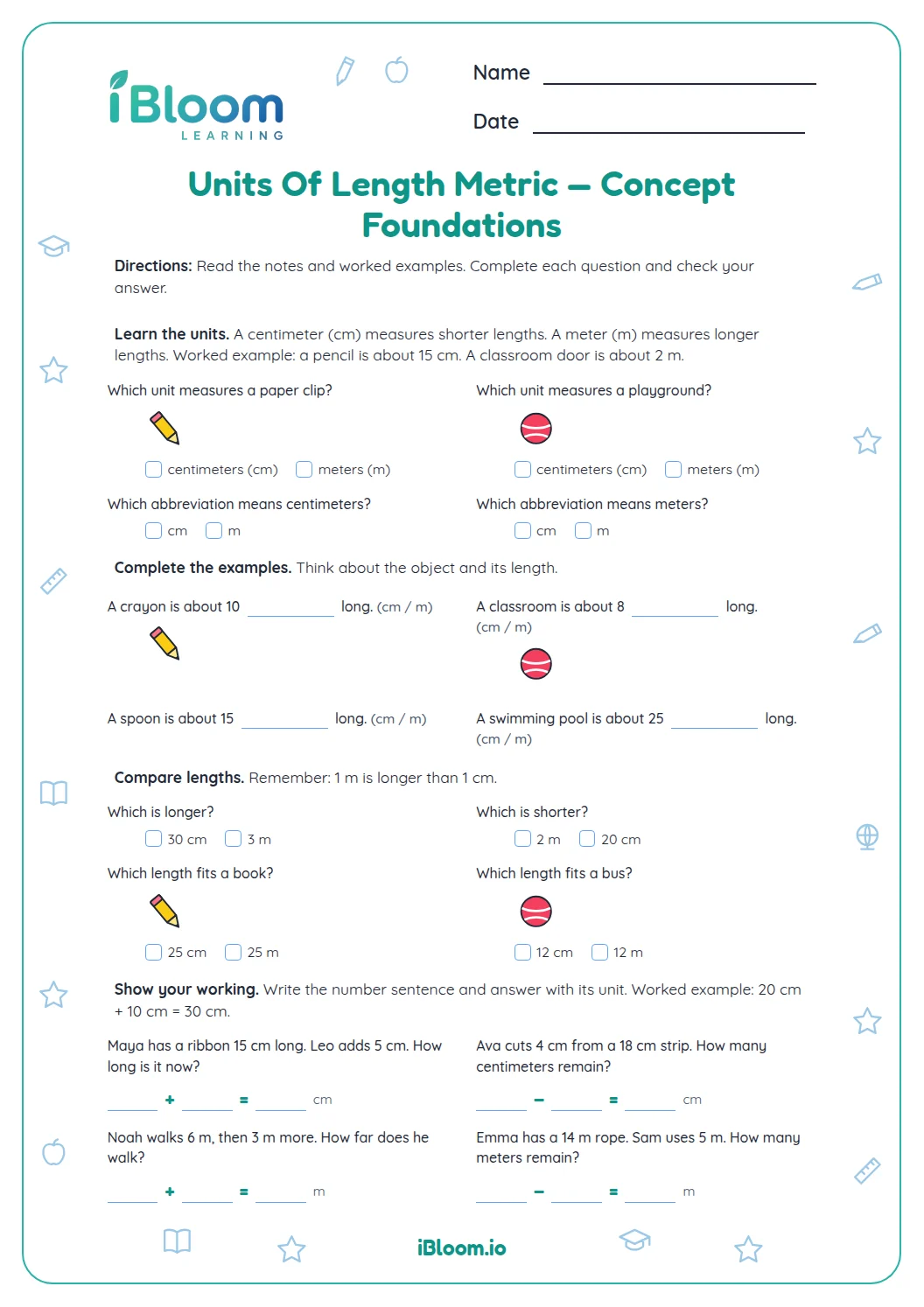
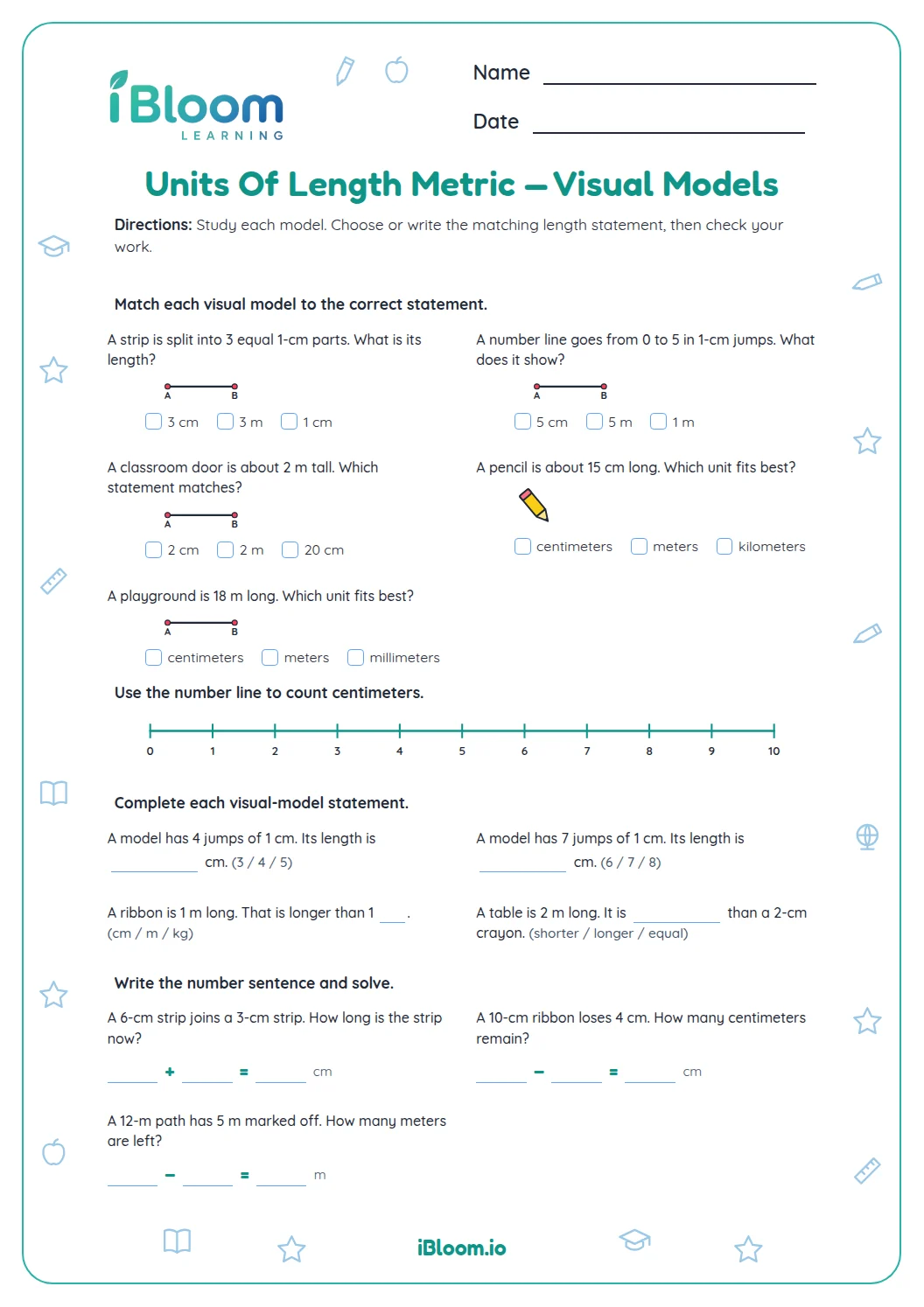
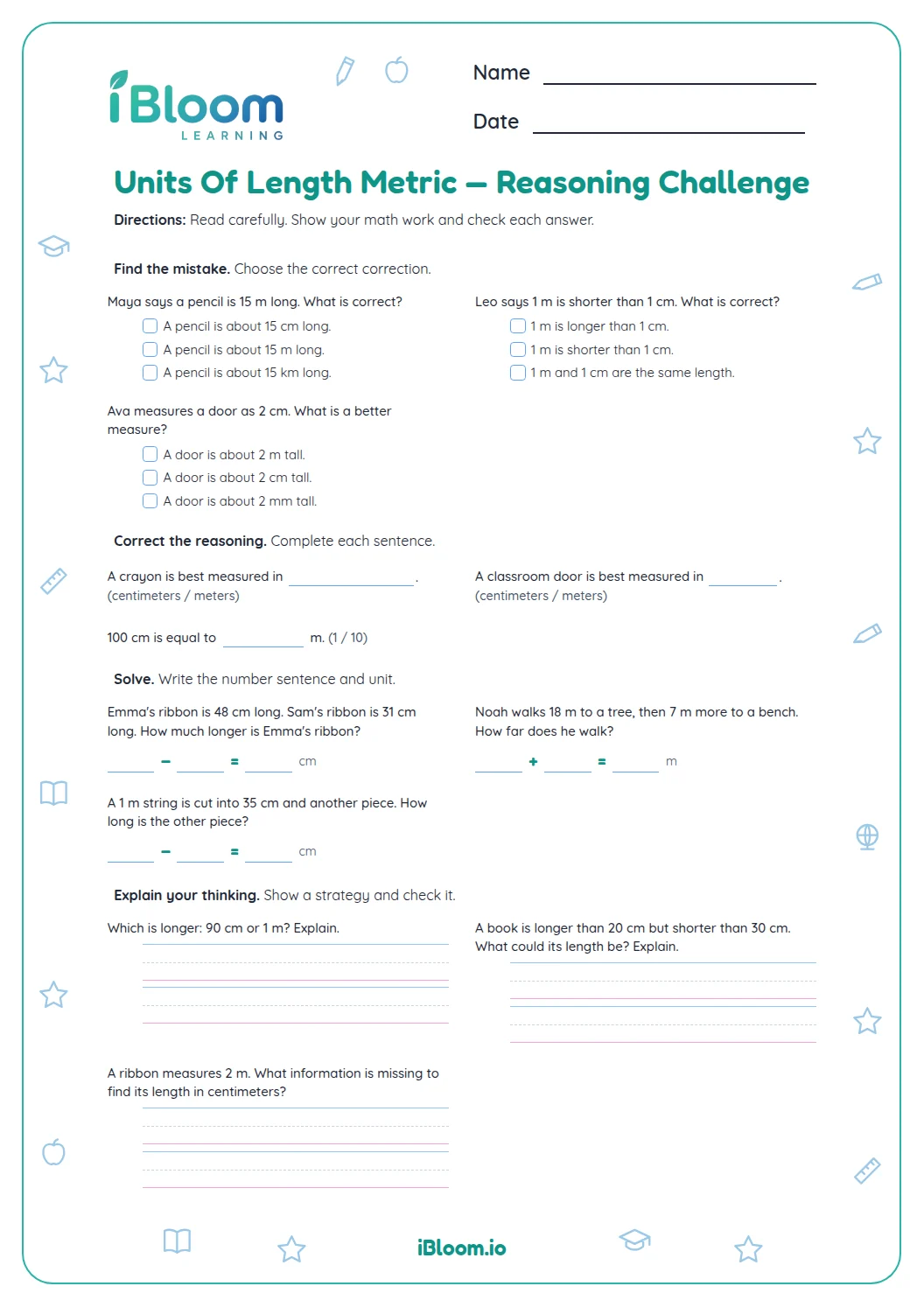
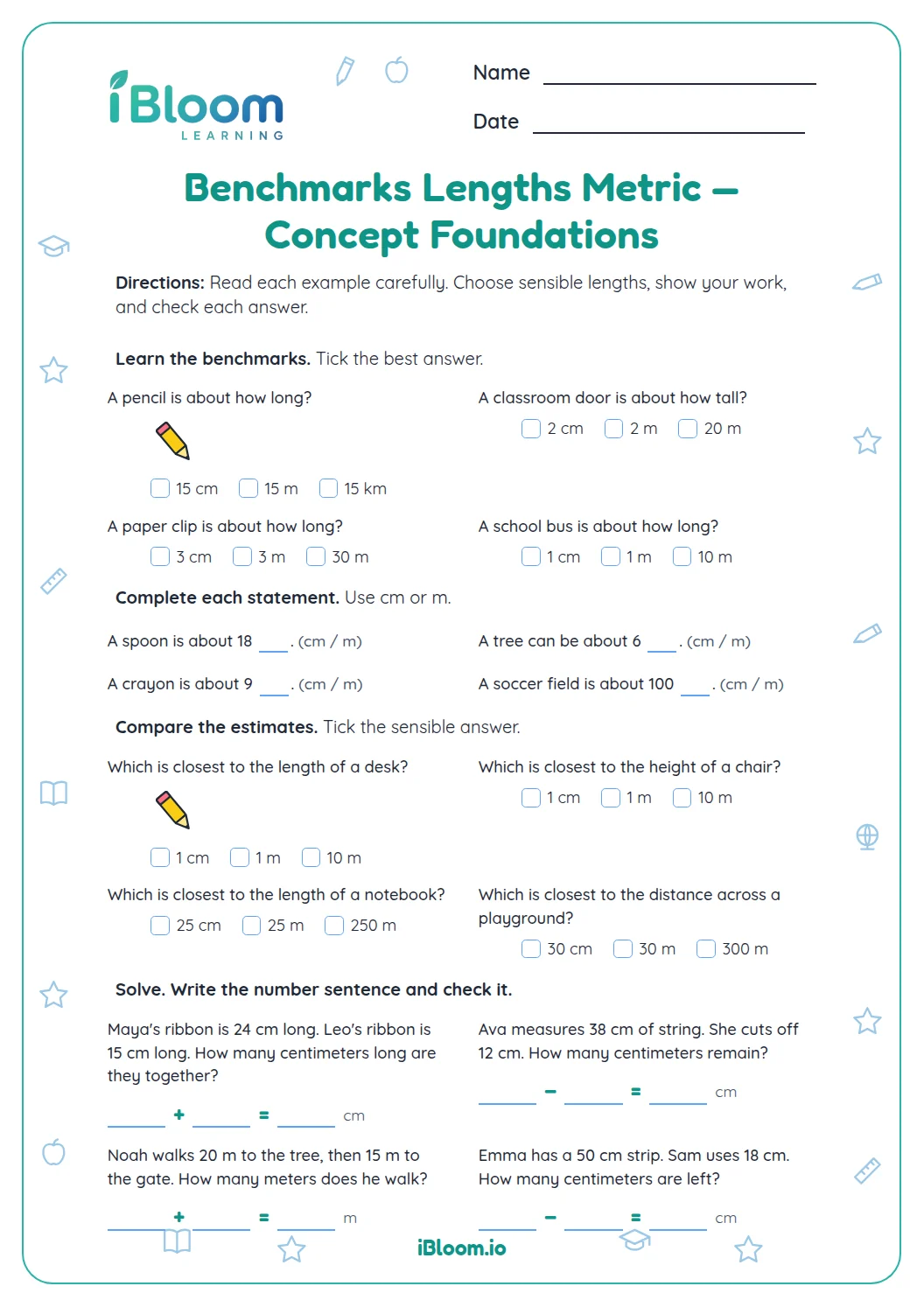
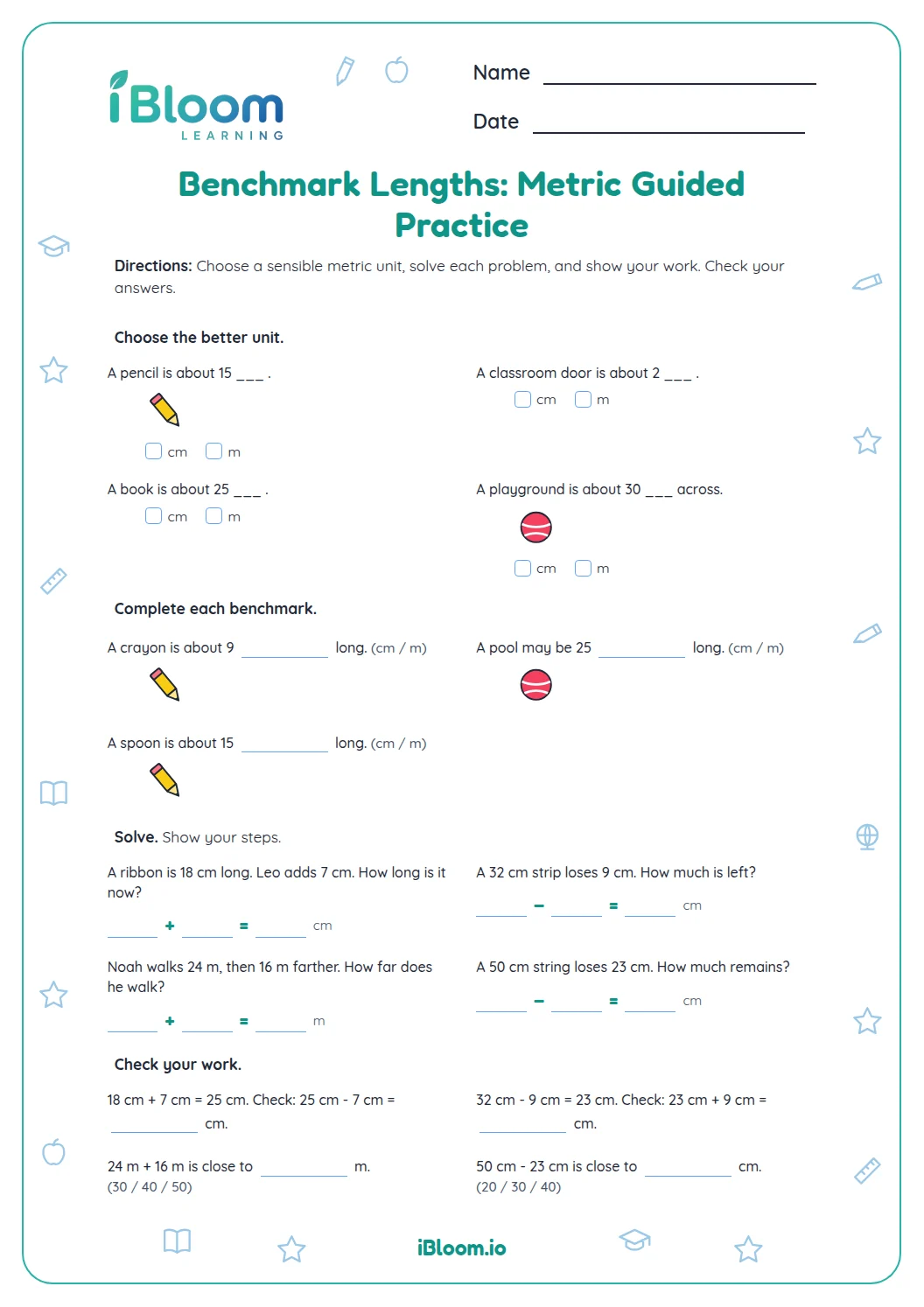
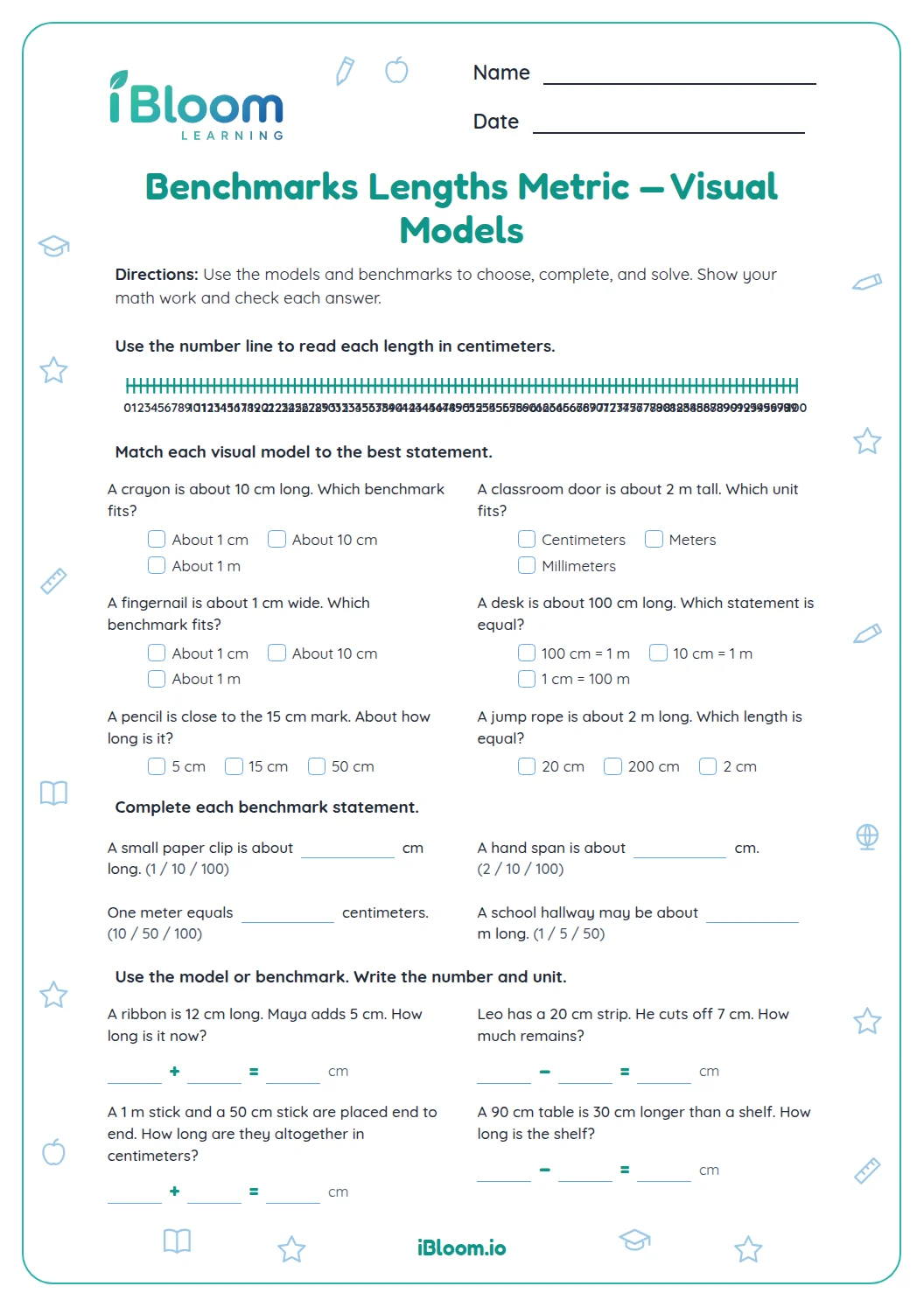
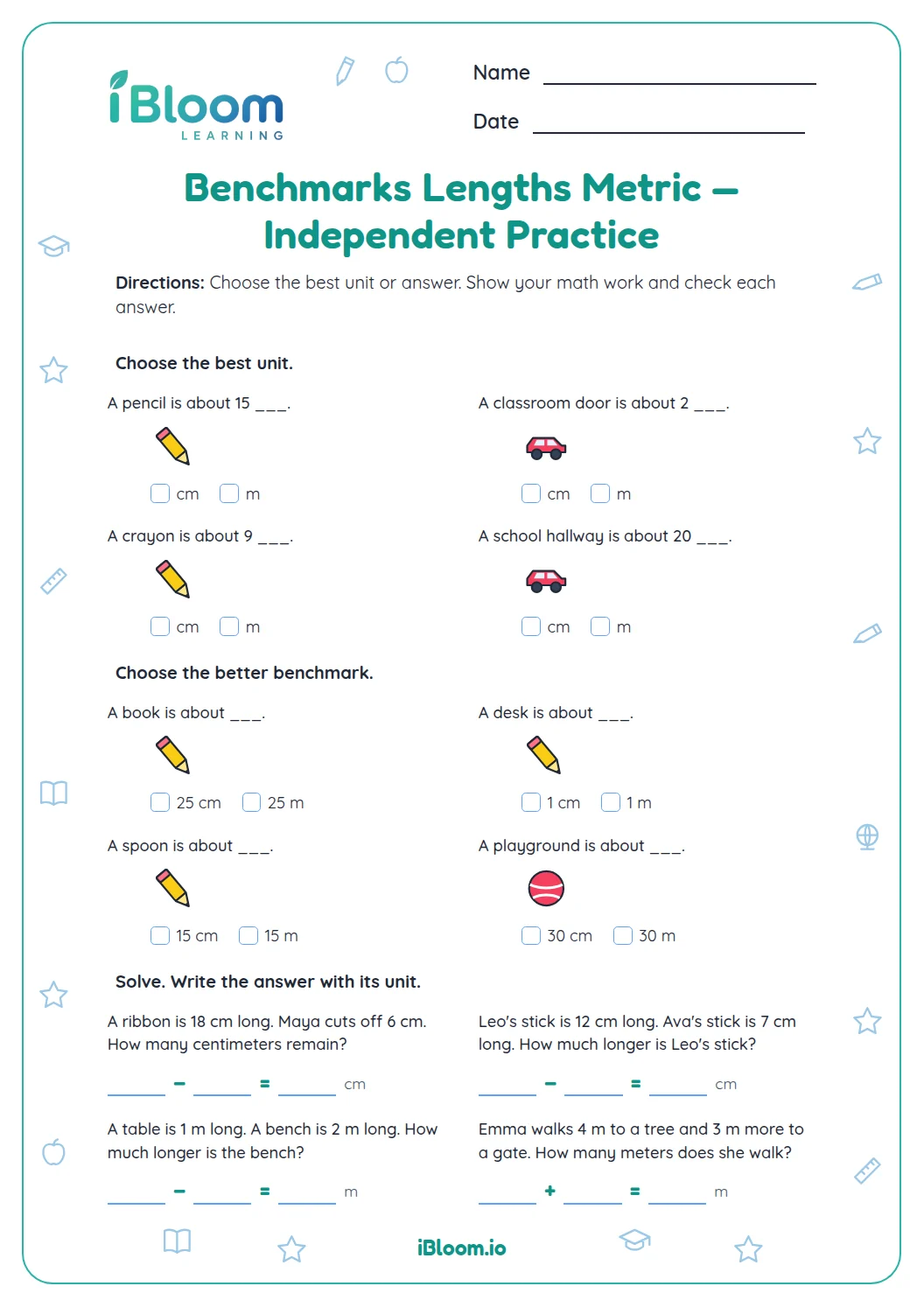
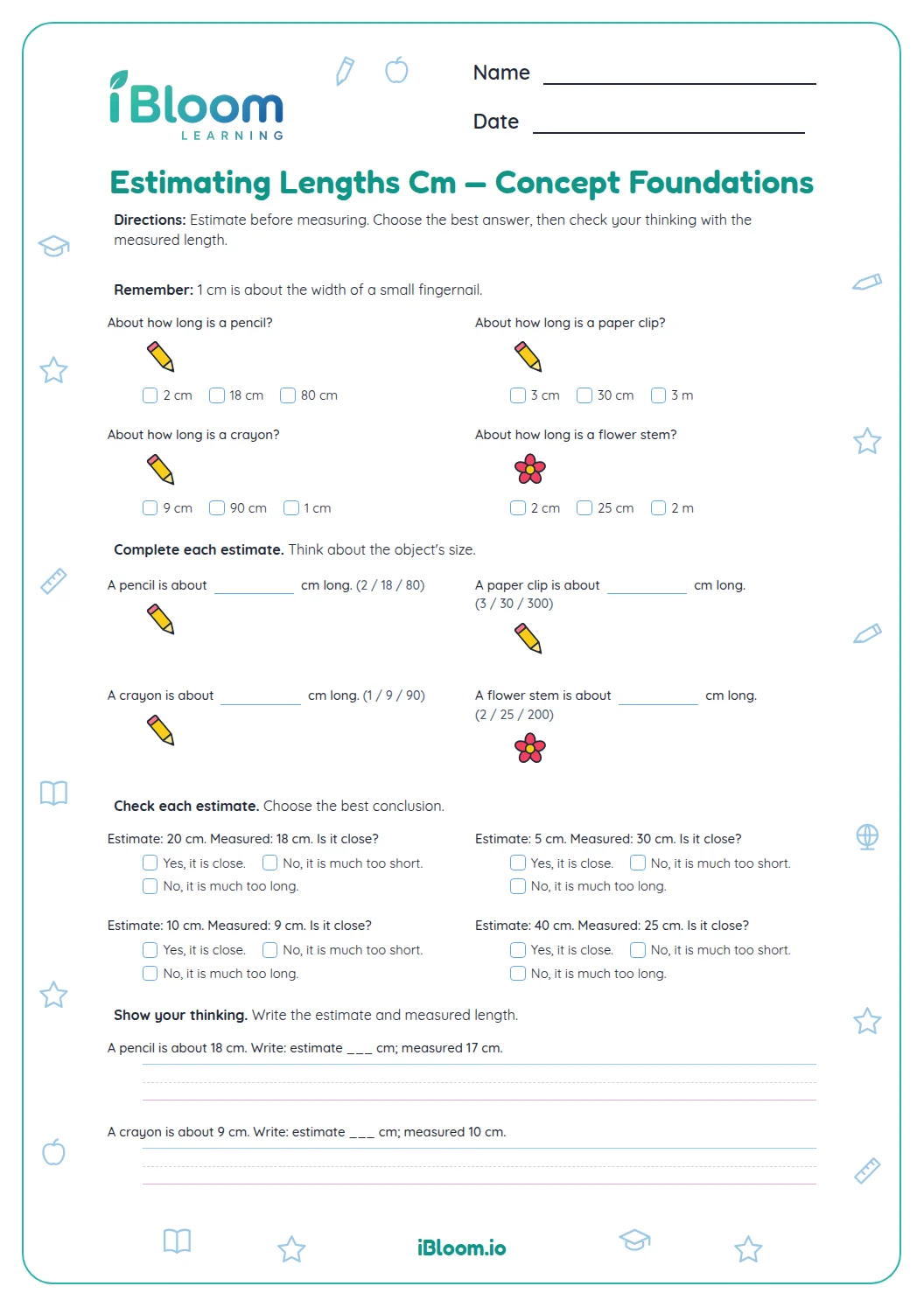
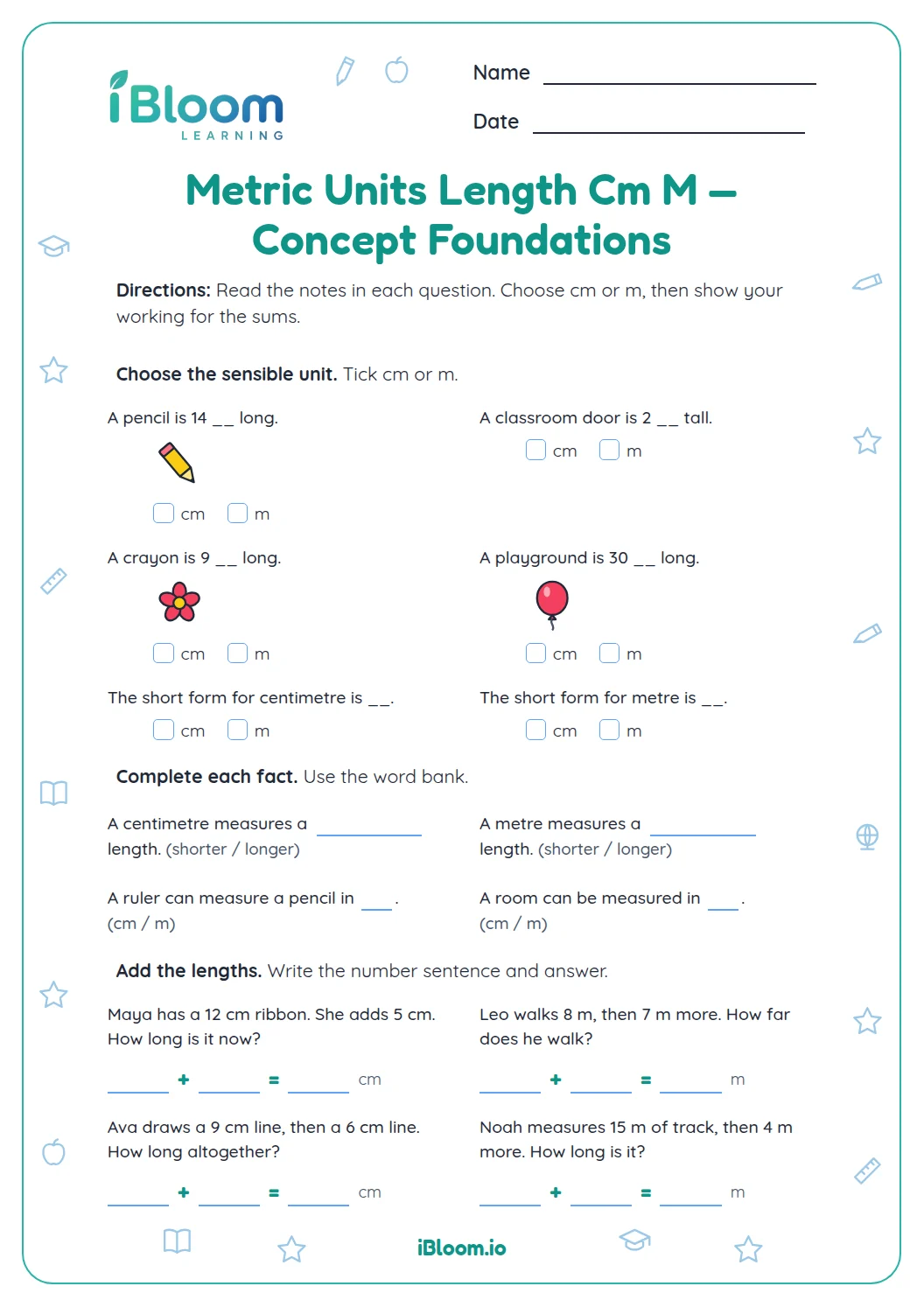
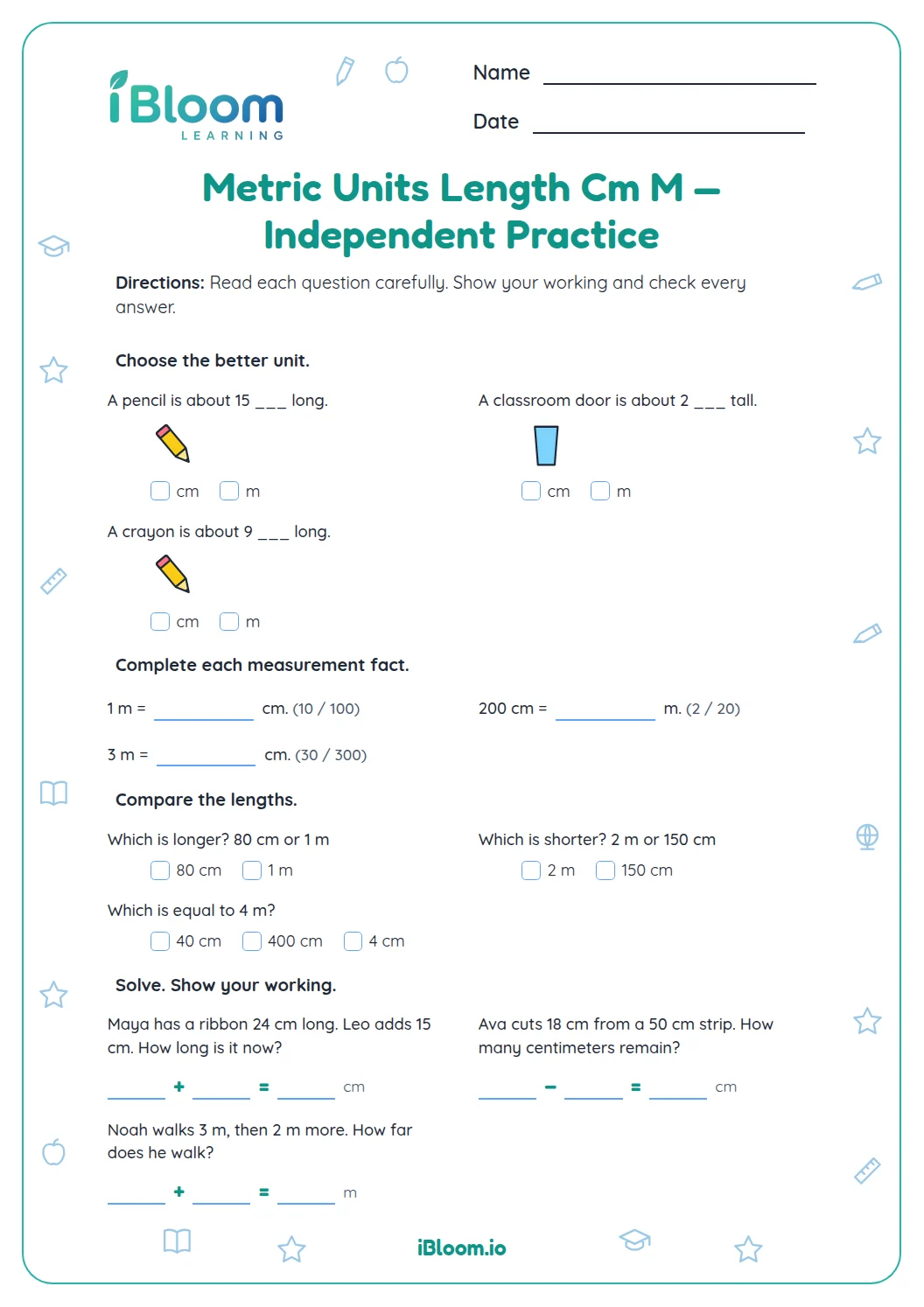
This free Grade 2 metric length worksheet guides learners through 14 questions in three parts. Children choose centimeters or meters for familiar objects, read centimeter lengths on ruler drawings, and solve simple comparisons and conversions using 100 cm = 1 m. It practices CCSS 2.MD.A.1 through appropriate unit choices and ruler reading. Two worksheet pages provide room for the guided progression, and a separate answer key gives the unit, measurement, or comparison answer for each problem.
Aligned to 2.MD.A.1
How do you choose centimeters or meters?
Think about the size of the object. A centimeter is a small unit, so it works for a crayon or spoon. A meter is larger and suits a door or hallway. Question 1 asks for cm because a paper clip is only a few centimeters long.
- 1A paper clip is about 3 ___.
- 2A paper clip is short.
- 3Choose centimeters: 3 cm.
How do you read a centimeter ruler?
Line up the start of the object with zero and look at the mark at its far end. Count the centimeter intervals. In Part B, each drawing begins at zero, so the pencil ending at 5 measures 5 cm.
How are meters and centimeters related?
There are 100 centimeters in 1 meter. So 2 m = 200 cm. To compare 80 cm and 1 m, rewrite 1 m as 100 cm; 100 − 80 = 20 cm.
- Part A: choose cm or m.
- Part B: read the length shown on each centimeter ruler.
- Part C: convert meters and compare lengths.
How to use this worksheet
- 1Name the object and estimate whether it is short or long.
- 2Choose cm for shorter items and m for longer distances or objects.
- 3For a ruler drawing, locate the zero point before reading the far end.
- 4Use 100 cm = 1 m to rewrite meter lengths as centimeters.
- 5Check that a comparison answer gives both the longer length and the difference.
Common mistakes and quick fixes
The mistake
Using meters for a tiny object.
The fix
Picture a centimeter next to the object; use cm when a few small units make sense.
The mistake
Reading the ruler from the page edge instead of zero.
The fix
Find the zero mark first, then count to the object’s endpoint.
The mistake
Treating 1 m as 10 cm.
The fix
Remember that one meter has 100 centimeters; write 100 cm = 1 m.
Common Core alignment
This worksheet practices selecting metric units and measuring with a ruler.
Choose centimeters or meters and measure length with a ruler.
On this sheet: The ruler questions use centimeters, and the first part selects a sensible metric unit for each object.
Show the official wordingHide the official wording
Measure the length of an object by selecting and using appropriate tools such as rulers, yardsticks, meter sticks, and measuring tapes.
What to practice next
Make more practice
Further reading
Questions parents and teachers ask
When should a child use centimeters instead of meters?
Centimeters fit short objects such as a crayon or paper clip. Meters fit longer distances and objects such as a hallway or classroom door. The first part asks children to choose between cm and m based on the size of each item.
How many centimeters are in one meter?
One meter equals 100 centimeters. This relationship helps answer the conversion questions: 2 m is 200 cm, and 3 m is 300 cm. A meter stick can help children see that a meter is a much longer unit than one centimeter.
How do I read the ruler drawings?
Start at zero, where the left end of each pictured object lines up, then find the centimeter mark at its other end. The pencil reaches 5 cm and the book reaches 8 cm. Count the numbered centimeter intervals between the ruler’s zero mark and the object’s endpoint.
What does the answer key show?
The separate key gives the four unit choices, two ruler readings, two length differences, and six conversion or comparison answers. For the last group, it shows how many centimeters equal each meter amount and how far a length is from 1 meter. Check the unit as well as the number.
Should a child measure real objects too?
Yes, after the printed practice, invite your child to choose a ruler and measure a few nearby objects. Ask why centimeters or meters make sense before measuring. The worksheet provides ruler-reading and unit-choice practice. Compare the result with an estimate to check it.
How many questions are on the worksheet?
There are 14 questions across three parts: four unit choices, four length-reading and comparison questions, and six conversion or comparison problems. The worksheet and its separate answer key each use two pages. The key includes the units, so learners can check both the measurement and its label.