






About this worksheet
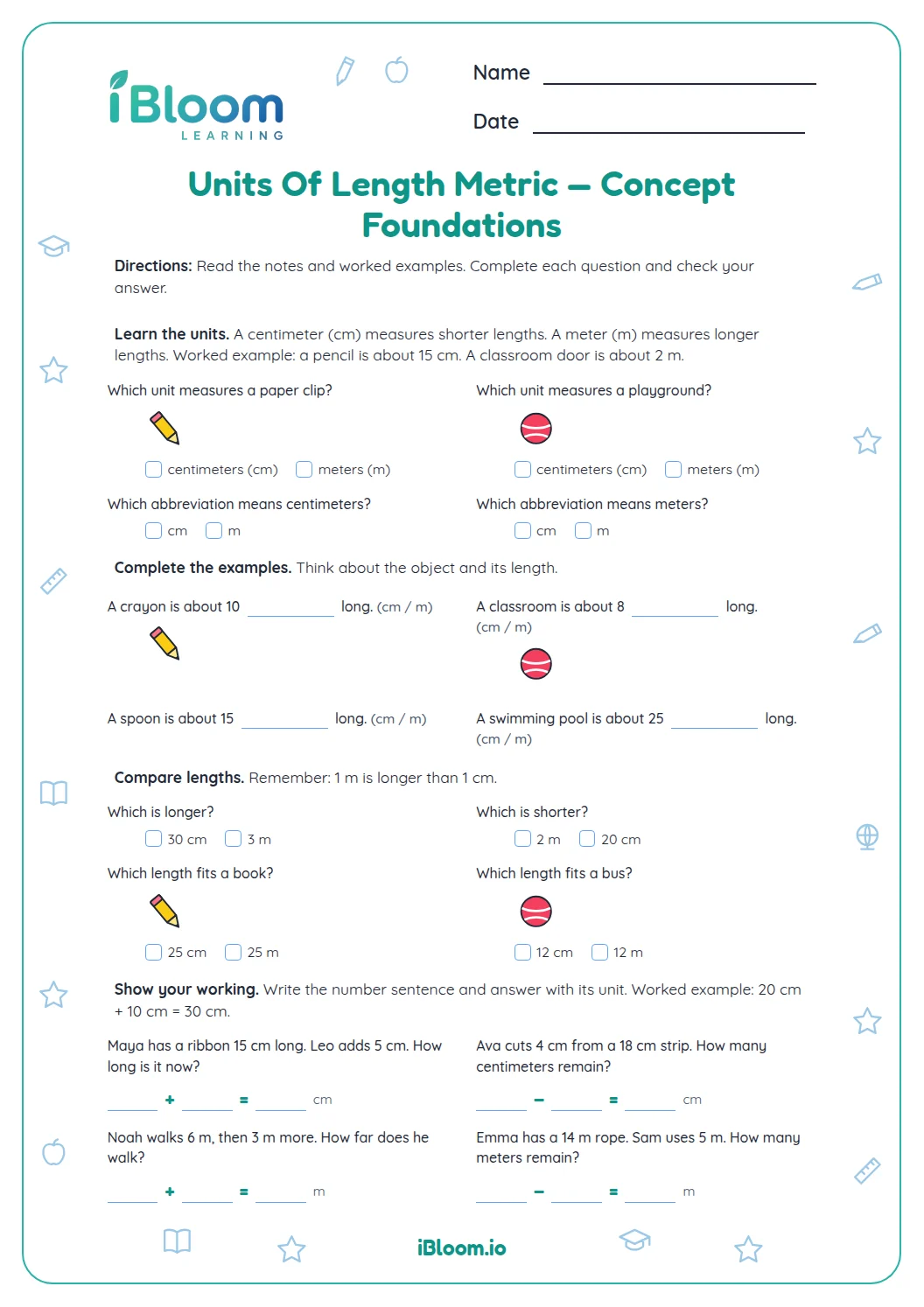
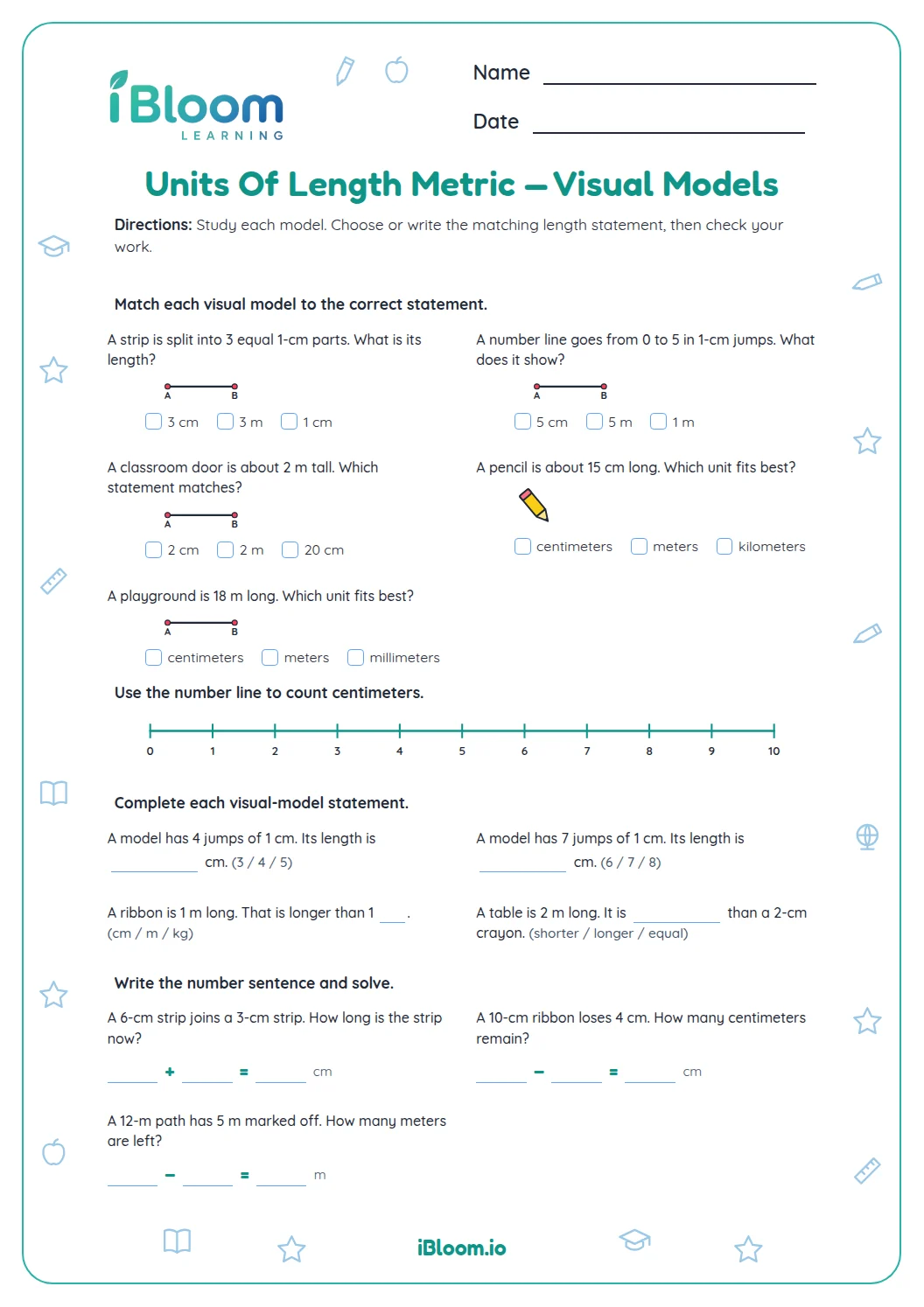
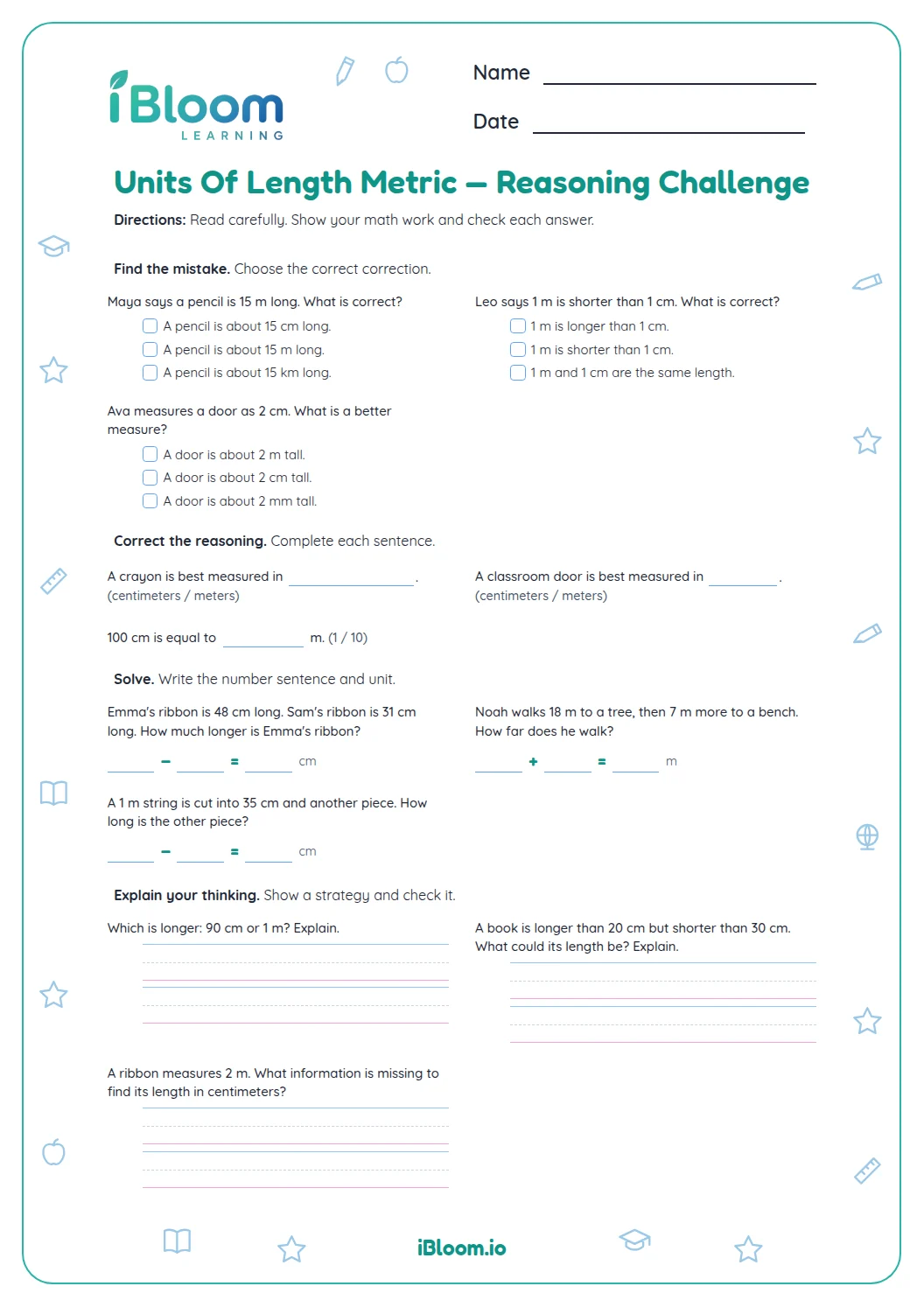
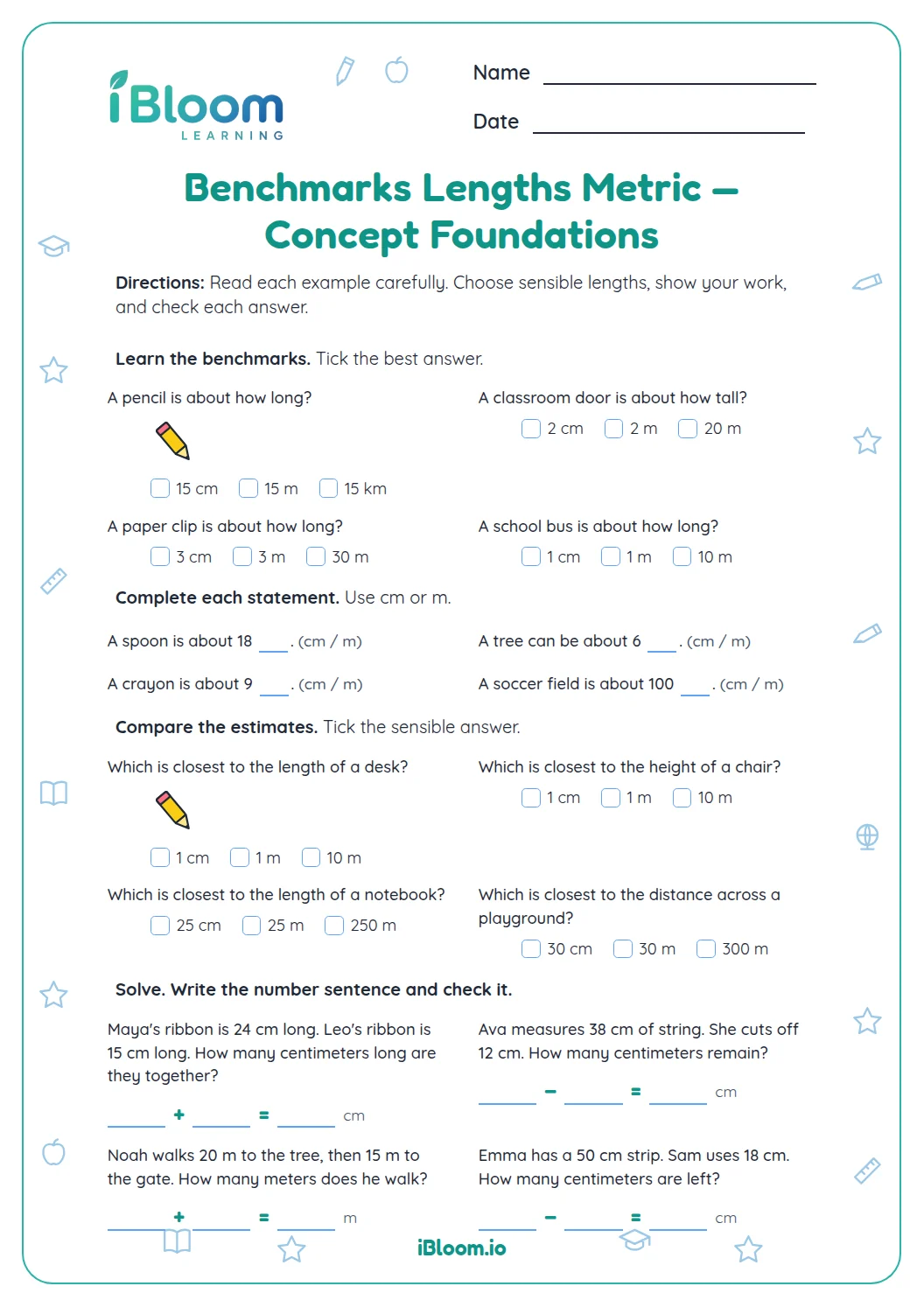
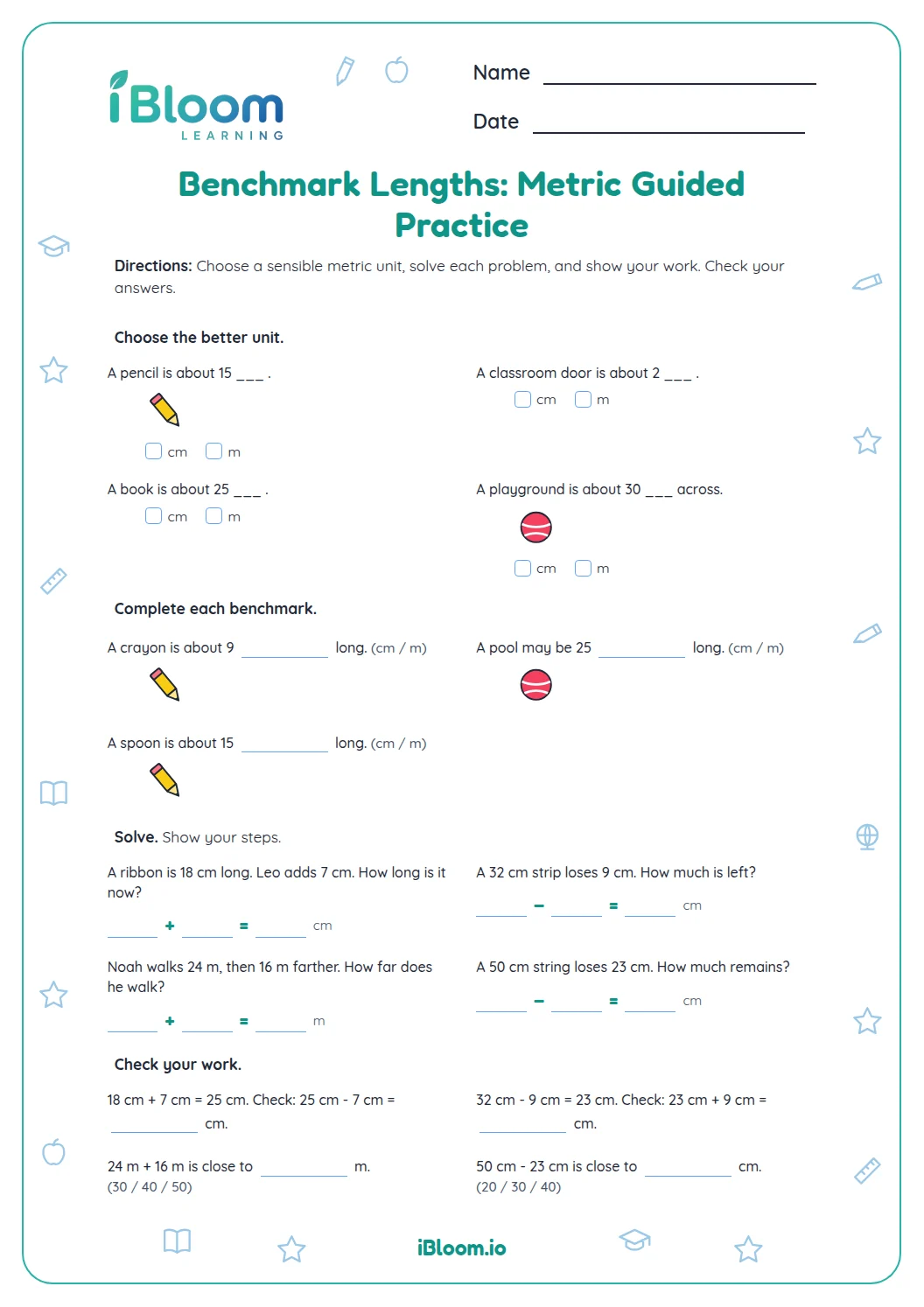
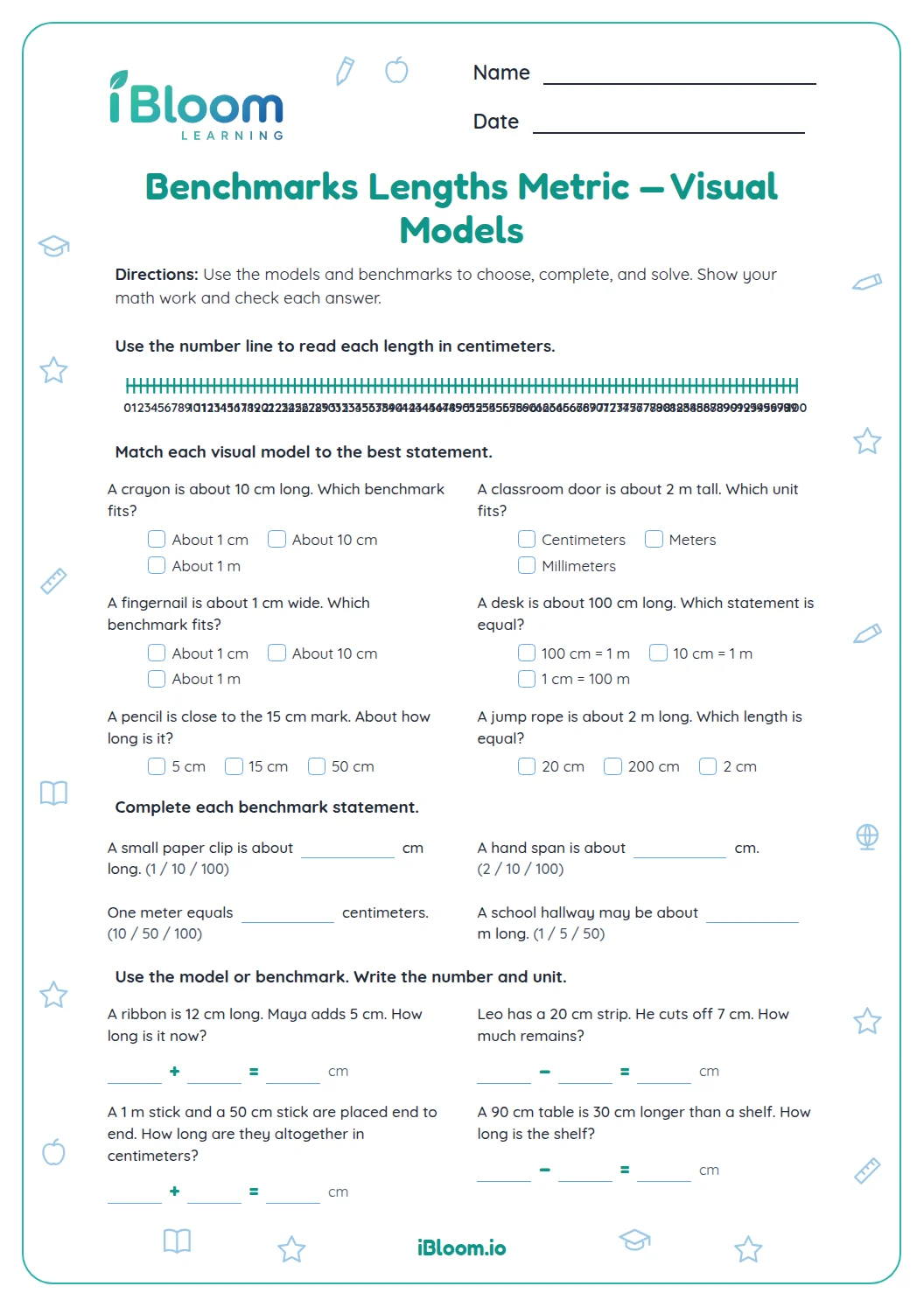
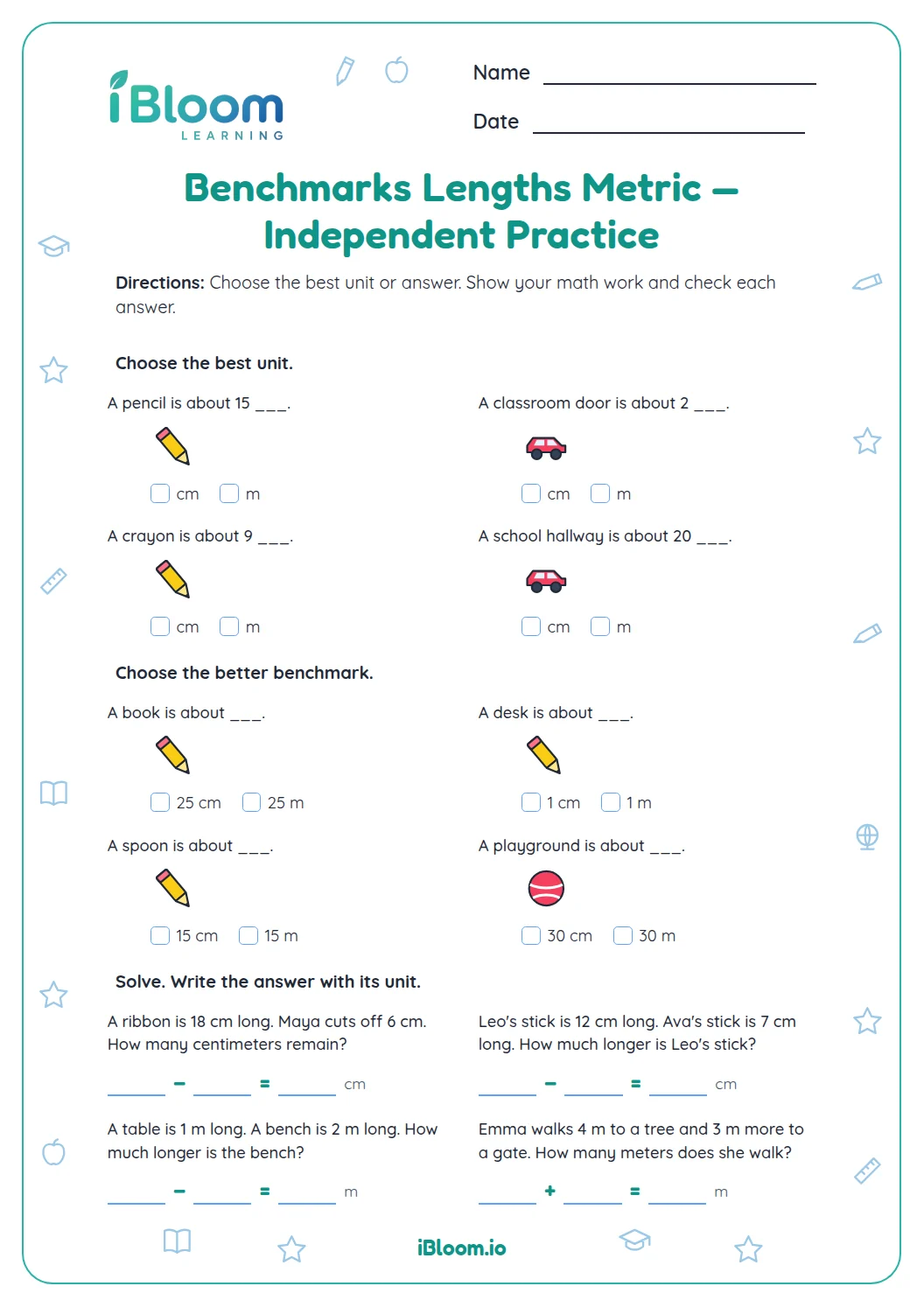
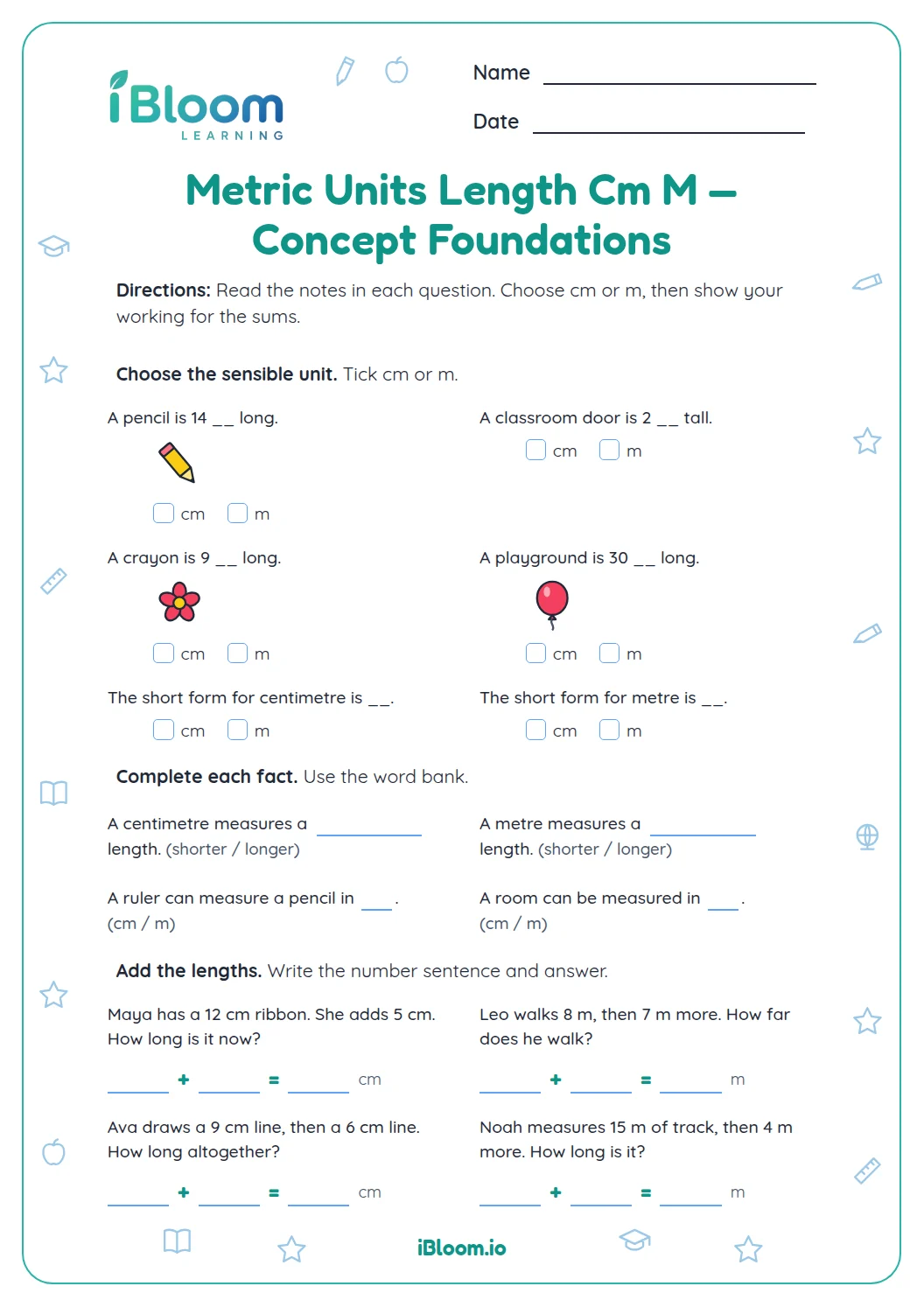
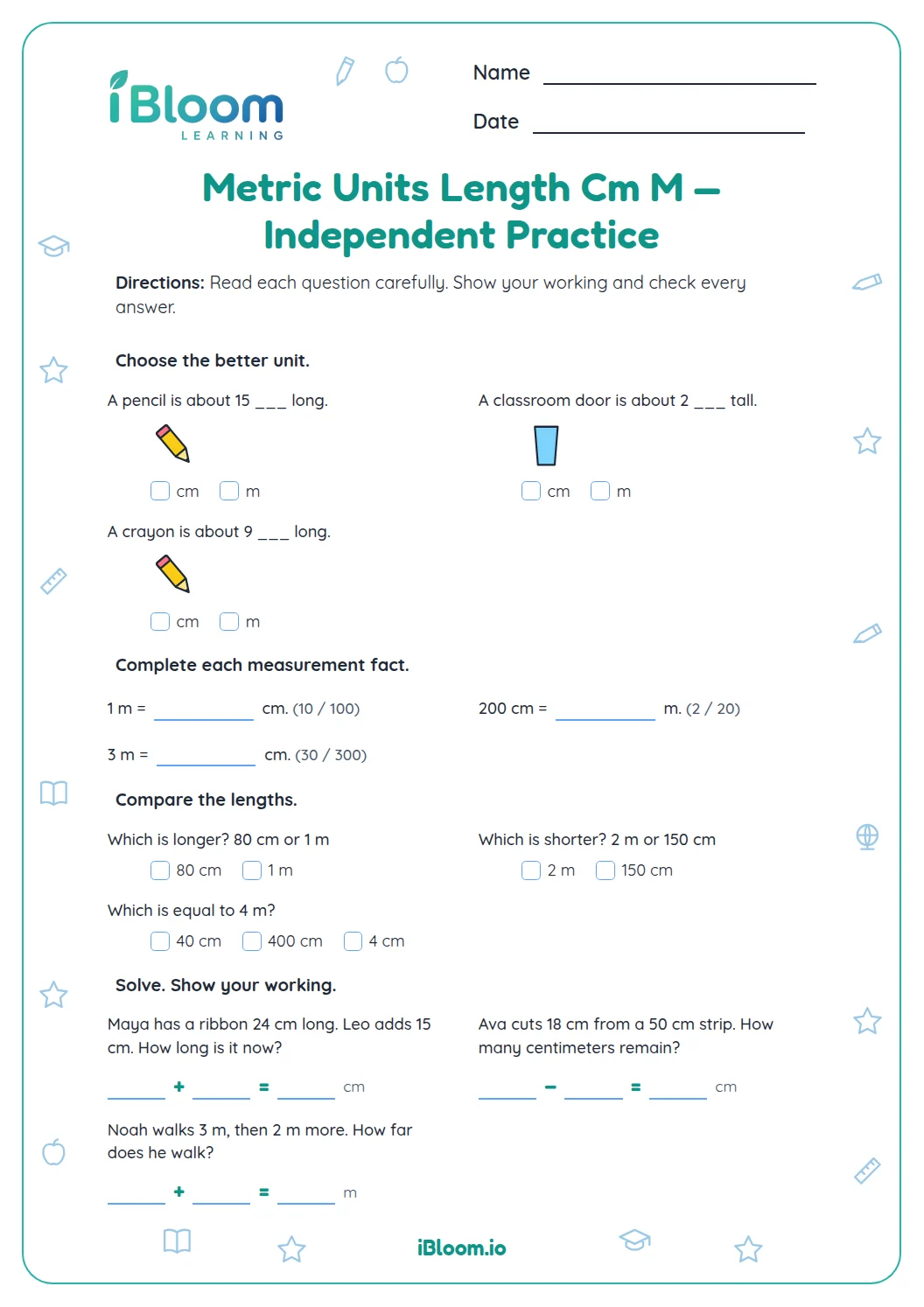
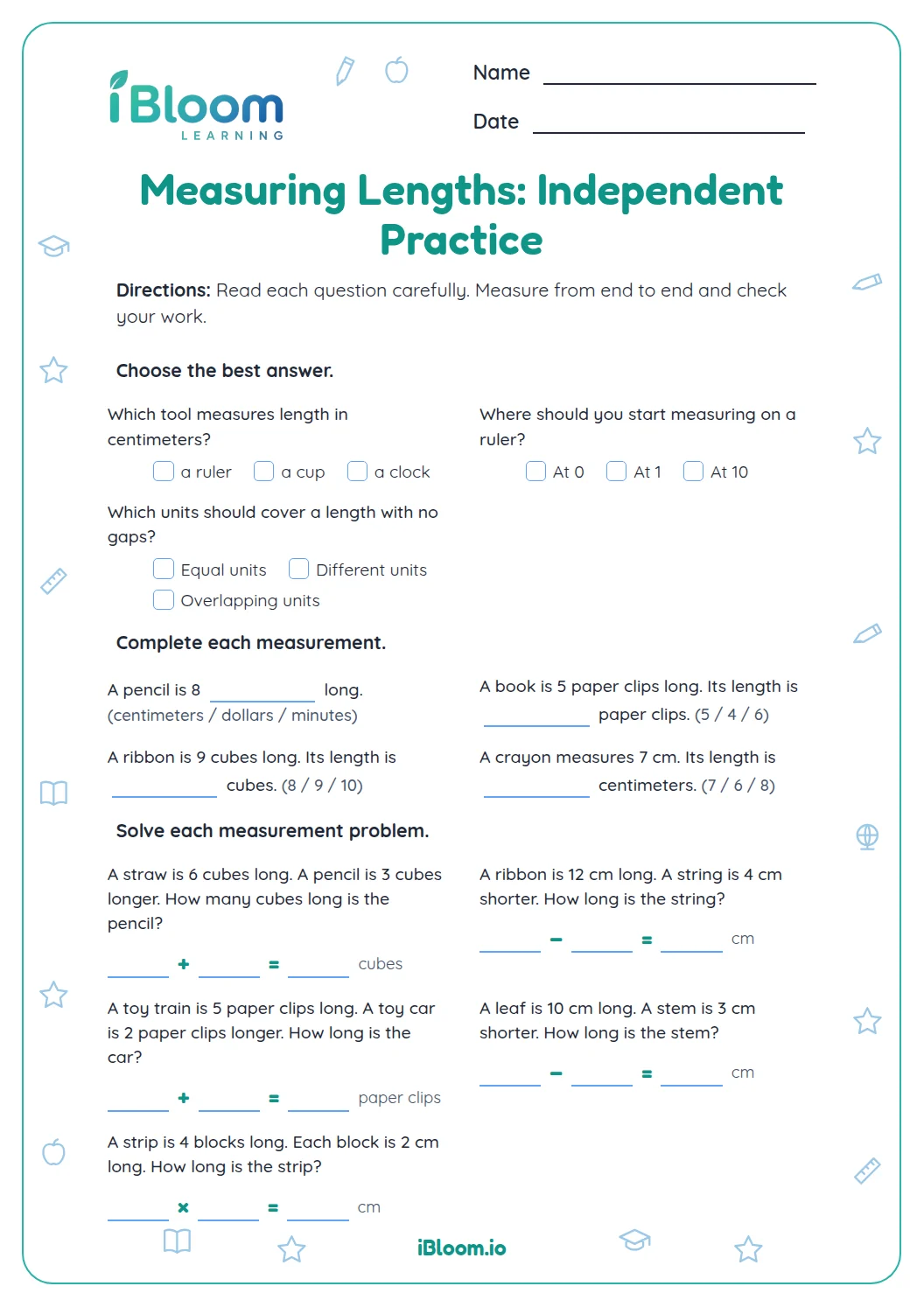
This Grade 2 printable practices choosing between centimeters and meters and reasoning about metric lengths. Learners select a sensible unit for familiar objects, use the relationship between meters and centimeters, compare measurements, and solve addition and subtraction stories. The 15 questions are arranged in four parts, with a separate key for checking units and answers.
What does each part ask learners to do?
Part A asks learners to choose centimeters or meters for familiar objects. Part B uses the relationship between the units. Part C compares lengths after expressing them in a common unit. Part D uses addition or subtraction to answer short length stories.
- Part A: select centimeters or meters
- Part B: use 100 centimeters = 1 meter
- Part C: compare measurements
- Part D: solve length stories and include the unit
When should you use centimeters or meters?
Centimeters suit shorter objects, such as a crayon or spoon. Meters are useful for longer distances, such as a classroom or hallway. Think about the object’s size before choosing; a number alone does not determine the unit.
How are meters and centimeters related?
One meter equals 100 centimeters. To change meters to centimeters, count 100 centimeters for each meter. To change an amount in centimeters to meters, group the centimeters into hundreds. For example, 500 centimeters is 5 meters.
- 13 meters = 3 × 100 centimeters
- 23 meters = 300 centimeters
How do you solve a length story?
Use the operation described by the story, then include the unit in your answer. If 35 cm of ribbon loses 12 cm, subtract 12 from 35 to find 23 cm remaining. If two lengths are joined, add them and keep the shared unit.
How to use metric units on this sheet
- 1Name the object or length in the question.
- 2Choose centimeters for shorter lengths and meters for longer lengths.
- 3Use 100 centimeters for each meter when changing units.
- 4For comparisons, rewrite both measures in the same unit.
- 5For a story, identify whether the length grows, shrinks, or combines.
- 6Write the correct unit with each story answer and check with the key.
Common metric length mistakes
The mistake
Choosing meters for a short object such as a crayon.
The fix
Picture the object beside a meter stick; a crayon is much shorter than one meter, so centimeters make sense.
The mistake
Writing 3 meters as 30 centimeters.
The fix
Use 100 centimeters per meter, so 3 meters equals 300 centimeters.
The mistake
Comparing 2 m and 180 cm by comparing 2 and 180 directly.
The fix
Convert 2 m to 200 cm first. Then compare 200 cm and 180 cm.
What to practice next
Make more practice
Questions parents and teachers ask
How many centimeters are in one meter?
One meter is 100 centimeters. The worksheet uses that relationship to convert between meters and centimeters, including 3 meters to centimeters and 500 centimeters to meters. The key lists the number for each blank, and the comparison section asks learners to put lengths in a shared unit.
How can a child choose between centimeters and meters?
Think about the likely size of the object or distance. A crayon or spoon is short, so centimeters are a sensible unit; a classroom or hallway is longer, so meters fit better. The first part uses familiar examples to practice choosing an appropriate unit.
How many questions are included?
There are 15 questions across four parts: unit choices, meter-centimeter relationships, comparisons, and short length stories. The worksheet and answer key each take two pages in all. Allow about 20 minutes, including time to write the unit beside each story answer.
Does the sheet use rulers?
This page focuses on choosing and reasoning about metric units, using the relationship between meters and centimeters, comparing lengths, and solving stories. It does not ask children to measure objects with a ruler on the page. The separate answer key gives the expected unit, comparison sign, or story result.
Why should measurements use the same unit before comparing?
A comparison is clear when both lengths use the same unit. For example, change 2 meters to 200 centimeters before comparing it with 180 centimeters. Then the numbers measure the same size of unit, and the larger value represents the longer length.
What is the answer to the ribbon story?
Mia starts with 35 centimeters and cuts off 12 centimeters, so 35 − 12 = 23. The ribbon has 23 centimeters left. Keep the unit because the story measures a length; the answer key includes the unit in its model answer.