
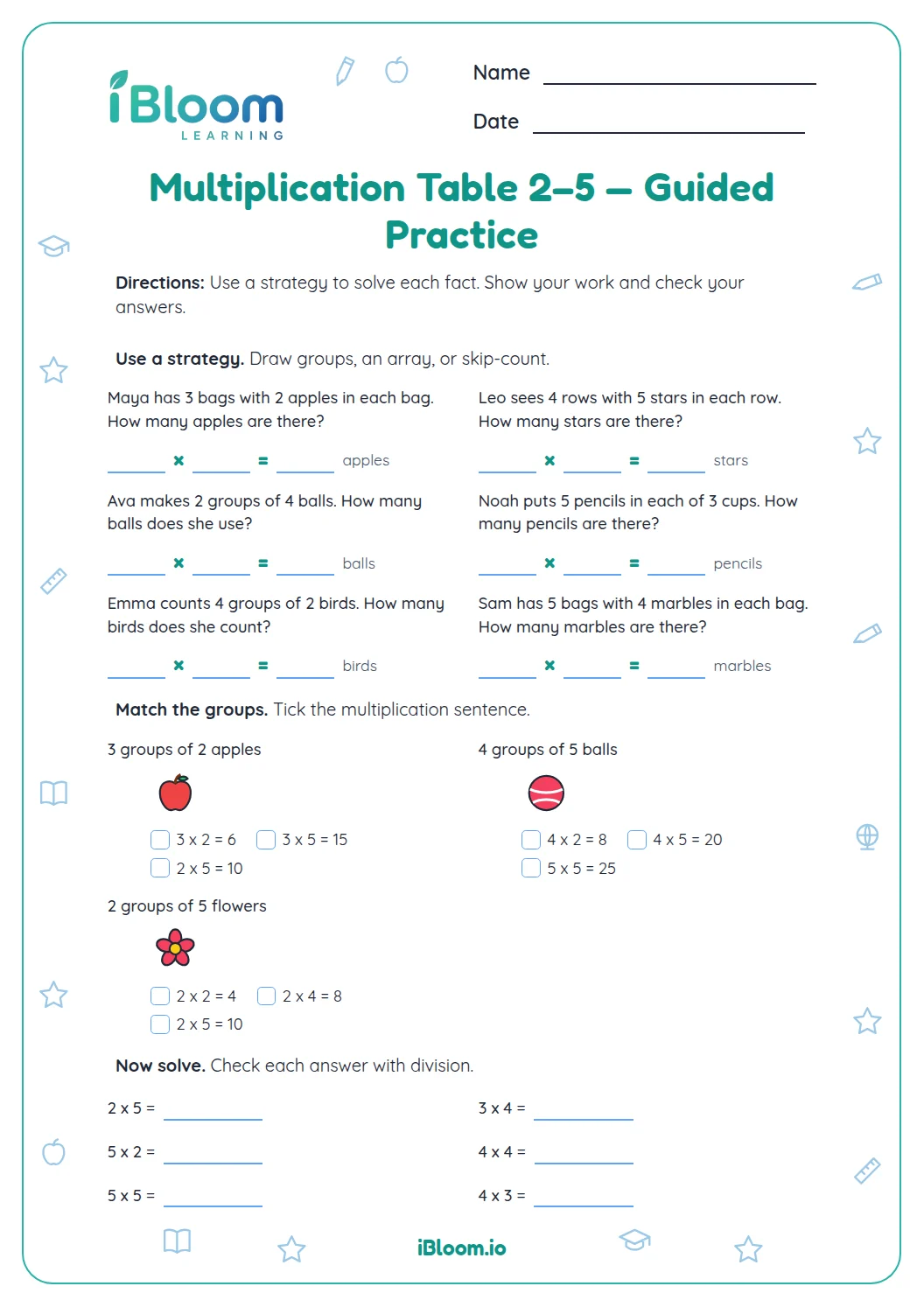
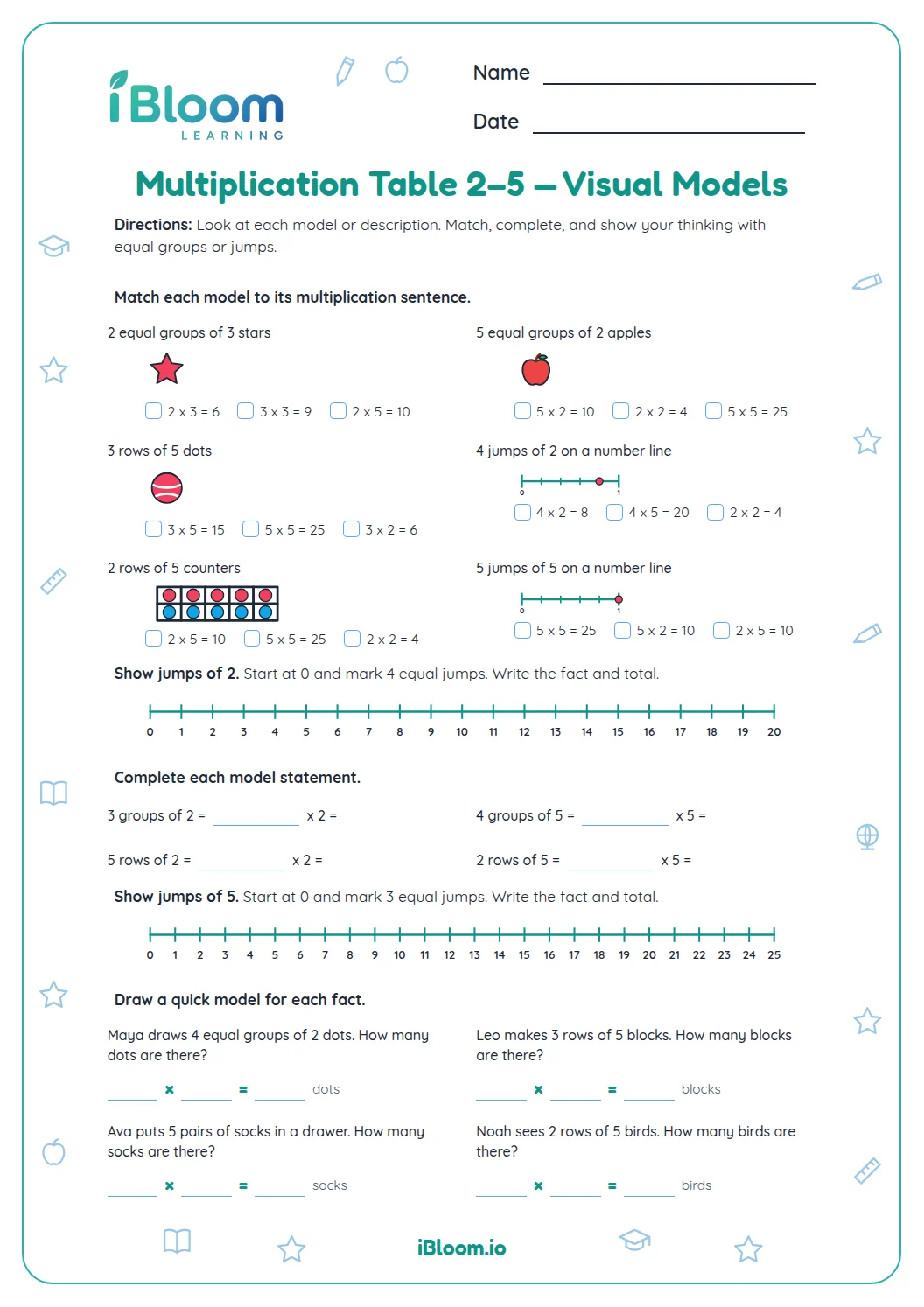
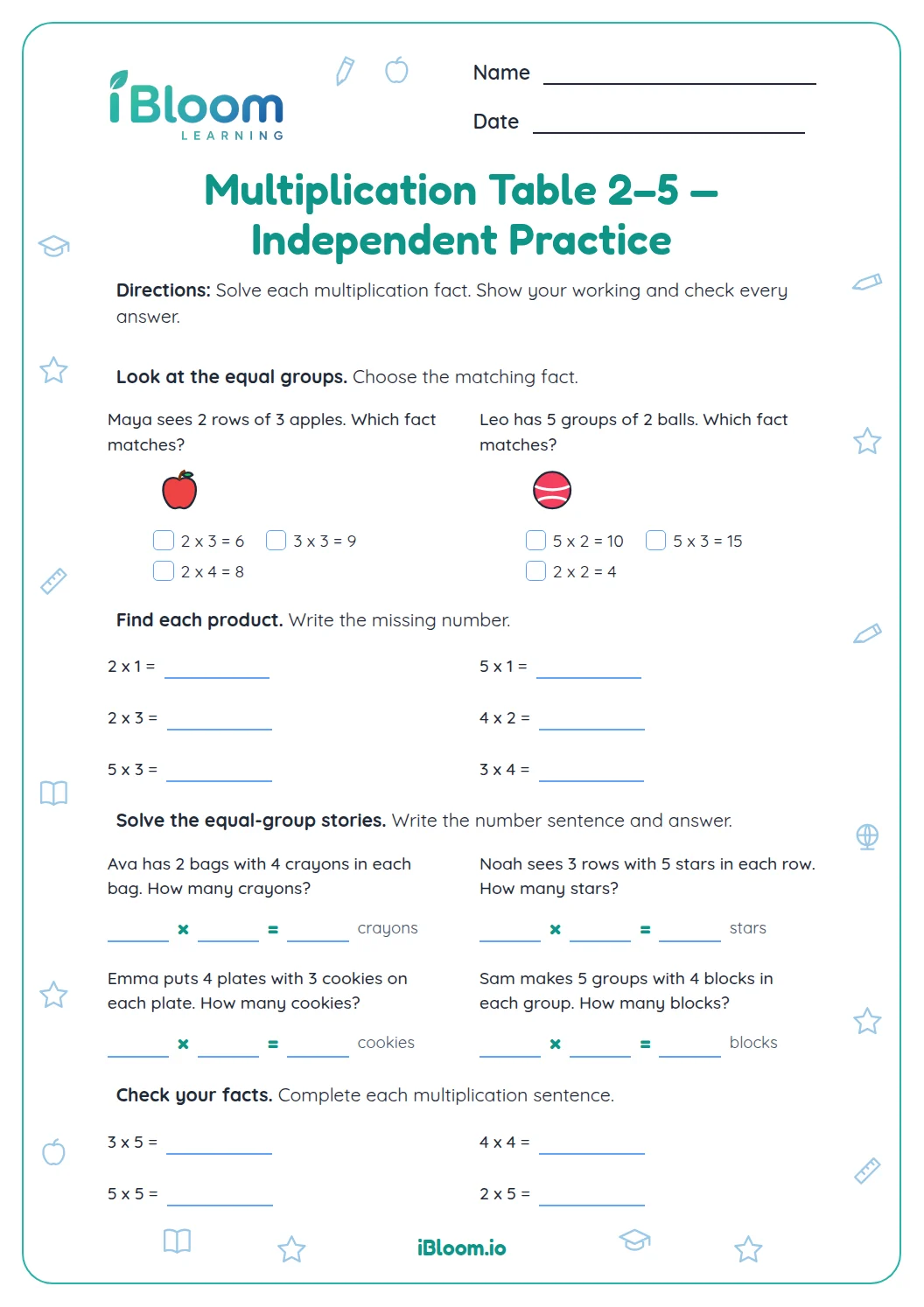
About this worksheet
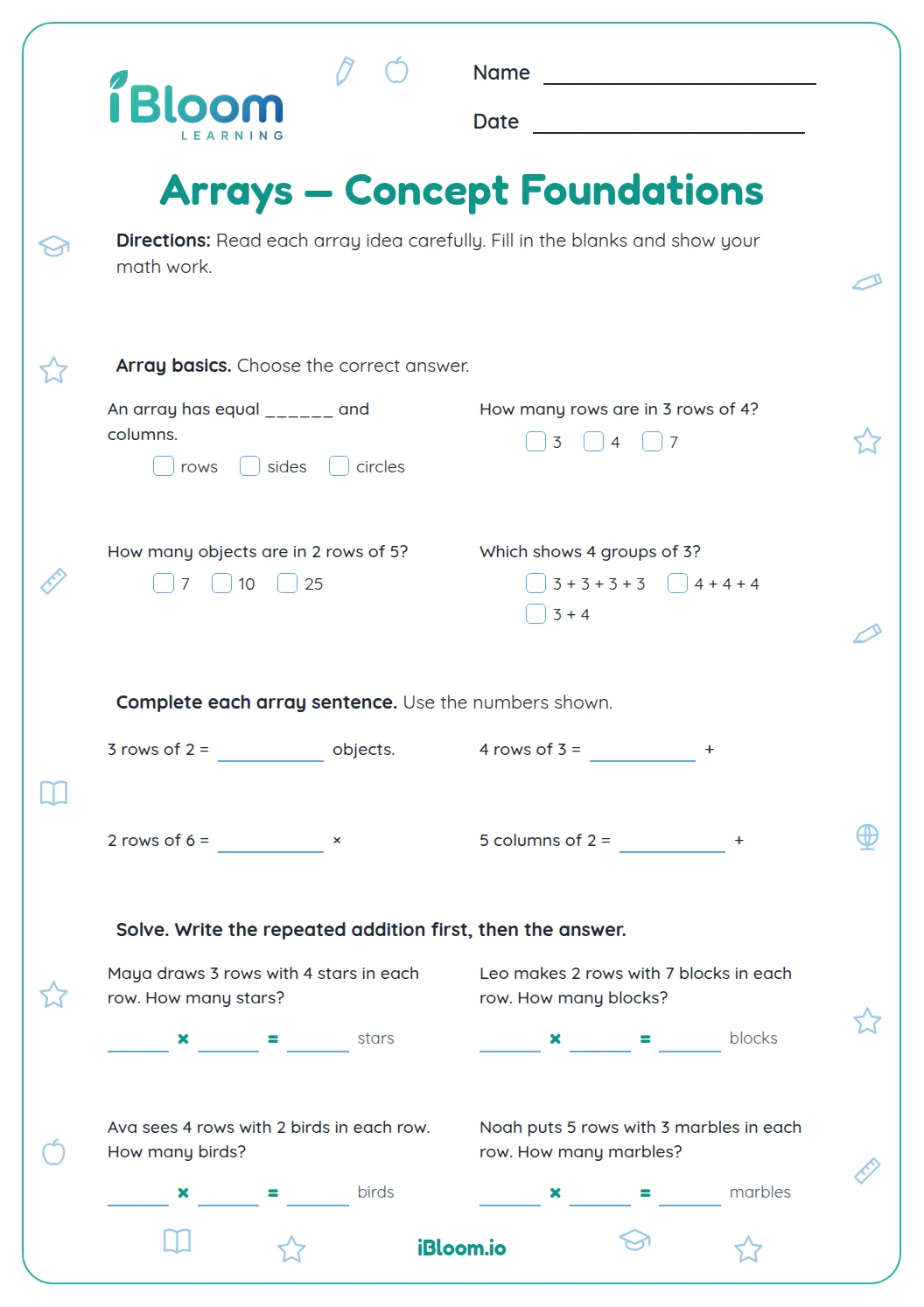
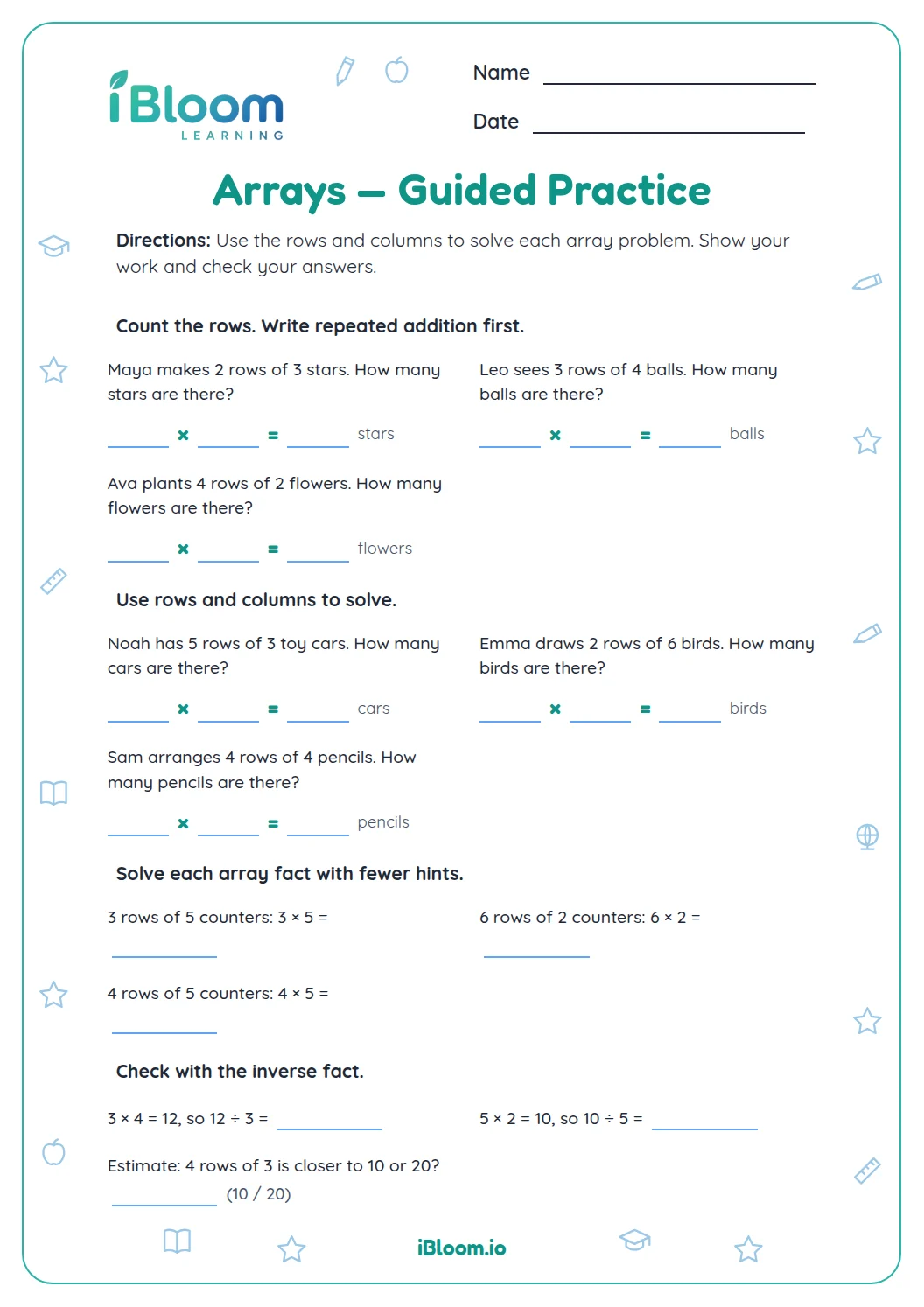
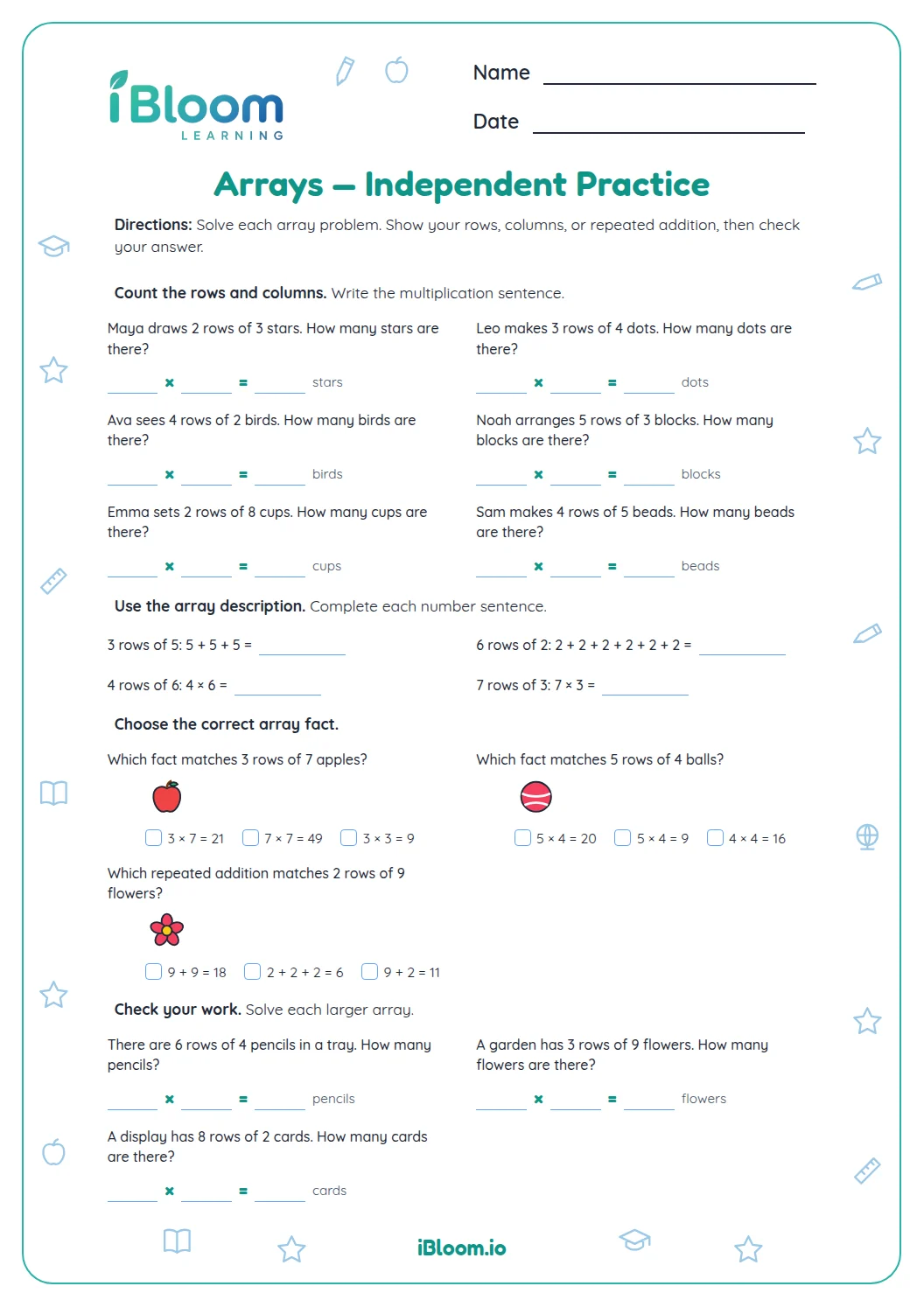
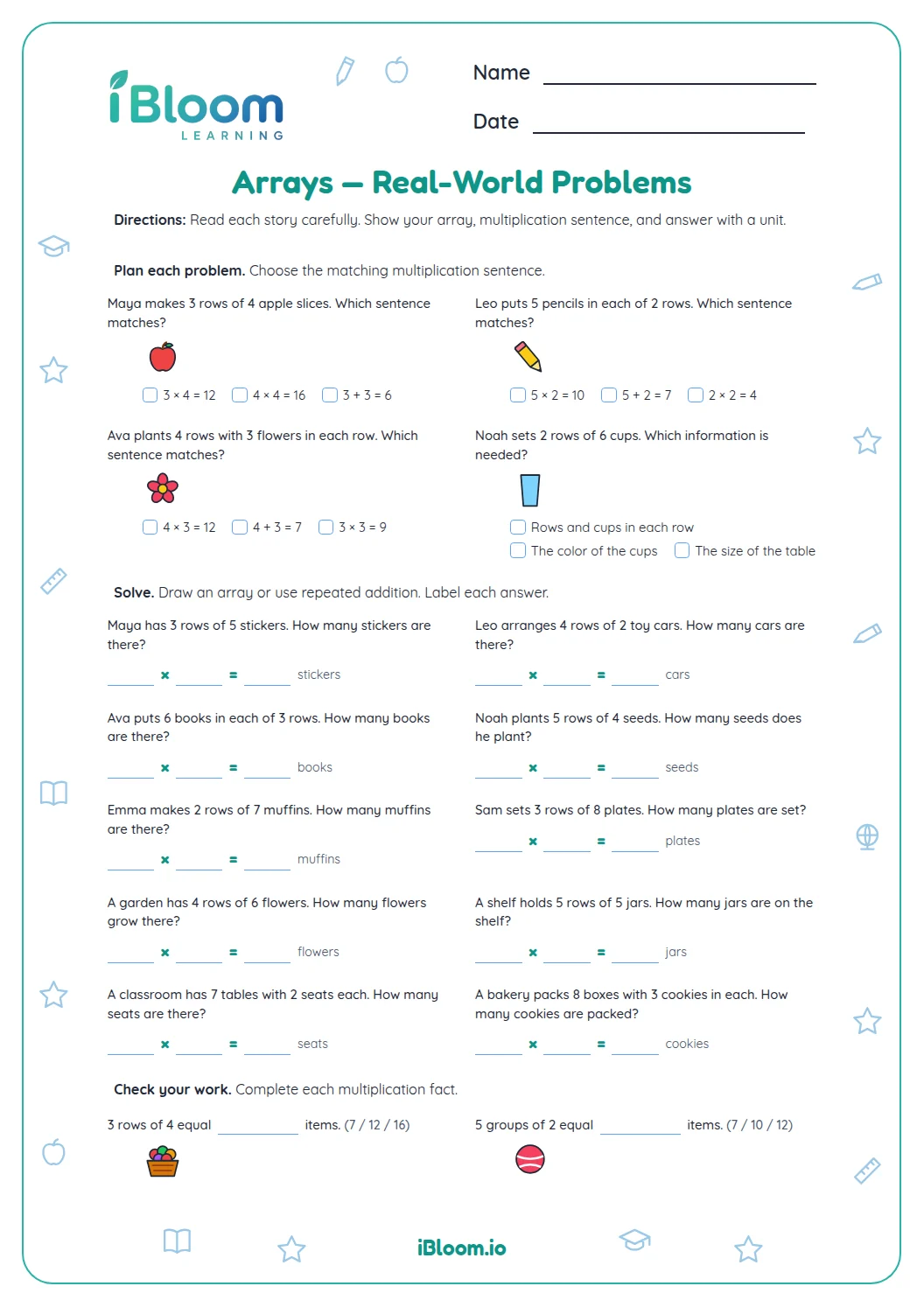
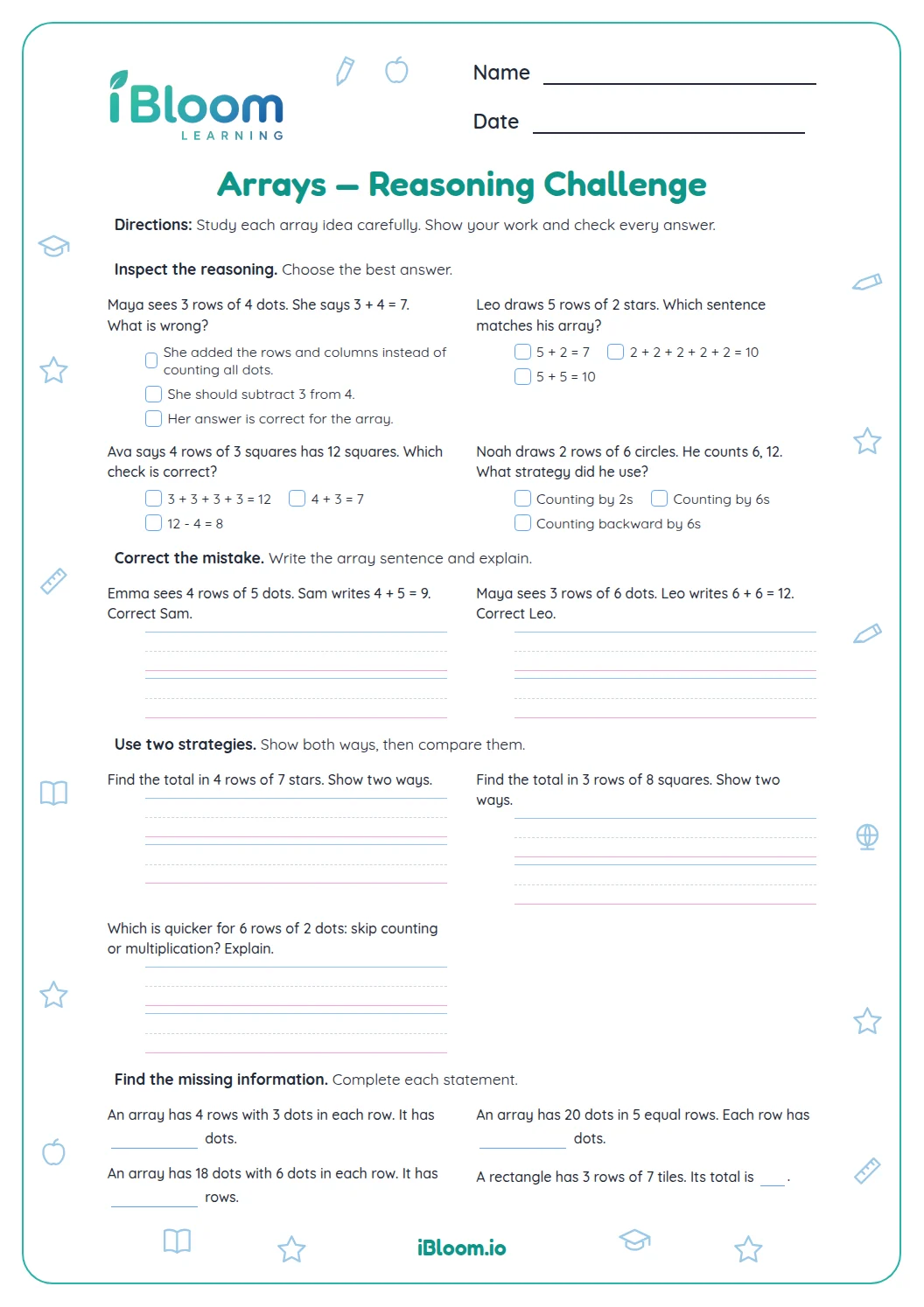
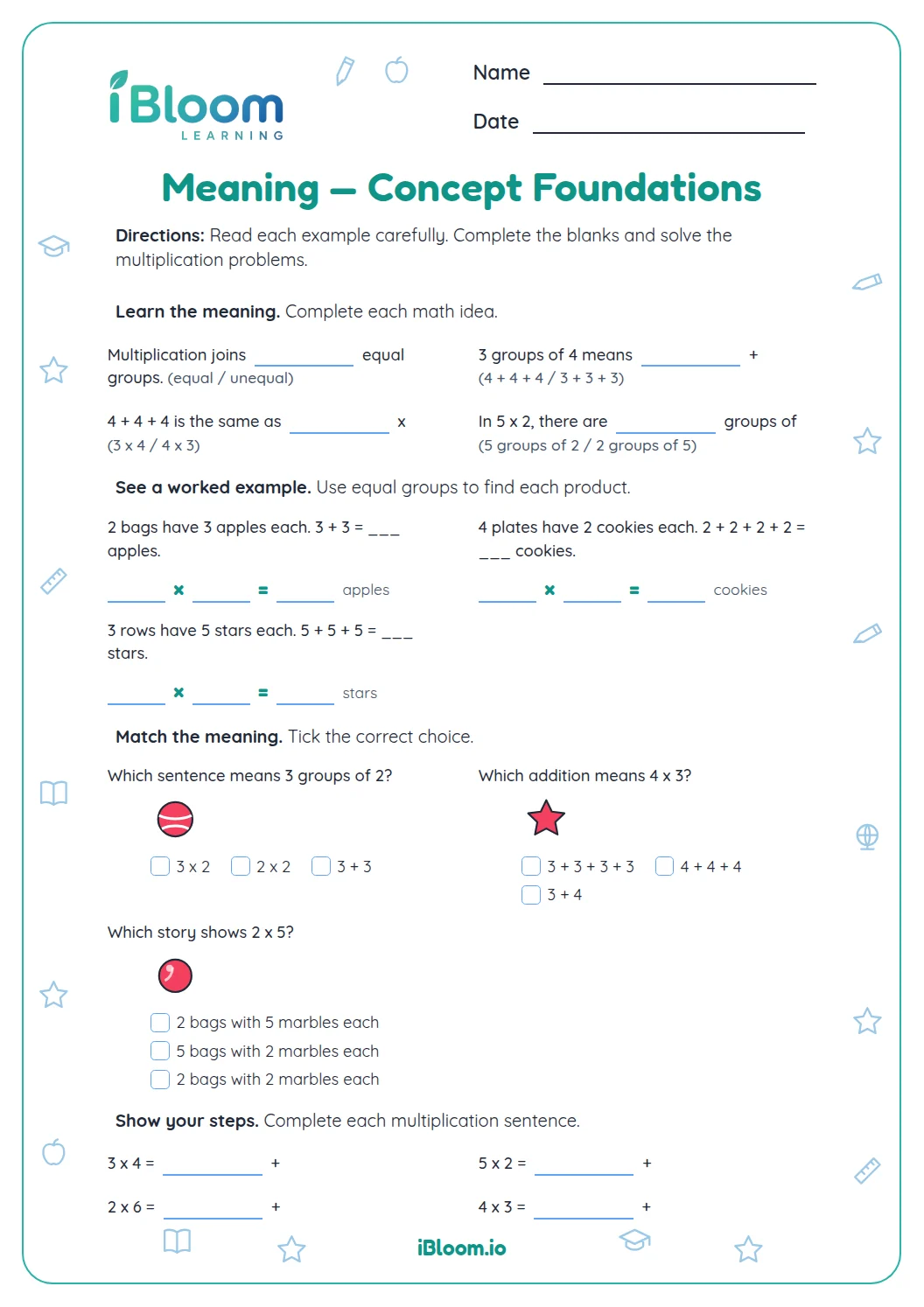
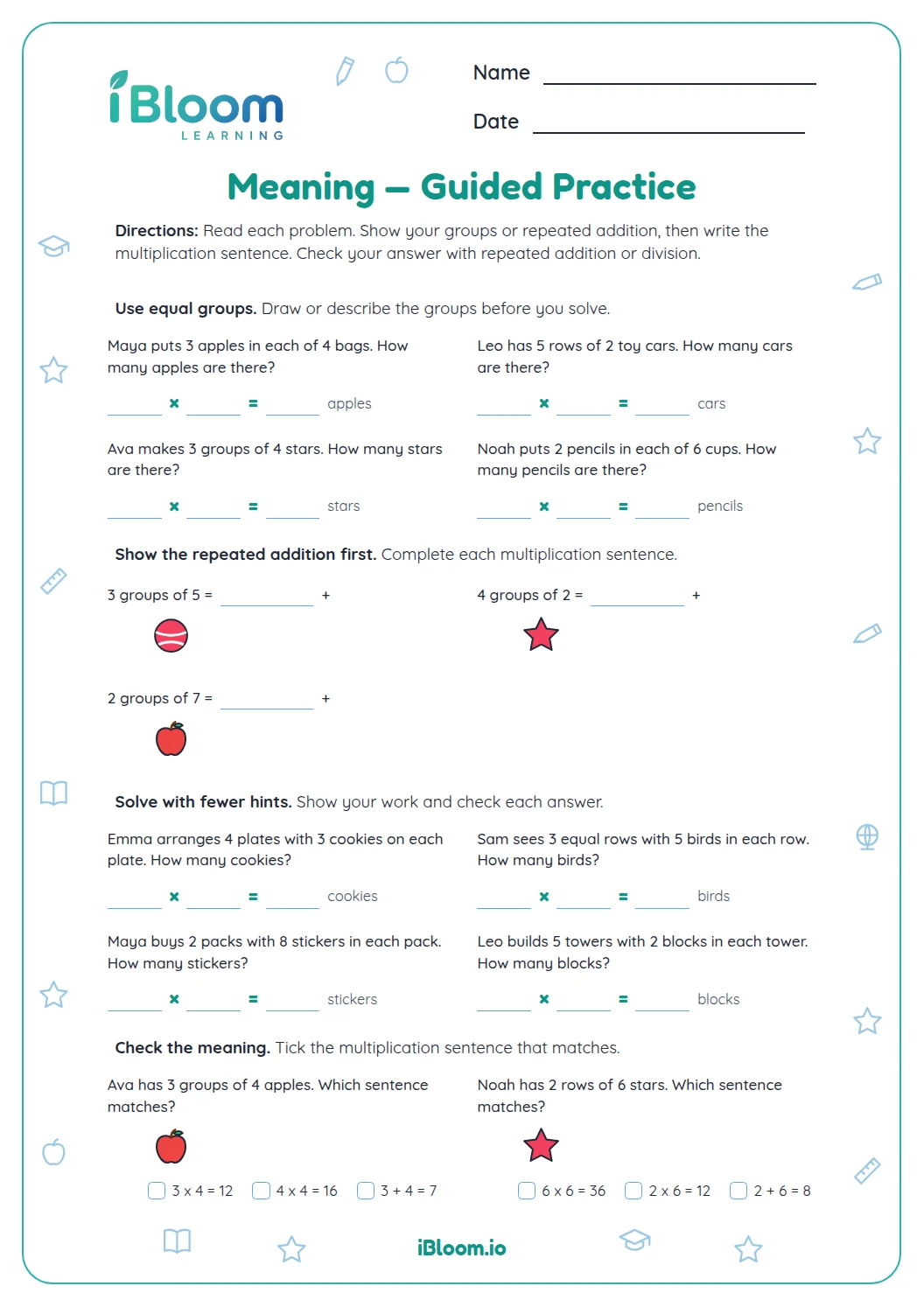
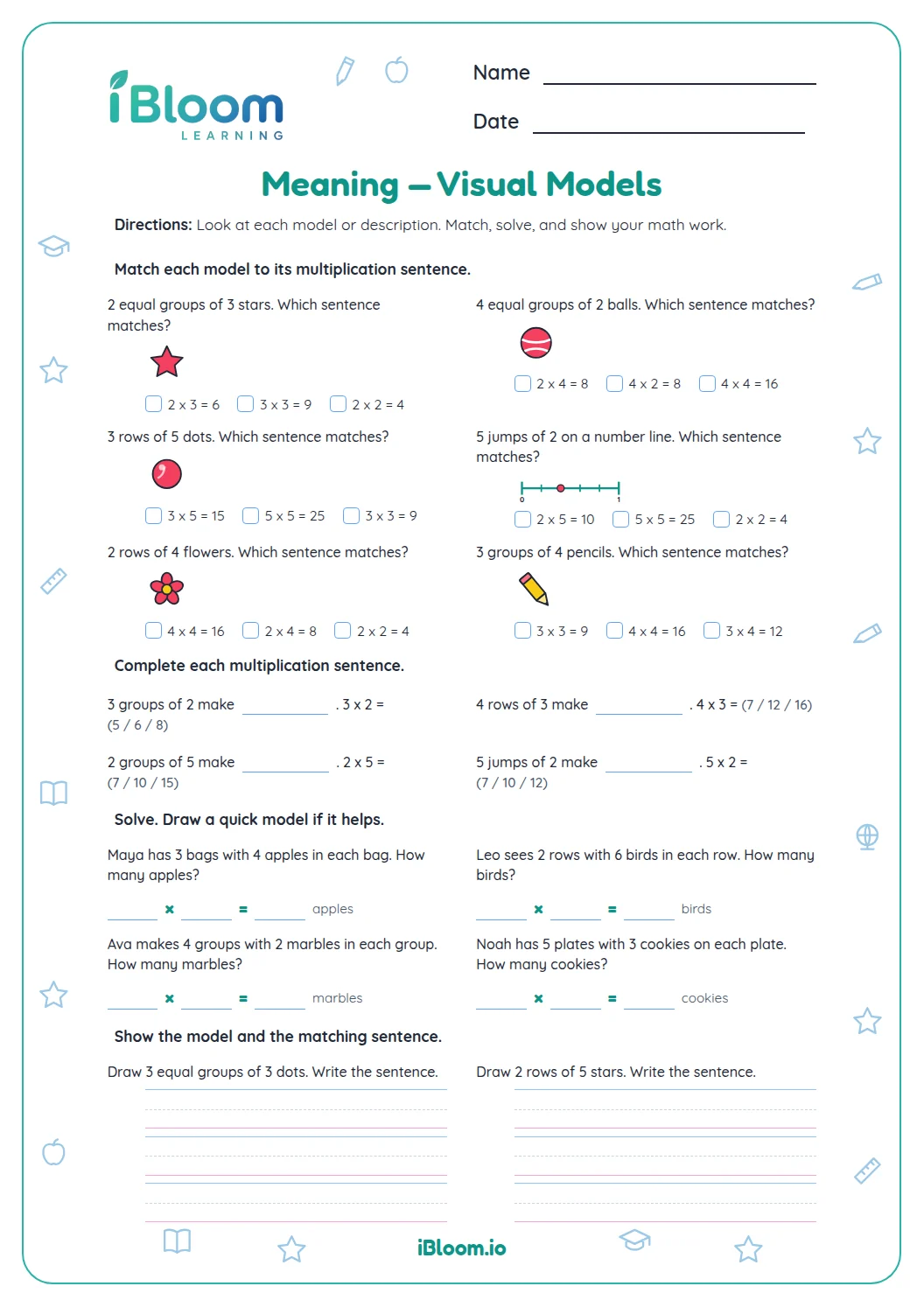
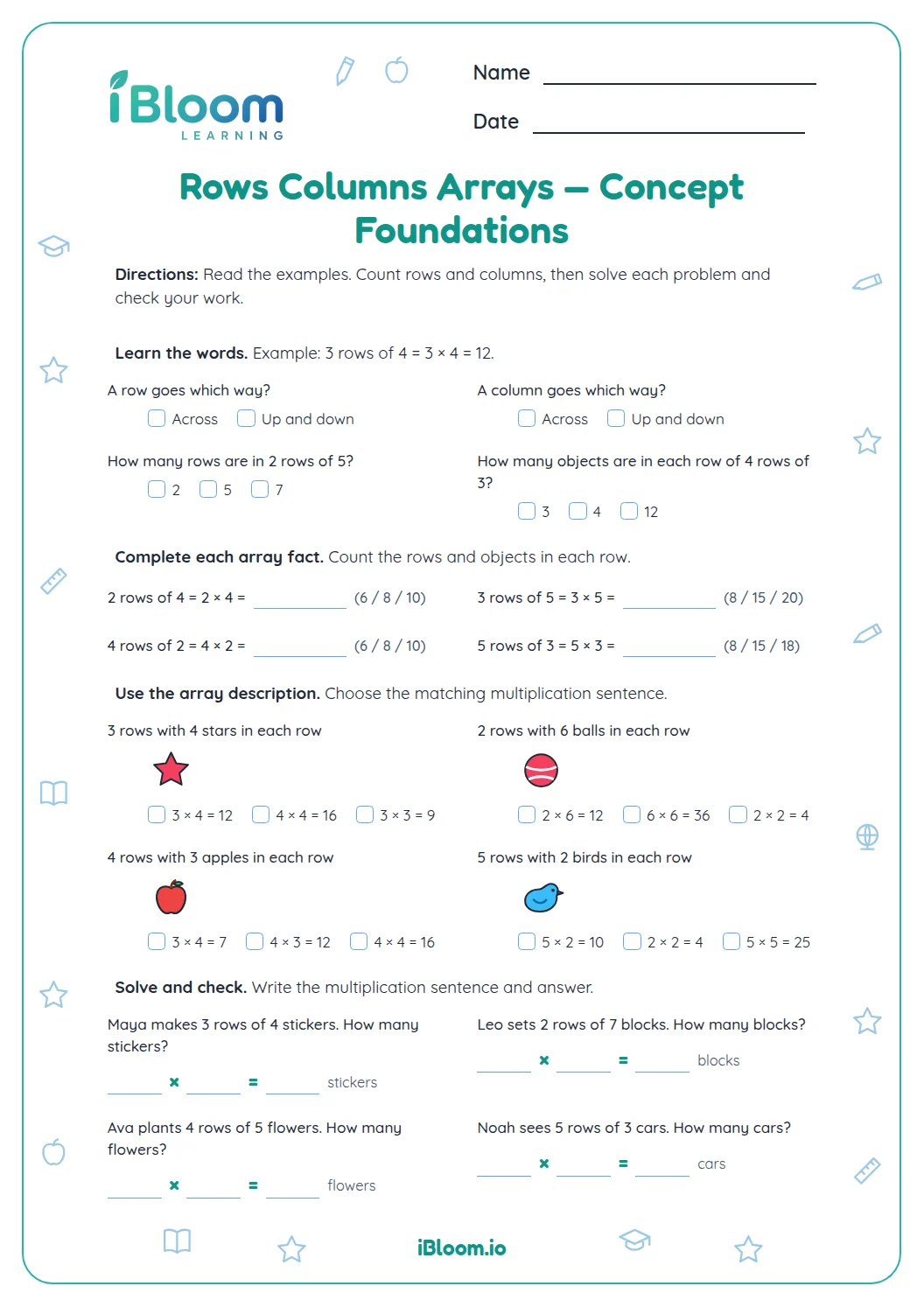
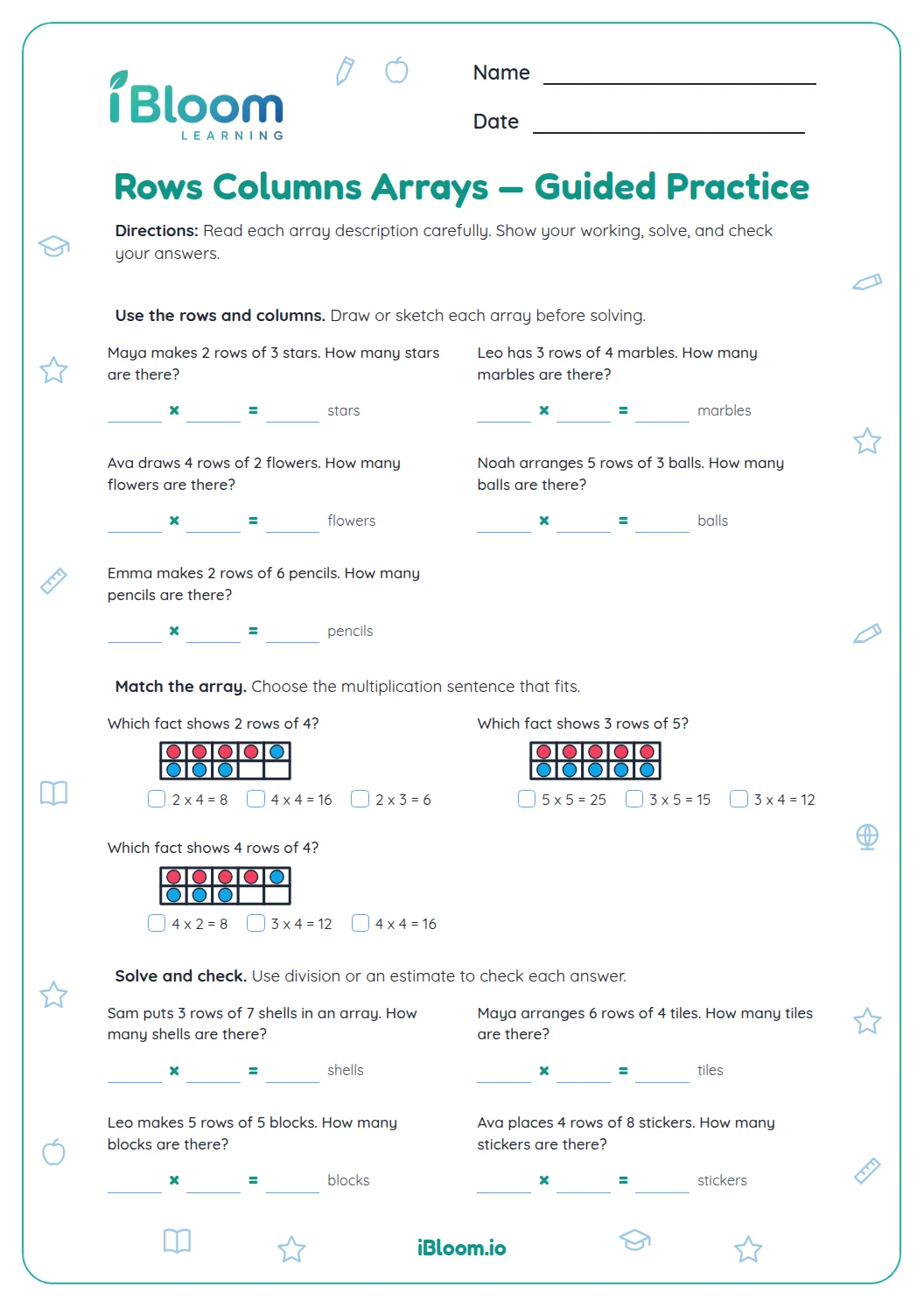
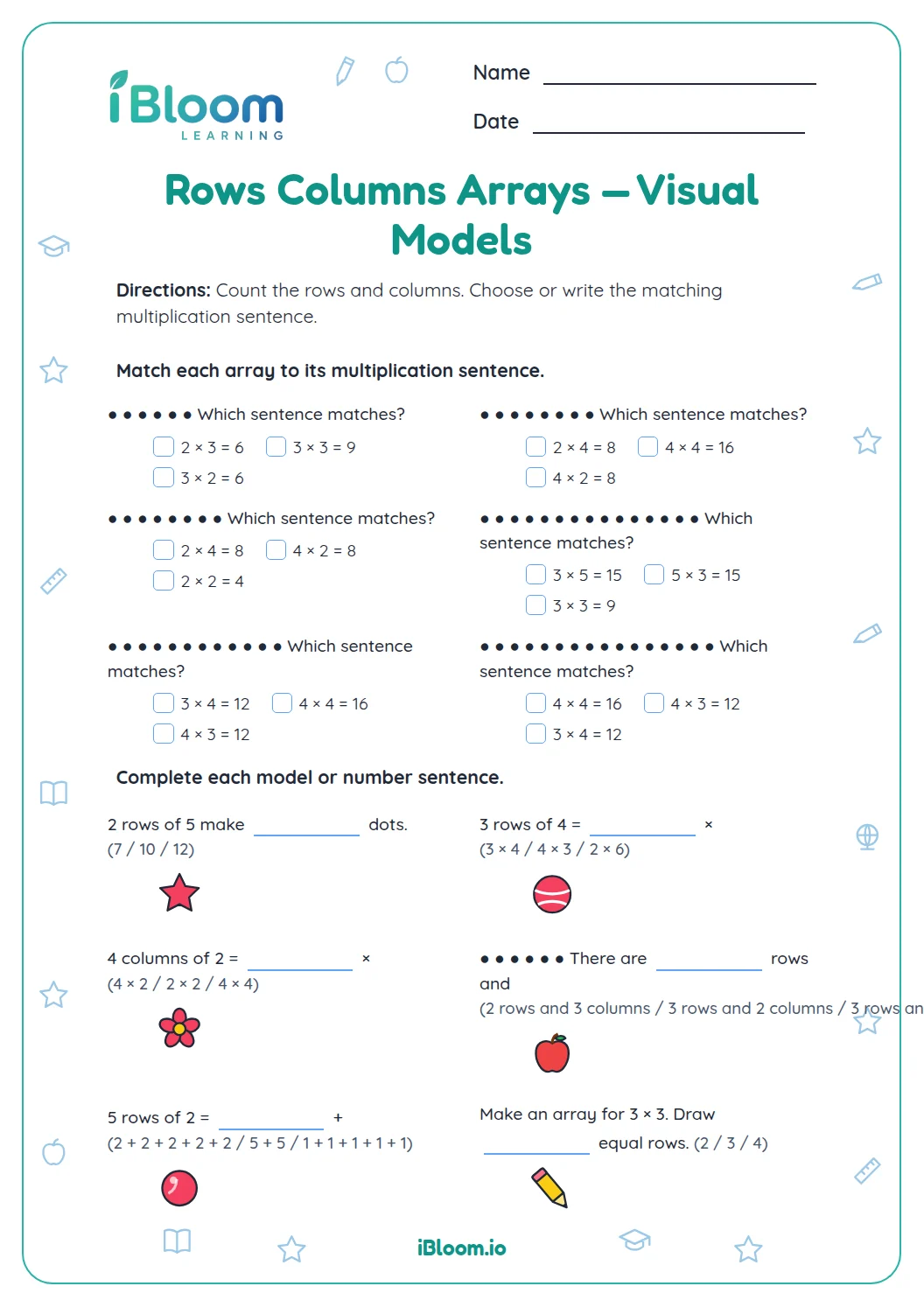
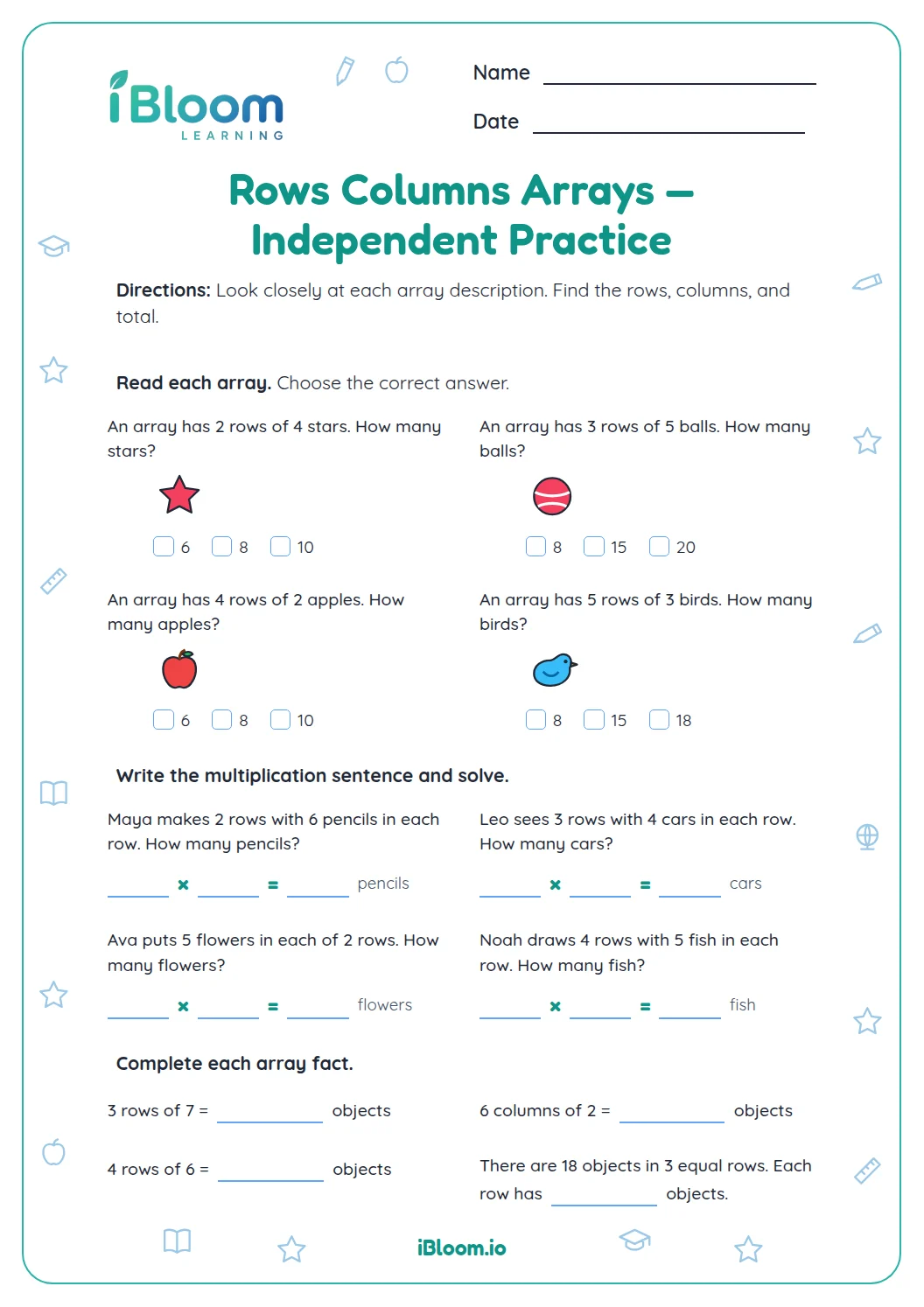
This free printable Grade 2 worksheet uses rectangular arrays to make equal groups visible. Children count rows and columns, find totals with multiplication facts, and write an addition equation with equal addends for each row. The practice aligns with Common Core 2.OA.C.4, which connects arrays to finding totals and writing equal-addend equations. All models have five or fewer rows and columns, and the answer key is on separate pages.
Aligned to 2.OA.C.4
How do you read a rectangular array?
An array is a set of objects lined up in equal rows and columns. Count the objects in one row, then count how many rows there are. Adding the rows gives the total.
For question 3, the model has 4 rows with 2 dots in each row. Add 2 + 2 + 2 + 2 to get 8 dots. The columns offer another way to organize the same array.
- 14 rows of 2 dots
- 22 + 2 + 2 + 2
- 38 dots altogether
How does an array show a multiplication fact?
Multiplication is a compact way to name equal groups. In question 6, the array has 3 rows of 4 dots, so 3 × 4 = 12. The first factor tells how many rows; the second tells how many dots are in each row.
Count the model if the fact is new. With practice, children may recognize familiar arrays without counting each dot. The answer key gives the product for every model.
What is an equal-addend equation?
An equal-addend equation adds the same number once for each row. A 4-by-4 array has four rows of four, so its row equation is 4 + 4 + 4 + 4 = 16.
For the last five questions, write one addend per row and finish with the total. Keep the row size as the addend; the number of rows tells how many times it appears.
What practice is on the worksheet?
The worksheet moves from reading totals to recording what the arrays show. Every question includes its own array, and the separate answer key lists the totals, products, and equal-addend equations.
- Part A: count objects in five arrays.
- Part B: use five arrays to complete multiplication facts.
- Part C: write five equal-addend equations, one addend per row.
How to work through the array practice
- 1Look across one row and count its objects.
- 2Count the rows from top to bottom.
- 3Add the same row count once for each row to find the total.
- 4For Part B, match the row count and row size to the two factors.
- 5For Part C, write the row size repeatedly, once per row, then add to check the total.
Array mistakes to watch for
The mistake
Counting only the objects in one row and stopping.
The fix
Count how many rows there are, then add the row size once for every row.
The mistake
Switching the number of rows and the number in each row.
The fix
Point down the array to count rows, then across one row to count objects per row.
The mistake
Writing unequal addends for an equal array.
The fix
Use the same addend each time; it matches the number of objects in one row.
Common Core alignment
This worksheet practices representing equal groups with rectangular arrays and addition.
Find array totals and write an addition equation with equal addends.
On this sheet: Children find totals in arrays of at most five rows and columns, then record equal-addend equations.
Show the official wordingHide the official wording
Use addition to find the total number of objects arranged in rectangular arrays with up to 5 rows and up to 5 columns; write an equation to express the total as a sum of equal addends.
What to practice next
Make more practice
Further reading
Questions parents and teachers ask
What does an array show?
An array shows objects arranged in equal rows and columns. A child can count each object, add the equal rows, or use the row and column counts to name a multiplication fact. Every question on this worksheet includes an array to read.
How do I find the total in an array?
Count how many objects are in one row, then count the rows. Add the row size once for each row. For example, four rows with two objects in each row make 2 + 2 + 2 + 2, or 8 altogether.
Which factor tells the number of rows?
On this worksheet, the first factor tells the number of rows, and the second factor tells how many objects are in each row. For an array with 3 rows of 4 dots, write 3 × 4 = 12. The model makes both groups visible.
What should my child write for an equal-addend equation?
Write one addend for each row, using the number of objects in a row as the repeated addend. A model with 3 rows of 5 becomes 5 + 5 + 5 = 15. Count the rows to check how many addends to include.
How many questions and pages are included?
There are 15 questions in three parts, followed by an answer key. The parts ask children to count array totals, complete multiplication facts, and write equal-addend equations. Print the key separately if you want to keep answers out of view.
What does the answer key include?
The answer key gives the total for each array, the completed product for each multiplication fact, and a matching equal-addend equation for each final model. For the last part, the addends follow the rows, so the key also shows how the model maps to the equation.