


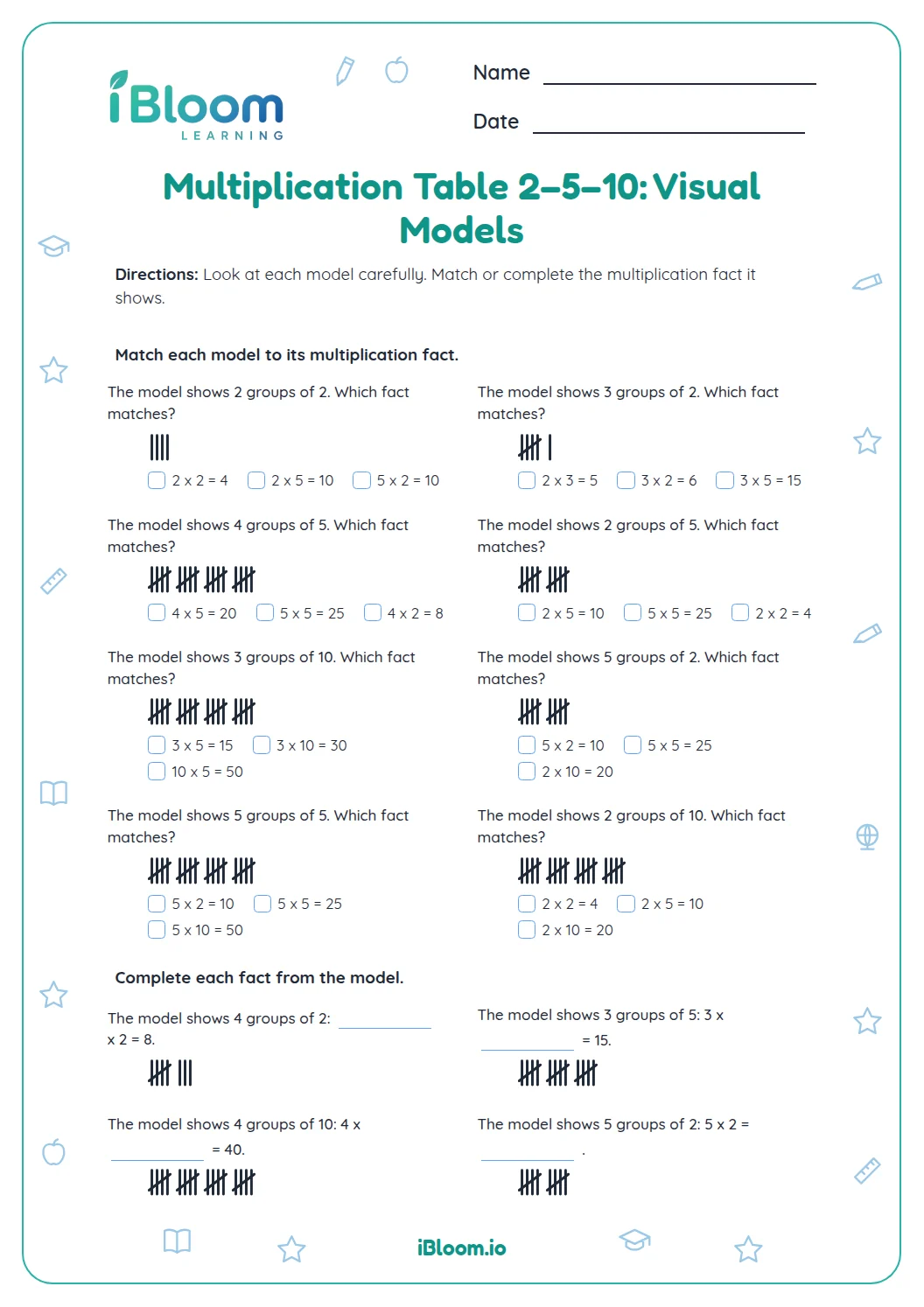
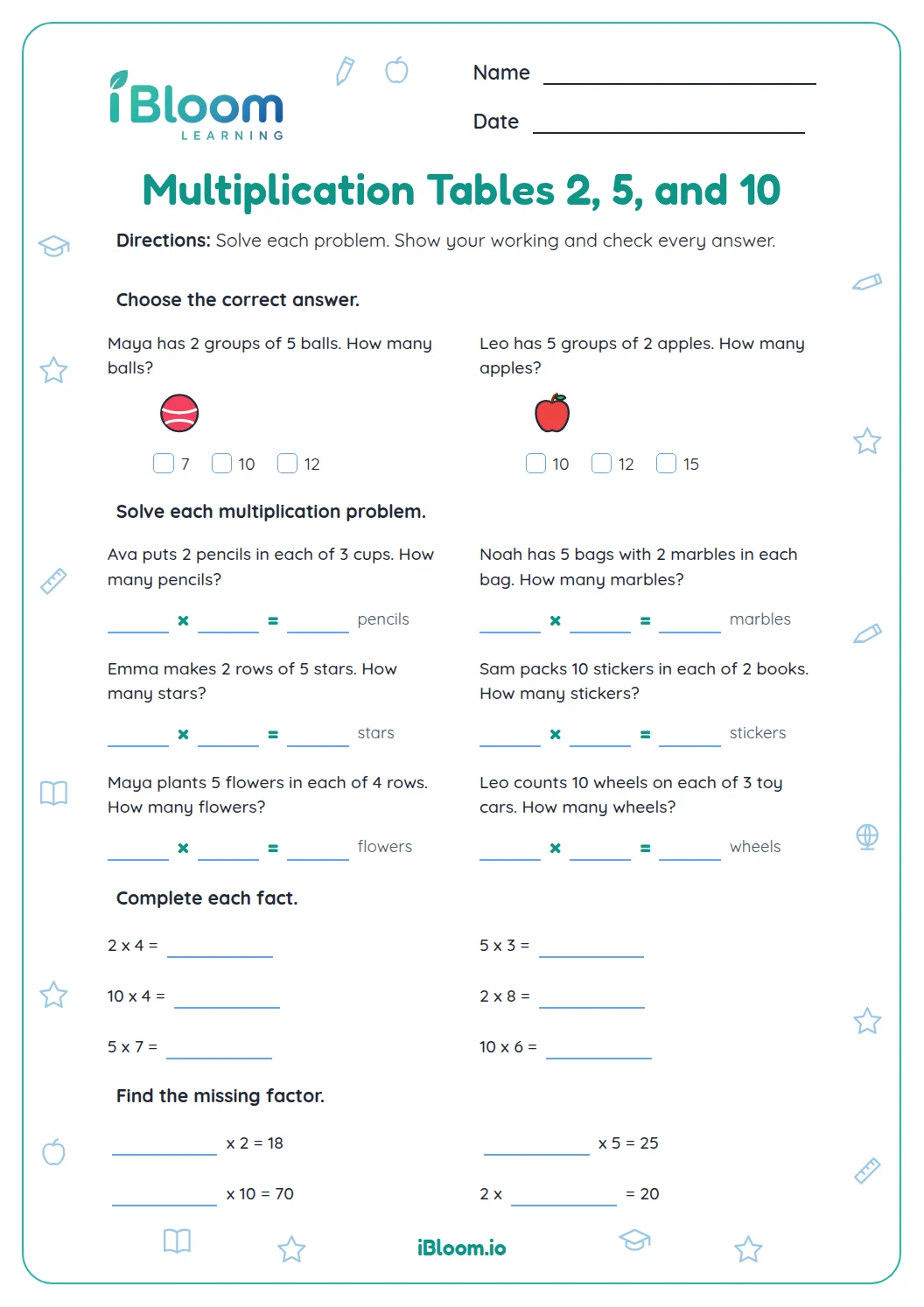
About this worksheet
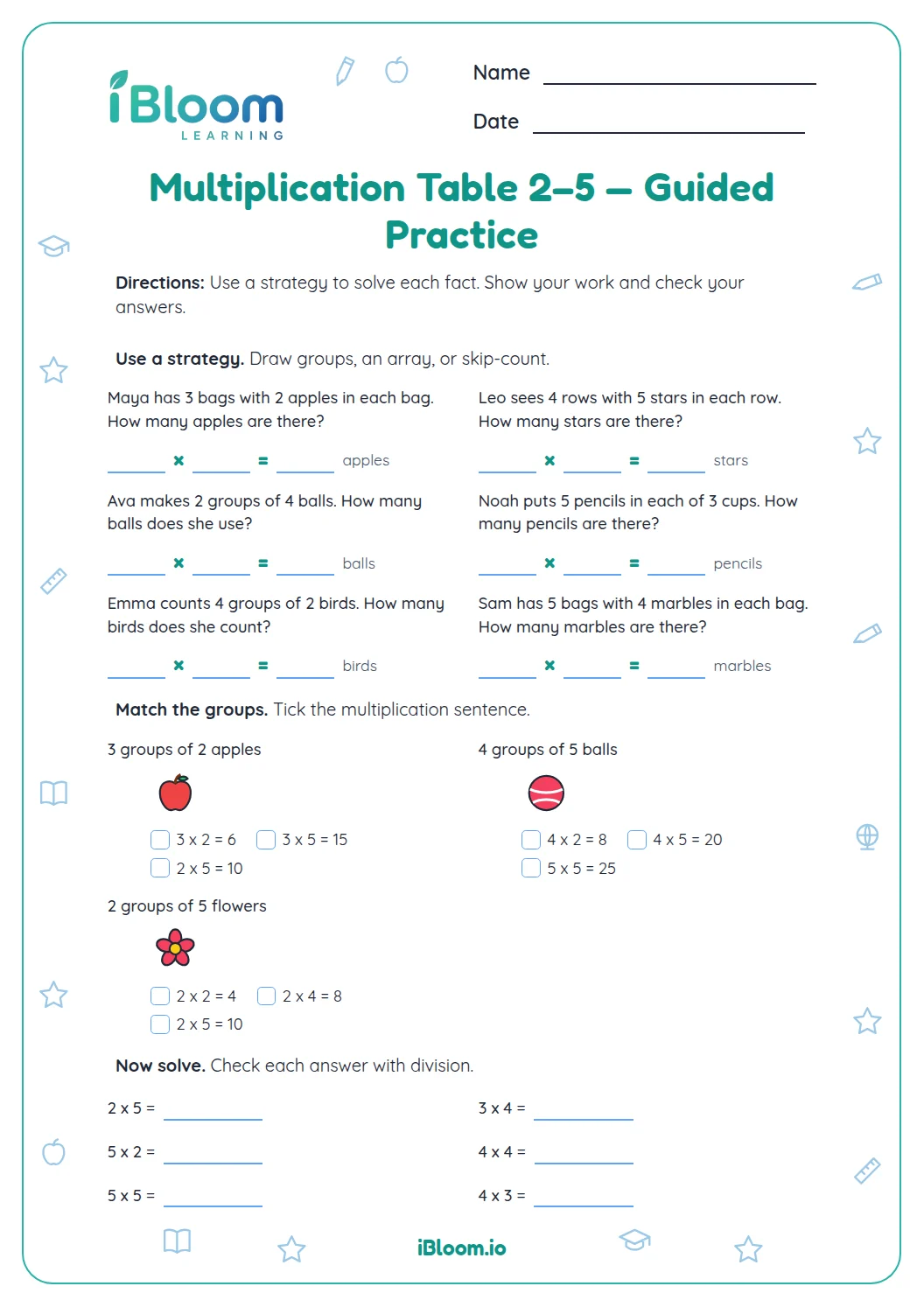
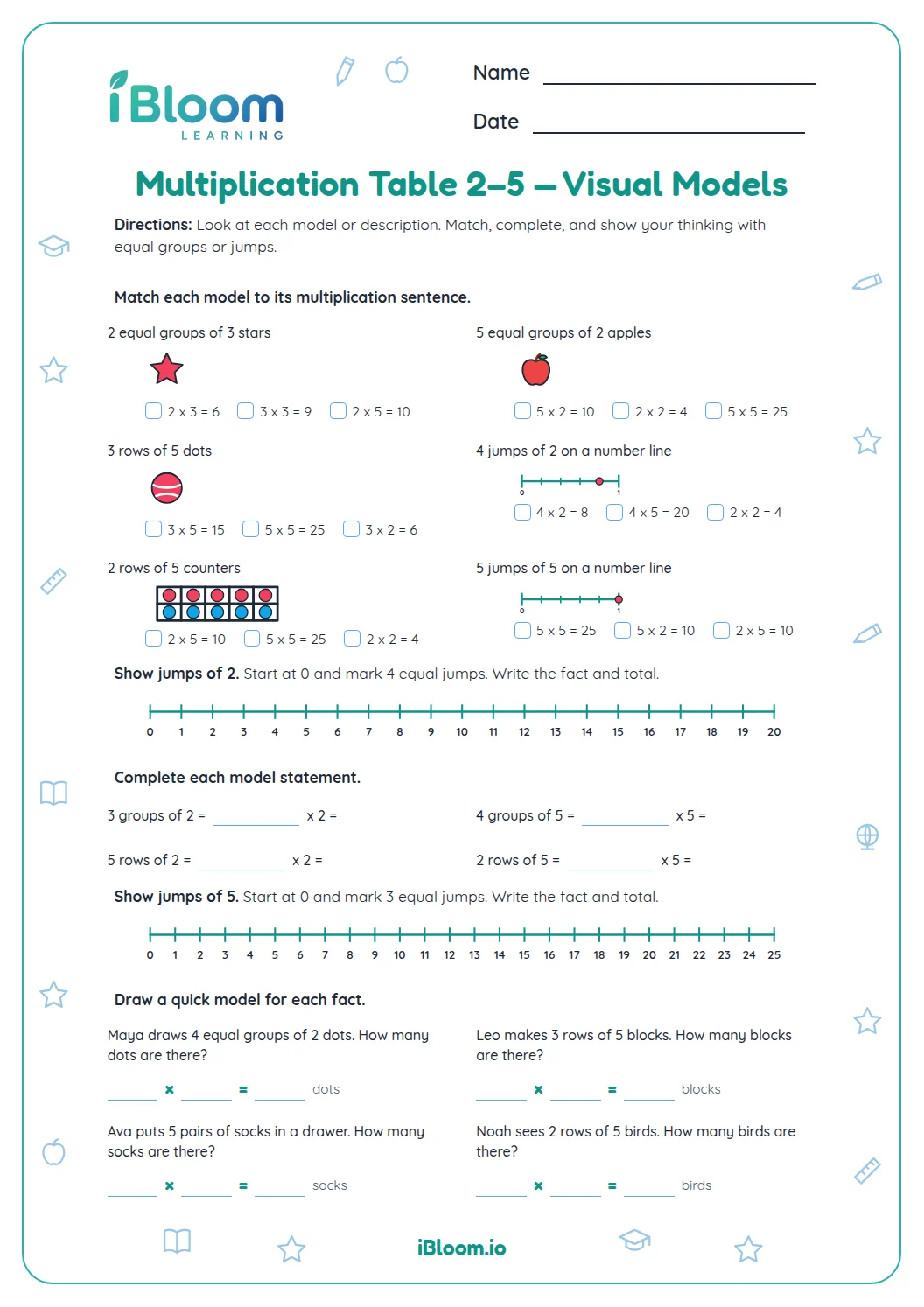
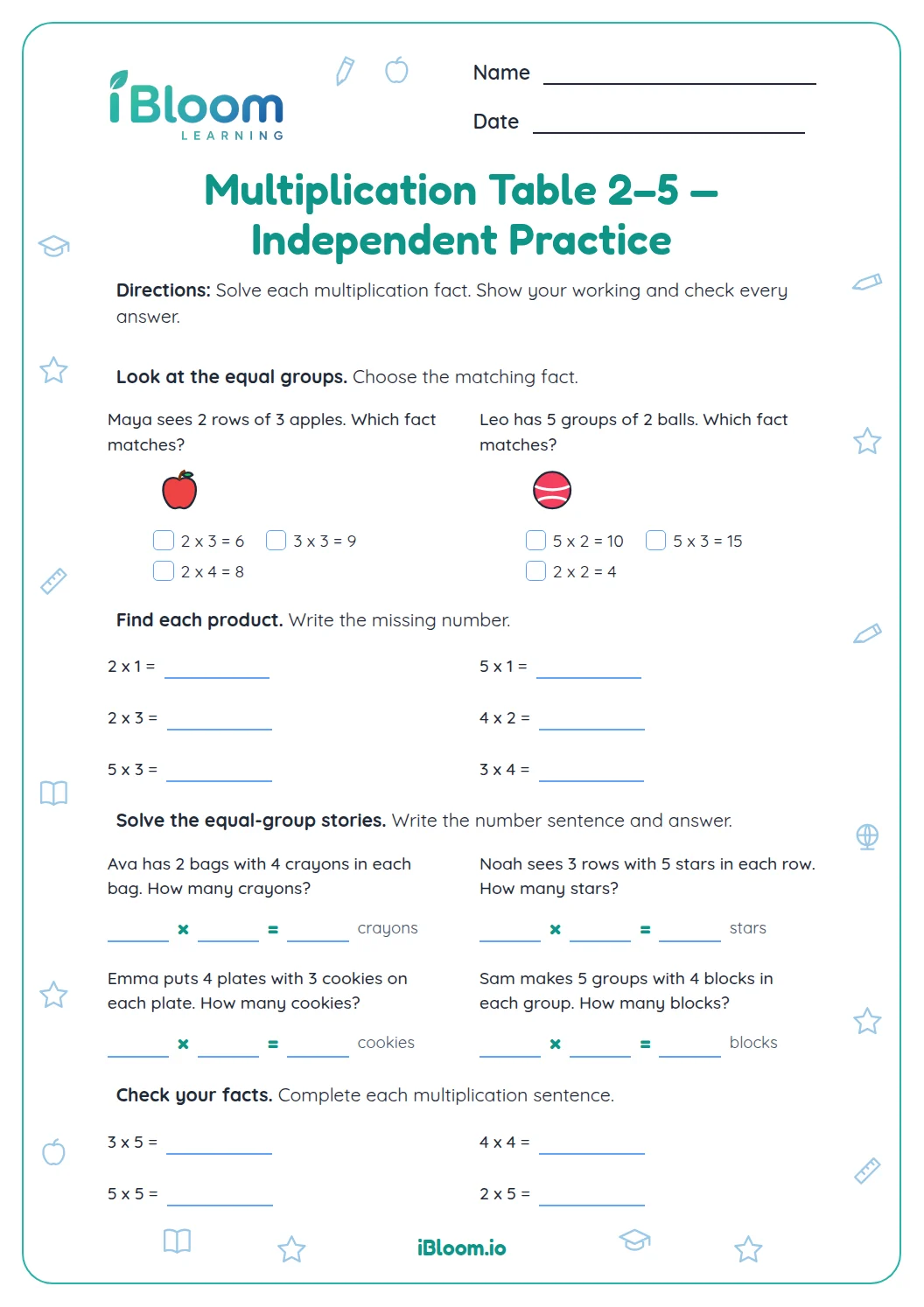
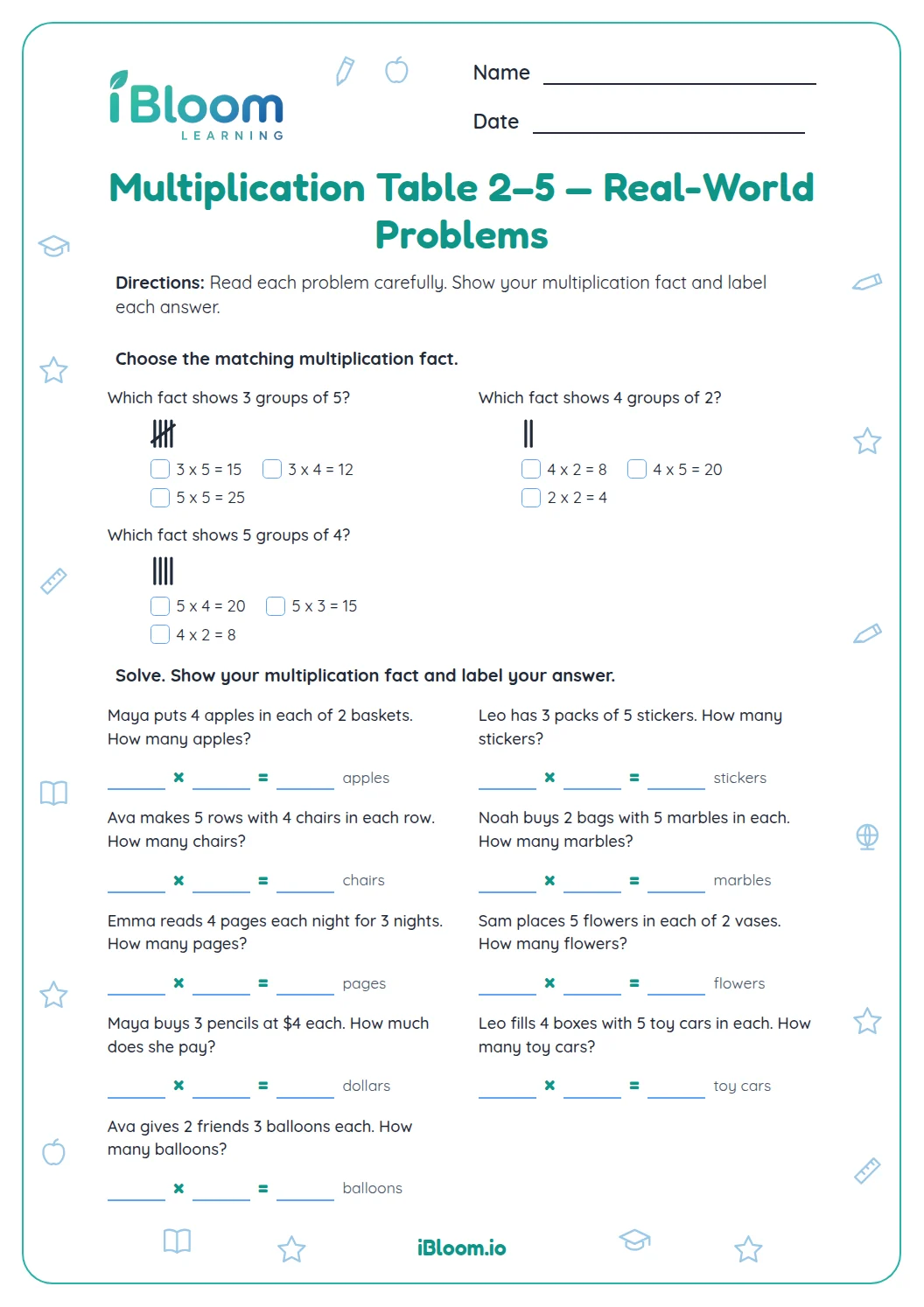
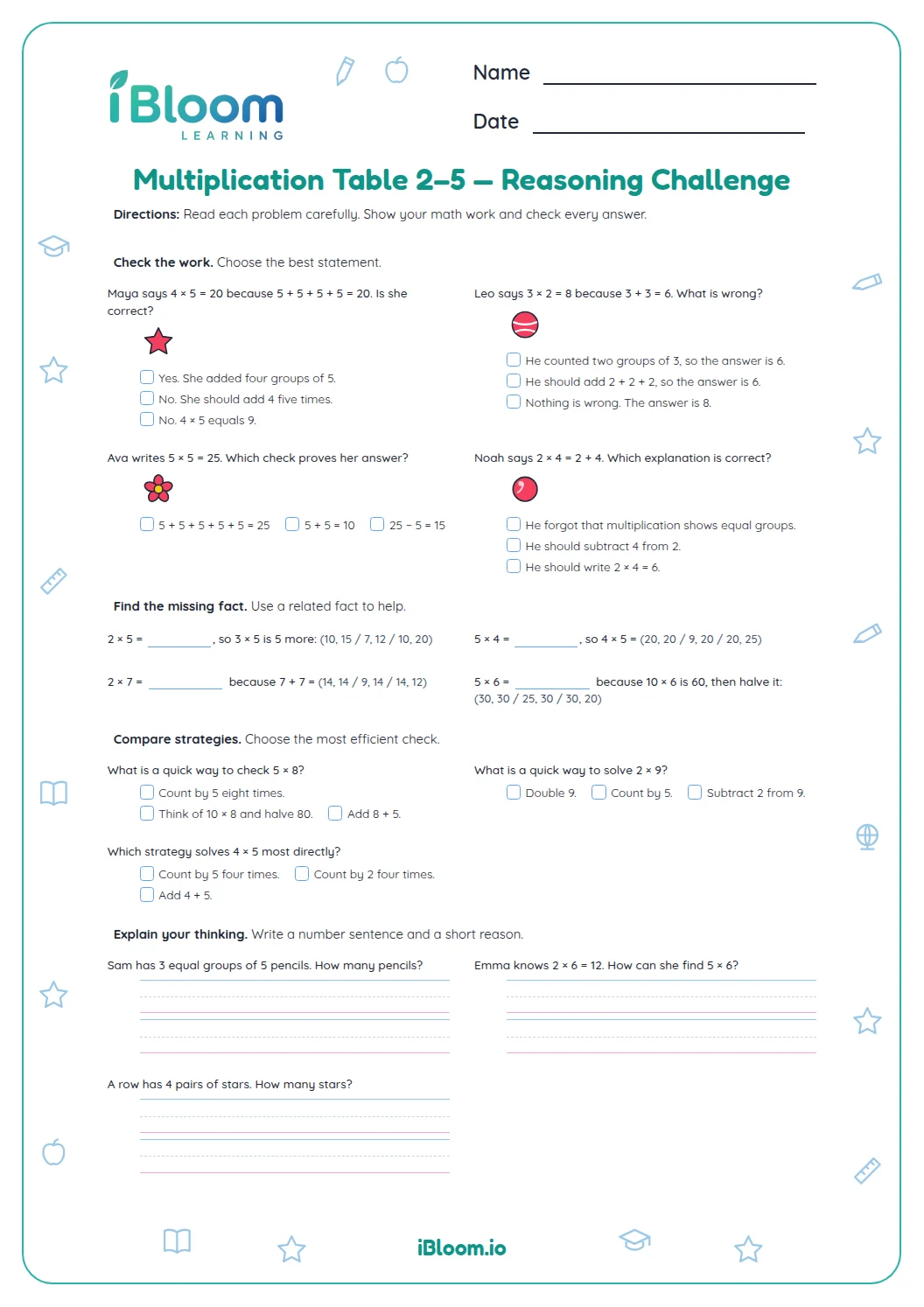
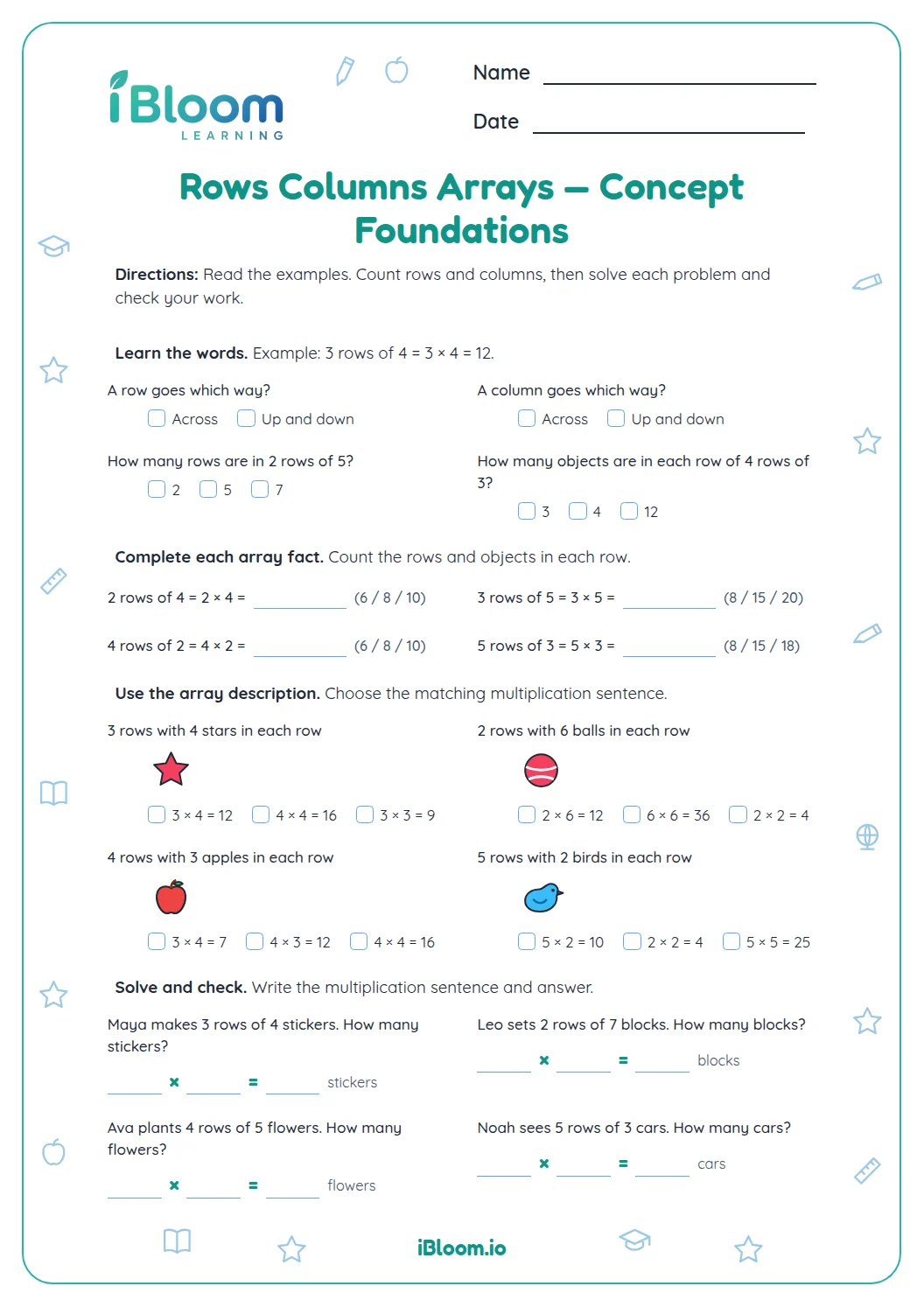
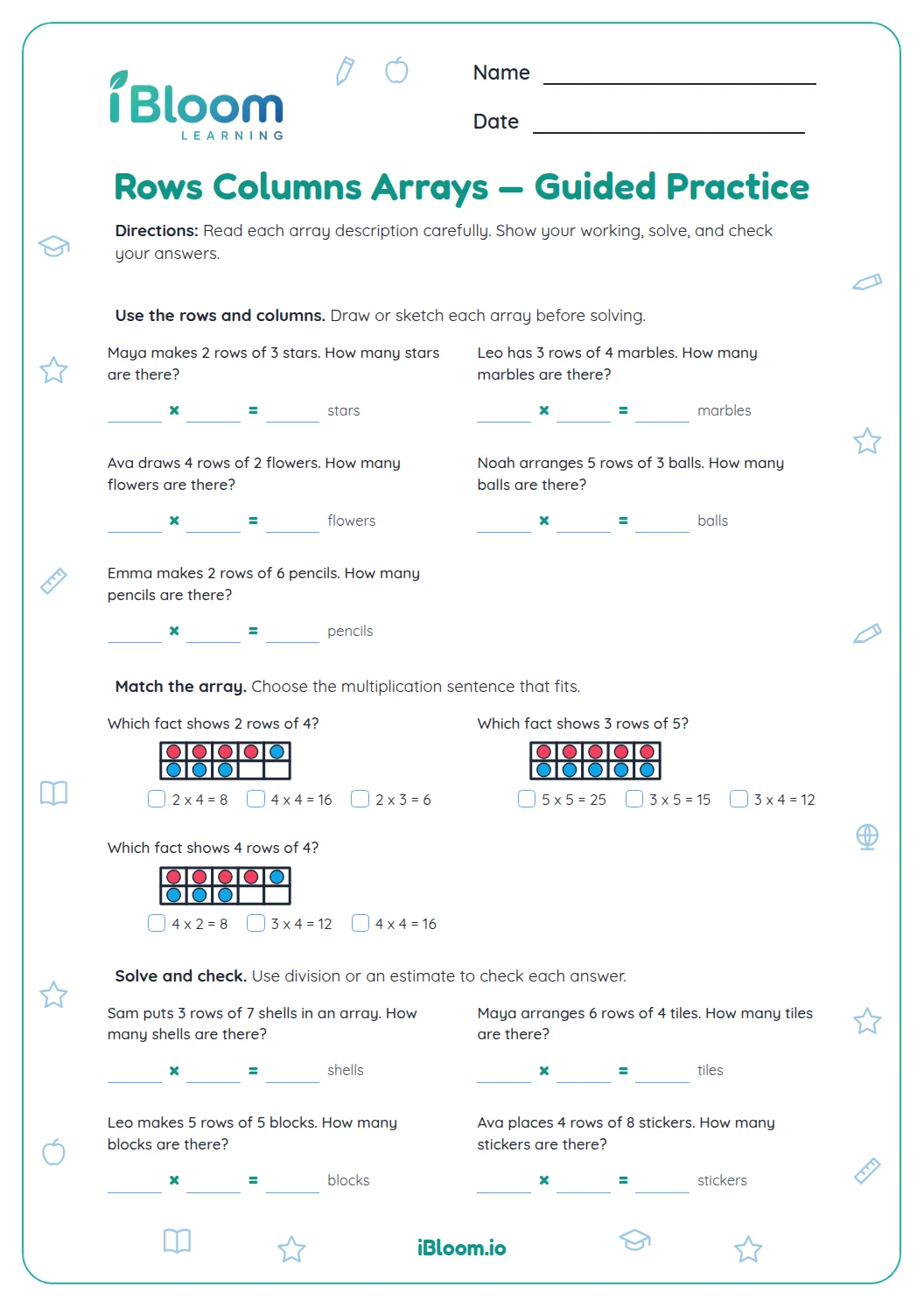
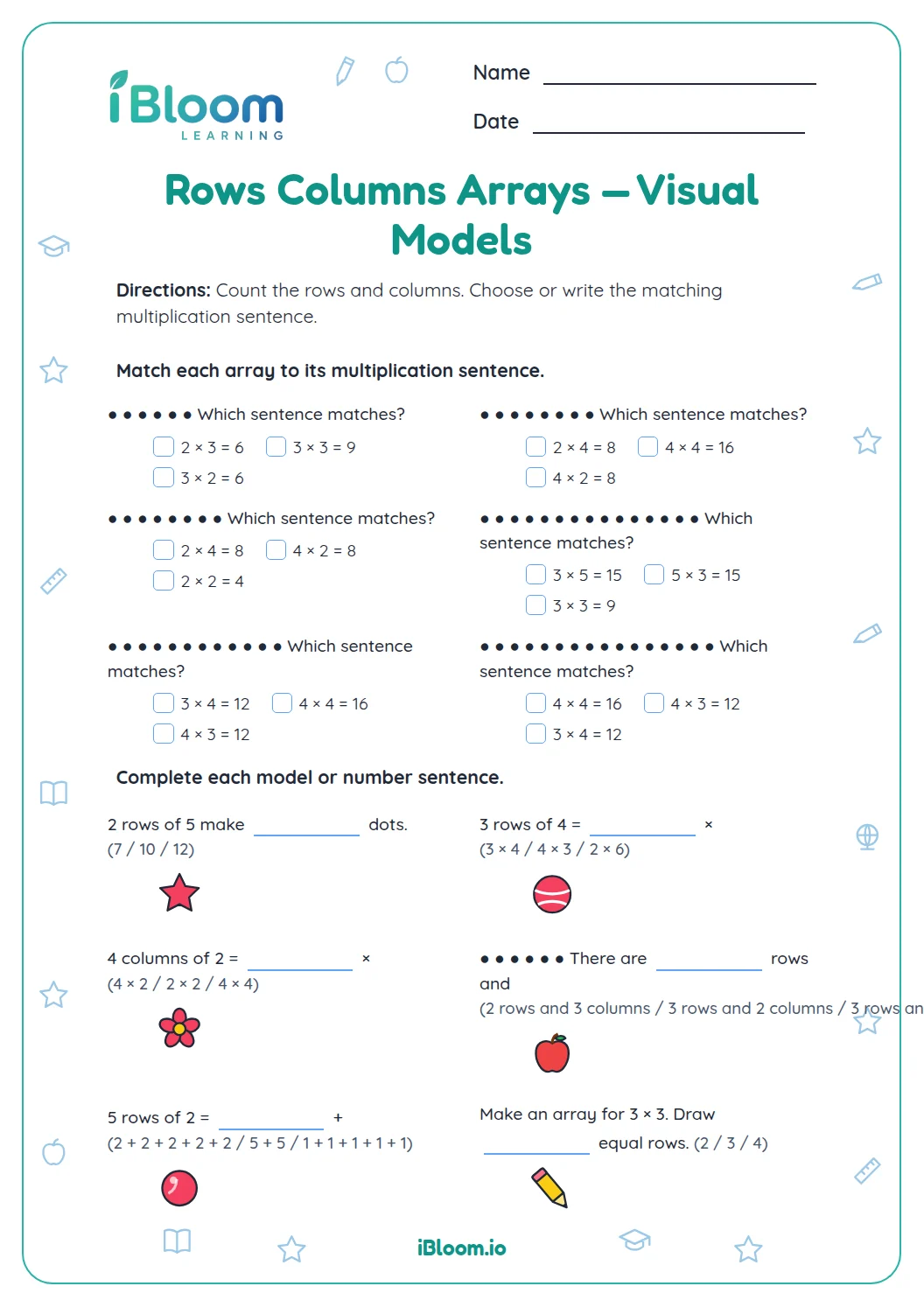
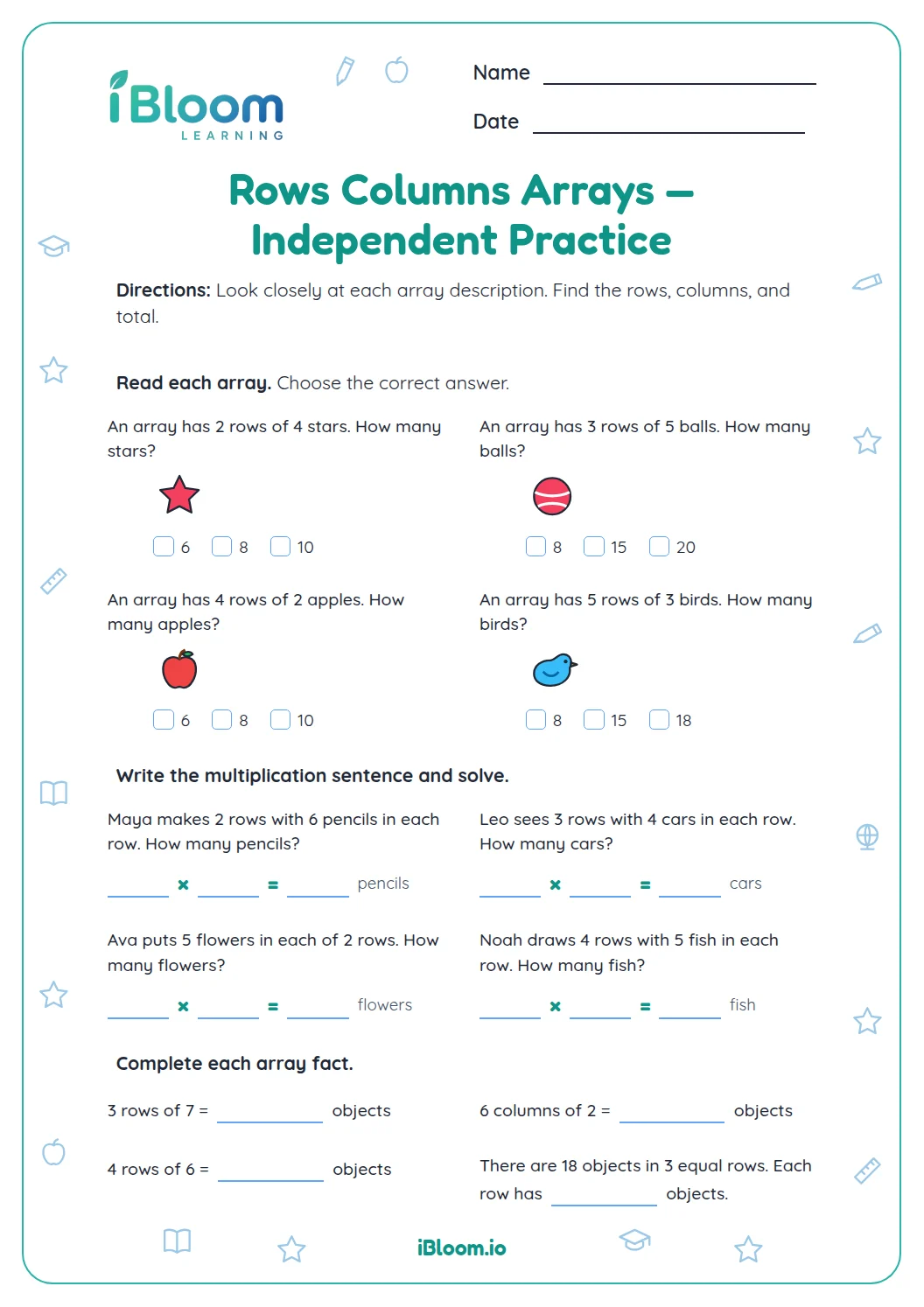
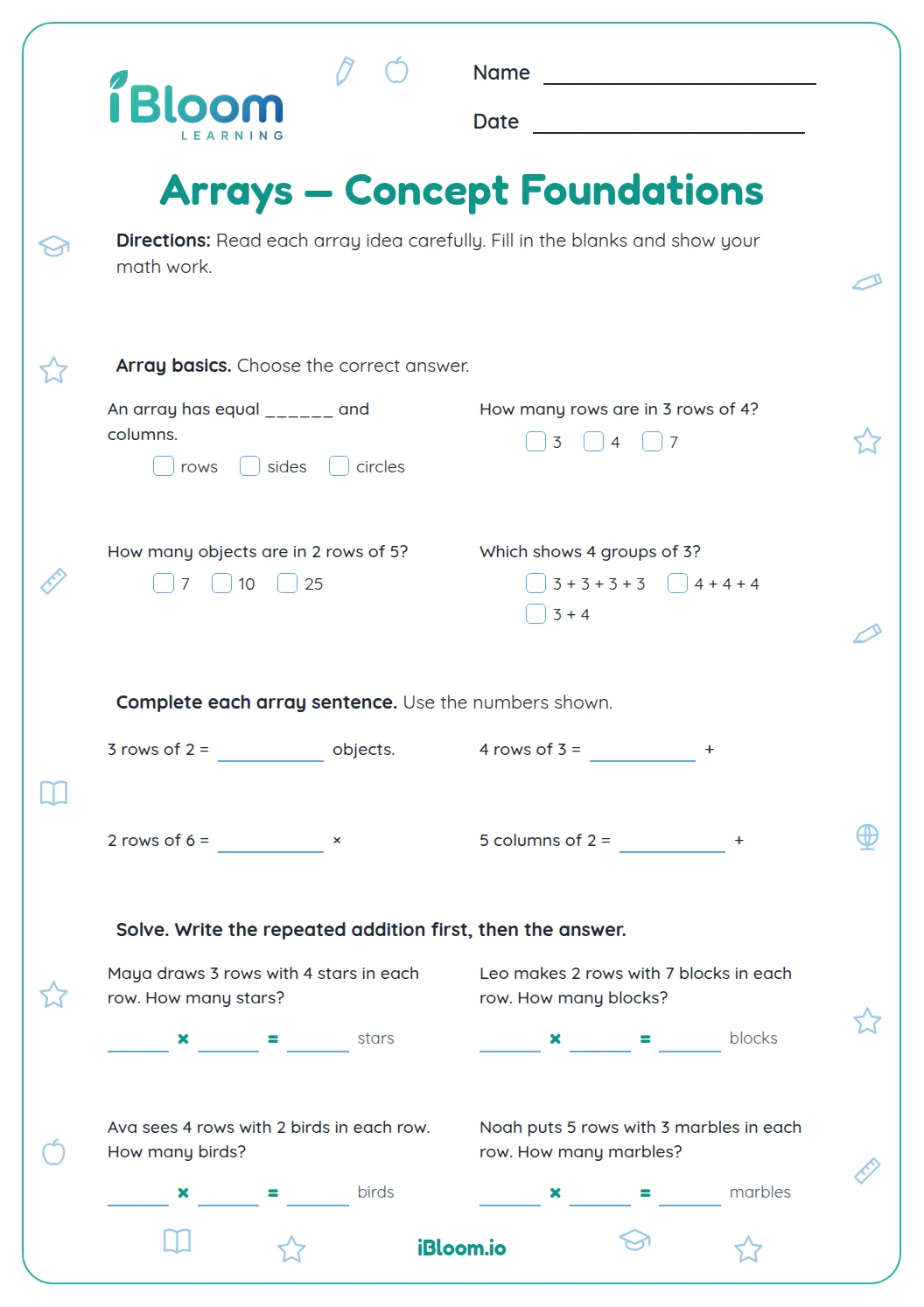
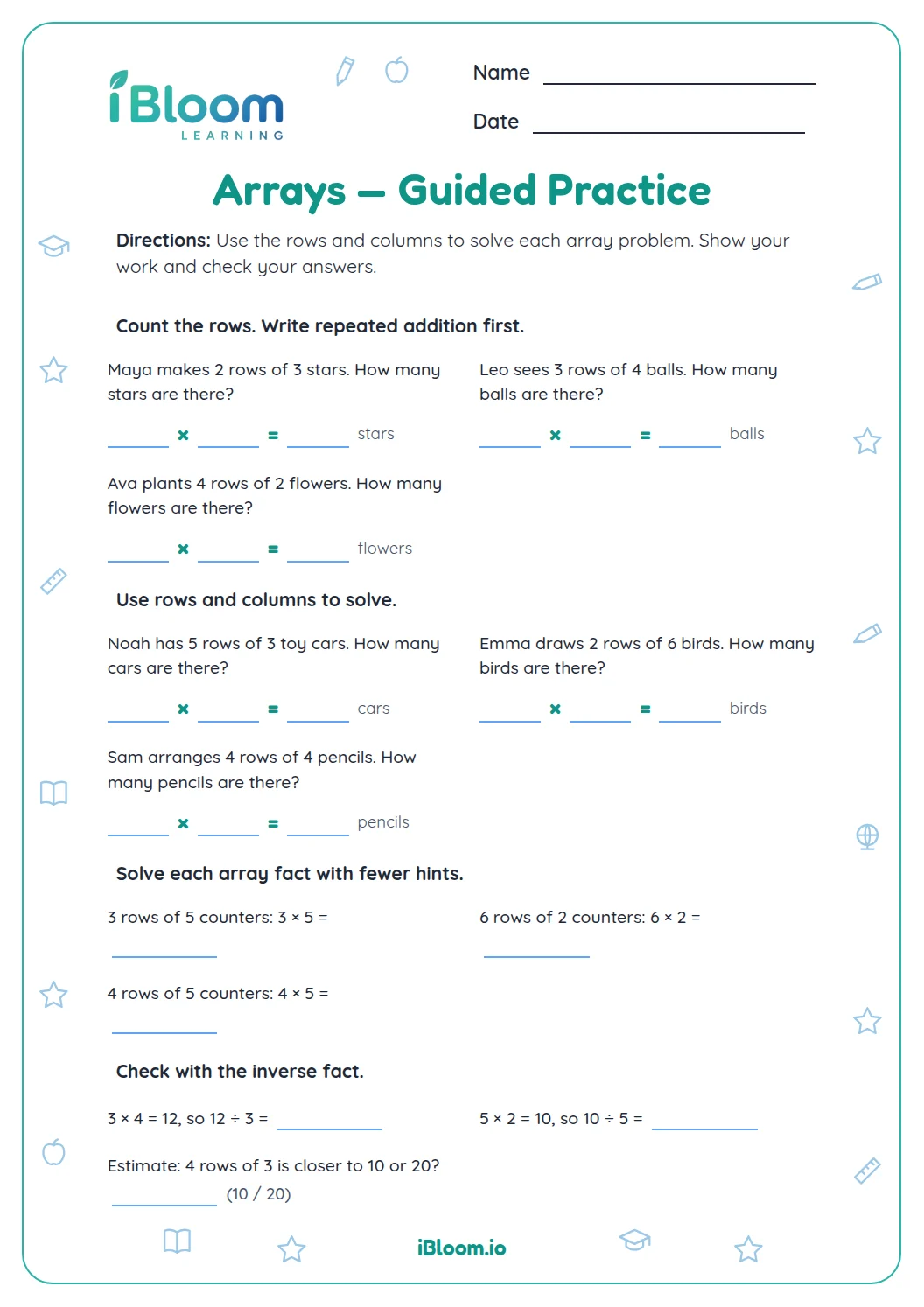
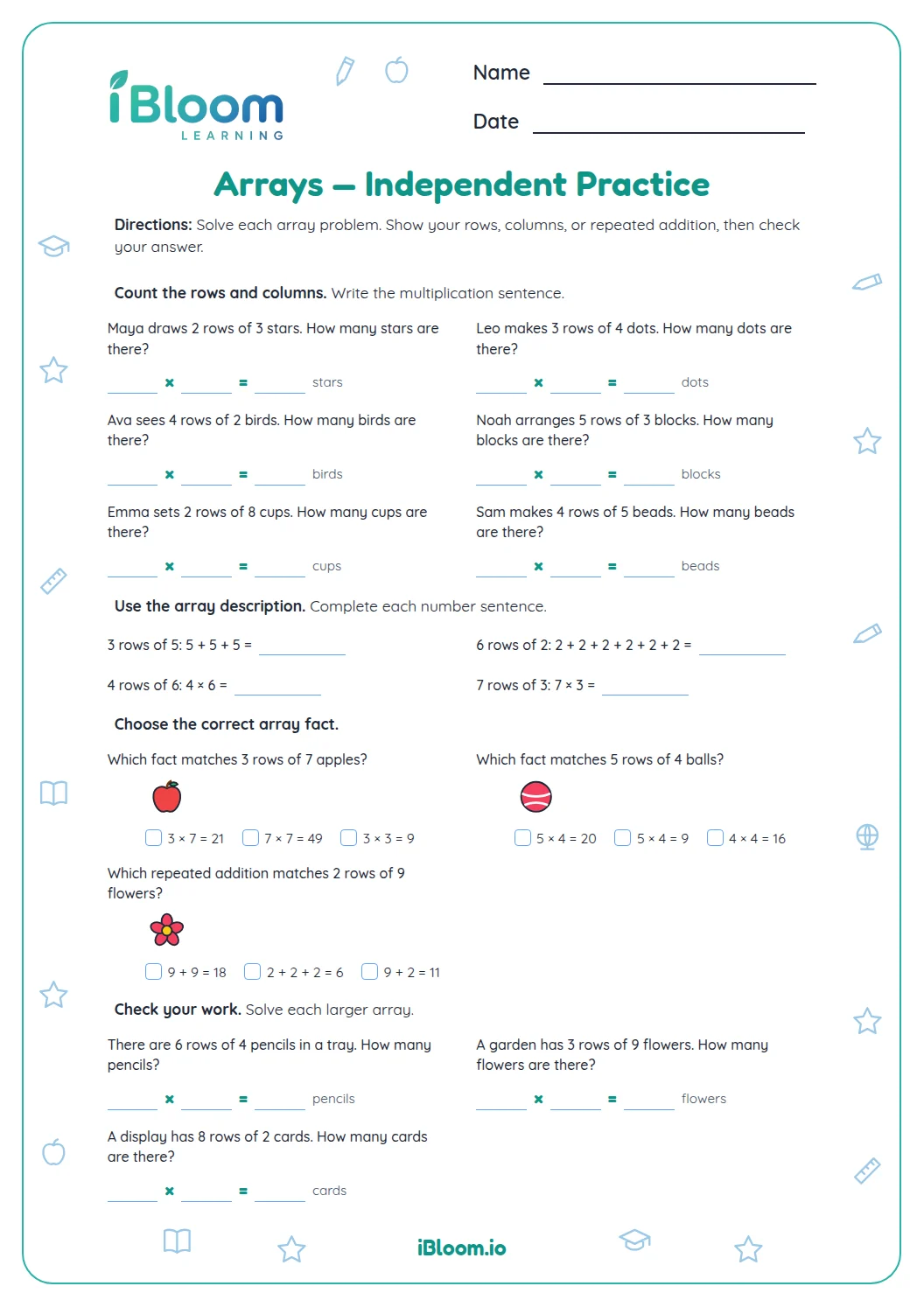
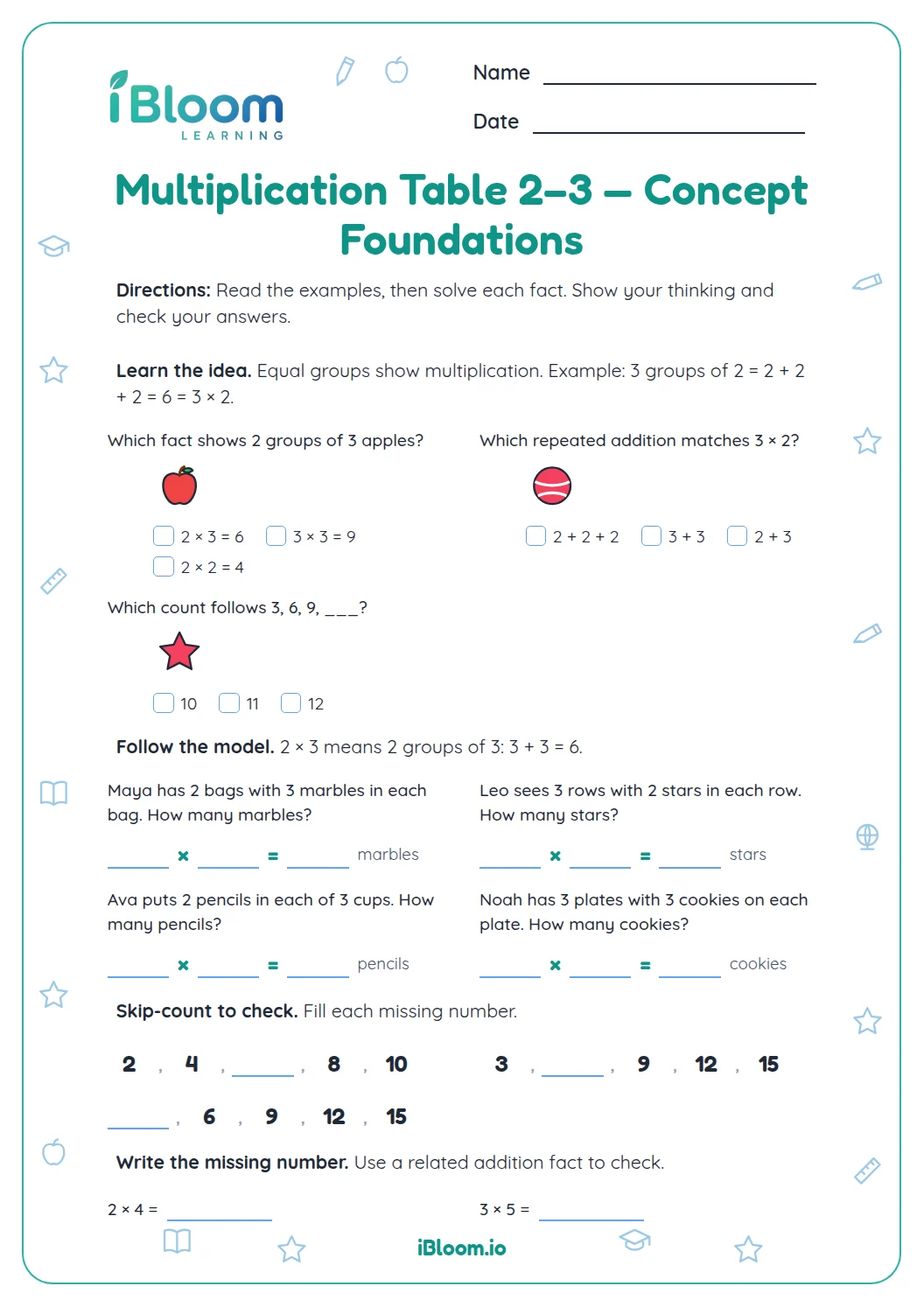
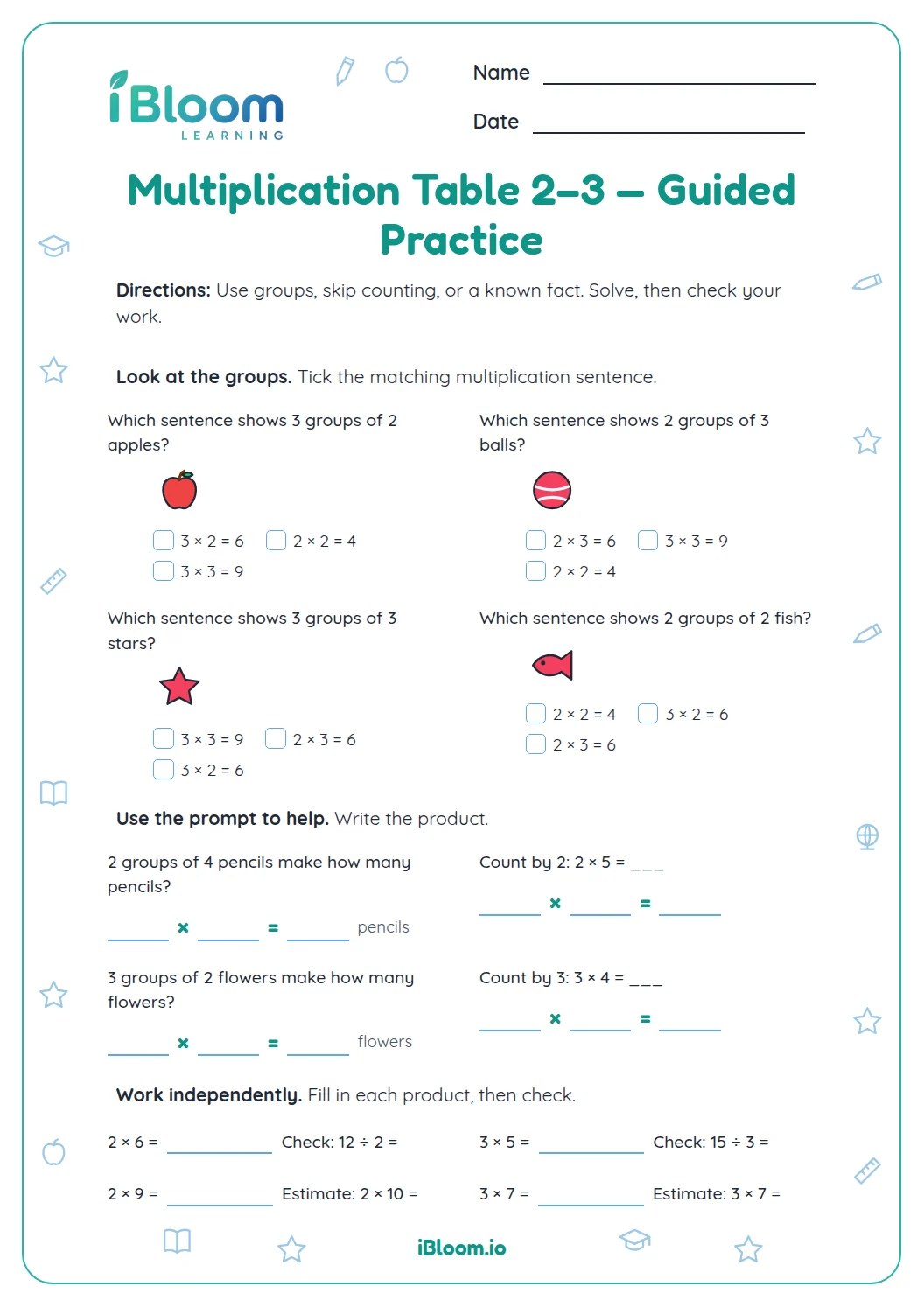
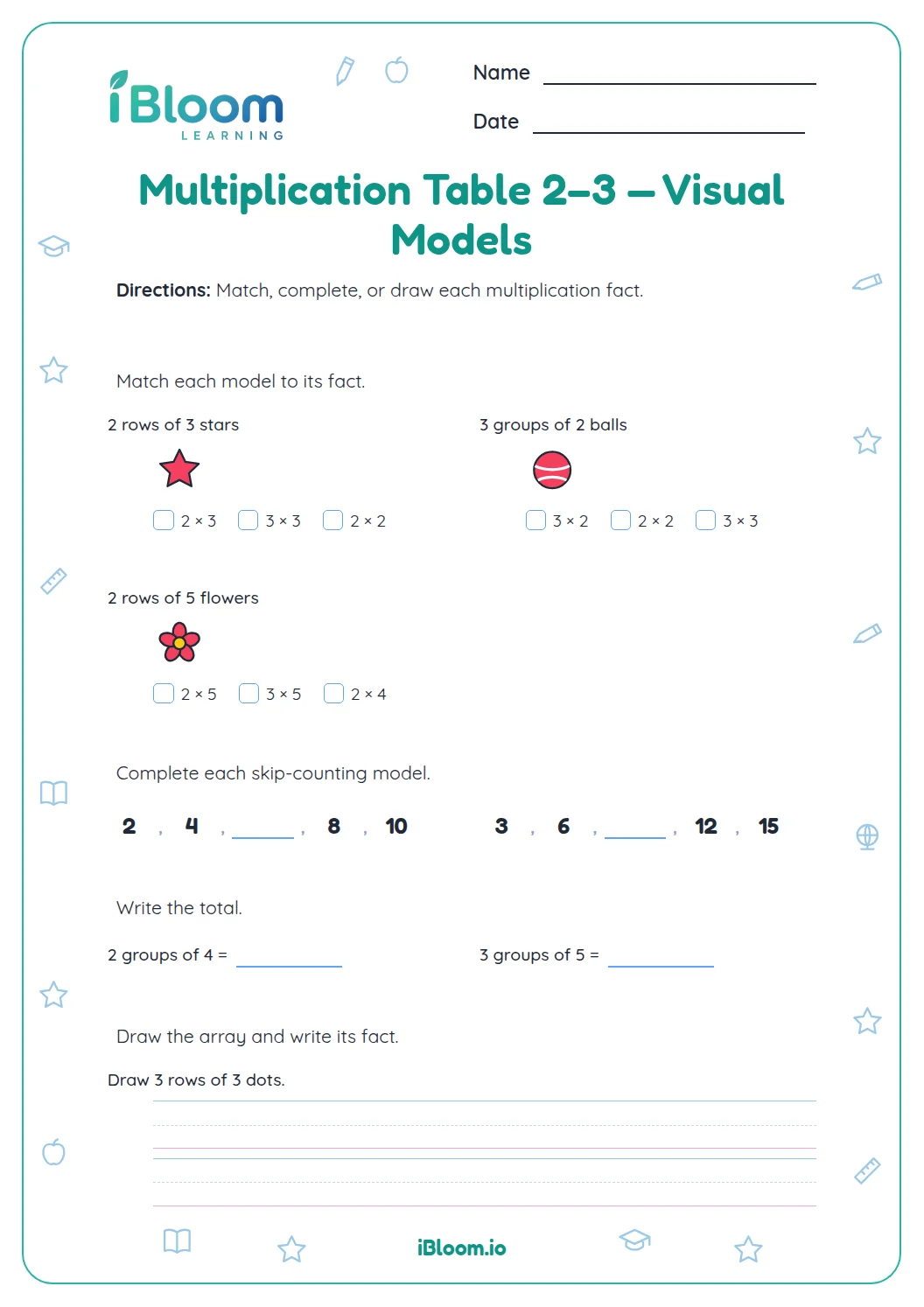
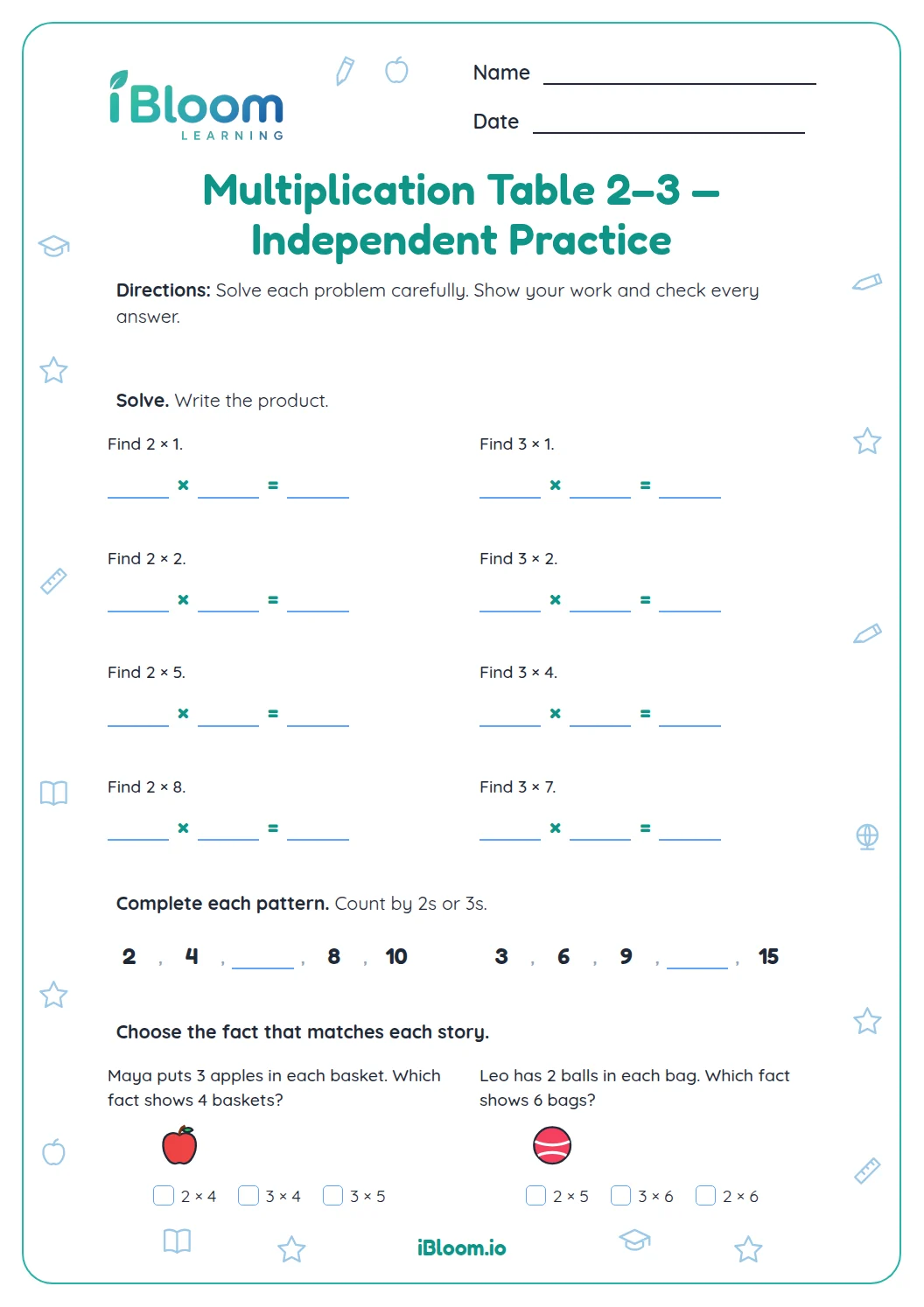
This free printable Grade 2 worksheet builds multiplication meaning with equal groups of 2, 3, 4, and 5. Part A shows four dot arrays and asks children to write a repeated-addition equation for each. Part B connects equal groups to multiplication sentences. Part C applies the same thinking to pairs of socks, toy cars, markers, and stickers. All fourteen questions stay with small totals that children can check by adding equal groups. The array work practices Common Core 2.OA.C.4, and a separate answer key gives the equations and totals.
Aligned to 2.OA.C.4
What does each row tell a child?
A row runs across the page. In Part A, every row in an array has the same number of dots. Children write one addend for each row, then add to find the total.
The four arrays contain groups of 2, 3, 4, and 5. Have the child slide a finger under one complete row before moving to the next row.
How does repeated addition become multiplication?
The number of equal groups and the amount in each group describe the multiplication sentence. On this worksheet, read the first factor as the number of groups and the second as the number in each group.
- 12 rows, with 4 dots in each row.
- 2Write one 4 for each row: 4 + 4 = 8.
- 3The same groups can be written as 2 × 4 = 8.
How do children use the same idea in word problems?
Part C names equal groups in everyday objects. For the socks problem, five pairs means five groups of two. A child can write 2 + 2 + 2 + 2 + 2 = 10 or 5 × 2 = 10.
Accept an accurate addition or multiplication equation in Part C. Include the object in the final answer so the total keeps its meaning: 10 socks, for example.
How to use this worksheet
- 1Point to one row in the first array and count its dots.
- 2Write one addend for each row; check that the number of addends matches the number of rows.
- 3Read each Part B prompt as groups of a fixed size before finding the total.
- 4Underline the number of groups and group size in each Part C problem.
- 5Check totals with the key, rebuilding any missed group with small objects.
Mistakes to notice and fix
The mistake
Writing 3 + 2 = 5 for three rows of two dots.
The fix
Write a 2 for each row: 2 + 2 + 2 = 6. The two numbers describe different features of the array.
The mistake
Counting one row twice when moving between rows.
The fix
Touch or lightly mark each row after including its addend.
The mistake
Reading five pairs of socks as five socks.
The fix
Build five pairs with counters and count two counters for every pair.
Common Core alignment
Use equal rows to write repeated-addition equations and find totals.
On this sheet: Part A asks children to write equal-addend equations for arrays with 2 to 5 objects in each row.
Show the official wordingHide the official wording
Use addition to find the total number of objects arranged in rectangular arrays with up to 5 rows and up to 5 columns; write an equation to express the total as a sum of equal addends.
What to practice next
Make more practice
Further reading
Questions parents and teachers ask
Does 2–5 include the 3 and 4 tables?
Yes, this worksheet practices groups of 2, 3, 4, and 5. Each appears in an array, a multiplication sentence, and a word problem. The repeated structure lets children compare group sizes while using the same strategy of adding equal amounts to find a total.
What should children write for the arrays?
Children should write a complete addition equation with one addend for each row. For three rows of two dots, that is 2 + 2 + 2 = 6. Ask the child to point from each written 2 to its row so the equation matches the drawing.
Can my child use counters?
Yes, counters can help a child rebuild any array or equal-group situation. Keep the rows straight and give each row the same number of counters. Then match each row to one addend. Move to the printed dots when the child can explain how the groups make the total.
Do the word problems require multiplication equations?
An accurate addition or multiplication equation works for Part C. For four packs of five stickers, a child can write 5 + 5 + 5 + 5 = 20 or 4 × 5 = 20. Both show the equal groups and support the final answer of 20 stickers.
How does the answer key help with teaching?
The key gives the repeated-addition equations for all four arrays and the totals for the remaining questions. Use it after the child has worked, then ask for an explanation of one answer. If a total differs, rebuild the groups and compare each row or group with the equation.