



About this worksheet
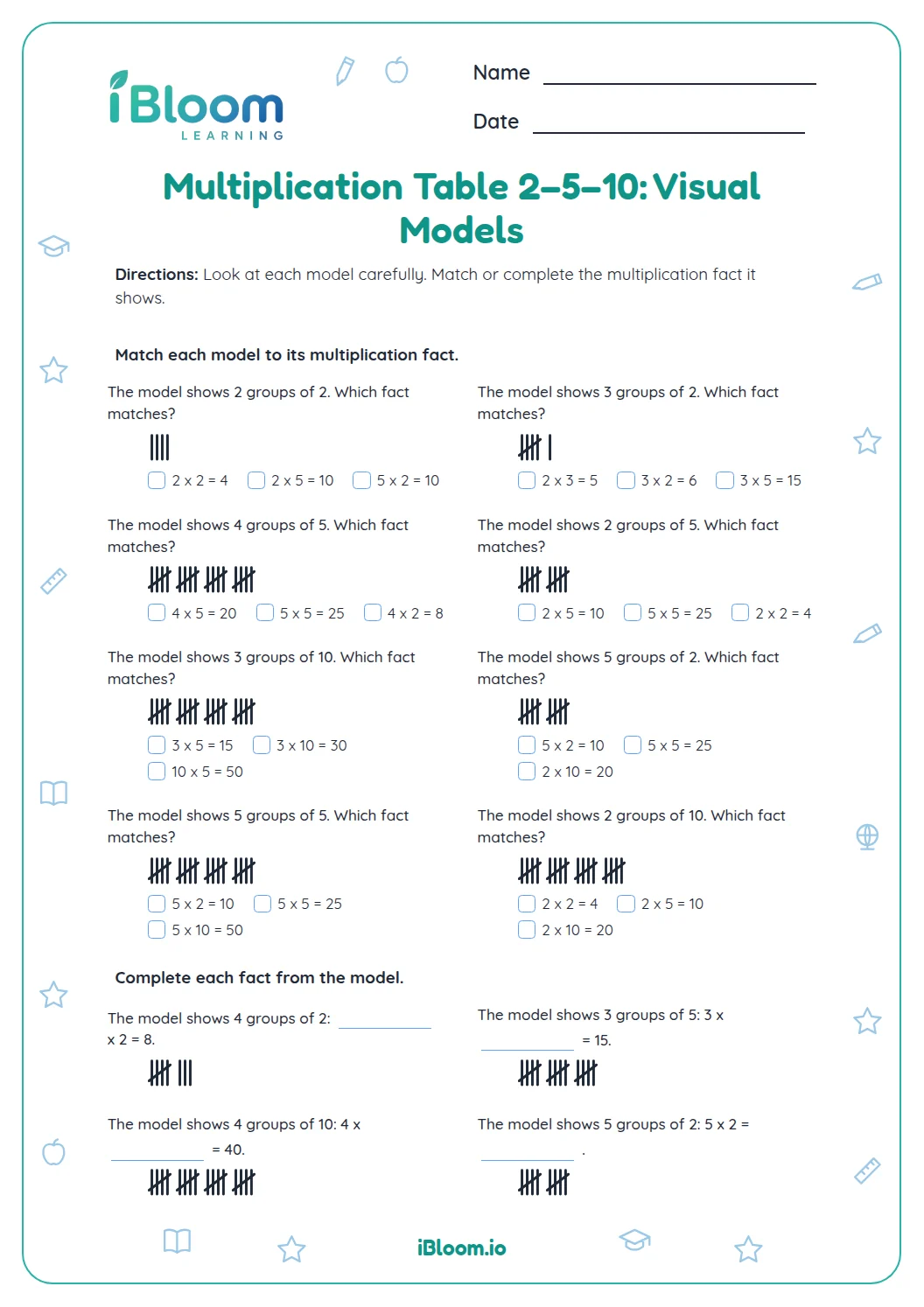
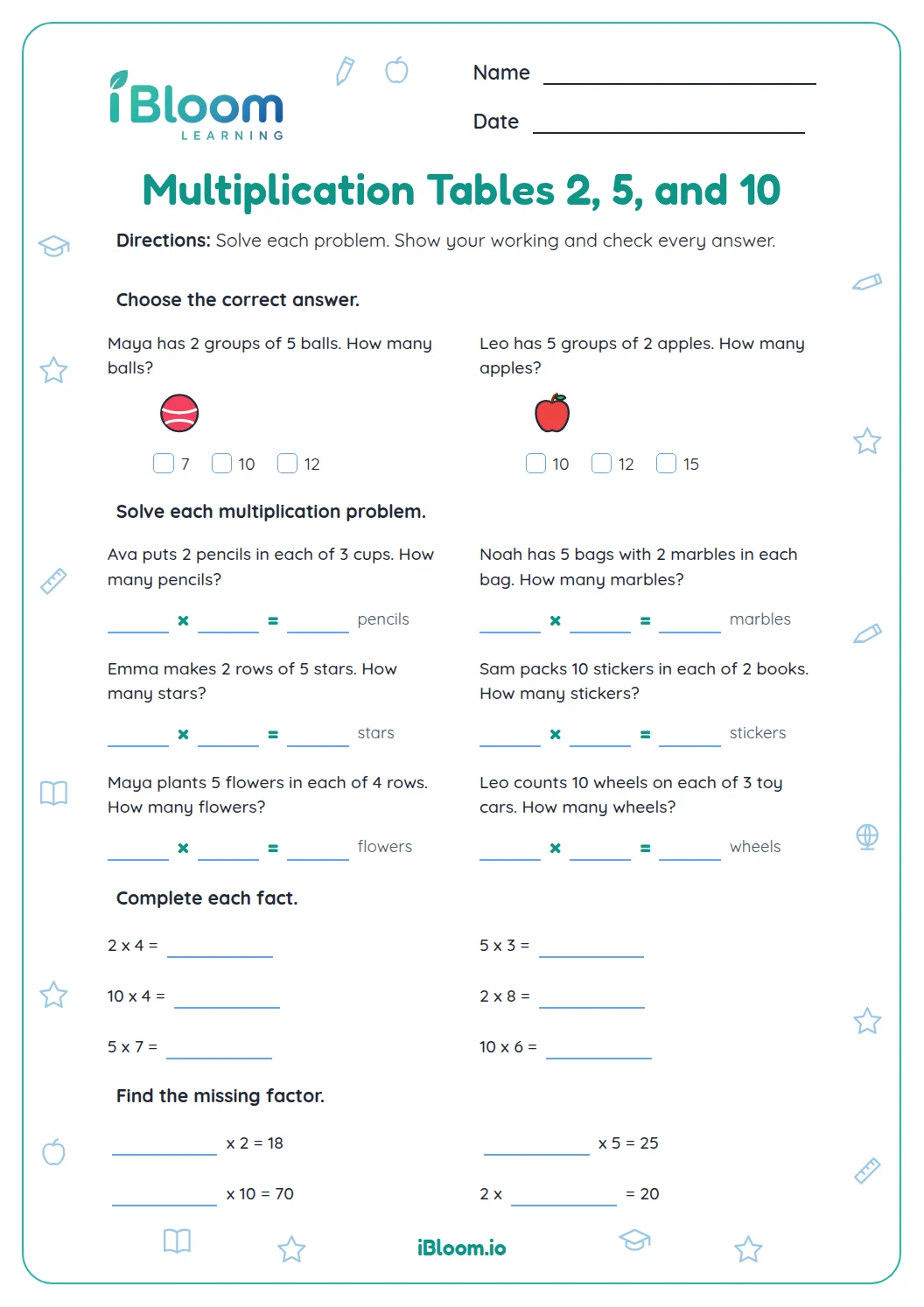
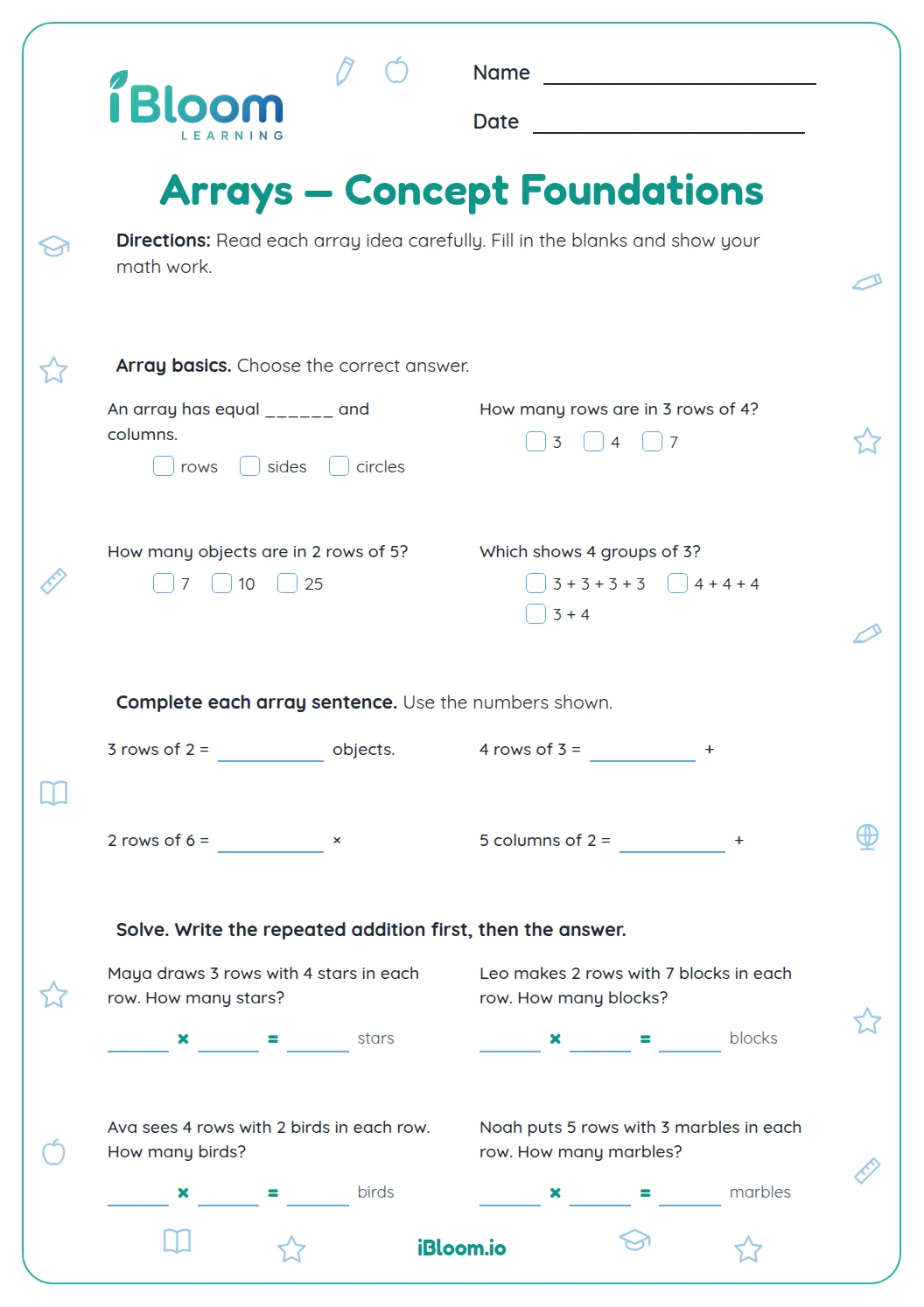
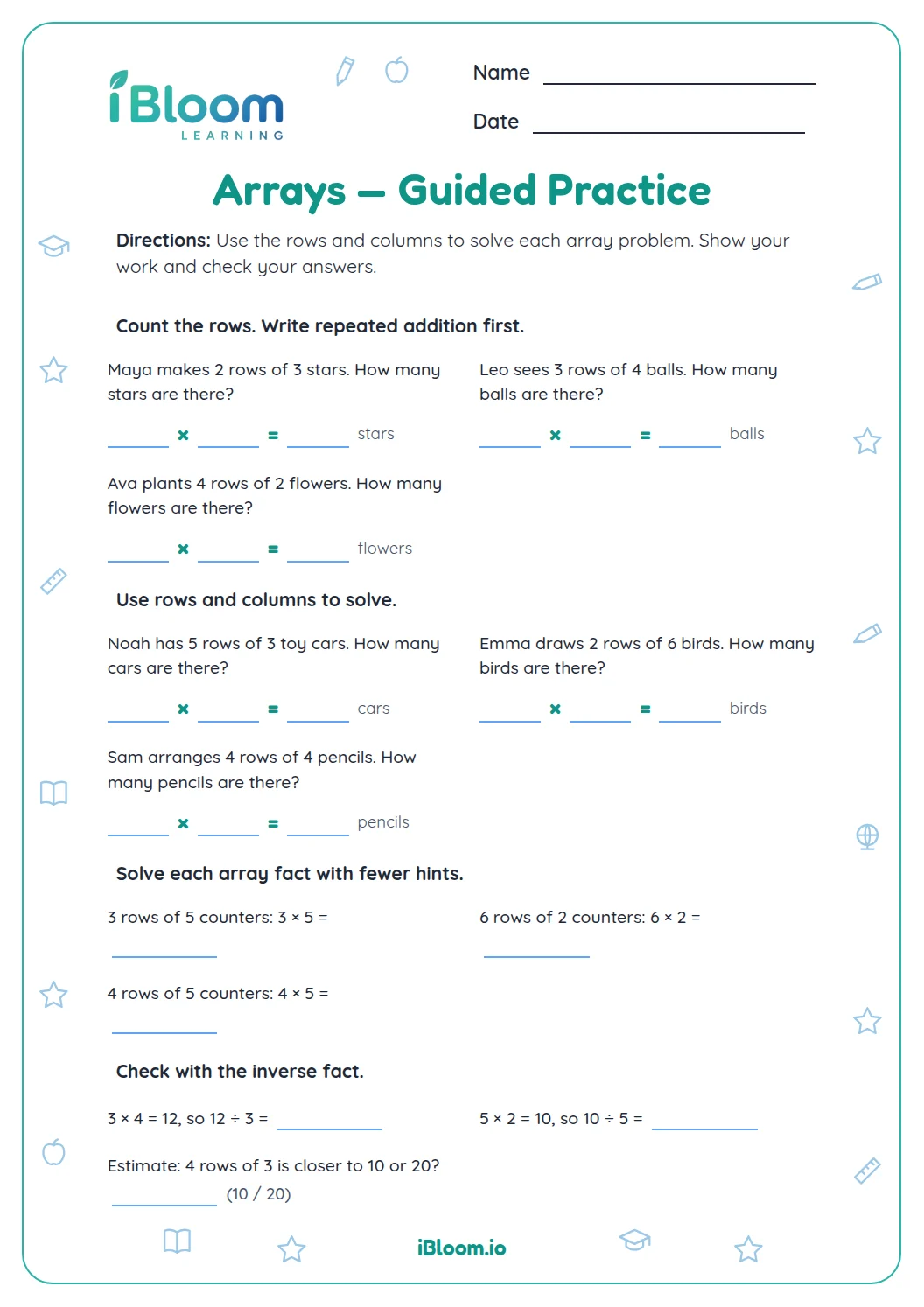
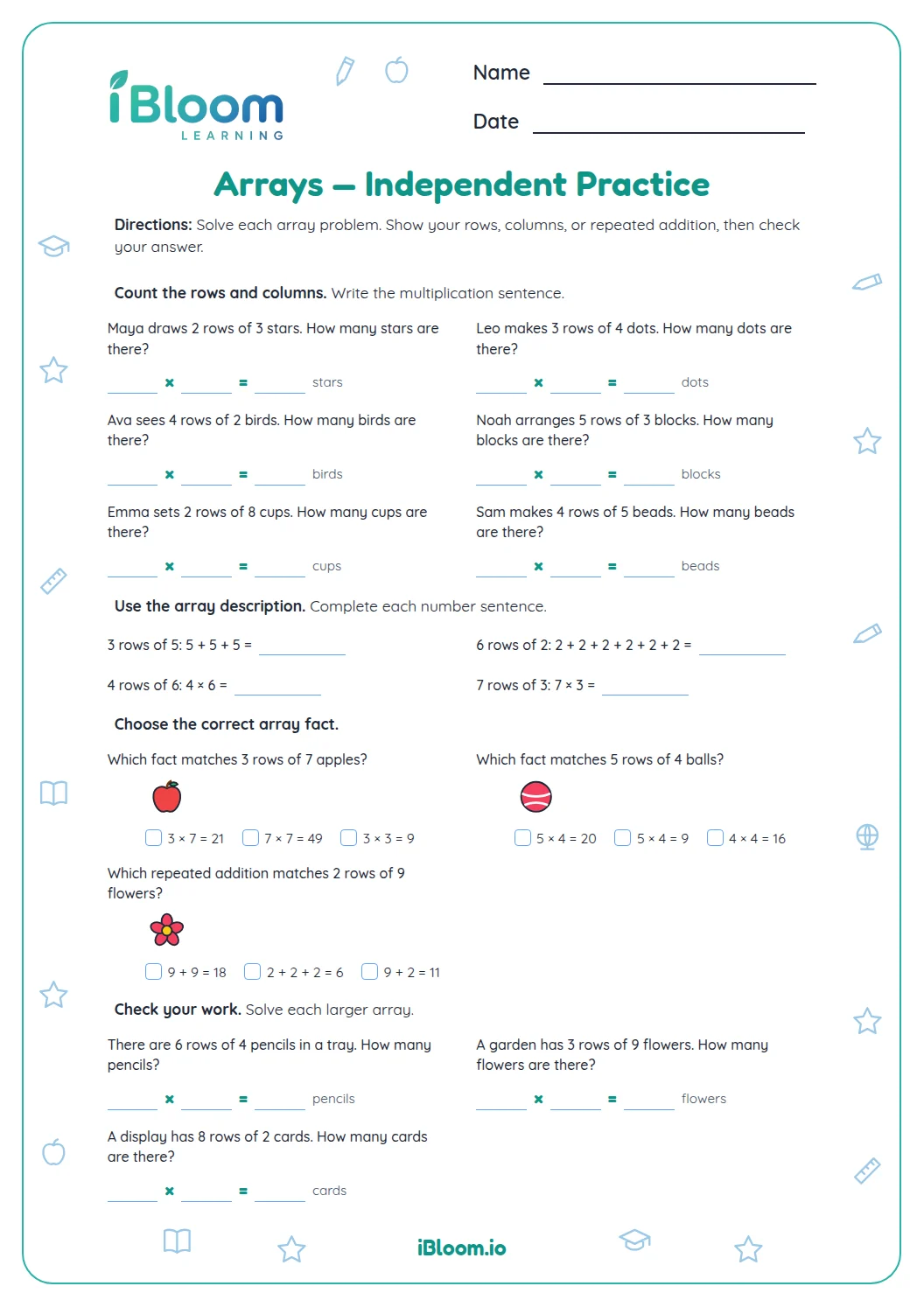
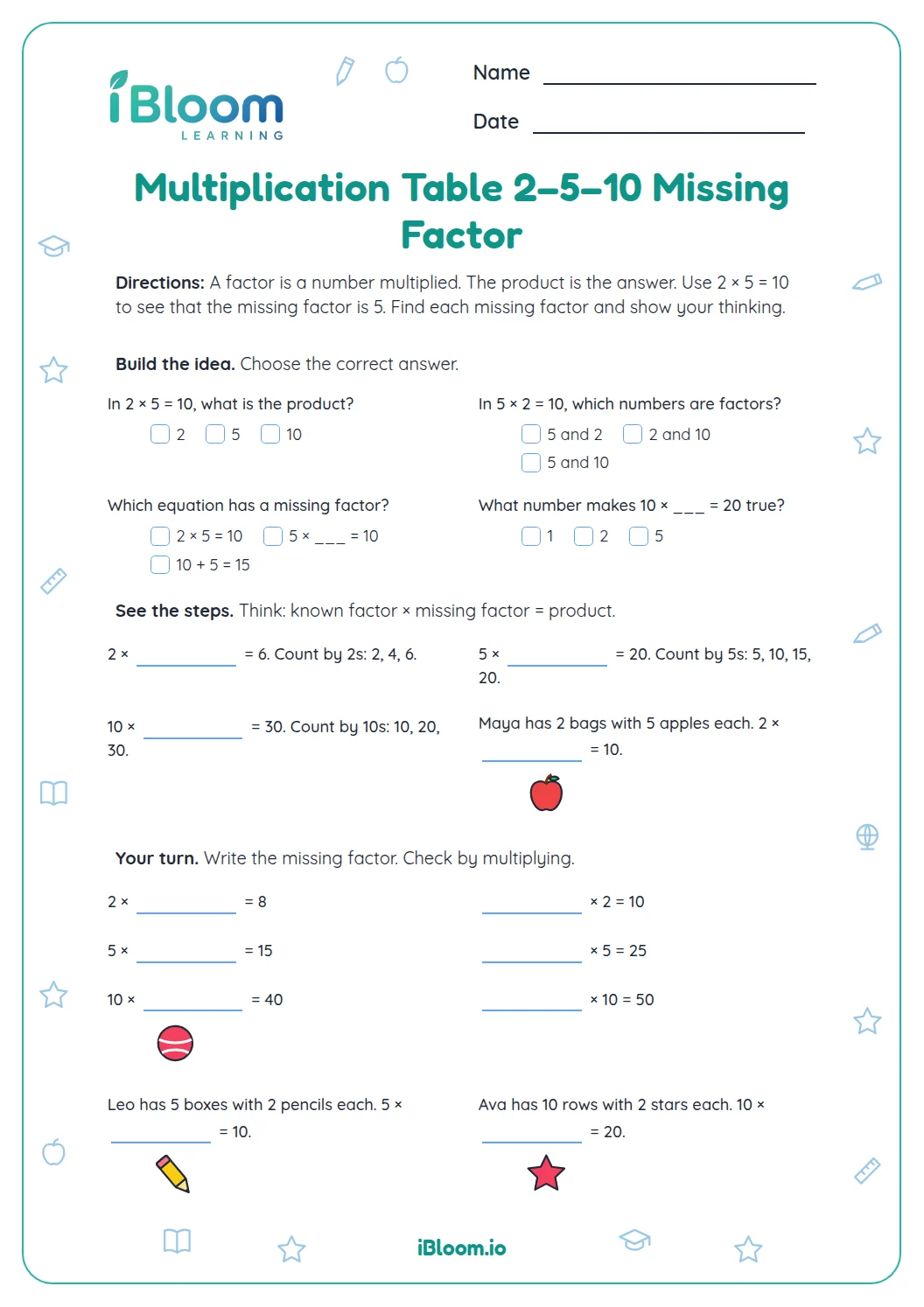
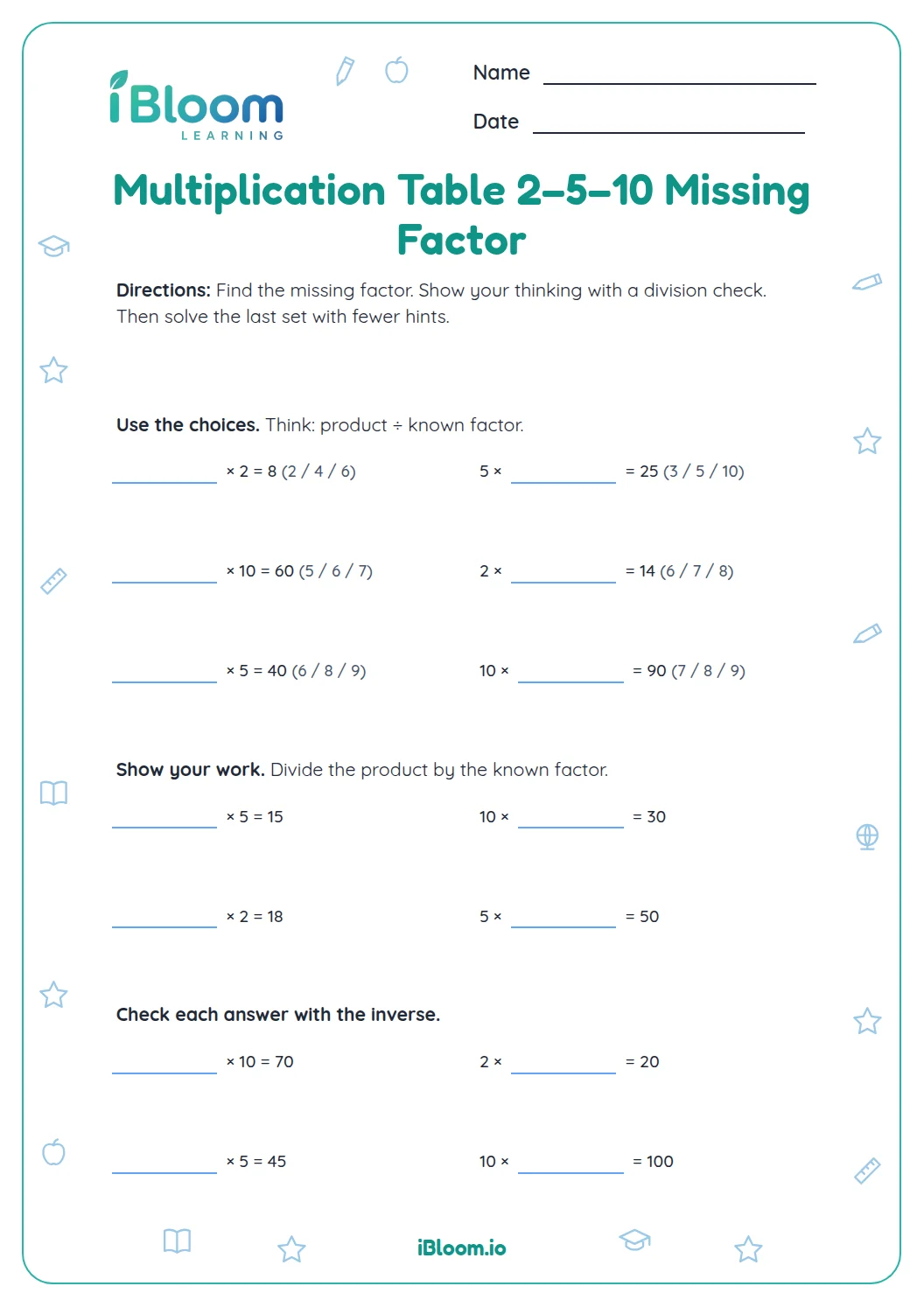
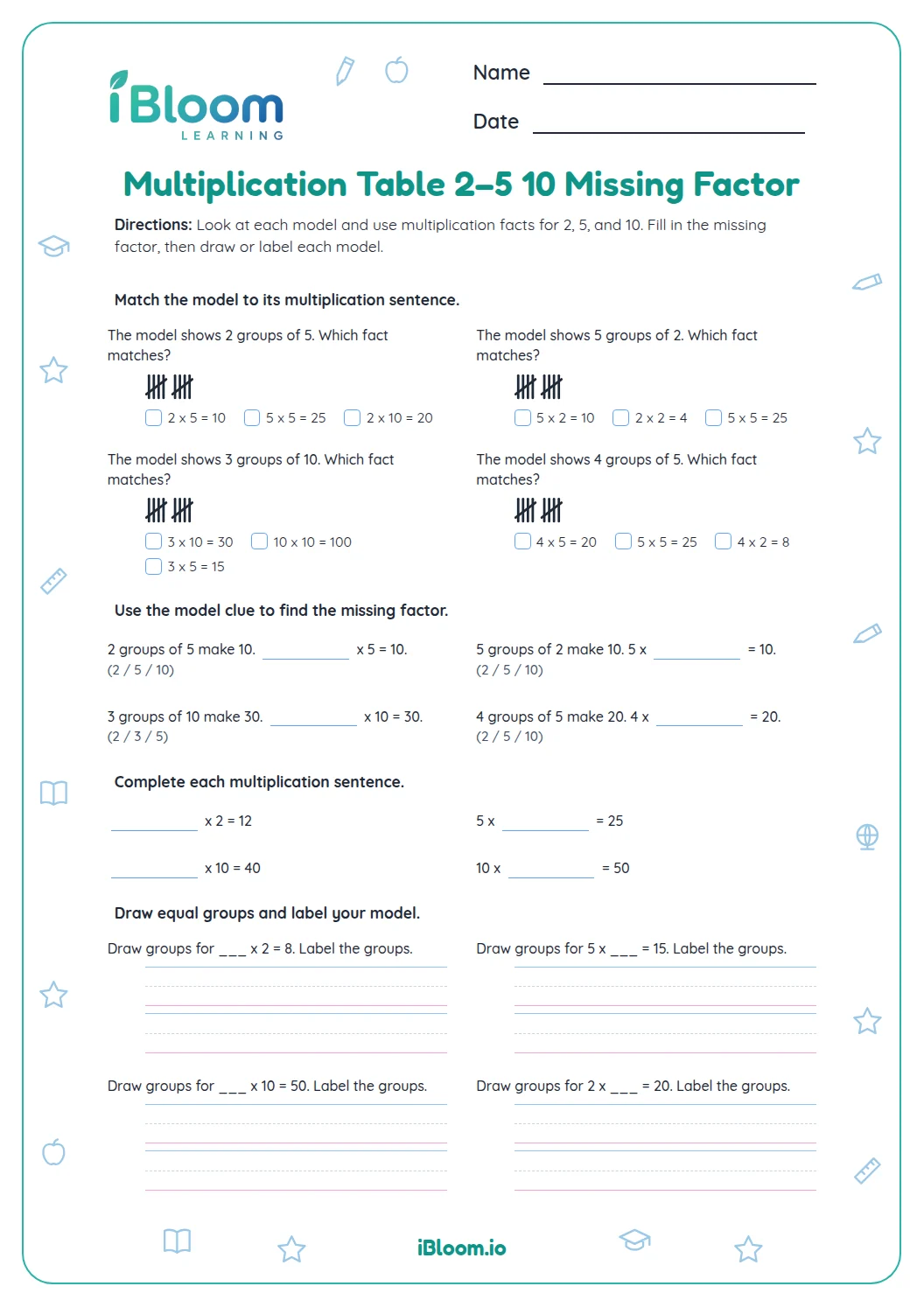
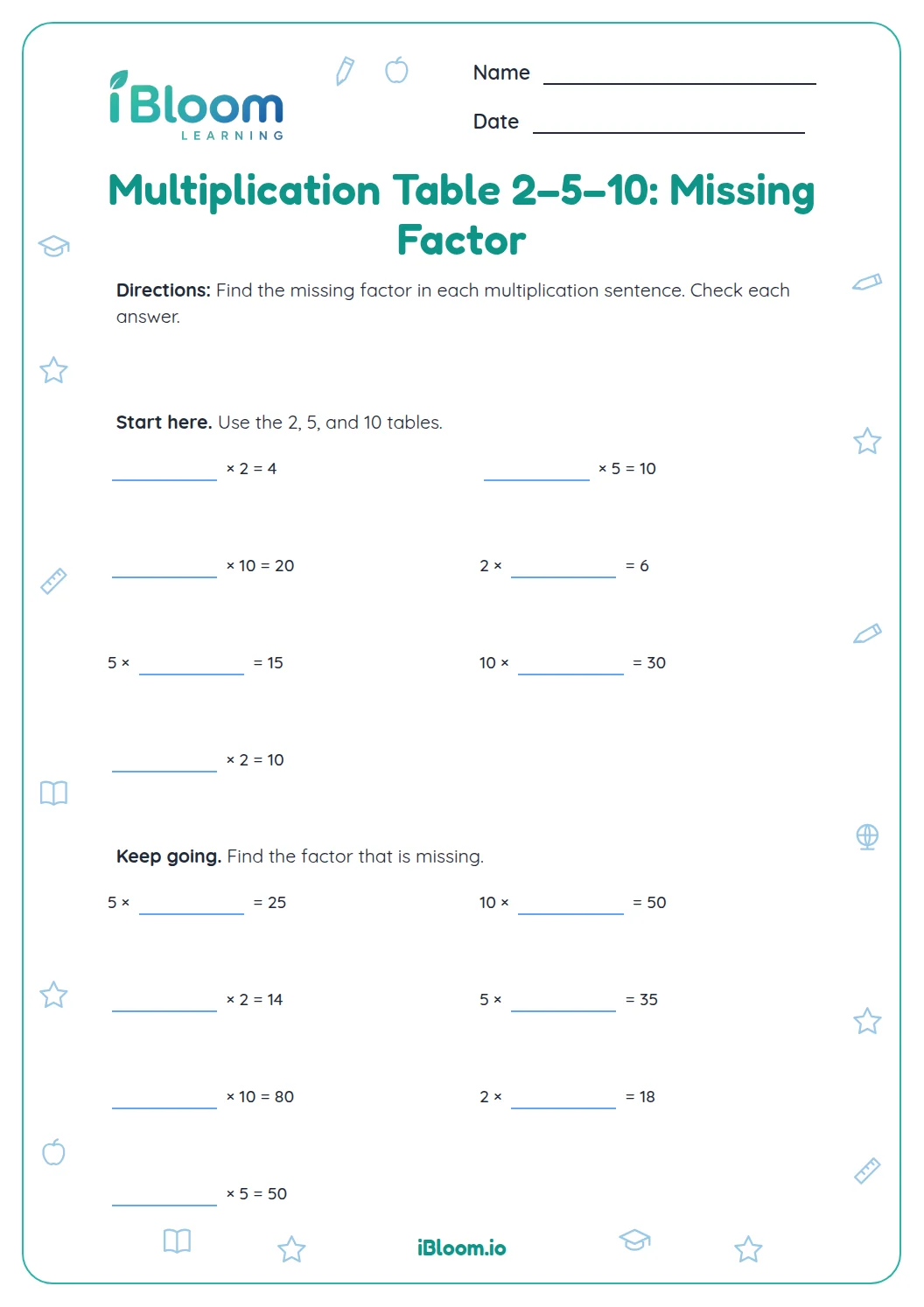
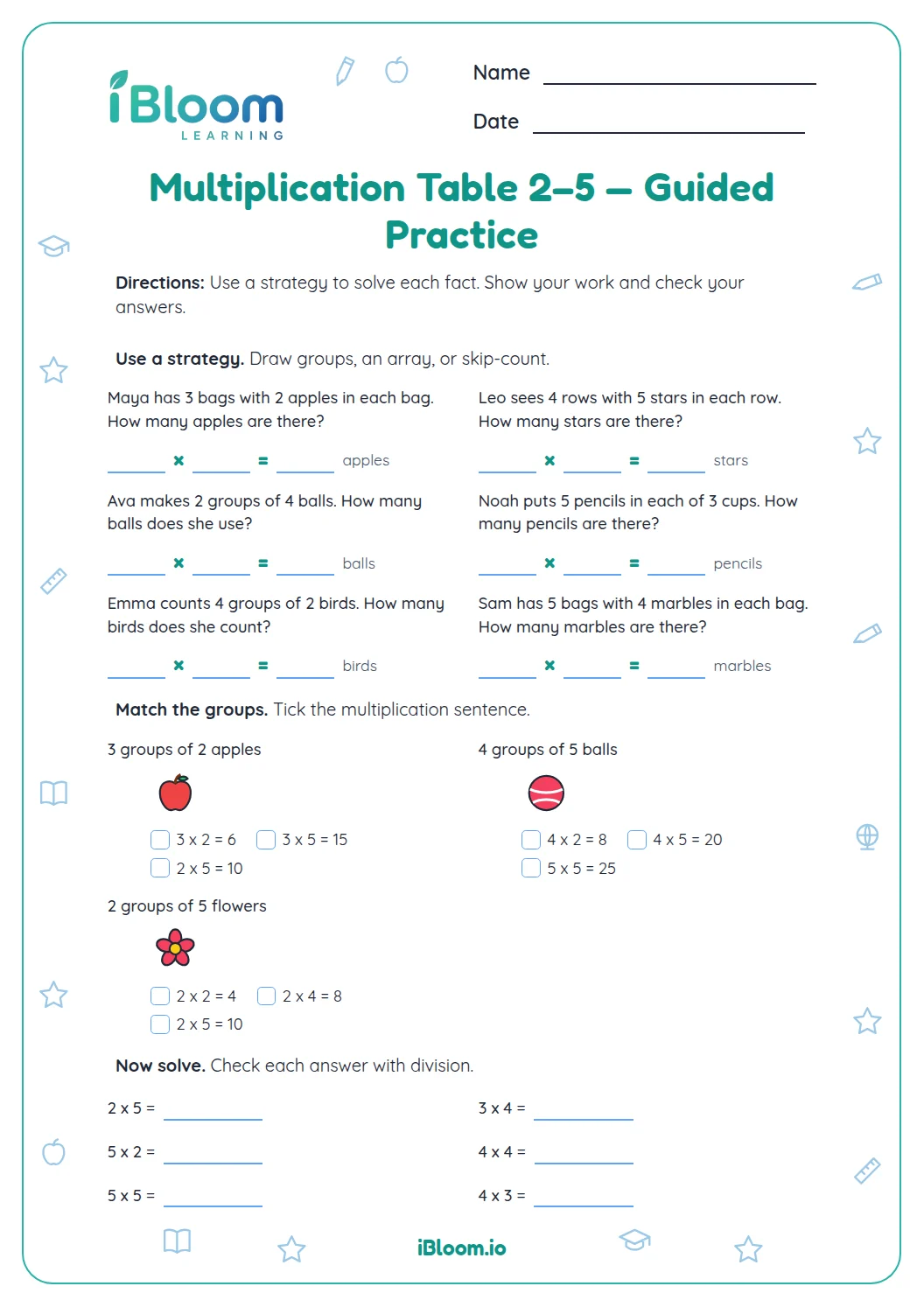
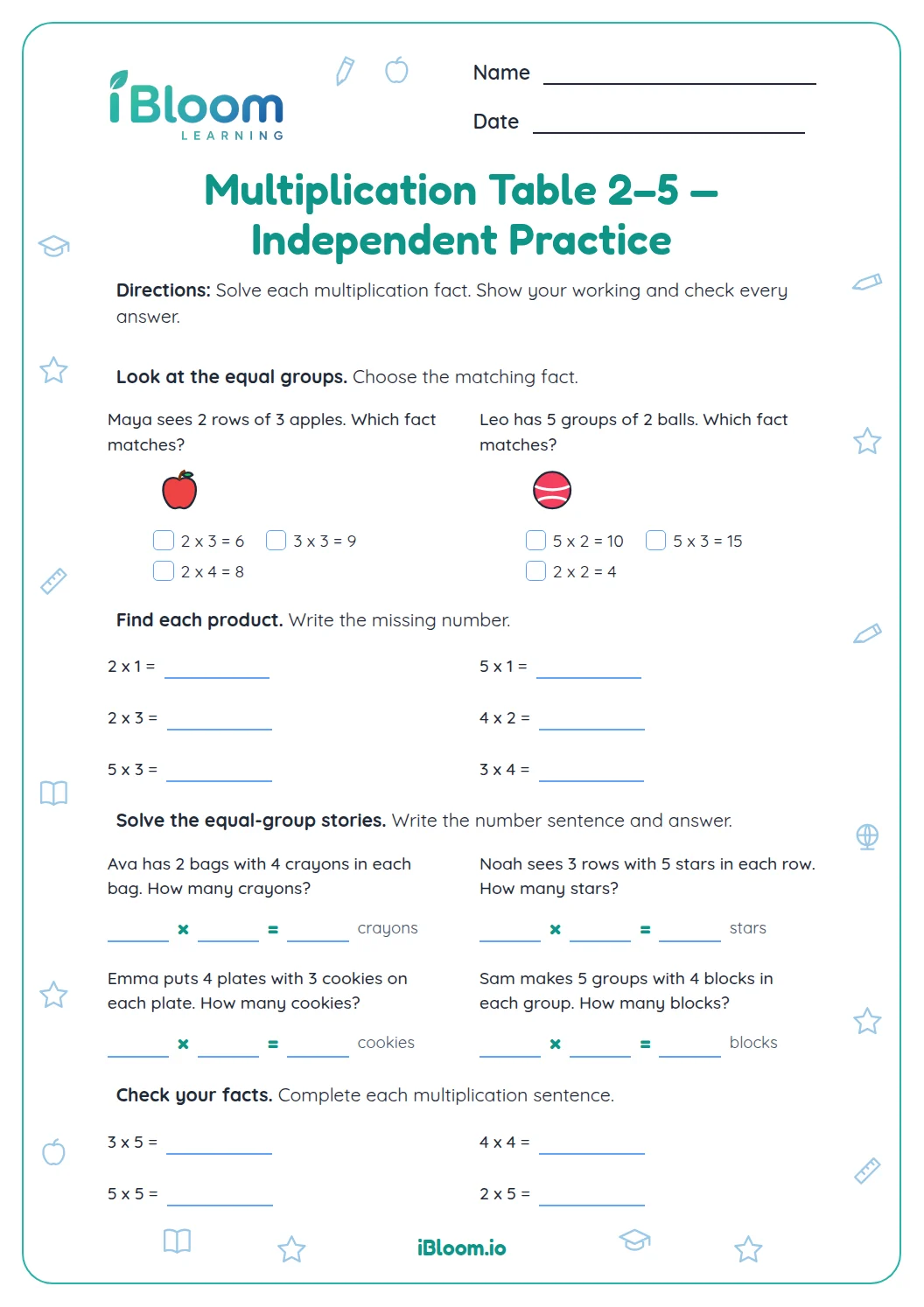
This Grade 2 printable connects multiplication facts for 2, 5, and 10 to equal groups and arrays. In Part A, five illustrated arrays show rows and columns to count. Part B practices five equations, and Part C mixes facts from the three tables. The sheet has 15 questions over two worksheet pages and a separate two-page answer key. Learners can use repeated addition or skip-counting to check each product.
What multiplication practice is included?
Part A uses five arrays to connect the wording “groups of” with rows and columns. The products include 6, 20, 20, 12, and 35. Part B asks for five direct facts, followed by five mixed facts from the 2, 5, and 10 tables.
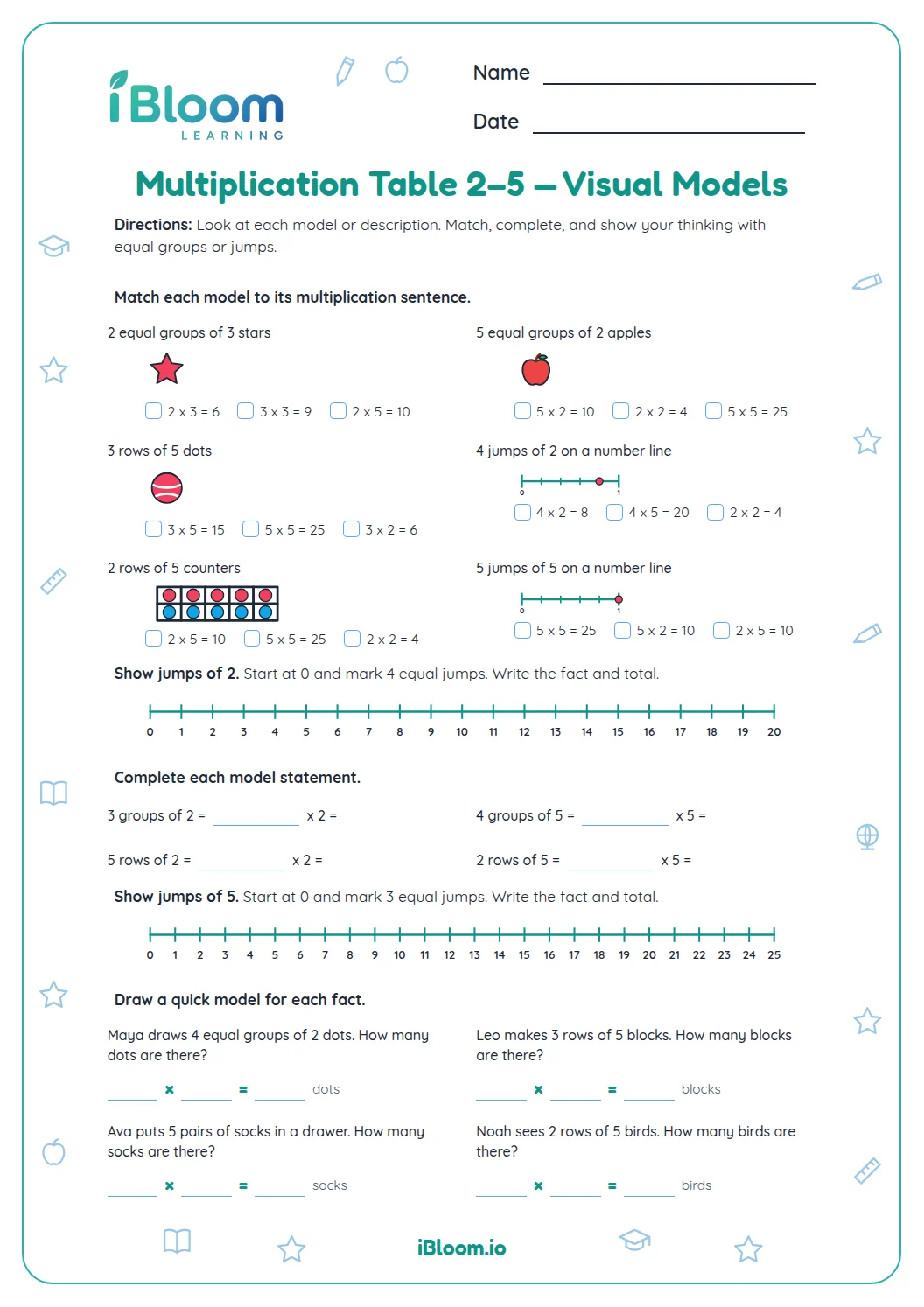
The visual models use arrays of stars. The later equations give learners a chance to recall a fact or count equal groups without a picture.
How can an array show a product?
Count the rows, then count how many items are in each row. Those counts are the factors. Repeated addition or skip-counting can check the total.
- 1A 2 by 3 array has 2 rows with 3 stars in each row.
- 2Count 3 + 3 to find 6, so 2 × 3 = 6.
What can help with a table fact?
For a 2 fact, count by twos; for a 5 fact, count by fives; and for a 10 fact, count by tens. If a fact is not remembered yet, use equal groups or repeated addition and then check the product.
How to use this worksheet
- 1Read the first factor as the number of groups or rows.
- 2Read the second factor as items in each group.
- 3Count equal groups or skip-count by 2, 5, or 10.
- 4Check the product with repeated addition.
Common mistakes and quick fixes
The mistake
Swapping the row and item counts.
The fix
Describe the groups before multiplying.
The mistake
Counting only one row.
The fix
Add or count every equal row.
The mistake
Using a 5 fact for a 10 fact.
The fix
Count by tens or double the matching 5 fact.
What to practice next
Make more practice
Further reading
Questions parents and teachers ask
Which times tables does this worksheet practice?
The questions use multiplication facts from the 2, 5, and 10 tables. The first five items show arrays for equal groups, and the remaining ten are equations to solve. Learners can use skip-counting, repeated addition, or a remembered fact to find each product.
How do rows and columns connect to multiplication?
Rows can represent equal groups, with the number of items in each row as the group size. A 2 by 3 array has two rows of three, so it represents 3 + 3 and the product 2 × 3 = 6. Count all the items to check.
Why are there pictures in the first part?
The star arrays make equal groups visible. Learners can count each row and connect that total to a multiplication sentence. Later items remove the pictures so the child can practice recalling or working out the same kinds of facts from an equation.
How many questions and pages are included?
There are 15 questions over two worksheet pages, followed by a separate two-page answer key. Five questions use arrays, five are multiplication equations, and five mix facts from the three tables. About 15 minutes is a reasonable estimate for completing and checking the sheet.
What if a learner does not remember a product?
Use repeated addition or skip-counting rather than guessing. For 5 × 4, count 5, 10, 15, 20; for 10 × 4, count four groups of ten. In an array, count each row once and check that every item is included.