
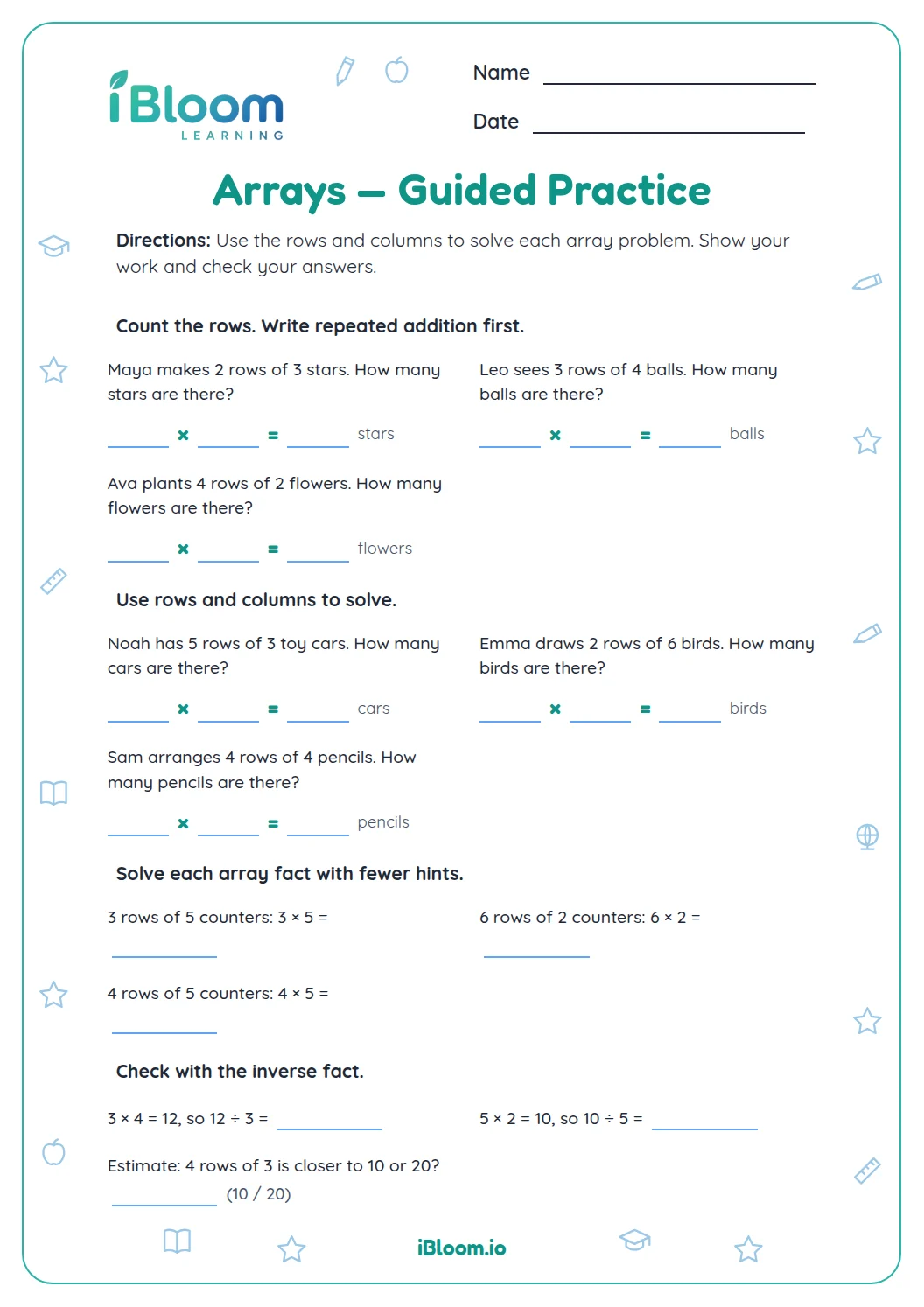
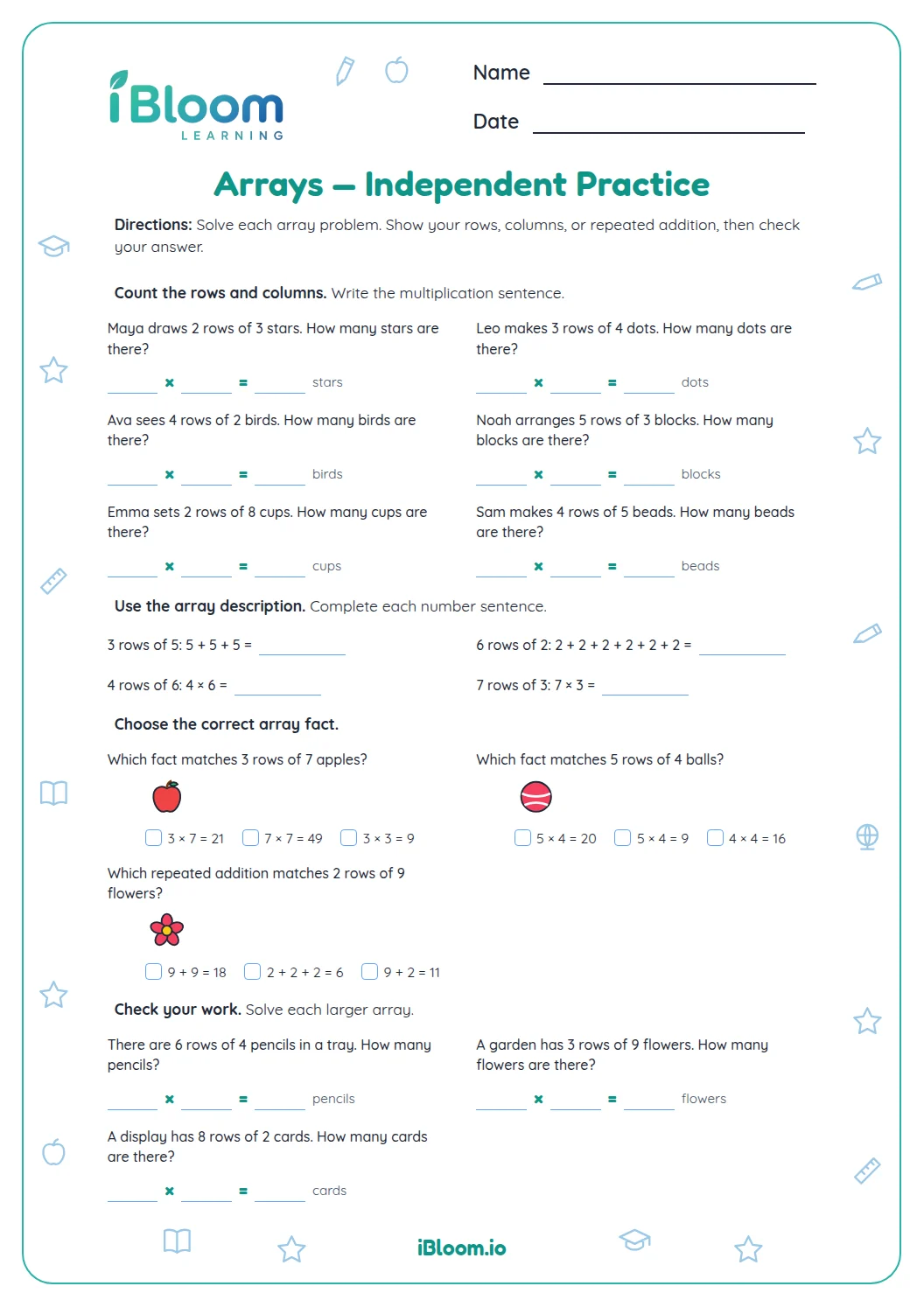
About this worksheet
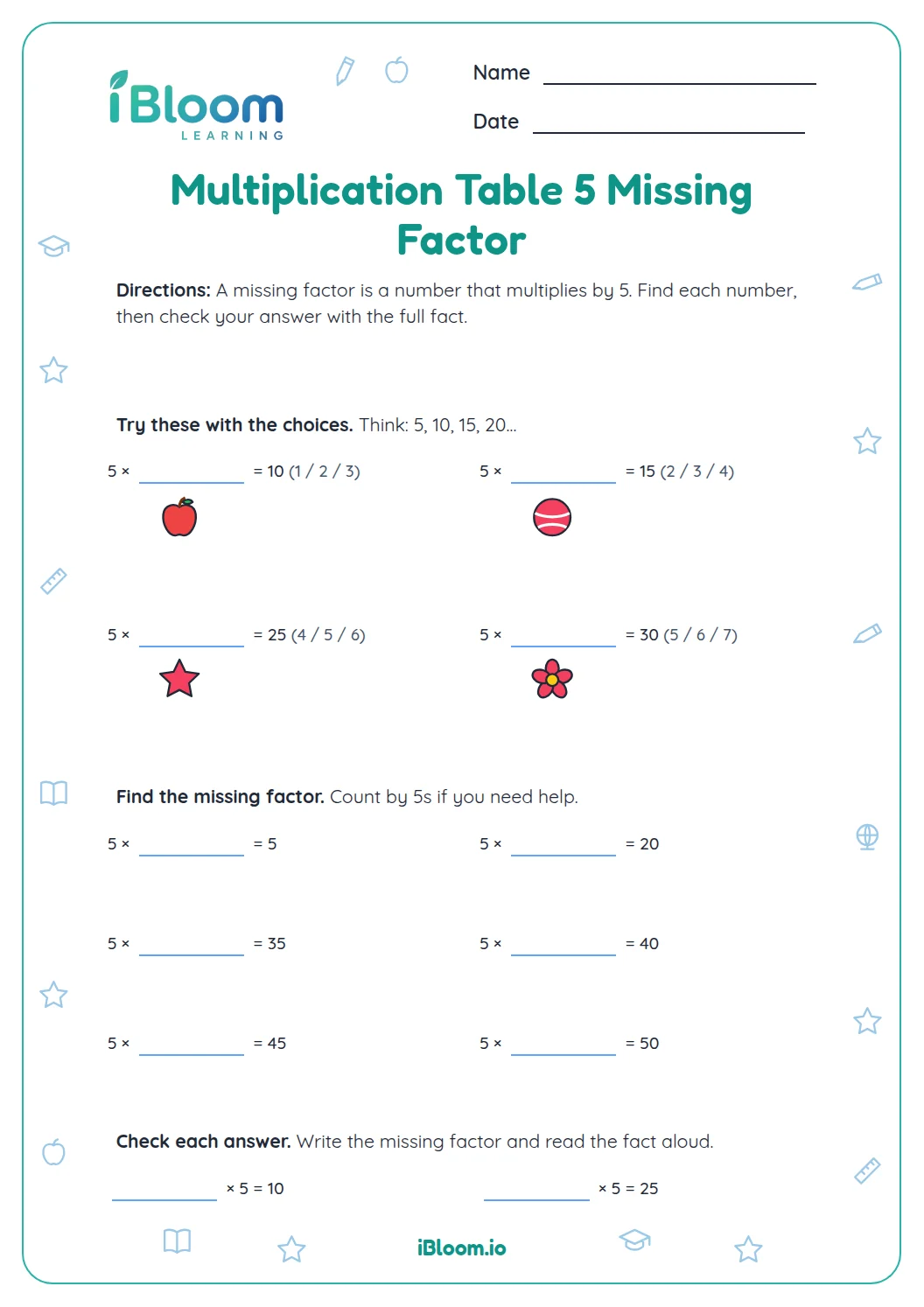
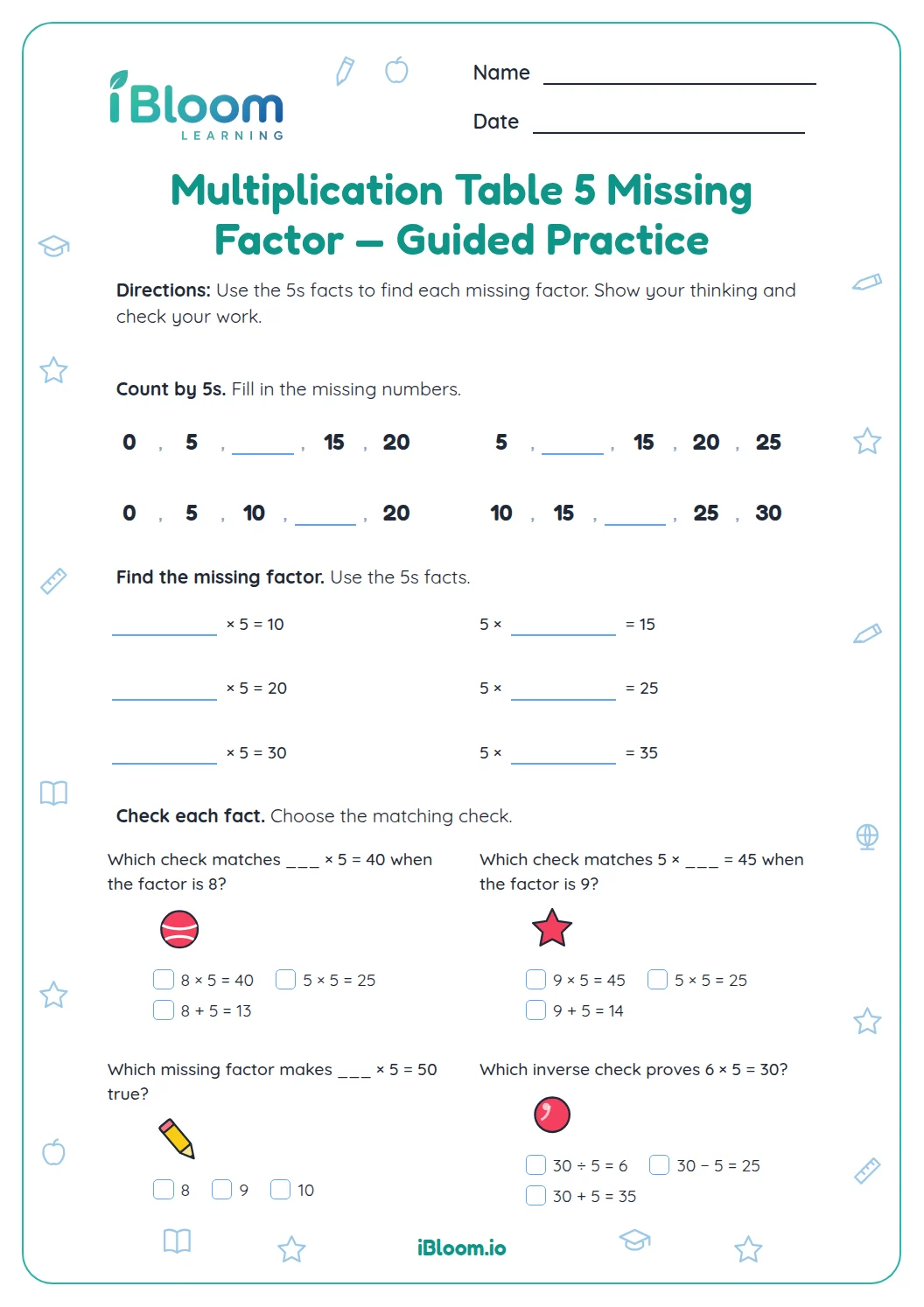
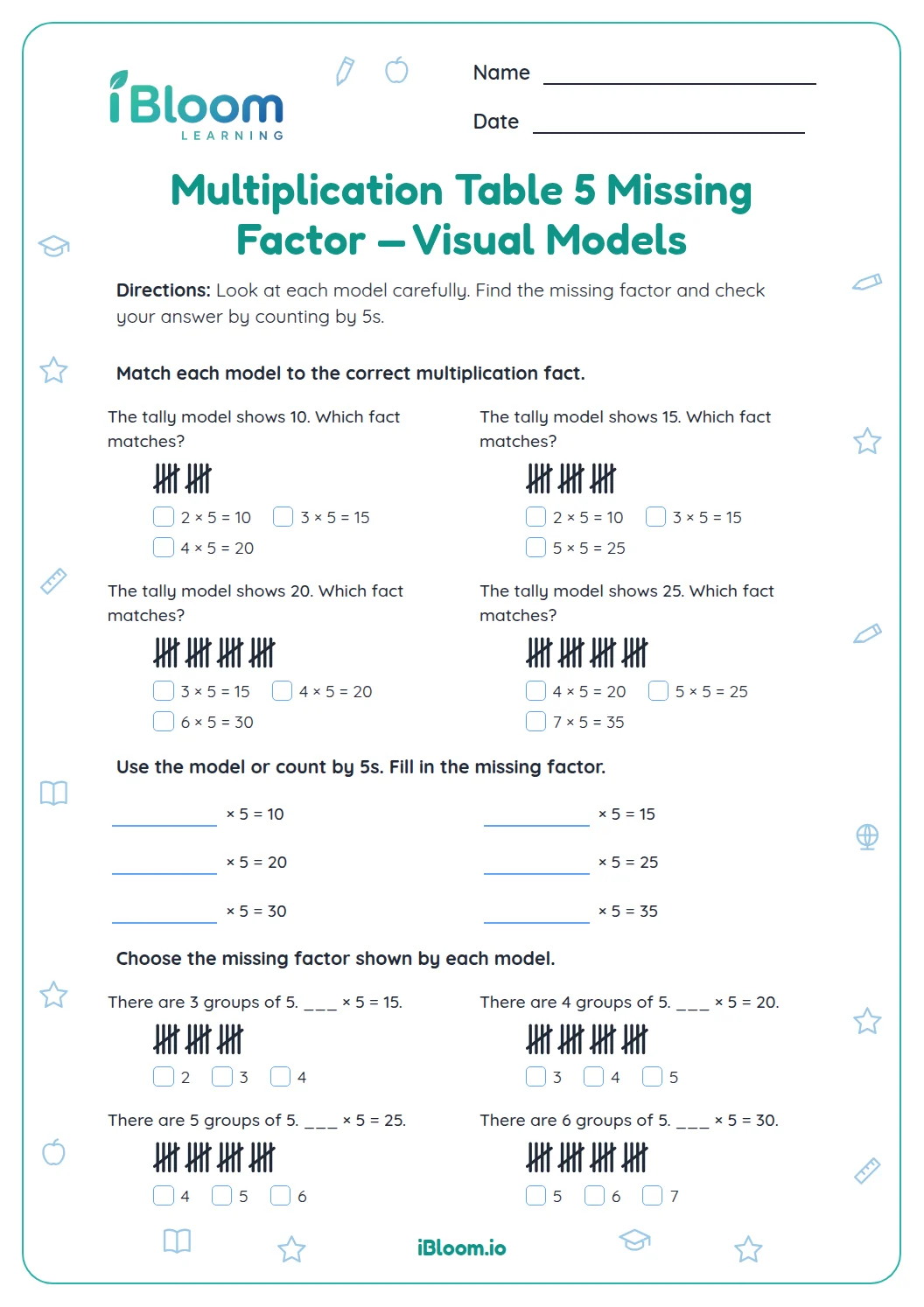
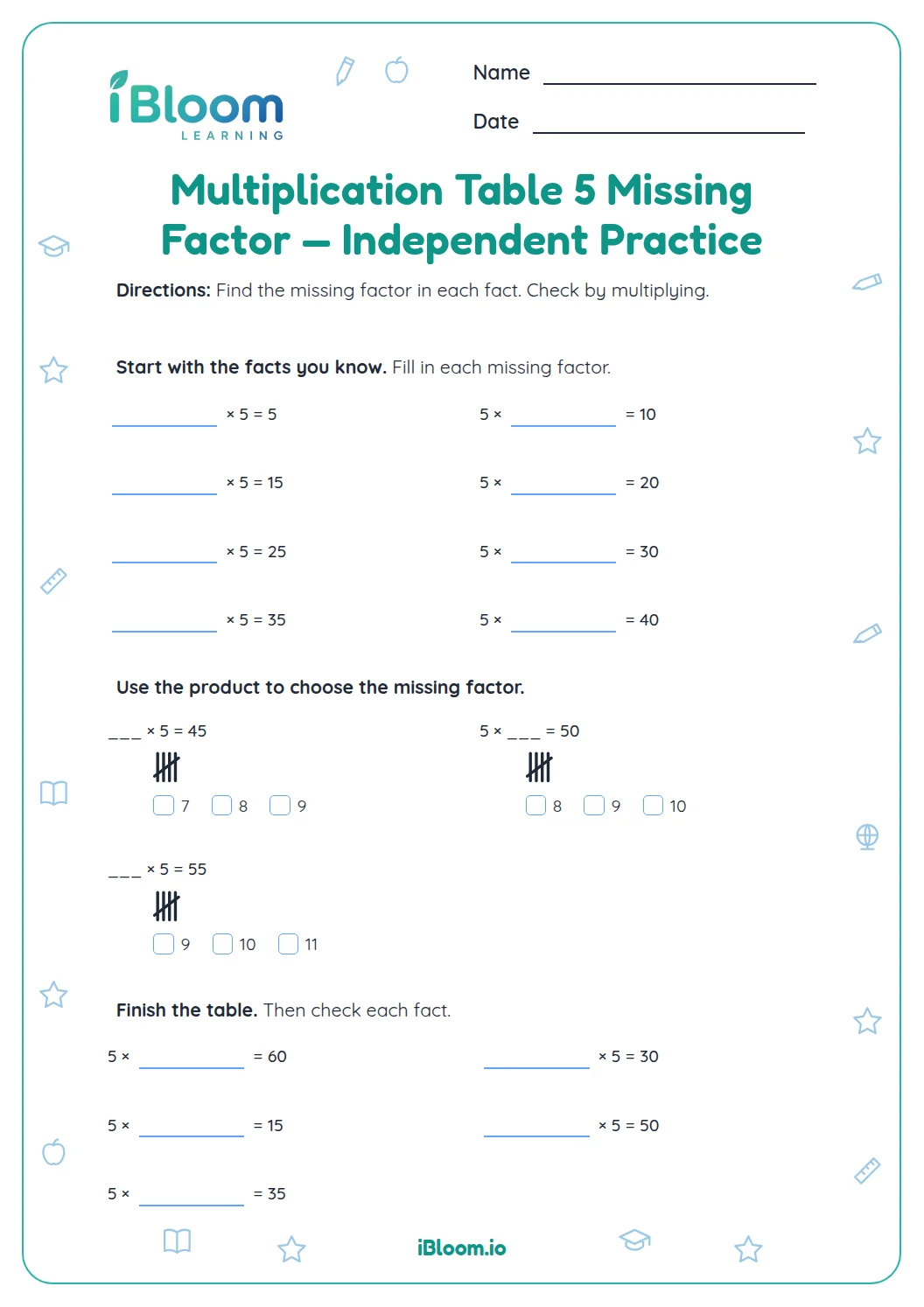
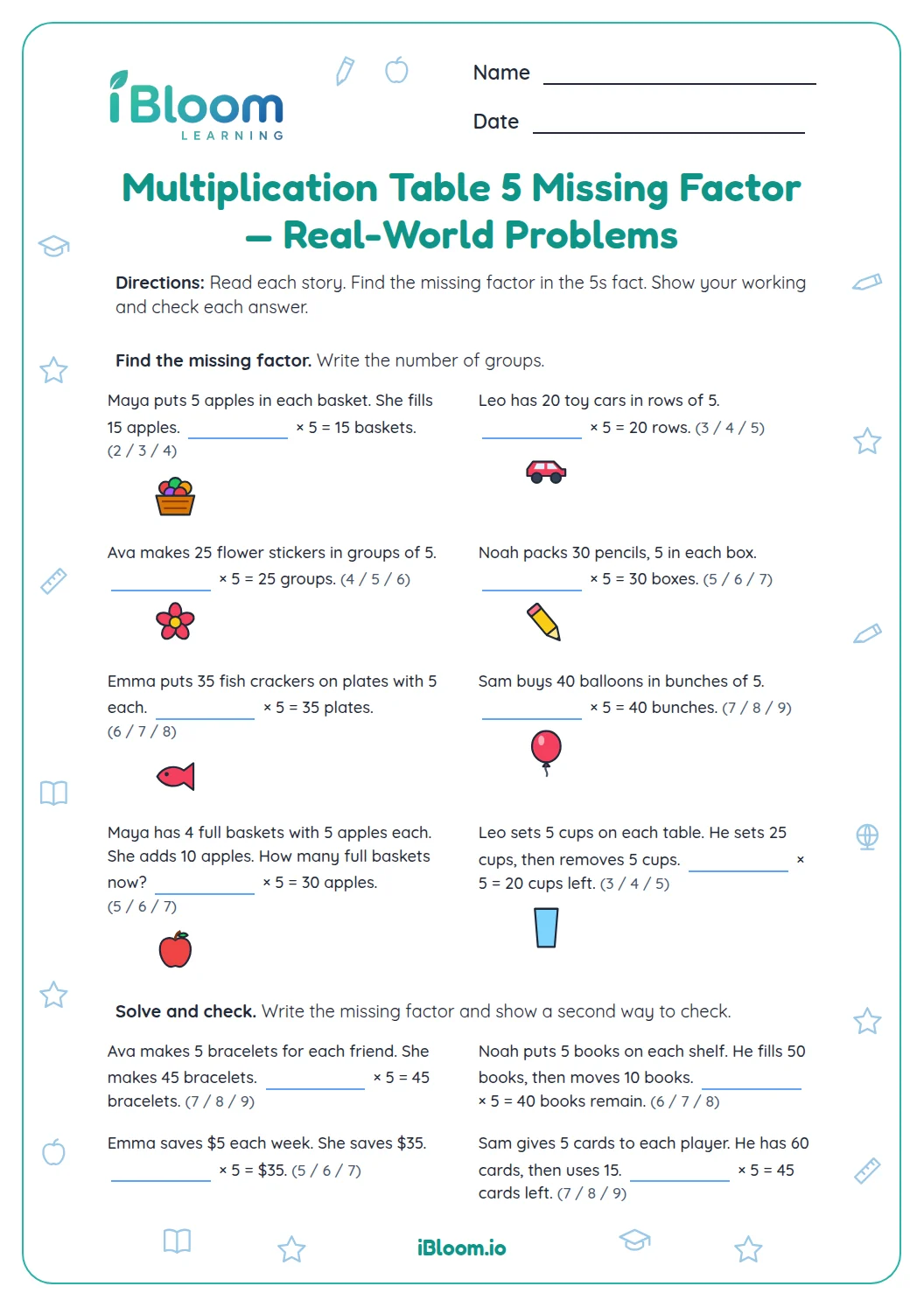
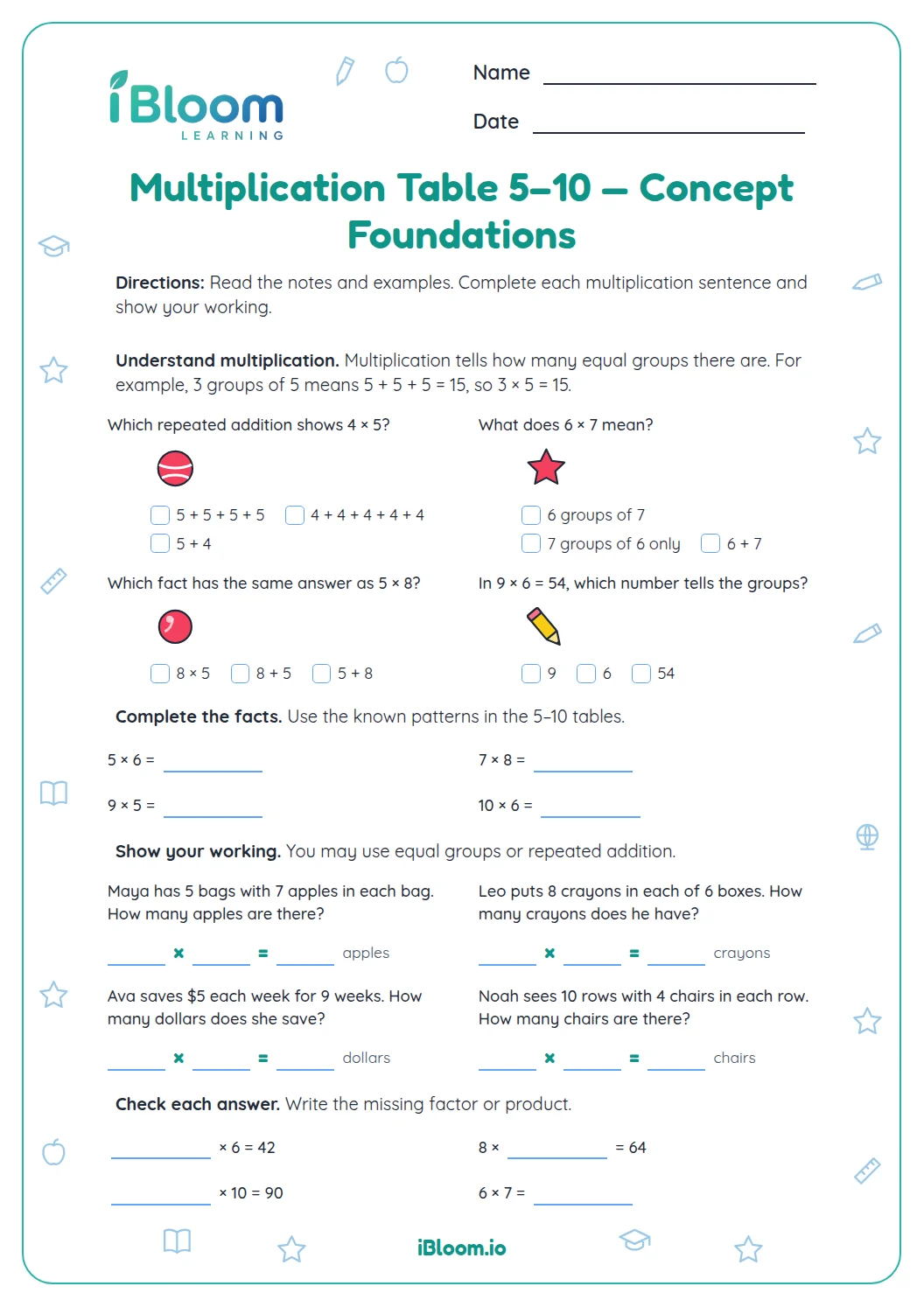
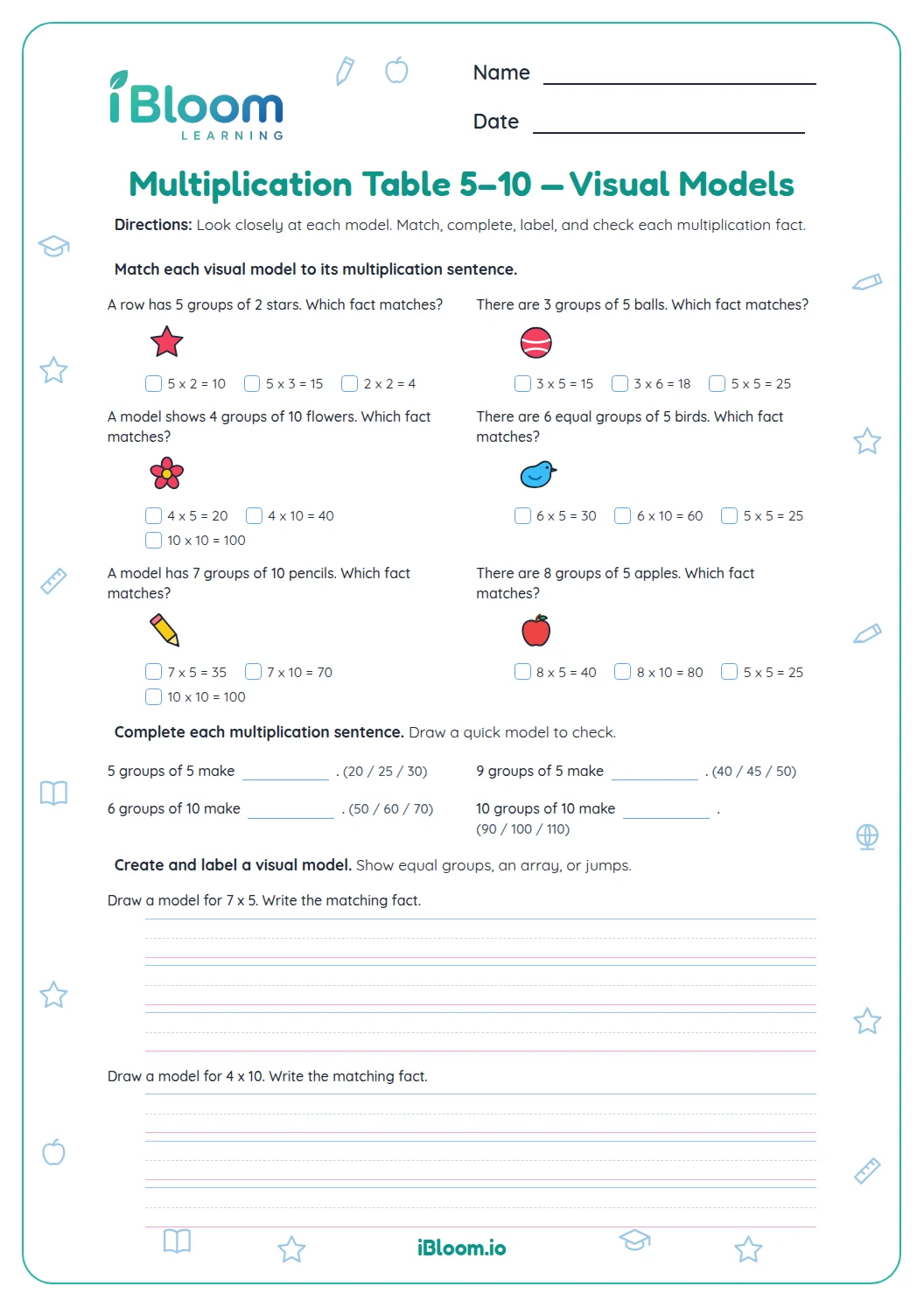
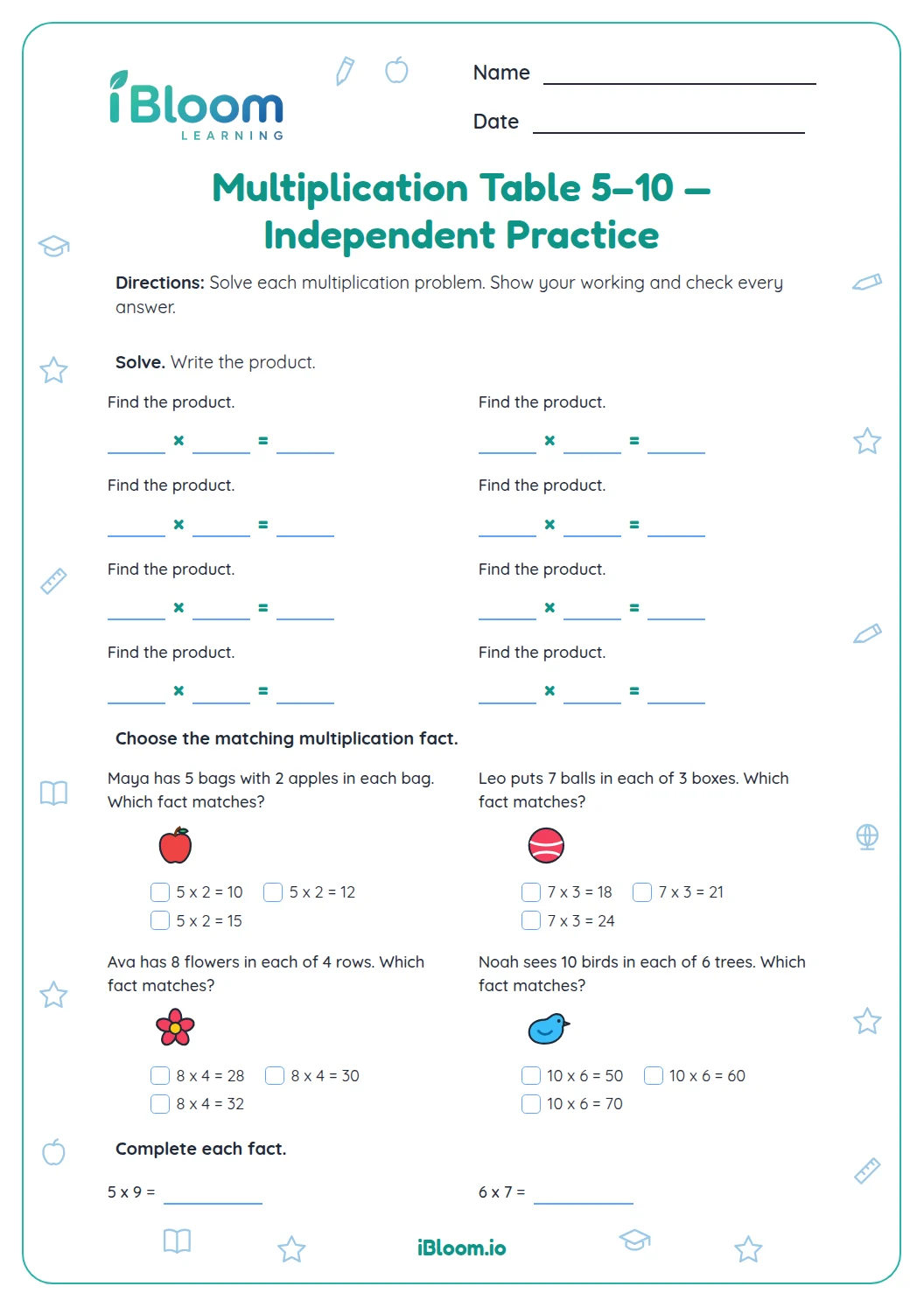
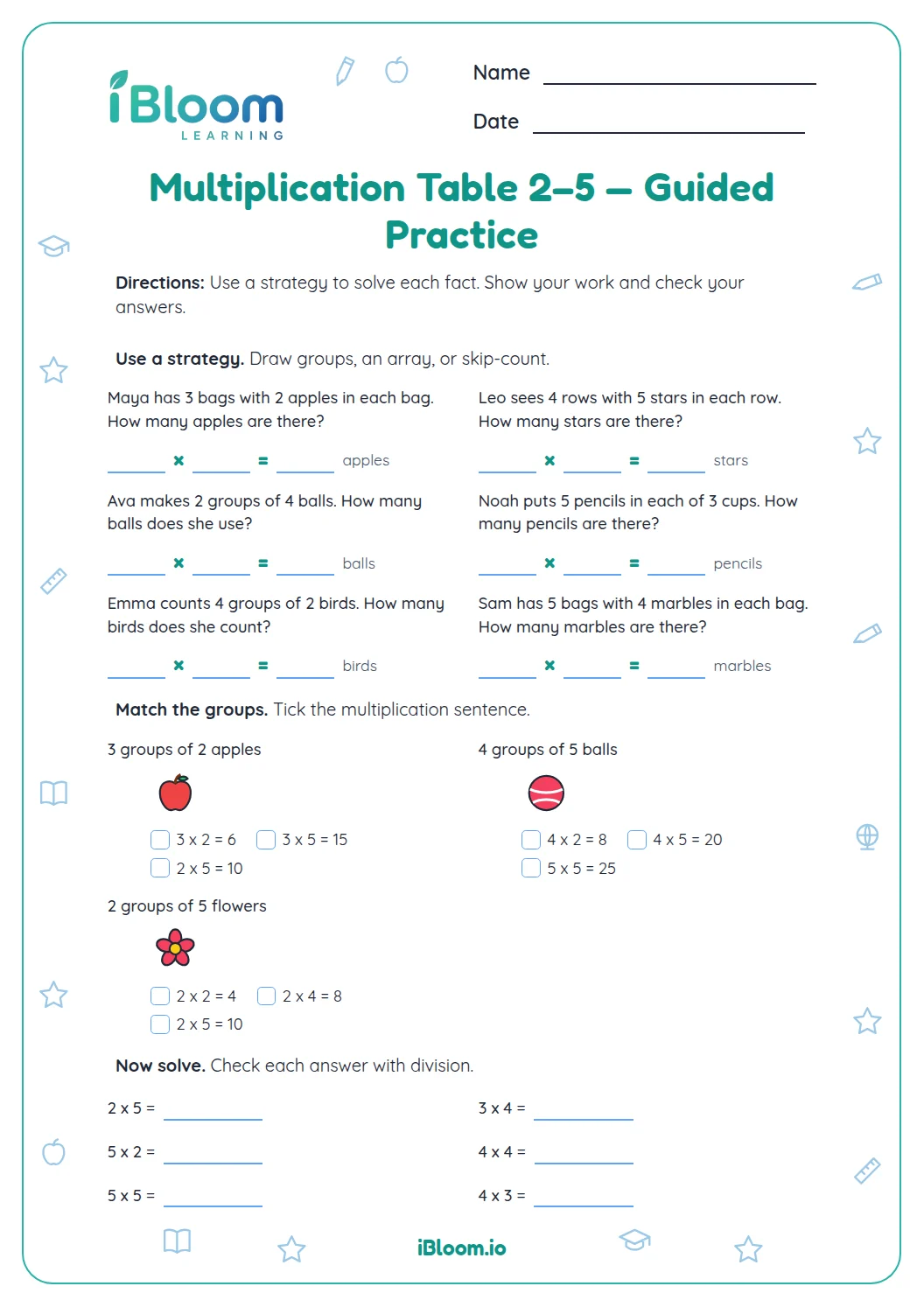
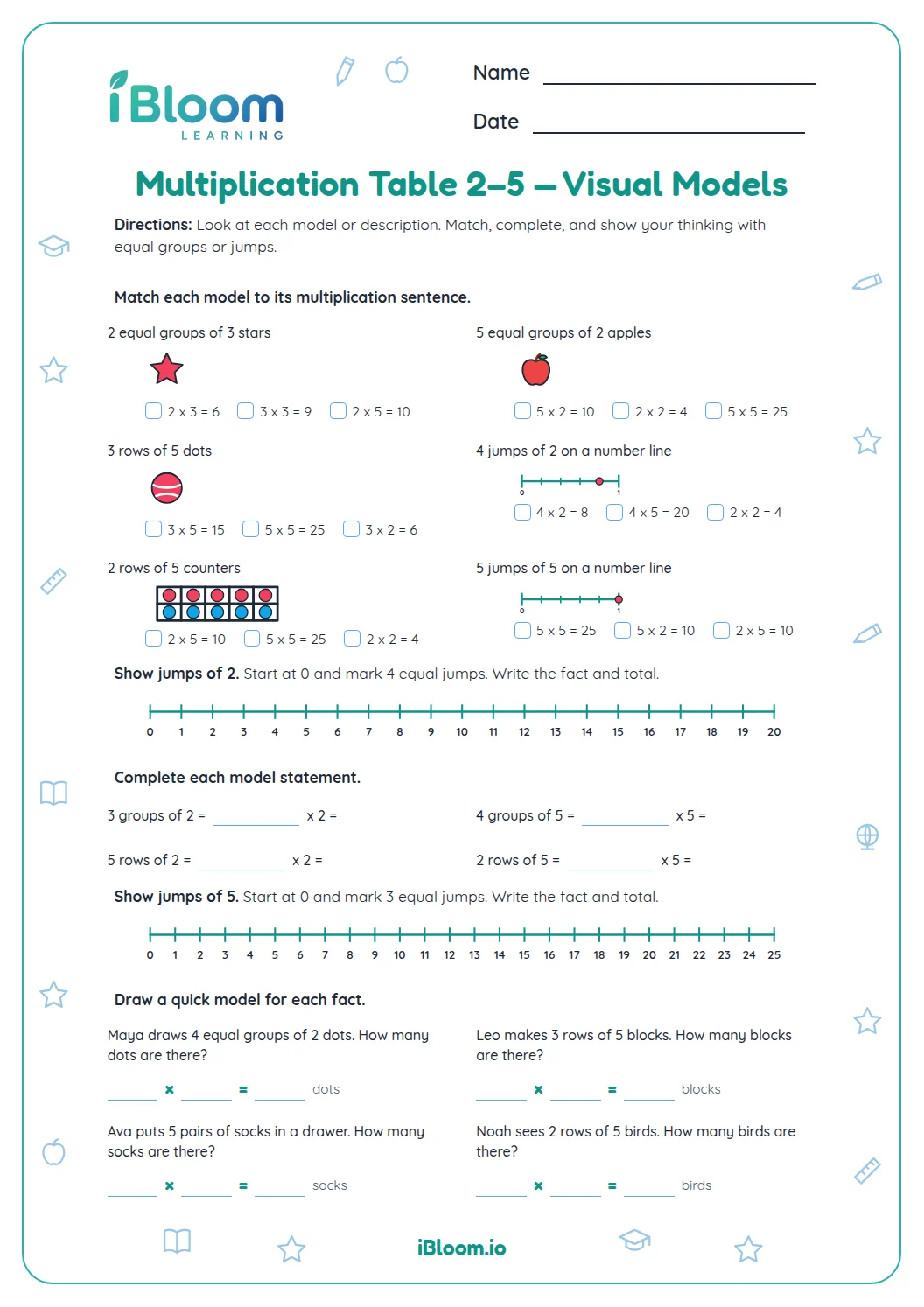
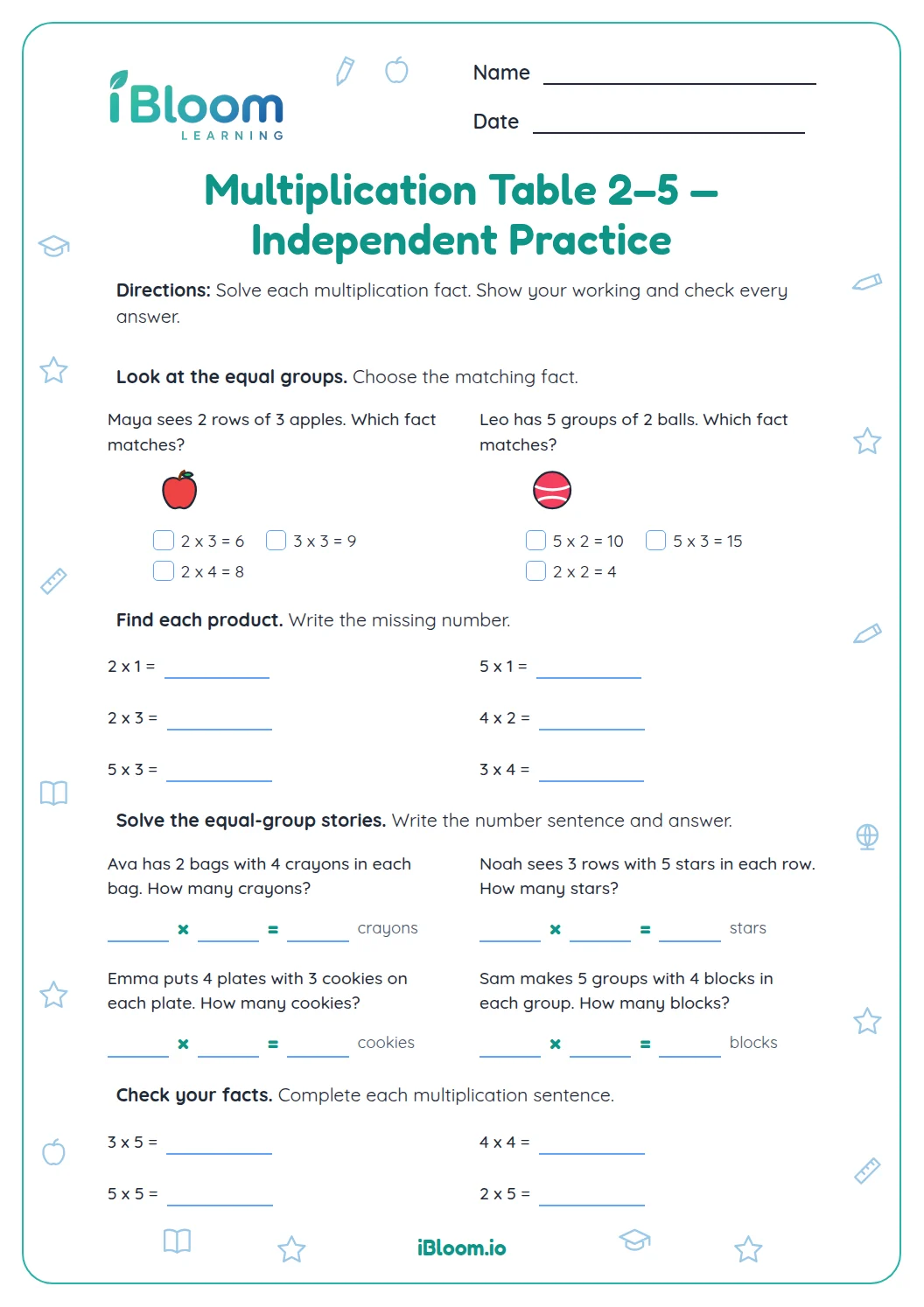
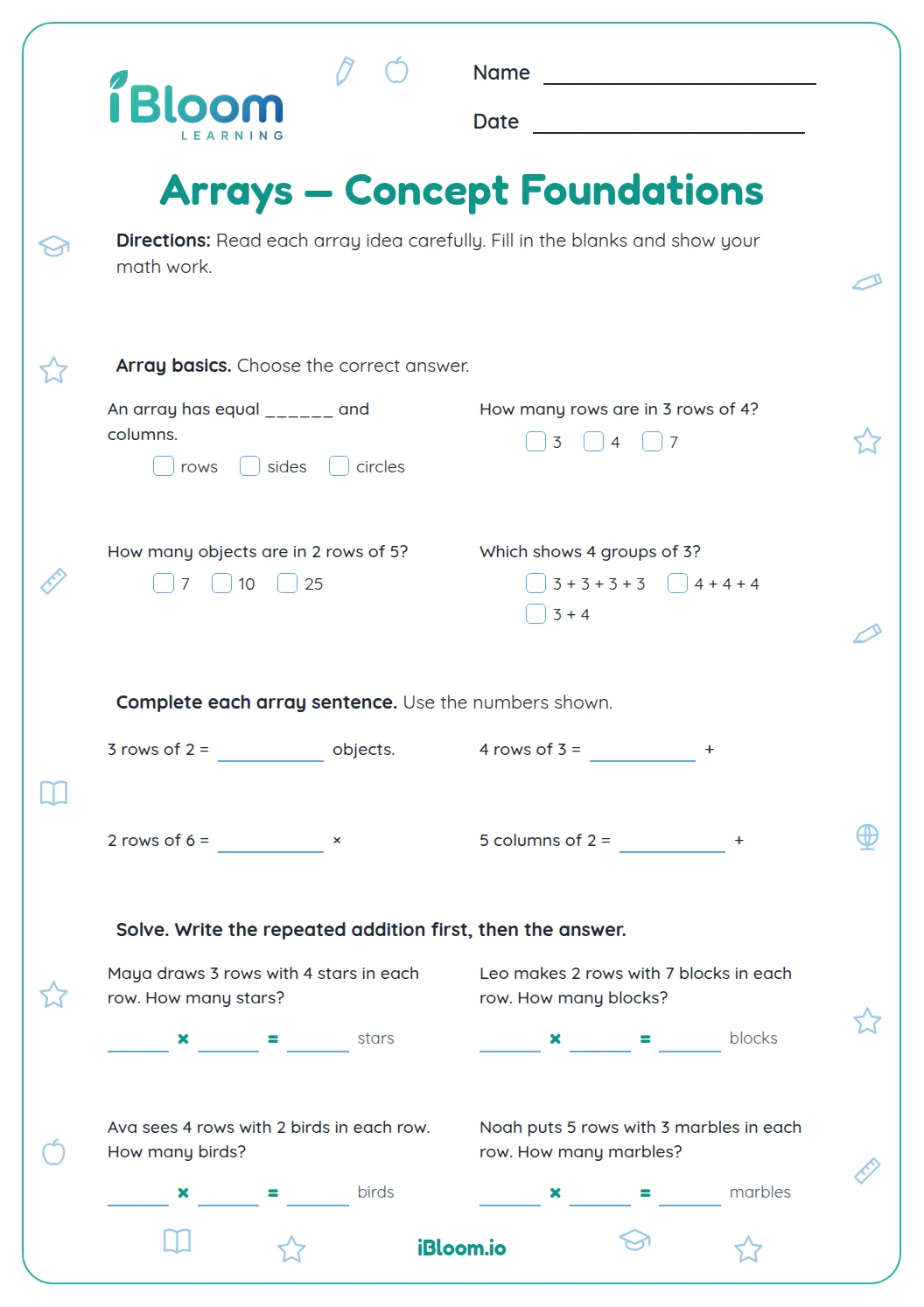
This Grade 2 worksheet builds reasoning with the table of five through 15 questions about missing factors, skip-counting, and equal groups. Students use the total to work backward to the number of groups, then check their answer by counting by fives. One item asks for a short explanation with writing space. The separate answer key lists each answer and a sample explanation.
Aligned to 3.OA.A.4
What does this missing-factor page practice?
Students reason about the table of five in several forms. They check claims, read a count-by-five sequence, find missing factors, solve equal-group stories, and explain one answer.
- Check claims and count-by-five patterns
- Find missing factors in table-of-five equations
- Solve equal-group stories and explain one count
How does skip-counting reveal a missing factor?
Keep one tally for each count of five. The number of counts is the missing factor, and the last count should match the total.
- 1Question 1: 5 × ___ = 15
- 2Count: 5, 10, 15 — three groups.
- 3The missing number is 3.
How to use this worksheet
- 1Read the total and identify the group size of five.
- 2Count by fives toward the total.
- 3Keep track of how many groups you counted.
- 4Check the fact by adding five once per group.
- 5Write the missing number or explain the count.
Common mistakes and quick fixes
The mistake
Writing the total as the number of groups.
The fix
Count the steps to the total; each step is one group.
The mistake
Skipping a multiple of five.
The fix
Say the count slowly: 5, 10, 15, and so on.
The mistake
Using the wrong number in each group.
The fix
Keep five as the group size in every question.
Common Core alignment
This page practices the listed Common Core skill through the questions on the worksheet.
Find the missing whole number in a multiplication equation.
On this sheet: The worksheet asks students to find the missing number in table-of-five multiplication equations.
Show the official wordingHide the official wording
Determine the unknown whole number in a multiplication or division equation relating three whole numbers.
What to practice next
Make more practice
Further reading
Questions parents and teachers ask
How can I find a missing factor in the five table?
Count by fives until you reach the total, keeping track of each count as one group. For 5 × blank = 35, the count is 5, 10, 15, 20, 25, 30, 35, so seven groups make 35. Keep a tally for each group so the group count and total do not get mixed up.
Why does this page use groups of five?
The worksheet focuses on the five table, so the group size stays at five while the number of groups or the total changes. This makes the skip-counting pattern visible and gives students a consistent way to check each missing number.
Can students use repeated addition?
Yes. Five groups of four can be checked as 5 + 5 + 5 + 5 = 20. Skip-counting and repeated addition both show how the total grows by five each time. The final question asks students to write a short explanation using a count by fives.
What if a student confuses the number of groups with the total?
Have the student label what each number means. In 5 × 7 = 35, 7 is the number of groups, 5 is in each group, and 35 is the total. A count-by-five list has seven entries ending at 35, which makes the group count visible.
Does the answer key accept different explanations?
The answer key shows a sample explanation for the final item. A student may word it differently if the count reaches the correct total and identifies the right number of groups. For the other questions, the key lists the unique number, choice or total.
How many questions are on the worksheet?
There are 15 questions in four parts: seven fact or reasoning choices, four missing-factor completions, three equal-group stories, and one written explanation. The worksheet uses two pages, followed by a separate two-page answer key. The key gives each result and a sample explanation for the final item.