

About this worksheet
This free printable worksheet asks Grade 2 children to reason about the order of three-digit numbers, not just to sort them. In Part A, they order sets such as 248, 284 and 428 and put three lettered points on a number line from 400 to 500 in order. In Part B, they find what went wrong in three children’s thinking. In Part C, they compare 672 and 627, find the middle and greatest of three numbers, and use clues to find a mystery number. It practices Common Core 2.NBT.A.4, comparing numbers by their hundreds, tens and ones. A separate answer key is included.
Aligned to 2.NBT.A.4
How do you decide which three-digit number is greater?
Look at the hundreds digits first, because a hundred is worth more than any tens or ones that follow. The number with more hundreds is greater. When the hundreds match, as in 391 and 319, move to the tens: 9 tens is more than 1 ten, so 391 is greater.
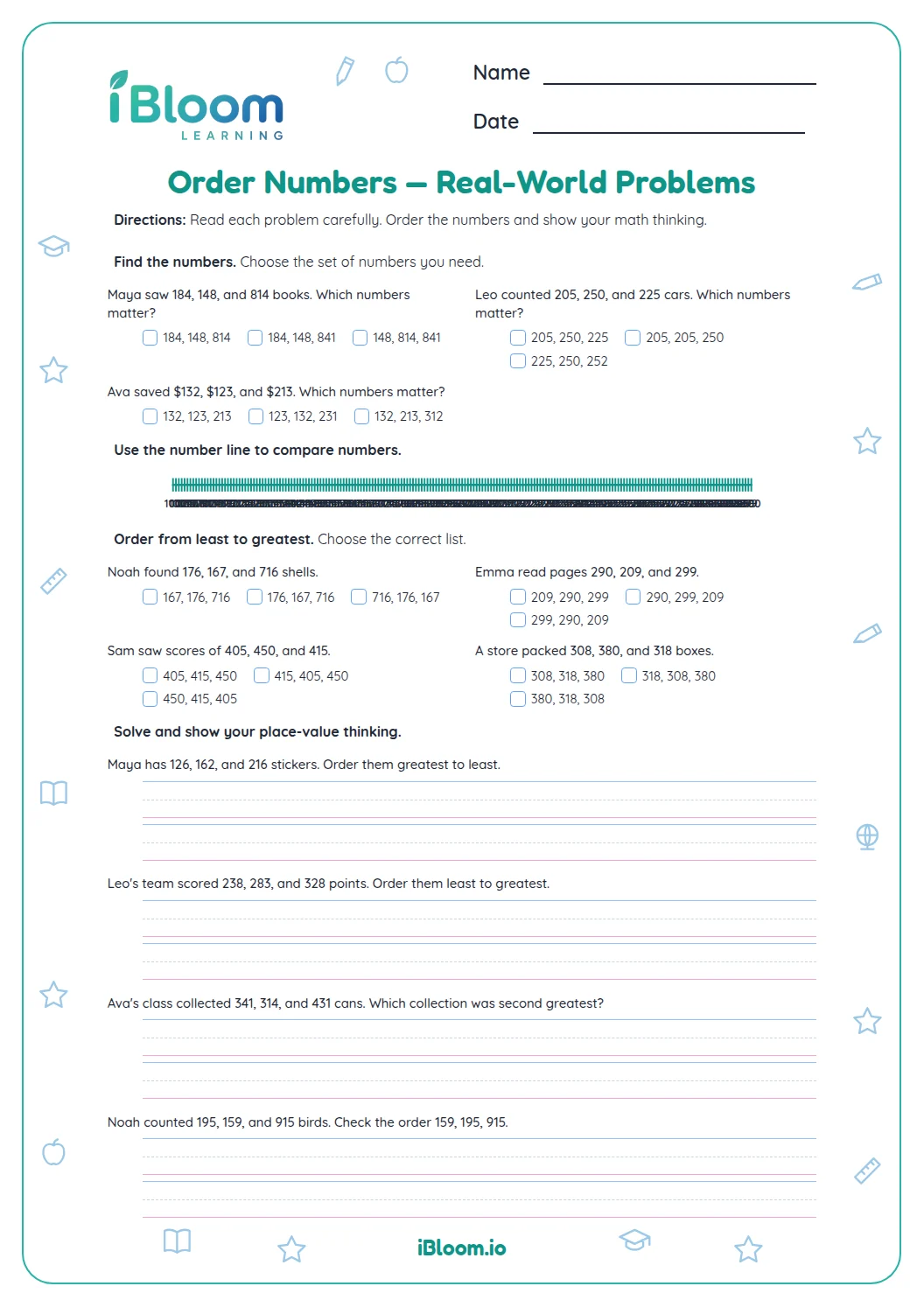
Ordering three numbers is the same idea repeated. Find the greatest, find the least, and the third number goes in the middle.
- 1Ava says 391 is less than 319 because 1 is less than 9.
- 2Hundreds: 3 and 3, the same.
- 3Tens: 9 tens and 1 ten, so 391 is greater.
- 4Ava compared the ones. The tens decide it.
- 5Answer: tens
Why is this a reasoning challenge?
Part B shows what happens when numbers are compared in a hurry. Sam says 88 is greater than 108 because 8 is greater than 1, but 88 has no hundreds and 108 has one. Mia orders 456, 546 and 465 from greatest to least but writes them from least to greatest. Children have to say why each answer is wrong, not only pick a correct order.
Explaining a mistake, even aloud to a parent, shows whether a child is using hundreds, tens and ones or has only learned a trick.
What is on this worksheet?
Eleven questions over two pages. The number line in question 3 runs from 400 to 500 with a tick mark every ten and only the two ends labeled, so children count the jumps to place A at 430, C at 450 and B at 470 before listing the letters from least to greatest.
Question 10 is a small puzzle: a number with 2 hundreds and 4 ones that sits between 274 and 290. Only 284 fits, and finding it means thinking about the tens place on purpose.
- Part A: 4 questions, two orderings, one number line and one number between 438 and 482
- Part B: 3 questions, find what Mia, Sam and Ava got wrong
- Part C: 4 fill-ins: write < or >, the middle number, the mystery number and the greatest number
- Answer key on its own pages
How can you help a child who mixes up the order?
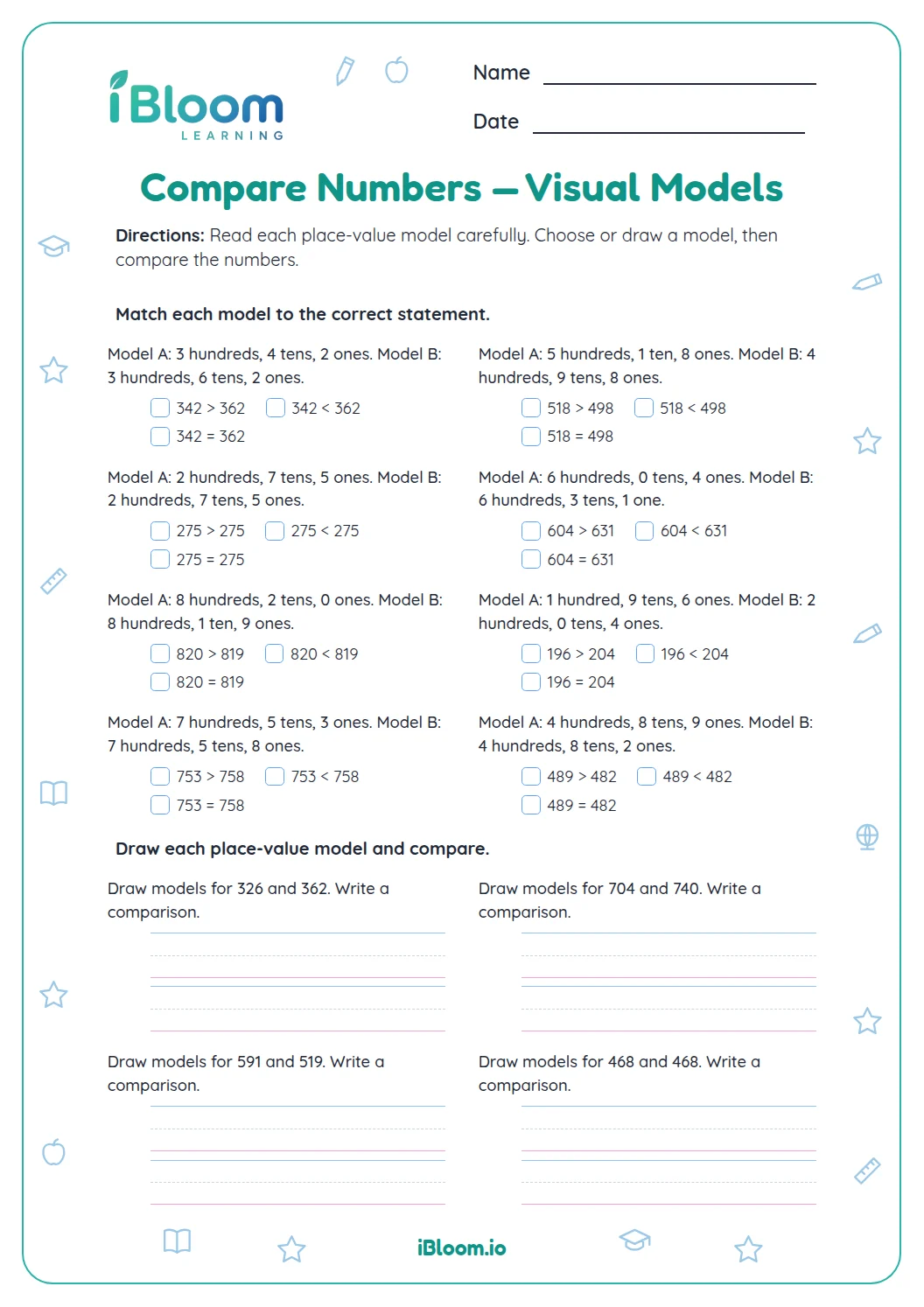
Build the numbers with place-value blocks or quick drawings, then line them up with the hundreds in one column. Seeing 2 hundreds beside 4 hundreds shows the difference without any rule. Then ask your child to say a full sentence, such as “428 is greater than 284 because 4 hundreds is more than 2 hundreds.”
How to use this worksheet at home or in class
- 1Write 248, 284 and 428 on paper and ask which is greatest before mentioning any rule. Ask how your child knows.
- 2Do question 1 together. Point to the hundreds digit in each number, then to the tens.
- 3Let your child try Part A alone. For the number line in question 3, ask them to count by tens from 400 to each point and say its number before listing the letters.
- 4In Part B, ask your child to explain each mistake aloud before coloring an answer.
- 5In Part C, have your child write < or > and read the finished sentence aloud: “672 is greater than 627.”
- 6Check with the answer key and redo any miss with place-value blocks or drawn hundreds, tens and ones.
Common mistakes and quick fixes
The mistake
Comparing the ones first, as in “391 is less than 319 because 1 is less than 9.”
The fix
Start at the left. Compare hundreds, then tens, then ones, and stop at the first place where the digits differ.
The mistake
Judging by the biggest single digit, as in “88 is greater than 108 because 8 is greater than 1.”
The fix
Write both numbers in hundreds, tens and ones columns. 88 has 0 hundreds and 108 has 1 hundred.
The mistake
Writing the order backward, such as least to greatest when the question says greatest to least.
The fix
Circle the words “least to greatest” or “greatest to least” first, then draw an arrow above the answer showing which way it goes.
Common Core alignment
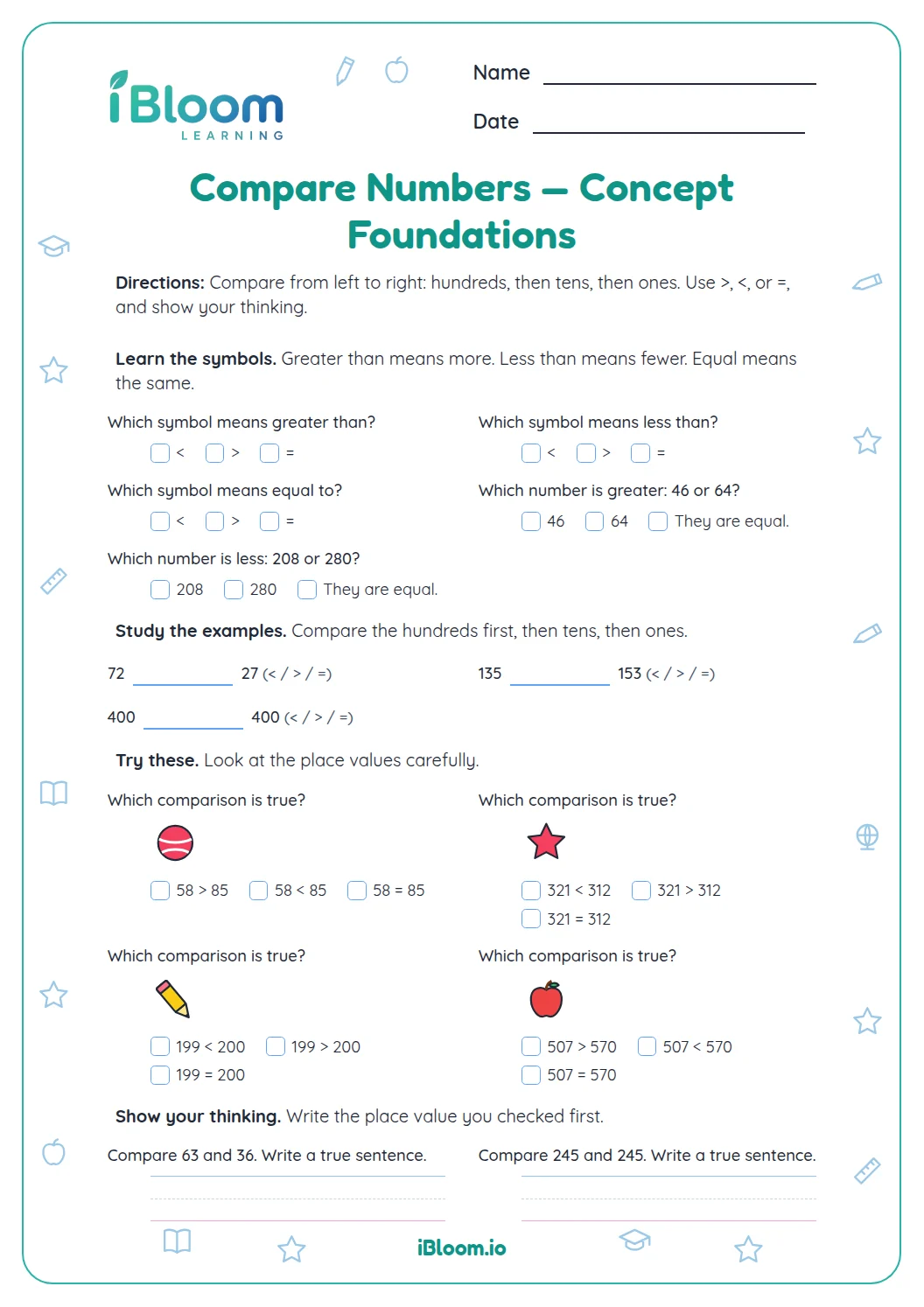
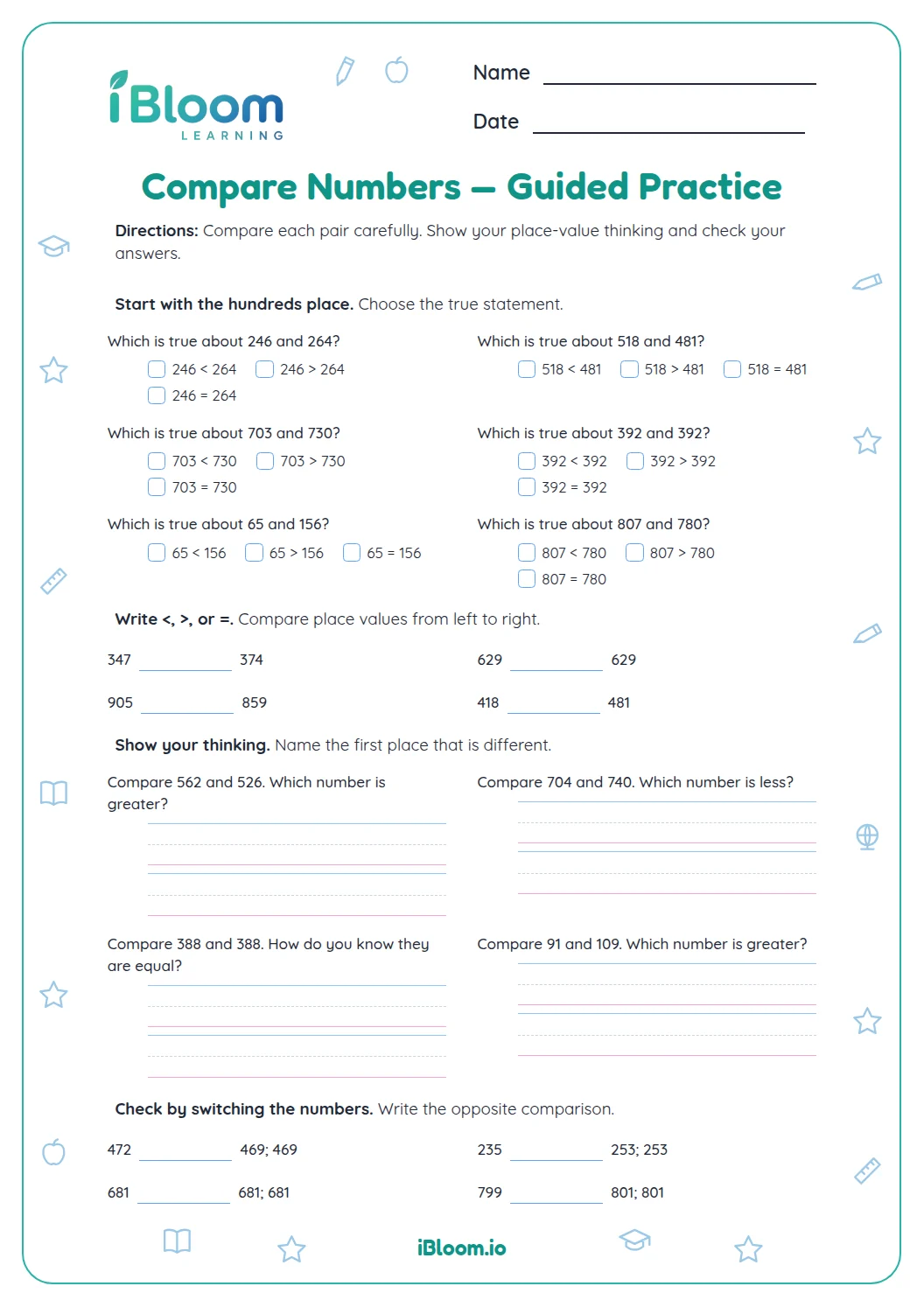
Compare three-digit numbers by their hundreds, tens and ones, and record it with >, = and <.
On this sheet: Every question asks children to compare three-digit numbers digit by digit, and Part C records a comparison with < or >.
Show the official wordingHide the official wording
Compare two three-digit numbers based on meanings of the hundreds, tens, and ones digits, using >, =, and < symbols to record the results of comparisons.
What to practice next
Make more practice
Further reading
Questions parents and teachers ask
How do you order three-digit numbers from least to greatest?
Compare the hundreds first, then the tens, then the ones. In question 1, the numbers 248, 284 and 428 have 2, 2 and 4 hundreds, so 428 comes last. The other two both have 2 hundreds, so the tens decide: 4 tens is less than 8 tens, giving 248, 284, 428.
What is wrong with Sam’s thinking in question 6?
Sam compared only the first digits he saw, 8 and 1. But 88 is a two-digit number with no hundreds, while 108 has one hundred. A number with more hundreds is greater, so 108 is greater than 88. The correct choice on the sheet is “88 has fewer hundreds.”
How does the number line in question 3 work?
The line runs from 400 to 500 with a tick mark every ten, and only 400 and 500 are labeled. Children count the tens to find each lettered point (A is 430, B is 470, C is 450), then list the letters from least to greatest. The answer is A, C, B, because 430 < 450 < 470.
What do the symbols < and > mean in Part C?
The open side of the symbol faces the greater number. In 672 and 627 the hundreds match, but 672 has 7 tens and 627 has 2 tens, so 672 is greater and the symbol is >. Reading it aloud as “672 is greater than 627” helps children check their choice.
My child orders correctly but cannot say why. Is that a problem?
It is a good moment to slow down, not a problem. Sorting by feel often comes before saying the rule. Ask your child to point to the digit that decided each order. Naming the hundreds digit, then the tens digit when the hundreds match, turns a guess into a method they can reuse.
Is there an answer key, and how long does it take?
Yes, a separate answer key gives all eleven answers, with the correct bubble filled in for each choice question. Plan on about 15 minutes. The three Part B questions may take longest because children think about someone else’s mistake, so it helps to read those aloud together first.