


About this worksheet
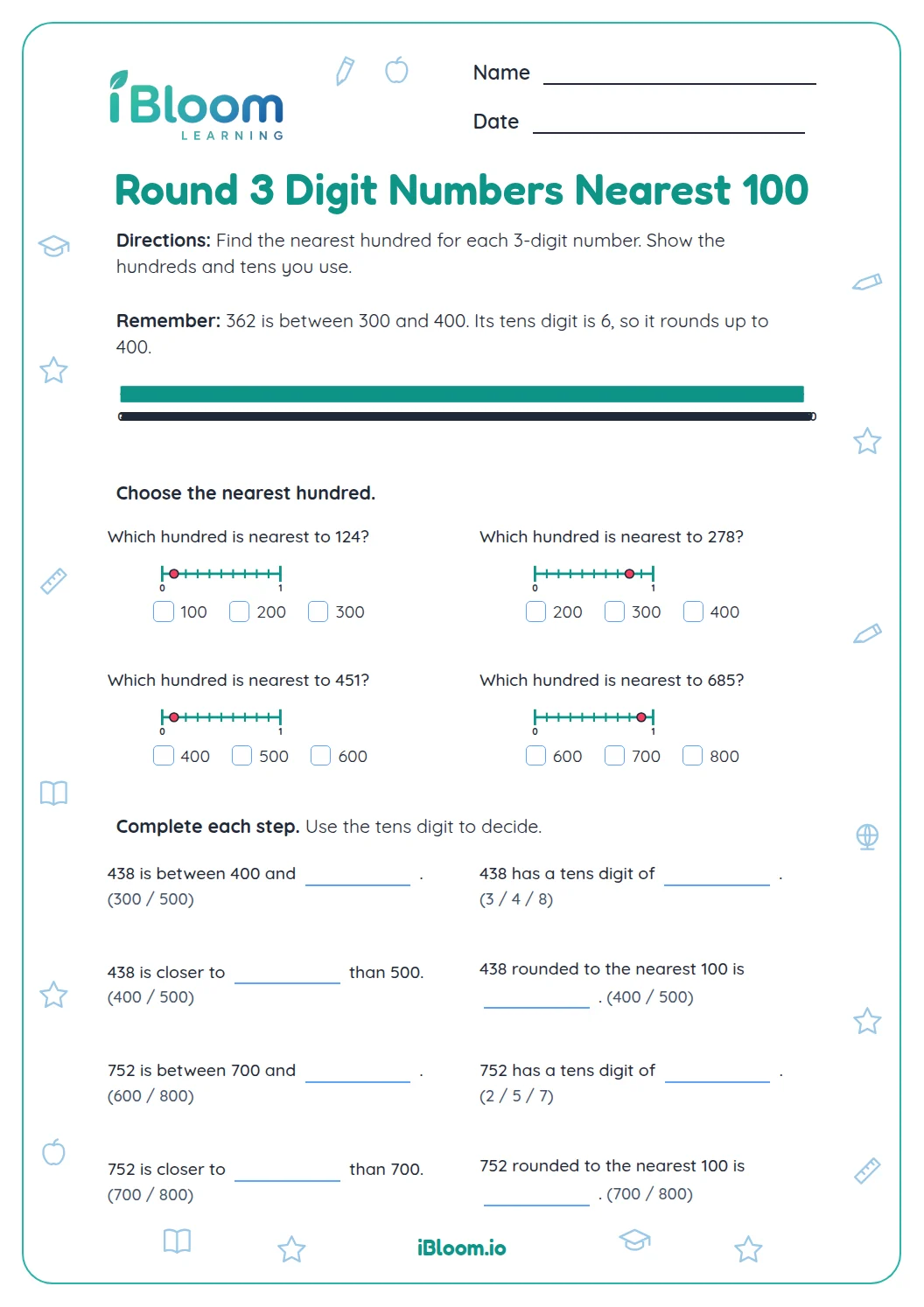
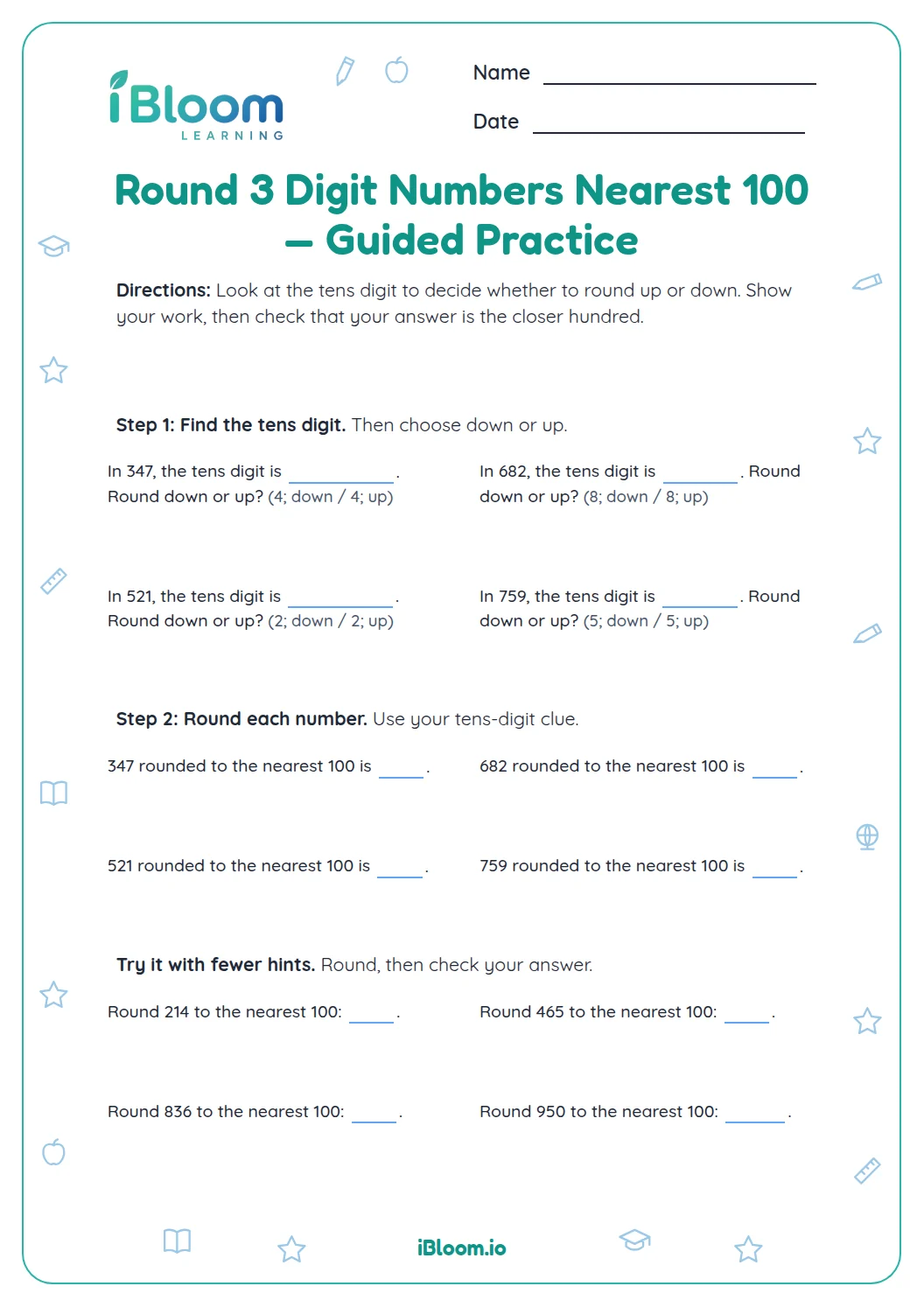
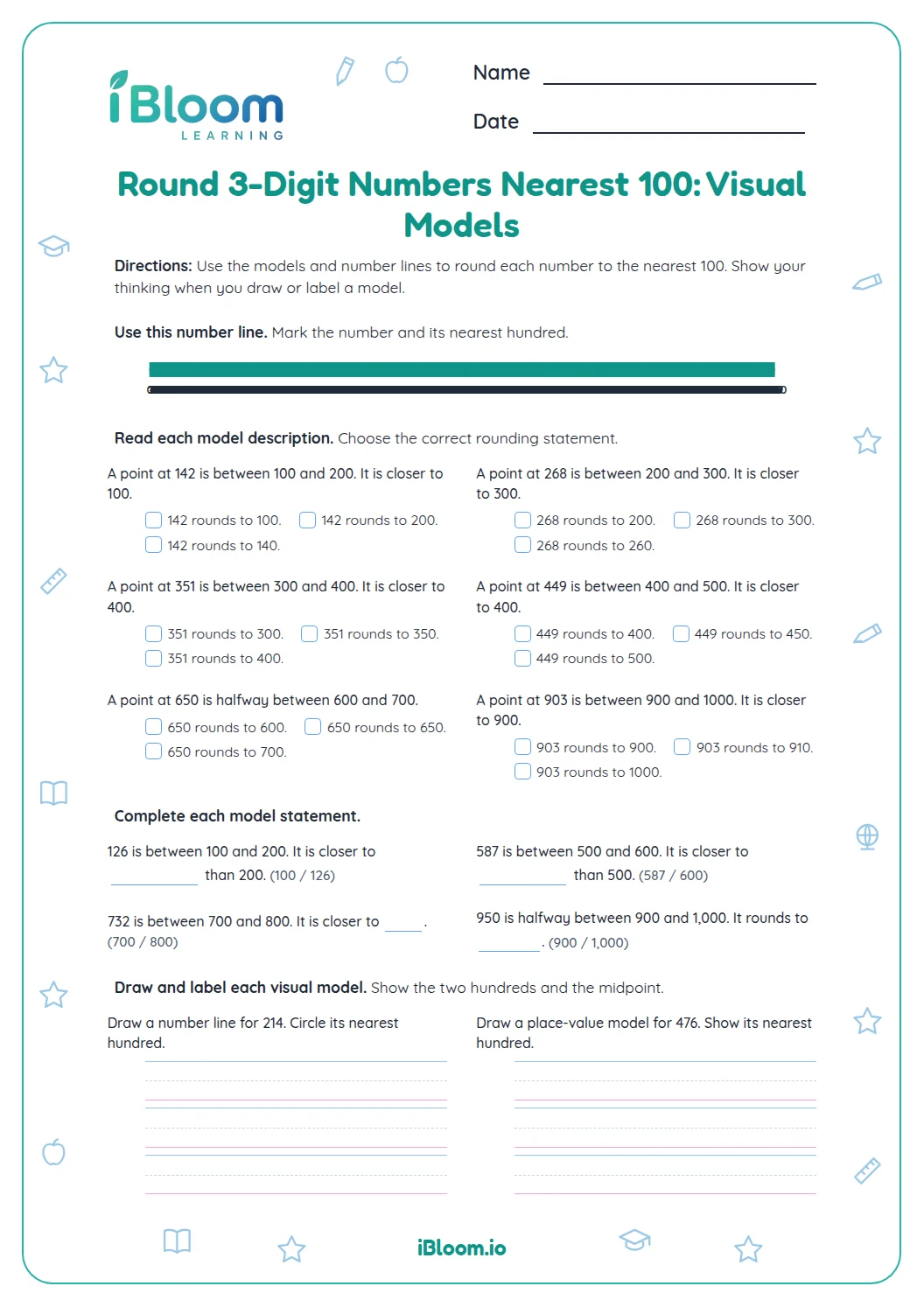
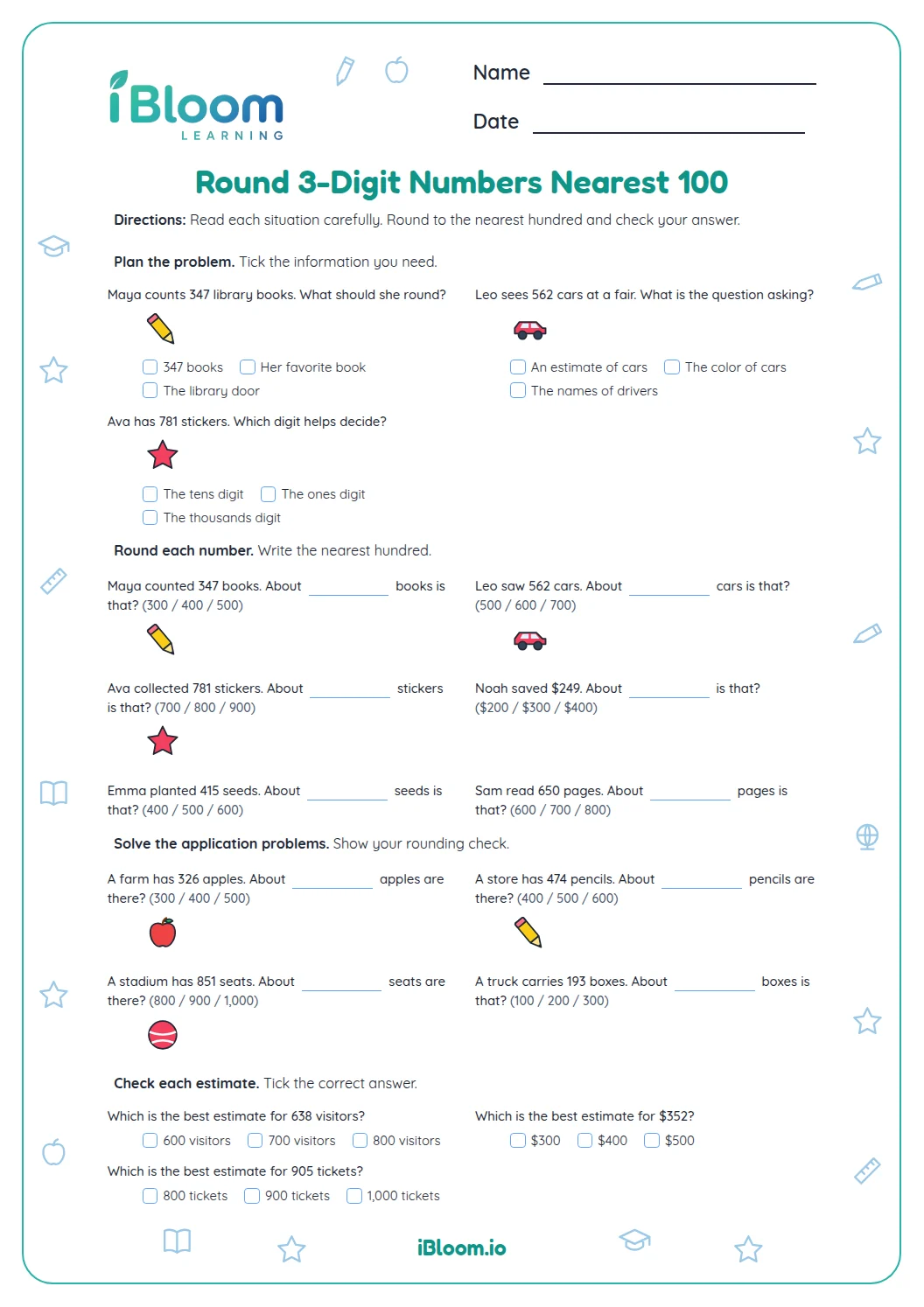
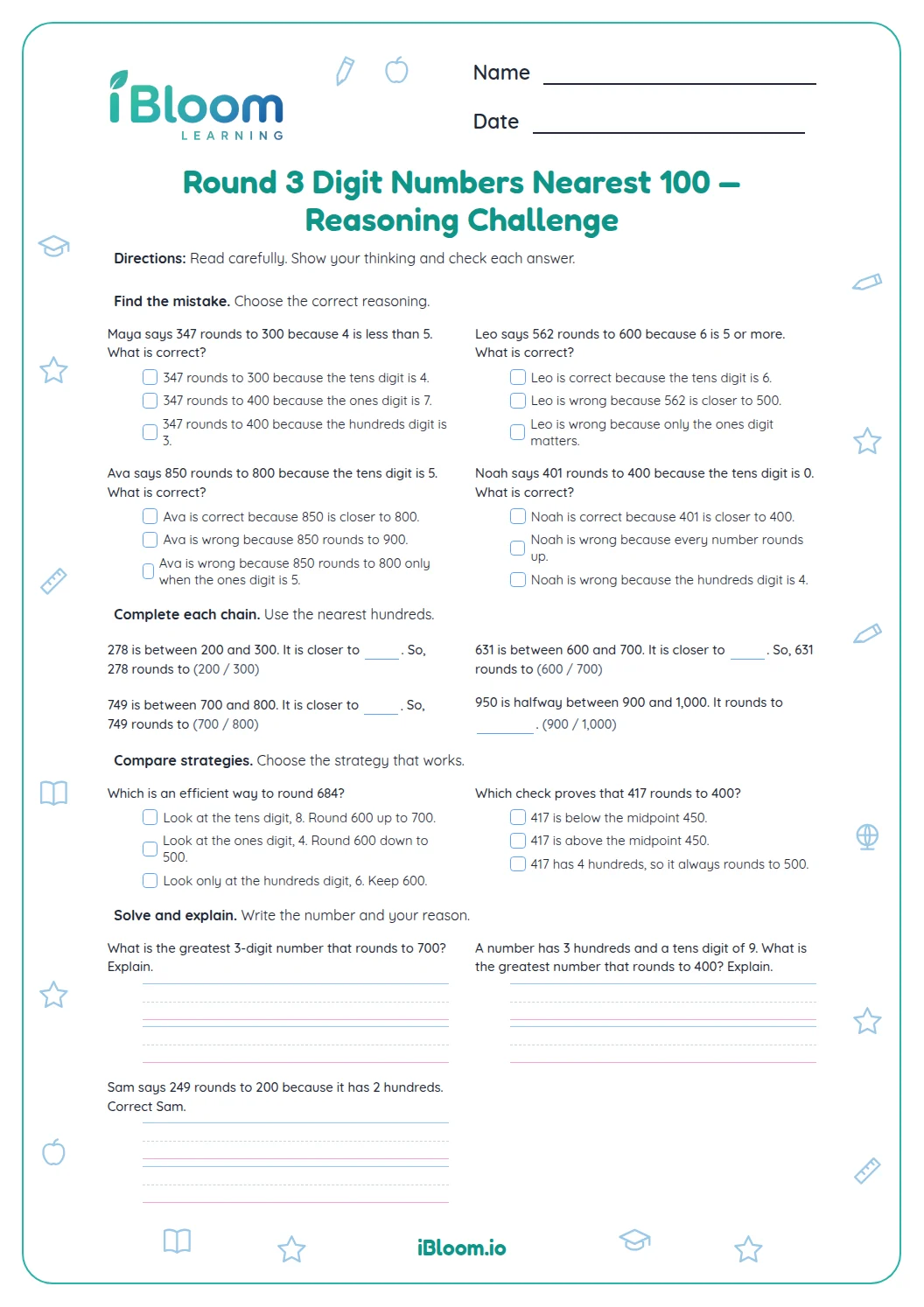
This free Grade 2 worksheet gives students 15 independent questions rounding three-digit numbers to the nearest hundred. It includes values below and above halfway points, tens that end in 50, a number line question, and three short real-world estimates. Students use the tens digit to decide whether a number is closer to the lower or higher hundred. The practice aligns with Common Core 3.NBT.A.1, which names rounding to the nearest 10 or 100 using place value understanding. A separate answer key is included.
Aligned to 3.NBT.A.1
What numbers will students round?
The page includes whole numbers from 186 to 950. Students round values closer to the lower hundred, values closer to the higher hundred, and halfway values such as 350, 750, and 950. Questions 11–13 connect rounding to estimated counts or lengths.
- Practice includes 3-digit values across several hundreds
- Halfway values round up to the next hundred
- Context questions ask for an approximate amount
How can place value help decide?
Find the two hundreds that the number sits between. The tens digit shows whether the number is below 50 past the lower hundred or at least 50 past it. Numbers with 50 extra are halfway and round up.
- 1243 is between 200 and 300.
- 2Its tens digit is 4, so 243 is closer to 200.
- 3243 rounded to the nearest hundred is 200.
What happens at a halfway number?
A number such as 350 is exactly halfway between 300 and 400. In this worksheet, halfway values round up: 350 rounds to 400. The same rule applies to 750 and 950.
How does rounding help estimate?
A rounded number gives a quick nearby amount. If a school has 327 books, rounding to the nearest hundred gives about 300 books. Keep the word “about” because 300 is an estimate, not the exact count.
How to use this worksheet
- 1Read the whole number and identify the two hundreds around it.
- 2Look at the tens digit to see which hundred is closer.
- 3If the number is exactly halfway, round up.
- 4For story questions, include the item or unit being estimated.
- 5Check each choice or answer with the answer key.
Common rounding mistakes
The mistake
Looking only at the ones digit.
The fix
Use the tens digit to see how far the number is past its lower hundred.
The mistake
Rounding 350 down because its tens digit is 5.
The fix
A number exactly halfway rounds up to 400.
The mistake
Writing 300 books as an exact count when the problem asks for an estimate.
The fix
Use “about” to show that the rounded amount is close, not exact.
Common Core alignment
Round whole numbers to the nearest hundred using place value understanding.
On this sheet: Every item rounds a whole number to its nearest hundred.
Show the official wordingHide the official wording
Use place value understanding to round whole numbers to the nearest 10 or 100.
What to practice next
Make more practice
Further reading
Questions parents and teachers ask
What does nearest hundred mean?
Nearest hundred means choosing the hundred closest to a number. For example, 243 is 43 past 200 and 57 away from 300, so it rounds to 200. The rounded result estimates the original value and is not its exact amount.
What do you do when a number is halfway?
When a number is exactly halfway between two hundreds, this worksheet uses the usual rule of rounding up. So 350, exactly between 300 and 400, rounds to 400. The same rule applies to 750 and 950 in the practice.
How many questions are included?
There are 15 questions. Students round three-digit numbers, choose a number that rounds to a target hundred, and apply rounding to estimates about books, trail length, and seats. The answer key lists the rounded hundred for each item.
Why look at the tens digit?
The tens digit shows how far the number is beyond the lower hundred. A tens digit below 5 means the lower hundred is closer. A 5 marks the halfway point, and digits above 5 put the number closer to the next hundred.
Does this worksheet have an answer key?
Yes. The separate key gives the rounded hundred for all 15 questions. For the story problems, it includes the rounded amount and the item or unit being estimated, such as about 300 books or about 500 meters, so the estimate stays tied to its context.