



About this worksheet
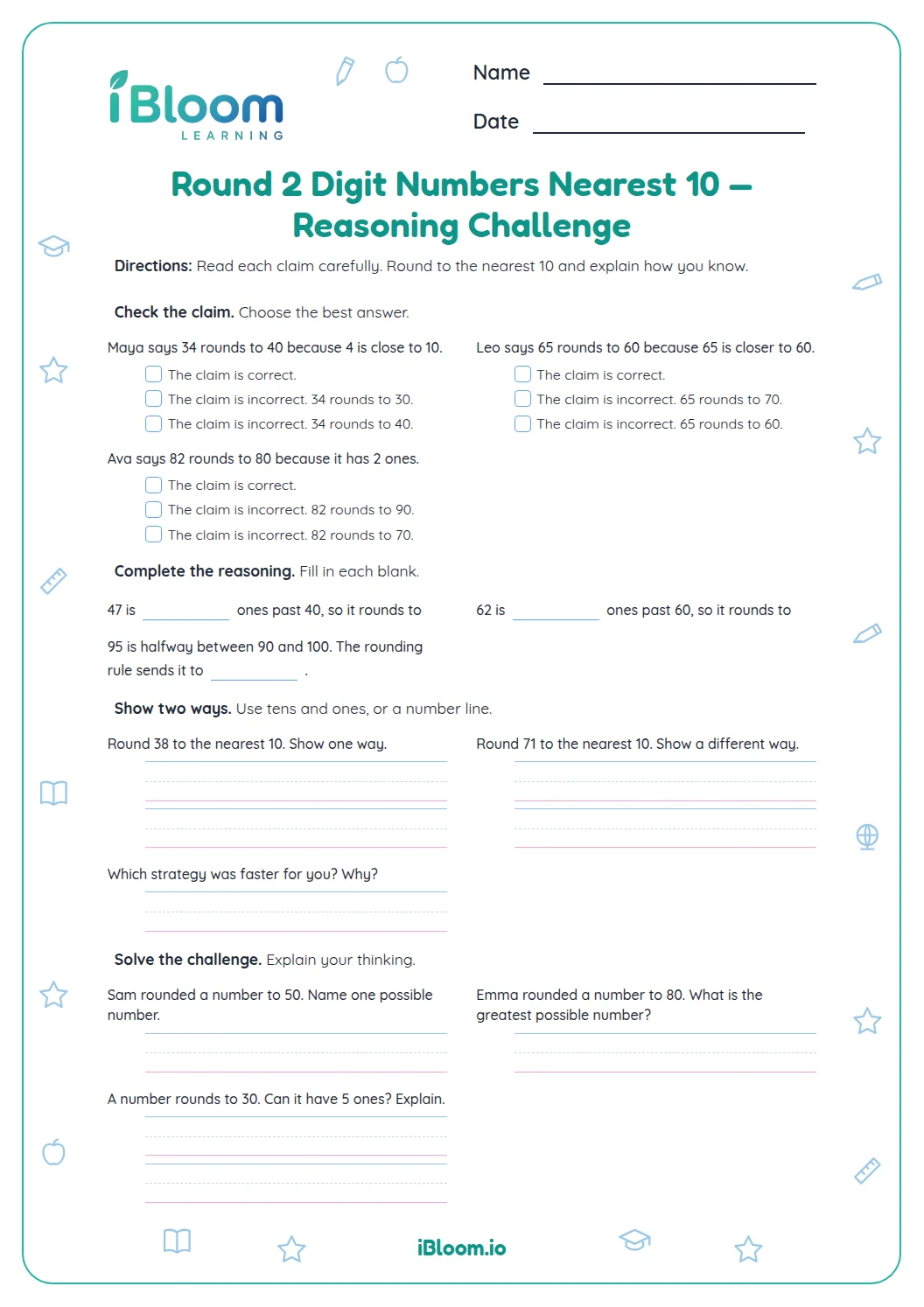
This free Grade 2 worksheet guides children through rounding two-digit numbers to the nearest ten. Part A gives four labeled number lines so children can compare distances to the two neighboring tens. Part B has eight rounding blanks, and Part C checks a halfway number and an exact ten. The practice uses the place-value reasoning described in Common Core 3.NBT.A.1. Children work with numbers from 14 to 95, including a result of 100. A separate answer key shows the selected tens and completed blanks.
Aligned to 3.NBT.A.1
How does a number line explain rounding?
The two endpoints are neighboring tens. Count the one-unit gaps from the marked number to each endpoint. The smaller distance identifies the nearest ten.
- 123 is between 20 and 30.
- 2It is 3 away from 20 and 7 away from 30.
- 323 rounds to 20.
What happens when the ones digit is 5?
A number such as 45 is the same distance from 40 and 50. The rounding convention used here chooses the higher ten for halfway numbers. Question 3 shows that tie on a number line; question 13 asks children to apply it to 75.
Say “halfway, choose the higher ten” while pointing to both endpoints. This explains why distance alone does not settle a tie.
Why do 60 and 95 need careful checking?
An exact ten stays the same: 60 rounds to 60 because it is already a multiple of ten. Rounding does not always change a number.
For 95, the neighboring tens are 90 and 100. The result can have three digits even though the starting number has two. Since 95 is halfway, it rounds to 100.
How to use this worksheet
- 1Name the endpoint tens on the first number line.
- 2Count the gaps from 23 to 20 and from 23 to 30, then choose 20.
- 3Use the other lines to compare distances and explain the halfway rule.
- 4For Part B, find the ones digit and write the rounded number.
- 5Finish with the two check questions, then compare every result with the key.
Mistakes to notice and fix
The mistake
Rounding 23 to 30 simply because 30 is larger.
The fix
Count the distances: 3 to 20 and 7 to 30. Choose the closer ten.
The mistake
Rounding 75 to 70 because both tens are equally close.
The fix
Apply the halfway convention: a ones digit of 5 rounds to the higher ten.
The mistake
Changing 60 to 70 because rounding should change the number.
The fix
Point to 60 itself; its distance from the exact ten 60 is zero.
Common Core alignment
Use neighboring tens and the ones digit to round two-digit numbers to the nearest ten.
On this sheet: Number lines show distances to neighboring tens; later questions apply the rounding rule.
Show the official wordingHide the official wording
Use place value understanding to round whole numbers to the nearest 10 or 100.
What to practice next
Make more practice
Further reading
Questions parents and teachers ask
What numbers does the worksheet use?
The worksheet uses two-digit numbers from 14 to 95. Four questions include labeled number lines; eight ask children to write rounded values. The final two choices focus on 75 and 60, giving children another chance to check the halfway rule and the behavior of an exact ten.
Why does 45 round to 50?
45 rounds to 50 because it is halfway between 40 and 50, and this rounding rule chooses the higher ten for a tie. On the question 3 number line, count five gaps in each direction. Equal distances signal that the halfway convention decides the answer.
Can the answer be 100 on a two-digit worksheet?
Yes, 95 rounds to 100 when rounding to the nearest ten. Its neighboring tens are 90 and 100, and it lies exactly halfway between them. Choosing the higher ten gives 100. The starting number has two digits even though the rounded result has three.
Should children use the ones-digit rule right away?
Use the number lines first so the rule has a visible meaning. After comparing distances in Part A, children can use the ones digit for Part B: 0 through 4 choose the lower ten, and 5 through 9 choose the higher ten. Exact tens keep their value.
How can I check understanding beyond the answer key?
Ask your child to name the two neighboring tens and explain the choice for one number. For 68, the endpoints are 60 and 70, and 68 is closer to 70. For 75, ask why equal distances still lead to 80. The explanation reveals how the child decided.