


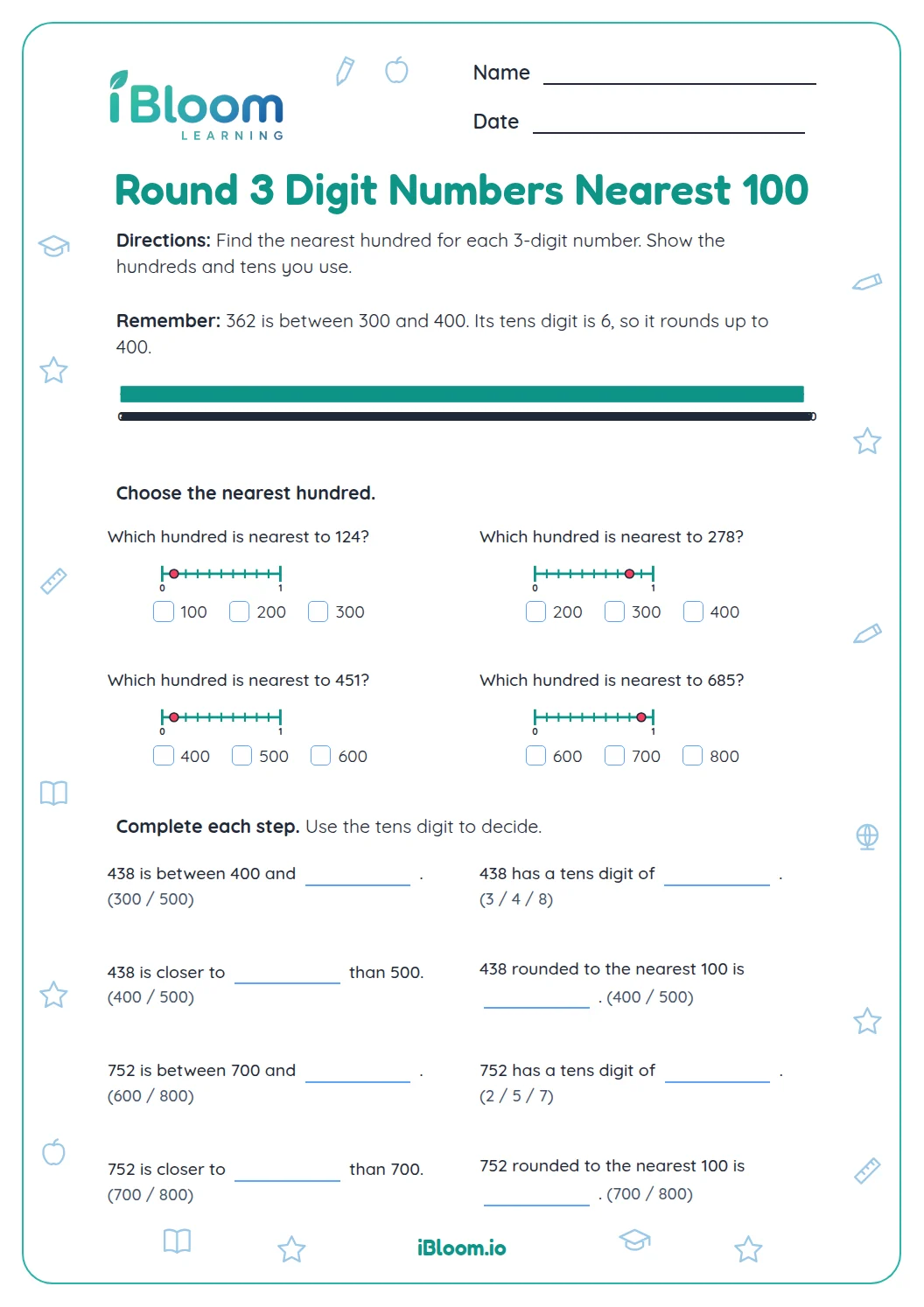
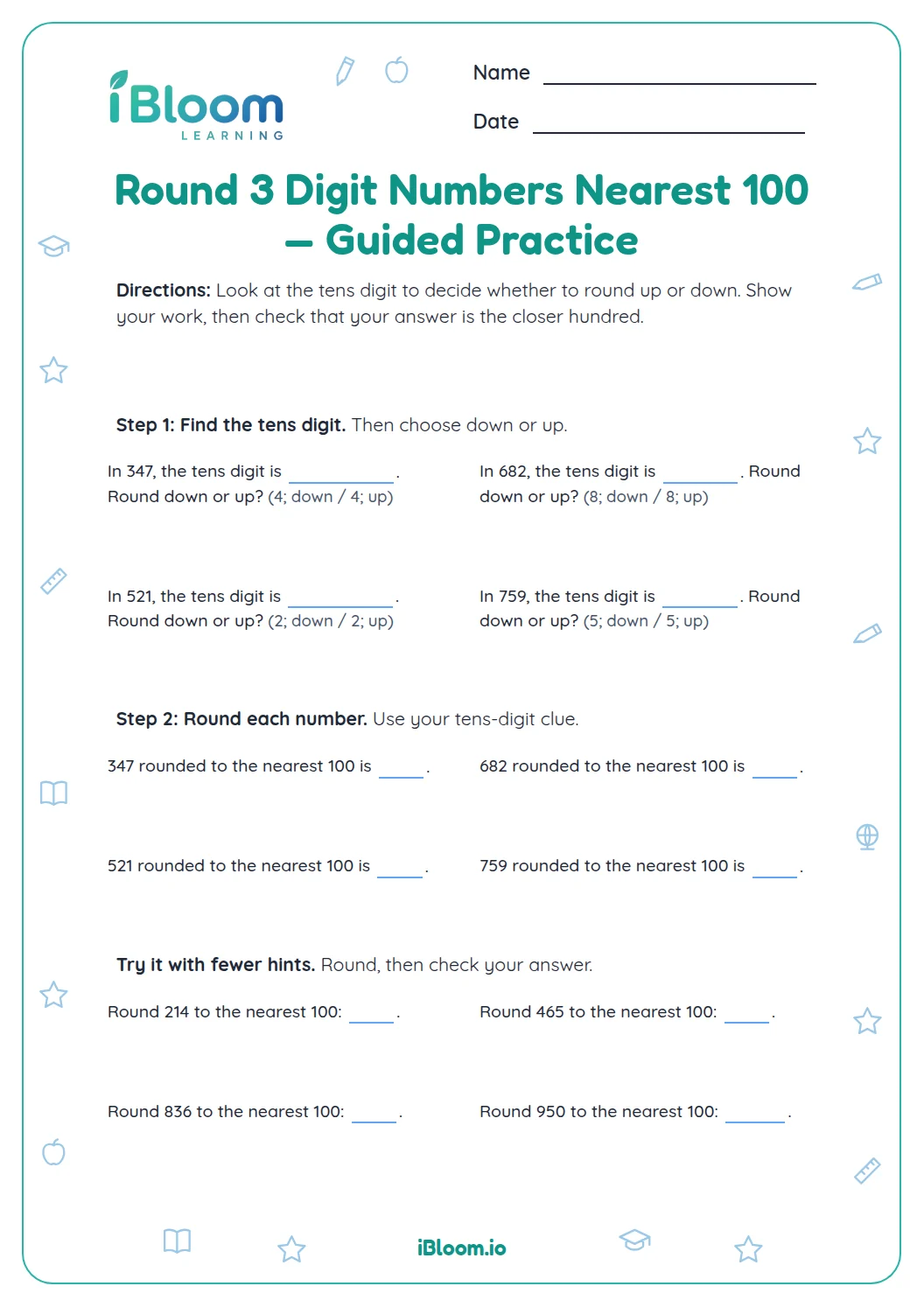
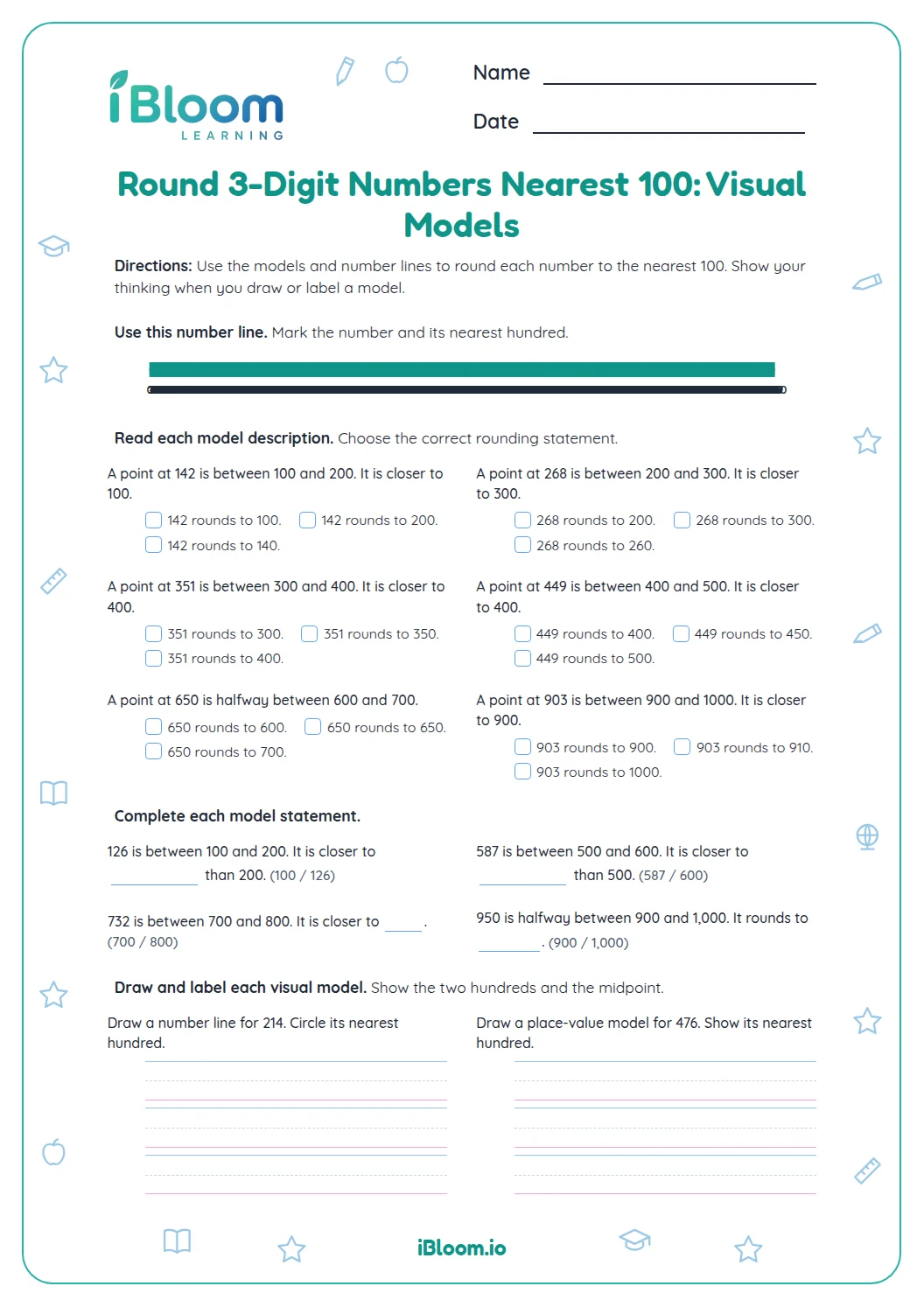
About this worksheet
This printable gives Grade 2 students 14 questions about rounding three-digit numbers to the nearest ten. Part A practices the ones-digit rule; Part B checks rounded results; Part C asks for a number that rounds to 430 and an estimate for two book counts. The answer key includes the possible-number range and estimated total. The page aligns its rounding practice with CCSS 3.NBT.A.1.
Aligned to 3.NBT.A.1
How do you round to the nearest ten?
Rounding to the nearest ten means finding which neighboring ten is closer. For 142, the ones digit is 2, so the number is closer to 140 than 150. For 148, the ones digit is 8, so it is closer to 150.
For a quick check, look at the ones digit: 0–4 rounds down to the lower ten; 5–9 rounds up to the next ten.
- 1Number: 142
- 2Neighboring tens: 140 and 150
- 3142 is closer to 140.
- 4Rounded number: 140
What happens at the halfway point?
A number ending in 5 is exactly halfway between two tens. In this worksheet, halfway values round up: 215 becomes 220 and 585 becomes 590.
How can rounding help estimate a total?
Round each amount to the requested place before adding. For the library problem, 347 rounds to 350 and 326 rounds to 330, for an estimate of 680 books.
How to use this worksheet
- 1Read the number and requested place.
- 2Compare the number with the tens just below and above it.
- 3Choose the nearer ten; halfway values round up.
- 4Estimate sums by rounding each addend first.
Common mistakes and quick fixes
The mistake
Changing the tens digit when the ones digit is below 5.
The fix
For 0–4, keep the lower ten.
The mistake
Rounding 5 down.
The fix
A ones digit of 5 is halfway, so round up.
The mistake
Rounding the total when the question asks to round each addend.
The fix
Round each number first, then combine the estimates.
Common Core alignment
This sheet uses place value to round whole numbers to the nearest ten.
Use place value to round whole numbers to the nearest ten.
On this sheet: Students round three-digit numbers to the nearest ten.
Show the official wordingHide the official wording
Use place value understanding to round whole numbers to the nearest 10 or 100.
What to practice next
Make more practice
Further reading
Questions parents and teachers ask
How many questions are included?
There are 14 questions in three parts. Ten ask students to round a number, two are multiple-choice checks, and two ask for a written response. The final items include a range of possible numbers and a book-total estimate. A separate key is included.
What does a number ending in 5 do?
A number ending in 5 is halfway between two tens. This worksheet rounds halfway numbers up, so 585 rounds to 590 and 215 rounds to 220. Students can check the neighboring tens to see why the halfway rule applies.
How does place value help students round?
Look at the ones digit to decide whether the number is closer to the lower ten or the next ten. For example, 142 has 2 ones, so it rounds down to 140; 148 has 8 ones, so it rounds up to 150.
Can the open response have more than one answer?
Yes. Any whole number from 425 through 434 rounds to 430 to the nearest ten. The key gives the full range and one example, 428. Students may write any number in that range and verify it by checking its ones digit.
How is rounding used in the library question?
Students round each shelf count, 347 and 326, to 350 and 330. They add the estimates for about 680 books, while the exact total is 673. The context shows how rounded numbers can provide a quick estimate. The estimate is useful when an exact count is not needed.