
About this worksheet
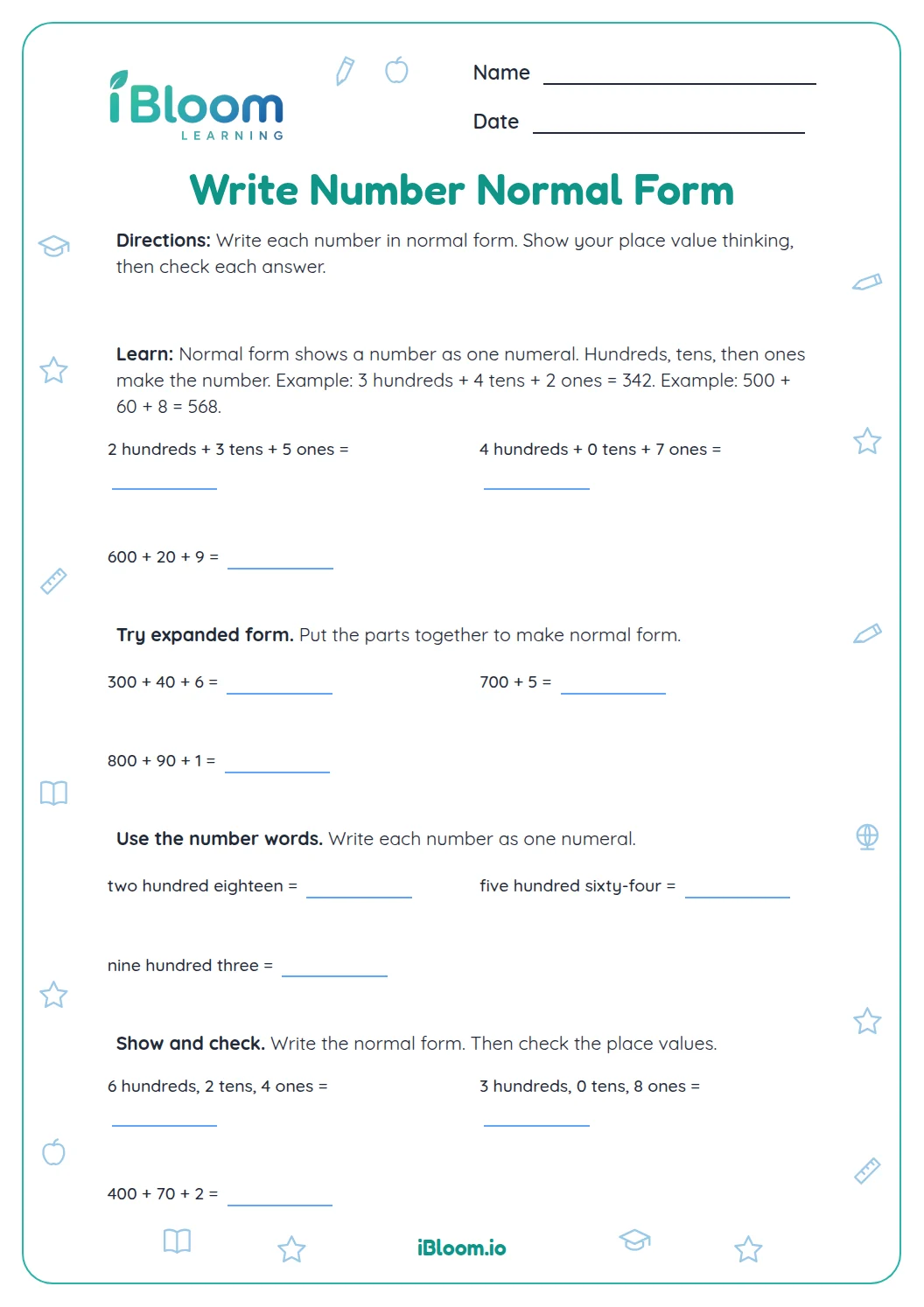
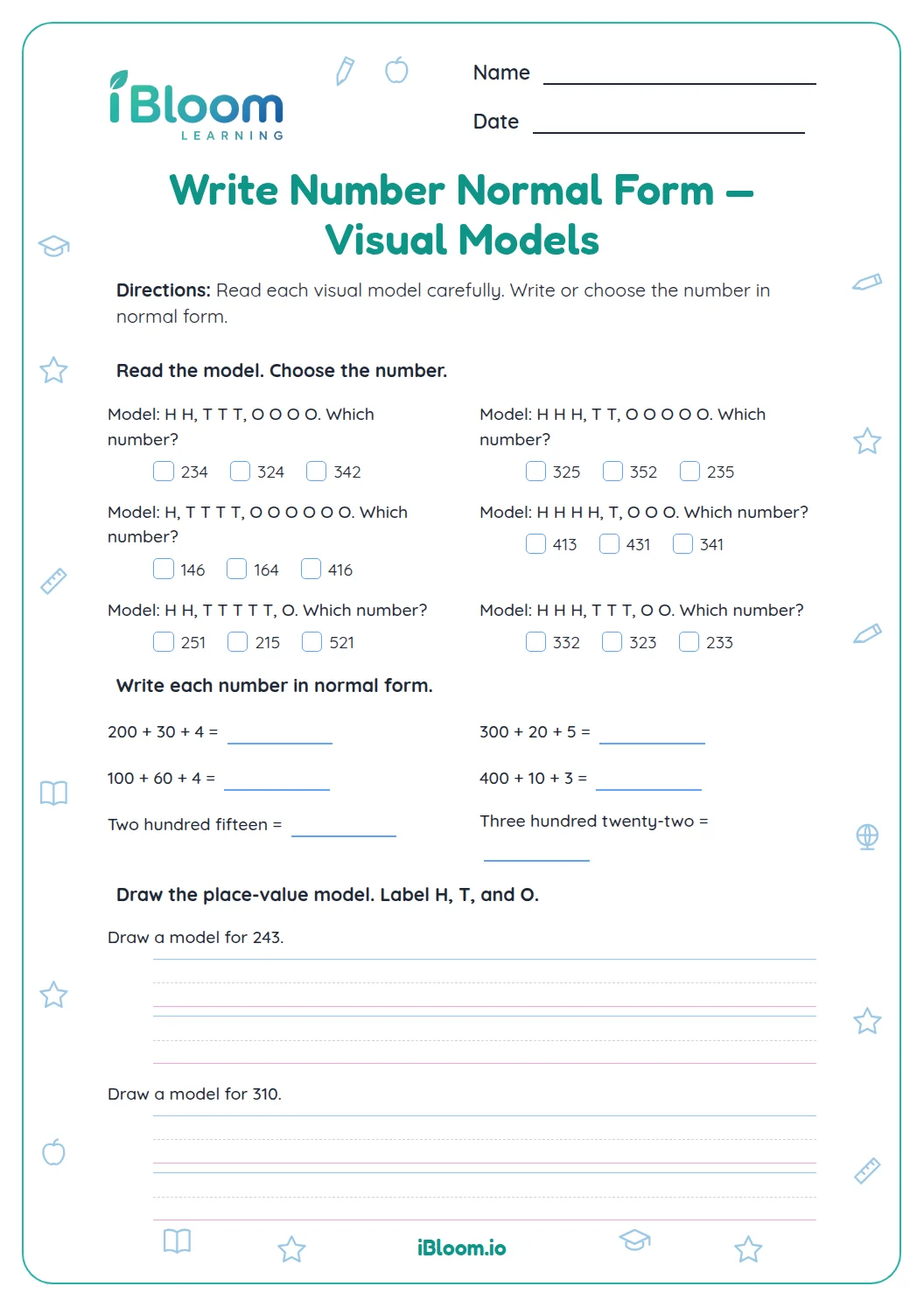
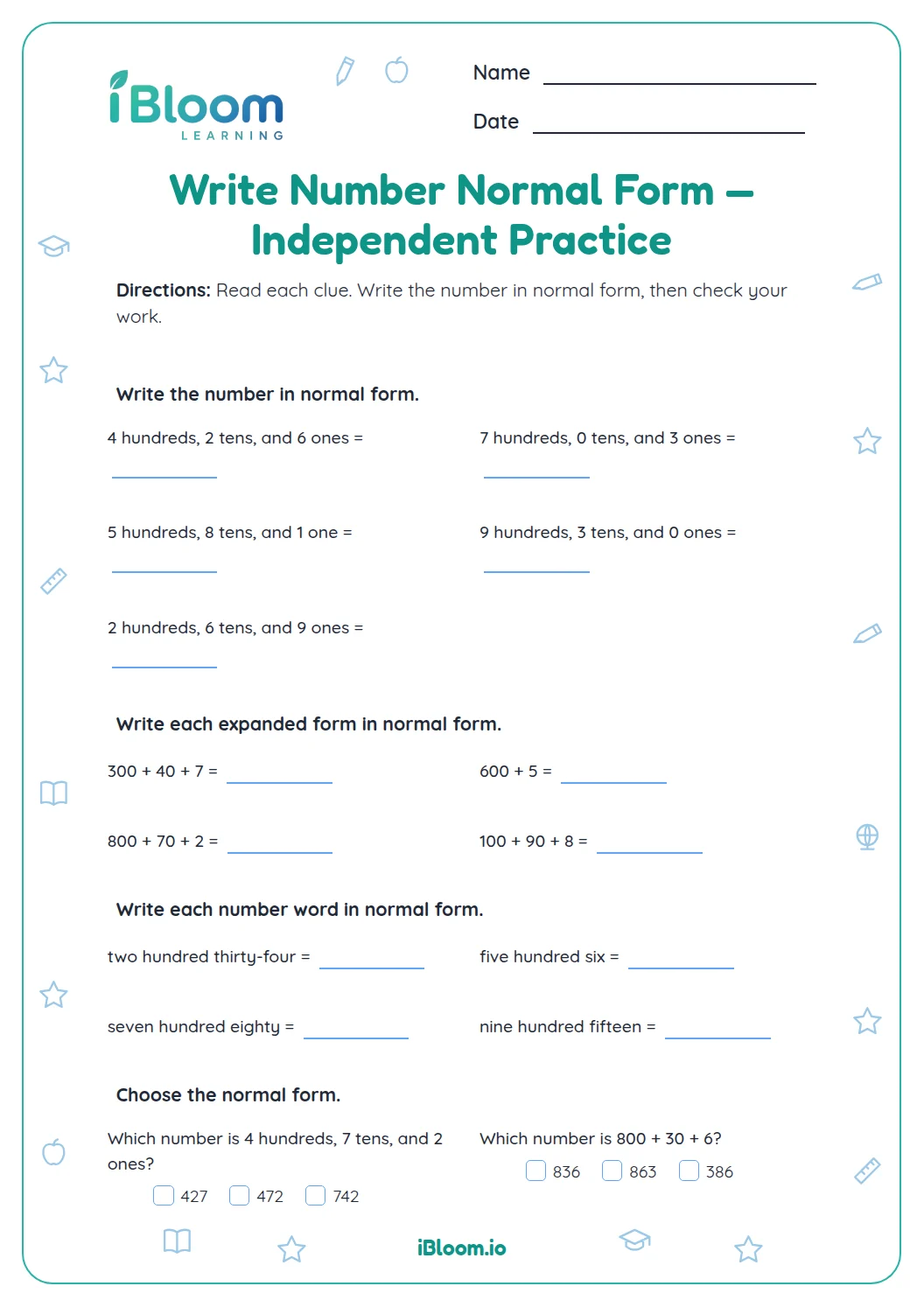
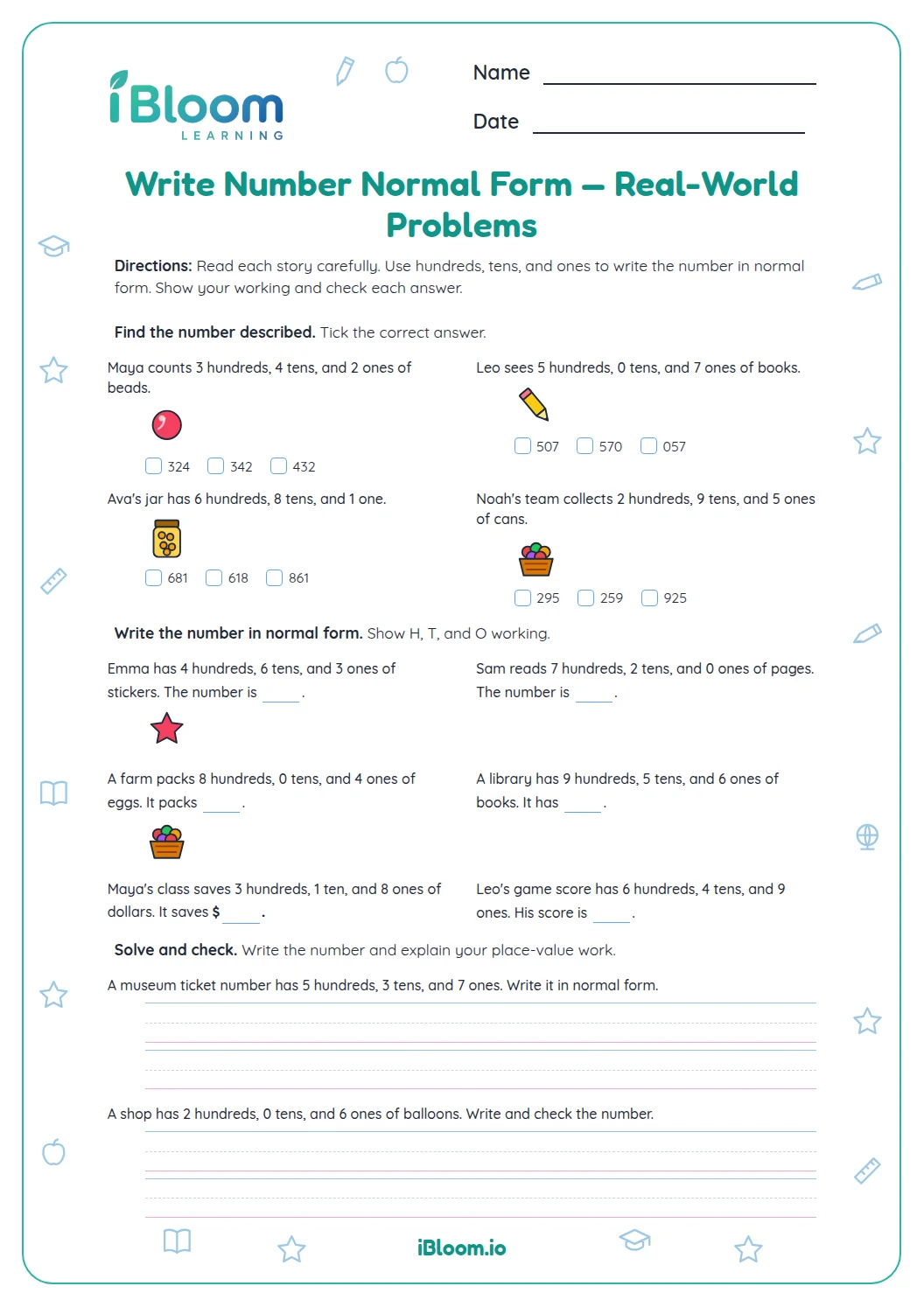
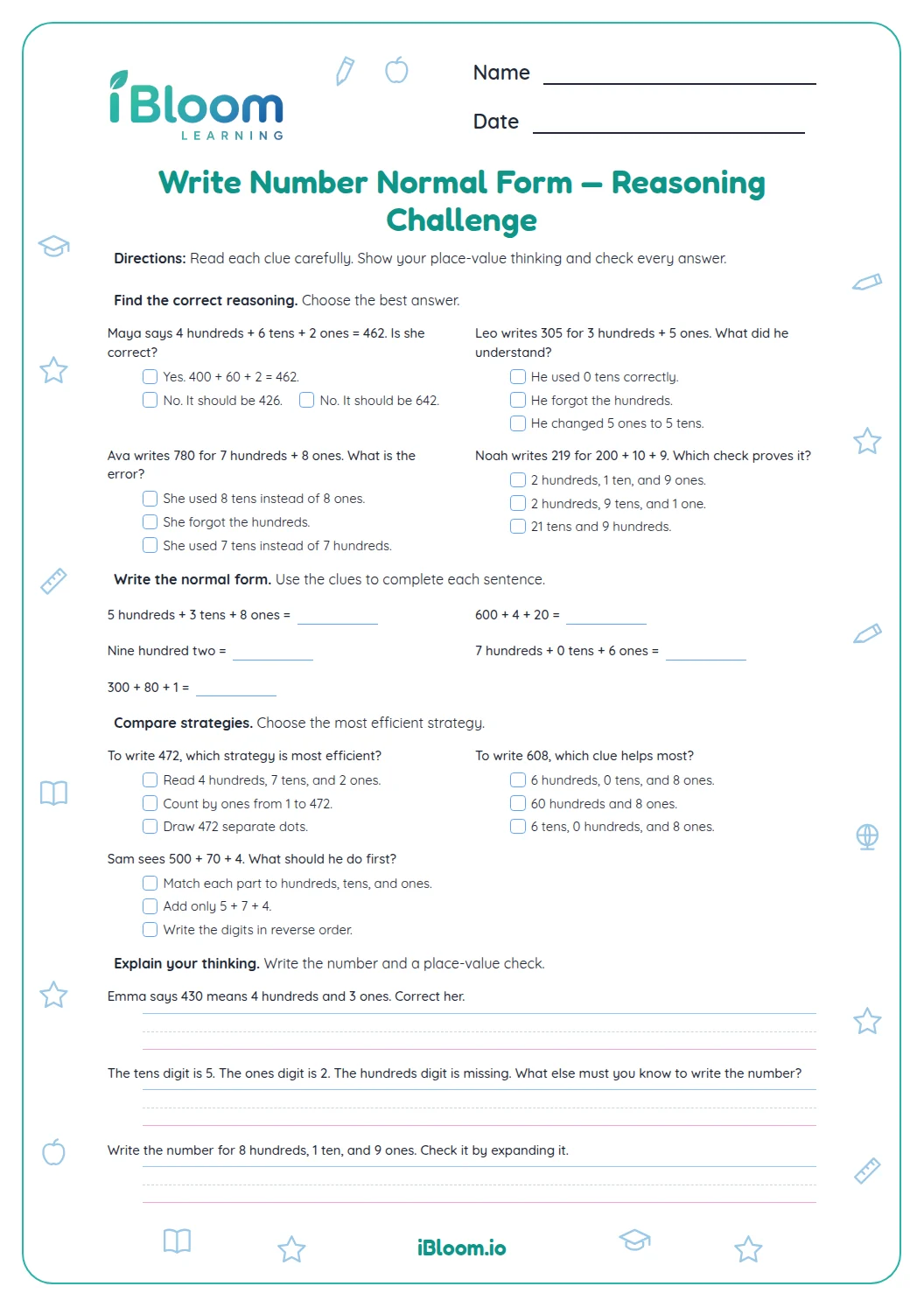
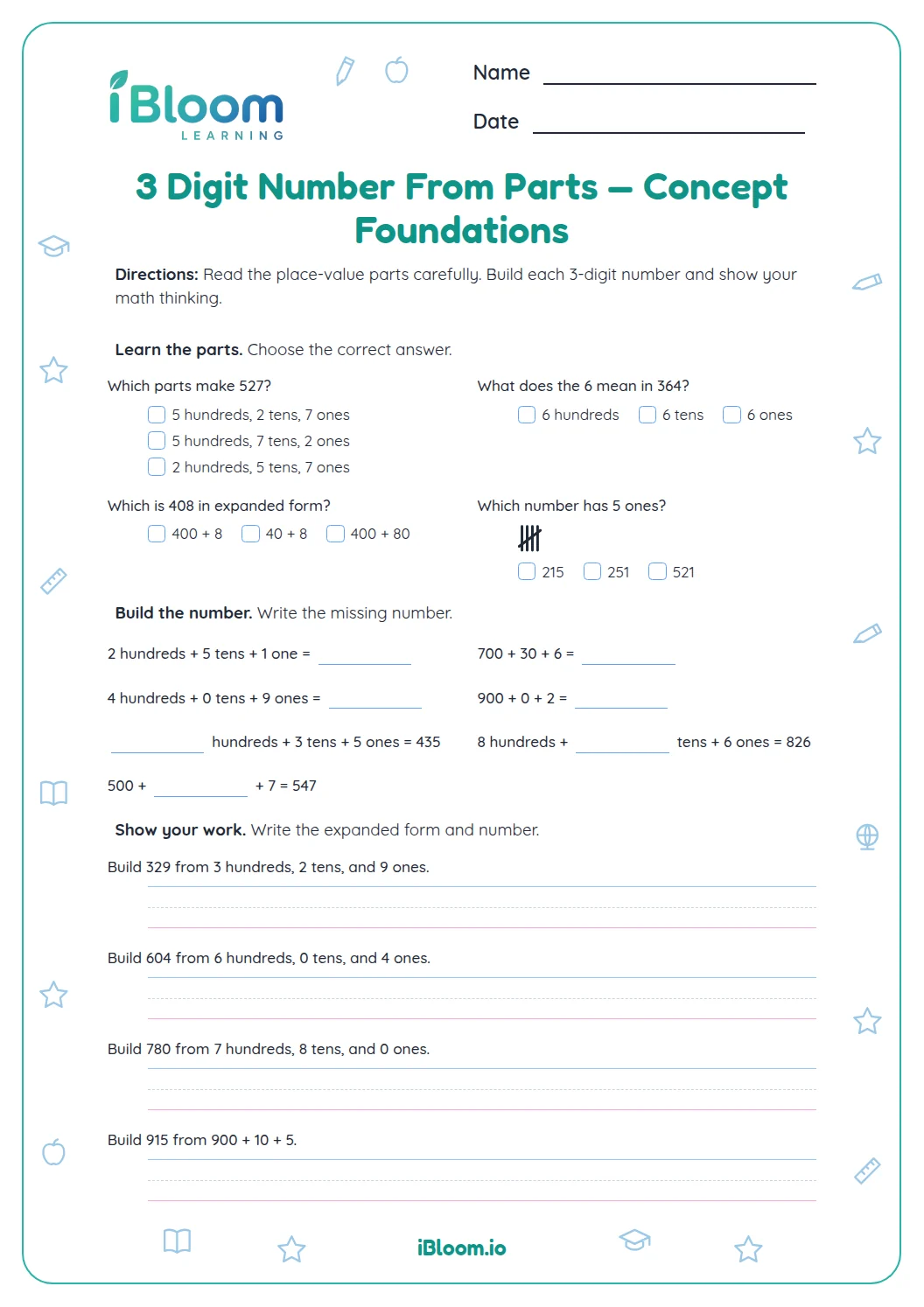
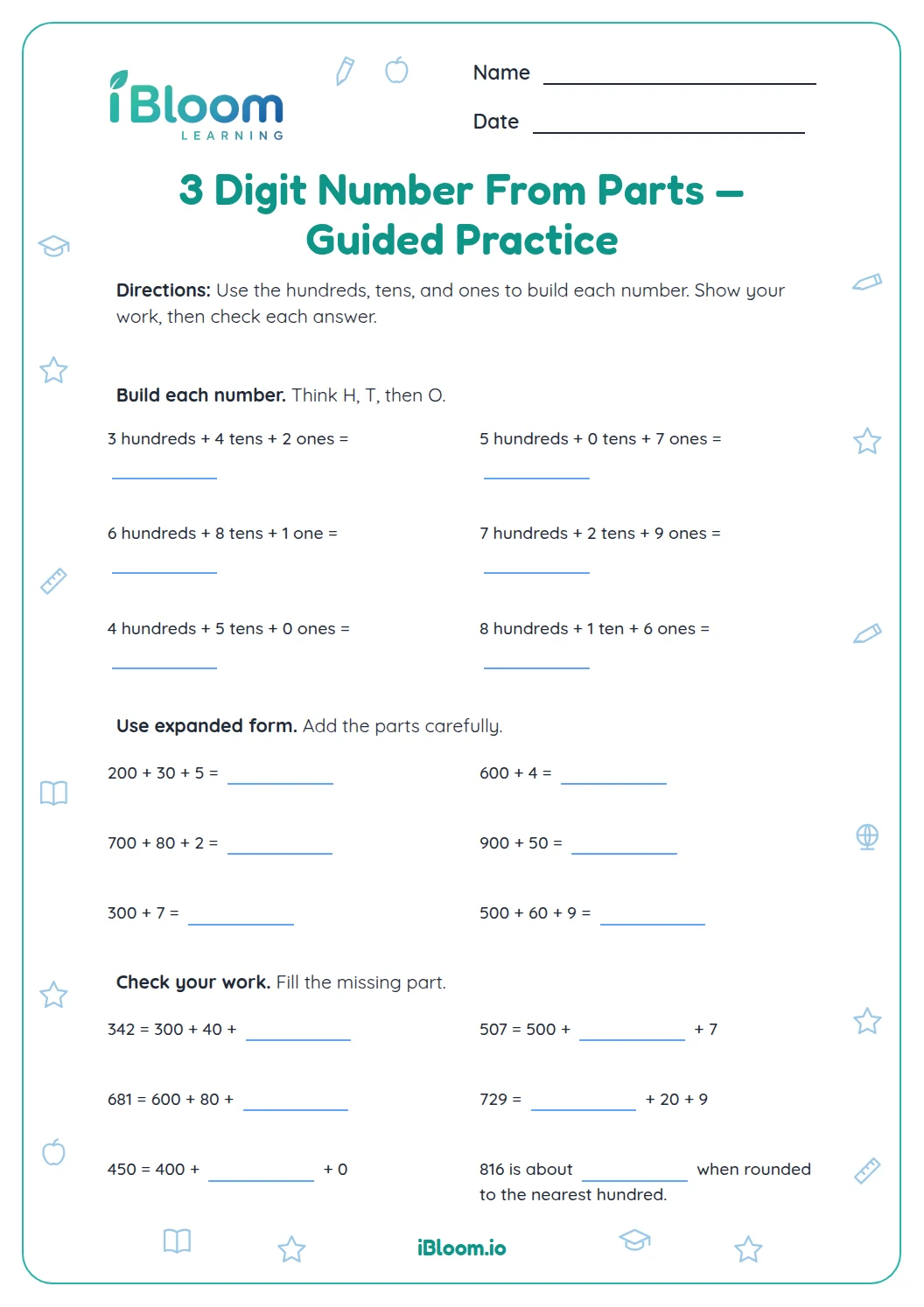
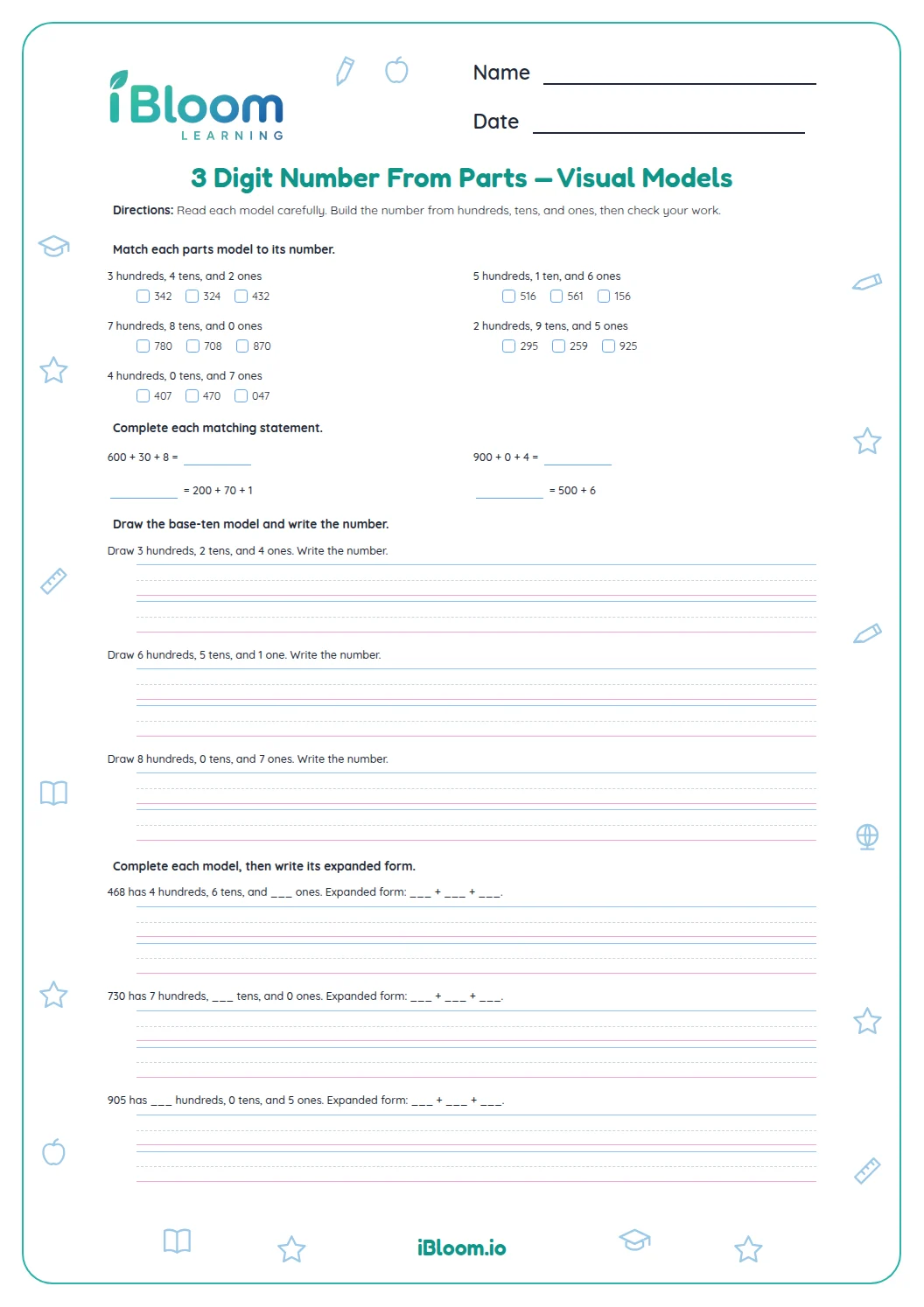
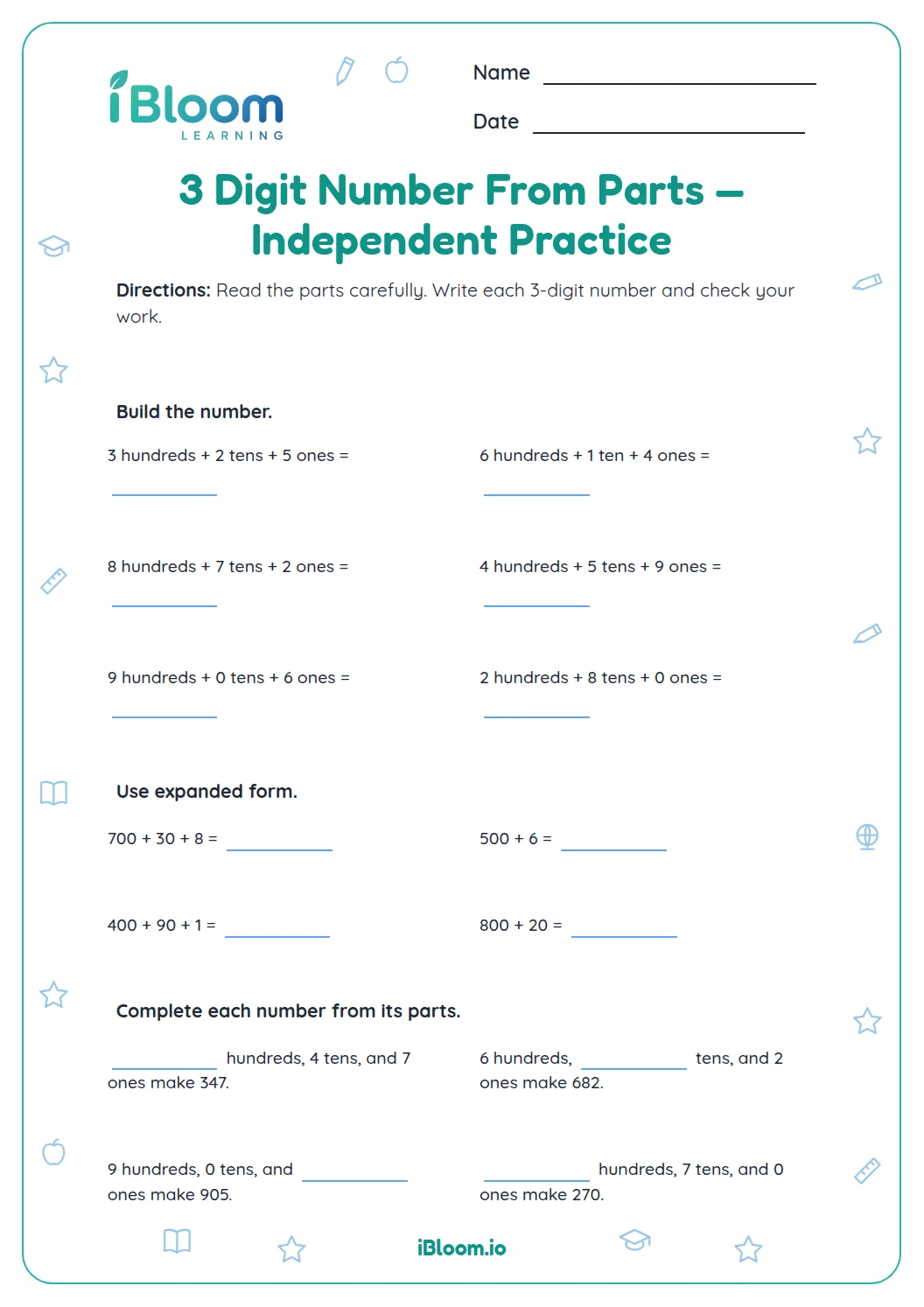
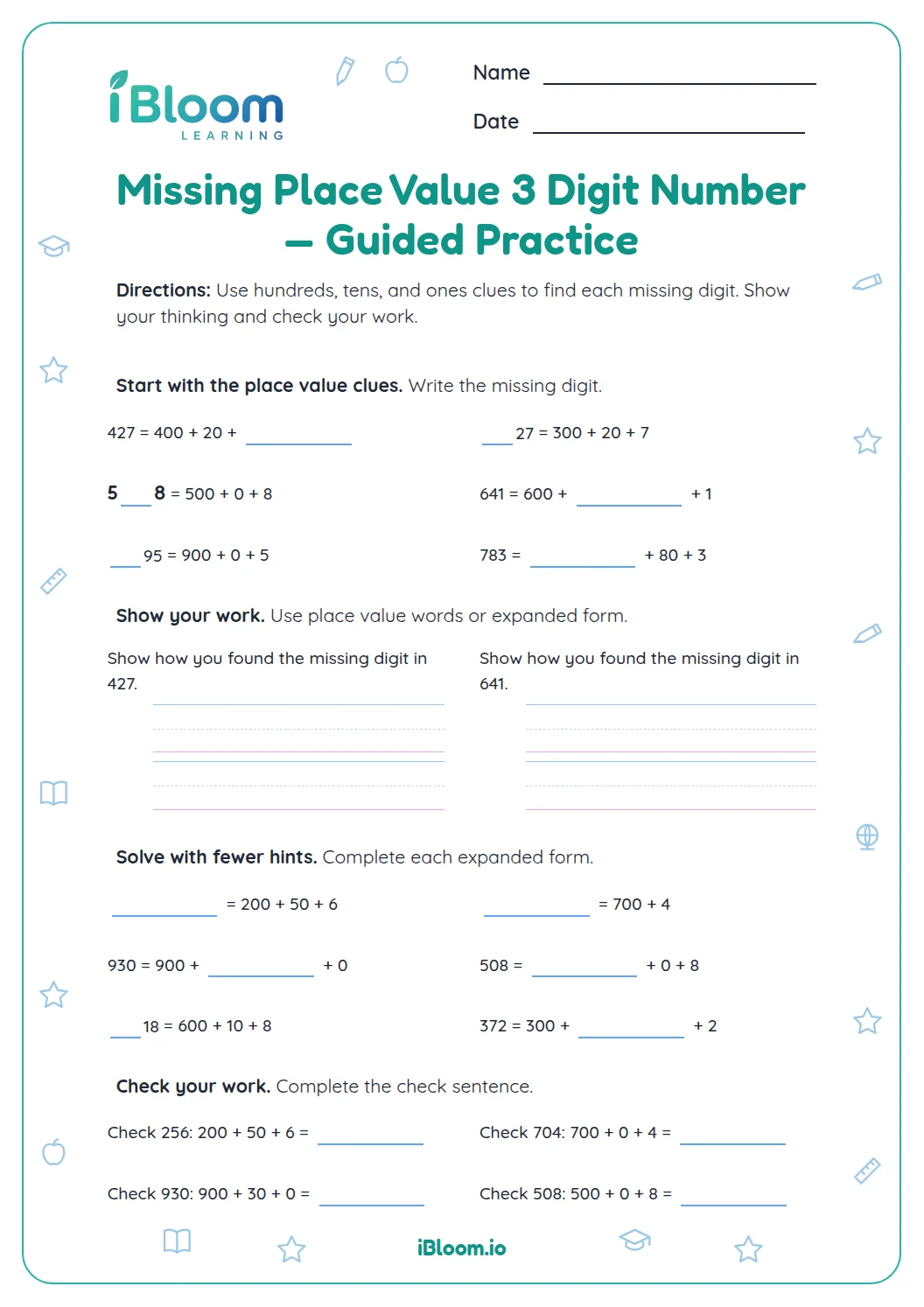
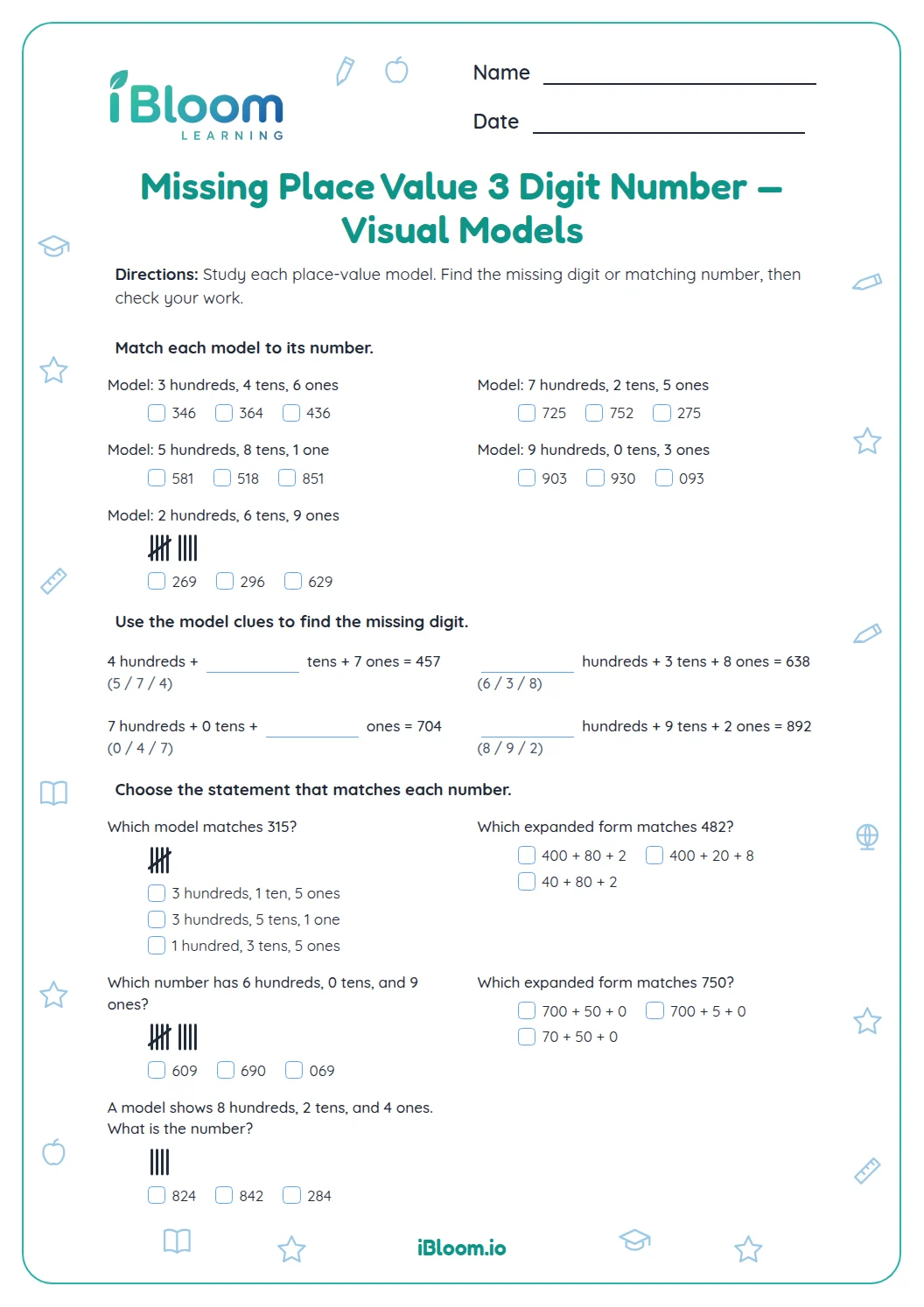
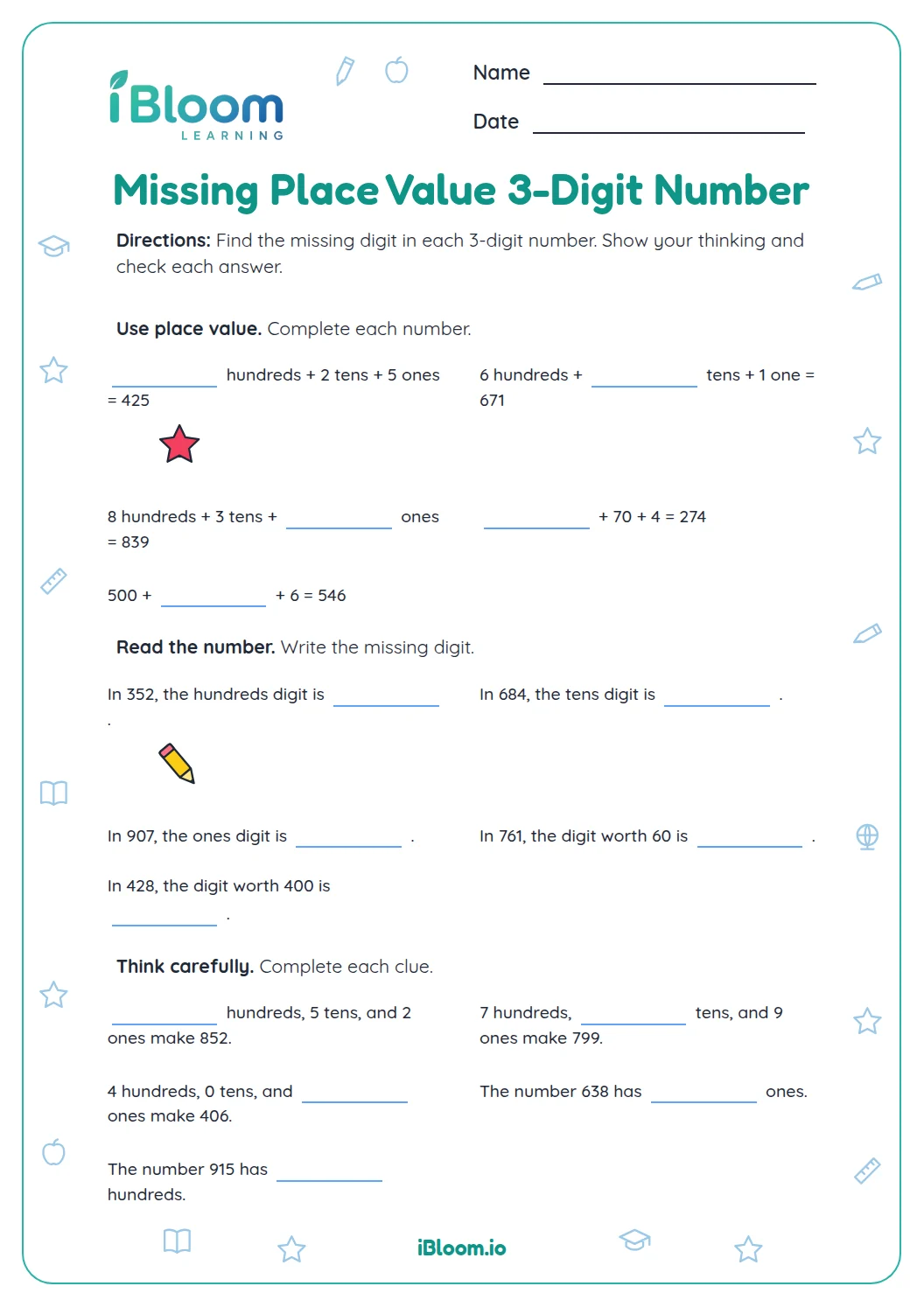
This Grade 2 printable gives 18 clues for writing three-digit numbers in normal form. Part A names hundreds, tens, and ones; Part B combines those place-value clues; Part C uses expanded-form sums. Several clues include a zero place, so students must keep its placeholder in the numeral. The sheet practices CCSS 2.NBT.A.1 and includes a separate answer key.
Aligned to 2.NBT.A.1
How do hundreds, tens, and ones make a numeral?
Place each digit in its named position: hundreds first, tens next, and ones last. Keep a zero where a place has no groups.
- 13 hundreds + 0 tens + 8 ones = 308
What does a zero tell us?
Zero means that place has no groups. It still holds the place in the written number, so 805 has 8 hundreds, 0 tens, and 5 ones.
- 18 hundreds + 0 tens + 5 ones = 805
How do you combine expanded form?
Add the hundreds, tens, and ones amounts, then write the total as one numeral.
- 1800 + 40 + 2 = 842
How to use this worksheet
- 1Read each hundreds, tens, and ones clue.
- 2Write each digit in its matching place.
- 3Keep a zero in an empty place.
- 4Add the expanded-form amounts in Part C.
- 5Check that the numeral matches every place named in the clue.
Place-value checks
The mistake
Leaving out a zero placeholder.
The fix
Keep the empty place in the numeral: 3 hundreds, 0 tens, 8 ones is 308.
The mistake
Treating 4 tens as the digit 4 ones.
The fix
Four tens equals 40, so place 4 in the tens position.
The mistake
Writing the expanded amounts separately.
The fix
Combine them into one numeral, such as 800 + 40 + 2 = 842.
Common Core alignment
Understand three-digit numbers as amounts of hundreds, tens, and ones.
On this sheet: Each item combines hundreds, tens, and ones into the matching three-digit numeral.
Show the official wordingHide the official wording
Understand that the three digits of a three-digit number represent amounts of hundreds, tens, and ones; e.g., 706 equals 7 hundreds, 0 tens, and 6 ones. Understand the following as special cases:
What to practice next
Make more practice
Further reading
Questions parents and teachers ask
What does normal form mean here?
Normal form means writing the number as one numeral. Students use the hundreds, tens, and ones named in a clue or combine expanded-form amounts to write a three-digit number. Ask the learner to read the numeral aloud by naming each digit’s place value.
Why do some clues include zero tens or ones?
A zero names an empty place, but that place still has to appear in the numeral. For example, 3 hundreds, 0 tens, and 8 ones is 308, with a zero holding the tens place. Ask the learner to read the numeral aloud by naming each digit’s place value.
What is in the last part?
Part C gives expanded-form sums such as 800 + 40 + 2. Students combine the hundreds, tens, and ones amounts and write a single three-digit numeral. Ask the learner to read the numeral aloud by naming each digit’s place value.
How many questions are included?
The worksheet has 18 questions in three parts. It begins with place-value clues, continues with another set of hundreds-tens-ones descriptions, and ends with expanded-form sums. Ask the learner to read the numeral aloud by naming each digit’s place value.
How can I check a numeral?
Read its digits by place value and compare them with the clue. For 427, the digits represent 4 hundreds, 2 tens, and 7 ones. The answer key lists the numeral for every question. Ask the learner to read the numeral aloud by naming each digit’s place value.