



About this worksheet
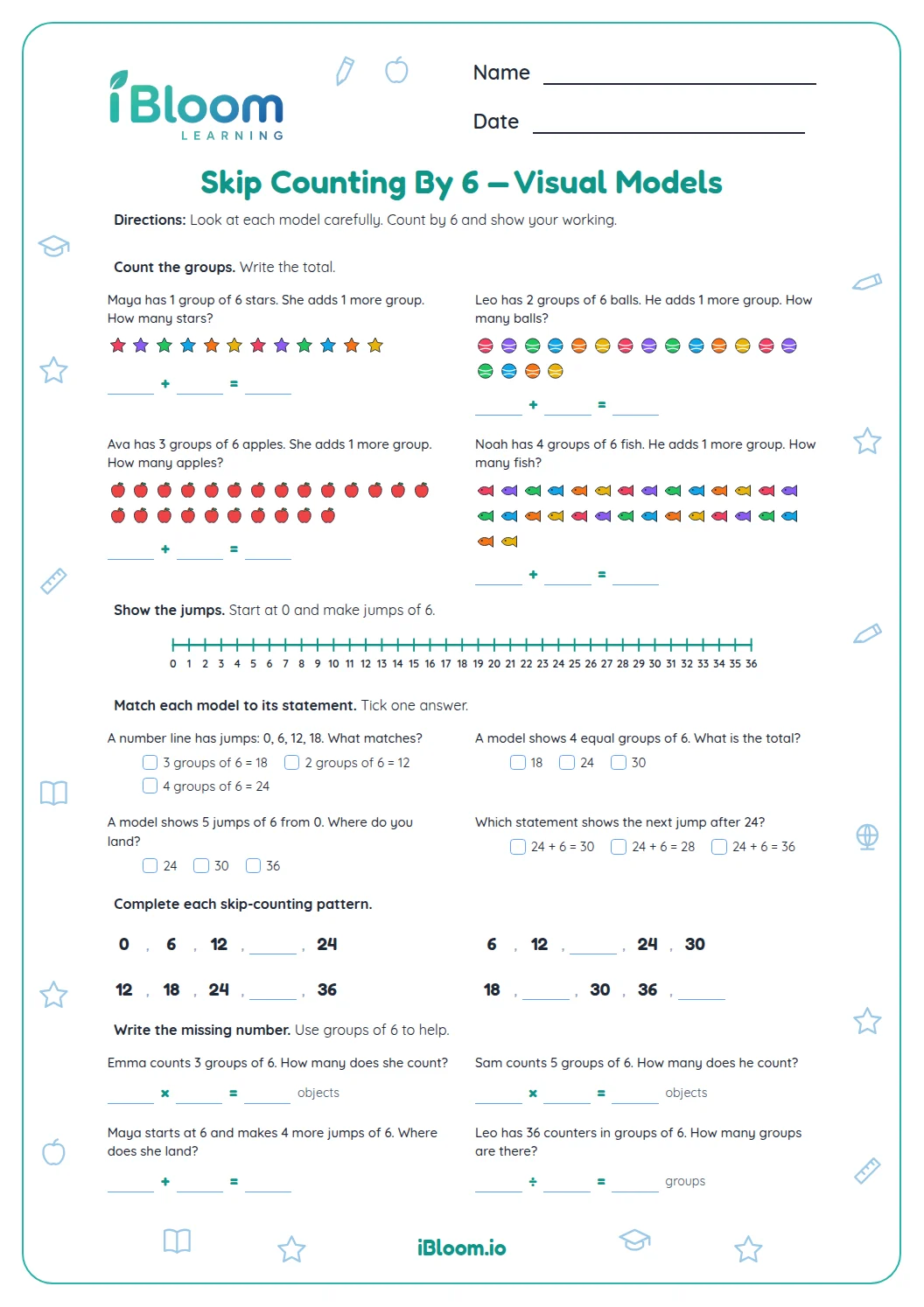
This Grade 2 printable connects skip counting by 6 to equal groups. Children find totals in eight short situations, fill six missing numbers in counts that move by six, and write out two more counts to check story answers. The settings include crayons, points, muffins, plants, and pages. Each story gives the number of groups and the amount in each group, so students can count by six and label the total. A separate key lists the answers.
What does counting by 6 look like?
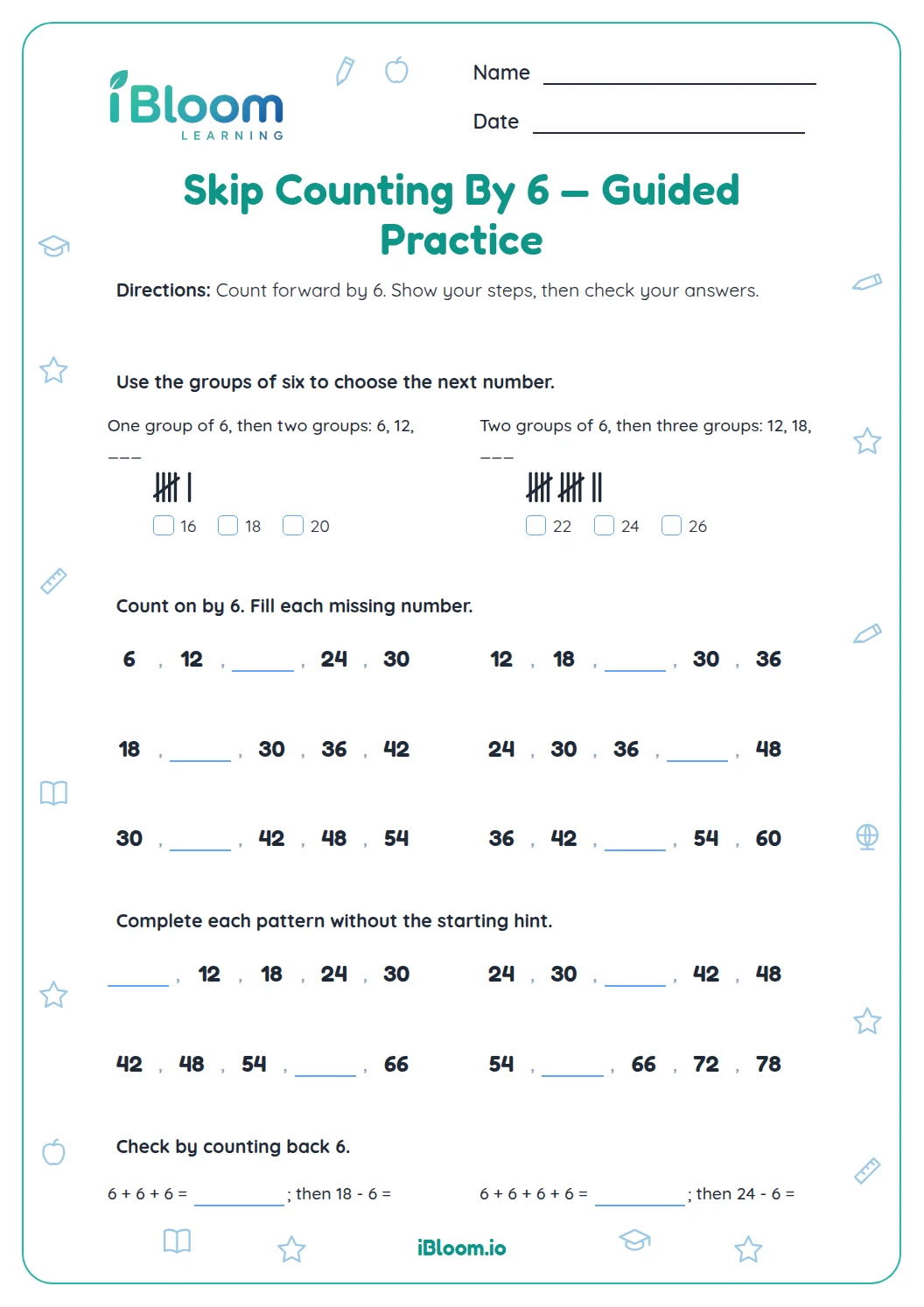
Each number in a count by six is six more than the number before it: 6, 12, 18, 24, 30. For equal groups, make one skip for each group. Four boxes with six crayons each give 6, 12, 18, 24 crayons.
- 14 boxes with 6 crayons each
- 26, 12, 18, 24
- 3There are 24 crayons.
How can a number pattern solve a story problem?
Find how many groups there are and what is in each group. Count by six once for each group, then label the final number with the item named in the story.
How can you check a total?
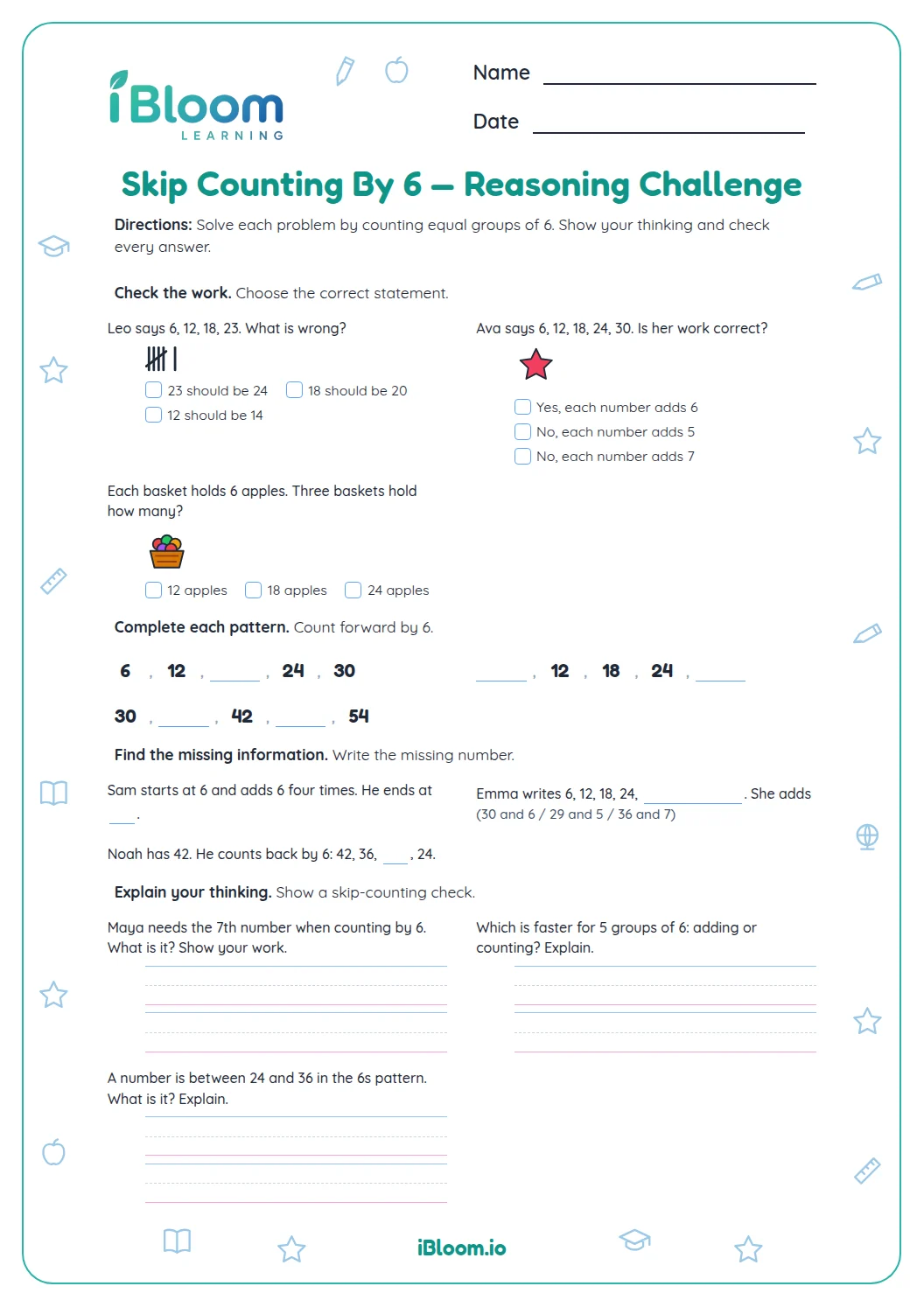
Count the number of jumps and make sure each jump adds 6. If the story says 7 boxes, the pattern needs seven groups. Check the final unit too: a total of 42 boxes would not answer a question about crayons.
How to use this worksheet
- 1Circle the number of groups and the amount in each group.
- 2For a story, count by six once for every group.
- 3Write the missing number in each pattern by adding 6.
- 4Label each total with the object named in the problem.
- 5Check that the final skip matches the group count.
Common mistakes and quick fixes
The mistake
Counting on by 6 but starting with 6 for each new group.
The fix
Keep a running total: 6, 12, 18, not 6, 6, 6.
The mistake
Making a jump of 5 or 7 in a pattern.
The fix
Compare neighboring numbers; their difference must be 6.
The mistake
Giving an unlabeled total.
The fix
Copy the object or unit from the question after the number.
What to practice next
Make more practice
Further reading
Questions parents and teachers ask
What does skip counting by 6 mean?
Skip counting adds the same amount each time. On this sheet, one skip of 6 stands for one group, so four groups make 6, 12, 18, 24, or 24 altogether. Children can say each count aloud before writing the final total and the matching unit.
How can I help with the word problems?
Start at the first number and add 6 for each next number. For example, 12, 18, ___, 30 becomes 12, 18, 24, 30. The six pattern questions leave one number blank, so check that each neighboring pair differs by exactly six.
Why do some patterns start after 6?
There are 16 problems: eight stories about equal groups, six missing-number counts, and two stories asking children to show the count by six. The key gives each total. For the story problems, include the item or measurement named in the question.
How many questions are included?
There are 18 items: six real-world problems, five missing-number patterns, and seven additional equal-group situations. The key gives totals with units so students can check both the calculation and what is being counted. The object named in the story gives a useful unit for recording each total.
Can children use repeated addition instead?
Yes. Repeated addition shows the same equal groups as skip counting. For four groups of six, a child might write 6 + 6 + 6 + 6 and then connect the sum to the fourth count in the pattern. It is a clear way to check the total.