



About this worksheet
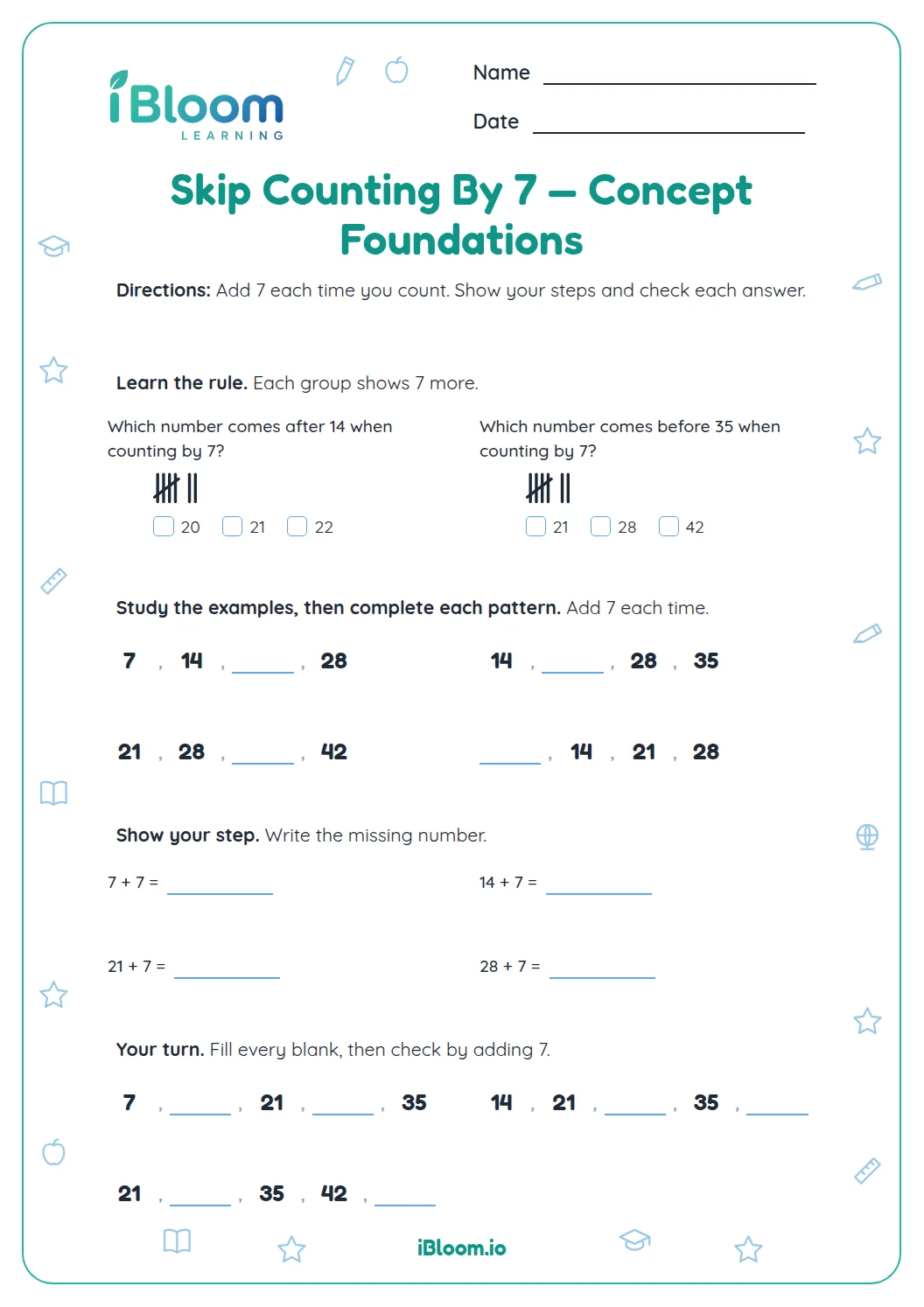
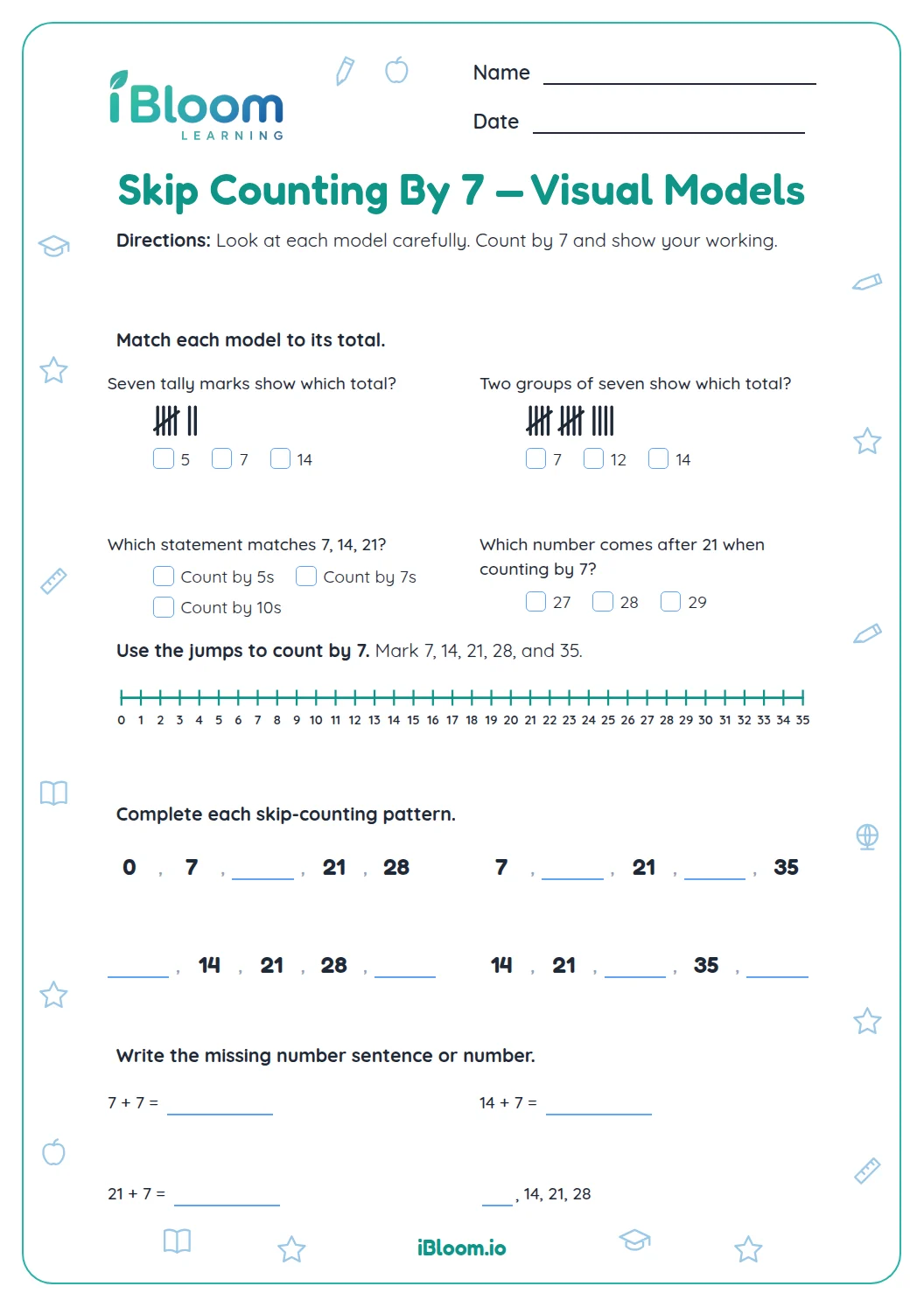
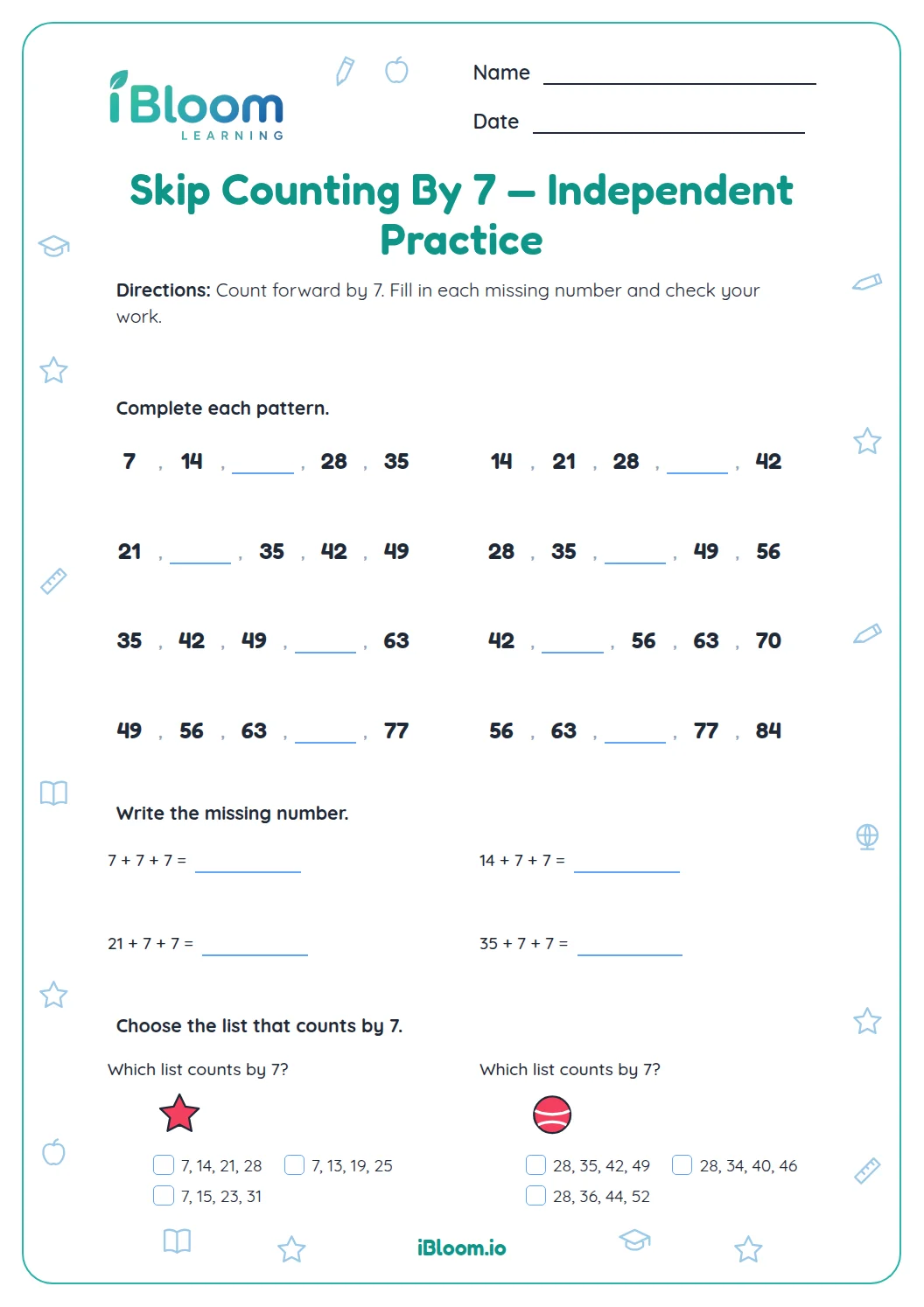
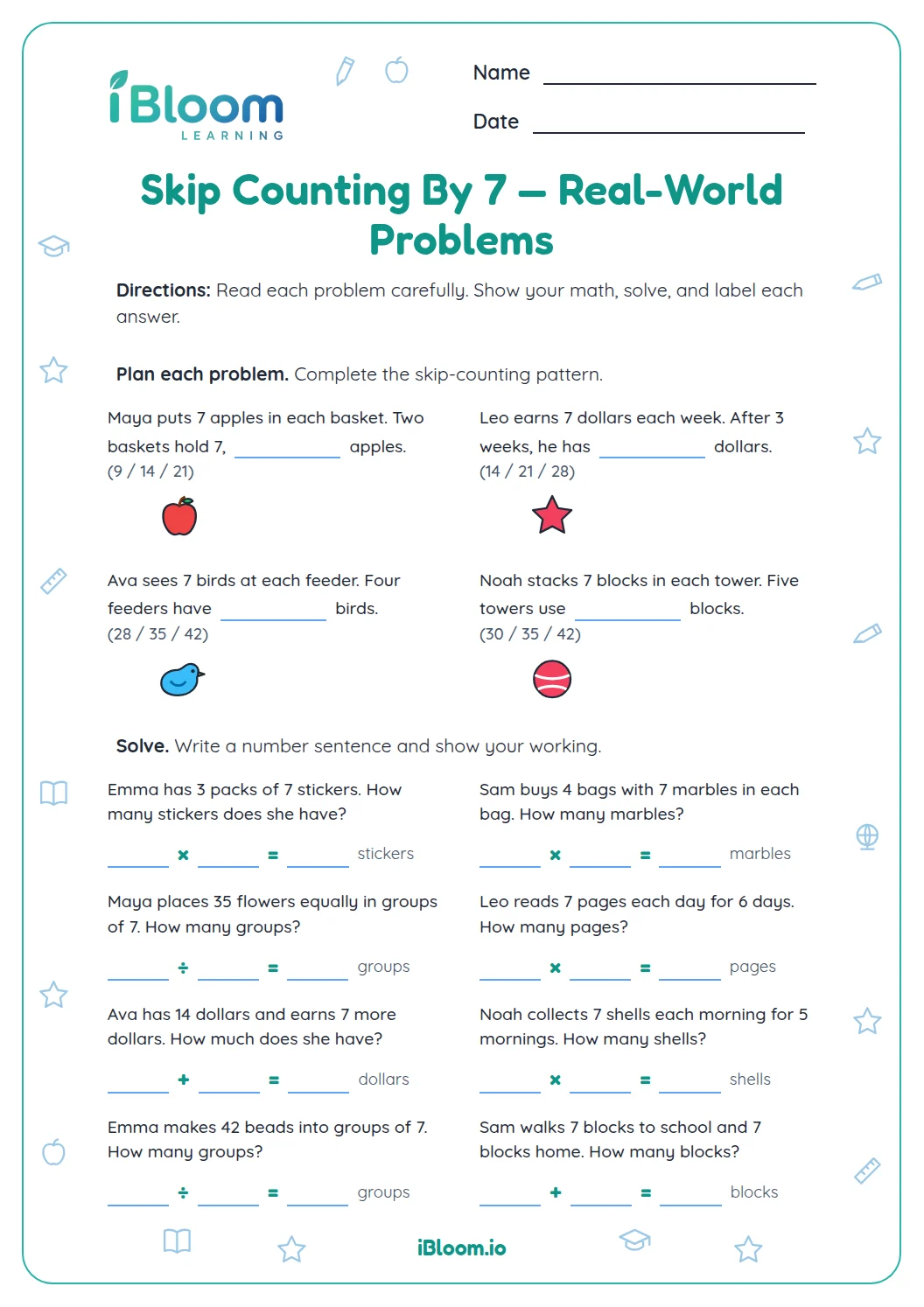
This Grade 2 printable guides learners through skip counting by 7. Part A fills gaps in sequences; Part B counts forward or back from a starting number; Part C applies equal groups to simple situations; Part D checks which patterns follow a step of 7. The questions build from supported sequence work to everyday equal-group problems, with a full answer key.
Aligned to 2.NBT.A.2
How do the missing numbers fit?
A count-by-7 sequence grows by the same amount each time. Part A gives the numbers around a gap so the learner can continue the pattern.
- 17, 14, 21, ___, 35
- 2Add 7 to 21.
- 3Answer: 28
How can learners count from a new starting number?
Part B begins at numbers such as 14, 35, or 63. Say the starting number, then add or subtract 7 for each jump. This makes the step clear even when counting does not begin at 7.
How does skip counting help with equal groups?
If each round earns 7 points, counting by 7 once per round totals the points. The same idea works for days in several weeks or objects arranged in equal groups. Part C asks learners to show the total with a number sentence.
How to use this worksheet
- 1Say the starting number first.
- 2Add 7 for each forward jump; subtract 7 for a backward jump.
- 3For Part C, count one group of seven for each round, week, turn, or tree.
- 4In Part D, compare each neighboring pair to check whether it changes by 7.
- 5Review the sequence and totals with the key.
Common mistakes and quick fixes
The mistake
Adding 7 only to the first number.
The fix
Make one equal jump for every place in the sequence.
The mistake
Skipping the starting number while counting on.
The fix
Say the start, then make the requested number of jumps.
The mistake
Stopping at a number near the pattern.
The fix
Check the difference between each pair; every step should be 7.
Common Core alignment
Count within 1,000 by equal steps of 7 and identify missing numbers.
On this sheet: Learners practice counting forward and backward by 7 within 100.
Show the official wordingHide the official wording
Count within 1000; skip-count by 5s, 10s, and 100s.
What to practice next
Make more practice
Questions parents and teachers ask
What does this skip counting by 7 worksheet practice?
It gives Grade 2 learners varied practice with counting forward or backward in equal jumps of seven. Each part builds on the idea introduced earlier, and the prompts use familiar contexts. The answer key follows the printable pages so an adult can review each response and discuss any answer that needs another look.
How many questions are on the worksheet?
There are 16 questions arranged in several parts, moving from recognition to application. The printable includes a separate answer key with answers and sample responses. A learner can complete one part at a time and check work after finishing the section.
How should I help if a learner gets stuck?
Ask the learner to reread the whole prompt and name the clue that matters. Then compare the answer with the key and talk through the step that led to it. For a missed item, try a similar example aloud before returning to the worksheet.
Can I use this in class or at home?
Yes. Print the worksheet pages and keep the answer key for checking. Learners can work independently or read the directions and questions with a teacher or family member. The short sections also make it easy to pause and review a strategy before moving on.
What is the best way to check answers?
Use the key after the learner completes a part. For written responses, look for the idea named in the sample answer; wording can vary when the meaning is clear. Ask the learner to point to the clue or step that supports the answer.