


About this worksheet
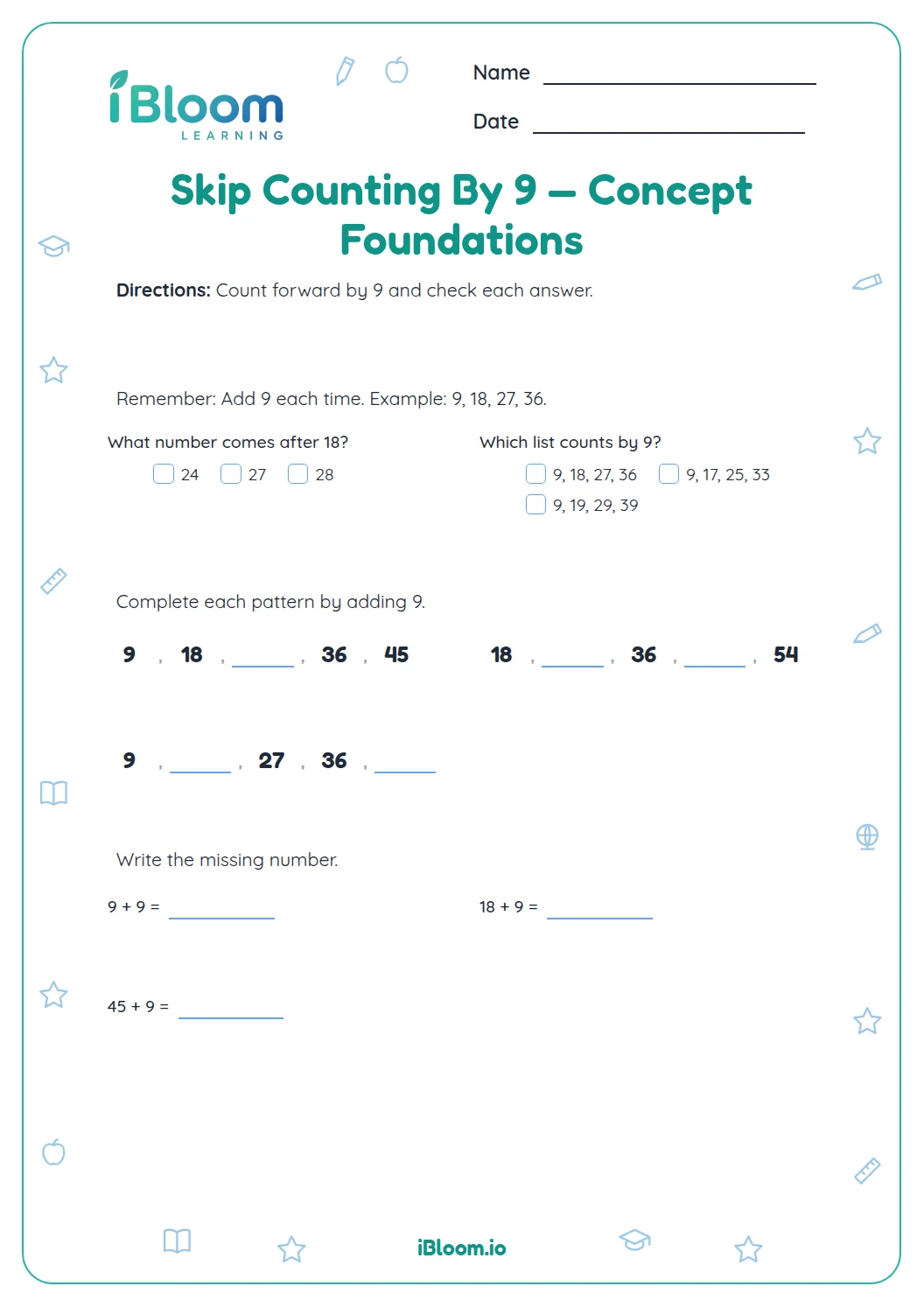
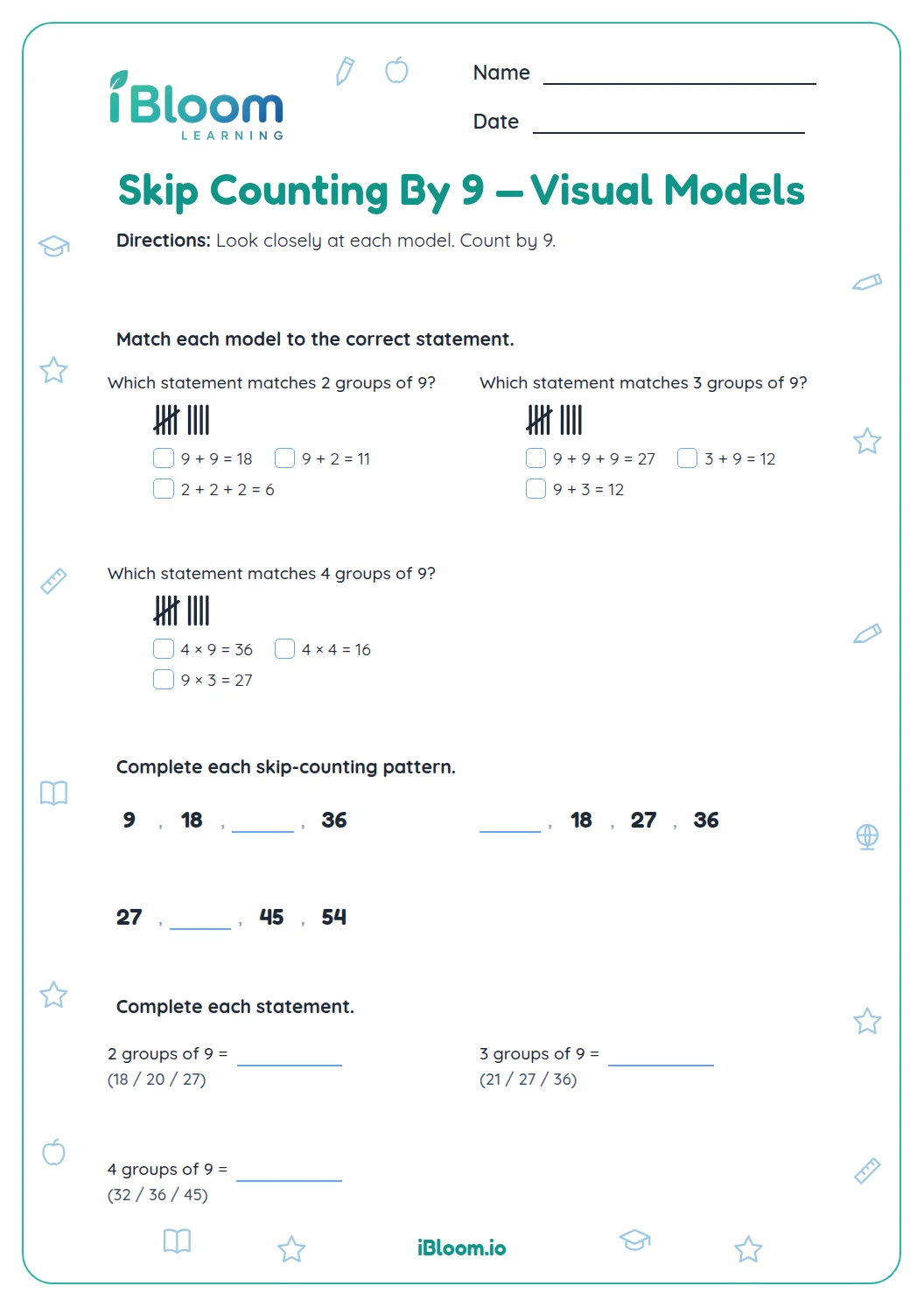
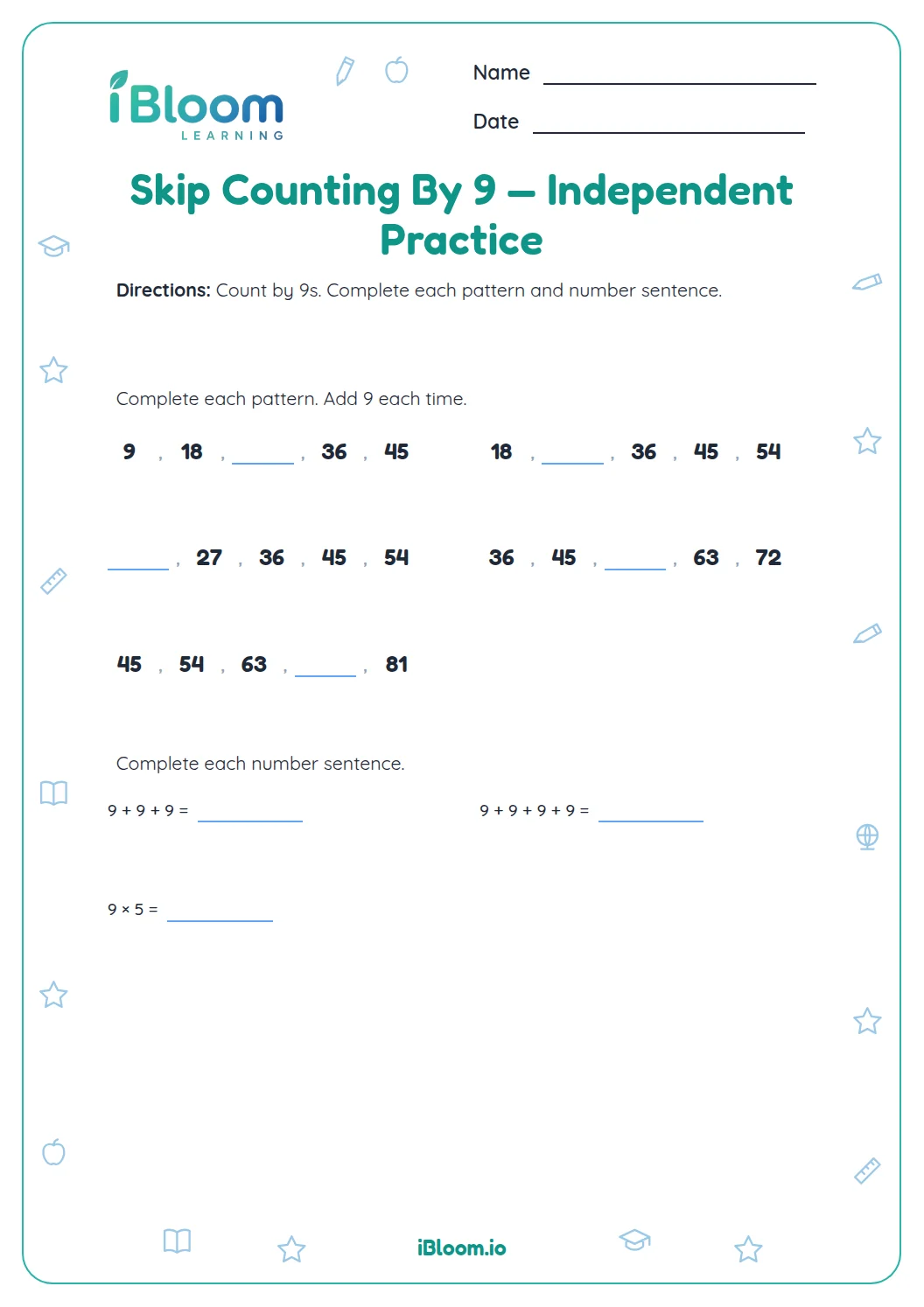
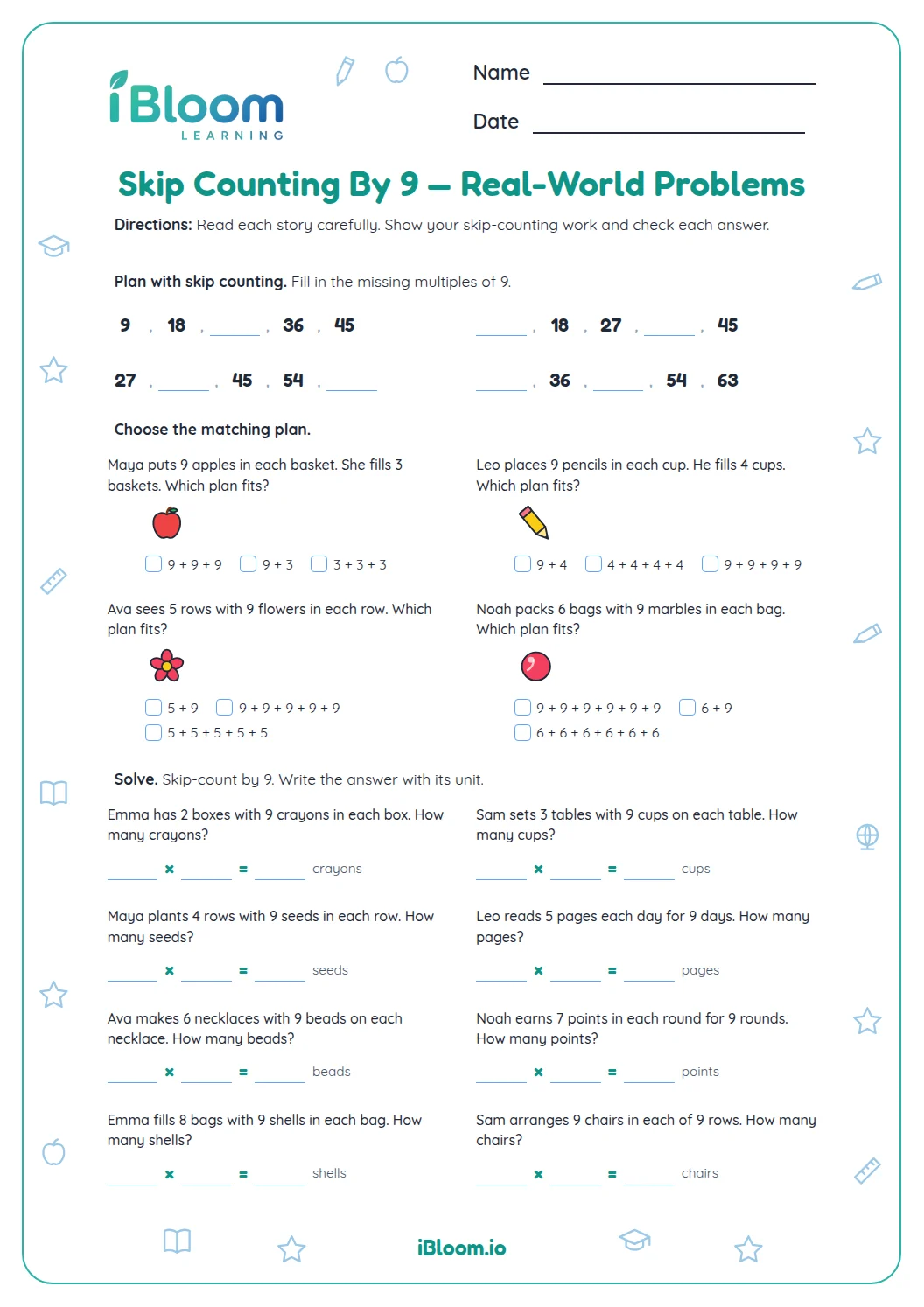
This free printable Grade 2 worksheet gives children focused practice with skip counting by 9. It replaces the old mixed or placeholder activity with questions built around the named skill. The sheet has 14 questions across short parts, with a separate answer key for checking work.
What does skip counting by 9 mean?
Skip counting by 9 adds nine at each step. A sequence can begin at a number other than 9, as long as every term increases by nine.
How can a missing term be found?
In q9, start at 6 and add 9: 6, 15, 24, 33. The missing number is 24.
- 1Start at 6.
- 2Add 9 to get 15, then add 9 again.
- 3The missing term is 24.
How is the practice organized?
The first part completes sequences that start at multiples of 9. The next questions use different starting points and reverse the count. The last question connects four groups of nine books to the total.
How to use this worksheet
- 1Read the first number and the direction of the sequence.
- 2Add 9 for each step forward.
- 3For a reverse question, subtract 9 once.
- 4Check that each neighboring pair differs by 9.
- 5For equal groups, count 9, 18, 27, 36.
Common mistakes and quick fixes
The mistake
Adding 9 to the wrong term.
The fix
Start with the last given term before filling the blank.
The mistake
Using the usual 9, 18, 27 sequence when the start is different.
The fix
Keep the stated starting number and add 9 each time.
The mistake
Listing four groups as 9, 18, 27, 36 but stopping at 27.
The fix
Count one term for each group; four groups end at 36.
What to practice next
Make more practice
Questions parents and teachers ask
How many questions are on the Grade 2 sheet?
There are 14 questions, grouped into short parts. Children can complete the parts in order and use the separate answer key to review their work. Invite the learner to explain one answer aloud and check that every step changes by 9.
Is an answer key included?
Yes. A separate answer key lists the answers for the worksheet. Use it after the child has tried each question, then revisit any answer that needs another look. Ask the child to compare each answer with the prompt and talk through any correction together.
How should I introduce the activity?
Read the directions together and talk through the first prompt. Ask the child to explain how the clue, model, or pattern helps with skip counting by 9 before moving on. That short conversation can make the written practice clearer and give you a chance to clear up confusion.
Can I use this at home or in class?
Yes. Print the worksheet for independent practice, a small group, or a short review with an adult. The answer key makes it easy to check completed work. The activities are grouped so learners can move through them at a comfortable pace.
What if a question feels difficult?
Pause and return to the prompt. Point out the information it gives, then solve one step at a time. The child can skip a tricky item and return after completing the next question. Keep the focus on the thinking process, not speed.