
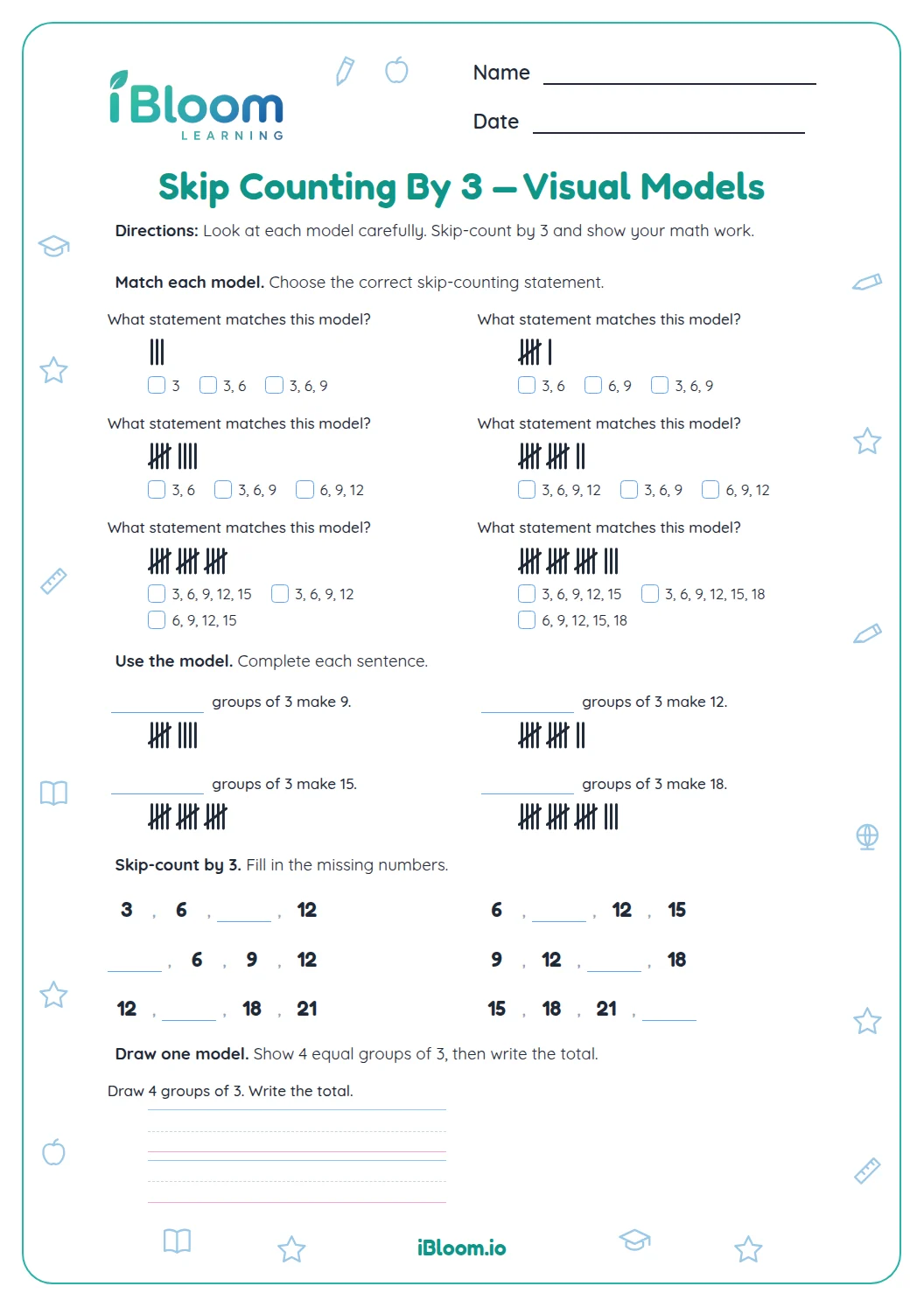
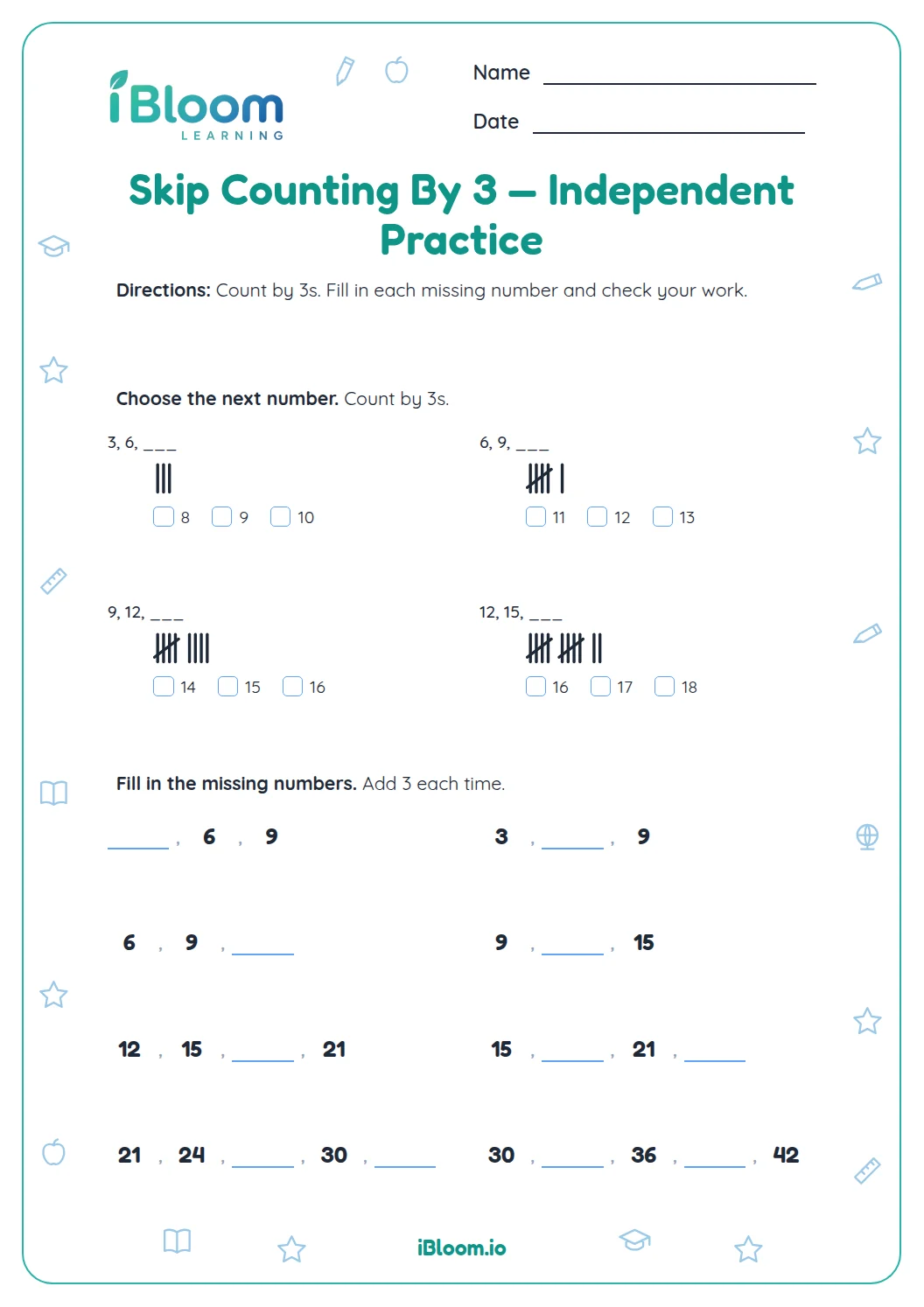
About this worksheet
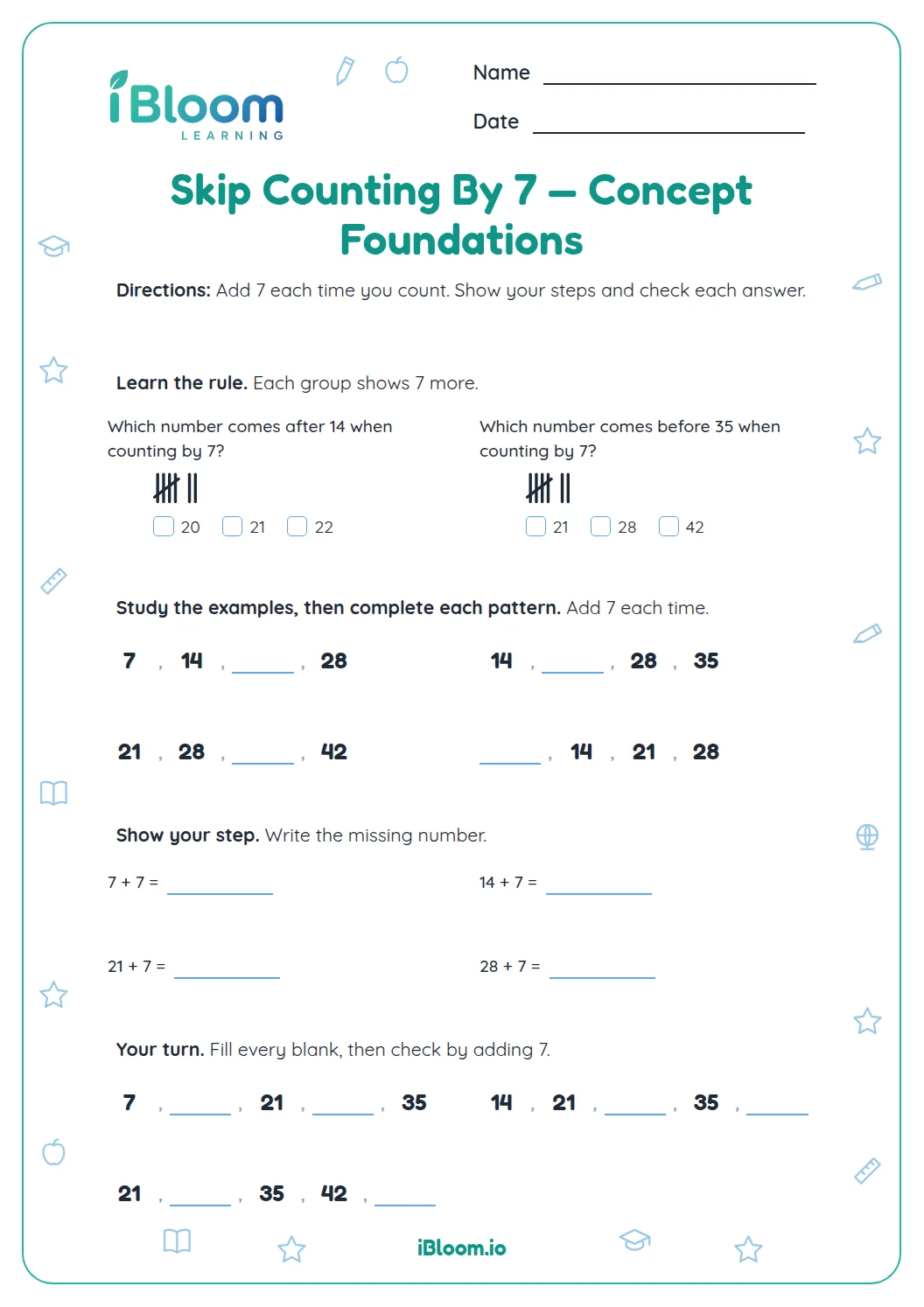
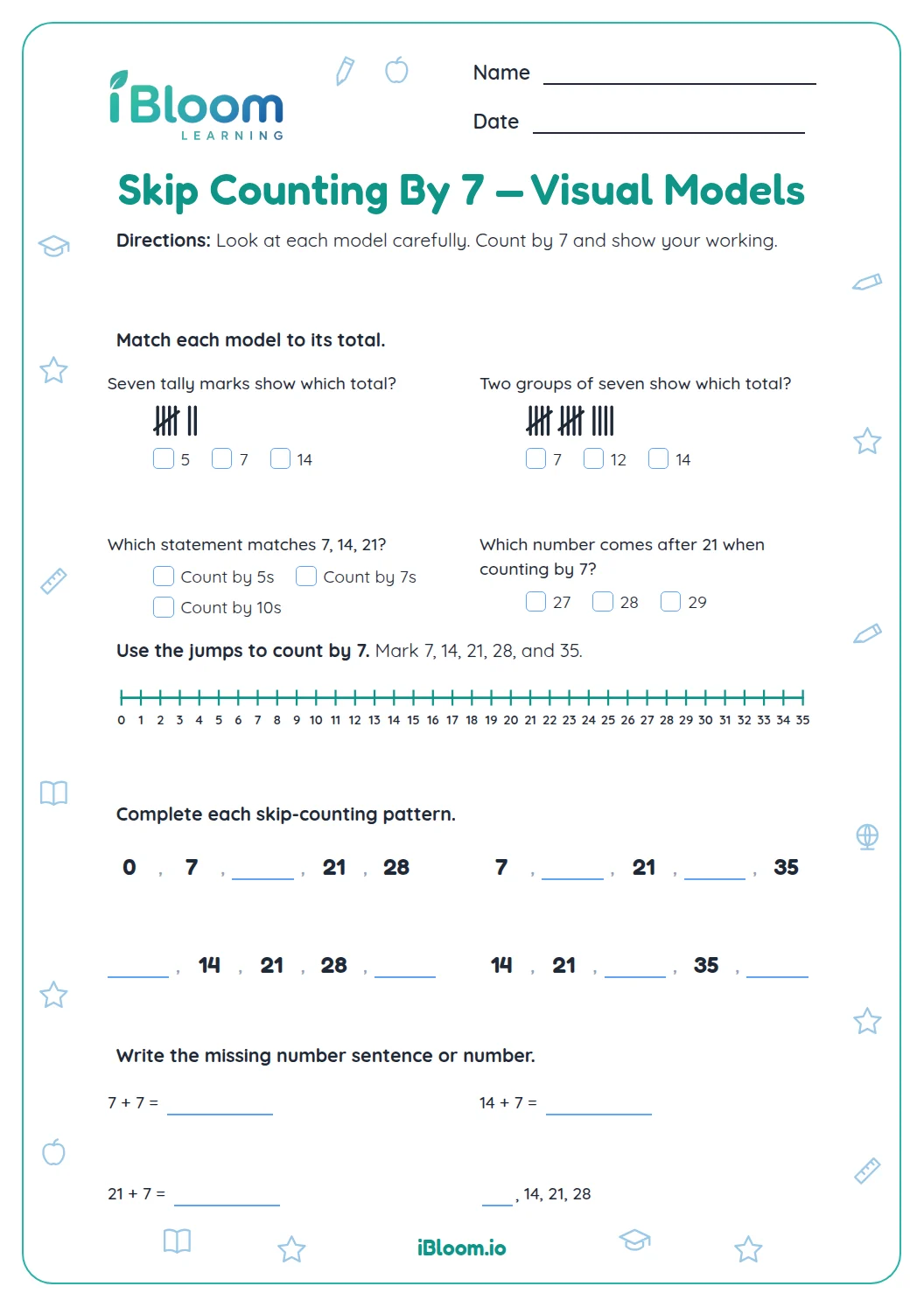
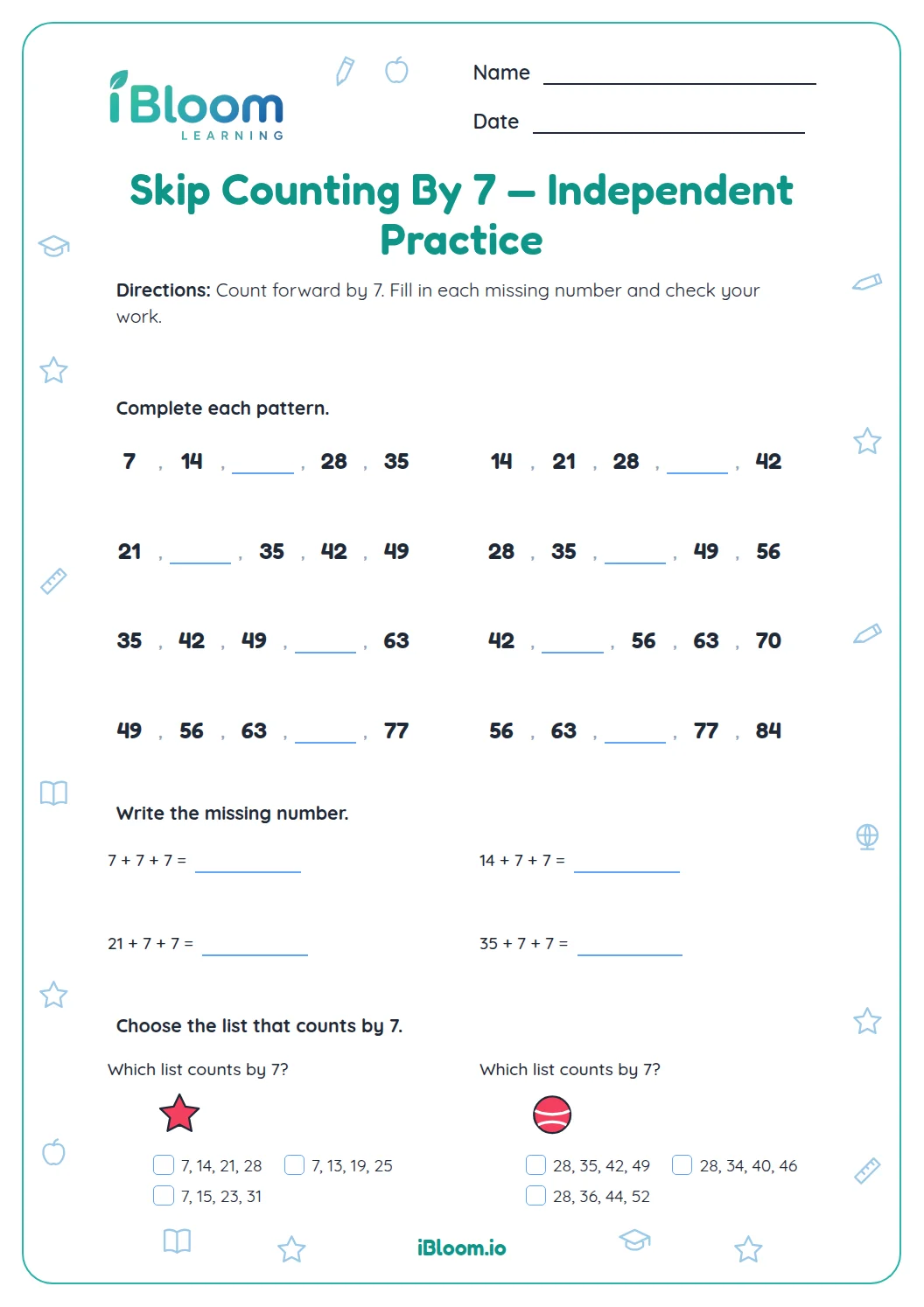
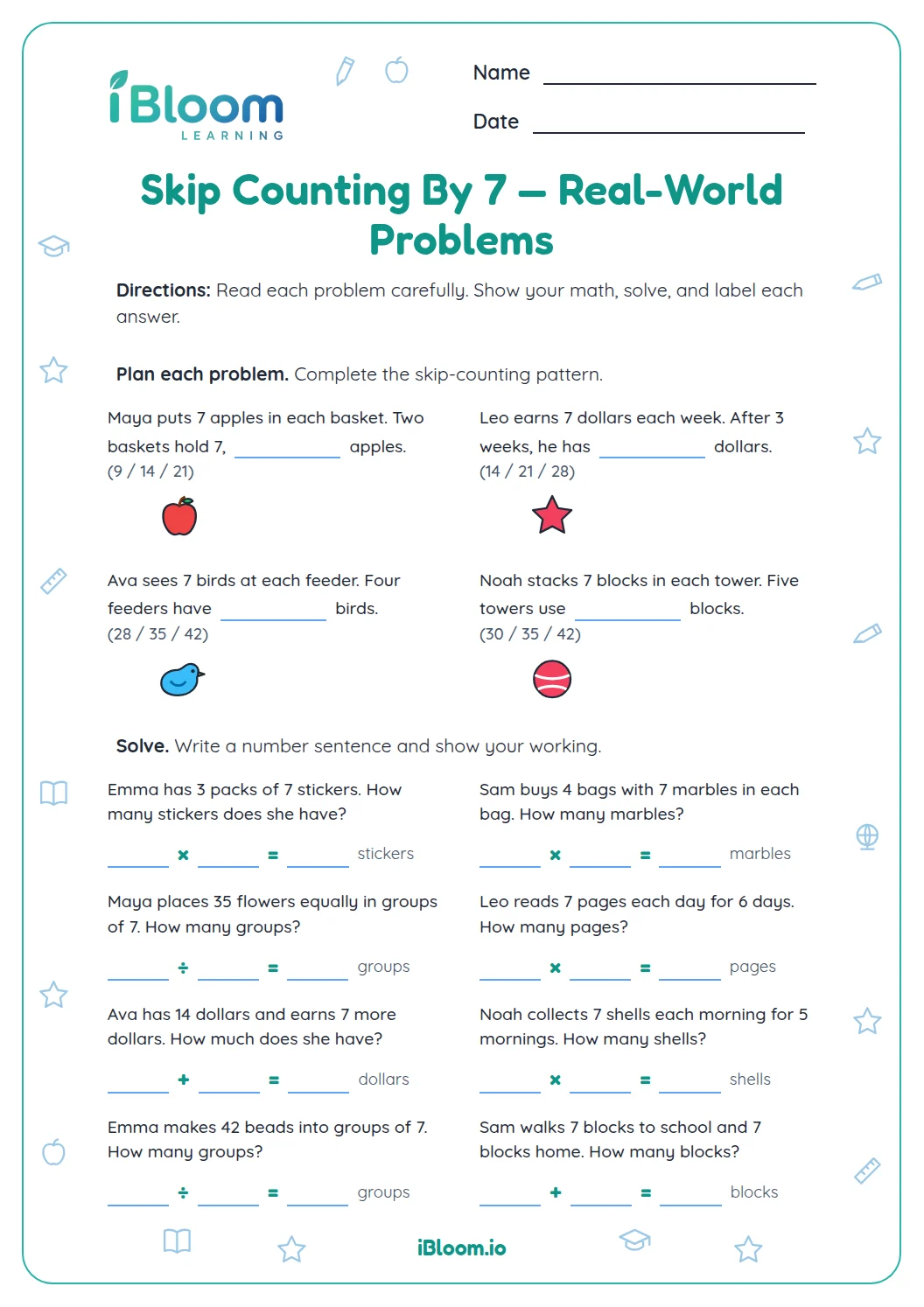
Students count forward by 7 from different starting points, reason about jumps, spot a broken pattern, and apply the sequence to rows and game points. The 16 questions stay within 1,000 and move from missing terms to equal groups.
Follow the equal jumps
In a count-by-7 pattern, each number is seven greater than the one before it. To find a missing term, check the step before and after it.
Use the pattern to reason
A skip-counting sequence can also find equal-group totals. Eight rows with seven chairs each match eight jumps of seven. For a pattern check, ask whether the difference between neighboring terms is always seven.
What to practice next
Make more practice
Questions parents and teachers ask
What does skip counting by 7 mean?
Skip counting by 7 means adding seven to each number to get the next one. Starting at 7 gives 7, 14, 21, and 28. Starting at another number changes the sequence, but every jump in a count-by-7 pattern is still seven.
Should the starting number count as the first term?
Yes. When a question asks for the sixth number starting at 7, count 7 as the first term. Then make five jumps of seven: 14, 21, 28, 35, and 42. The sixth number is 42. Students can say each jump aloud as they check.
How can students check a missing number?
Compare the terms on both sides of the blank. The next term should be seven greater than the one before it, and the term after the blank should be seven greater than the missing value. Checking both directions helps catch a skipped or extra count.
How many questions and pages are included?
This worksheet has 16 questions in four parts: missing terms, jump reasoning, pattern checks, and equal groups. The printable worksheet uses two pages, followed by a separate two-page answer key with sample responses for written items. The answer key shows the totals for both situations.
How does skip counting connect to equal groups?
If seven chairs are placed in each row, count by sevens once for each row. Eight rows give 7, 14, 21, 28, 35, 42, 49, and 56 chairs. Repeated addition gives the same total: 7 added eight times is 56.
What if a student makes a counting error?
Return to a nearby term that is correct and add seven one jump at a time. For example, after 28 comes 35, then 42. Ask the student to compare each neighboring pair and confirm that the difference stays seven throughout the pattern.