


About this worksheet
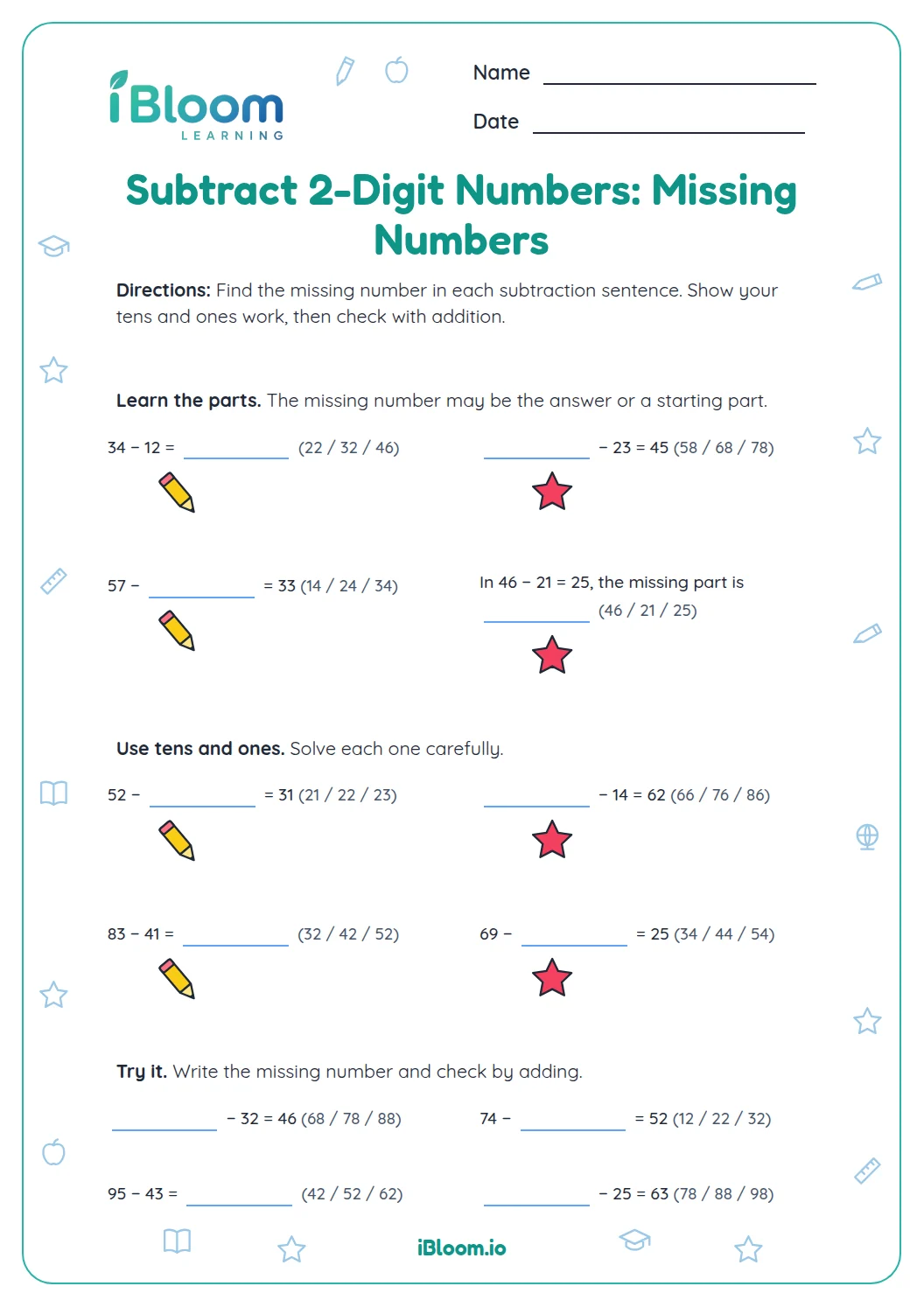
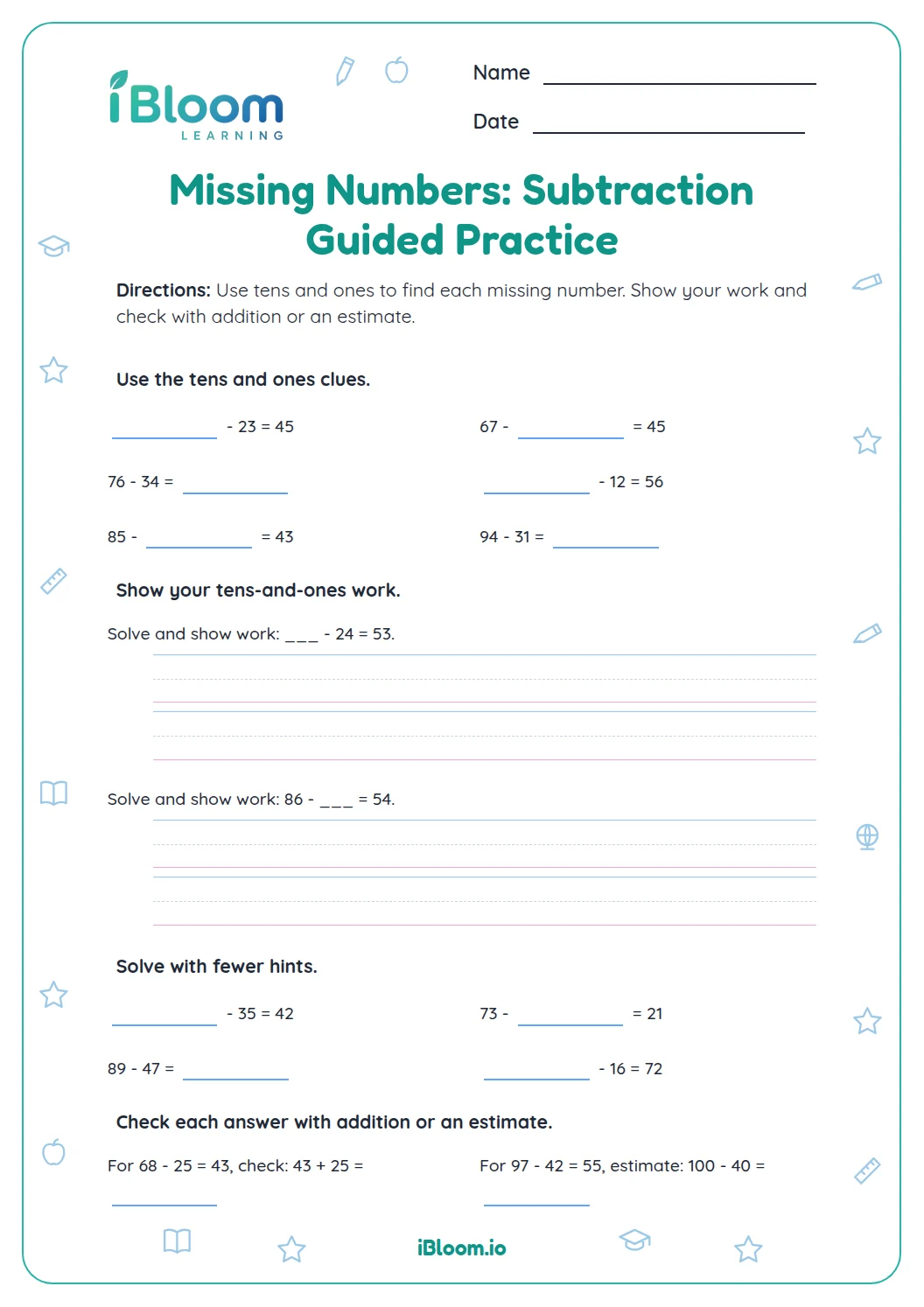
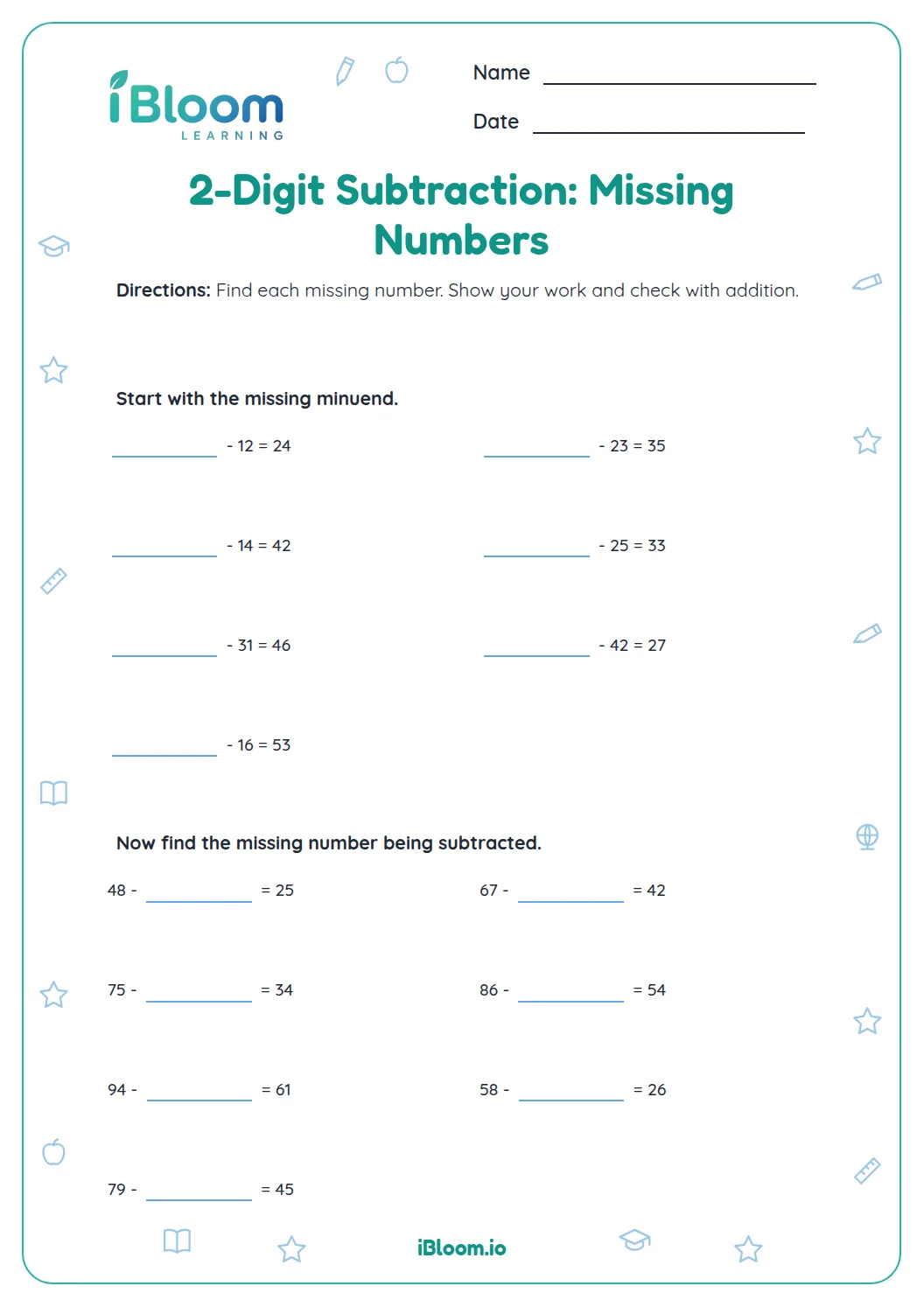
This free printable Grade 2 worksheet asks children to reason about single-digit subtraction facts. Part A has eight equations with a missing starting number, amount taken away, or result. Part B has four choices about checking an answer or using one number in two equations. Part C asks for two short explanations of mistakes. All values stay between zero and nine, so attention can stay on what the blank means. The sheet practices mental addition and subtraction under CCSS 2.OA.B.2. A separate answer key includes the missing numbers, correct choices, and sample explanations.
Aligned to 2.OA.B.2
Why does the position of the blank matter?
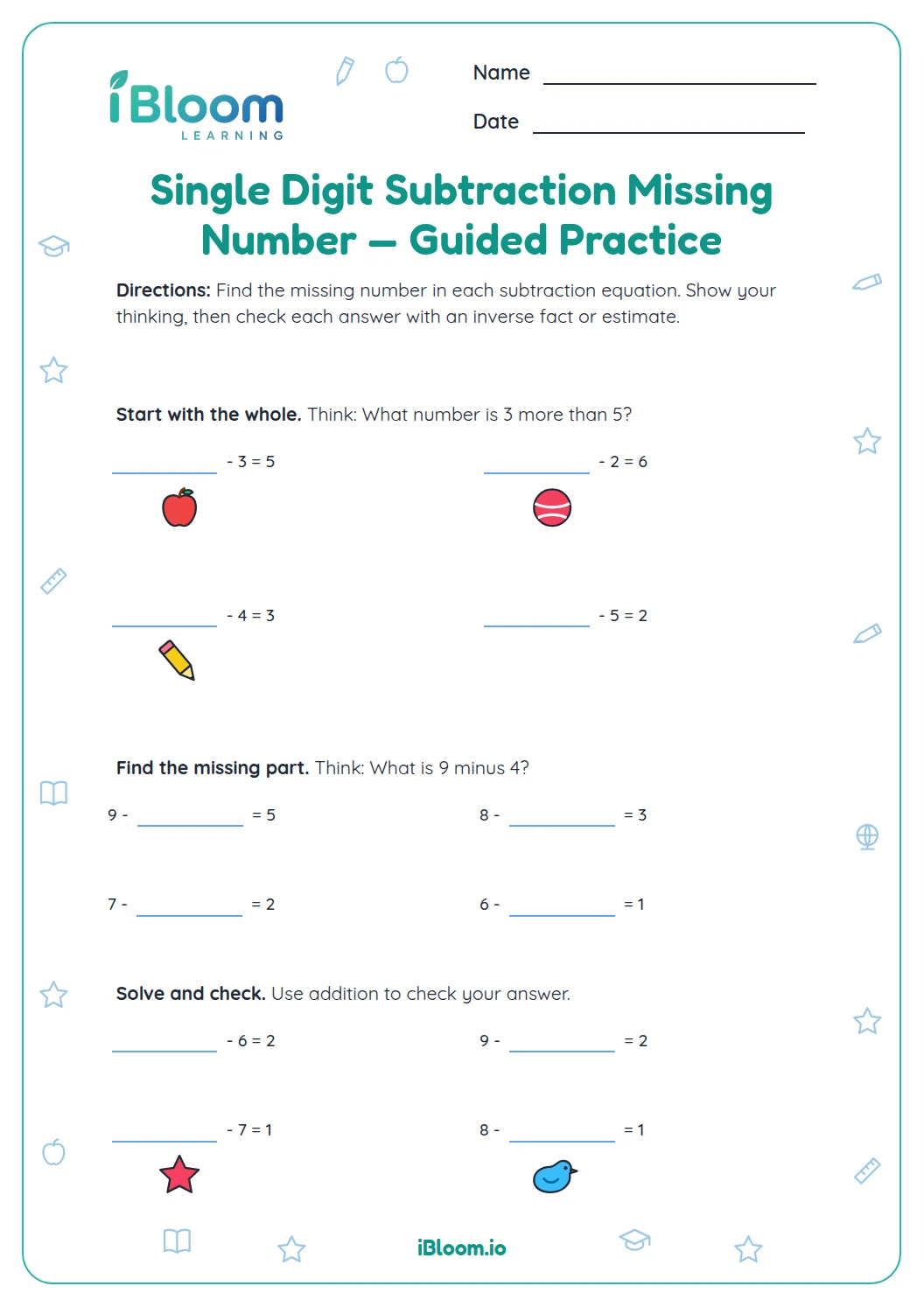
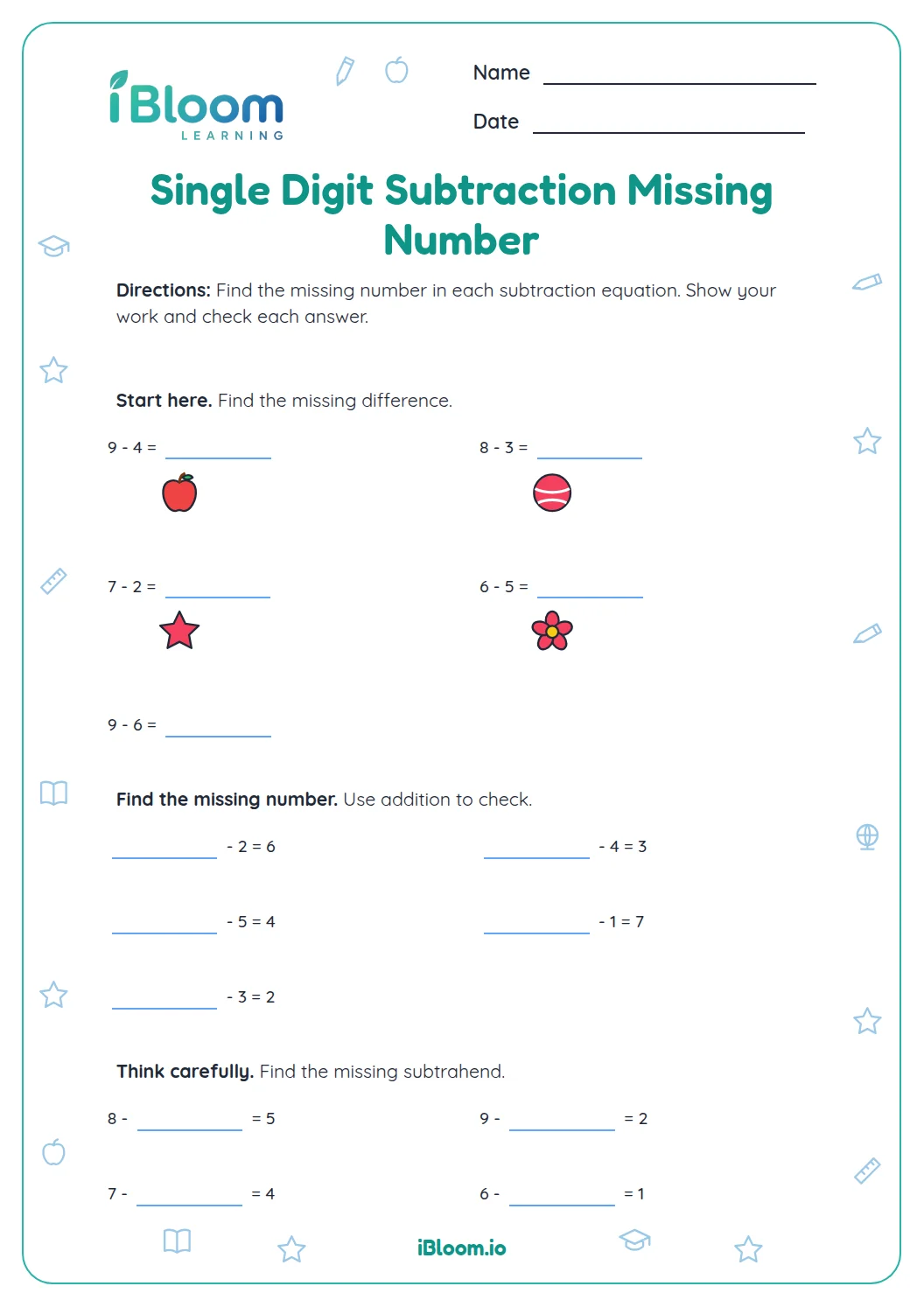
The same three numbers can play different roles. In 9 − 4 = ___, the amount left is missing, so subtract. In 9 − ___ = 5, find the amount taken away. In ___ − 4 = 5, put the two parts back together to find the starting number.
Part A moves the blank among all three positions and includes zero. Have children name the blank’s role before calculating.
- 1___ − 4 = 5
- 2The start includes the 4 taken away and the 5 left.
- 34 + 5 = 9, so the missing number is 9.
- 4Check: 9 − 4 = 5.
Which equation really checks an answer?
A useful check uses the amount taken away and the amount left to recreate the starting number. For 9 − ___ = 6, the missing number is 3 because 6 + 3 = 9. Merely seeing a true equation is not enough; the numbers must play the right roles.
Part B also asks which single number fits two equations. Students should substitute their choice into both equations before accepting it.
What should the two explanations include?
Question 13 presents a child who puts 3 in ___ − 3 = 6. A successful response gives 9 and explains that 6 + 3 = 9. Question 14 presents 5 − ___ = 5 with an incorrect answer of 5; students explain that taking away zero preserves the starting amount.
Accept clear words or a short explanation with an equation. The answer key shows examples, while the child’s own reasoning is the part to listen for.
How to use this worksheet
- 1Ask your child to name what the blank stands for in the first three equations.
- 2Complete Part A and replace each blank with the proposed answer to check it.
- 3For Part B, choose an equation that checks the exact subtraction fact.
- 4Try the same candidate in both equations when a question asks for one shared number.
- 5Read each Part C mistake aloud and write a corrected answer with a reason.
Mistakes to notice and fix
The mistake
Subtracting the two visible numbers when the start is missing.
The fix
For ___ − 4 = 5, rebuild the start with 4 + 5 = 9.
The mistake
Putting the amount left into a blank for the amount taken away.
The fix
For 8 − ___ = 3, test 3: 8 − 3 is 5. The blank must be 5.
The mistake
Thinking a blank can never be zero.
The fix
In 7 − ___ = 7, no amount is removed. The missing number is 0.
Common Core alignment
Use mental addition and subtraction to solve and check single-digit missing-number facts.
On this sheet: Children complete facts, identify useful addition checks, and explain incorrect missing-number answers.
Show the official wordingHide the official wording
Fluently add and subtract within 20 using mental strategies. By end of Grade 2, know from memory all sums of two one-digit numbers.
What to practice next
Make more practice
Further reading
Questions parents and teachers ask
Are all the numbers single digits?
Yes, the equations and answer choices use numbers from zero through nine. That keeps the calculations small while the reasoning changes. Children work with blanks in three positions, choose checks, find one number that fits two facts, and explain two incorrect answers in the final part.
Why is the answer to question 3 nine?
The blank is the starting number in ___ − 4 = 5, so it must include both the four taken away and the five left. Adding 4 + 5 gives 9. Substituting 9 back into the equation produces 9 − 4 = 5, which is true.
How does this sheet make basic facts more challenging?
It changes what is unknown and asks children to justify their choices. A child who knows 9 − 4 = 5 must also recognize 9 − ___ = 5 and ___ − 4 = 5. Later questions ask for a useful check, a shared answer, or an explanation of a mistake.
Can children use counters to reason through a blank?
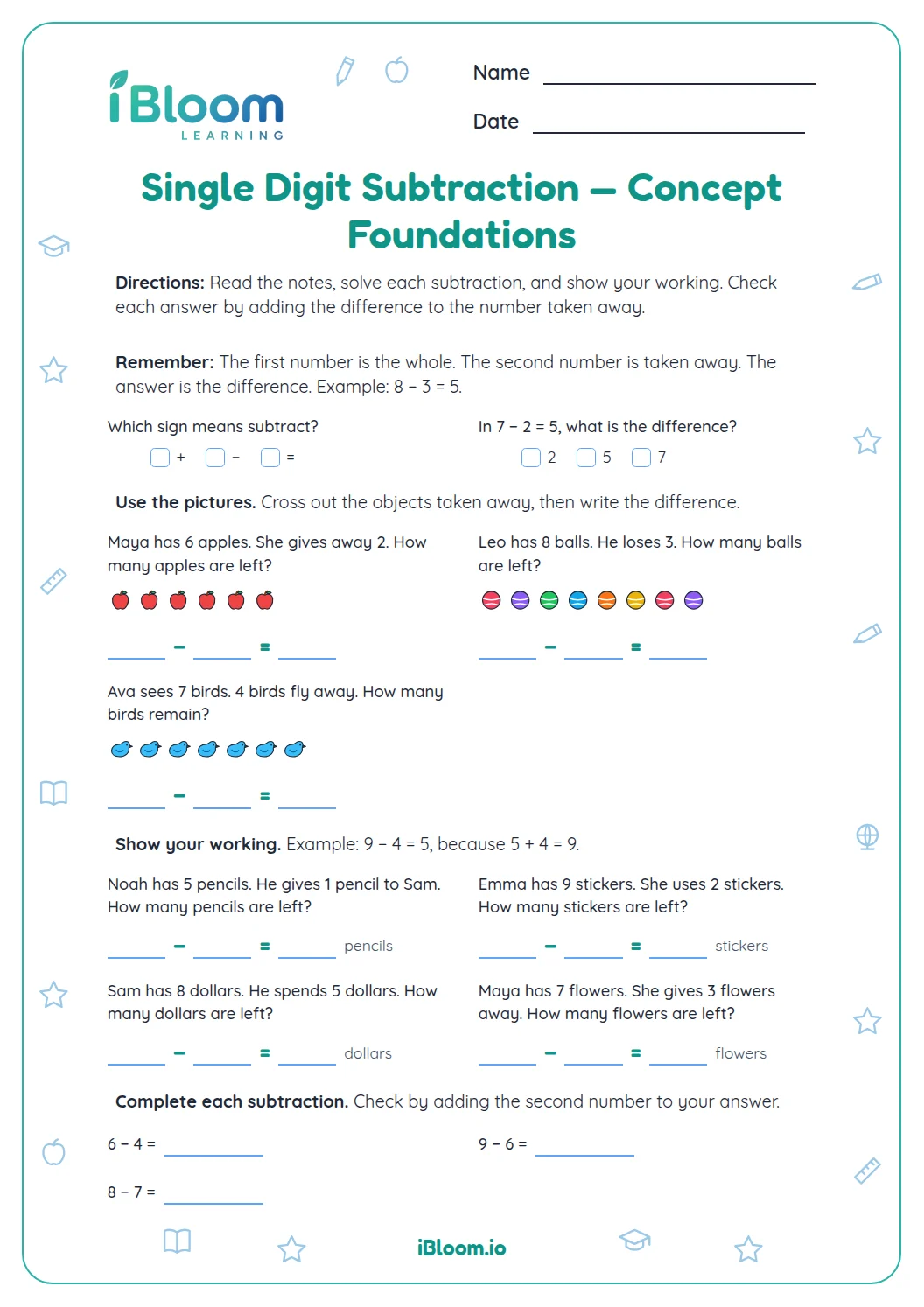
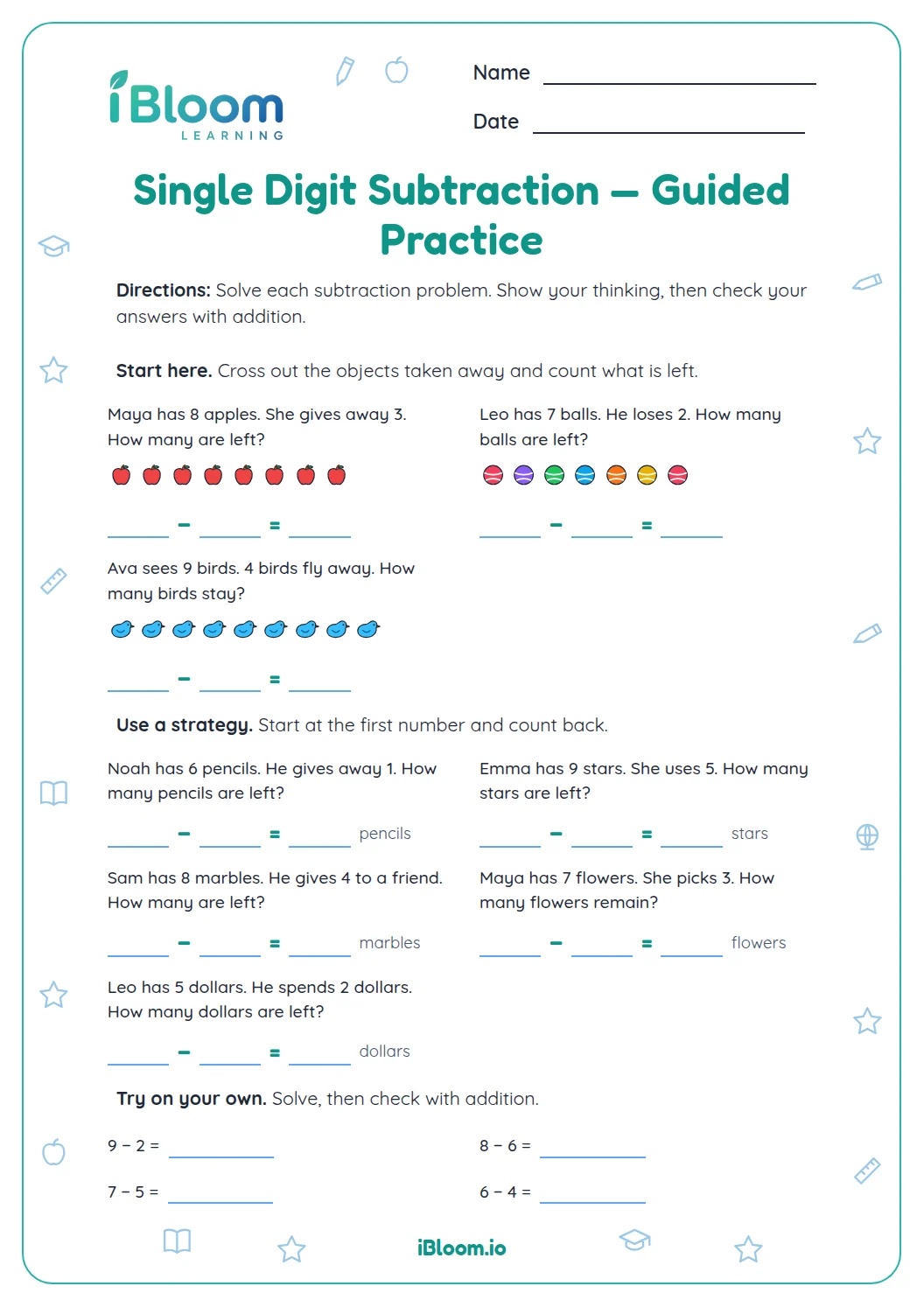
Yes, counters can make the roles of the numbers visible. For 8 − ___ = 3, begin with eight counters and move some away until three remain. Count the moved counters to find five, then connect that action to the completed equation and a mental addition check.
Does the answer key require exact wording for Part C?
No, the two explanations may use different words if they give the correct number and a valid reason. For question 13, children should rebuild nine from six and three. For question 14, they should explain that taking away zero leaves five. Sample responses show those ideas concisely.