


About this worksheet
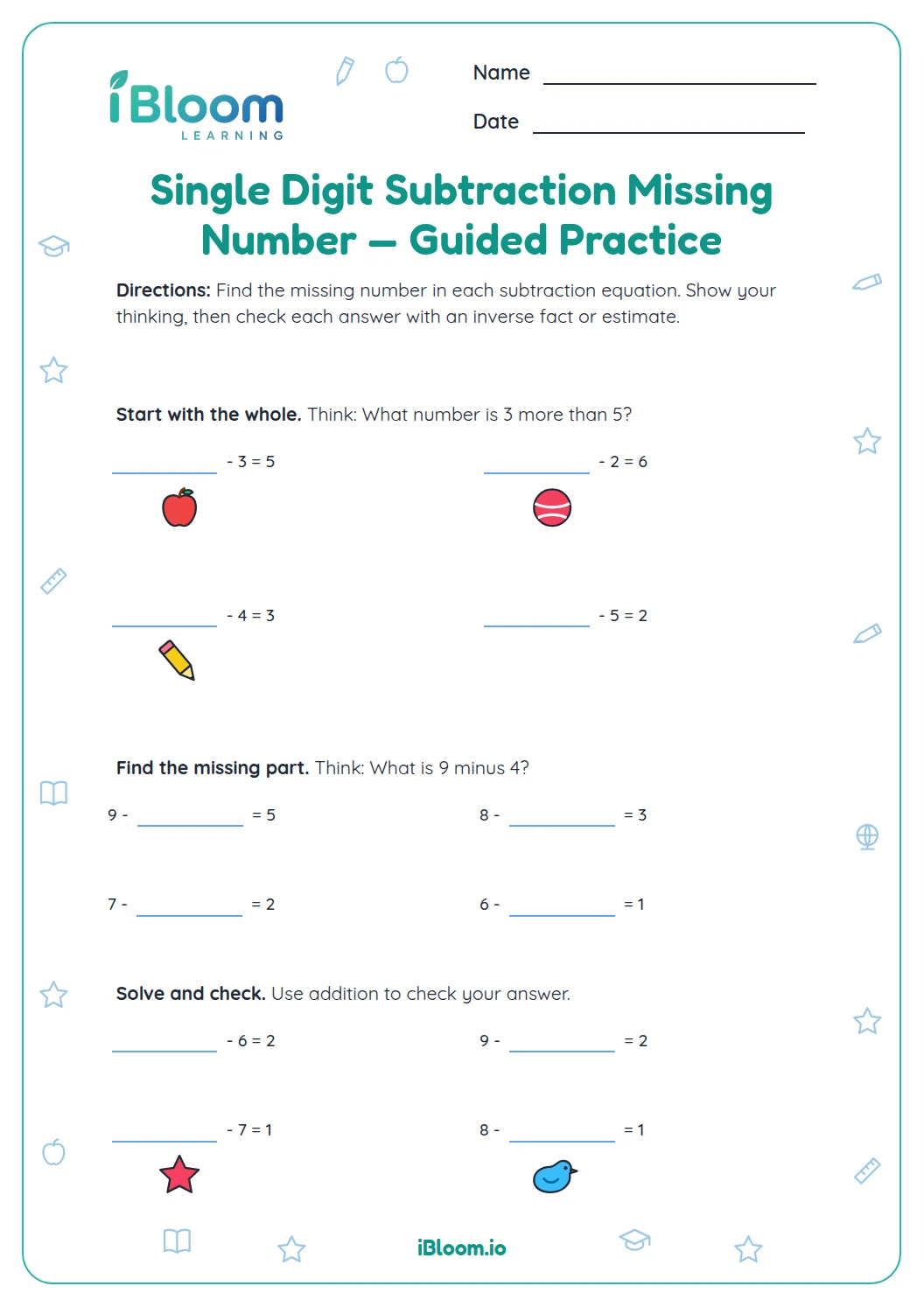
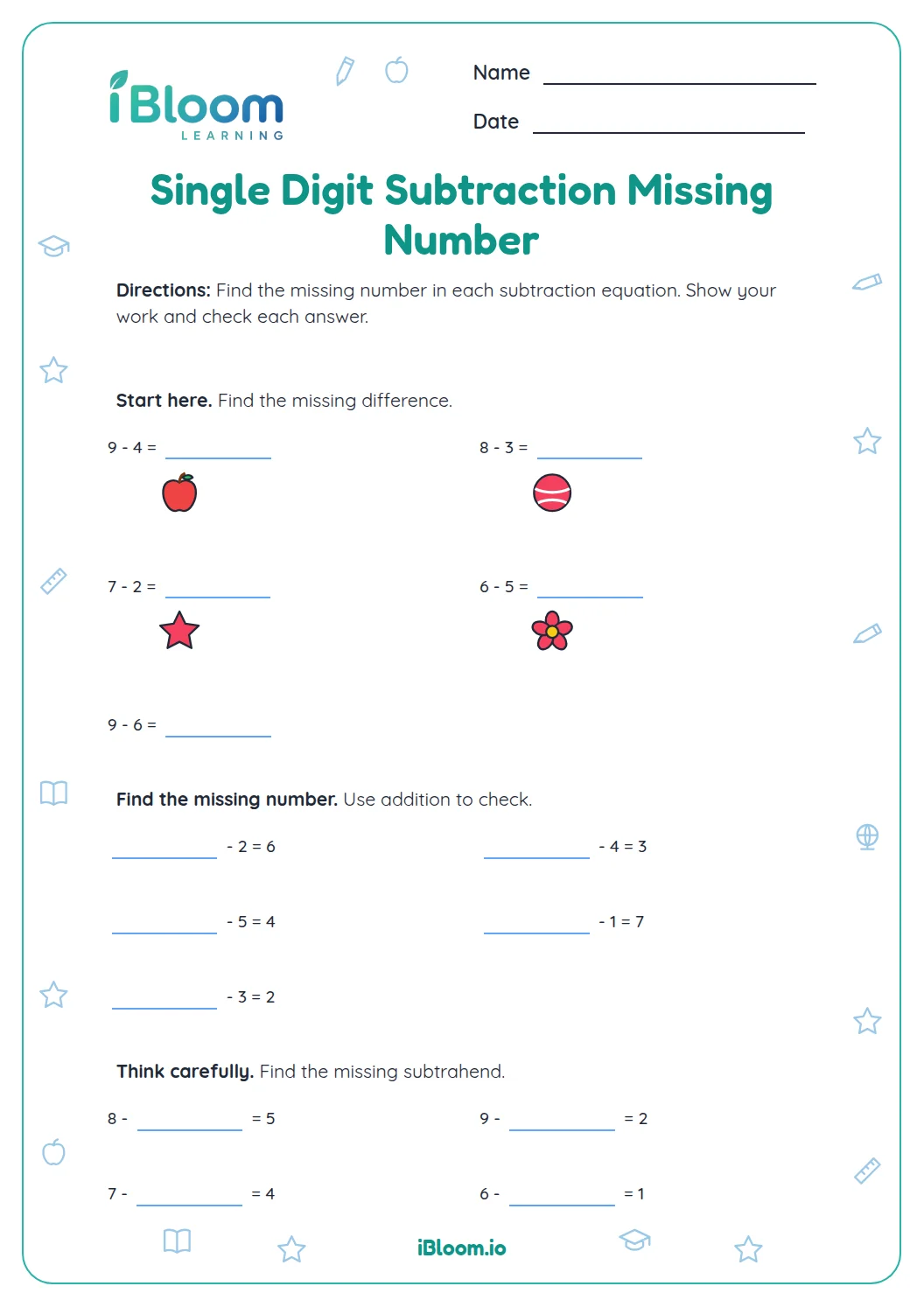
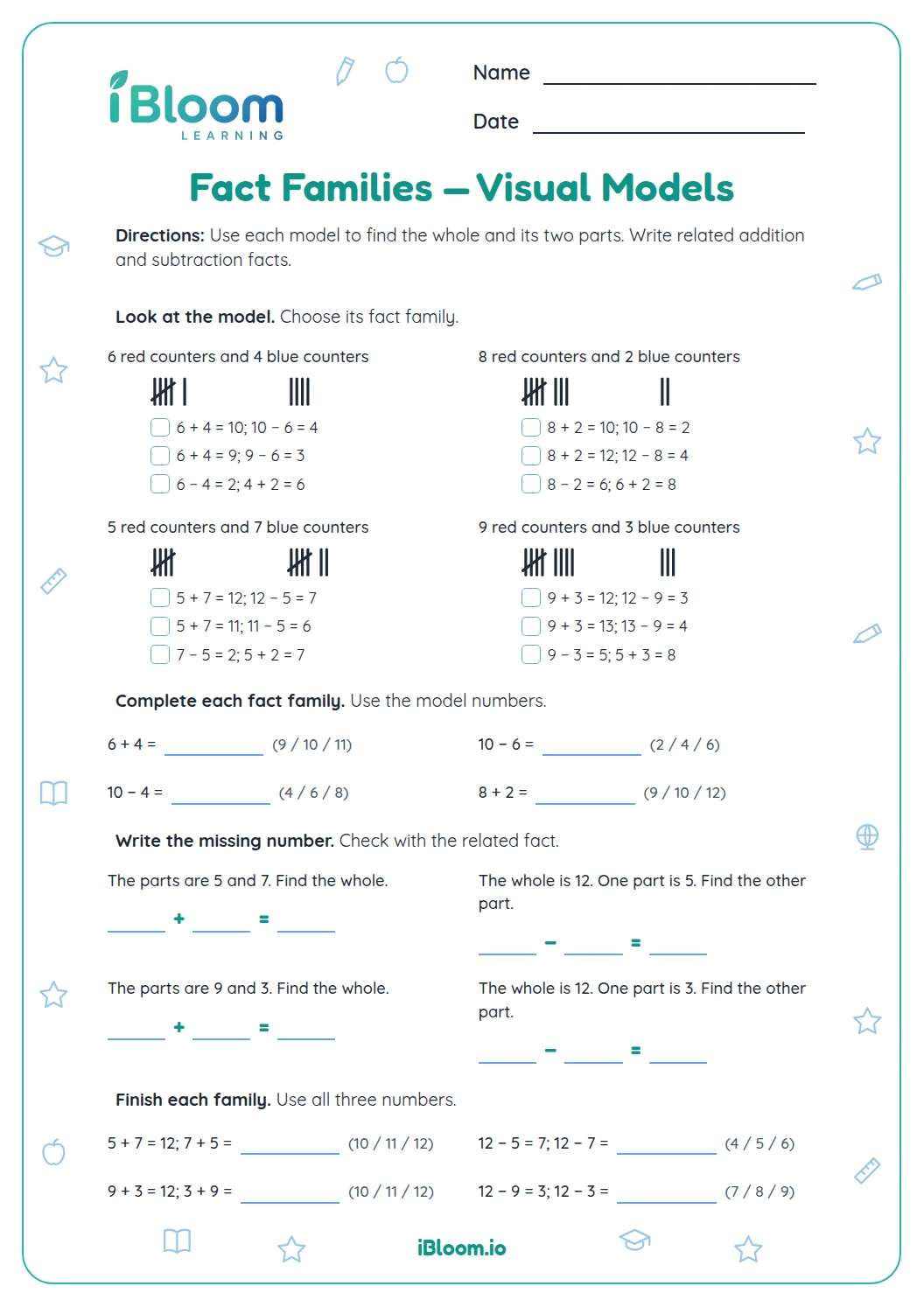
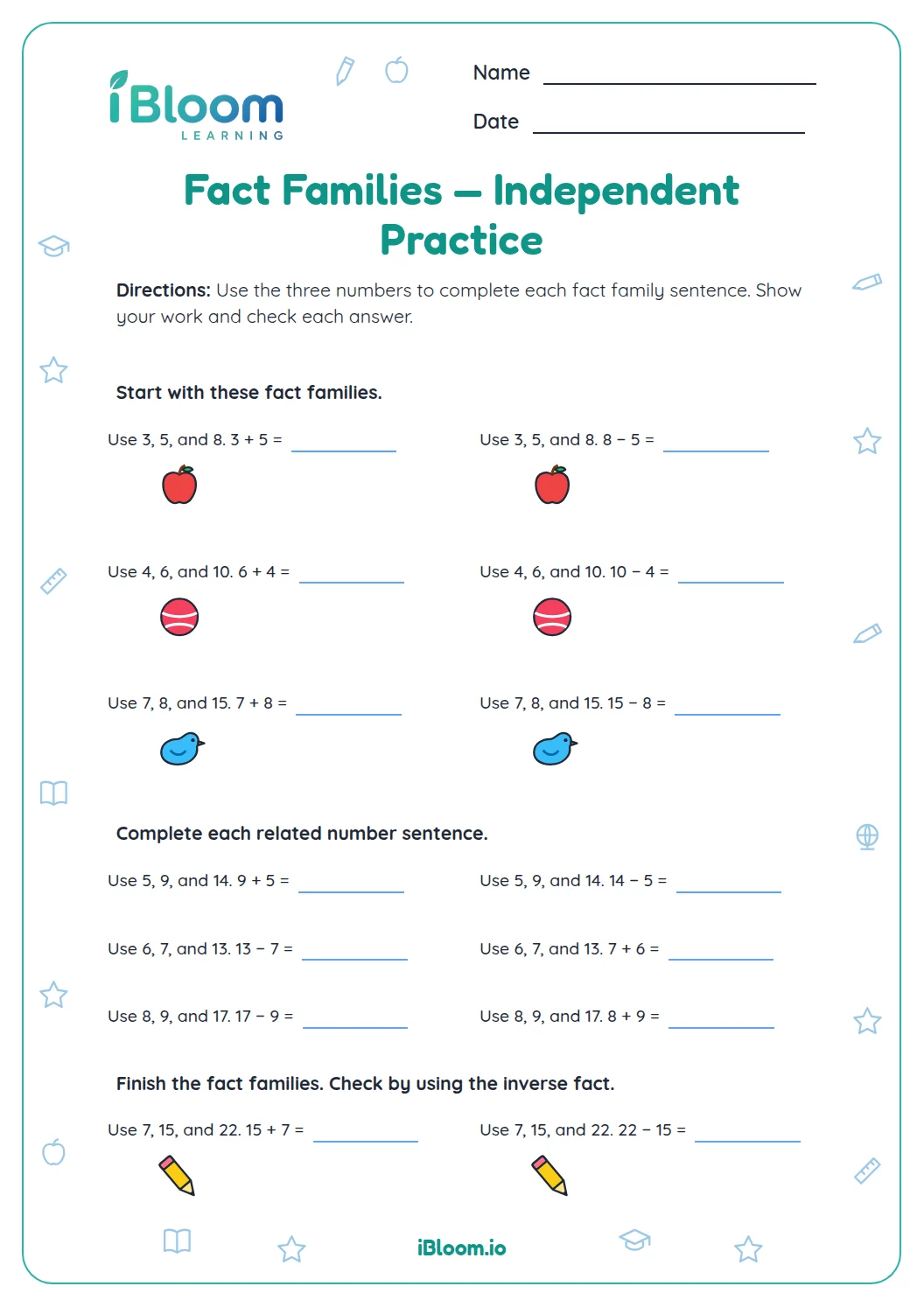
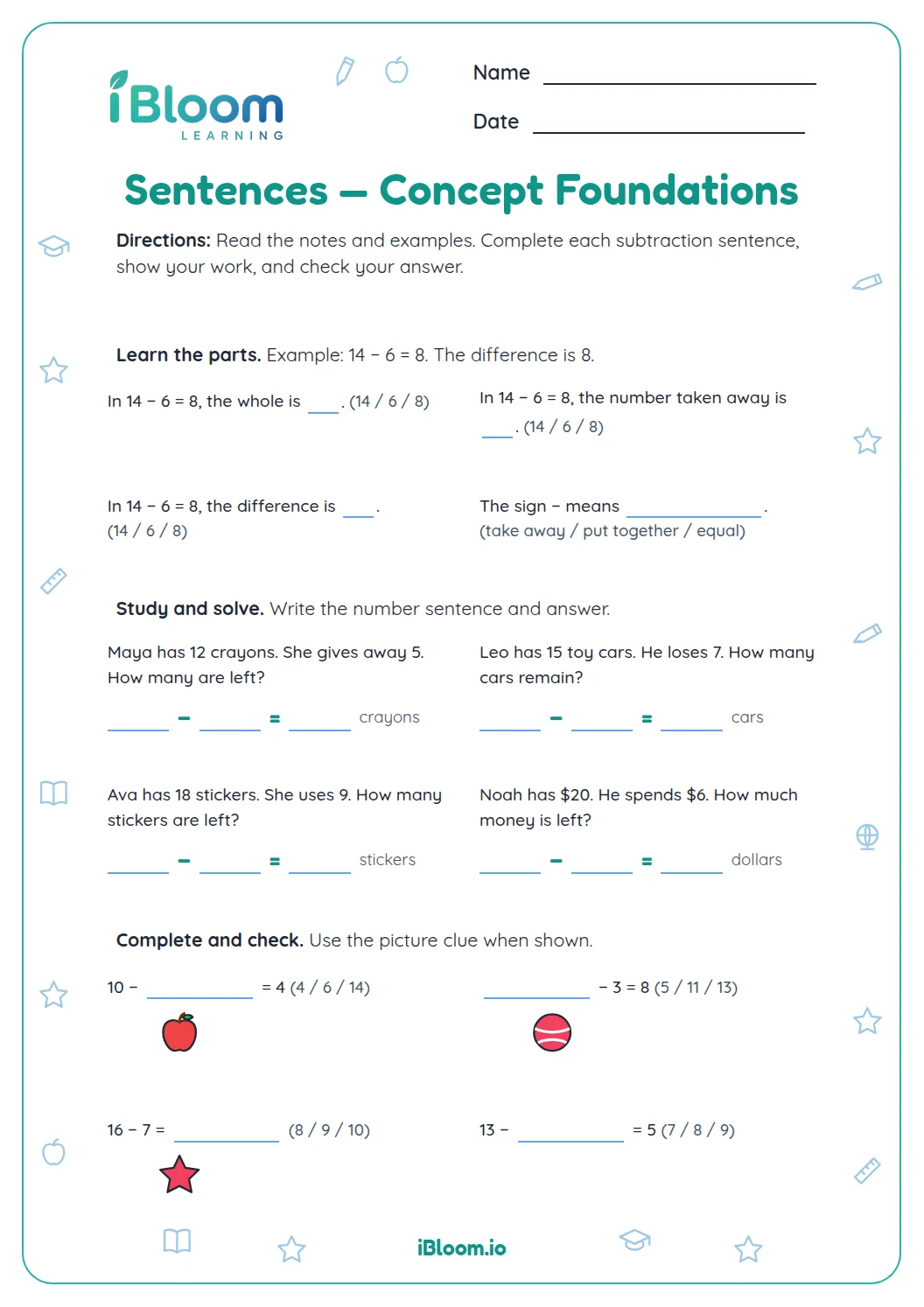
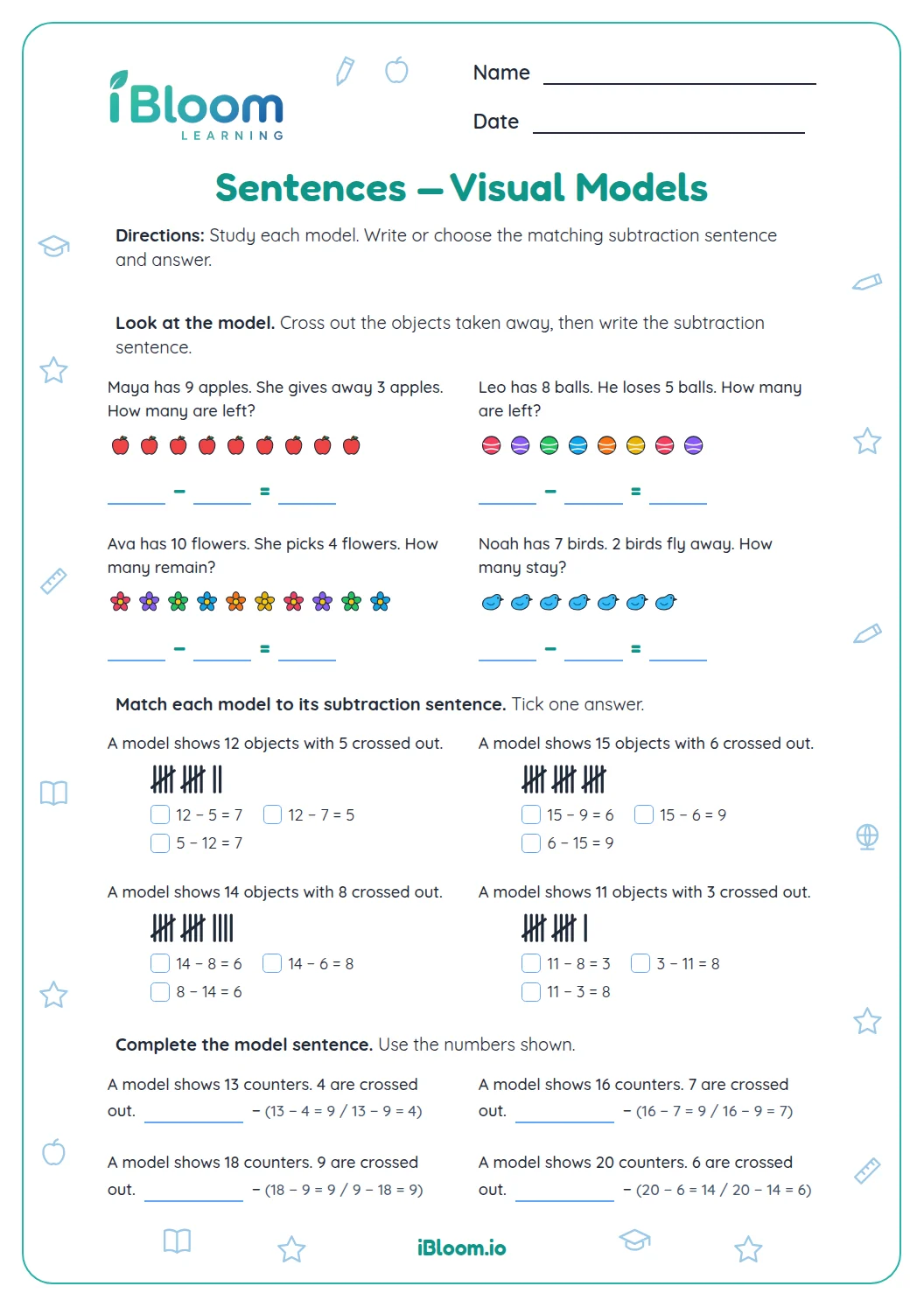
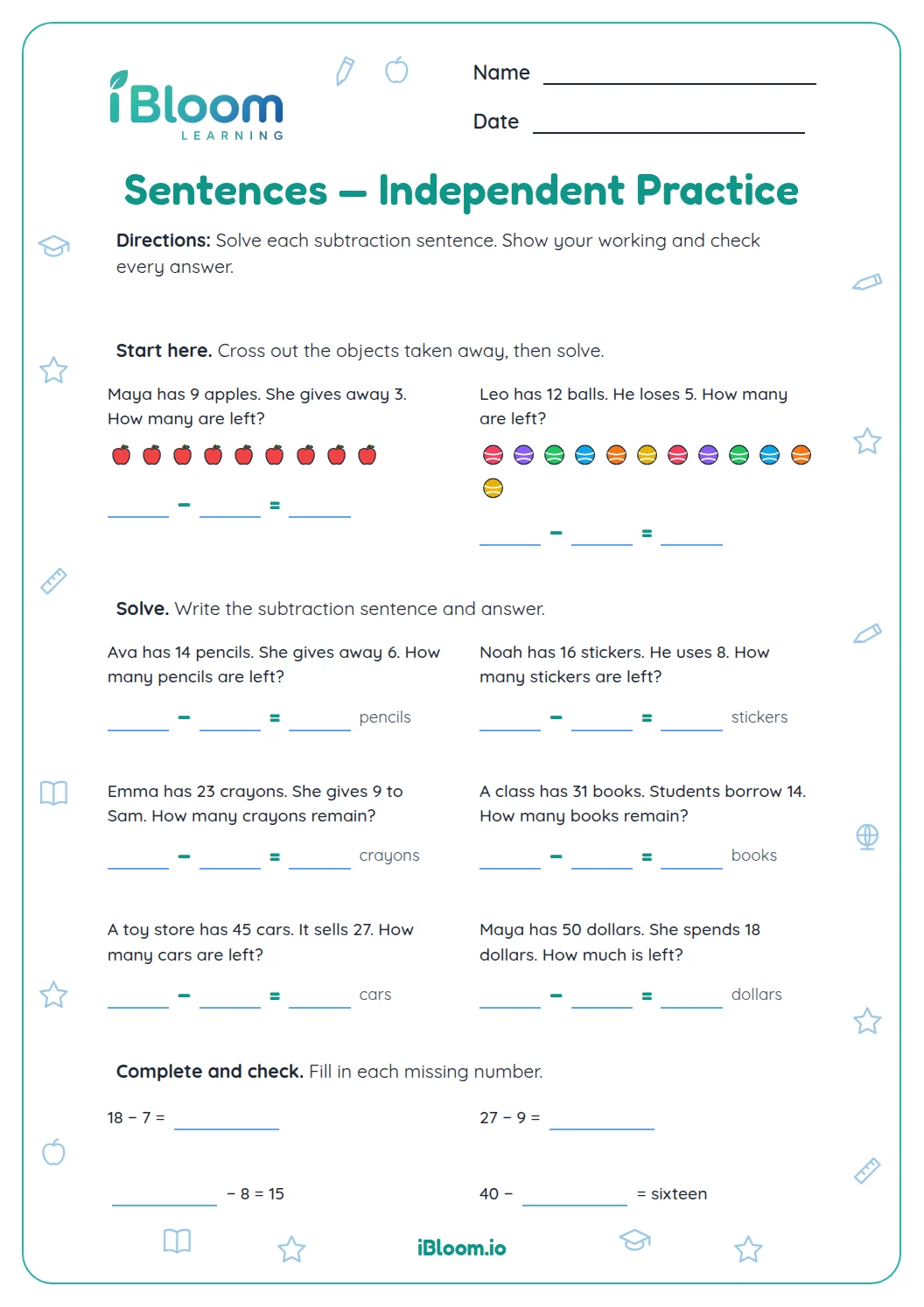
This Grade 2 printable gives 15 questions on missing-number subtraction. Ten frames and number bonds make the relationships visible before learners solve for a missing starting number or use subtraction in a short story. A separate answer key supports checking each fact. It aligns with CCSS 2.OA.B.2.
Aligned to 2.OA.B.2
How do I get started?
Use the whole and known part to find the missing part; for a missing start, combine the parts.
The first eight items use missing subtrahends, the next five ask for a missing start, and the last two put subtraction in a story.
- 19 − ___ = 4; the whole is 9, and 4 remain, so 5 were taken. Check: 9 − 5 = 4.
What changes across the questions?
For 8 − ___ = 3, subtracting 3 from 8 would find the wrong quantity.
Ask how many were taken: 8 − 3 = 5, then check that 8 − 5 = 3.
How can I use the answer key?
It includes ten-frame and number-bond models, missing-start facts, and two short subtraction stories. The learner can use the model to identify the whole and parts, then check each answer in the original equation. Check the calculation against the original question, including its unit or place value.
How to use the worksheet
- 1Read the part heading and look at the model or number sentence.
- 2Name what is known and what the blank represents.
- 3Solve each item and write units or labels when the question asks for them.
- 4Check the answer by substituting it or using the inverse relationship.
Common mistakes and quick fixes
The mistake
For 8 − ___ = 3, subtracting 3 from 8 would find the wrong quantity.
The fix
Ask how many were taken: 8 − 3 = 5, then check that 8 − 5 = 3.
The mistake
Writing a value in the wrong place or unit.
The fix
Reread the label and keep the answer in the unit or place named.
The mistake
Accepting a result without checking it.
The fix
Substitute the answer or use an inverse operation to verify it.
Common Core alignment
This worksheet practices the listed Common Core skill.
Use the whole and known part to find the missing part; for a missing start, combine the parts.
On this sheet: Use the whole and known part to find the missing part; for a missing start, combine the parts.
Show the official wordingHide the official wording
Fluently add and subtract within 20 using mental strategies.
What to practice next
Make more practice
Further reading
Questions parents and teachers ask
How many questions are included?
The printable has 15 questions across 3 sections, followed by a separate answer key. Learners can complete one section at a time, then check each result against the key. The worked example below explains one of the same use the whole and known part to find the missing part; for a missing start, combine the parts. tasks.
What grade is this worksheet for?
This page is written for Grade 2. The prompts use the numbers and vocabulary shown on the worksheet, with each section building on the skill named in its heading. An adult may read a word problem aloud, while the learner chooses and records the mathematical steps.
How should learners check their answers?
Use the separate key after attempting the problems. Check the result in the original equation or situation: a missing value should make the equation true, and a measurement or fraction should keep the requested unit or form. For a missed item, redo that one step before moving on.
Can I print only the worksheet pages?
Yes. The worksheet pages and answer key pages are separate in the printable. Print the learner pages for practice and keep the key nearby for checking. If a child is working independently, cover the key until the questions are complete, then review any item that needs another attempt.
What can help if an item feels difficult?
Return to the representation used in the question: use the whole and known part to find the missing part; for a missing start, combine the parts. Start by identifying the known quantities and the unknown, then write or calculate one step at a time. Check the result in context instead of relying only on whether the arithmetic seems reasonable.