


About this worksheet
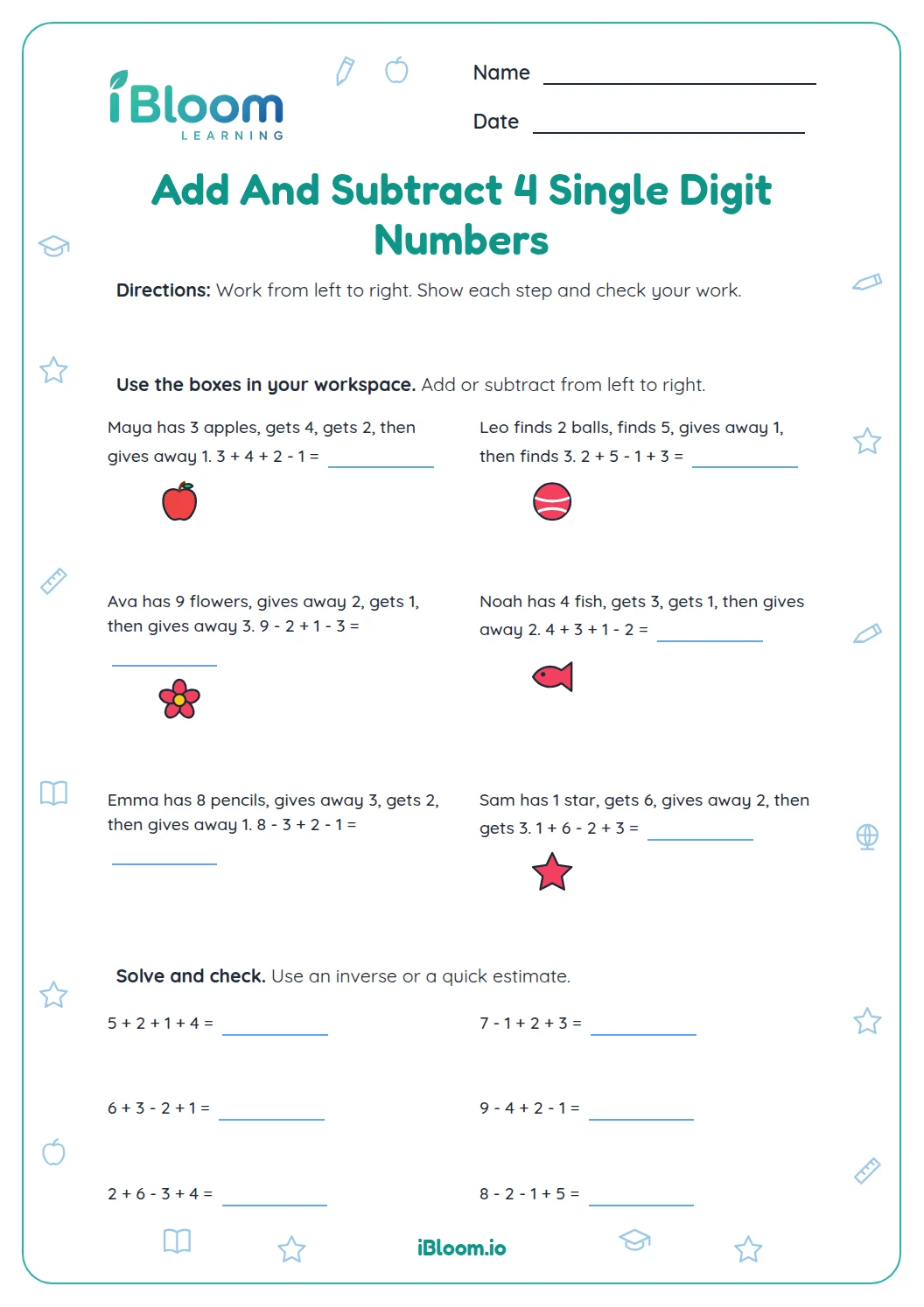
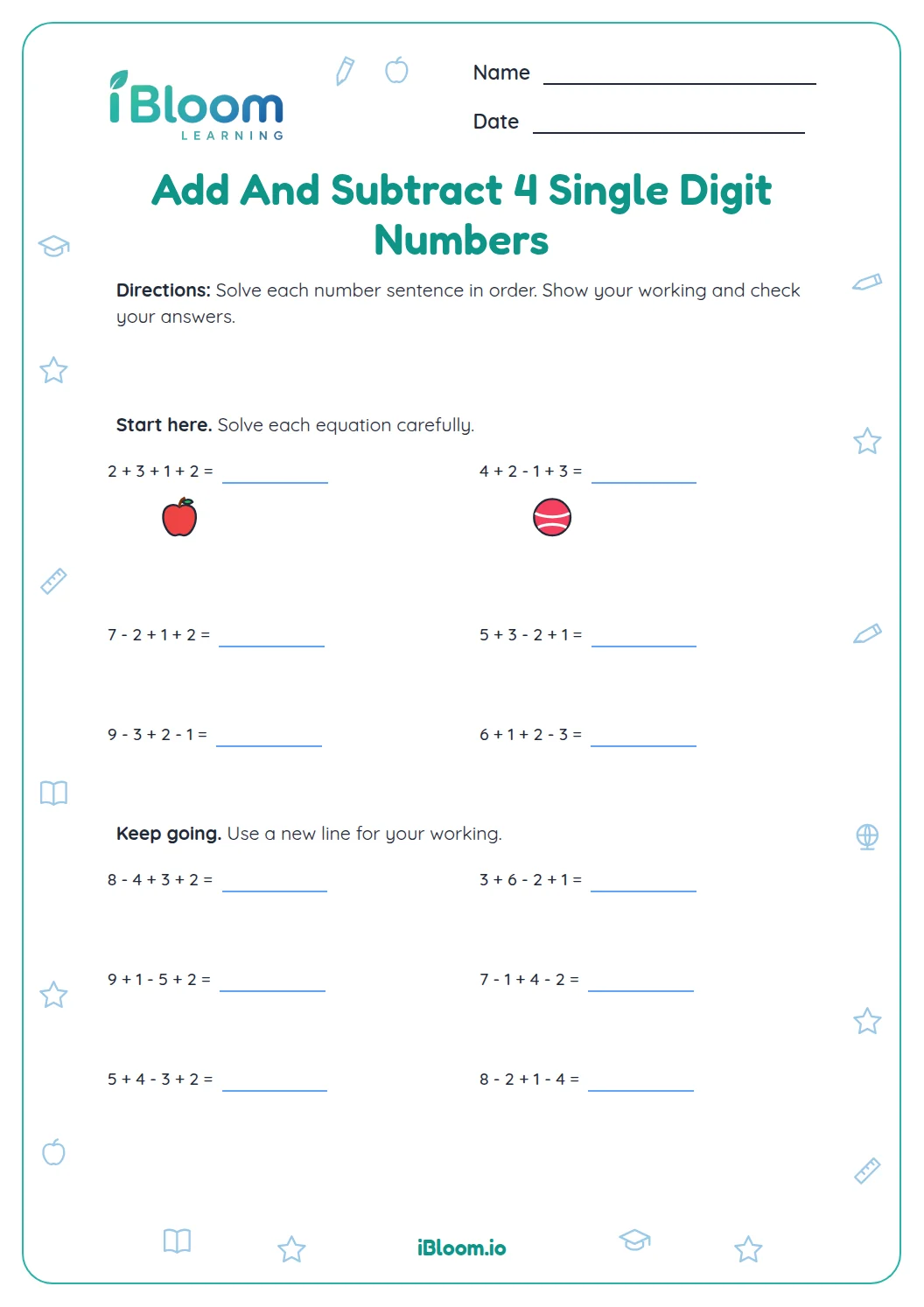
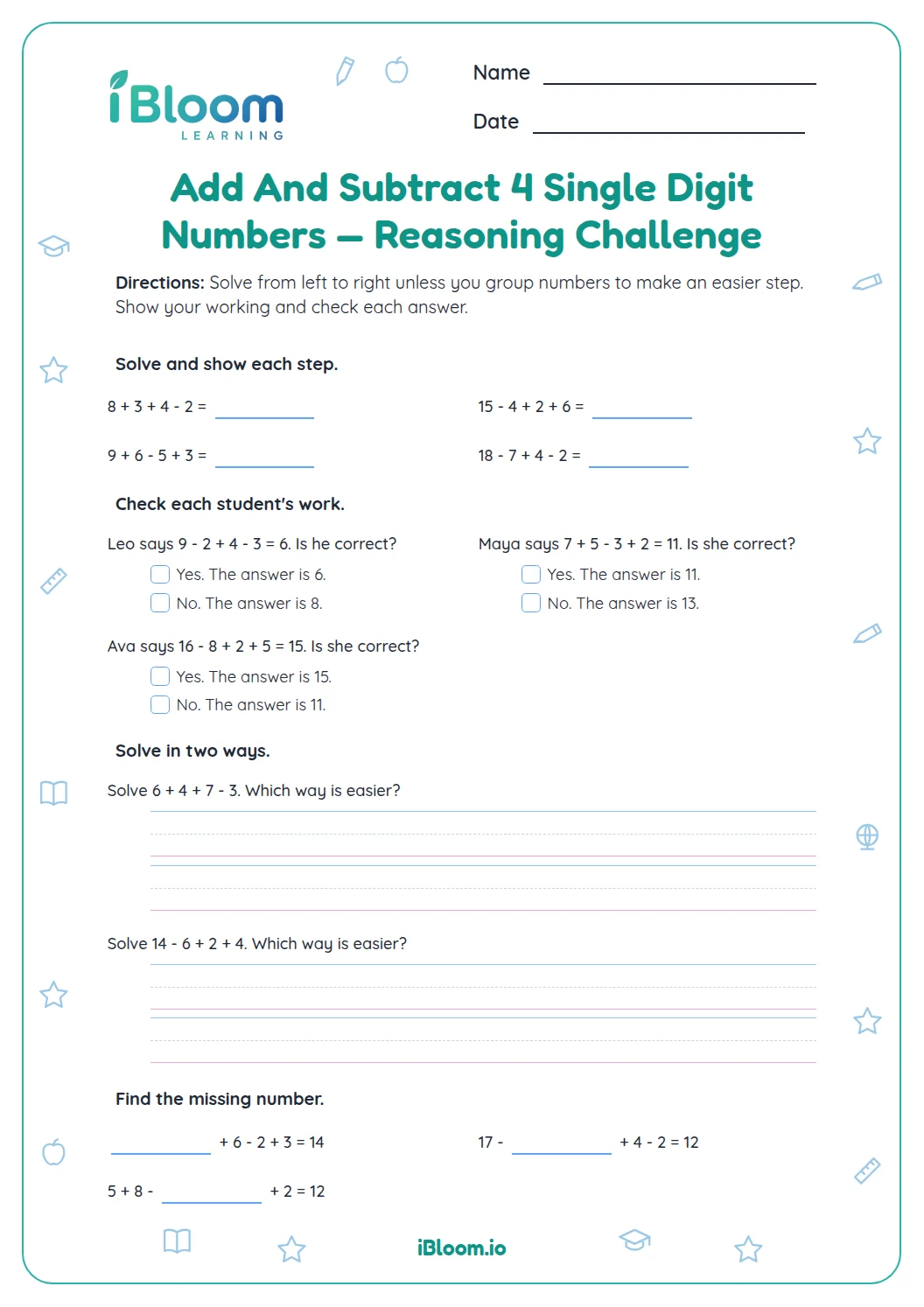
This Grade 2 worksheet builds fluency with expressions that combine four single-digit numbers. Children subtract in steps, add in steps, and solve short stories by tracking a total from left to right. The final questions include a missing number and an open addition problem. The key shows correct totals and one possible set of four addends. This practice supports CCSS 2.OA.B.2 through adding and subtracting within 20 using mental strategies.
Aligned to 2.OA.B.2
What does this worksheet practice?
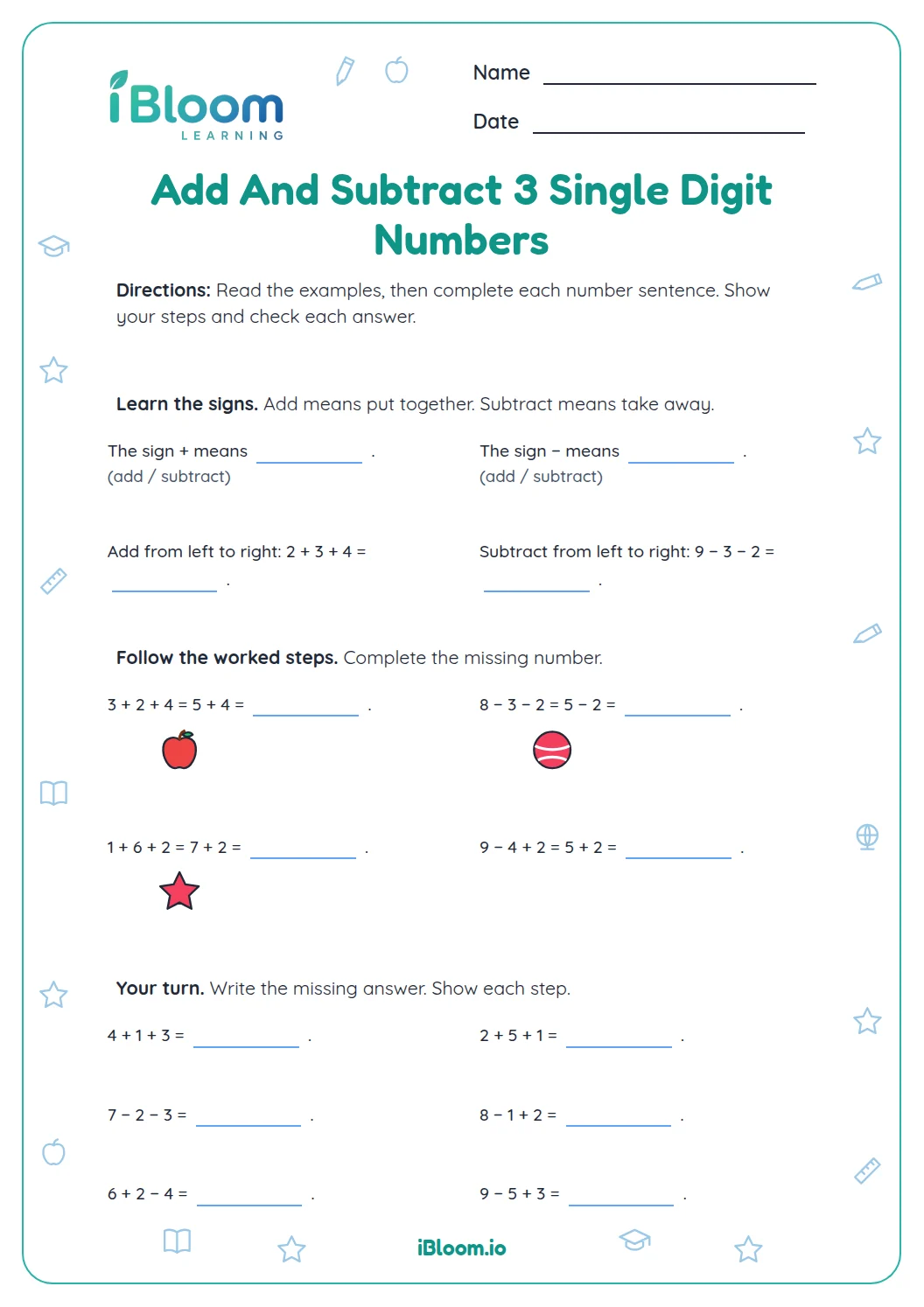
Add and subtract four numbers. Children subtract in steps, add in steps, and solve short stories by tracking a total from left to right
How can a learner solve one question?
Use the question as a model, then check each step against the words, numbers, or clues in the prompt.
- 18 − 3 = 5
- 25 − 2 = 3
- 33 − 1 = 2
How should an adult use the answer key?
Check the answer after the learner completes a part. For open responses, accept a different answer when it is clear and uses the target skill.
How to use this worksheet
- 1Read the instructions and the first part heading.
- 2Complete each question in order, showing a step when useful.
- 3Reread the prompt before choosing or writing an answer.
- 4Use the answer key after finishing a part.
- 5Review a missed answer by explaining the word, value, or clue that supports the correction.
Common mistakes and quick fixes
The mistake
Rereading only part of the prompt
The fix
Read the complete sentence or expression before responding.
The mistake
Using a familiar answer without checking the target skill
The fix
Point to the specific word, number, or clue that supports the answer.
The mistake
Leaving a question blank
The fix
Return to the question and write one clear answer before checking the key.
Common Core alignment
This worksheet practices the listed Common Core skill.
Add and subtract within 20 by combining or removing one addend at a time.
On this sheet: Add and subtract within 20 by combining or removing one addend at a time.
Show the official wordingHide the official wording
Fluently add and subtract within 20 using mental strategies. By end of Grade 2, know from memory all sums of two one-digit numbers.
What to practice next
Make more practice
Further reading
Questions parents and teachers ask
Why should children work from left to right?
Addition and subtraction have the same precedence in these expressions, so the operations are completed in the order they appear. After each step, the child has a new total to use with the next number. Writing the running totals can prevent skipped steps.
Are the numbers within 20?
Yes. The practice expressions and story totals stay within 20, making them suitable for Grade 2 mental addition and subtraction practice. Learners may still jot down intermediate totals if that helps them keep track. The expressions are designed for the child to track one change at a time.
What kinds of questions are included?
There are 17 questions: six subtraction expressions, five addition expressions, short story or situation questions, an open four-addend problem, and a missing-number equation. The sequence moves from repeated calculations to applying the same steps in context. The answer key lists the expected totals and a sample for the open response.
Can the four addends in the open question vary?
Yes. Any four single-digit addends that total 9 are valid. The answer key gives one example, 2 + 2 + 2 + 3, but children can use another correct combination and check it by adding all four numbers.
How can I check a missing number?
Put the proposed number back into the equation and calculate from left to right. In 9 − 2 − ___ − 1 = 3, the missing value is 3: 9 − 2 = 7, 7 − 3 = 4, and 4 − 1 = 3.