

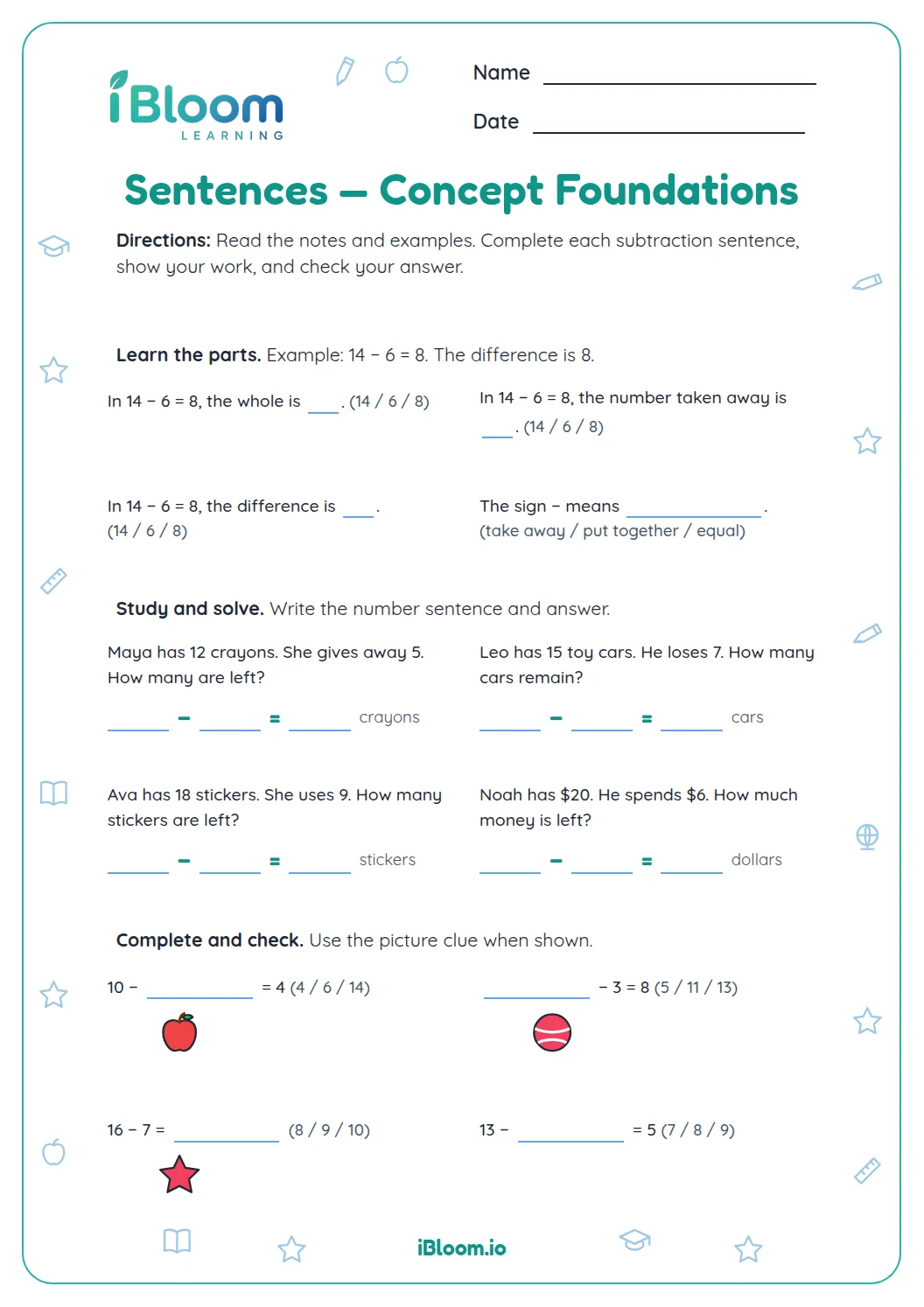
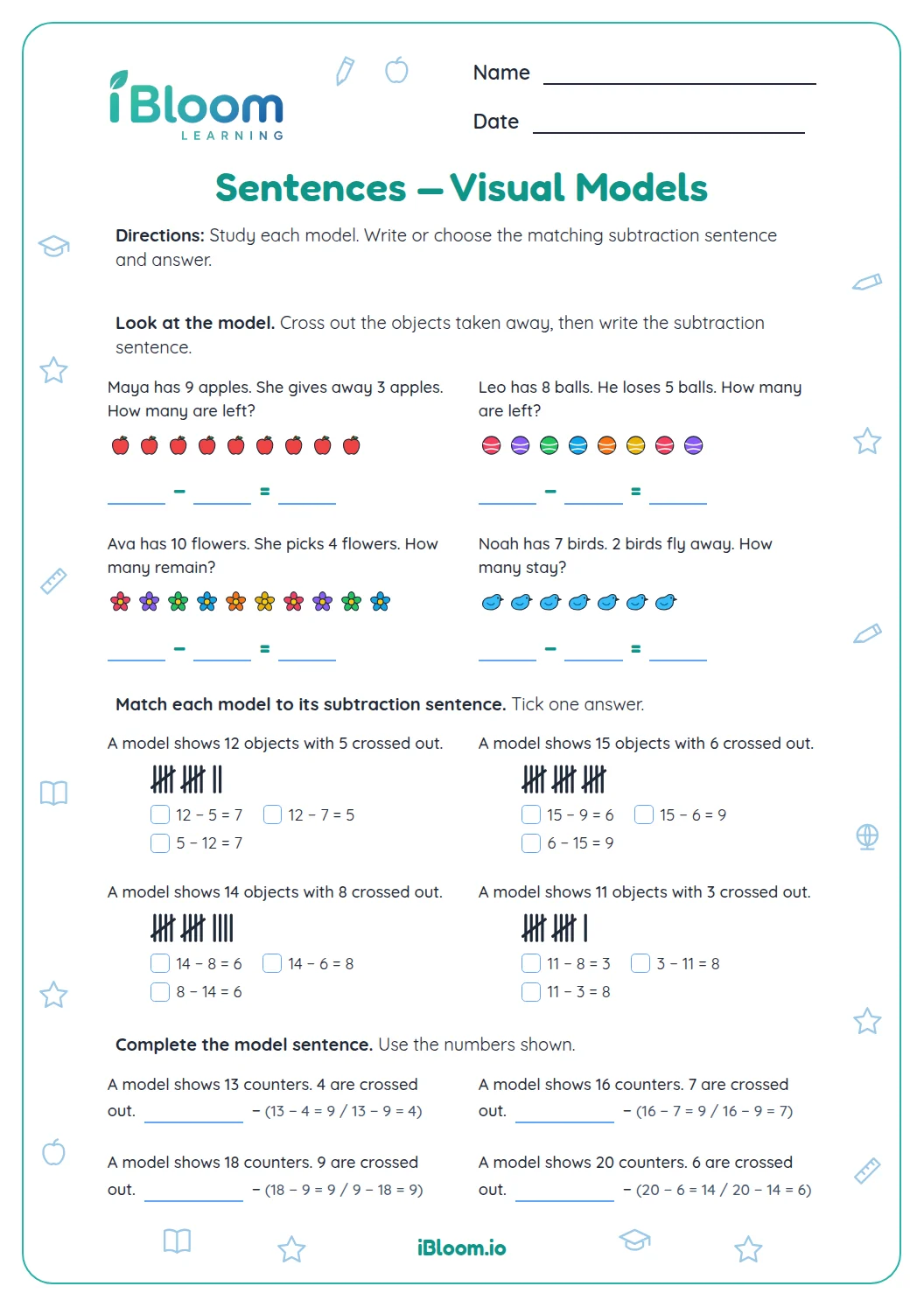
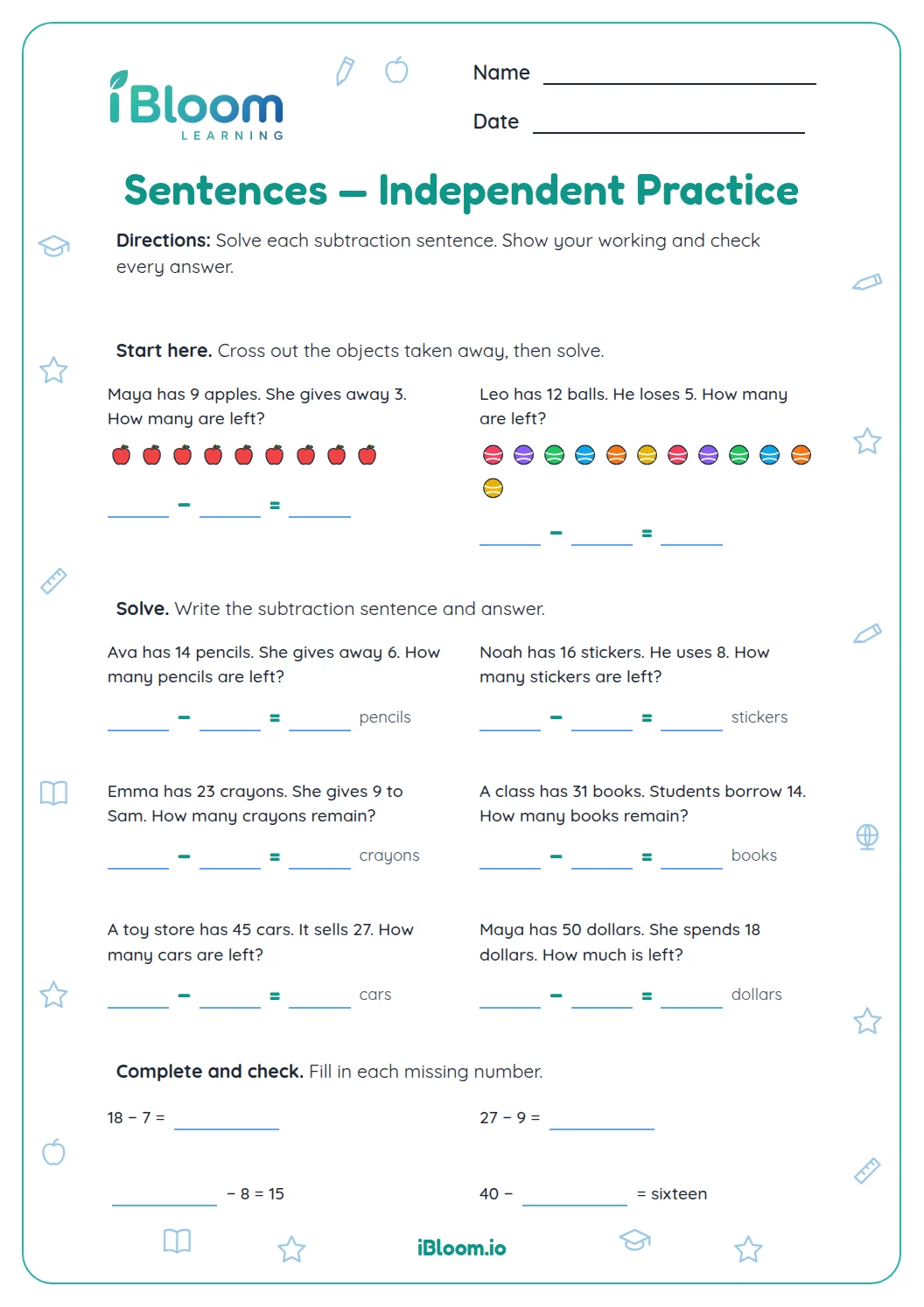
About this worksheet
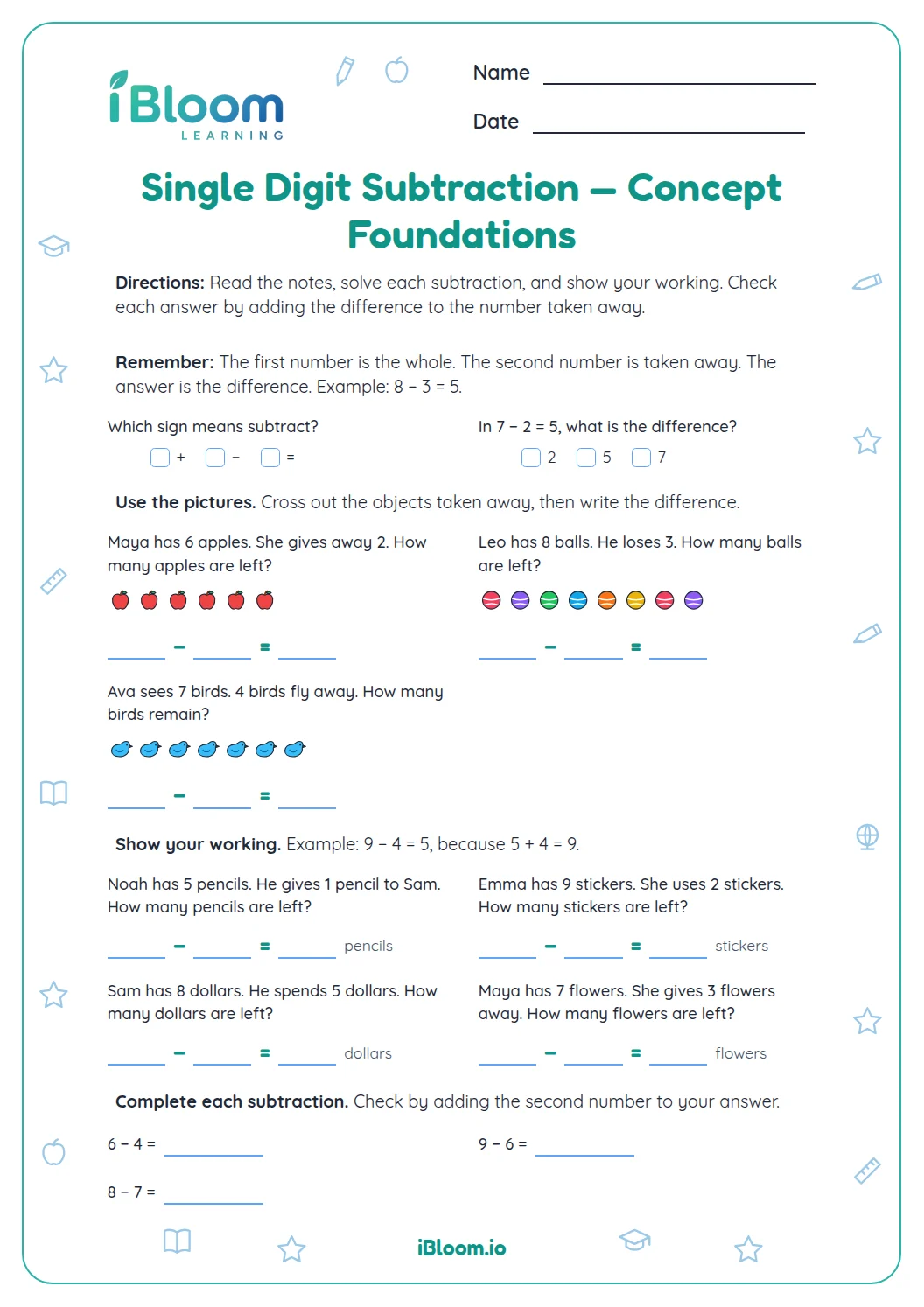
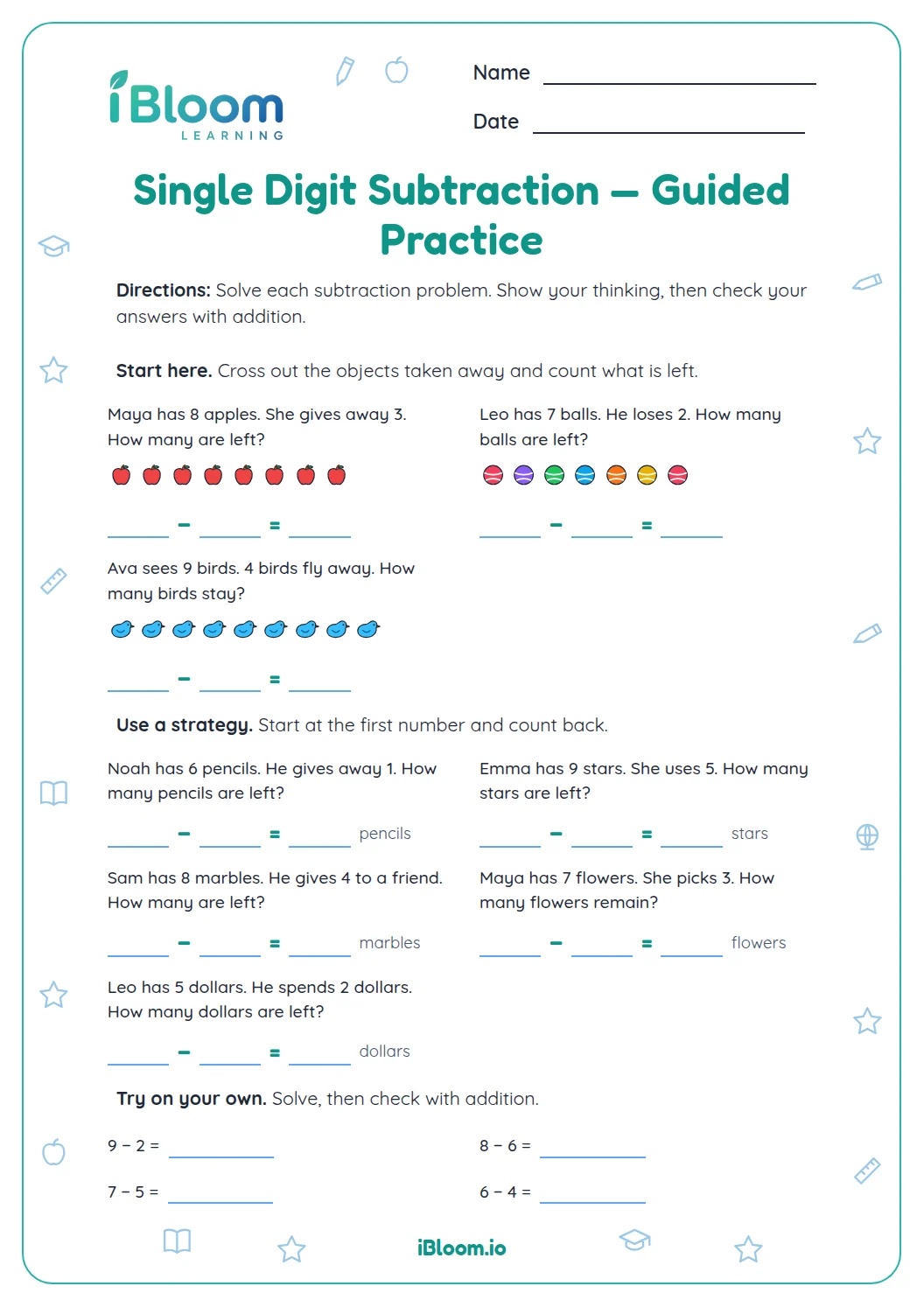
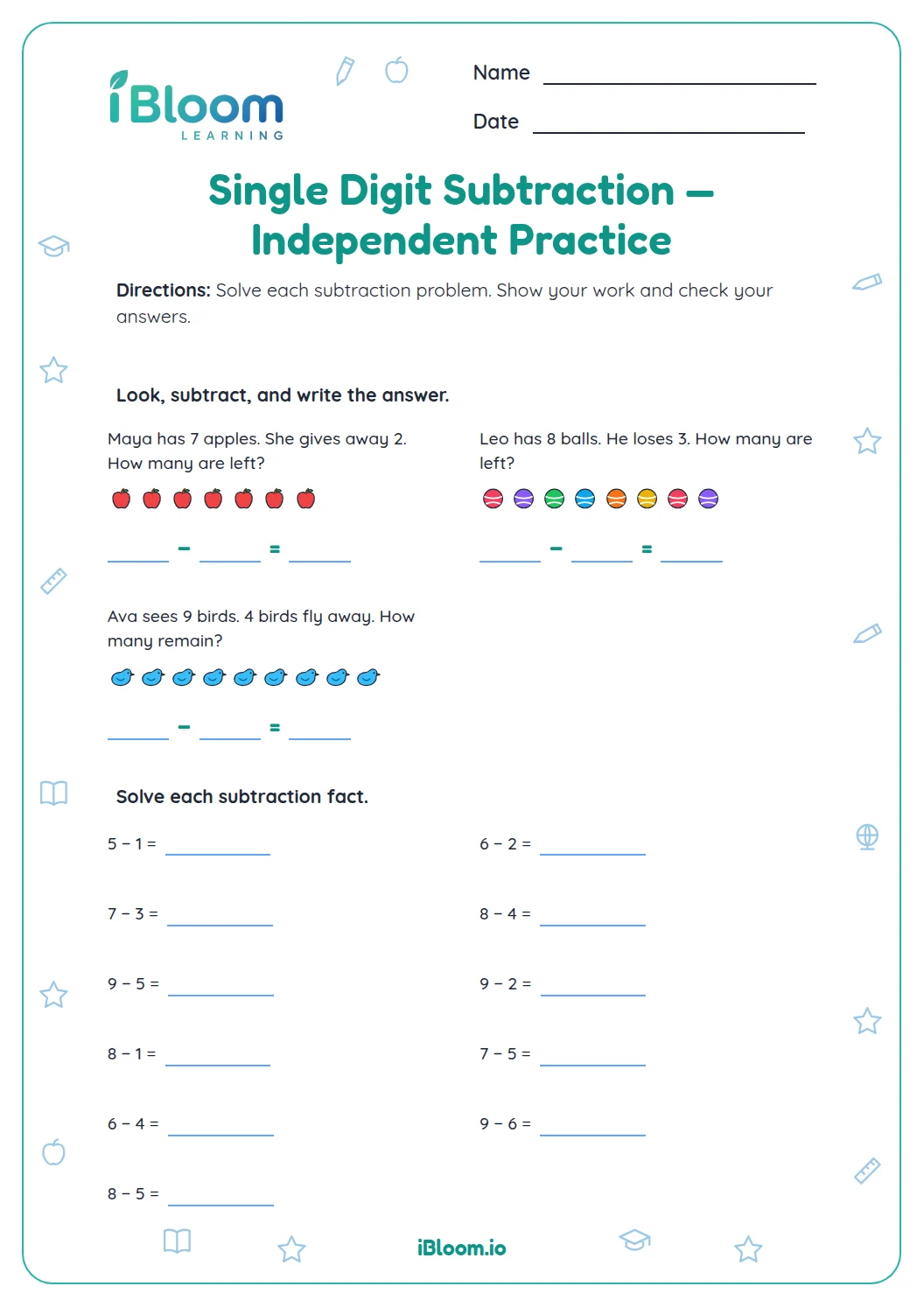
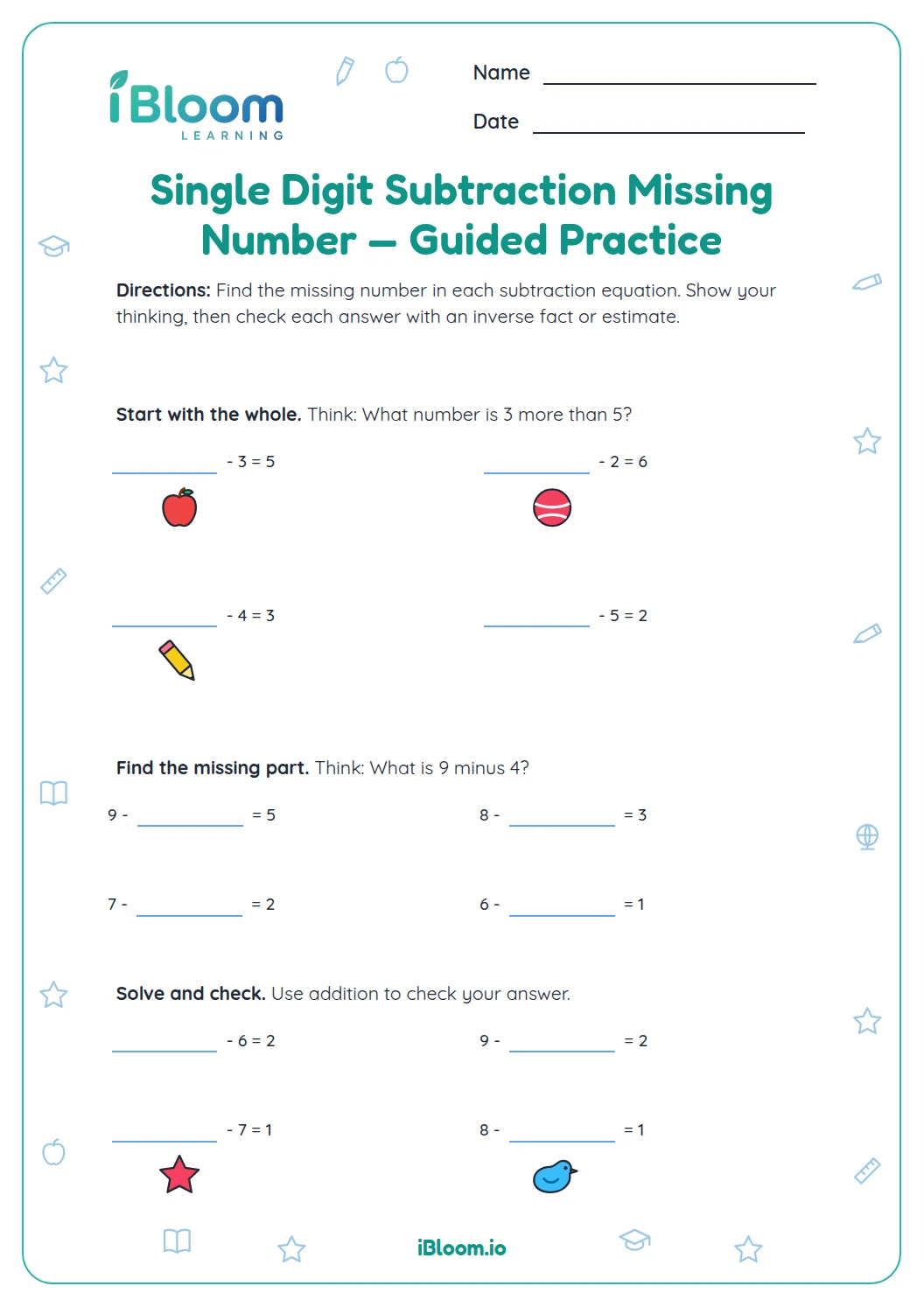
This Grade 2 worksheet uses number bonds in ten of its 14 subtraction questions. Students connect a whole and known part to find a difference, then try compact equations and two short stories. The separate answer key lists the results. The practice supports CCSS 2.OA.B.2.
Aligned to 2.OA.B.2
How does a number bond show subtraction?
A number bond shows a whole and the parts that make it. To find 9 − 4, start with 9, take away the part 4, and find the missing part: 5. That missing part is the difference.
- 1Whole: 9; known part: 4
- 29 − 4 = ___
- 3The missing part is 5.
How can children subtract within 20?
Children can count back, use a known fact, or think of the related addition fact. For 14 − 8, ask what number goes with 8 to make 14. The answer is 6, so 14 − 8 = 6.
What is on the two practice pages?
Part A uses six number bonds to connect a whole, a part, and the missing difference. Part B gives six subtraction equations. Part C applies the same thinking to four short stories. The answer key follows the worksheet.
How to use this worksheet
- 1Look at the whole and known part in Part A.
- 2Name the missing part that completes the whole.
- 3Solve Part B with a mental strategy such as counting back.
- 4Read each Part C story and identify the amount taken away.
- 5Check a difference with addition: part plus difference should equal the whole.
Common mistakes and quick fixes
The mistake
Subtracting the larger number from the smaller one.
The fix
Point to the starting amount first; subtract from that amount.
The mistake
Counting the starting number as the first number back.
The fix
For 9 − 4, begin with 8 as the first count back, then count four steps.
The mistake
Writing the number taken away as the difference.
The fix
Use the related fact: 4 + ___ = 9 to check the missing part.
Curriculum alignment
This worksheet gives children direct practice with the skill named in the standard.
Use mental strategies to subtract within 20.
On this sheet: Students use number bonds and subtraction equations to subtract within 20.
Show the official wordingHide the official wording
Fluently add and subtract within 20 using mental strategies. By end of Grade 2, know from memory all sums of two one-digit numbers.
What to practice next
Make more practice
Further reading
Questions parents and teachers ask
How do number bonds help with subtraction?
A number bond shows how a whole is split into two parts. If the whole is 9 and one part is 4, the missing part is 5 because 4 and 5 make 9. This gives a visual way to see why 9 − 4 equals 5.
What does the blank in a subtraction equation mean?
The blank stands for the answer, or difference. In 14 − 8 = ___, a child can count up from 8 to 14 or count back from 14 by 8. Both strategies lead to 6, which belongs in the blank.
Are the story problems also about subtraction within 20?
Yes. Each story gives a starting amount and tells how many go away or how many belong to a known part. Children subtract the smaller amount from the total and write a short equation and answer in the working space.
Can my child use a counting strategy?
Yes. Counting back is a useful way to check a difference: for 12 − 4, say 11, 10, 9, 8. The answer is 8. As facts become familiar, children can solve many of these questions mentally without counting each step.
What is included in the answer key?
The key gives the missing number-bond parts, all six equation answers, and the four story answers. For the story problems, it lists the numerical answer so an adult can compare it with the child’s equation and response. A quick reread of the completed item can confirm the answer and make the word relationship clear.