



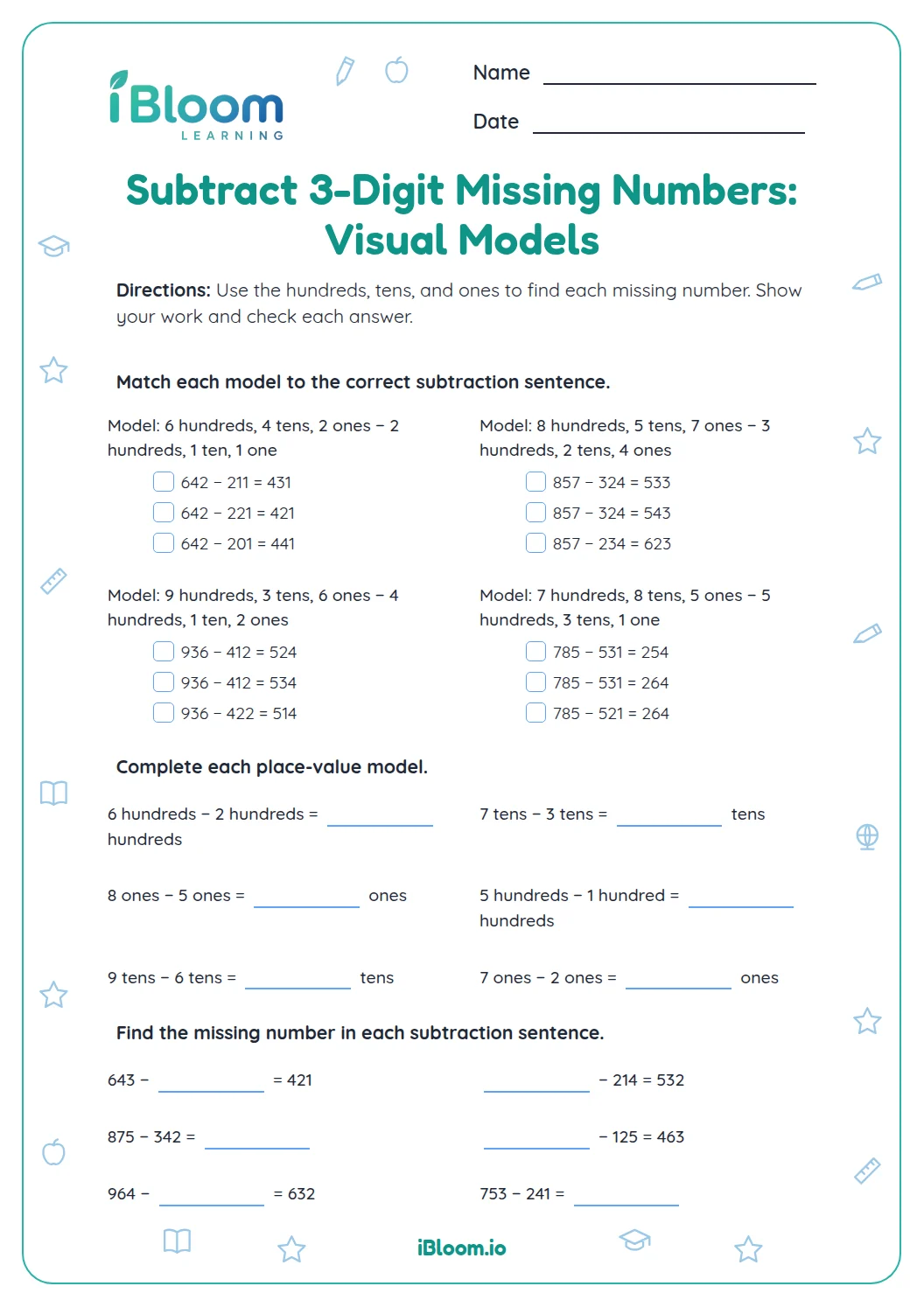

About this worksheet
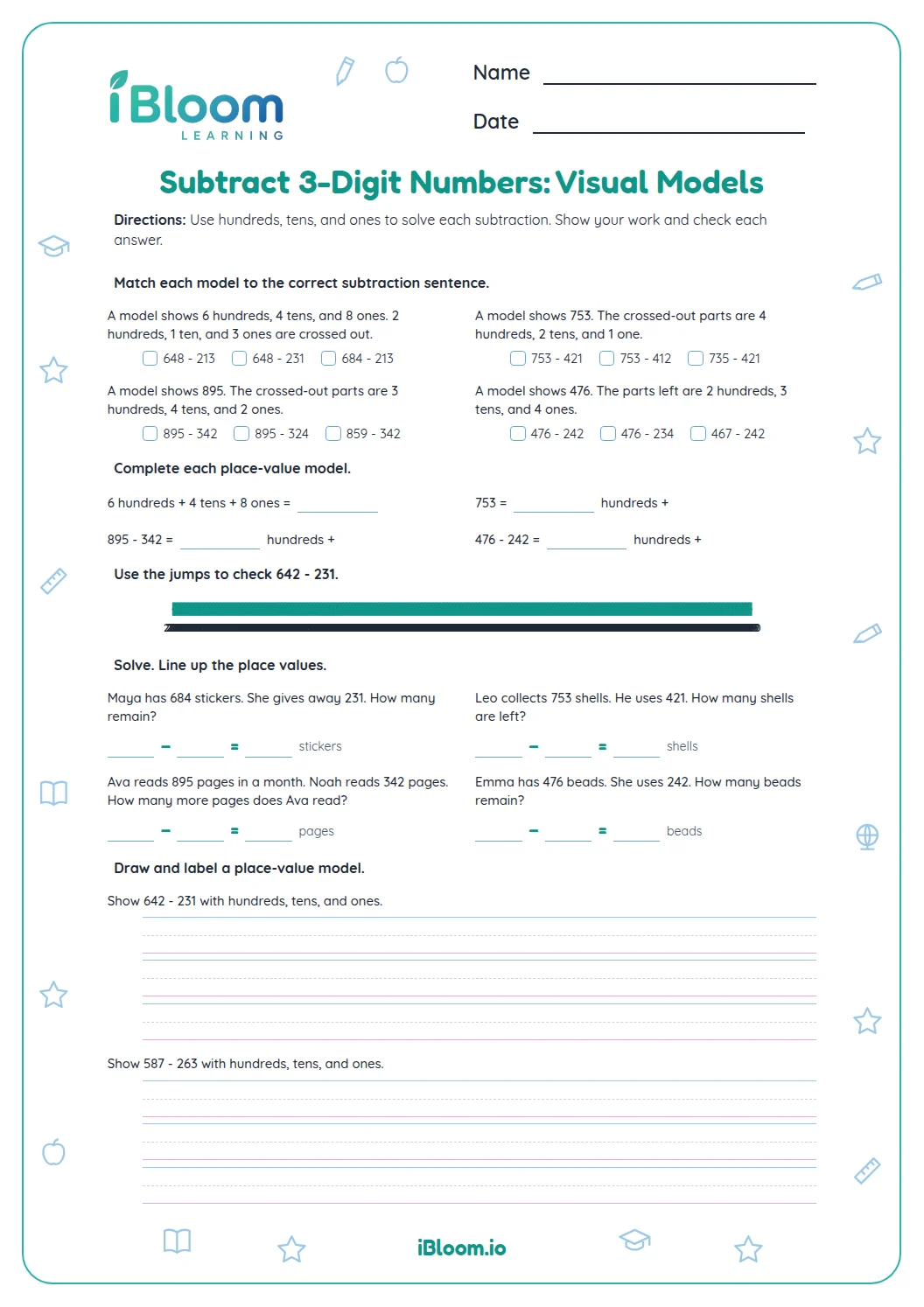
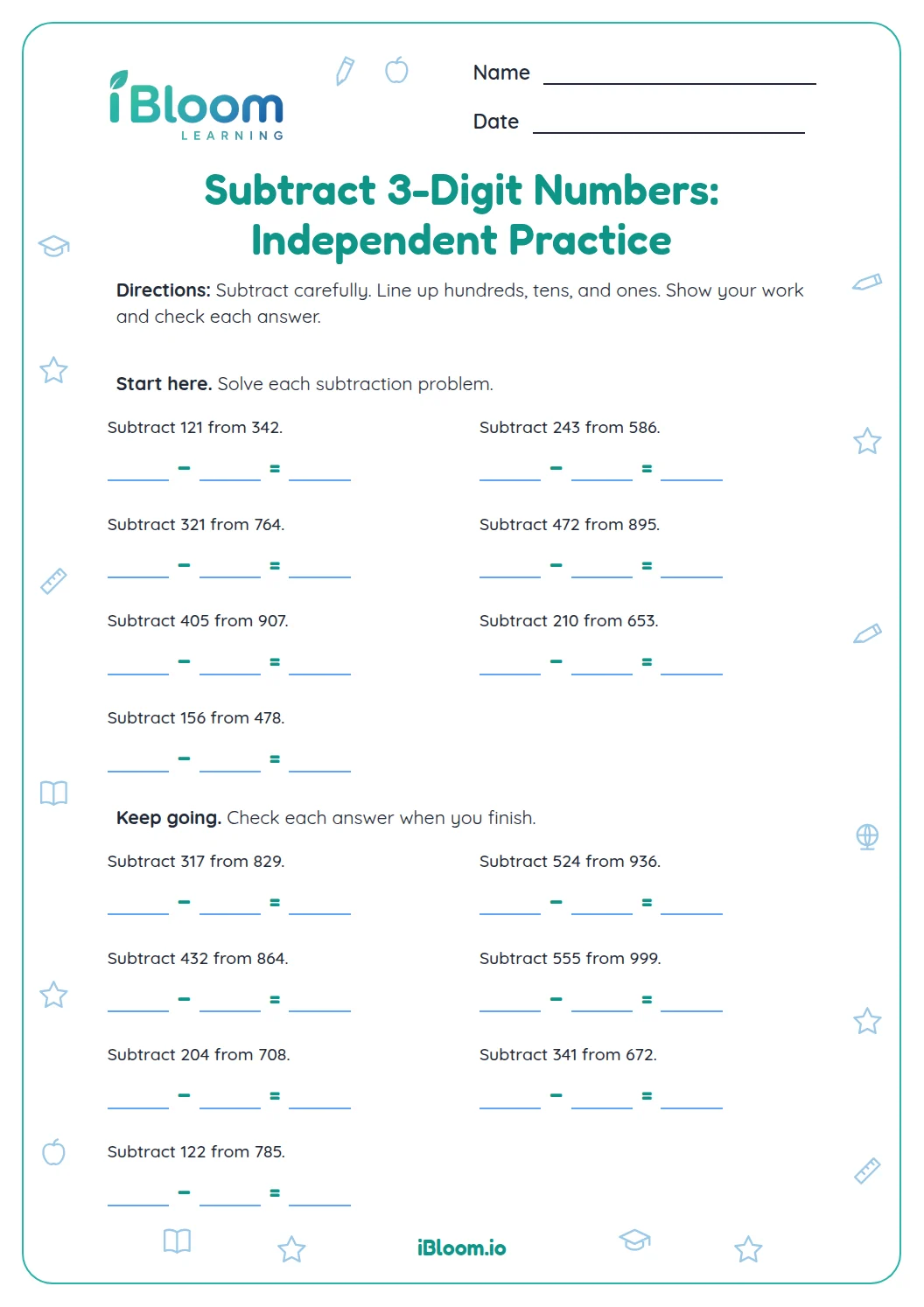
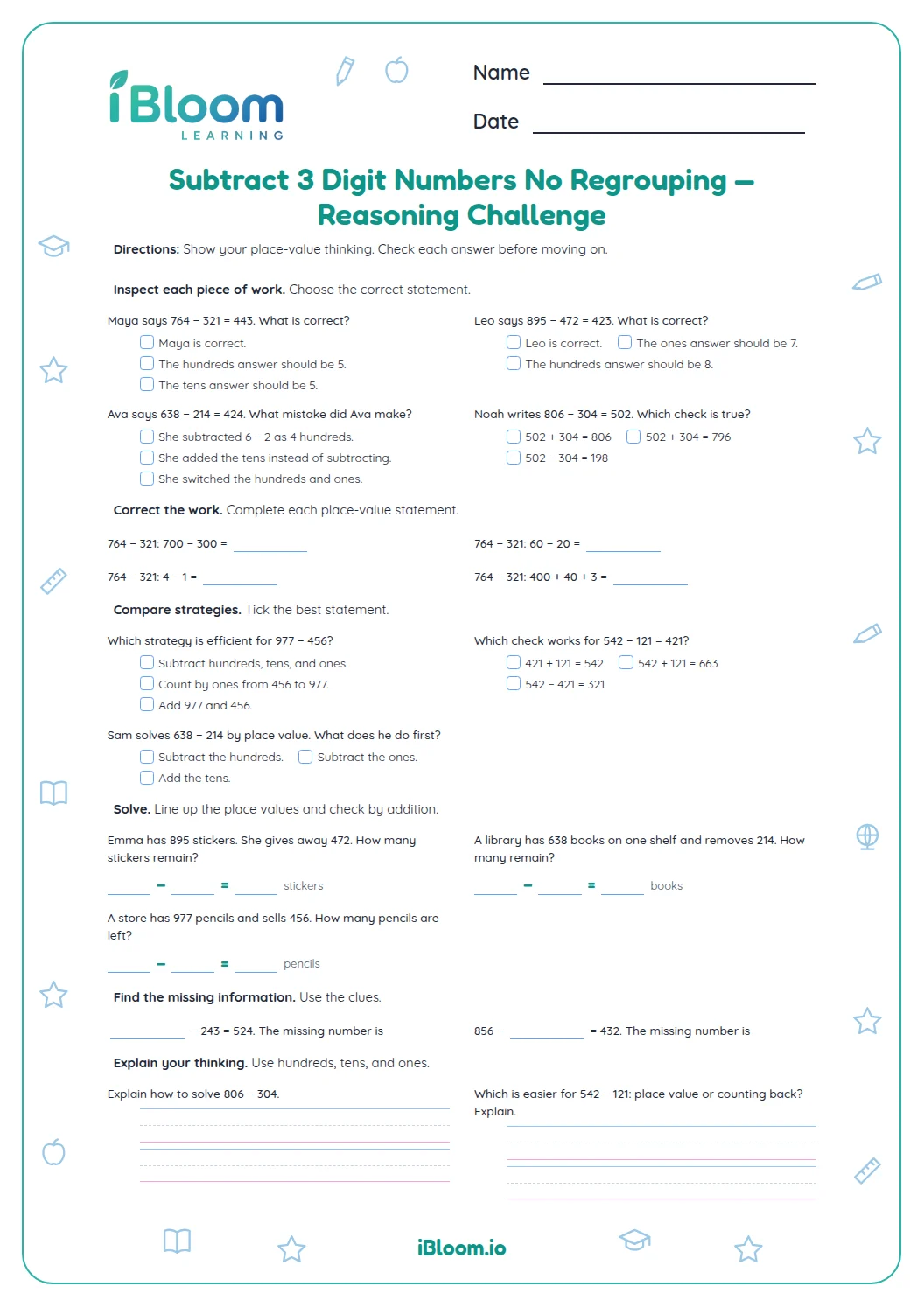
Children begin with base-ten block models and then solve three-digit subtraction equations and short stories. Every problem is chosen so the ones, tens, and hundreds can be subtracted without regrouping. The 16-question page builds from seeing the place values to using subtraction in context. It practices 2.NBT.B.7.
Aligned to 2.NBT.B.7
Subtract each place value
A three-digit number has hundreds, tens, and ones. In 347, the digits mean 3 hundreds, 4 tens, and 7 ones. In 125, they mean 1 hundred, 2 tens, and 5 ones.
Subtract each column: 3 hundreds − 1 hundred = 2 hundreds; 4 tens − 2 tens = 2 tens; and 7 ones − 5 ones = 2 ones. So 347 − 125 = 222. No regrouping is needed because each top digit is at least as large as the digit below it.
- 1347 = 3 hundreds, 4 tens, 7 ones
- 2125 = 1 hundred, 2 tens, 5 ones
- 3222 = 2 hundreds, 2 tens, 2 ones
How to tell regrouping is not needed
Look at each place from right to left. If the top ones digit is at least as large as the bottom ones digit, then check the tens and hundreds. These problems are selected so every column can be subtracted directly.
The base-ten pictures in the first problems make the quantities visible. After those, use the same hundreds-tens-ones structure without a model.
How to use this worksheet
- 1Name the hundreds, tens, and ones in both numbers.
- 2Start with the ones column and subtract the bottom digit from the top digit.
- 3Repeat for tens and hundreds; do not trade a ten or hundred in these problems.
- 4Check by adding the difference to the number subtracted.
Common mistakes and quick fixes
The mistake
Subtracting each top digit from the bottom digit.
The fix
The first number is the starting amount. Subtract the second number from it in each place.
The mistake
Ignoring a place value and writing only the ones difference.
The fix
Record a hundreds digit, a tens digit, and an ones digit in the answer.
The mistake
Leaving out a zero when a place has no tens or no hundreds.
The fix
Keep a digit in every place so the answer still shows hundreds, tens, and ones.
Curriculum alignment
This worksheet focuses on the skill named in its title. The standard below describes the work children practice.
Add and subtract within 1,000 using place value strategies.
On this sheet: Learners subtract within 1,000 using place-value models and equations, with no regrouping required.
Show the official wordingHide the official wording
Add and subtract within 1,000, using concrete models or drawings and strategies based on place value, properties of operations, and/or the relationship between addition and subtraction.
What to practice next
Make more practice
Further reading
Questions parents and teachers ask
What does each digit in a three-digit number represent?
The digits show hundreds, tens, and ones, from left to right. For 347 − 125, the hundreds, tens, and ones can each be subtracted directly. The answer contains a digit for every place in the original numbers. This keeps the written method organized.
How can a learner tell if regrouping is needed?
Compare the digits in each place. If a top digit is smaller than the digit below it, regrouping is needed. This sheet avoids that case. Check each place separately: the top digit must be at least as large as the digit beneath it for this no-regrouping practice set.
How can subtraction be checked?
Add the difference to the number subtracted. The sum should equal the starting number. For example, 347 − 125 gives 222, and 222 + 125 returns to 347. This inverse-operation check works for each subtraction problem. It confirms the starting amount.
Does the worksheet use visual models?
Yes. Base-ten blocks appear in the first three problems before learners continue with equations and stories. The first three questions include base-ten blocks, followed by equations and short stories. The answer key lists the difference for all sixteen items.
Why do the first three questions show base-ten blocks?
The blocks show the hundreds, tens, and ones in each starting number. Students subtract matching place values in the first three problems, then continue with number sentences and stories. The answer key lists all sixteen differences for checking.