


About this worksheet
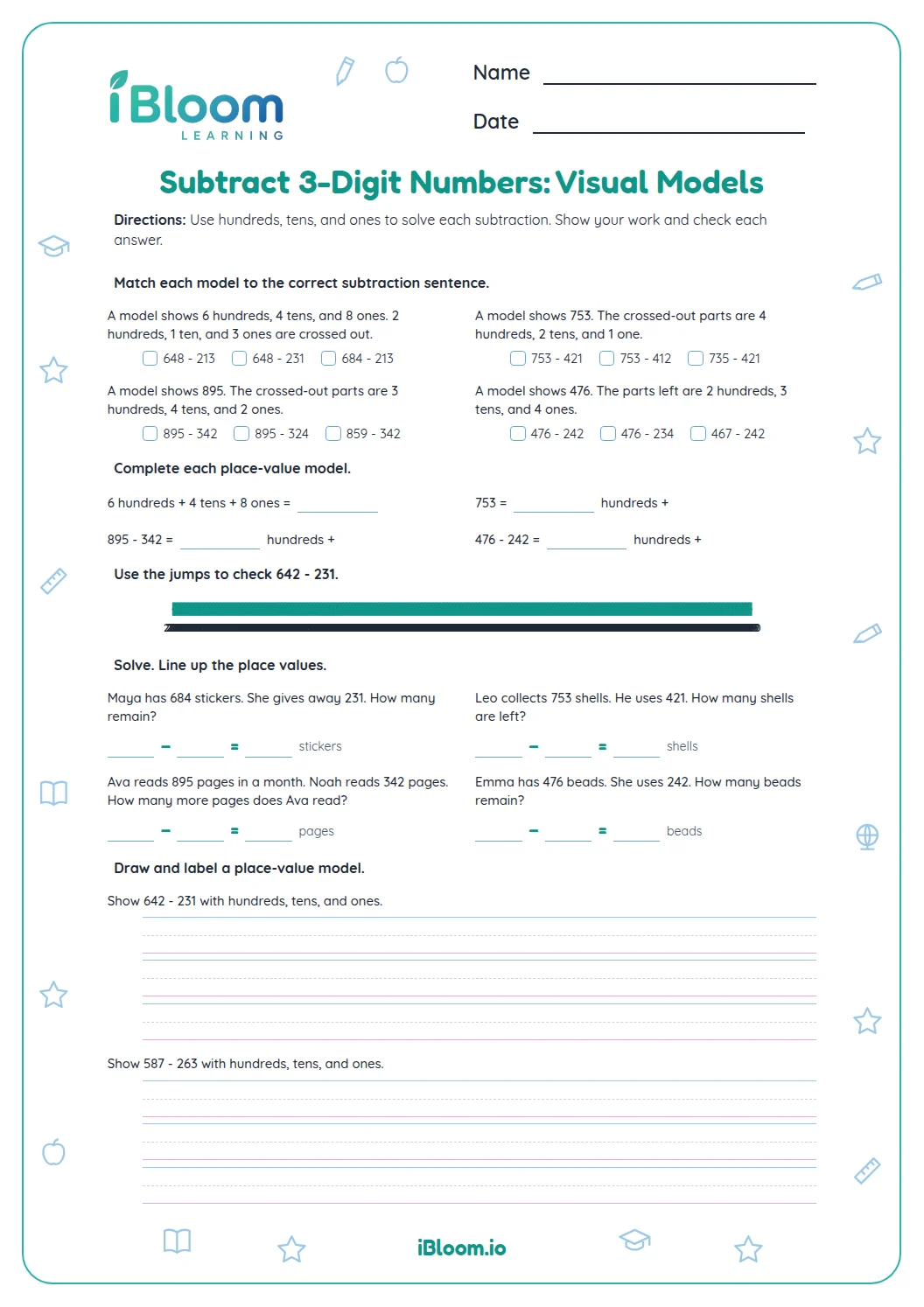
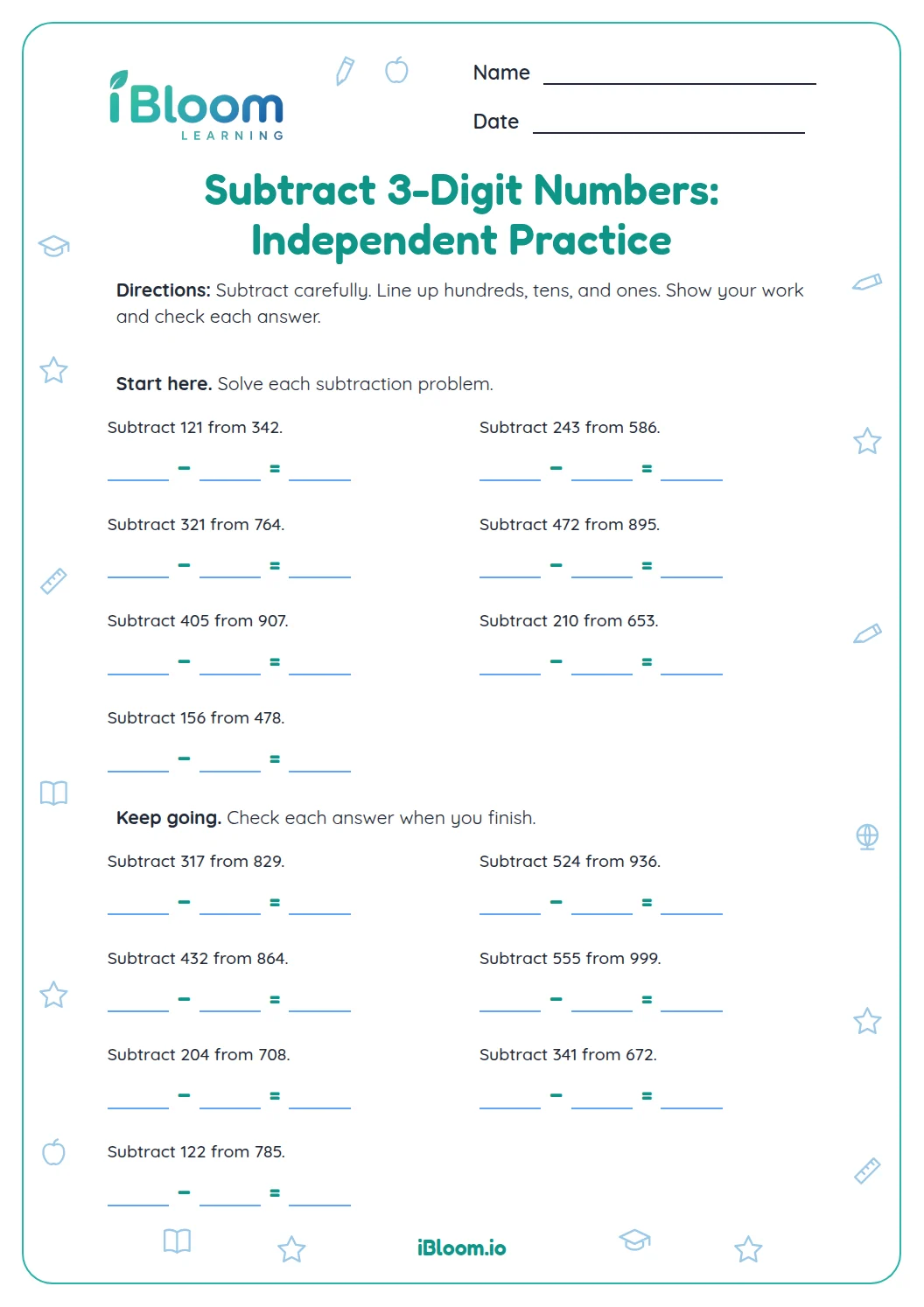
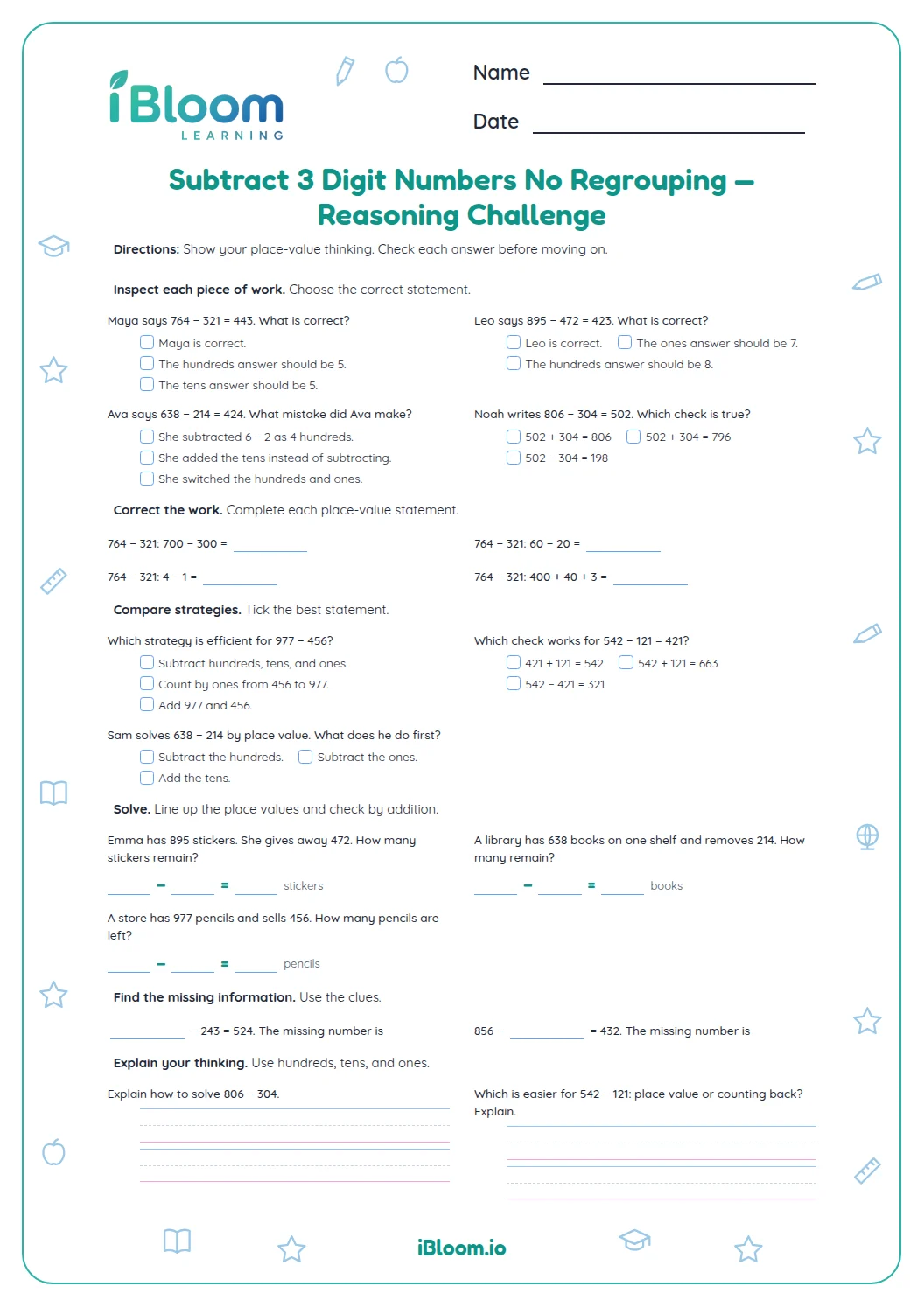
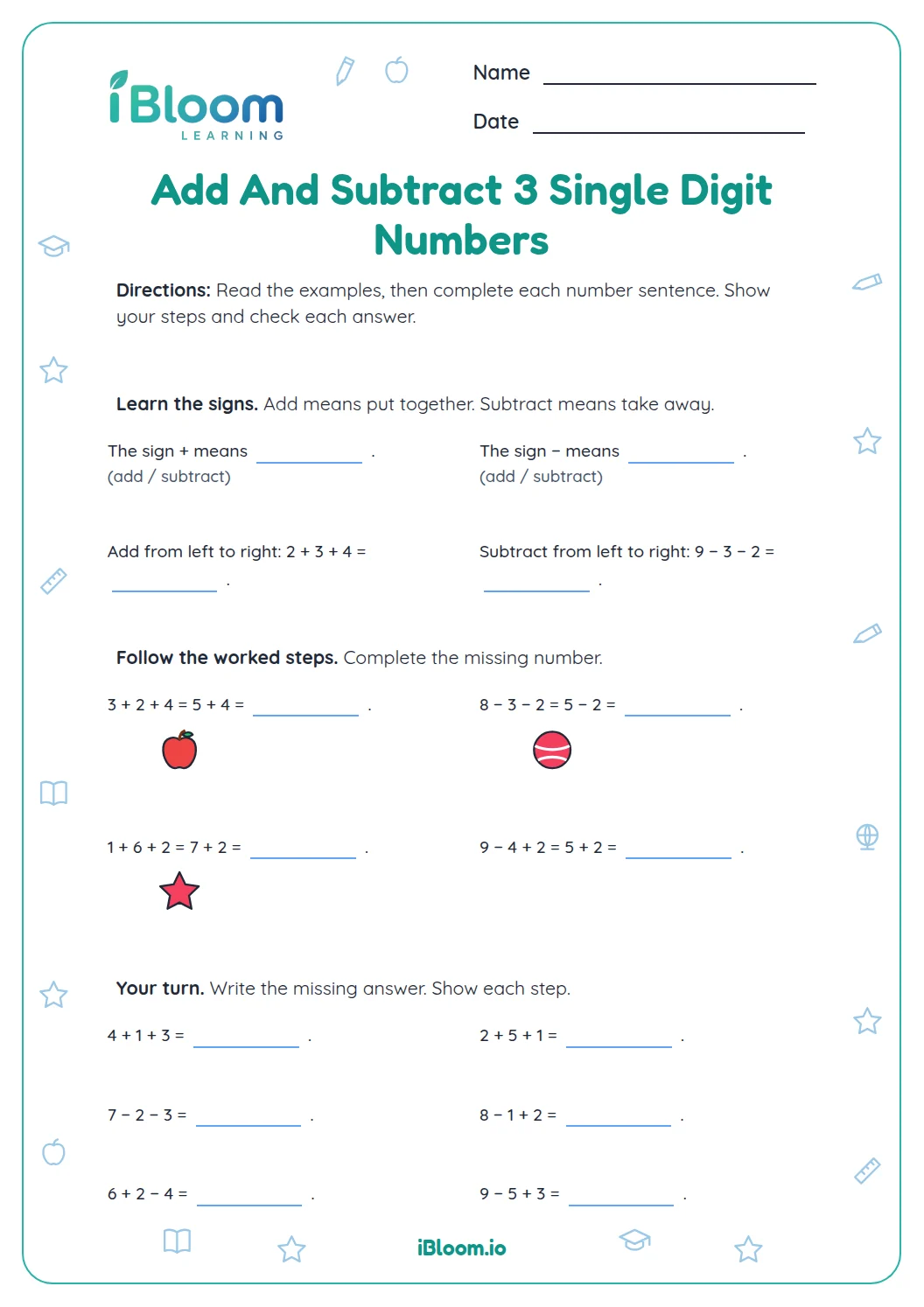
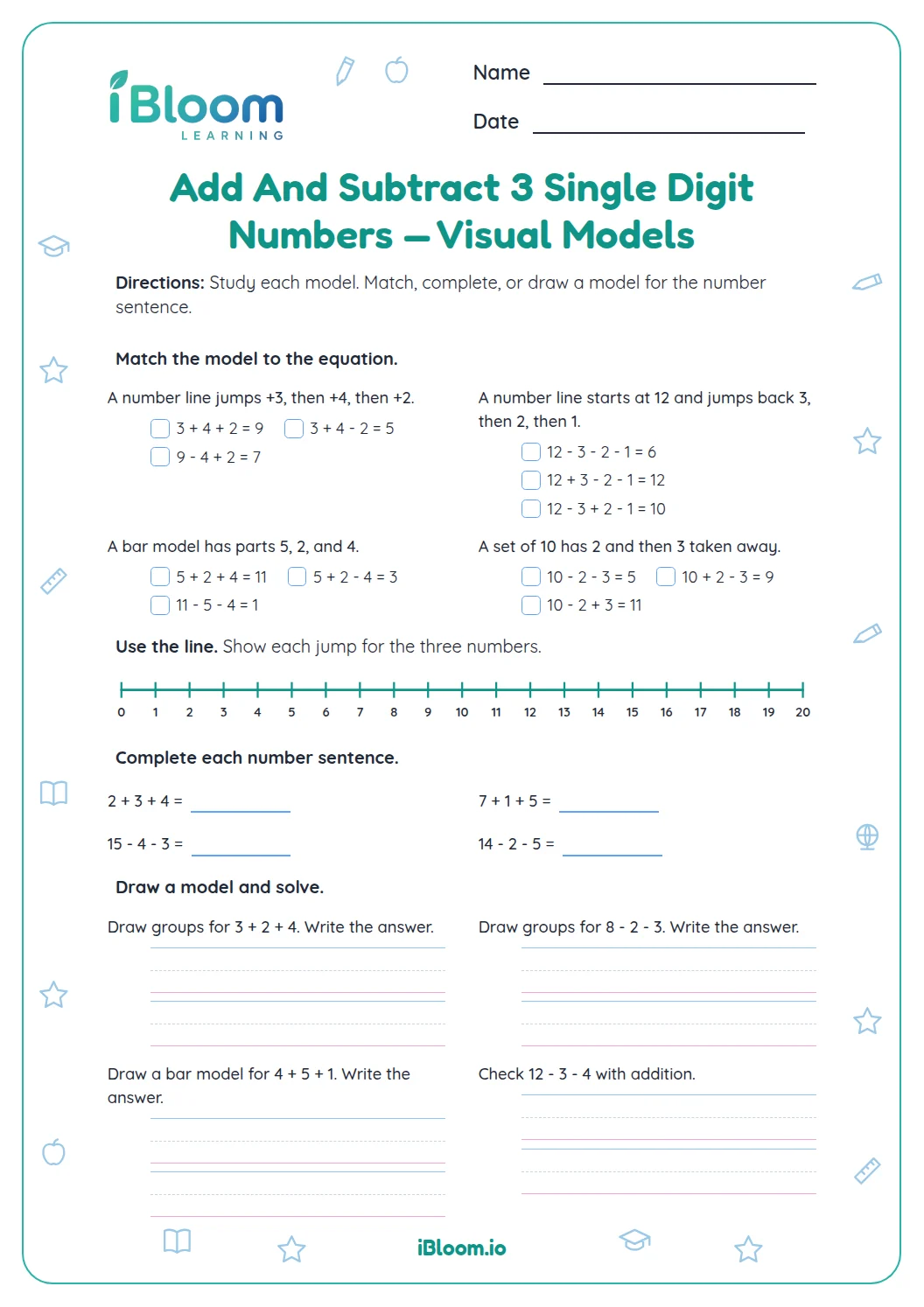
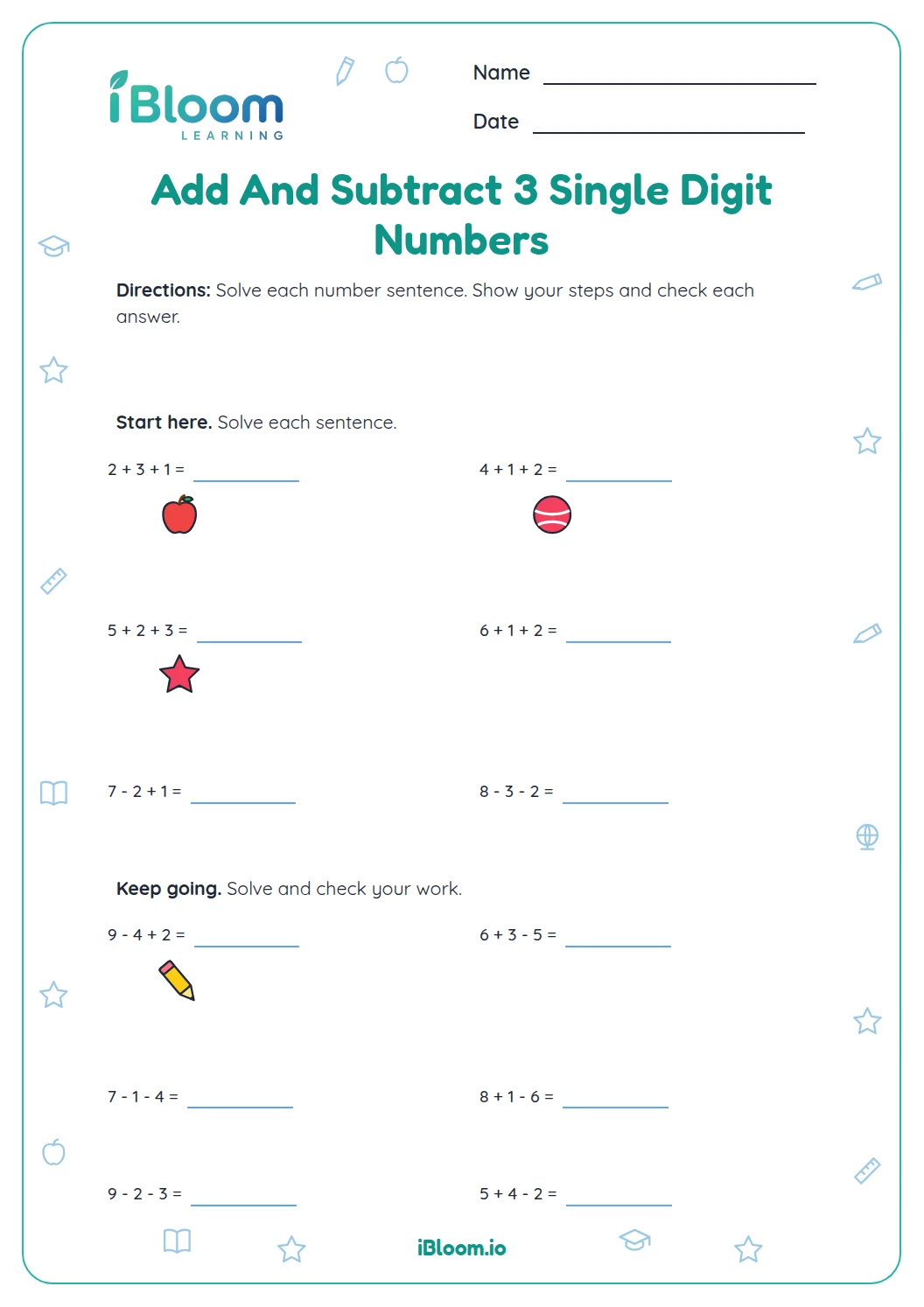
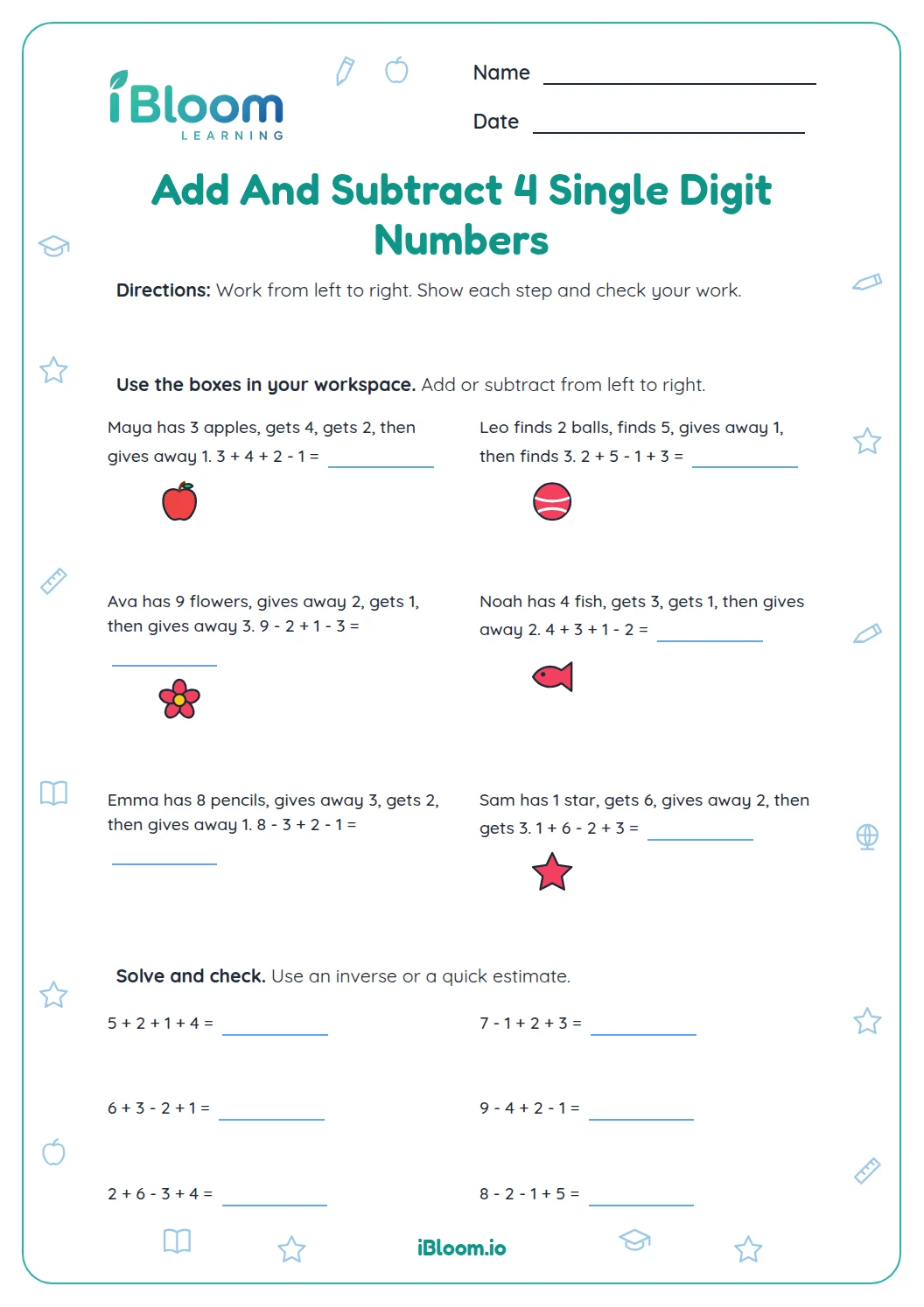
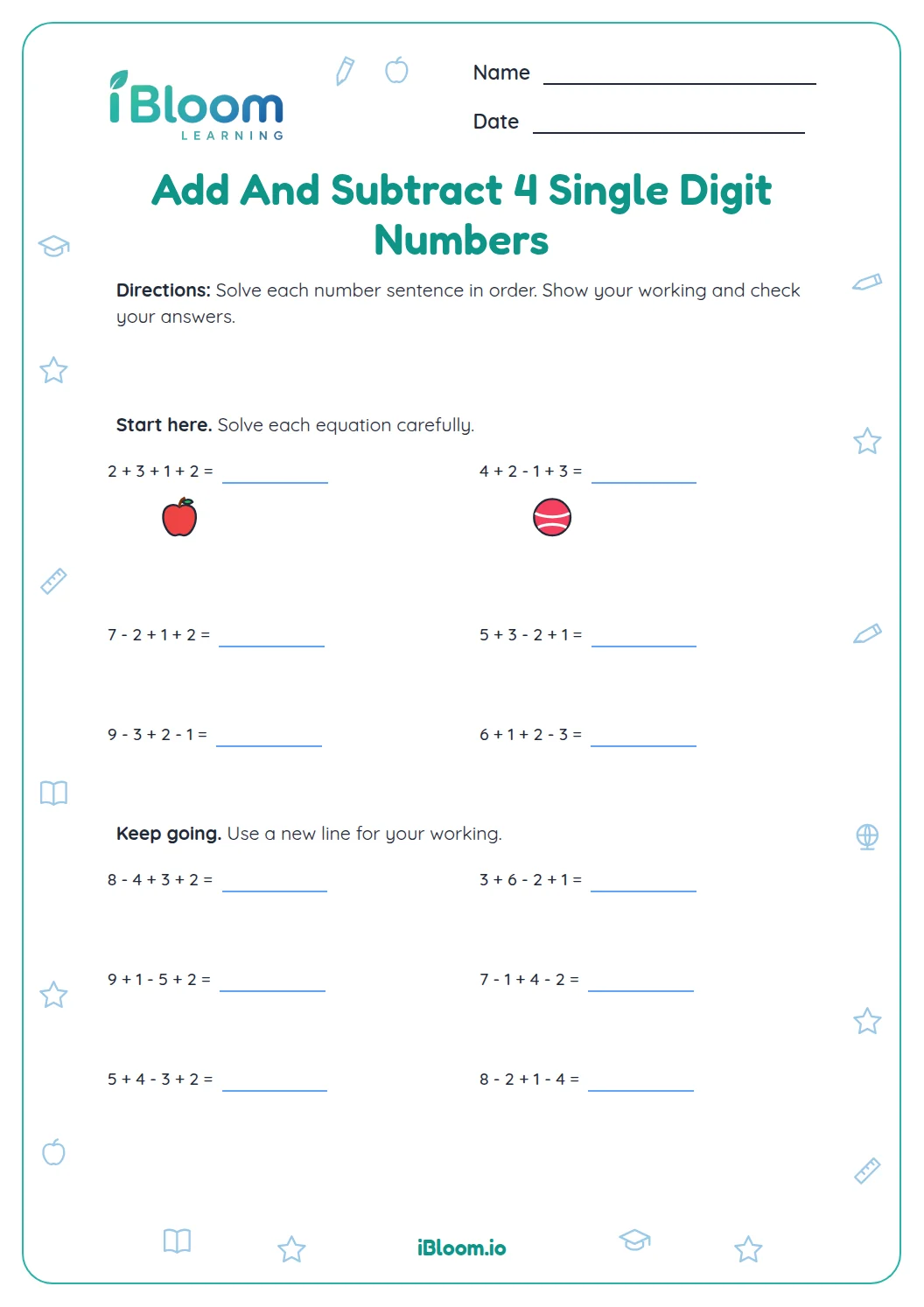
This free printable worksheet is for Grade 2 learners practicing three-digit subtraction without regrouping. It includes 14 questions in 3 parts, with focused directions and a separate answer key for checking.
Aligned to 2.NBT.B.7
How do base-ten blocks show three-digit subtraction?
A flat represents one hundred, a rod represents ten, and a small cube represents one. In 487 − 234, subtract 2 hundreds, 3 tens, and 4 ones from the matching groups. The difference is 253.
- 1487 − 234
- 2400 − 200 = 200; 80 − 30 = 50; 7 − 4 = 3
- 3200 + 50 + 3 = 253
How can place value guide each subtraction?
Keep hundreds with hundreds, tens with tens, and ones with ones. For 684 − 251, subtract each place: 6 − 2 hundreds, 8 − 5 tens, and 4 − 1 ones. The difference is 433.
How can an answer be checked?
Add the difference to the number taken away. For 487 − 234 = 253, check 253 + 234 = 487. In a story, name what the answer counts, such as books left on a cart.
How to use this worksheet
- 1Look at the hundreds, tens, and ones in the minuend.
- 2Subtract the hundreds, tens, and ones in matching places.
- 3Use the base-ten model to count what remains.
- 4For a story, identify the starting amount and the amount removed.
- 5Check by adding the difference and the amount subtracted.
Common slips and how to fix them
The mistake
Subtracting digits from different places, such as tens from hundreds.
The fix
Line up hundreds, tens, and ones before working.
The mistake
Reversing the numbers in a story.
The fix
Ask what amount the story starts with and what amount is removed; subtract removed from starting.
The mistake
Writing a difference without checking it.
The fix
Add the difference to the amount subtracted and see whether it returns to the starting number.
Curriculum alignment
Use place value models and strategies to subtract within 1,000.
On this sheet: Subtract three-digit numbers without regrouping using base-ten blocks, equations, and stories.
Show the official wordingHide the official wording
Add and subtract within 1000, using concrete models or drawings and strategies based on place value, properties of operations, and/or the relationship between addition and subtraction; relate the strategy to a written method. Understand that in adding or subtracting three-digit numbers, one adds or subtracts hundreds and hundreds, tens and tens, ones and ones; and sometimes it is necessary to compose or decompose tens or hundreds.
What to practice next
Make more practice
Further reading
Questions parents and teachers ask
What does “without regrouping” mean?
Each digit in the minuend is large enough to subtract the digit beneath it in the same place. In 487 − 234, subtract 4 hundreds, 3 tens, and 4 ones directly, with no exchange between places. Use the same reasoning on the other questions in this section.
How do place-value blocks help?
The model for 487 shows 4 hundreds, 8 tens, and 7 ones. Taking away 2 hundreds, 3 tens, and 4 ones leaves 2 hundreds, 5 tens, and 3 ones, so the difference is 253. Use the same reasoning on the other questions in this section.
How can a subtraction answer be checked?
Add the difference to the number subtracted. For 487 − 234 = 253, compute 253 + 234 = 487. Returning to the starting amount is evidence that the subtraction is correct. Use the same reasoning on the other questions in this section. Read the final question to identify the number being found.
What do the story problems ask learners to find?
Each story gives a three-digit starting amount and an amount that is moved, packed, given out, or walked. The question asks what remains. The answer should name the matching unit, such as books, apples, or meters. Use the same reasoning on the other questions in this section.
What comes after the guided examples?
The worksheet moves from two modeled subtractions to independent subtraction equations and short stories. The answer key includes the differences and units for the story answers, so learners can check both computation and meaning. Use the same reasoning on the other questions in this section.