


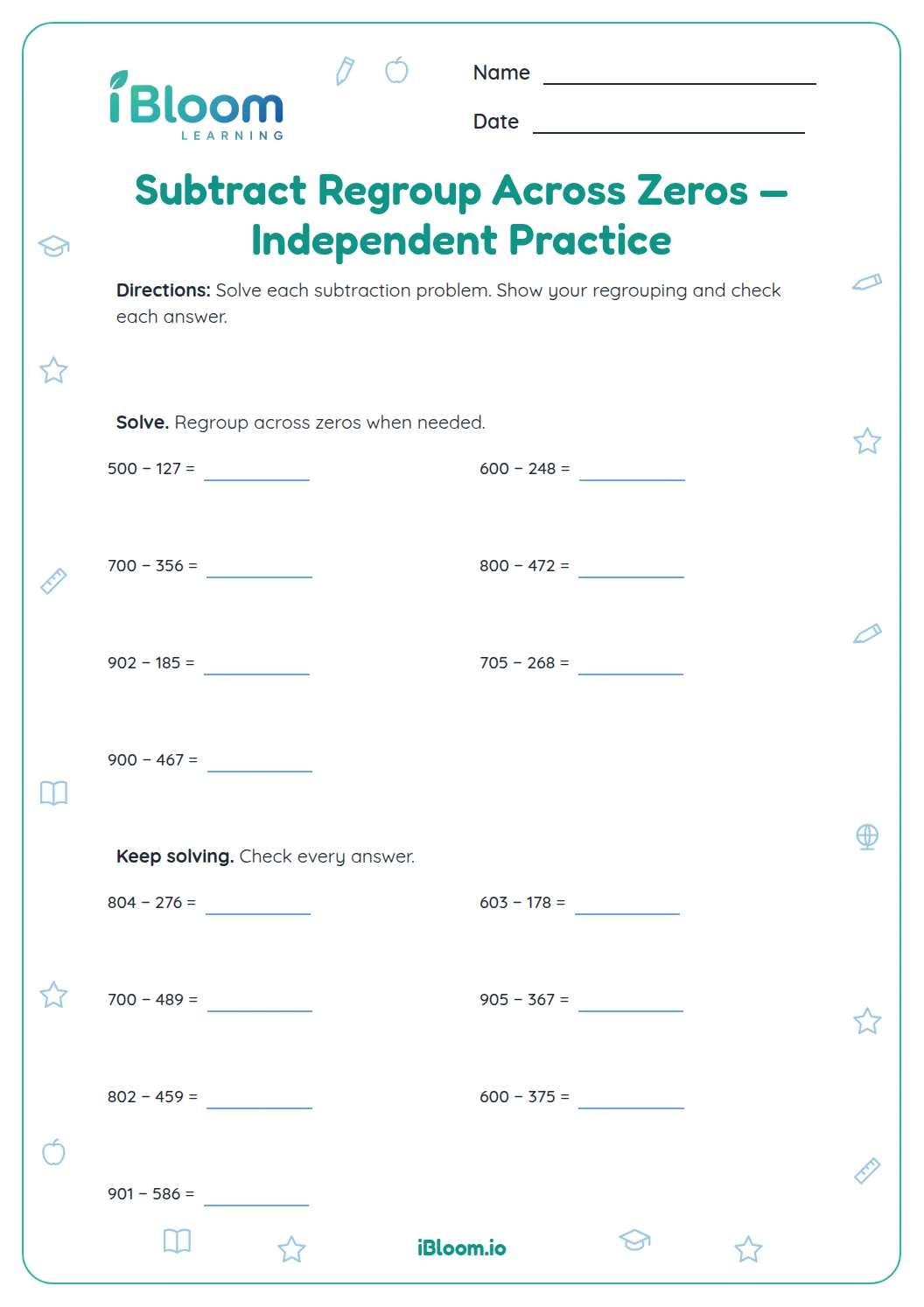
About this worksheet
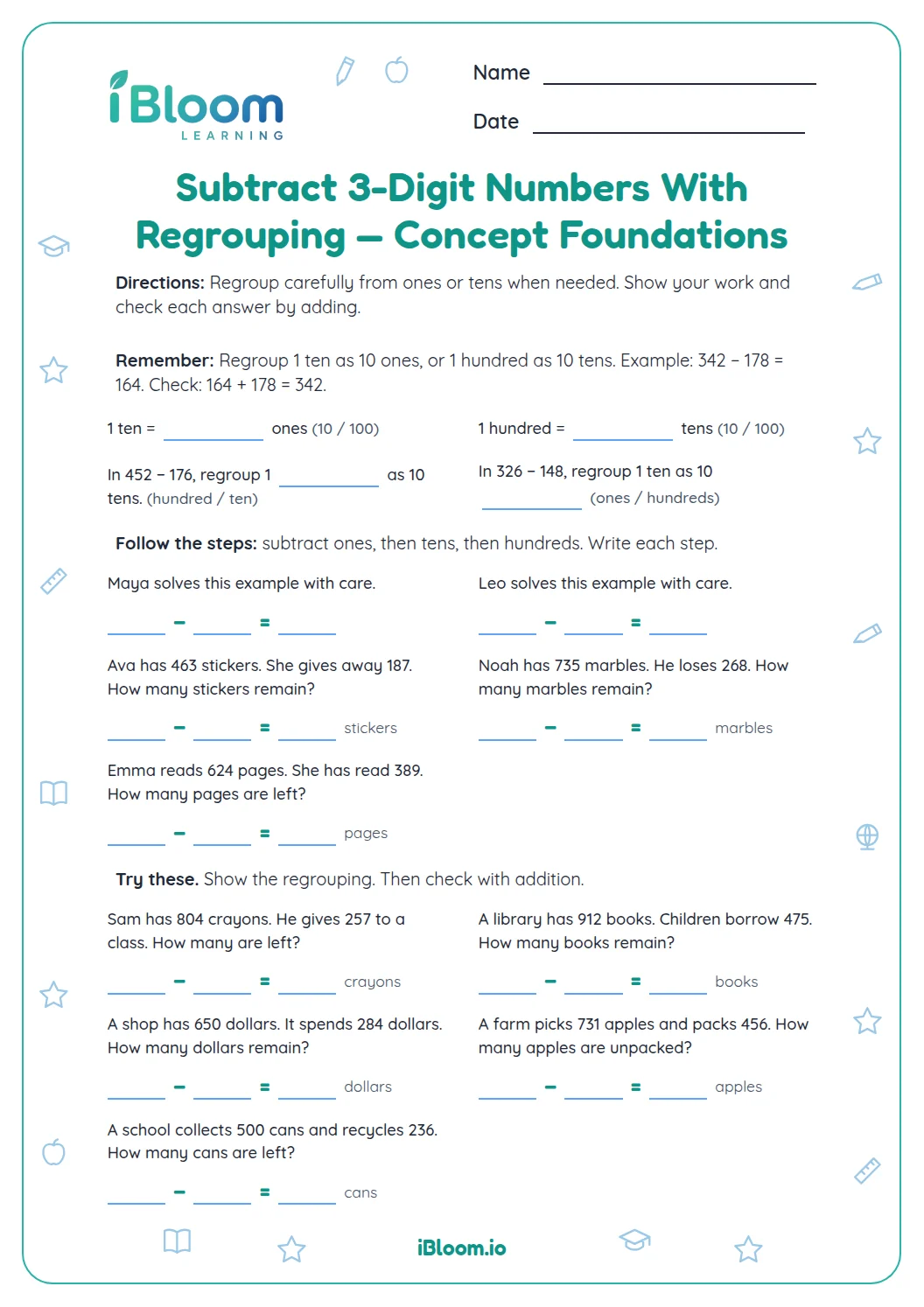
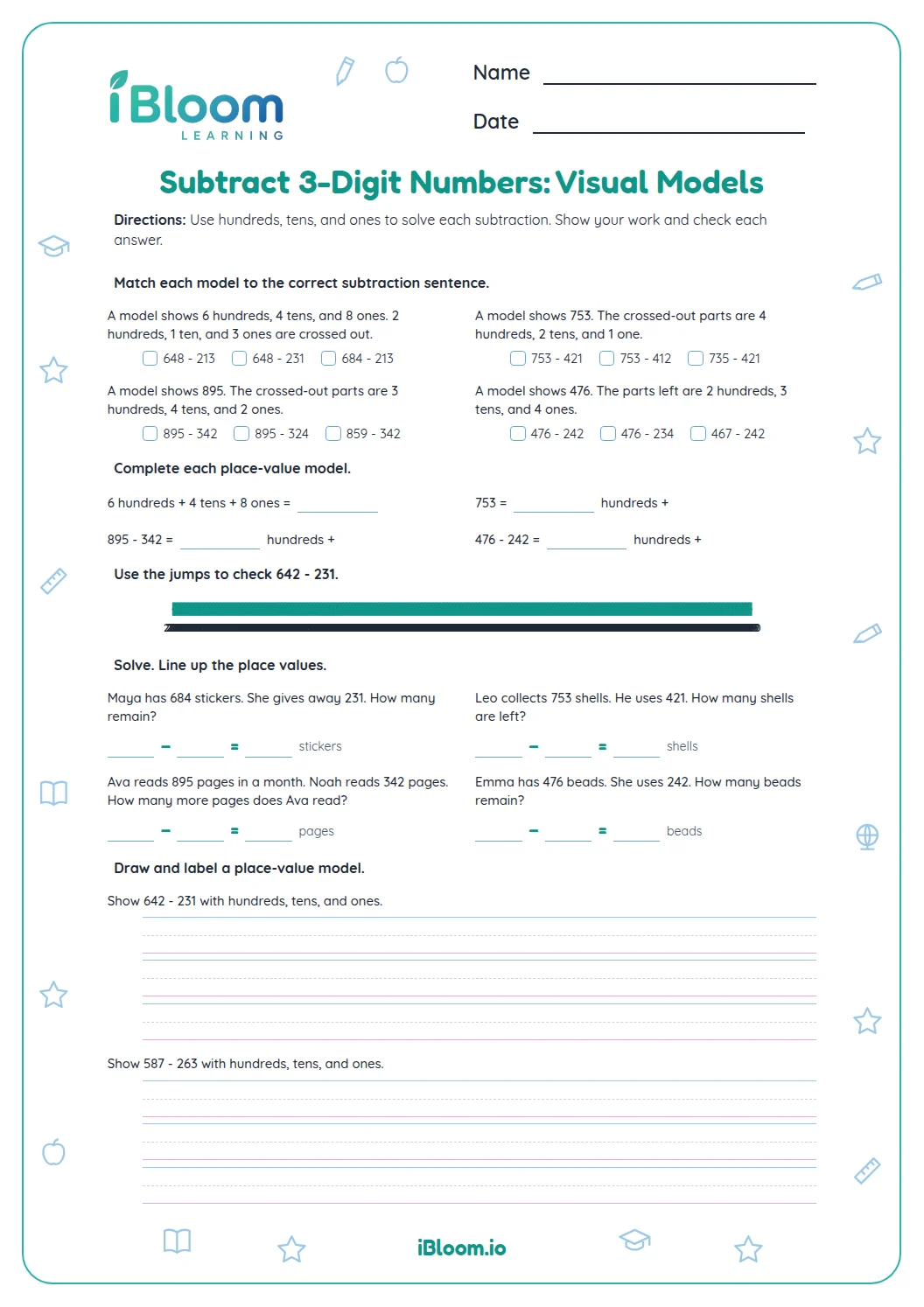
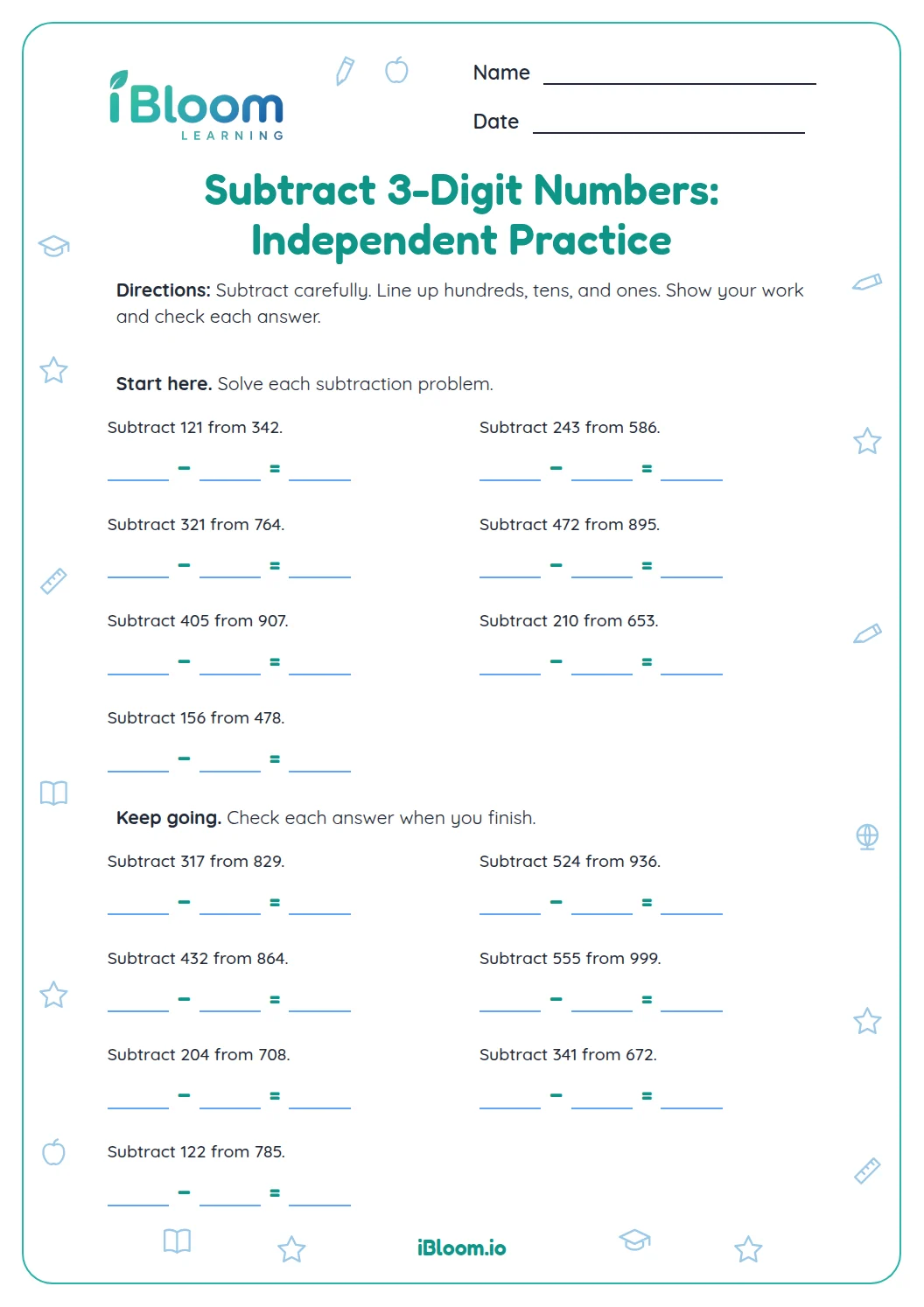
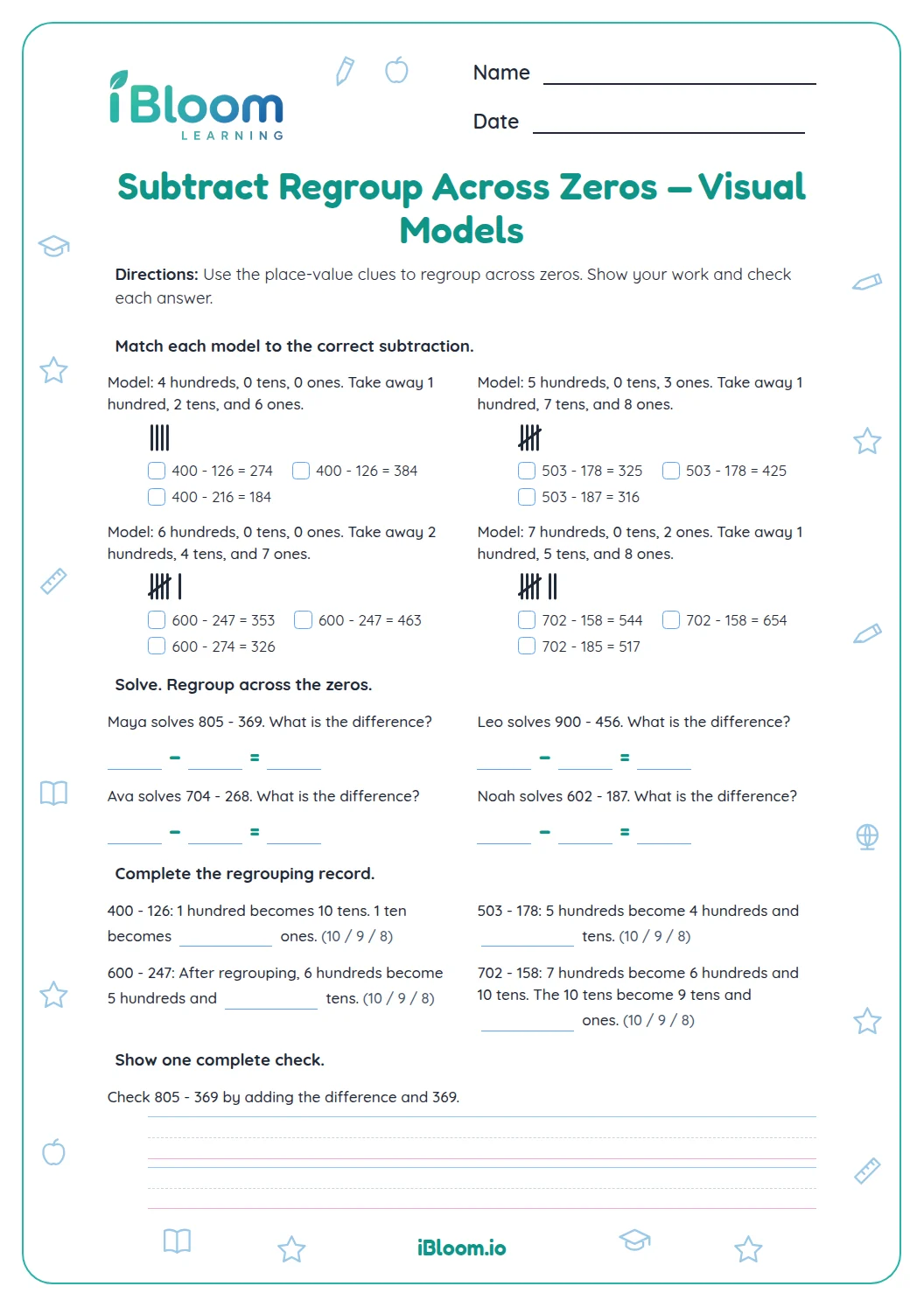
This three-page Grade 2 worksheet builds subtraction with regrouping from clear place-value practice to short word problems. Children subtract three-digit numbers, including examples that regroup across a zero, then represent real situations with a subtraction sentence. The answer key is separate so an adult or student can check each difference.
Aligned to 2.NBT.B.7
When do you regroup?
Regroup when the top digit in a place is smaller than the bottom digit. In 542 − 178, 2 ones cannot subtract 8 ones, so rename 1 ten as 10 ones. Then 12 − 8 = 4.
Next, 3 tens cannot subtract 7 tens, so rename a hundred. The hundreds and tens now show 4 hundreds and 13 tens; finish by subtracting each place. This same place-value method appears throughout the sheet.
- 1542 − 178
- 212 − 8 = 4 ones
- 313 − 7 = 6 tens
- 44 − 1 = 3 hundreds
- 5Answer: 364
How do you regroup across a zero?
In a problem such as 503 − 176, there are no tens to trade directly. First rename 1 hundred as 10 tens, then rename 1 of those tens as 10 ones. The number is still 503, now shown as 4 hundreds, 9 tens and 13 ones.
Keep the value in each place visible as you subtract. The word problems later on use the same computation after the child identifies the starting amount and the amount taken away.
What does the worksheet ask children to do?
The first six problems focus on written subtraction, including regrouping across a zero. The next eight give a short situation and ask for the amount remaining or the missing part.
How to use this worksheet
- 1Line up the ones, tens and hundreds.
- 2Start in the ones place and regroup only when needed.
- 3For a zero in the tens place, trade a hundred for ten tens first.
- 4Write a subtraction sentence for each story.
- 5Add the difference to the number taken away to check.
Common mistakes and quick fixes
Common Core alignment
This sheet practices Grade 2 place-value subtraction within 1,000.
Subtract within 1,000 by place value, regrouping when needed, and relate the strategy to a written method.
On this sheet: The computation and story problems subtract three-digit numbers within 1,000, including decomposing tens and hundreds.
Show the official wordingHide the official wording
Add and subtract within 1000, using concrete models or drawings and strategies based on place value, properties of operations, and/or the relationship between addition and subtraction; relate the strategy to a written method. Understand that in adding or subtracting three-digit numbers, one adds or subtracts hundreds and hundreds, tens and tens, ones and ones; and sometimes it is necessary to compose or decompose tens or hundreds.
What to practice next
Make more practice
Further reading
Questions parents and teachers ask
What does regrouping mean in subtraction?
Regrouping renames a number without changing its value. For example, 1 ten can become 10 ones, which lets a child subtract when the ones digit on top is too small. This worksheet practices regrouping in the ones and tens places, including a problem that crosses a zero.
How should a child check a subtraction answer?
Add the difference to the number that was subtracted. For example, if 542 − 178 = 364, then 364 + 178 should equal 542. The check works for the short computation items and for the word problems after the child writes a subtraction sentence.
Why does 503 − 176 need two trades?
There are 3 ones, so a ten is needed, but there are no tens to trade. First rename 5 hundreds as 4 hundreds and 10 tens. Then trade one ten for 10 ones, leaving 4 hundreds, 9 tens and 13 ones to subtract.
How many problems are on the pages?
There are 14 problems: six written subtraction problems followed by eight short word problems. The answer key is separate and gives a difference for each item. Children can show their regrouping on the computation problems and write a subtraction sentence for each story.
What should I do if my child misses a word problem?
Ask your child to name the starting amount and what changed. Then write those numbers in a subtraction sentence before calculating. For example, “753 stickers and gives away 268” becomes 753 − 268. This separates understanding the story from carrying out the regrouping.