



About this worksheet
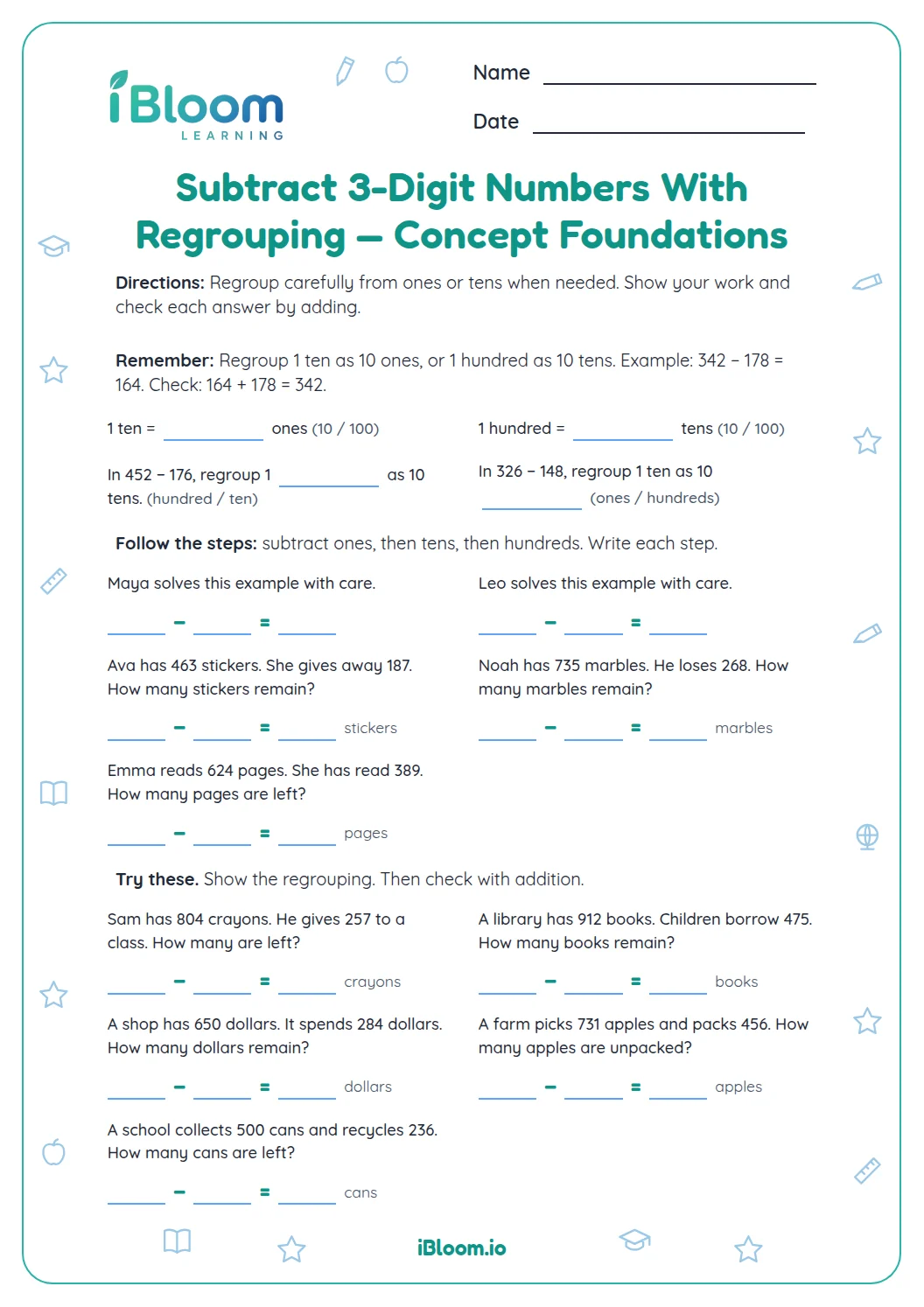
This Grade 2 worksheet gives students 15 problems subtracting three-digit numbers within 1,000. They solve number sentences, apply subtraction to two short stories, and correct a regrouping error. The separate answer key includes the results and a sample explanation. The page practices place-value strategies and the relationship between addition and subtraction in Common Core standard 2.NBT.B.7.
Aligned to 2.NBT.B.7
How does regrouping change the places?
Trade one hundred for ten tens or one ten for ten ones when a place does not have enough to subtract. In 624 − 278, the ones need a ten, and the tens need a hundred.
- 1624 − 278
- 2Regroup: 6 hundreds → 5 hundreds, 12 tens
- 3Then 11 tens and 14 ones
- 4Difference: 346; check 346 + 278 = 624
How can addition check a difference?
Add the difference to the number subtracted. If the sum equals the starting number, the subtraction is consistent.
How to use this worksheet
- 1Line up hundreds, tens, and ones in your mind or on the page.
- 2Start with the ones and regroup when there are too few.
- 3Continue through the tens and hundreds.
- 4For a story, identify the starting amount and what is taken away.
- 5Add the difference to the amount subtracted to check.
Common mistakes and quick fixes
The mistake
Subtracting the smaller ones digit from the larger one.
The fix
Regroup a ten so the ones place has enough to subtract.
The mistake
Forgetting a zero can require regrouping across places.
The fix
Trade a hundred into ten tens, then trade a ten into ten ones if needed.
The mistake
Checking by adding the difference to the wrong number.
The fix
Add the difference to the amount taken away; the sum should match the start.
Curriculum alignment
This worksheet practices 2.NBT.B.7.
Apply subtract 3 digit numbers with regrouping in the questions on this sheet.
On this sheet: The questions directly practice subtract 3 digit numbers with regrouping.
Show the official wordingHide the official wording
Add and subtract within 1000, using concrete models or drawings and strategies based on place value, properties of operations, and/or the relationship between addition and subtraction; relate the strategy to a written method.
What to practice next
Make more practice
Further reading
Questions parents and teachers ask
How many problems are included?
There are 15 problems: 12 subtraction number sentences, two story problems, and one question about correcting an error. Each uses three-digit numbers within 1,000. The separate key lists the differences and gives a sample explanation for the regrouping question.
What does regrouping mean in subtraction?
Regrouping trades a unit in one place for ten units in the place to its right. For example, one hundred can be renamed as ten tens, and one ten as ten ones. This gives enough units to subtract when a place has too few.
How can a student check a subtraction answer?
Add the difference to the amount that was subtracted. The total should equal the starting number. For 624 − 278 = 346, adding 346 + 278 gives 624, which checks the result. It verifies both the subtraction and the place-value regrouping.
Does the worksheet include subtraction stories?
Yes. Two questions ask students to find how many items remain after some are taken away. Students identify the starting amount and the amount removed, subtract, and include the item name in the answer. Students can check the difference by adding it to the amount removed.
What is the final reasoning question?
The final item gives an incorrect result for 503 − 268 and asks students to correct it and name a regrouping step. The correct difference is 235. A valid explanation can mention trading a hundred for ten tens before regrouping a ten into ones.