




About this worksheet
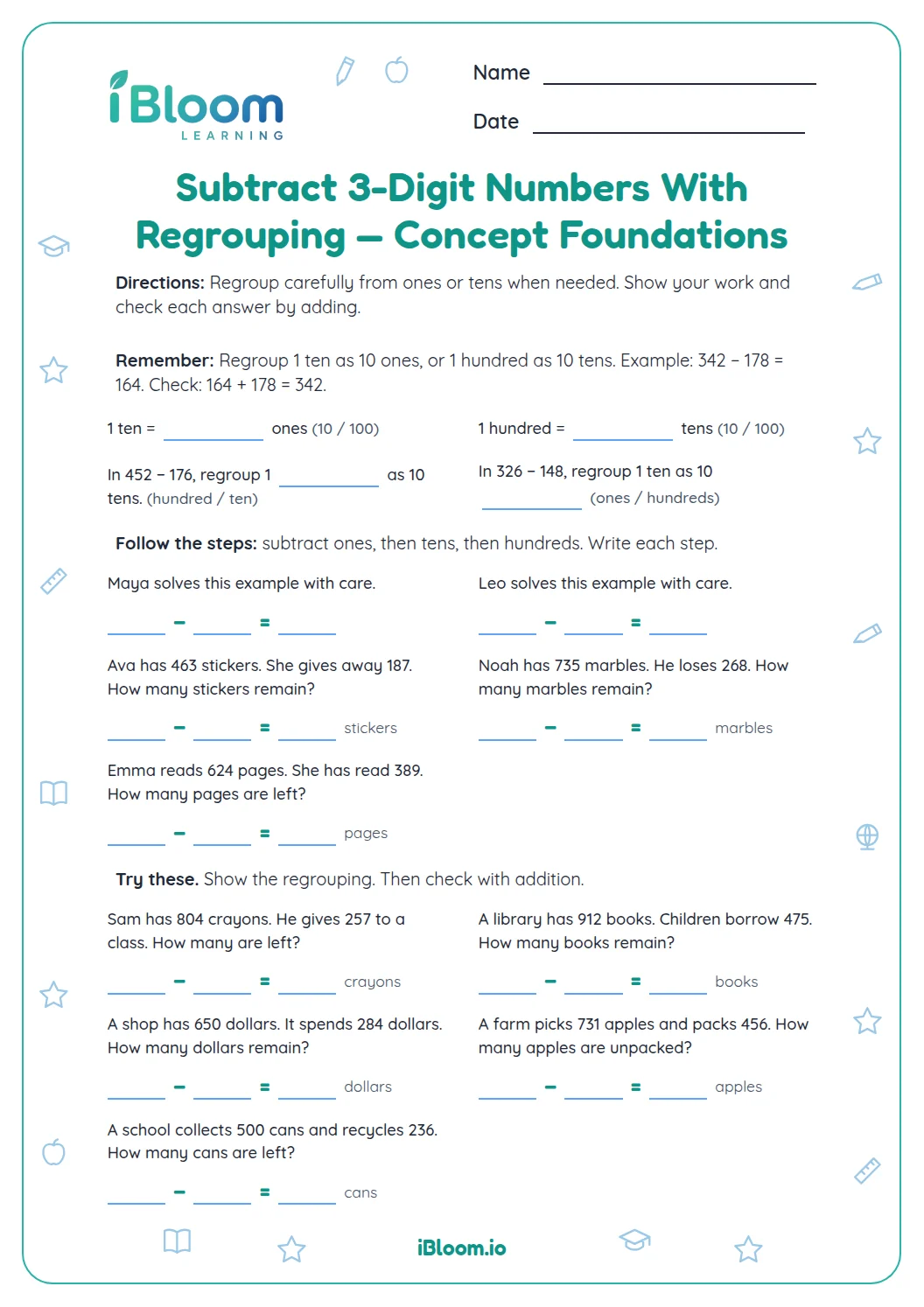
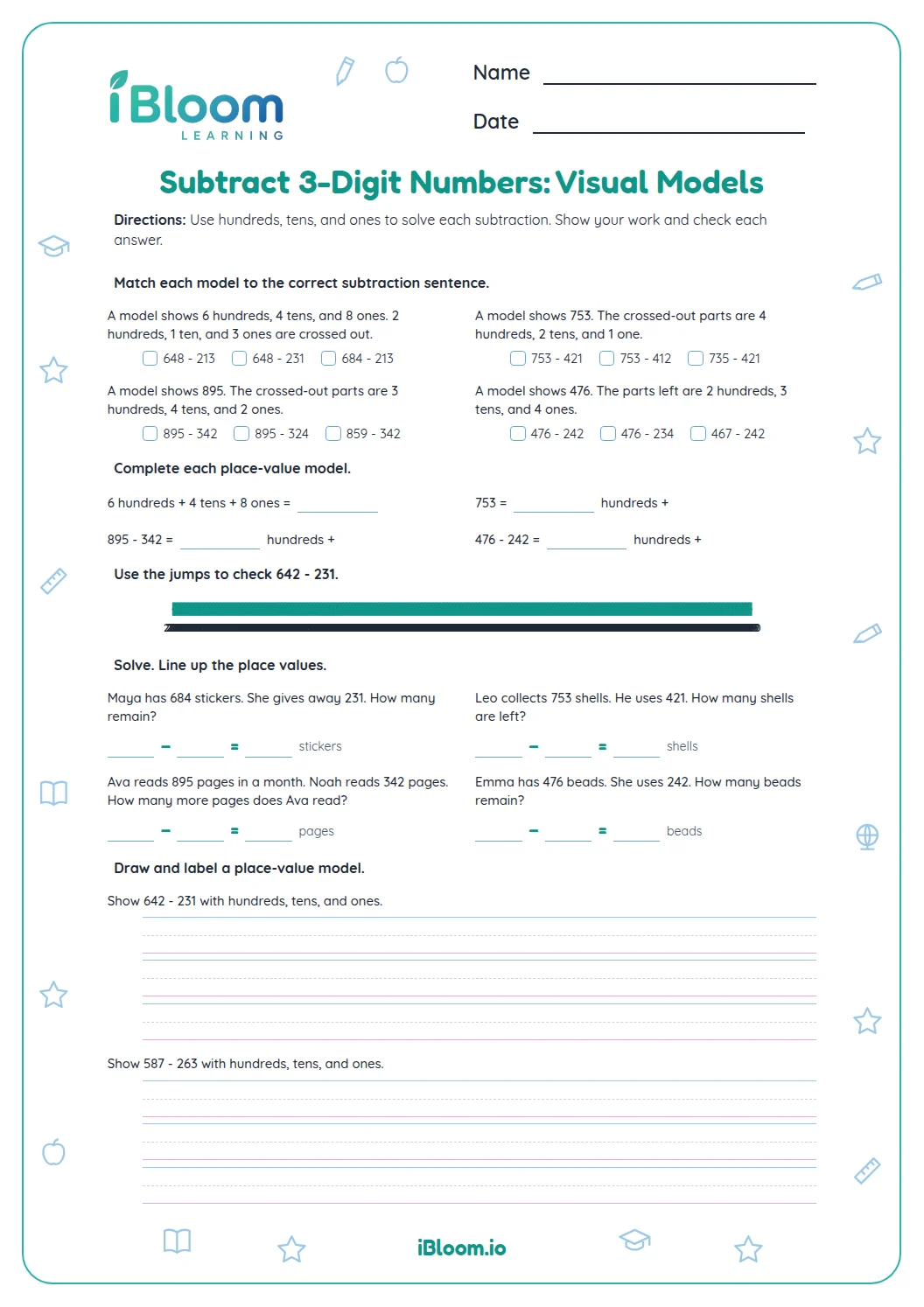
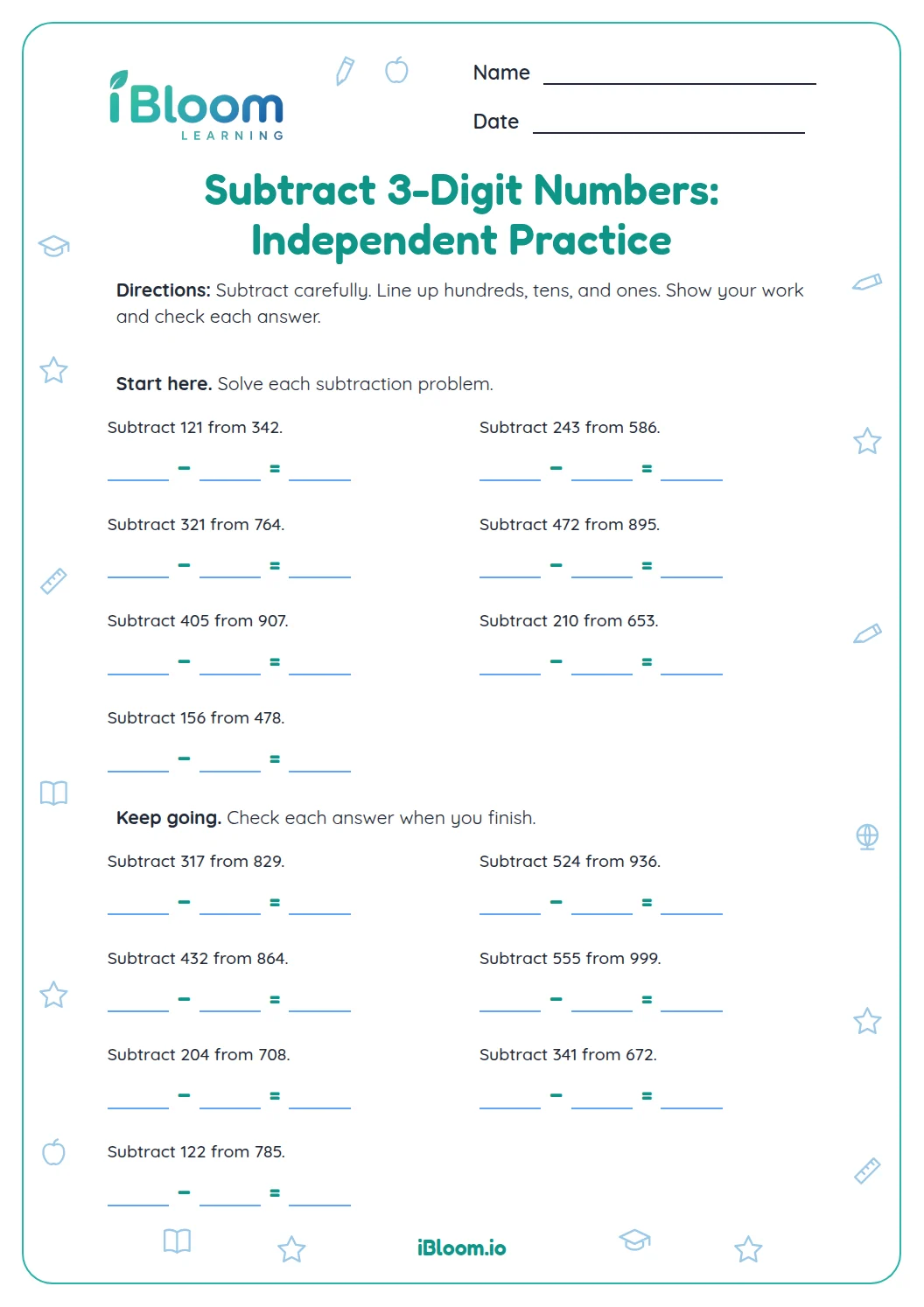
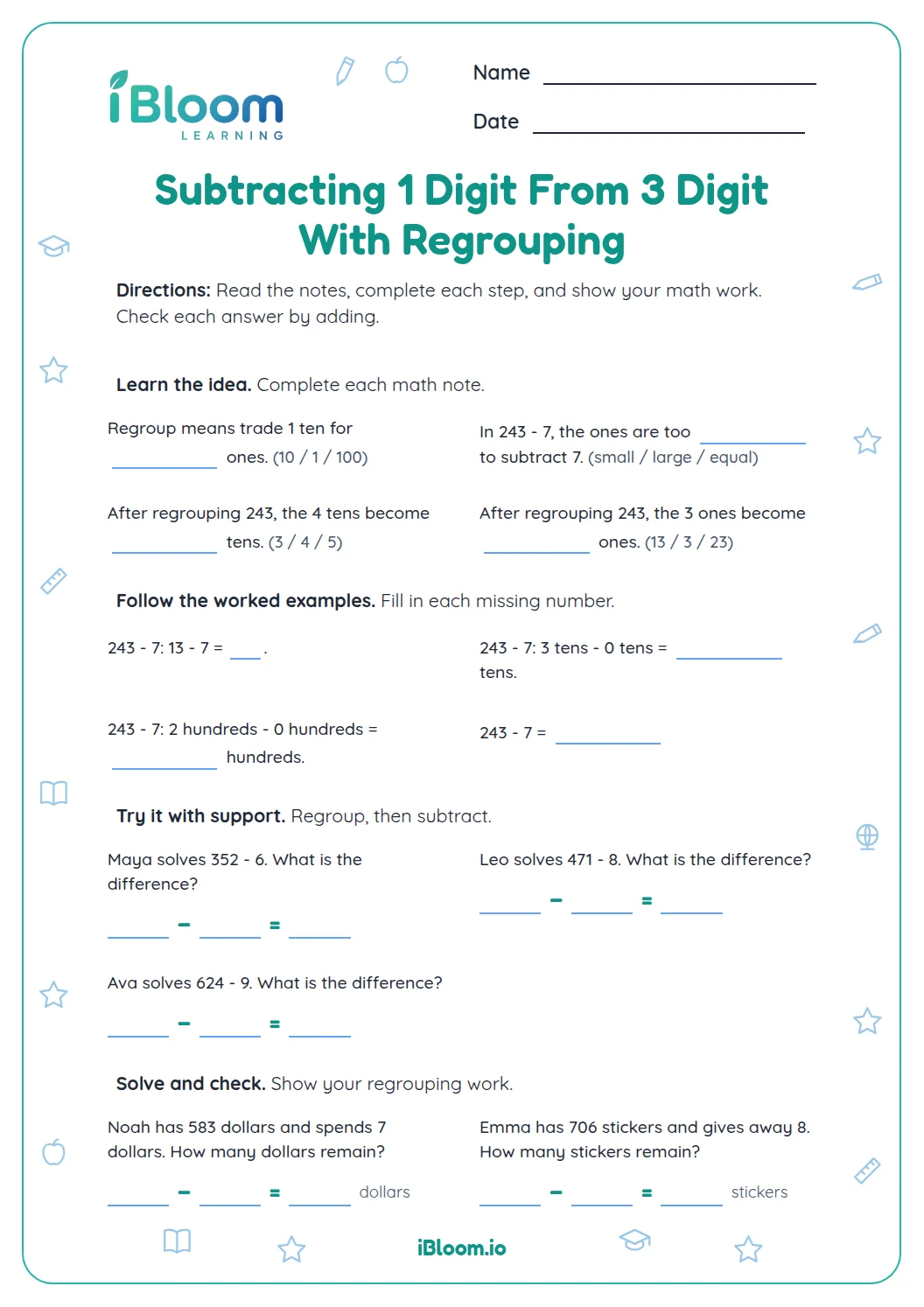
This free printable Grade 2 worksheet gives children real-world stories that need subtraction with regrouping within 1000. The stories use things a child can picture, such as library books, farm-stand apples and bottle caps. Children first pick the number sentence that fits a story, then solve four stories with room to show their regrouping, and finally choose the correct answer where another child made a slip. It practices Common Core 2.NBT.B.7, and every subtraction on the sheet needs at least one regroup. A separate answer key is included.
Aligned to 2.NBT.B.7
How do children turn a story into a subtraction sentence?
Words like gives away, sells, checked out and are left signal that a group is getting smaller. The starting amount comes first, and the amount taken away comes second, so Maya's 524 stickers and 178 given away becomes 524 − 178.
Part A asks children to choose that sentence before doing any math. A wrong choice, like 524 + 178 or 178 − 524, shows the child has the numbers but not yet the picture of what happened in the story.
What does regrouping look like in a story problem?
Take question 4, where the school library has 432 books and 175 are checked out. The ones place cannot give 5 from 2, so one ten becomes 10 ones. That makes 12 ones, and 12 − 5 = 7. The tens place now has 2 tens, which cannot give 7, so one hundred becomes 10 tens. That makes 12 tens, and 12 − 7 = 5. The hundreds place has 3 hundreds left, and 3 − 1 = 2. The answer is 257 books.
- 1432 − 175 = ?
- 2Ones: 2 − 5 needs more, so regroup 1 ten: 12 − 5 = 7
- 3Tens: 3 tens became 2, so 2 − 7 needs more: regroup 1 hundred: 12 − 7 = 5
- 4Hundreds: 4 hundreds became 3, so 3 − 1 = 2
- 5Answer: 257 books
What is on this worksheet?
Nine questions over two pages, in three parts that grow harder. The stories use items from home, school and community, and every subtraction needs regrouping.
- Part A, Pick the sentence: three stories, where children choose the matching number sentence from three choices
- Part B, Solve the story: four stories with working space and an answer box
- Part C, Find the mistake: two wrong answers, 541 − 276 = 335 and 703 − 286 = 583, with the right answer to choose
- Answer key on a separate page
Why is 703 − 286 hard?
The tens digit in 703 is zero, so there are no tens to regroup. Children have to take from the hundreds first: 7 hundreds become 6 hundreds and 10 tens, then one of those tens becomes 10 ones, leaving 9 tens. Now 13 − 6 = 7, 9 − 8 = 1 and 6 − 2 = 4.
Jay's answer of 583 comes from a different slip: taking the smaller digit from the larger one in each place (6 − 3, 8 − 0, 7 − 2). The choice 427 is what you get by forgetting that the 10 tens drop to 9. Question 6, 603 − 258, uses the same across-zero step in a story.
How to use this worksheet at home or in class
- 1Warm up with a quick problem using coins or base-ten blocks: 32 − 15. Trade one ten for ten ones and take away.
- 2Read the first story aloud. Ask: "Is the group getting bigger or smaller?" and then pick the number sentence in Part A.
- 3Do question 4 together, saying each regrouping step out loud: "I need more ones, so I trade a ten."
- 4Let your child finish the other stories alone, writing the regrouped numbers above each digit.
- 5Have your child check each answer by adding it to the amount taken away. The sum should equal the starting number.
- 6Use the answer key to mark the sheet. For a miss, redo the question with the regrouping written out.
Common mistakes and quick fixes
The mistake
Subtracting the smaller digit from the larger in each place, so 541 − 276 becomes 335.
The fix
Remind your child that the top number stays on top. If the top digit is too small, regroup from the place to its left. Here, 11 − 6 = 5 in the ones, not 6 − 1.
The mistake
Regrouping a ten for the ones but forgetting to lower the tens digit, so 524 − 178 comes out as 356 instead of 346.
The fix
After each regroup, cross out the old digit and write the new one above it. The 2 tens become 1 ten, and 11 − 7 = 4.
The mistake
Adding instead of subtracting because the story has two numbers.
The fix
Ask whether the group is getting bigger or smaller. Words like sold, gave away and left mean subtract.
Common Core alignment
Most US states use the Common Core standards or a close state version. This sheet practices the Grade 2 standard below.
Subtract within 1000 and regroup tens or hundreds when needed.
On this sheet: Every question subtracts two 3-digit numbers and needs a regroup.
Show the official wordingHide the official wording
Add and subtract within 1000, using concrete models or drawings and strategies based on place value, properties of operations, and/or the relationship between addition and subtraction; relate the strategy to a written method. Understand that in adding or subtracting three-digit numbers, one adds or subtracts hundreds and hundreds, tens and tens, ones and ones; and sometimes it is necessary to compose or decompose tens or hundreds.
What to practice next
Make more practice
Further reading
Questions parents and teachers ask
What should my child know before this worksheet?
Your child should know place value for hundreds, tens and ones, and should be able to subtract 3-digit numbers when no regrouping is needed. Knowing that one ten is ten ones, and one hundred is ten tens, makes regrouping make sense. Base-ten blocks or drawings help if trading is new.
What is the answer to question 4?
The answer is 257. The library had 432 books and 175 were checked out, so 432 − 175 = 257. Regroup a ten to get 12 ones, then a hundred to get 12 tens. Subtract each place: 12 − 5 = 7, 12 − 7 = 5, and 3 − 1 = 2.
Why does the sheet ask children to pick the number sentence first?
Choosing the sentence makes children decide what the story is asking before they start to subtract. The wrong choices in Part A add the two numbers or put the smaller number first, so a wrong pick tells you whether your child misread the story or simply mixed up the order of the numbers.
How can children check a subtraction answer?
They add the answer to the number that was taken away. If the sum matches the starting number, the answer is right. For question 5, 645 − 278 = 367, and 367 + 278 = 645. This addition check is a quick habit to build on every Part B story before looking at the key.
What should I do if my child gets 583 for question 9?
Ask your child to look at the tens place of 703. There are zero tens, so you cannot take 8 from it, and the 7 hundreds must give up one hundred first. Redo the problem with blocks or a drawing. The correct answer to 703 − 286 is 417.
Is there an answer key for this worksheet?
Yes. A separate answer key shows the answers to all nine questions: the matching number sentence in Part A, each story answer with its unit in Part B, and the correct choice in Part C. Print the worksheet pages on their own and keep the key for checking once your child has finished.