

About this worksheet
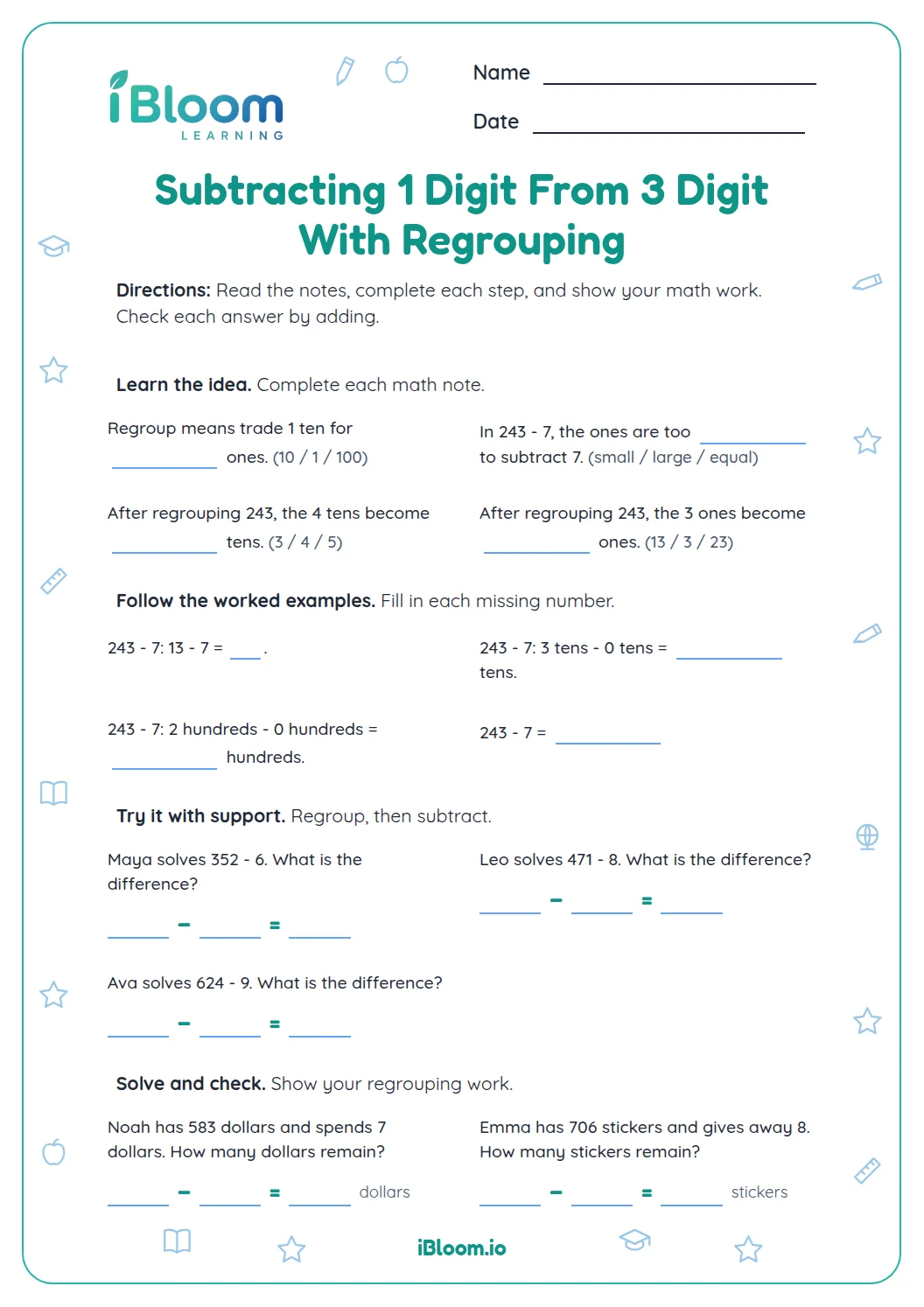
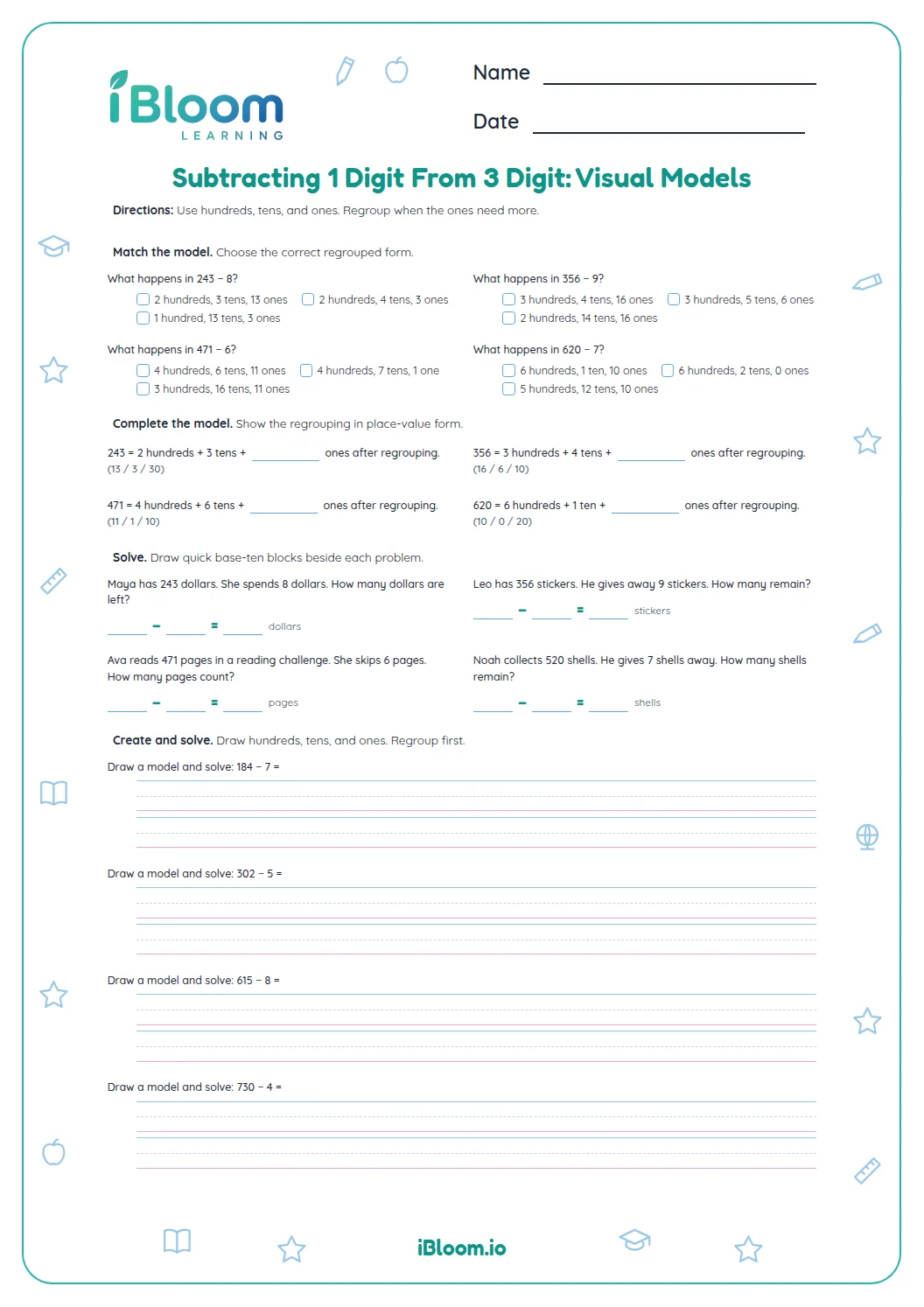
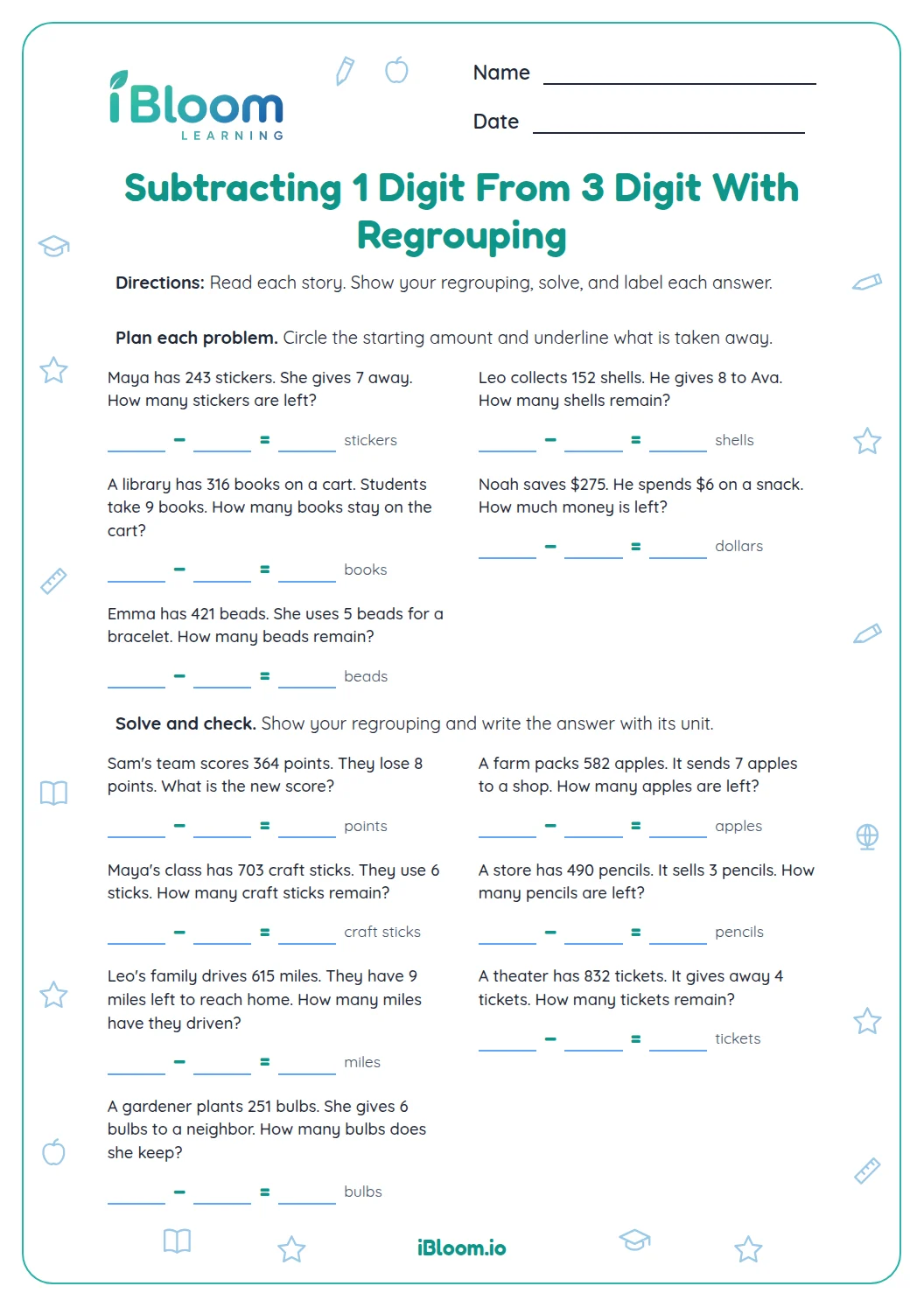
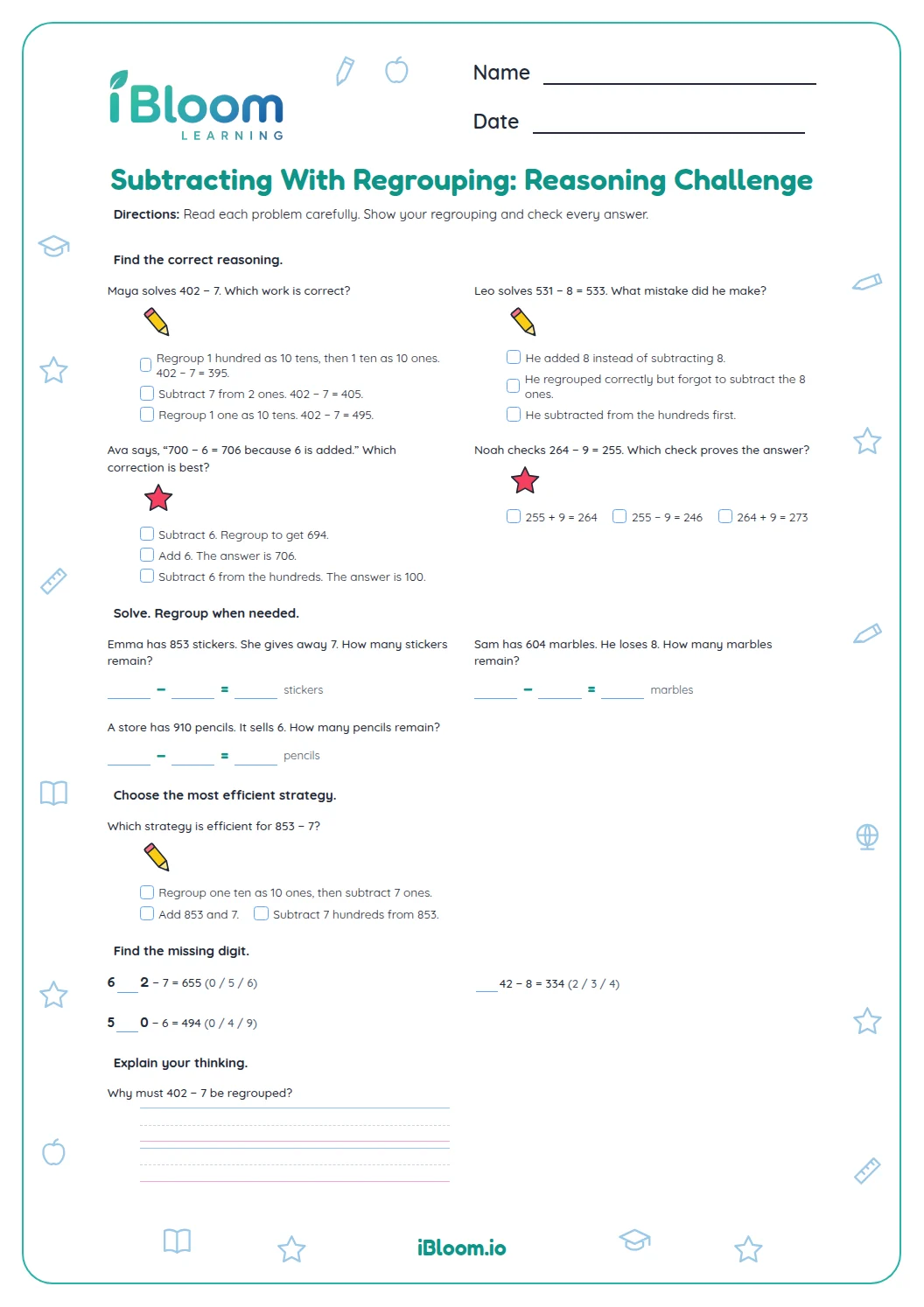
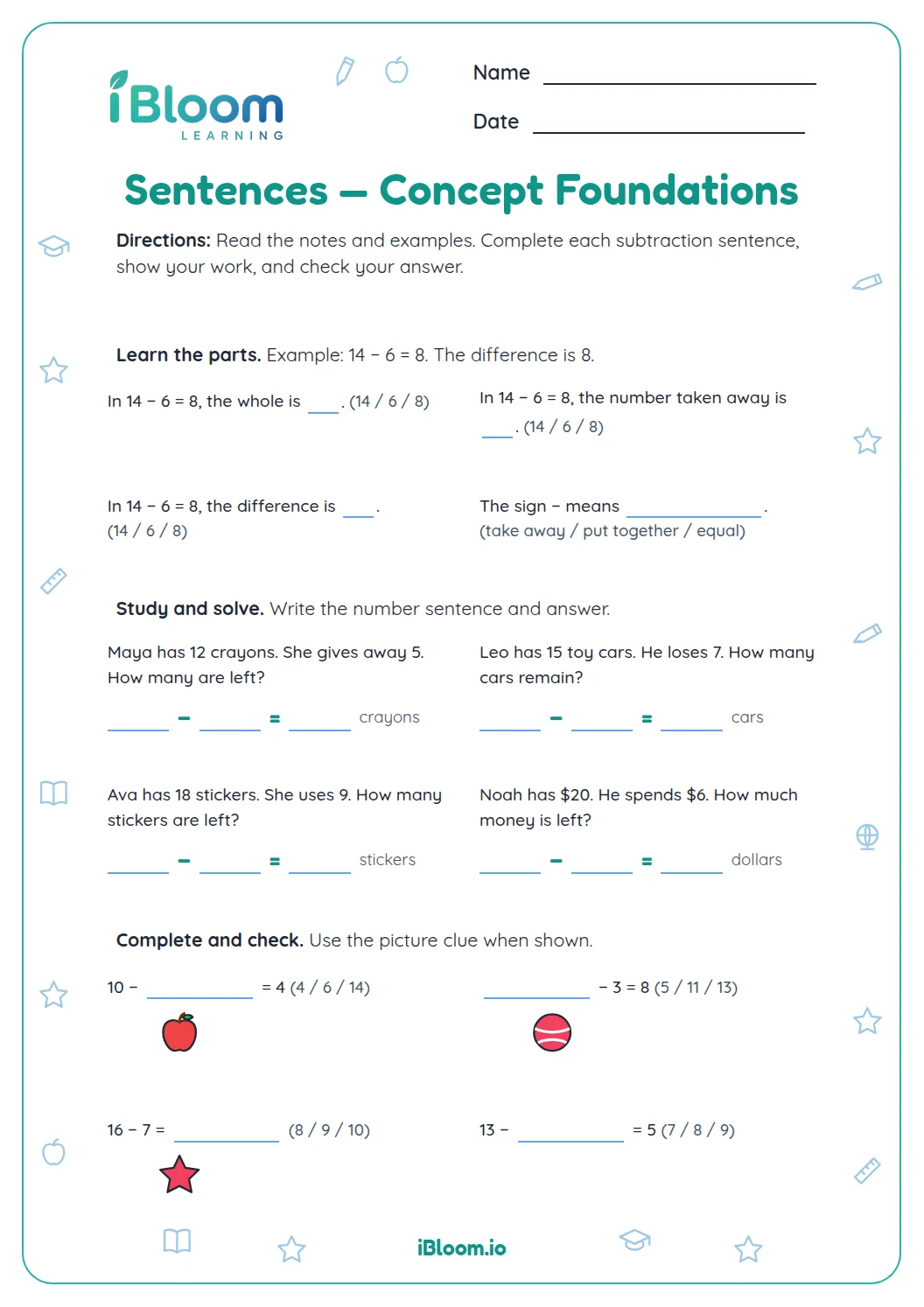
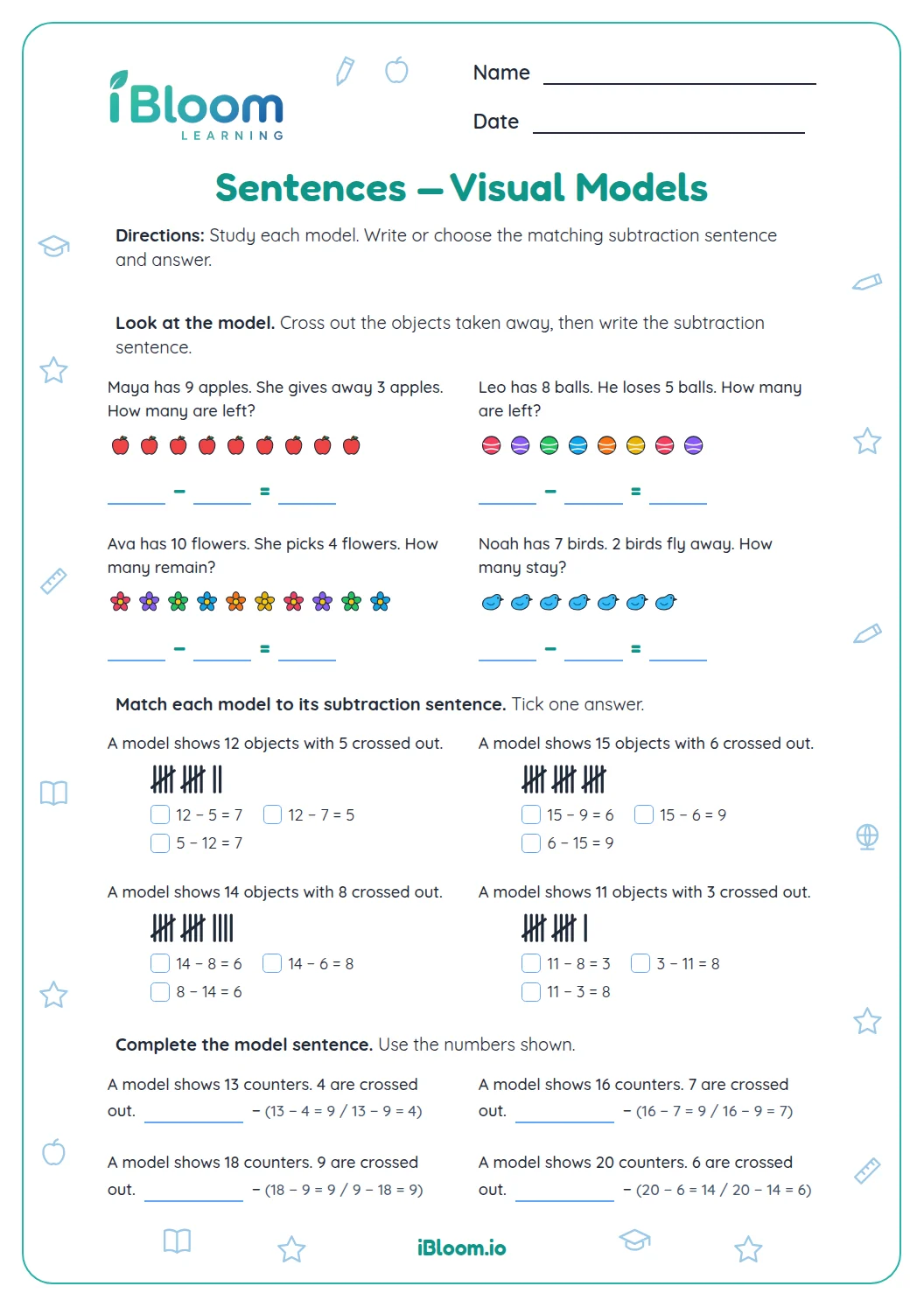
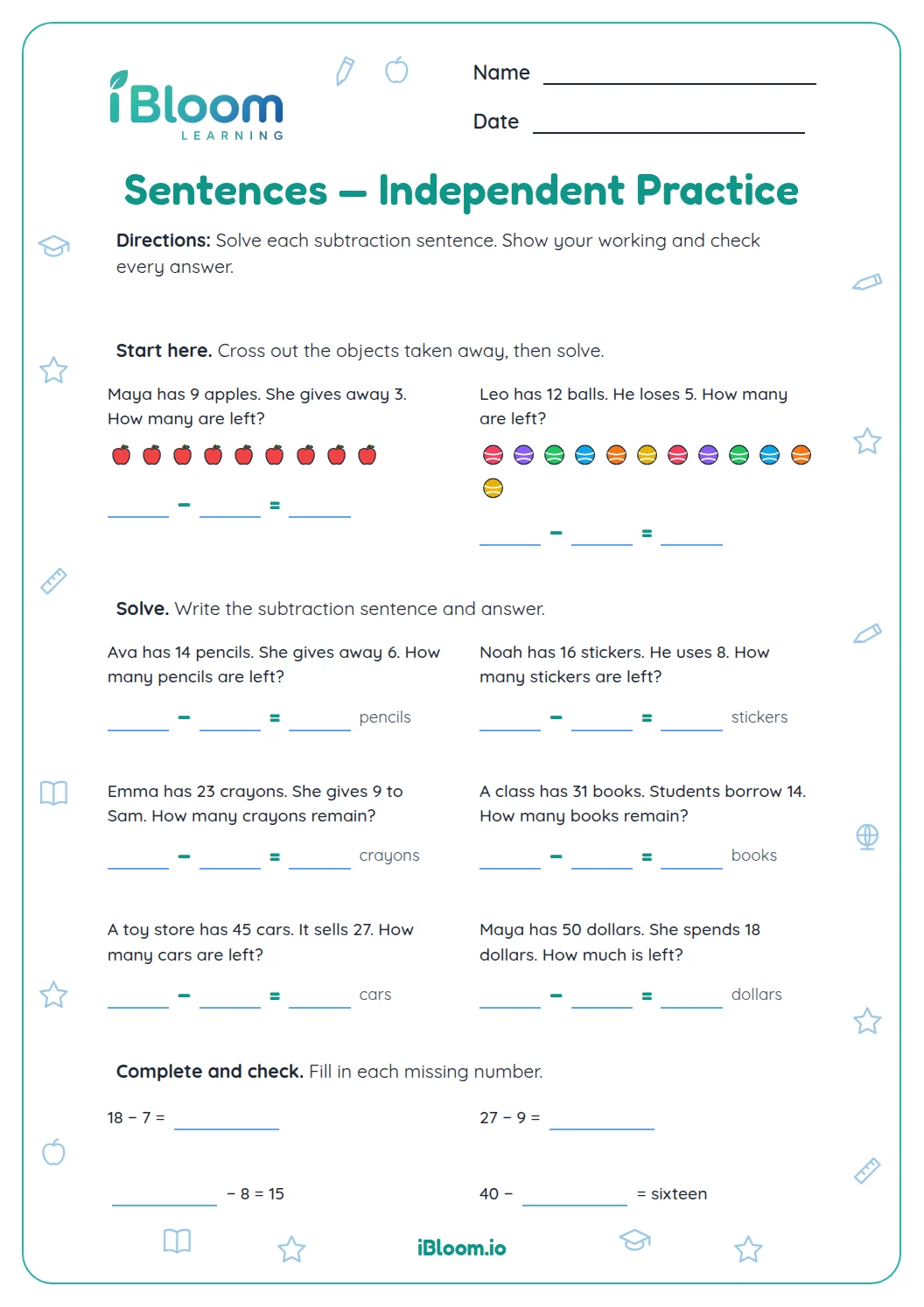
This Grade 2 worksheet gives independent practice subtracting a one-digit number from a three-digit number. Problems include regrouping from the tens place and regrouping across a zero, as in 703 − 6. Learners show a written method and can check each difference with addition. The work practices Common Core standard 2.NBT.B.7, which connects place-value strategies to written methods.
Aligned to 2.NBT.B.7
What does regrouping change?
For 432 − 7, rename 3 tens as 2 tens and 12 ones. Then subtract 7 ones from 12 ones to get 5, leaving 2 tens and 4 hundreds: 425.
How do you regroup across a zero?
In 703 − 6, there are no tens to rename directly. Rename 7 hundreds as 6 hundreds and 10 tens, then rename one of those tens as 9 tens and 10 ones. The difference is 697.
How can the answer be checked?
Add the one-digit number back to the difference. For example, 425 + 7 = 432, so 425 is the difference for 432 − 7.
How to use this worksheet
- 1Start with the ones place.
- 2If the top ones digit is too small, rename one ten as 10 ones.
- 3If there are zero tens, rename a hundred as 10 tens, then rename one ten as 10 ones.
- 4Subtract the ones, then the tens and hundreds.
- 5Add the difference and the number subtracted to check.
Common mistakes and quick fixes
The mistake
Subtracting the smaller ones digit from the larger one without regrouping.
The fix
Rename one ten as 10 ones first.
The mistake
Keeping the original tens digit after renaming a ten.
The fix
Reduce that digit by one when you rename it.
The mistake
Trying to take ones from zero tens without regrouping through the hundreds.
The fix
Rename a hundred as 10 tens, then rename a ten as 10 ones.
This page practices a skill named in the Common Core State Standards.
Subtract within 1,000 using place-value strategies and a written method.
On this sheet:
Show the official wordingHide the official wording
Add and subtract within 1000, using concrete models or drawings and strategies based on place value, properties of operations, and/or the relationship between addition and subtraction; relate the strategy to a written method. Understand that in adding or subtracting three-digit numbers, one adds or subtracts hundreds and hundreds, tens and tens, ones and ones; and sometimes it is necessary to compose or decompose tens or hundreds.
What to practice next
Make more practice
Further reading
Questions parents and teachers ask
What does this three-digit subtraction worksheet practice?
This printable has 20 independent subtraction problems, including regrouping across zero for Grade 3 learners. It moves from spotting the skill to using it in context, with an answer key for checking fixed answers and comparing open responses. Use the prompts to talk through the choices and the evidence behind them.
How should we use the answer key?
Have the learner finish a part before checking its key page. For a written response, compare the child’s idea with the sample and the story or sentence; the wording does not need to match exactly. Invite the learner to revise one answer after checking.
Can I use this printable at home or in class?
Yes. Print the worksheet pages for independent practice, a small group, or a short lesson. The key pages are for the adult or teacher. A pencil is enough for the activities, and the writing prompts can be completed at the learner’s own pace.
How long will the worksheet take?
Plan for about 20 minutes, allowing extra time for the open-response items. The page is divided into short parts, so a learner can pause after a section and return to the remaining questions later. Time will vary with reading and writing speed.
What if a written answer differs from the key?
Check whether the response meets the prompt and uses the relevant sentence or story detail. The key gives a sample for answers that can vary, so equivalent wording may be correct. For a fixed answer, revisit the item together and look for the clue that settles it.