




About this worksheet
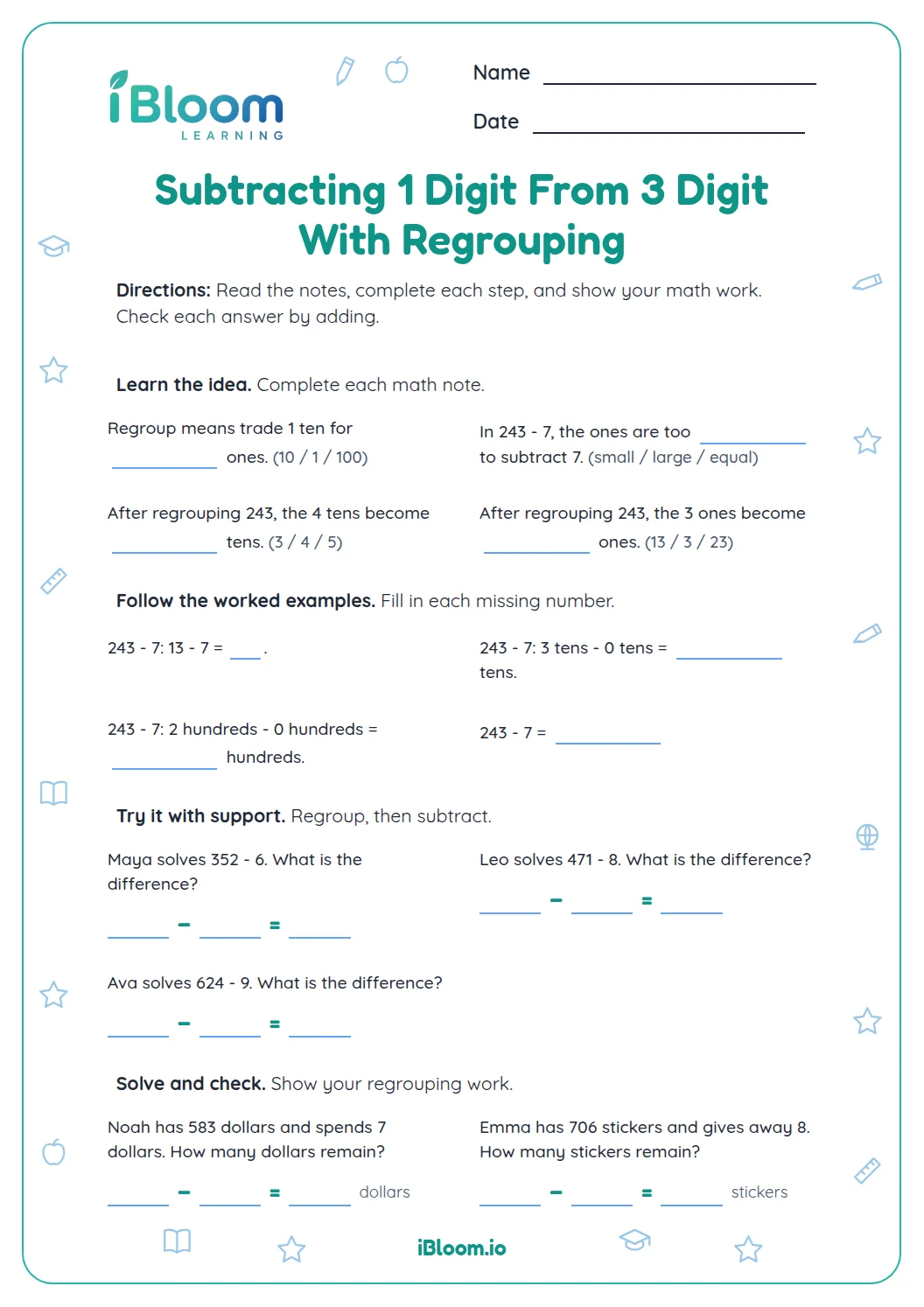
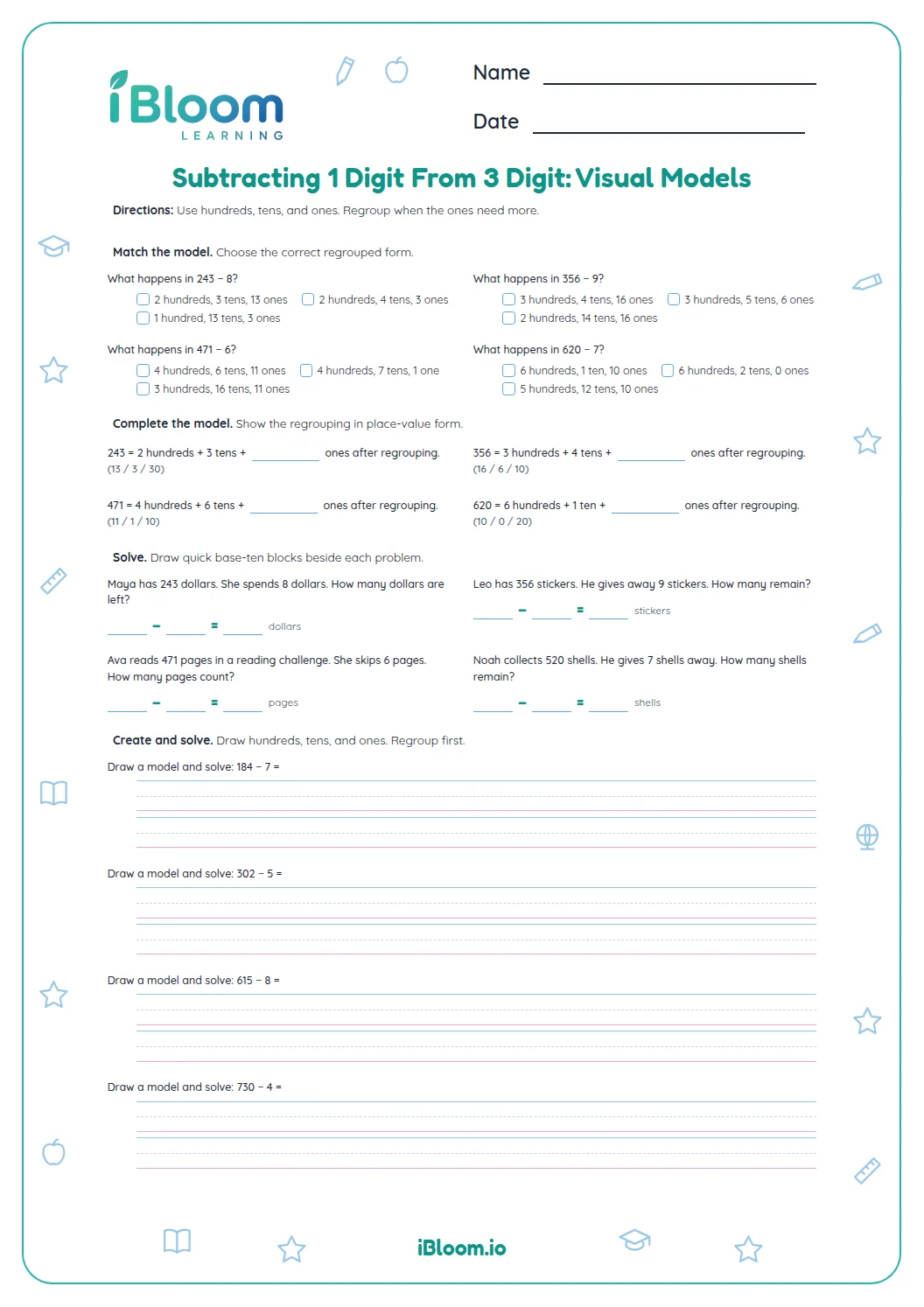
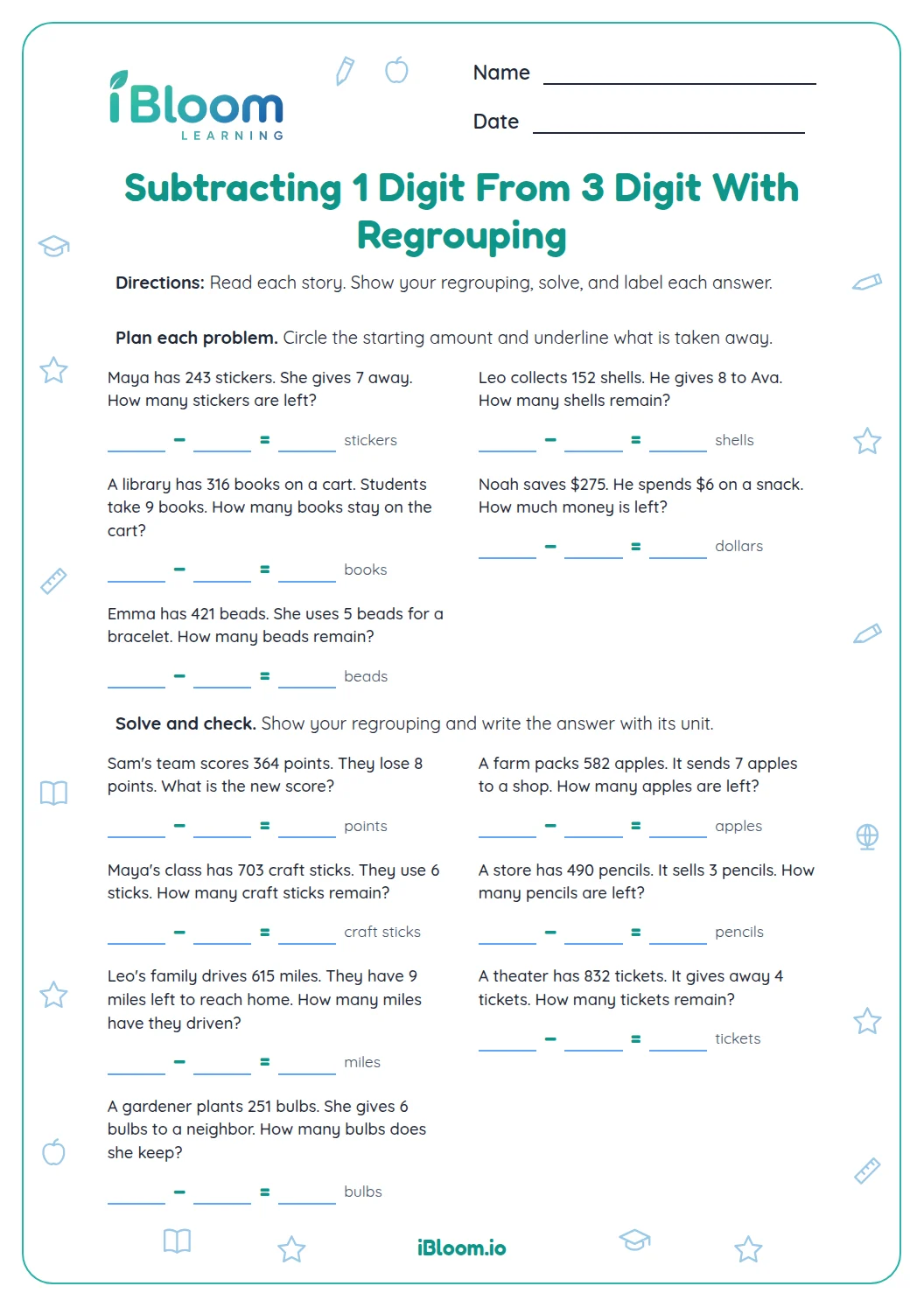
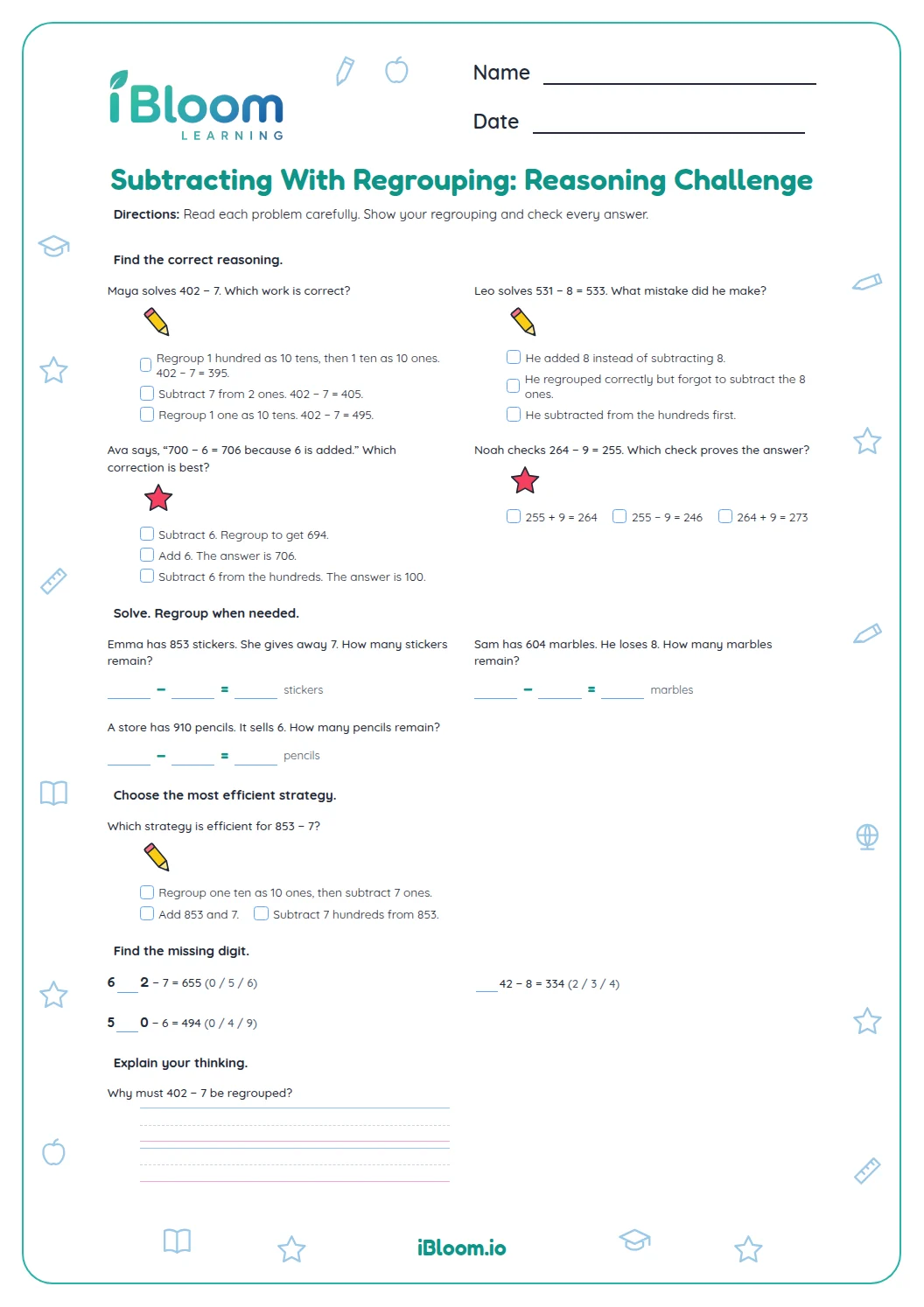
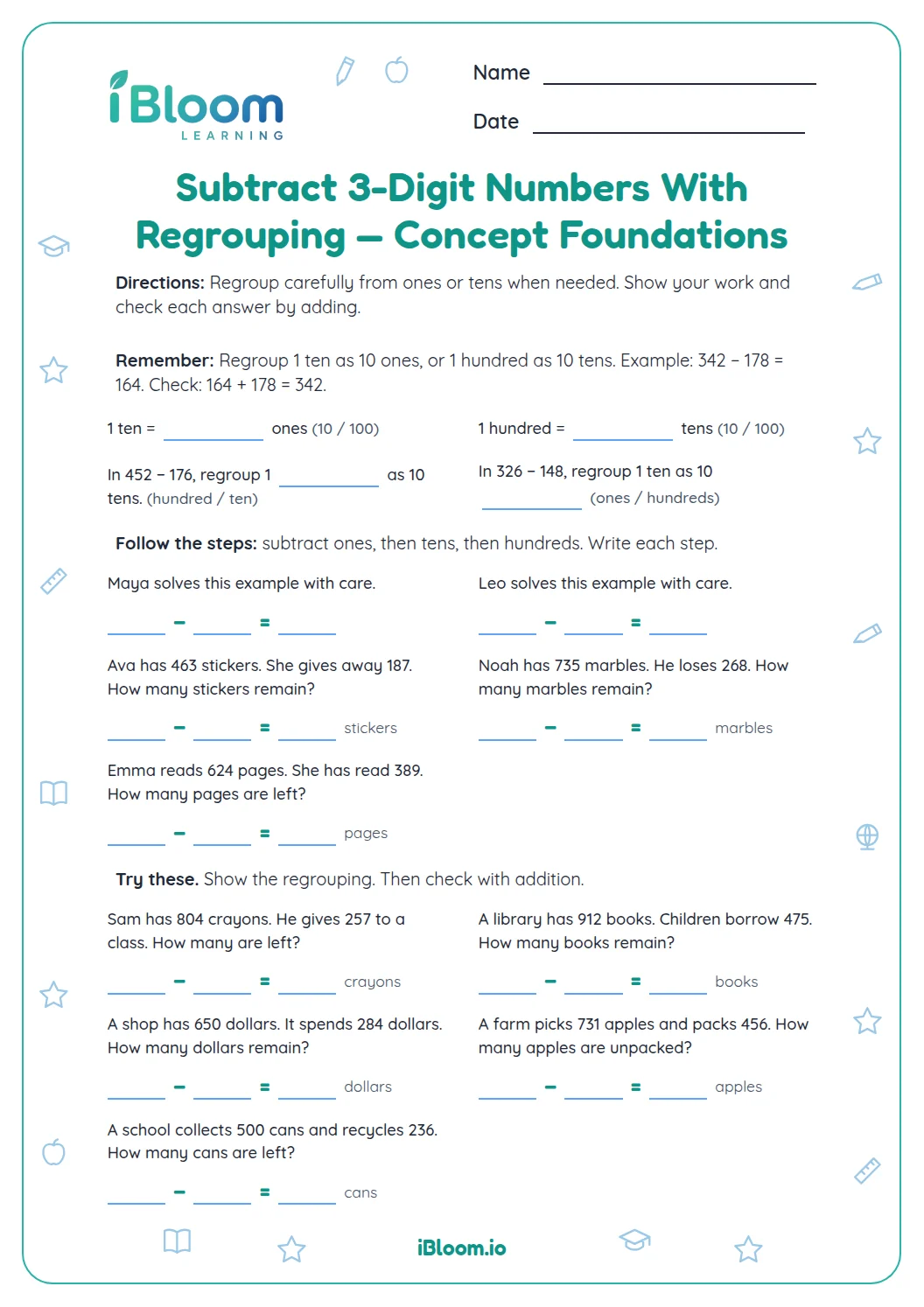
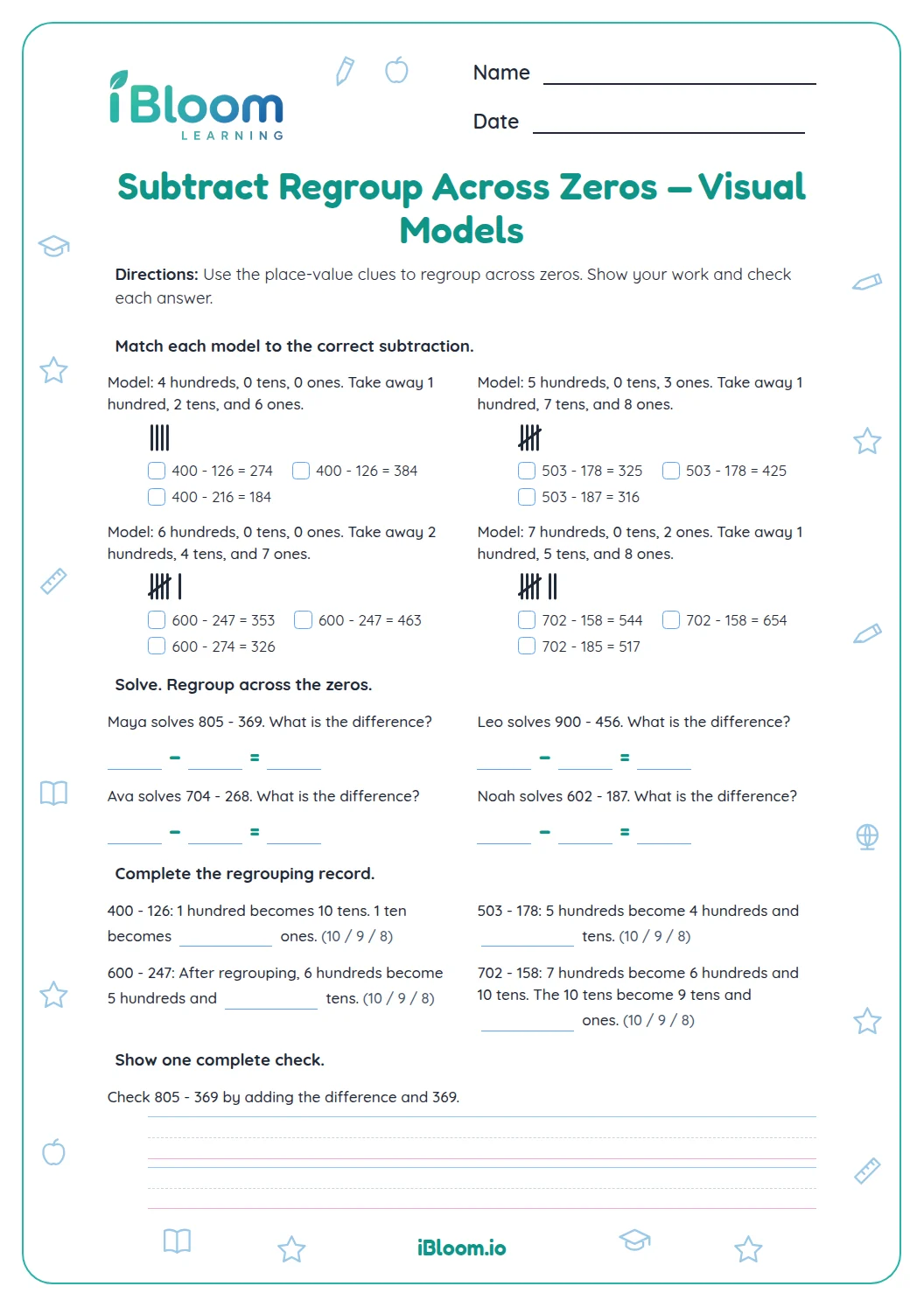
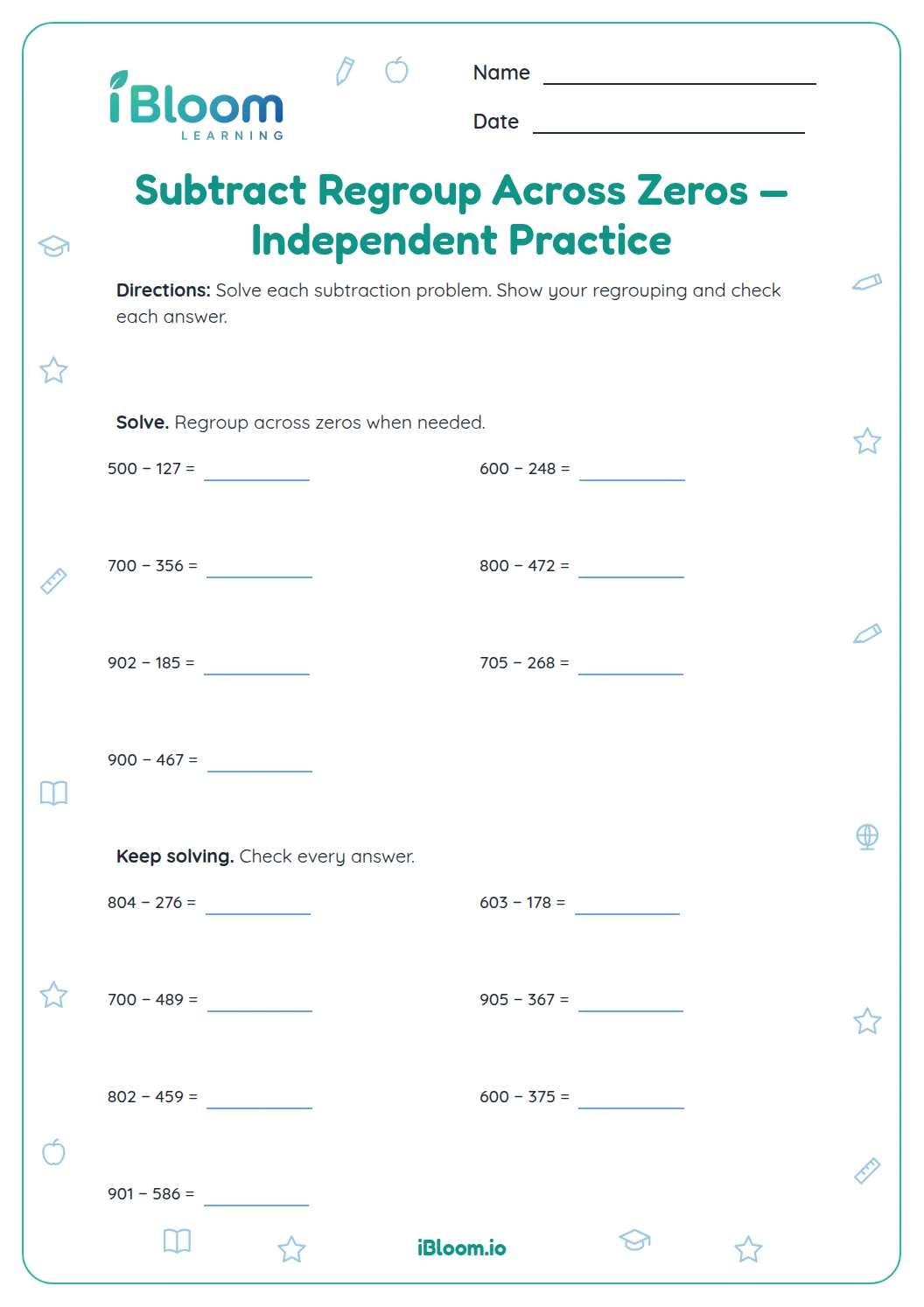
This Grade 2 worksheet gives learners guided practice subtracting a one-digit number from a three-digit number when regrouping is needed. Eight direct differences lead into four missing-number problems and four short stories. The examples include regrouping across a zero, so students can connect a written method with place value. It practices subtraction within 1,000 in Common Core 2.NBT.B.7.
Aligned to 2.NBT.B.7
What does regrouping do?
Regrouping renames a number without changing its value. One ten can become ten ones. If there are no tens to trade, one hundred can become ten tens, and then one of those tens can become ten ones.
- 1605 − 8
- 2Rename 605 as 5 hundreds, 9 tens, 15 ones
- 315 − 8 = 7; 9 tens remain
- 4597
Where does the practice begin?
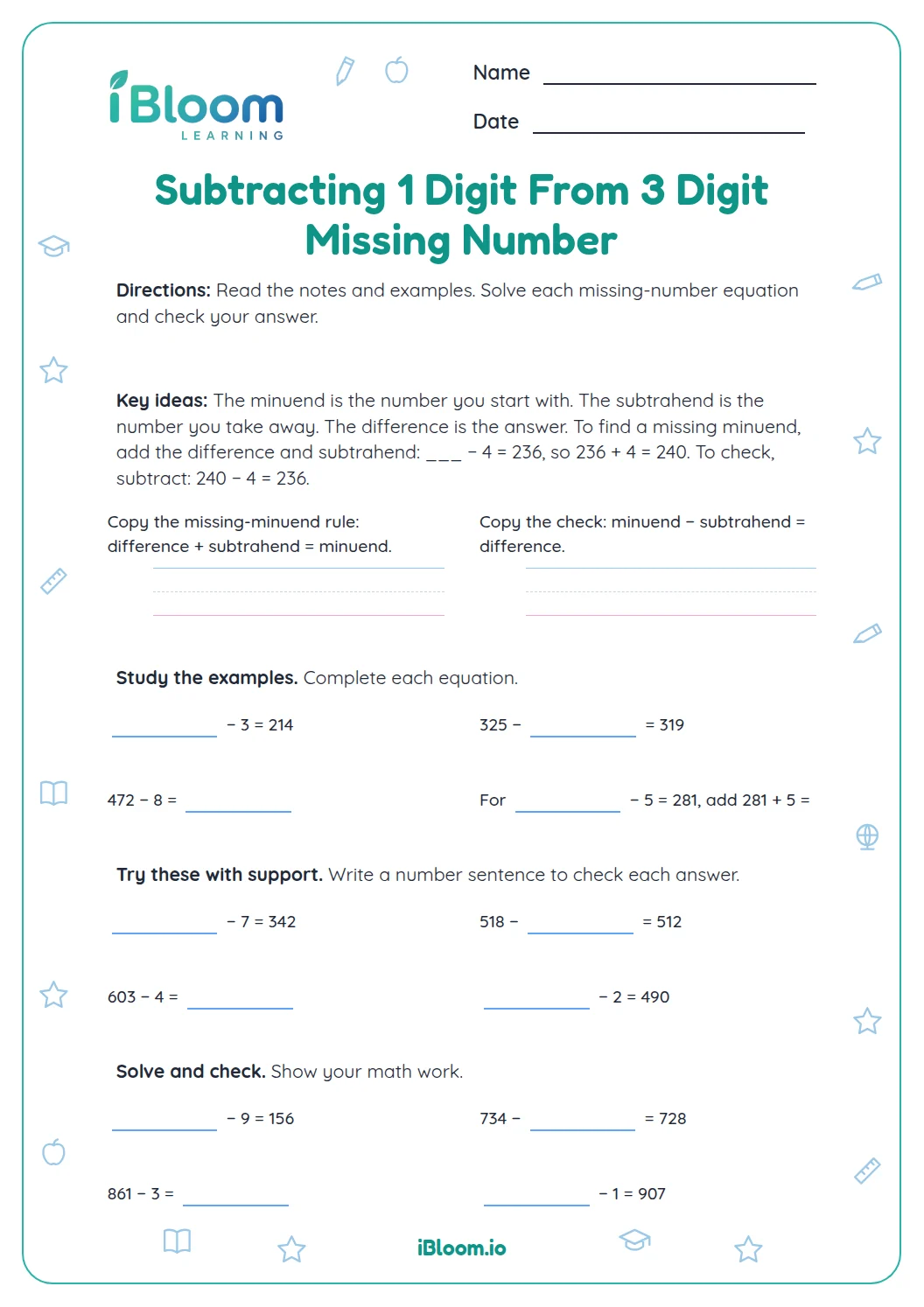
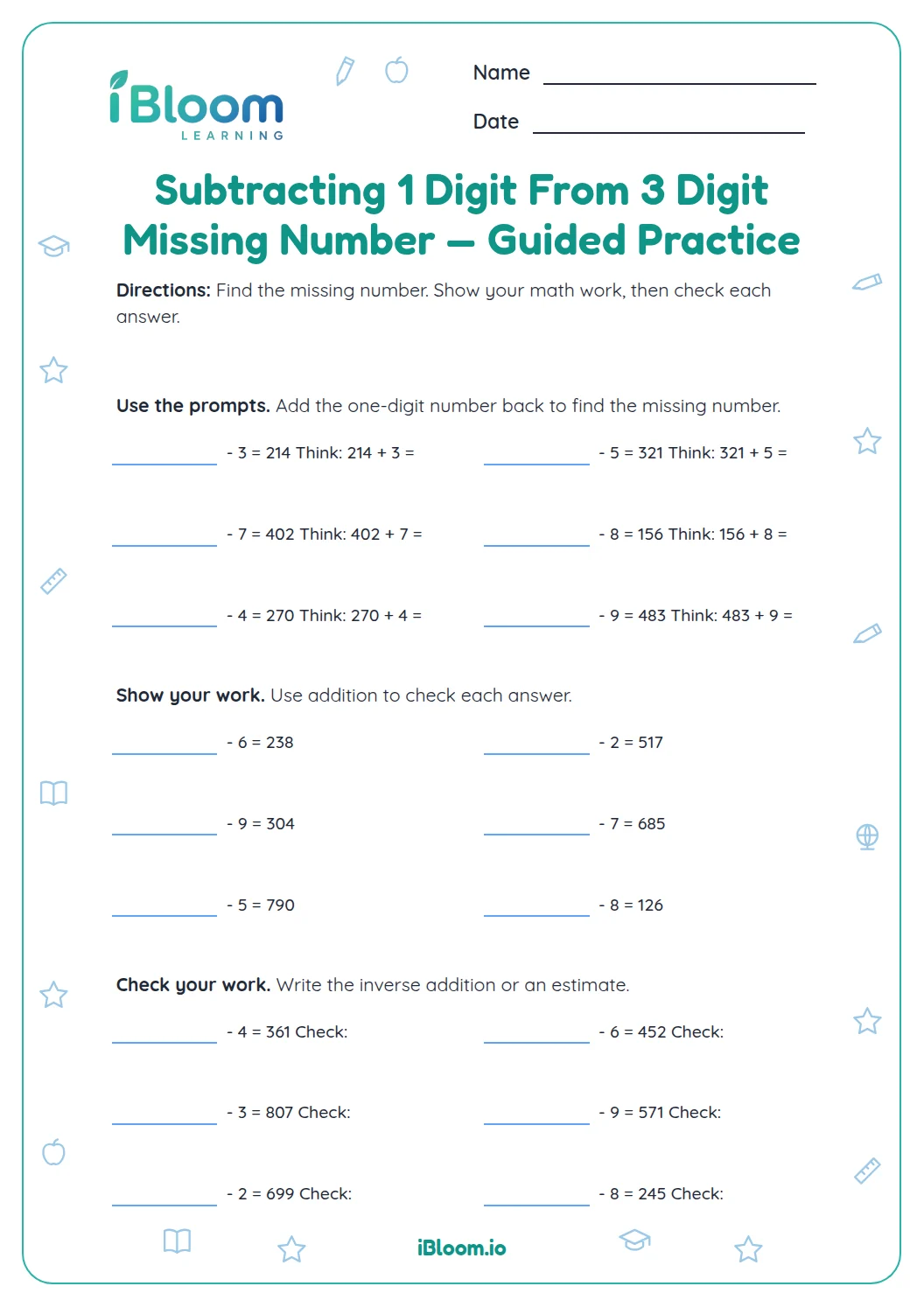
Part A has eight direct subtraction facts, including problems that cross a zero. Part B places the unknown in different positions, so learners decide whether to subtract or add to find it.
- Part A: find each difference
- Part B: solve a missing-number equation
- Part C: write and solve a story equation
How do stories connect to the skill?
Each story describes a starting amount and a small number taken away. Writing the equation first helps keep the starting amount, amount removed, and amount remaining in the right places.
How can I use this worksheet?
- 1Subtract the ones first.
- 2If the ones digit is too small, trade one ten for ten ones.
- 3If the tens digit is zero, trade one hundred for ten tens first.
- 4Solve the missing-number sentences in Part B.
- 5For each story, write the subtraction equation and check by adding the amount taken away.
What should learners check?
The mistake
Subtracting the smaller ones digit from the larger one without regrouping.
The fix
Check whether the top number has enough ones before subtracting.
The mistake
Regrouping from a zero tens digit without first making tens.
The fix
Trade a hundred for ten tens, then trade one ten for ones.
The mistake
Changing the value while regrouping.
The fix
Keep the total unchanged: one ten equals ten ones, and one hundred equals ten tens.
Common Core alignment
The examples use place value and regrouping to subtract within 1,000.
Subtract within 1,000 by using place value and regrouping.
On this sheet: Subtract within 1,000 by using place value and regrouping.
Show the official wordingHide the official wording
Add and subtract within 1000, using concrete models or drawings and strategies based on place value, properties of operations, and/or the relationship between addition and subtraction; relate the strategy to a written method. Understand that in adding or subtracting three-digit numbers, one adds or subtracts hundreds and hundreds, tens and tens, ones and ones; and sometimes it is necessary to compose or decompose tens or hundreds.
What to practice next
Make more practice
Questions parents and teachers ask
What does “regroup” mean in these questions?
Regrouping means renaming a place-value unit as smaller units with the same total value. For example, one ten becomes ten ones. If the tens place is zero, first rename one hundred as ten tens, then trade one ten for ten ones.
How many problems are included?
The worksheet contains 16 questions in three parts. There are eight direct subtraction problems, four equations with a missing number, and four story problems. The separate key lists each difference and story answer. The item types are deliberately mixed so learners can practice direct subtraction, find unknown values, and apply the skill in short situations.
Why are some problems regrouped across a zero?
A zero in the tens place means there is no ten to trade directly for ones. Learners must first trade a hundred for ten tens, then trade one ten for ten ones. Questions such as 605 − 8 give practice with that sequence.
What should learners do with the missing-number problems?
They should use the relationship between subtraction and addition to identify the unknown. For example, if a starting number minus 6 equals 438, add 6 to 438 to find the starting number, then check the subtraction. Each story uses a distinct context and asks for the amount remaining. The equation should match the words before a learner calculates.
Do the story problems need an equation?
Yes. Each story provides working space for a subtraction equation and its answer. The equation should begin with the starting amount, subtract the amount taken away, and equal the amount that remains. Working space is provided for the equation and answer, which helps make the relationship between the story and subtraction visible.
How can I check a subtraction answer?
Add the difference and the number subtracted. Their sum should match the starting number. This inverse-operation check is especially useful when regrouping crosses a zero, because it confirms the total value stayed the same. The key includes the differences and story answers. To check any item, add the subtracted amount back to the answer and compare with the start.