

About this worksheet
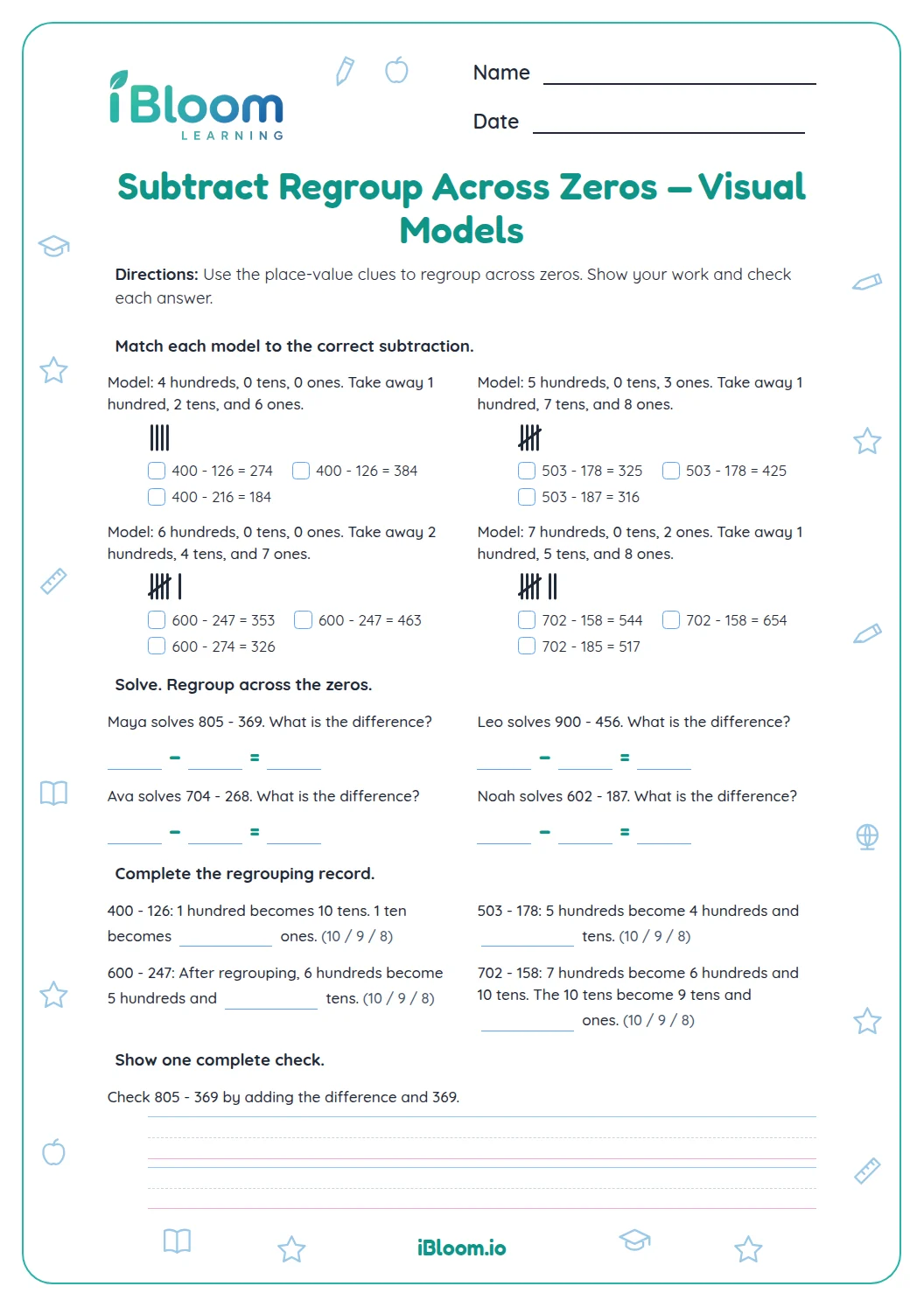
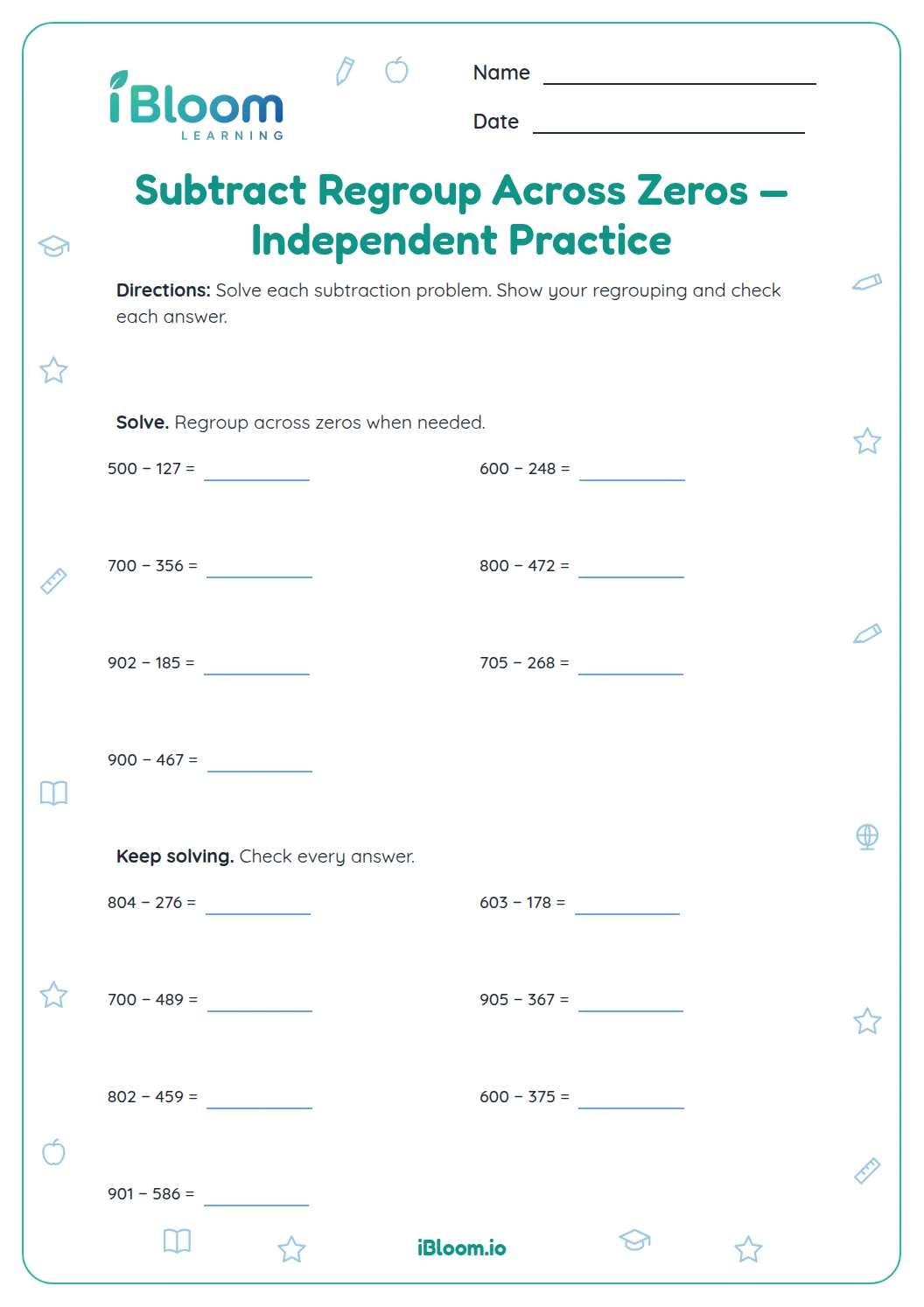
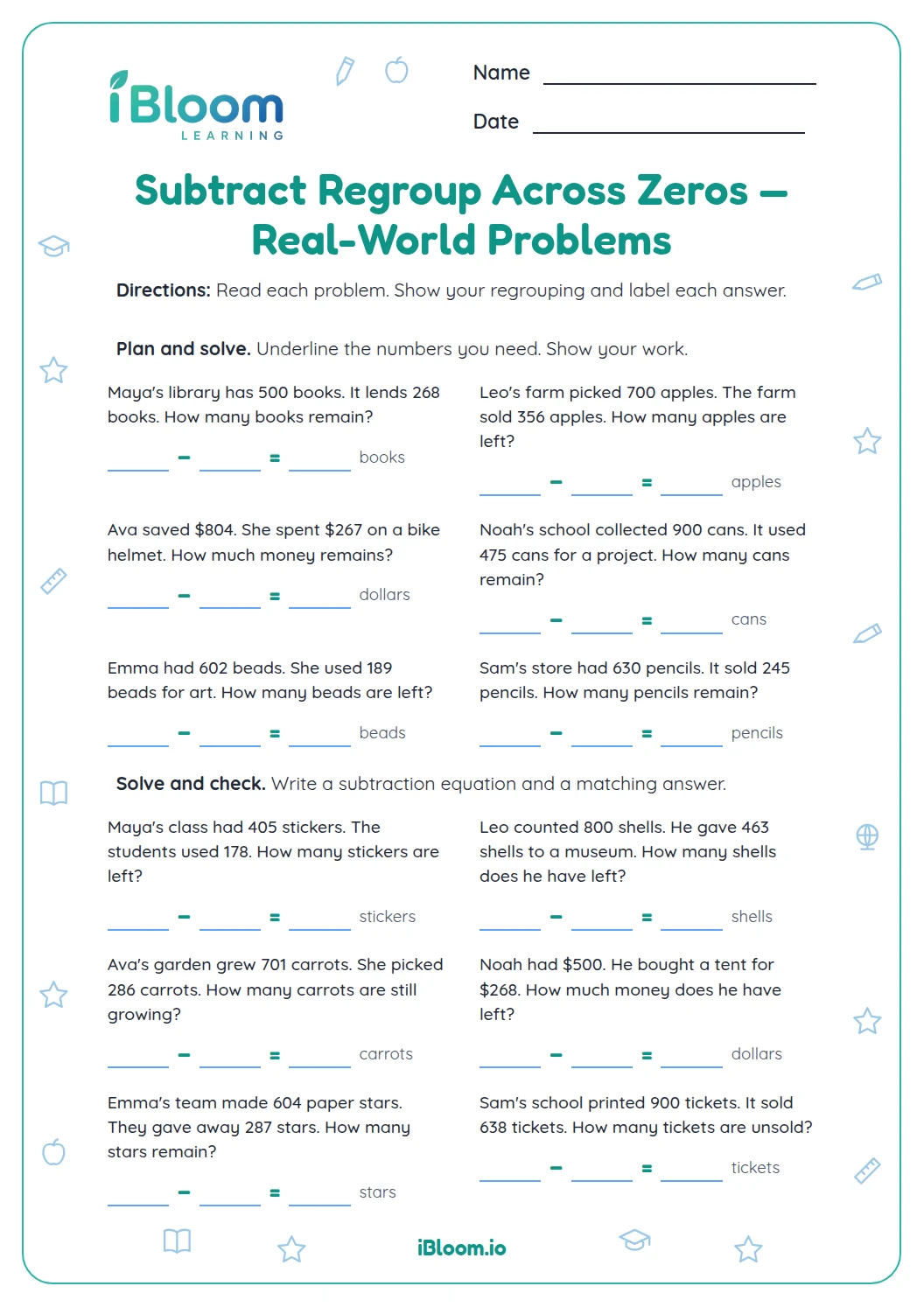
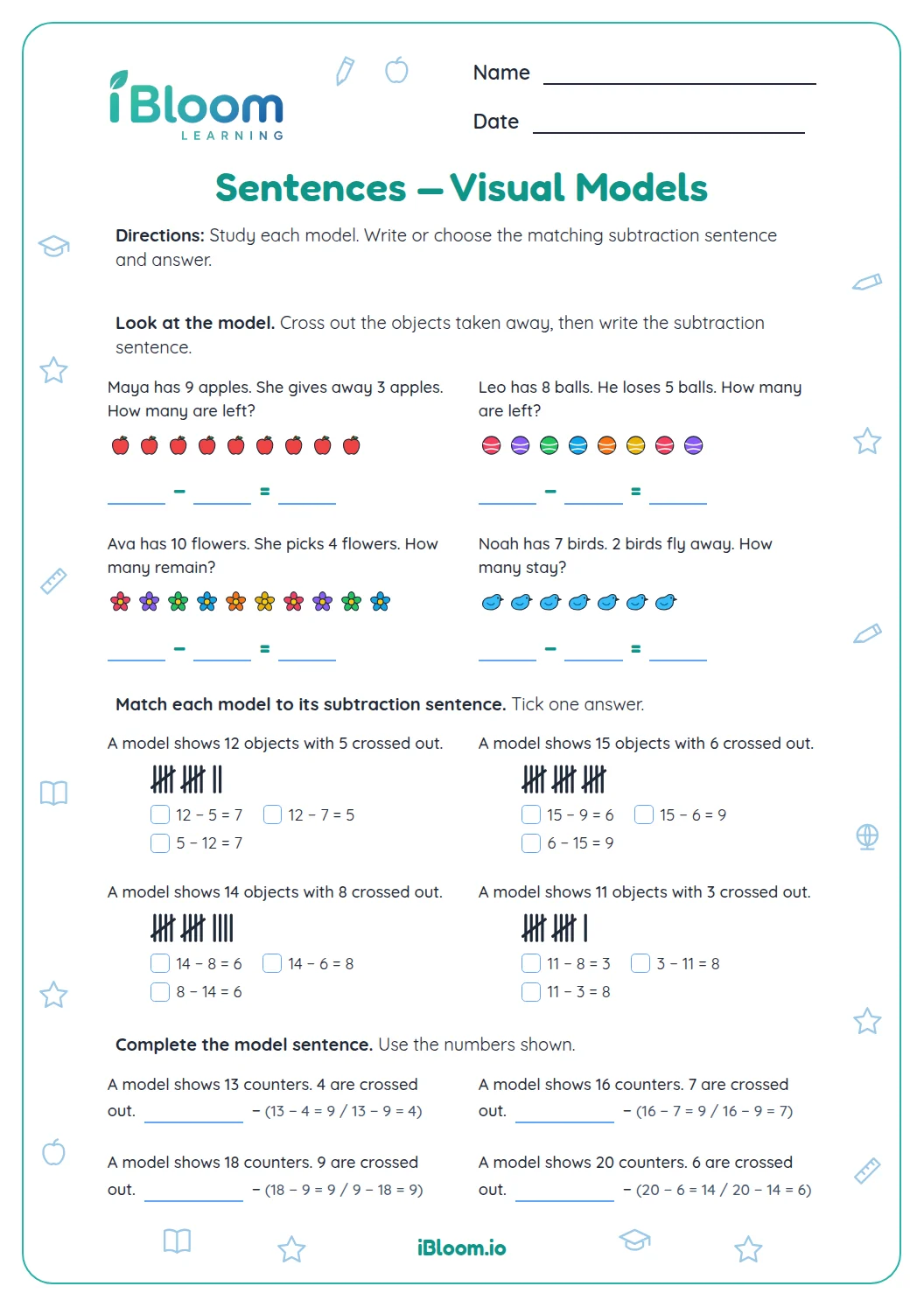
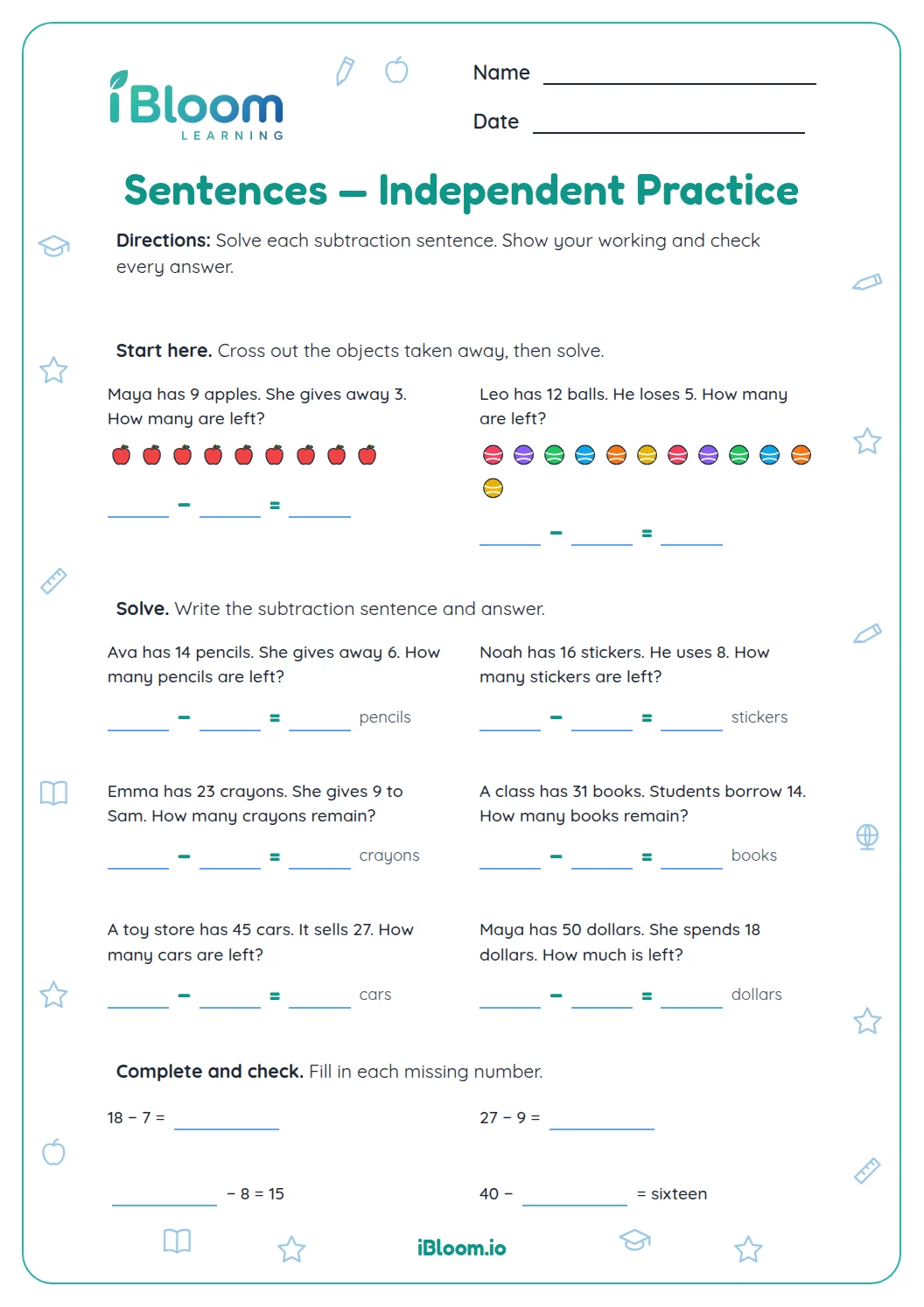
This free printable Grade 2 math worksheet gives learners 16 focused questions on three-digit subtraction across zeros. The two-page activity moves from recognizing the idea to applying it in short contexts, with room to work and a separate answer key. It practices 2.NBT.B.7.
Aligned to 2.NBT.B.7
How can you subtract when a place has zero?
When a number has zero tens, regroup a hundred as ten tens. Then regroup one of those tens as ten ones if the ones are too small to subtract. The value stays the same while the pieces change.
Question 1 starts with 502. Regroup one hundred into ten tens, then regroup one ten into ten ones: 5 hundreds, 0 tens, 2 ones becomes 4 hundreds, 9 tens, 12 ones.
- 1502 = 4 hundreds + 9 tens + 12 ones
- 212 − 6 = 6 ones
How can addition check a difference?
Add the answer to the number subtracted. For 502 − 176 = 326, check 326 + 176 = 502. If the sum returns to the starting number, the subtraction is consistent.
What kinds of problems are on the sheet?
Sixteen problems move from a place-value regrouping explanation to subtraction equations and short stories about supplies. All answers stay within 1,000, and the separate key shows each result.
How can I use this worksheet?
- 1Write hundreds, tens, and ones for the starting number.
- 2Rename one hundred as ten tens when the tens digit is zero.
- 3Rename one ten as ten ones when needed.
- 4Subtract each place and check by adding the answer back.
Common mistakes and quick fixes
The mistake
Trying to subtract ones from a zero before renaming a ten.
The fix
Rename a hundred as ten tens, then one ten as ten ones before subtracting.
The mistake
Forgetting that 1 hundred has the same value as 10 tens.
The fix
Check that the renamed hundreds and tens still have the same total value.
The mistake
Taking a ten from the hundreds place without reducing its hundreds digit.
The fix
After regrouping, reduce the place that gave a ten or hundred.
Curriculum alignment
The subtraction problems stay within 1,000 and use place-value regrouping.
Subtract three-digit numbers by decomposing hundreds, tens, and ones.
On this sheet: Each problem subtracts within 1,000 and requires decomposing a ten or hundred.
Show the official wordingHide the official wording
Add and subtract within 1000, using concrete models or drawings and strategies based on place value, properties of operations, and/or the relationship between addition and subtraction; relate the strategy to a written method. Understand that in adding or subtracting three-digit numbers, one adds or subtracts hundreds and hundreds, tens and tens, ones and ones; and sometimes it is necessary to compose or decompose tens or hundreds.
What to practice next
Make more practice
Further reading
Questions parents and teachers ask
Why does 502 become 4 hundreds, 9 tens, and 12 ones?
One hundred from 502 is renamed as ten tens, giving 4 hundreds and 10 tens. One of those tens is renamed as 10 ones, which combines with the original 2 ones to make 12. The total value remains 502 throughout the trades.
How can I check 502 − 176 = 326?
Add the difference and the subtrahend: 326 + 176 = 502. Returning to the starting amount confirms the subtraction. A learner can also check the hundreds, tens, and ones in the addition to locate a regrouping error. A quick drawing can make the trade between places easier to see.
Why is this called subtracting across zeros?
The starting number has zero in a place needed for subtraction, such as the tens place in 502. Regrouping across that zero requires renaming a hundred as tens before making enough ones to subtract. A quick drawing can make the trade between places easier to see.
How many questions are included?
There are 16 questions on two worksheet pages, including a guided regrouping item, subtraction practice, and four short supply stories. The two-page answer key lists each result for checking. A quick drawing can make the trade between places easier to see.
Can a learner use base-ten blocks?
Yes. Trade one hundred flat for ten tens rods, then trade one tens rod for ten unit cubes when needed. Each trade keeps the total value the same while providing enough units to subtract. A quick drawing can make the trade between places easier to see.
What is an easy way to catch an error?
Check the answer by adding the subtracted number back. For 604 − 258, adding 346 + 258 should return 604. Also check that each regrouped place reflects the ten or hundred that was traded away. A quick drawing can make the trade between places easier to see.