




About this worksheet
This Grade 2 reasoning worksheet gives students 15 questions about three-digit subtraction across zeros. They check subtraction claims, solve equations and a brief story, compare strategies, and identify the trades needed between hundreds, tens, and ones. The separate answer key includes results and trade descriptions. The work practices CCSS 2.NBT.B.7.
Aligned to 2.NBT.B.7
How can a subtraction answer be checked?
Use addition to reverse the subtraction: difference + amount taken away should equal the starting number. The first four questions ask students to inspect claims and estimates before they solve longer problems.
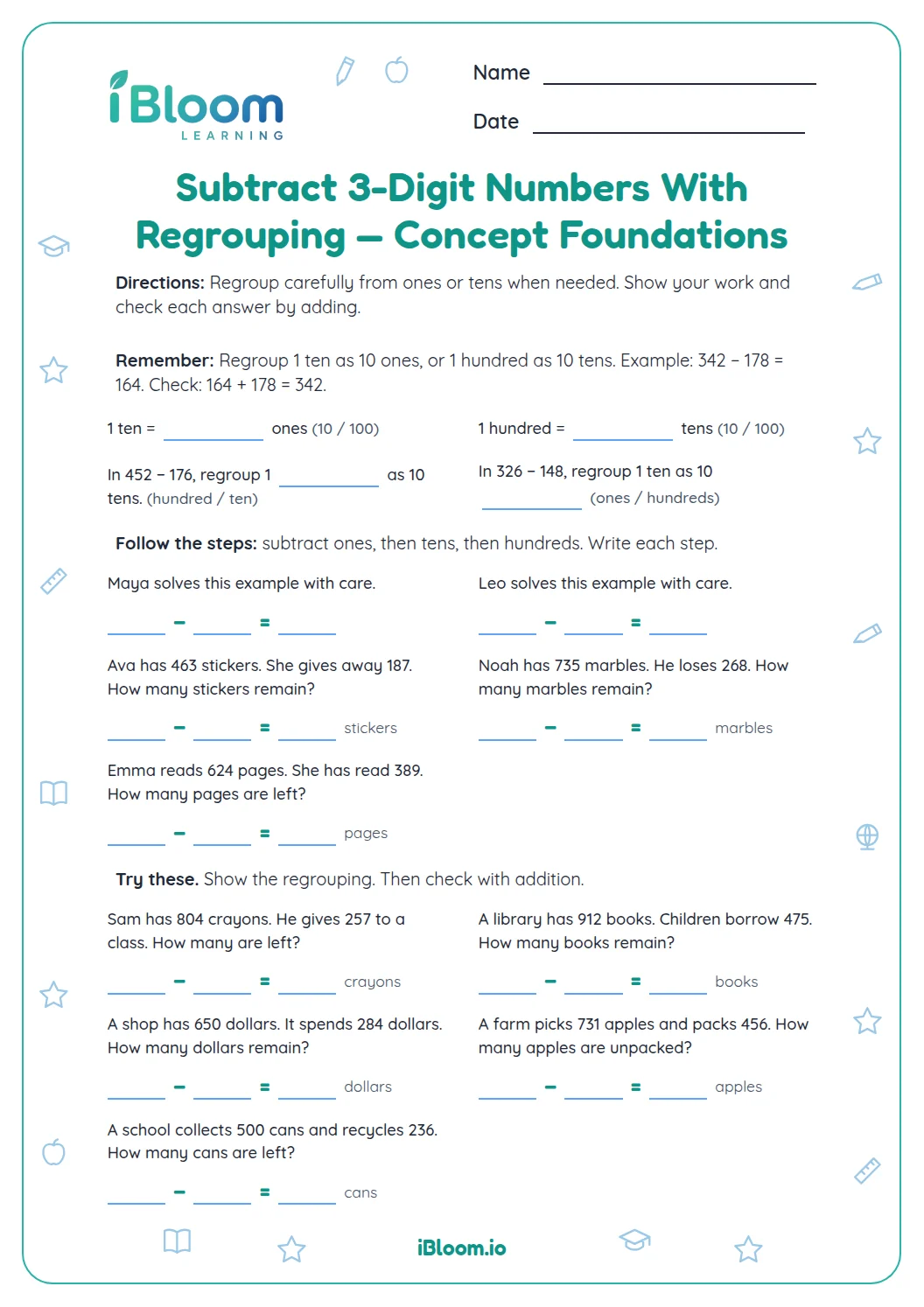
For example, 700 − 458 = 242 because 242 + 458 = 700. The addition check confirms the difference.
- 1Question 1: 700 − 458 = 242
- 2Check: 242 + 458 = 700, so 242 is correct.
What happens when a subtraction problem has zeros?
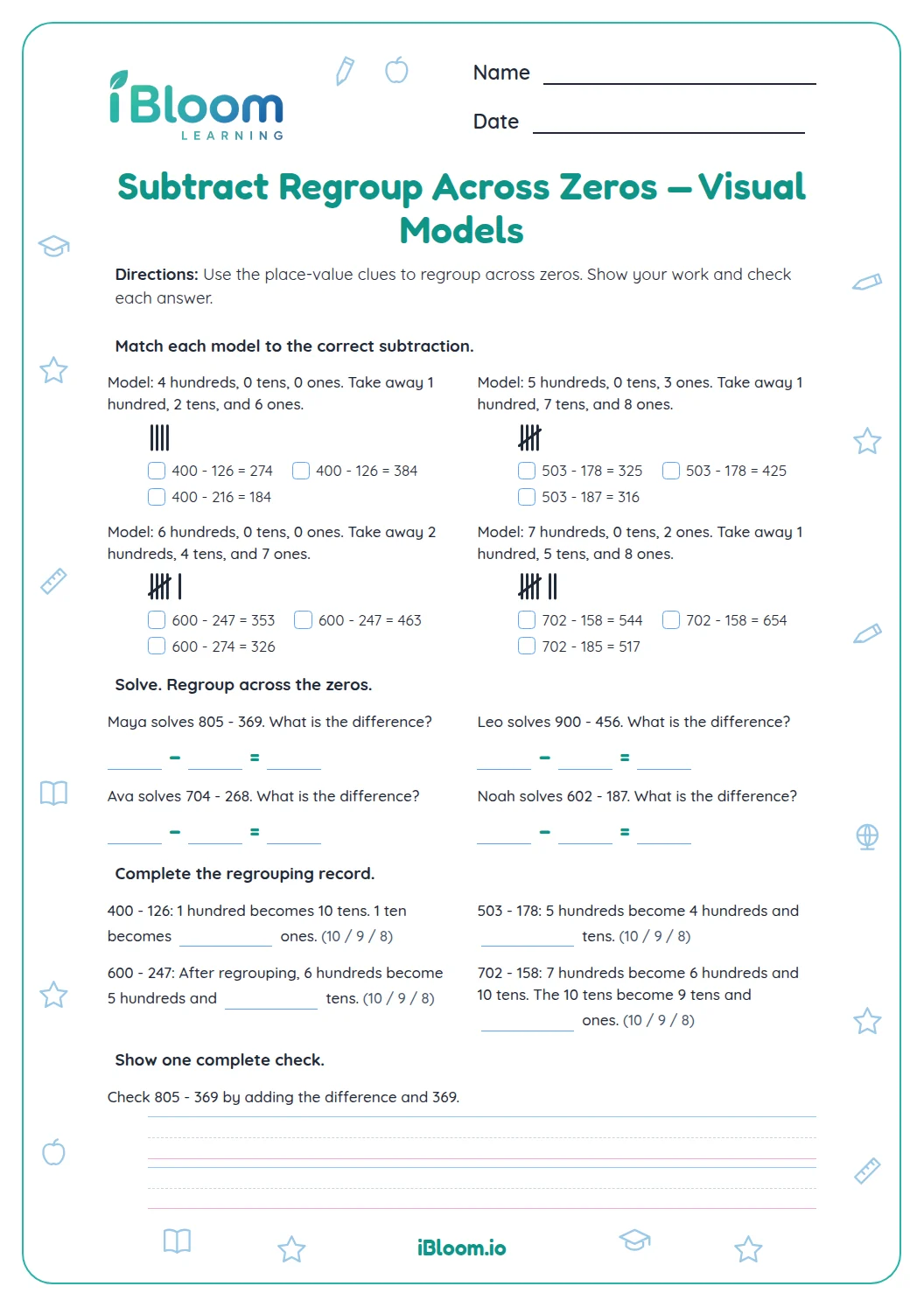
A zero means there are no tens or ones to take from that place yet. Trade one hundred for 10 tens. If the tens place is still too small, trade one ten for 10 ones. Keep the value of the whole number the same as you regroup.
For 500 − 263, trade 1 hundred for 10 tens, then 1 ten for 10 ones. The number is now 4 hundreds, 9 tens, and 10 ones before subtracting.
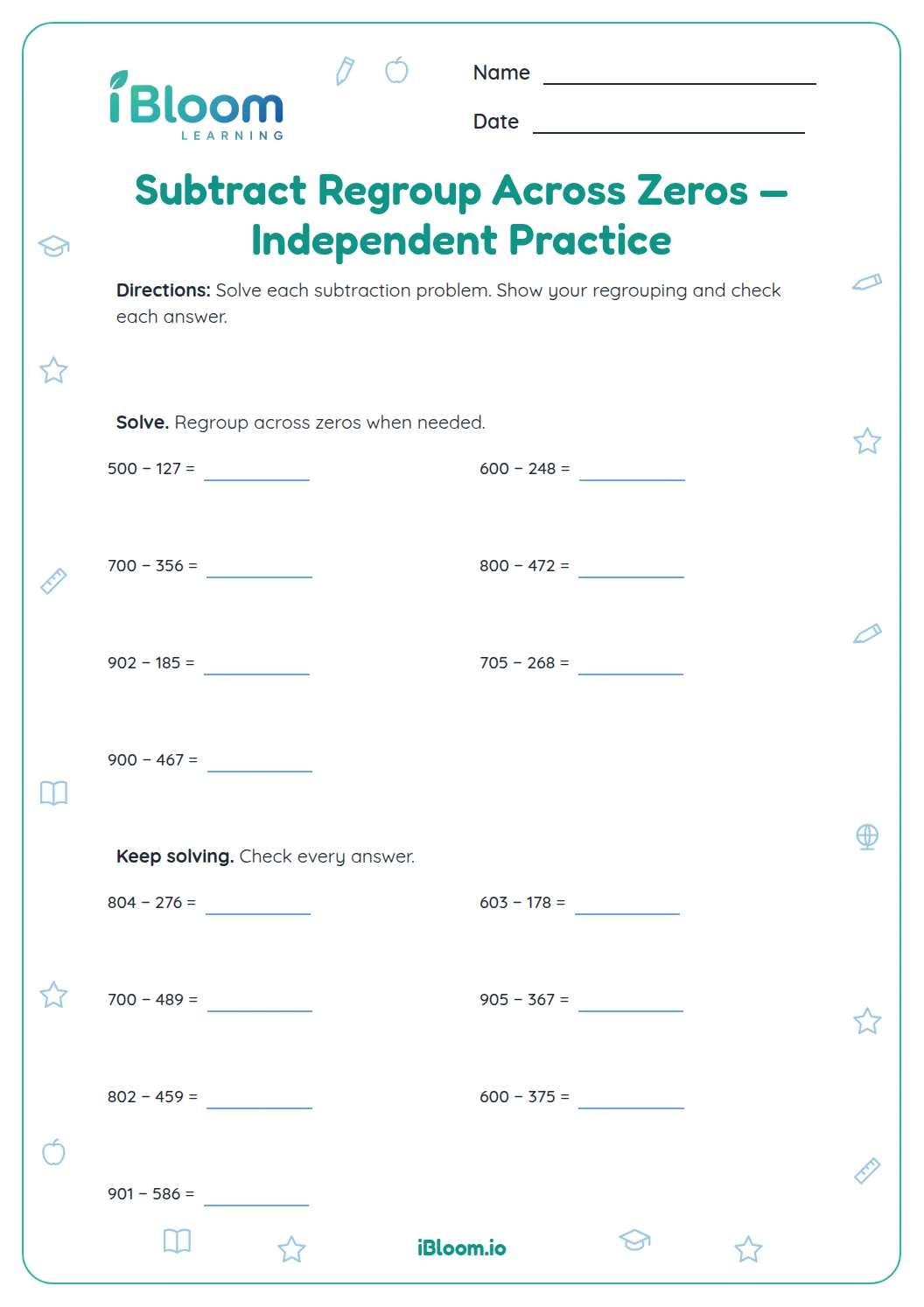
- 1500 − 263 = 237
- 2Trade 1 hundred for 10 tens, then 1 ten for 10 ones.
How can addition confirm the difference?
After finding a difference, add it to the number being subtracted. The sum should match the starting number. This check is especially useful when regrouping because it checks the full equation, not just one place.
For question 15, 517 + 385 = 902, which confirms that 902 − 385 = 517.
How to use this worksheet
- 1Read each claim and check the subtraction with addition.
- 2For each problem, identify the starting number and amount subtracted.
- 3Trade 1 hundred for 10 tens when the tens place has too few.
- 4Trade 1 ten for 10 ones when the ones place has too few.
- 5Add the difference and subtrahend to check the minuend.
Common mistakes and quick fixes
The mistake
Taking the smaller digit from the larger in every column.
The fix
Regroup by place value, then subtract in each place.
The mistake
Trading a hundred but forgetting to reduce the hundreds digit
The fix
When 1 hundred becomes 10 tens, the hundreds digit goes down by 1.
The mistake
Changing the difference during the addition check
The fix
Keep the original numbers: difference + subtrahend must equal the minuend, using place values correctly every time.
Common Core alignment
This page connects regrouping across zeros to place-value strategies for three-digit subtraction.
Use place value to subtract within 1,000 and regroup hundreds or tens.
On this sheet: Students subtract three-digit numbers across zeros and explain regrouping with place value.
Show the official wordingHide the official wording
Add and subtract within 1000, using concrete models or drawings and strategies based on place value, properties of operations, and/or the relationship between addition and subtraction; relate the strategy to a written method. Understand that in adding or subtracting three-digit numbers, one adds or subtracts hundreds and hundreds, tens and tens, ones and ones; and sometimes it is necessary to compose or decompose tens or hundreds.
What to practice next
Make more practice
Further reading
Questions parents and teachers ask
Why does subtracting across zeros take more than one regrouping step?
A zero has no tens or ones to trade directly, so the trade may move through more than one place. In 500 − 263, one hundred becomes 10 tens, and one of those tens becomes 10 ones. The total value stays 500 while each place gets enough to subtract.
How can my child check a subtraction answer?
Add the difference to the number that was subtracted. For example, if 902 − 385 = 517, check that 517 + 385 equals 902. If the sum is different, revisit the regrouping and the subtraction in each place.
What does the answer key include?
The separate key gives the selected choices and answers for all 15 problems. For the written explanations, it provides sample responses that show the place-value idea; a child can use different words if the explanation still describes a correct trade.
Can students use a number line or base-ten blocks?
Yes. A number line can show counting back in friendly jumps, and base-ten blocks can show a hundred traded for ten tens. This page asks students to write subtraction and explain regrouping, so models can support the written work without replacing it.
What should students practice next?
Students can revisit three-digit subtraction with regrouping, then use addition to find missing numbers in subtraction equations. The linked pages build on the same relationship between place value, subtraction and addition checks, with more number ranges and varied equations for continued practice.