



About this worksheet
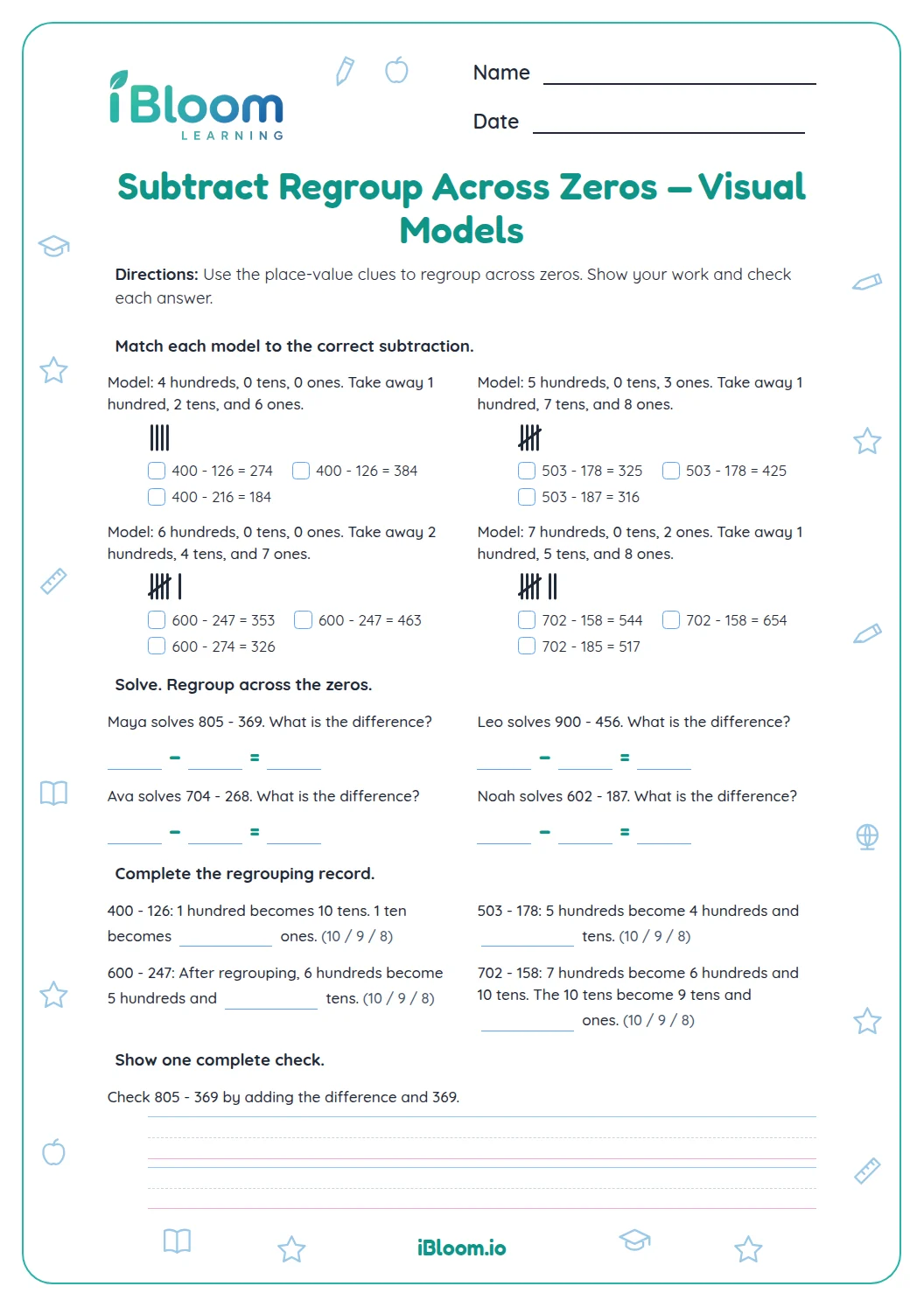
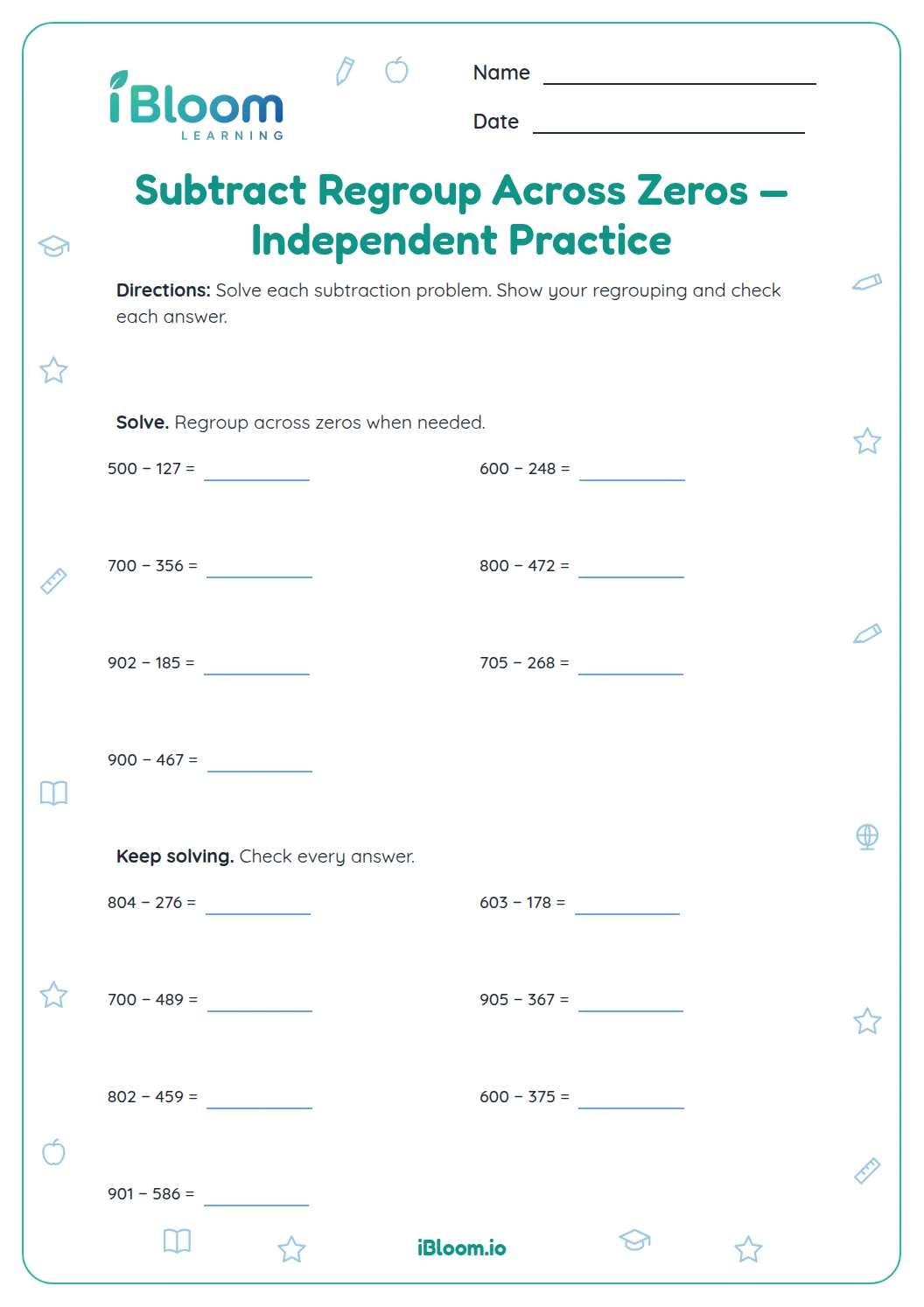
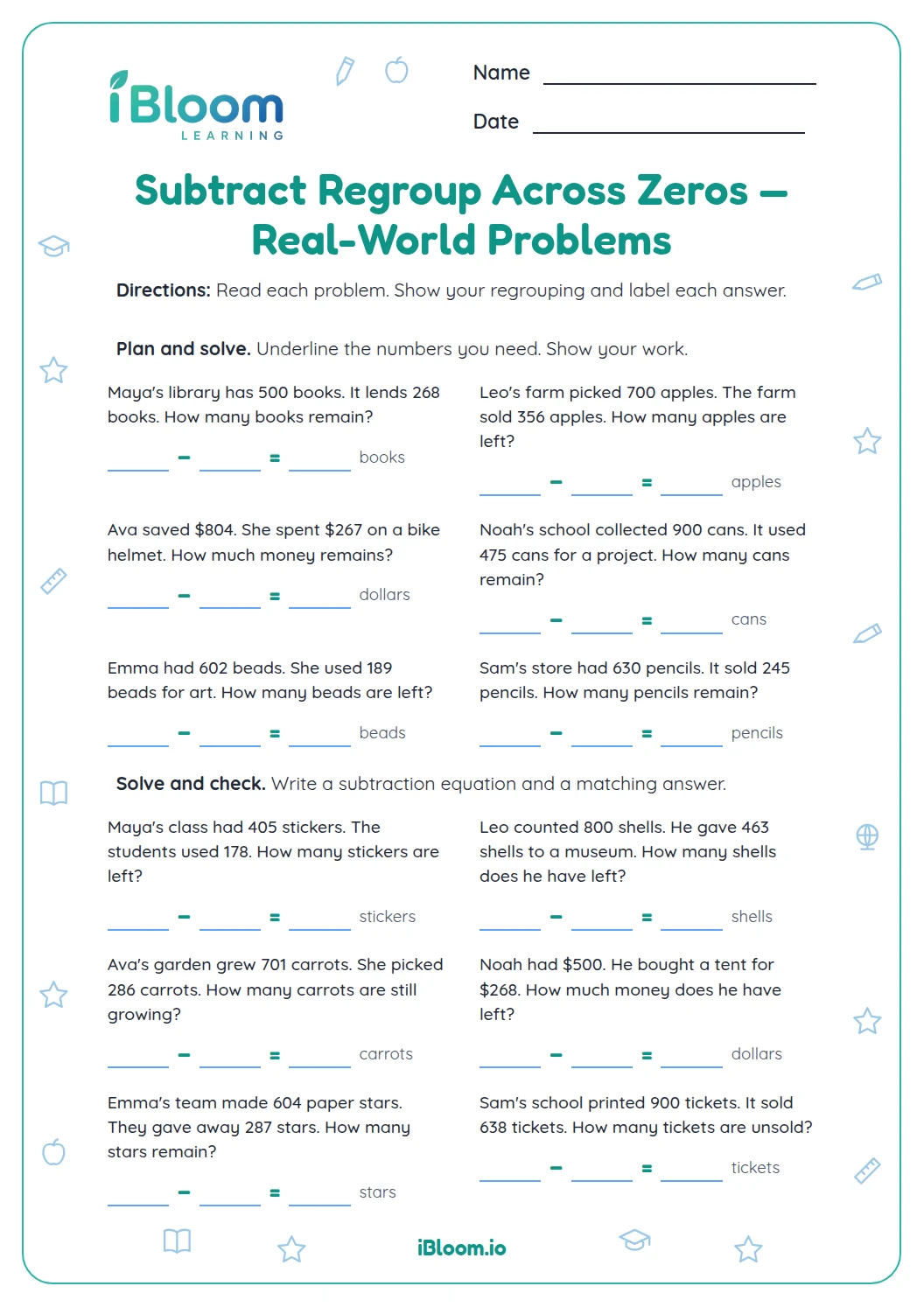
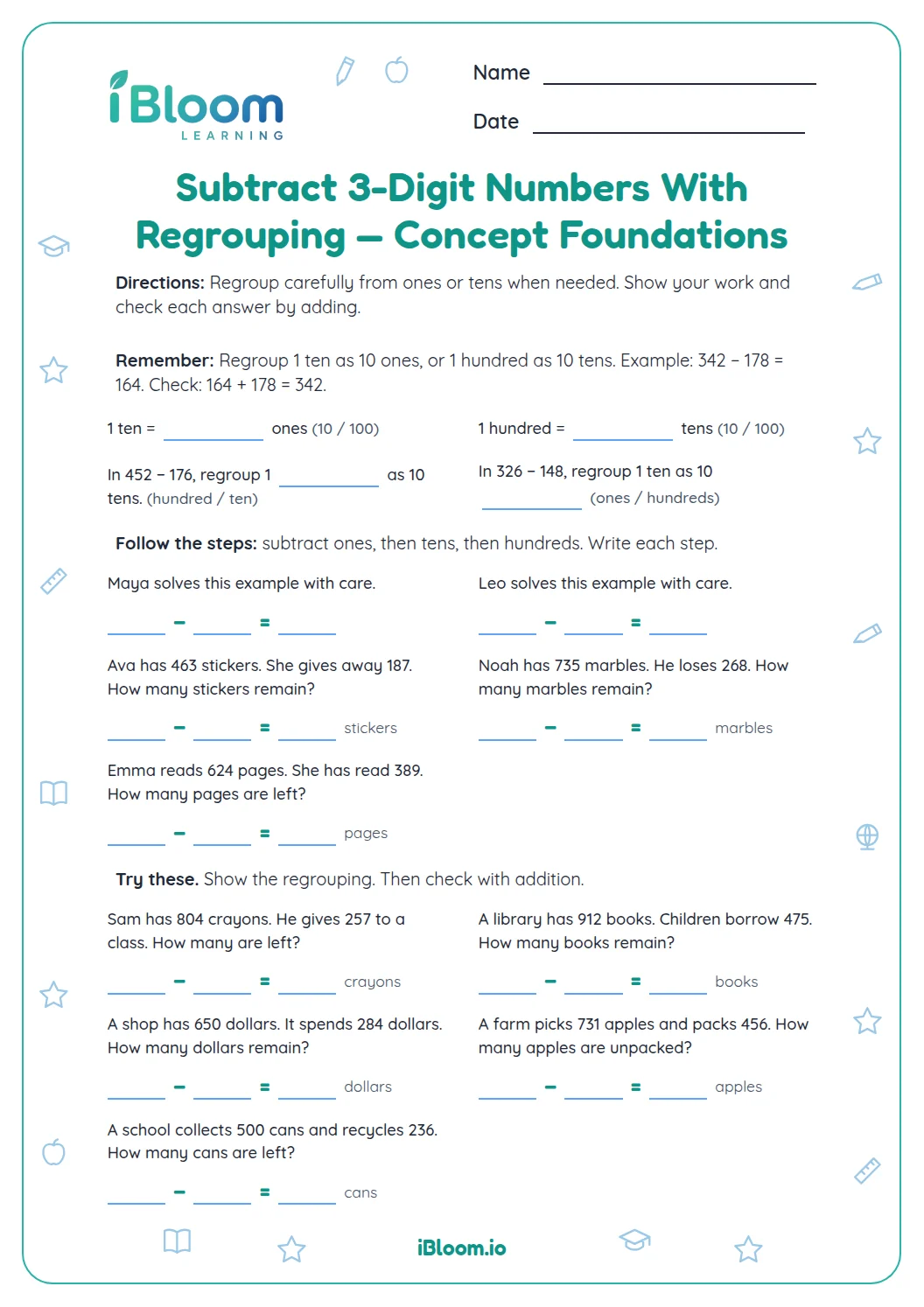
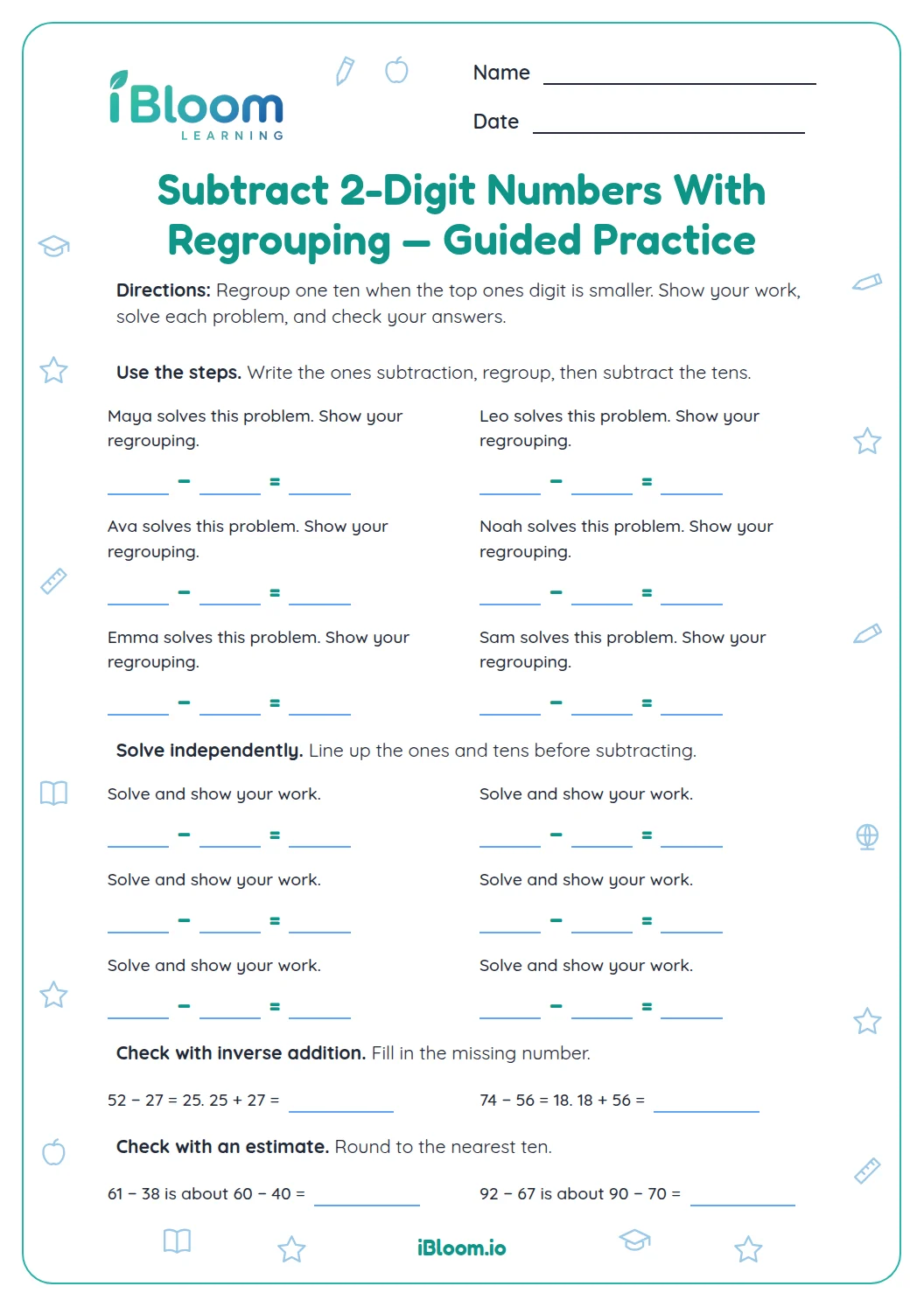
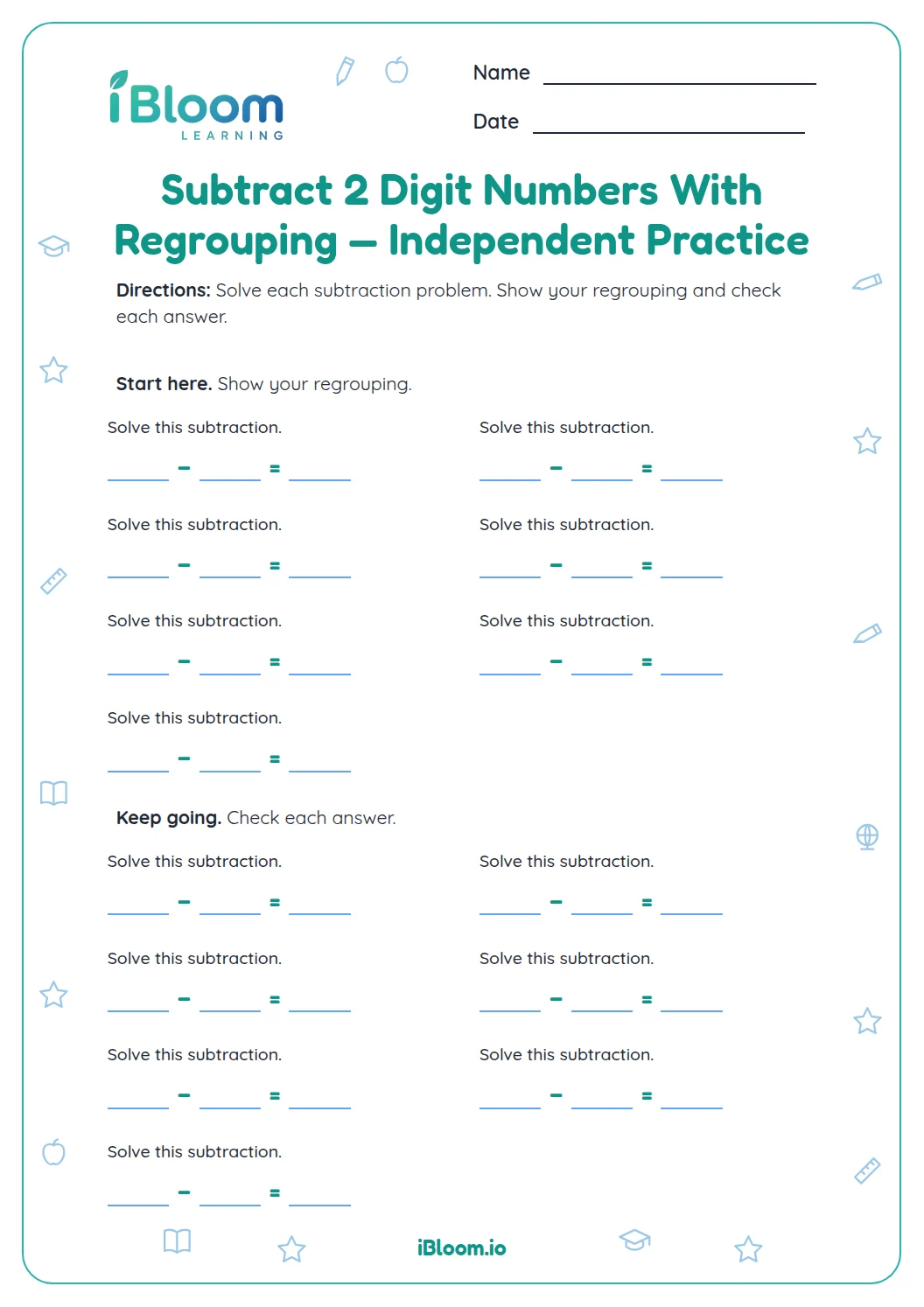
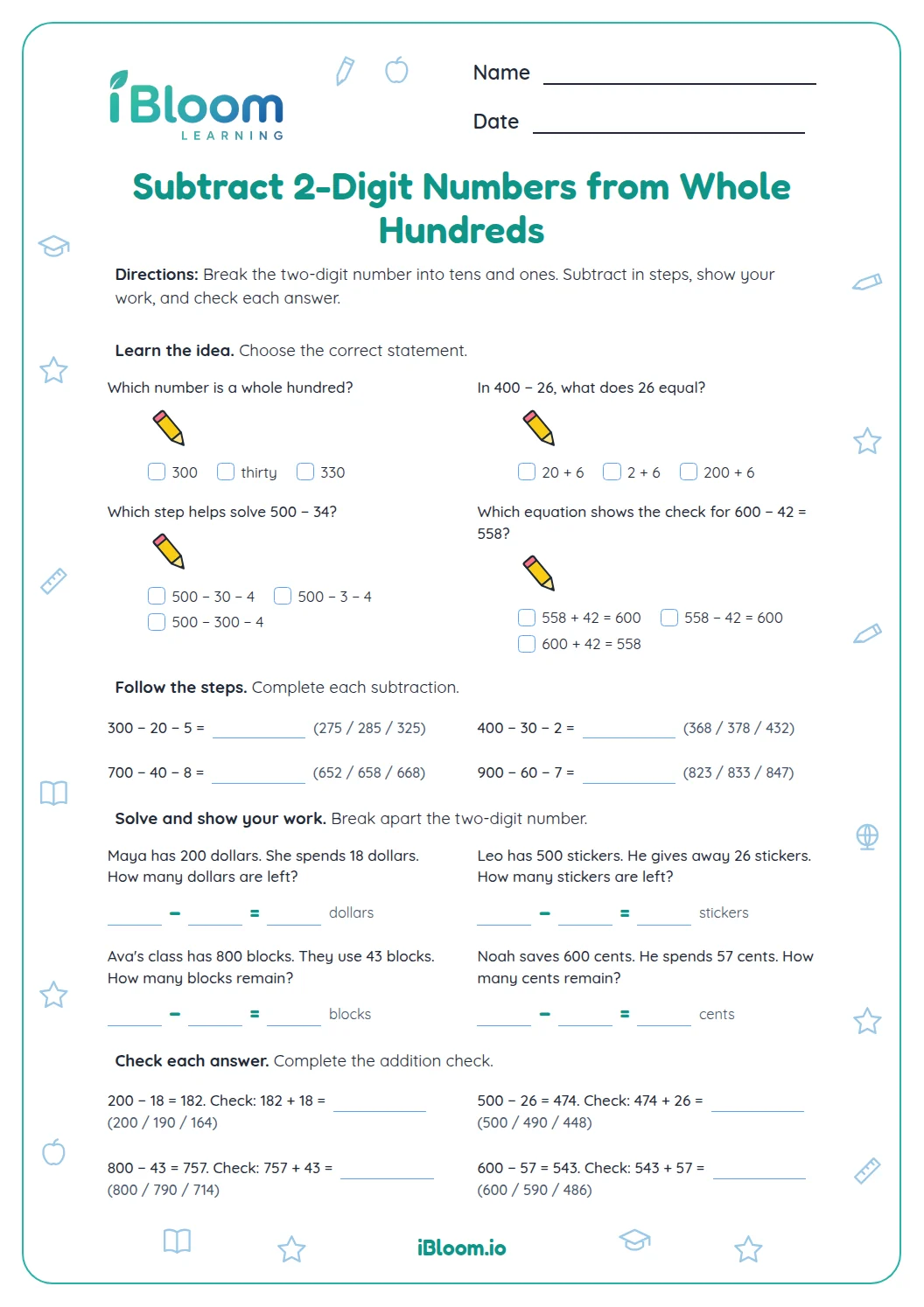
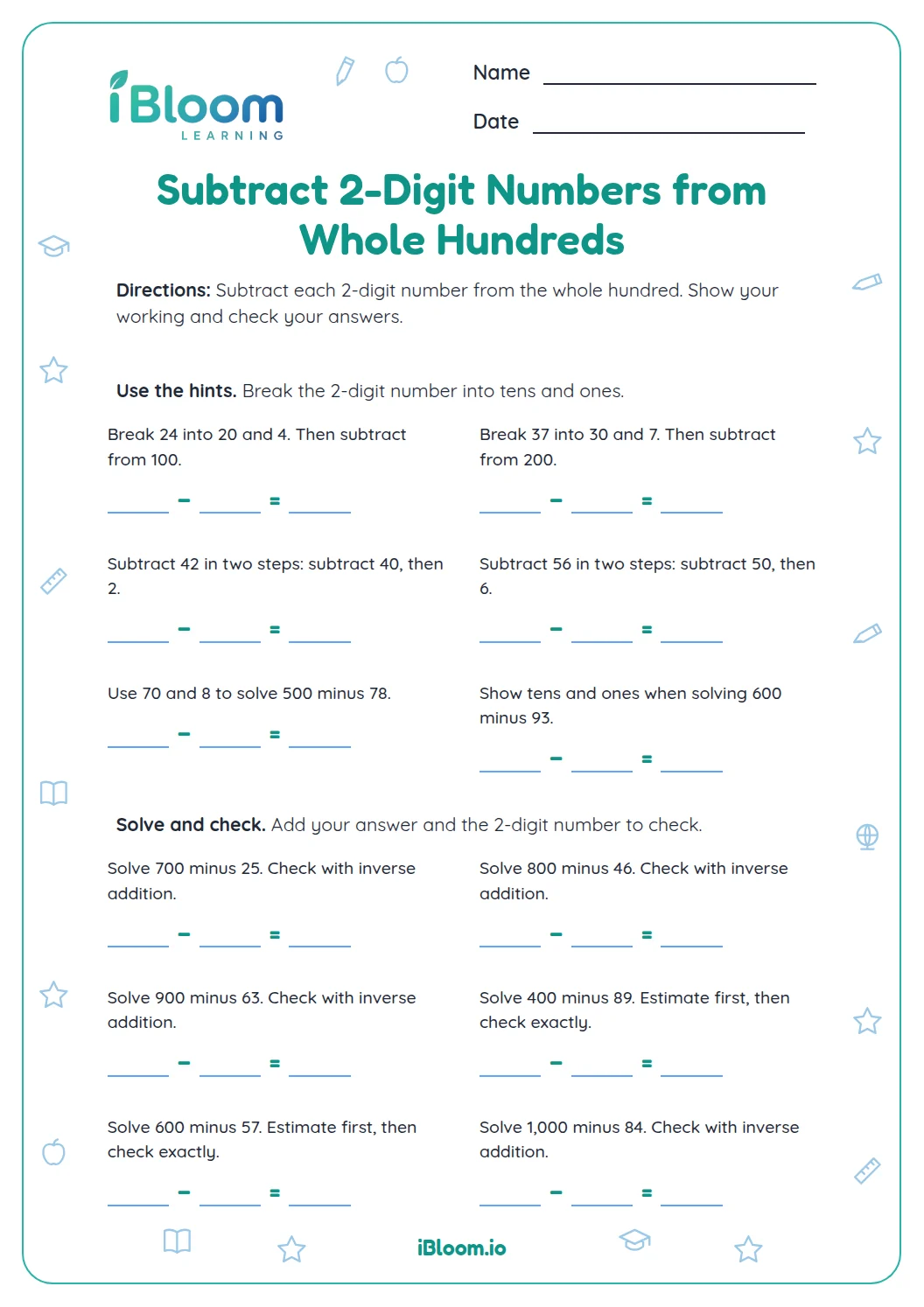
This free Grade 2 subtraction worksheet gives learners repeated practice when a zero in the tens or ones place makes regrouping necessary. The 14 questions start with two base-ten block models, continue with subtraction equations, and end with short story problems. Children exchange a hundred for tens or a ten for ones, then connect those place-value trades to a written difference. The work aligns with Common Core 2.NBT.B.7, which includes decomposing hundreds and tens in three-digit subtraction. The answer key is included on a separate page.
Aligned to 2.NBT.B.7
What does a zero place mean when subtracting?
A zero means there are no tens or ones in that place to take away. You can decompose a larger place: 302 can be renamed as 2 hundreds, 10 tens, and 2 ones. If the ones still are too few, exchange one ten for 10 ones.
How do blocks show a subtraction across zero?
Start with 302. To subtract 148, exchange one hundred for ten tens. Then exchange one of those tens for ten ones. Subtract 8 ones from 12, 4 tens from 9, and 1 hundred from 2.
- 1302 − 148
- 2Rename 302 as 2 hundreds, 9 tens, and 12 ones.
- 3Subtract: 12 − 8 = 4; 9 − 4 = 5; 2 − 1 = 1.
- 4Answer: 154
What is in each part of the worksheet?
Part A pairs two subtraction problems with base-ten block drawings. Part B gives seven equations to solve, and Part C uses five short situations about books, trails, tiles, tickets, and blocks.
Use the written method or blocks to make each exchange clear. For a story problem, name what the final number counts.
How to use this worksheet
- 1Read the minuend and subtrahend in each place.
- 2If a place has too few units, trade from the next place to the left.
- 3When a zero blocks the trade, continue left until you reach a place with units.
- 4Subtract ones, tens, then hundreds.
- 5Check by adding the difference to the number subtracted.
Common mistakes and quick fixes
The mistake
Subtracting a digit from zero without trading.
The fix
Trade from the next place; if it is also zero, keep moving left.
The mistake
Forgetting to reduce the place that was traded.
The fix
After trading one hundred, record one fewer hundred and ten more tens.
The mistake
Changing the number value during a trade.
The fix
Remember that one hundred equals ten tens and one ten equals ten ones.
Curriculum alignment
This practice connects the worksheet tasks with the listed learning standard.
Subtract three-digit numbers by place value, composing or decomposing as needed.
On this sheet: The models and written problems practice decomposing across a zero while subtracting within 1,000.
Show the official wordingHide the official wording
Add and subtract within 1000, using concrete models or drawings and strategies based on place value, properties of operations, and/or the relationship between addition and subtraction; relate the strategy to a written method. Understand that in adding or subtracting three-digit numbers, one adds or subtracts hundreds and hundreds, tens and tens, ones and ones; and sometimes it is necessary to compose or decompose tens or hundreds.
What to practice next
Make more practice
Further reading
Questions parents and teachers ask
What does regrouping across a zero mean?
Regrouping across a zero means exchanging a hundred or ten when a place has no units available to subtract. For example, 302 can be renamed as 2 hundreds, 9 tens, and 12 ones. The place-value exchanges keep the total value unchanged.
How many problems are on this worksheet?
The worksheet has 14 questions in three parts: two modeled subtractions, seven number sentences, and five word problems. The answer key is separate. Each problem subtracts three-digit numbers across a zero and asks learners to connect place-value trades with a difference.
How can base-ten blocks help?
Blocks make the exchanges visible. A hundred flat can be traded for ten tens, and a ten can be traded for ten ones. The first two problems show starting quantities with base-ten blocks; learners can use the same exchange idea to solve the equations that follow.
Why do students need to regroup twice?
In 302 − 148, there are too few ones, and after exchanging a hundred there still are too few tens. Rename 302 as 2 hundreds, 9 tens, and 12 ones. Then subtract 8 from 12, 4 from 9, and 1 from 2 to get 154.
What should I check in an answer?
Check that each exchange keeps the same total value, then add the difference to the amount subtracted. For example, the check for 302 − 148 = 154 is 154 + 148 = 302. For a story problem, include the object or unit in the answer.
Is there an answer key?
Yes. The separate answer key lists all 14 answers, including units or objects for the story problems. If an answer is incorrect, review the regrouping in each place and use addition to check the final difference. Review the place-value exchanges with the learner as needed.