



About this worksheet
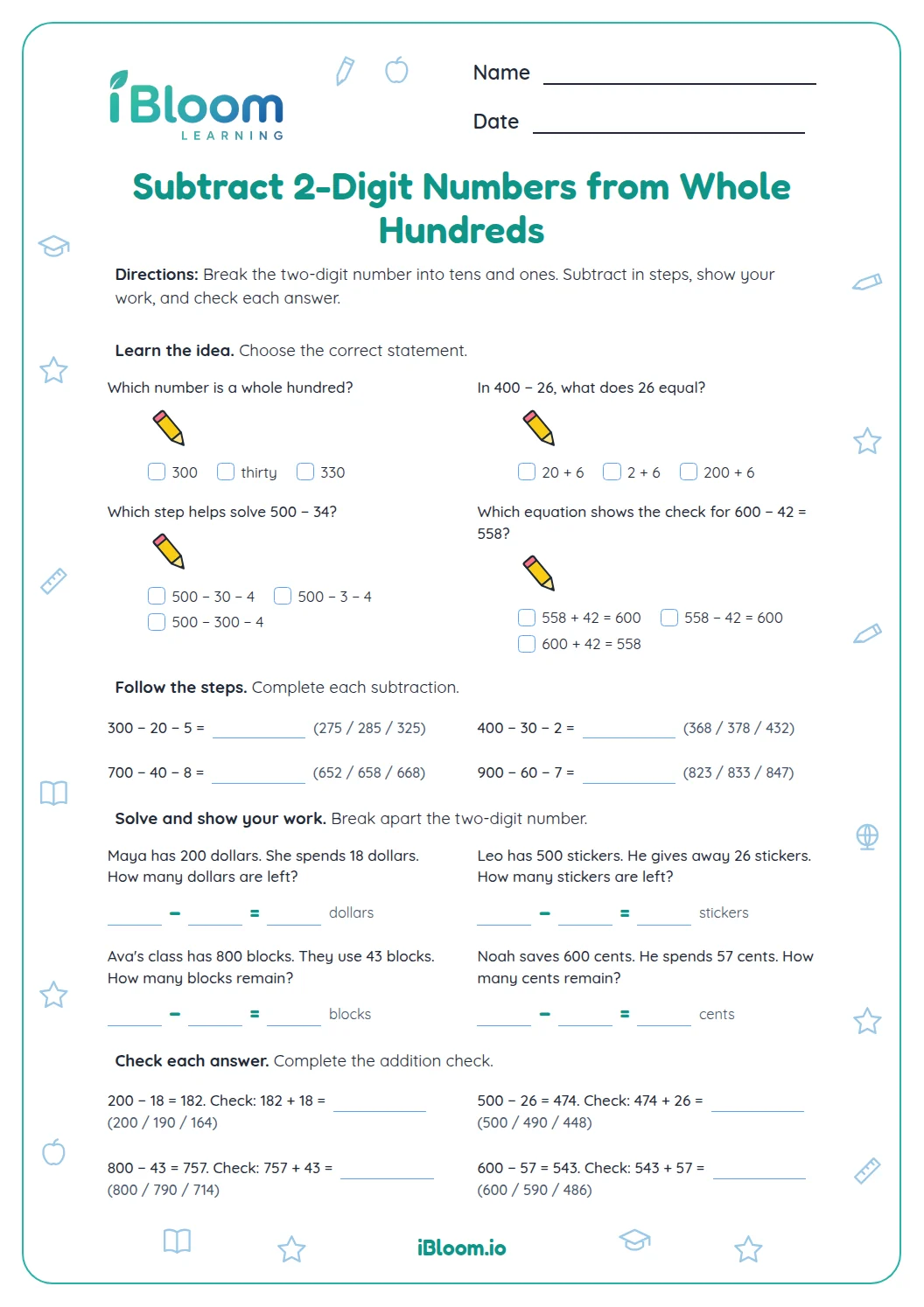
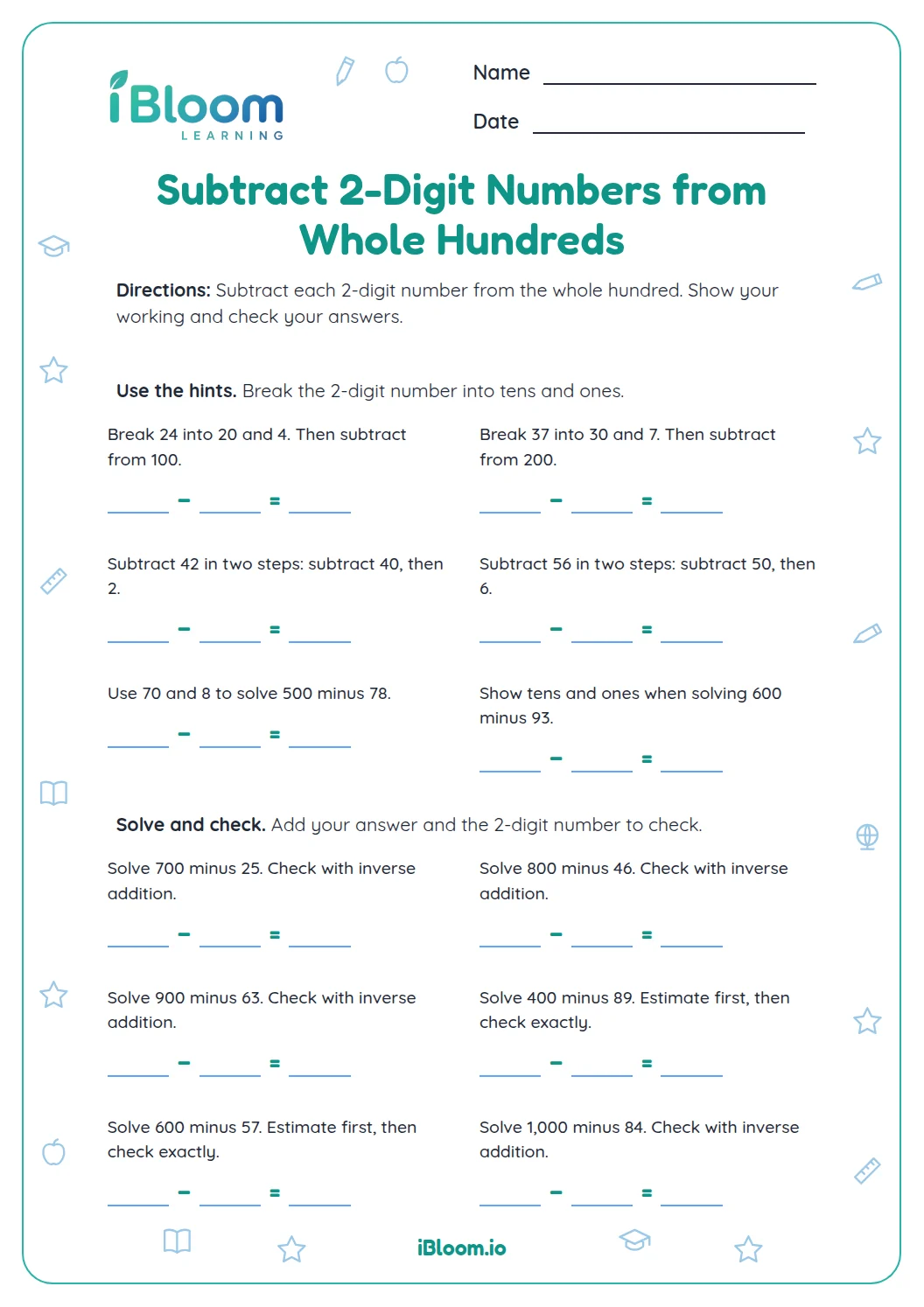
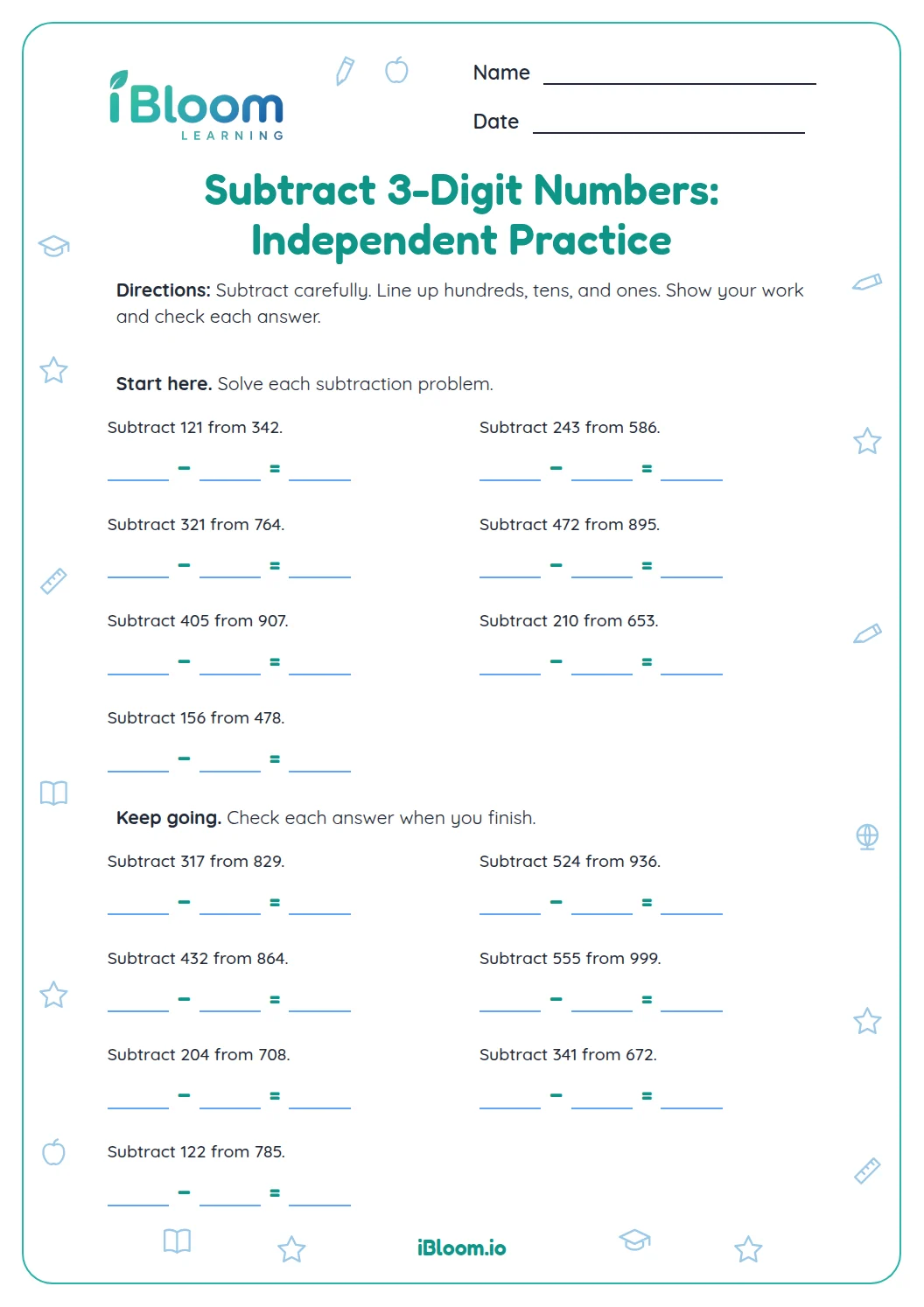
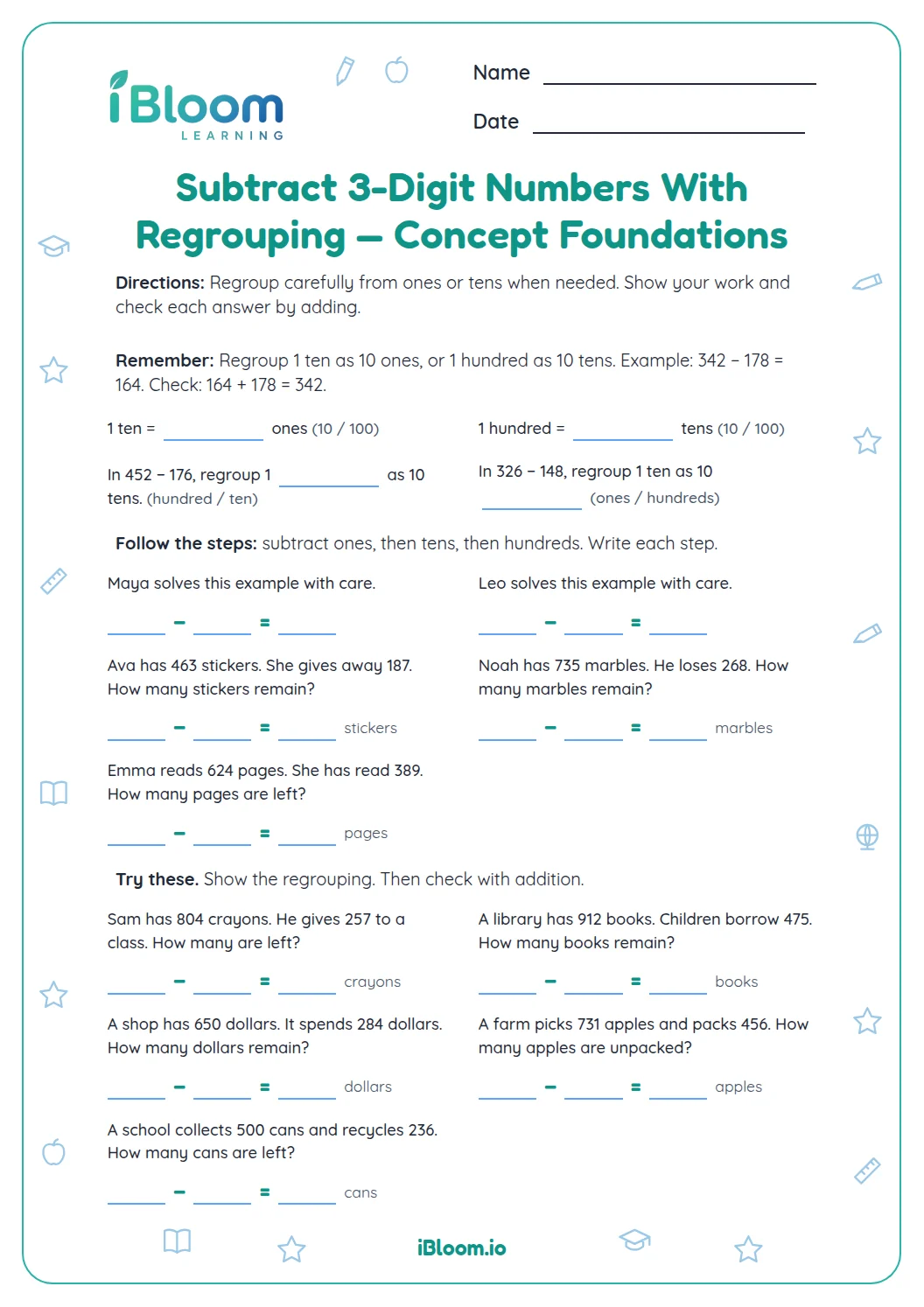
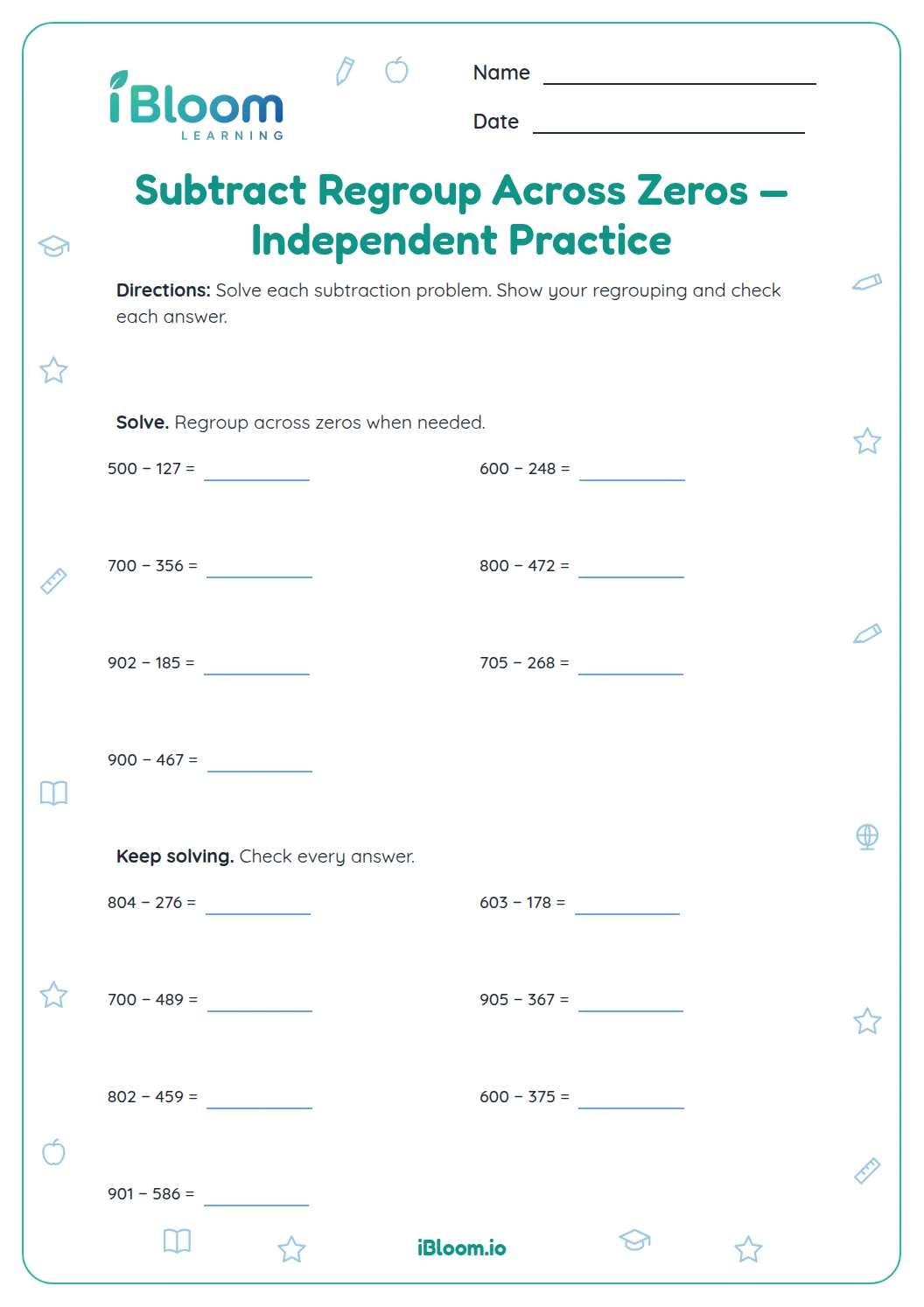
This printable Grade 2 subtraction worksheet focuses on taking a two-digit number away from a whole hundred. Children solve 12 number sentences, including regrouping across a zero, and then apply the same skill in four short stories with space for working. The separate answer key lists the differences. The problems stay within 1,000 and connect subtraction to place-value thinking.
Aligned to 2.NBT.B.7
Why does a whole hundred need regrouping?
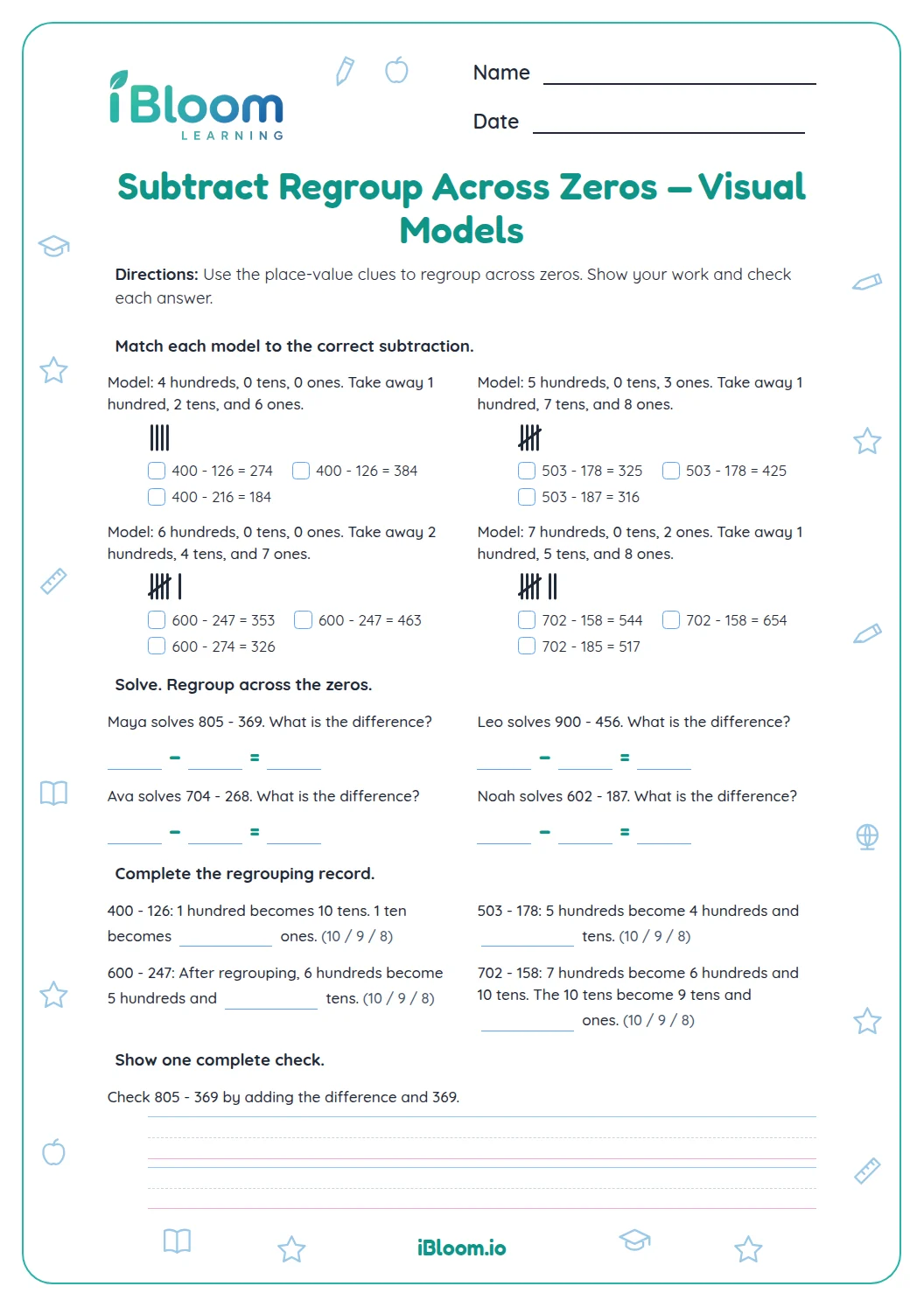
A whole hundred has zero tens and ones. When subtracting a two-digit amount, rename the hundred as tens and then rename one ten as ten ones. For 300 − 12, use 2 hundreds, 9 tens and 10 ones; the difference is 288.
How can I check a difference?
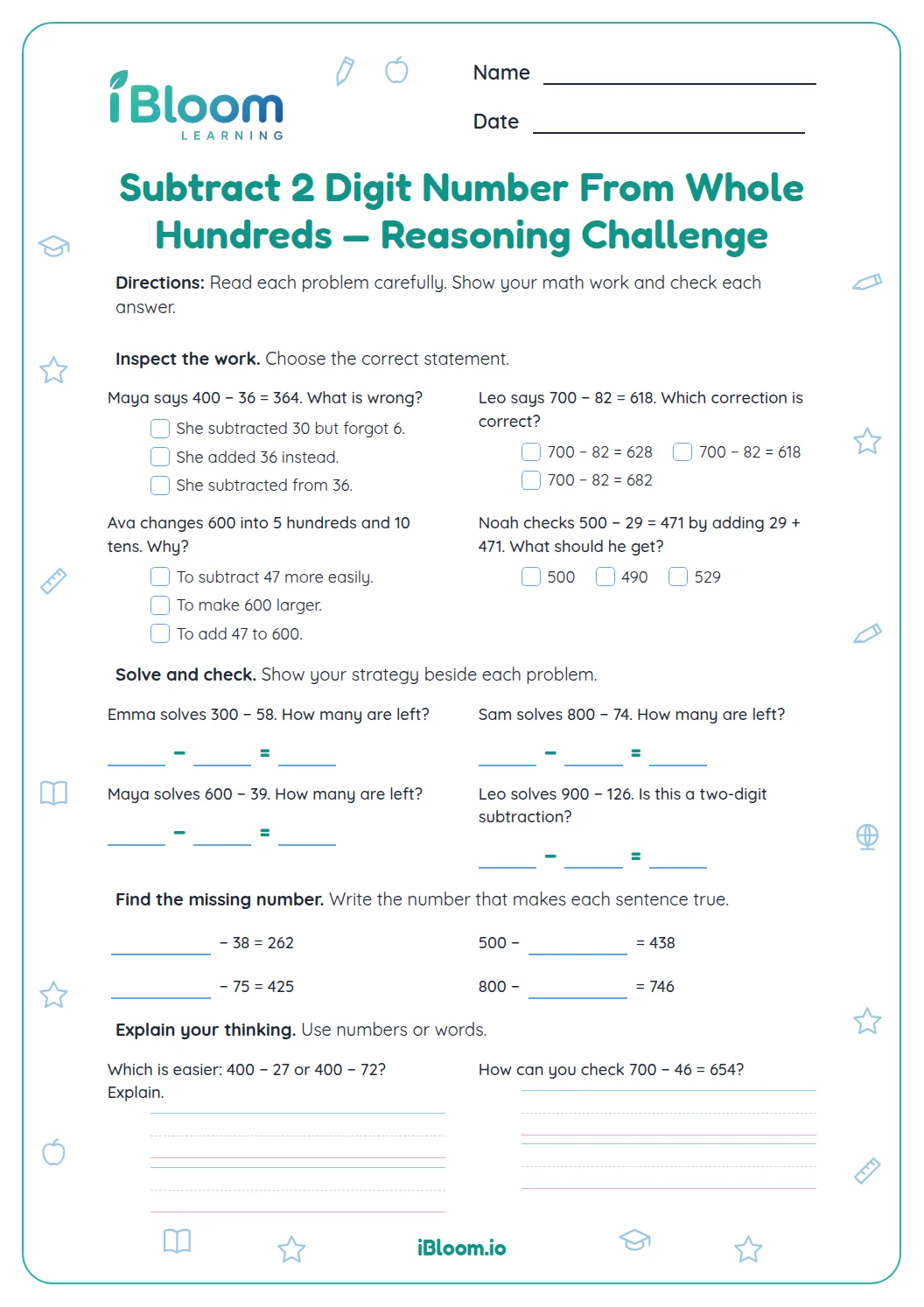
Add the amount taken away to the difference. For example, 288 + 12 = 300, so 300 − 12 = 288. This check works for each number sentence on the page.
How do the stories use subtraction?
Each story begins with a whole hundred and removes a two-digit amount. Underline the starting amount, identify what is taken away, and subtract to find what remains.
What is included in the worksheet?
The worksheet has twelve equations and four story problems. Story questions provide room for a number sentence and work; the answer key gives all sixteen results.
How can I use this page?
- 1Read the whole hundred and the number being subtracted.
- 2Rename one hundred as ten tens if needed.
- 3Regroup one ten as ten ones to subtract the ones digit.
- 4Add the amount subtracted to check your difference.
Common slips and quick fixes
The mistake
Subtracting the digits as though 300 had no hundreds to regroup.
The fix
Rename 300 as 2 hundreds, 9 tens and 10 ones.
The mistake
Writing 298 for 300 − 12 by subtracting only the ones.
The fix
Subtract both 10 and 2; check by adding 12 back.
The mistake
In a story, subtracting the remaining amount from the starting amount in reverse.
The fix
Use starting amount minus amount removed equals amount left.
Common Core alignment
This worksheet practices subtraction within 1,000 using place-value strategies.
Subtract within 1,000 by using place value and composing or decomposing hundreds.
On this sheet: Each item subtracts a two-digit number from a whole hundred using place-value regrouping.
Show the official wordingHide the official wording
Add and subtract within 1000, using concrete models or drawings and strategies based on place value, properties of operations, and/or the relationship between addition and subtraction; relate the strategy to a written method. Understand that in adding or subtracting three-digit numbers, one adds or subtracts hundreds and hundreds, tens and tens, ones and ones; and sometimes it is necessary to compose or decompose tens or hundreds.
What to practice next
Make more practice
Further reading
Questions parents and teachers ask
Why do I need to regroup in 300 − 12?
The number 300 has no tens or ones to subtract 12 directly. Rename one hundred as 10 tens, then trade one of those tens for 10 ones. The result is 288, and adding 12 back confirms the starting amount. The trade keeps the total value the same; it simply gives ones and tens that can be taken away accurately.
What is 500 − 37?
500 − 37 = 463. Rename 500 as 4 hundreds, 9 tens and 10 ones; after taking away 3 tens and 7 ones, 4 hundreds, 6 tens and 3 ones remain. The same check works for any item on this page, including differences that require regrouping across a zero.
How can I check an answer?
Add the subtracted number to your difference. If the sum equals the original whole hundred, the answer checks out. For example, 463 + 37 returns to 500. A correct difference restores the whole hundred when the removed amount is added back to it.
What should my child write for a story problem?
Write the starting amount minus the amount removed, then solve for what remains. The four stories include equation space so children can record the subtraction and their calculation. The key lists the numerical difference, while the story itself gives the context and the worksheet provides space for calculation.
How many questions are included?
There are 16 items: twelve subtraction number sentences and four short word problems. A separate key provides the difference for each question. This mix gives children practice first with direct equations and then with the same subtraction inside a short context.