





About this worksheet
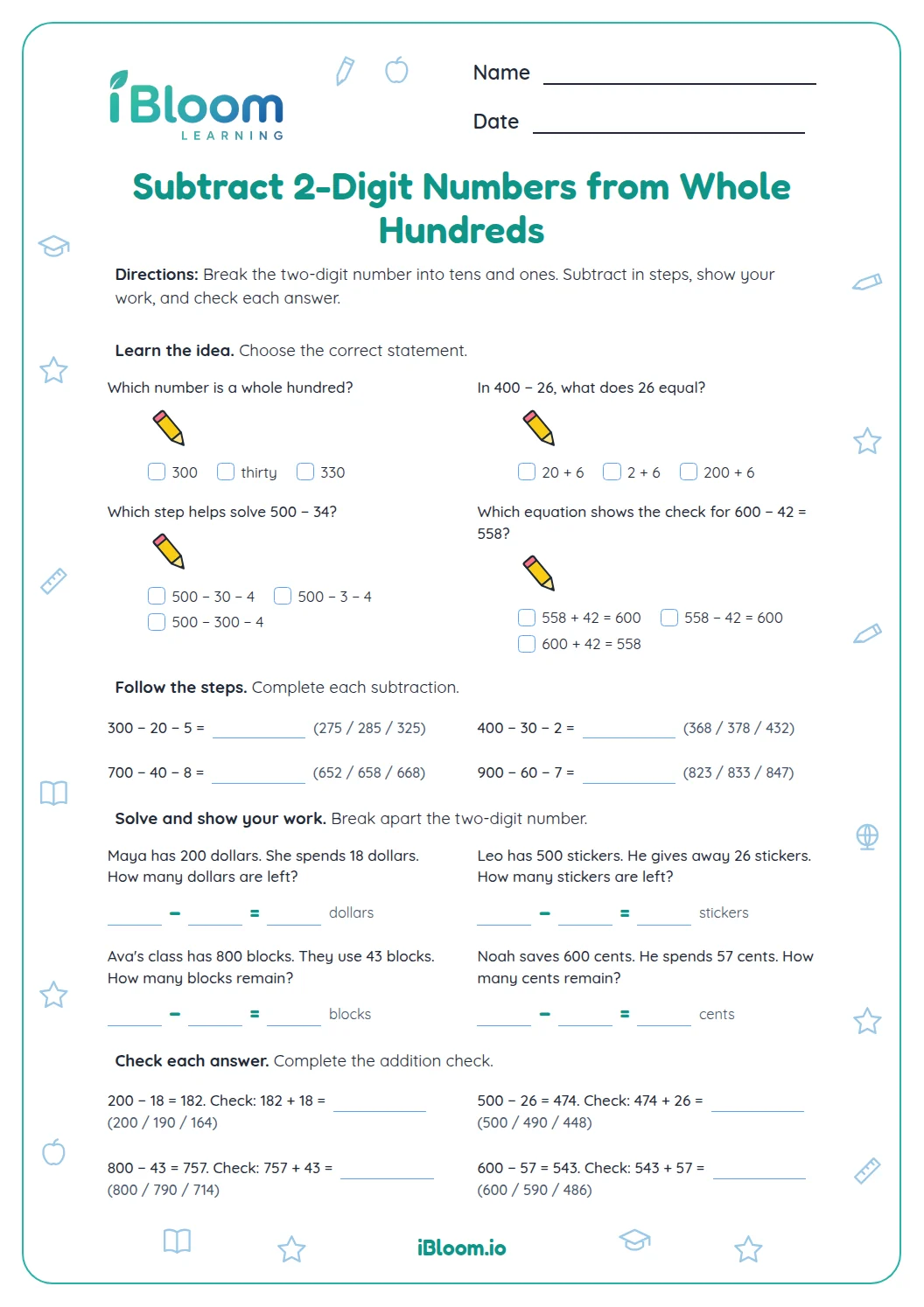
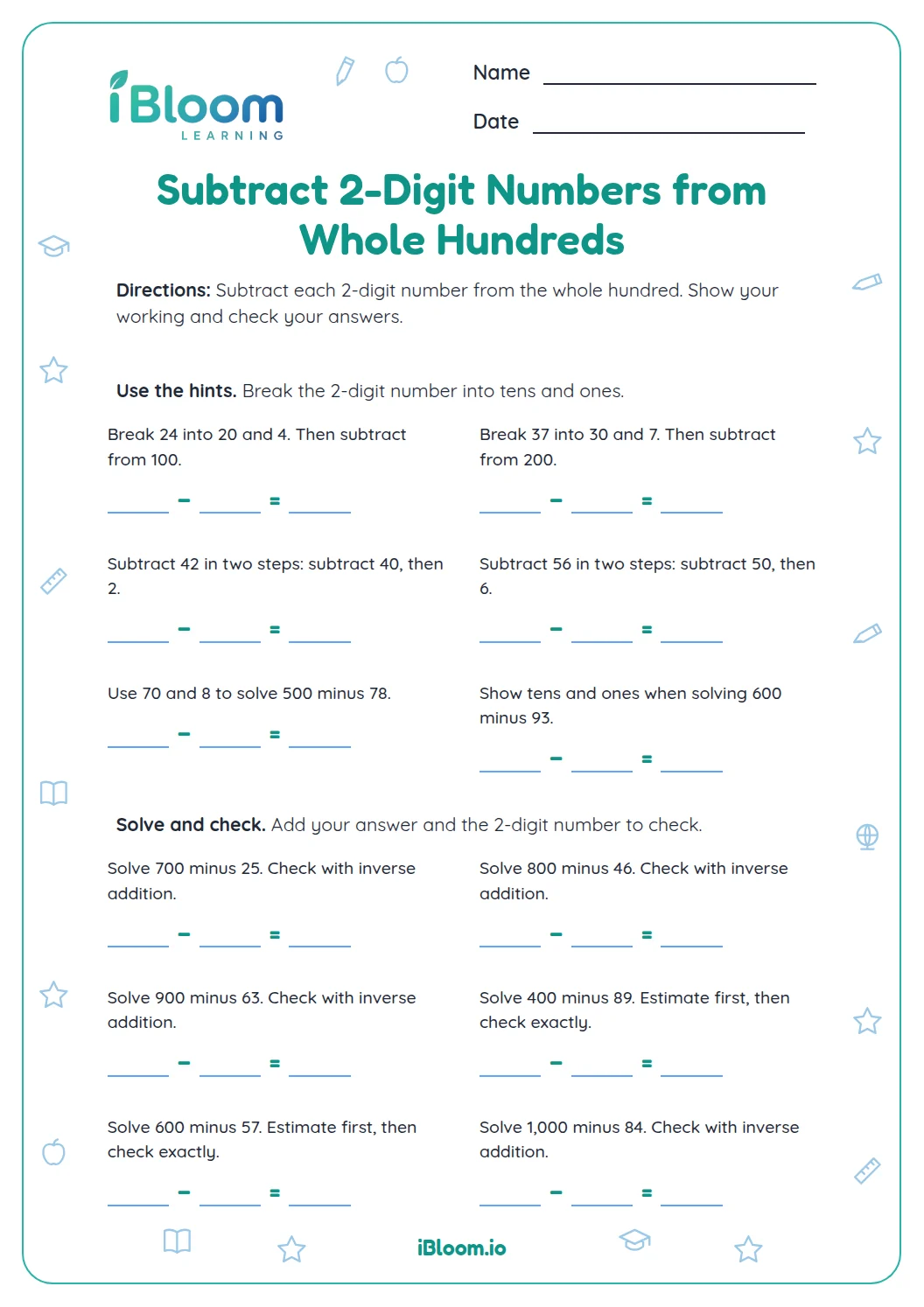
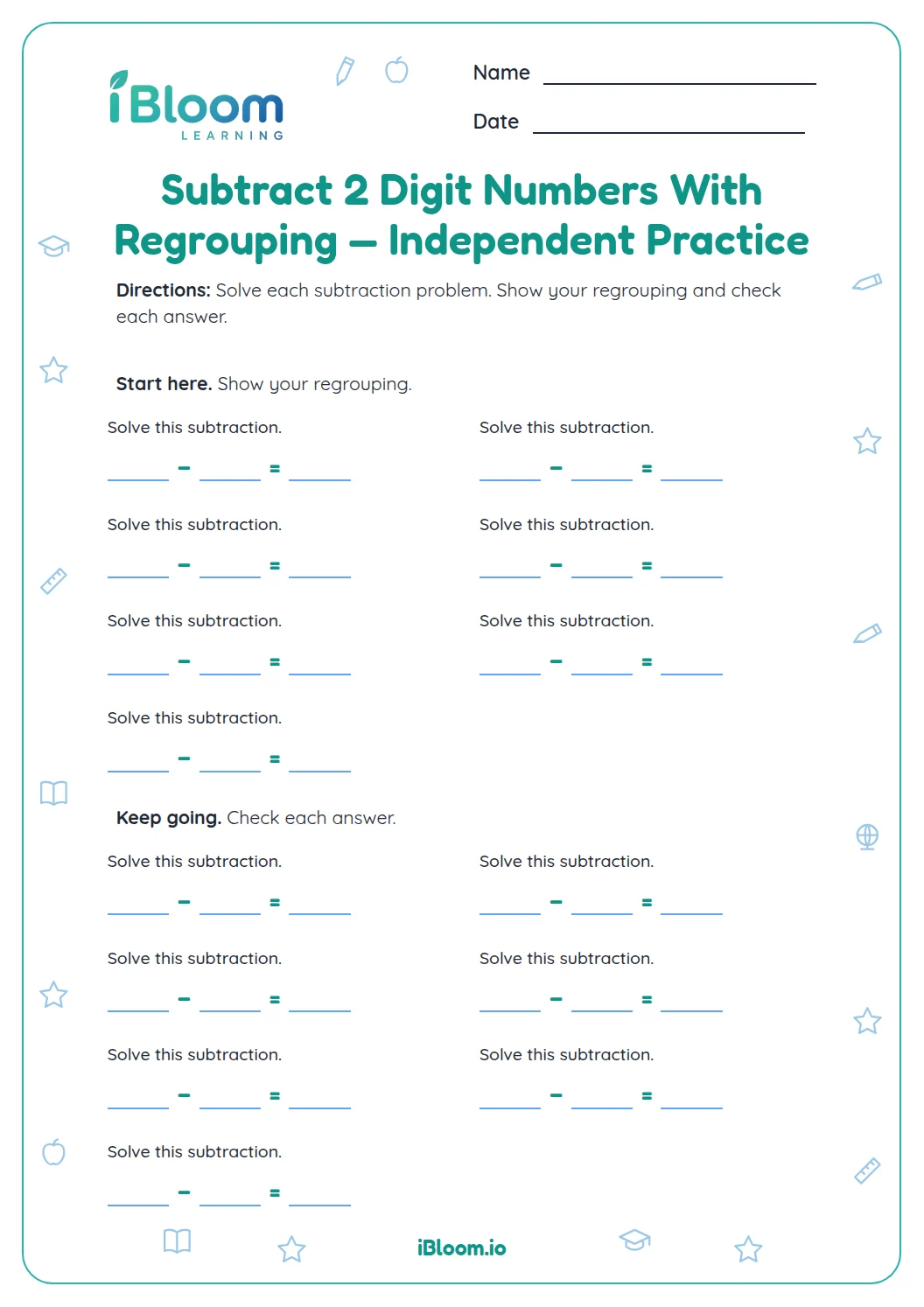
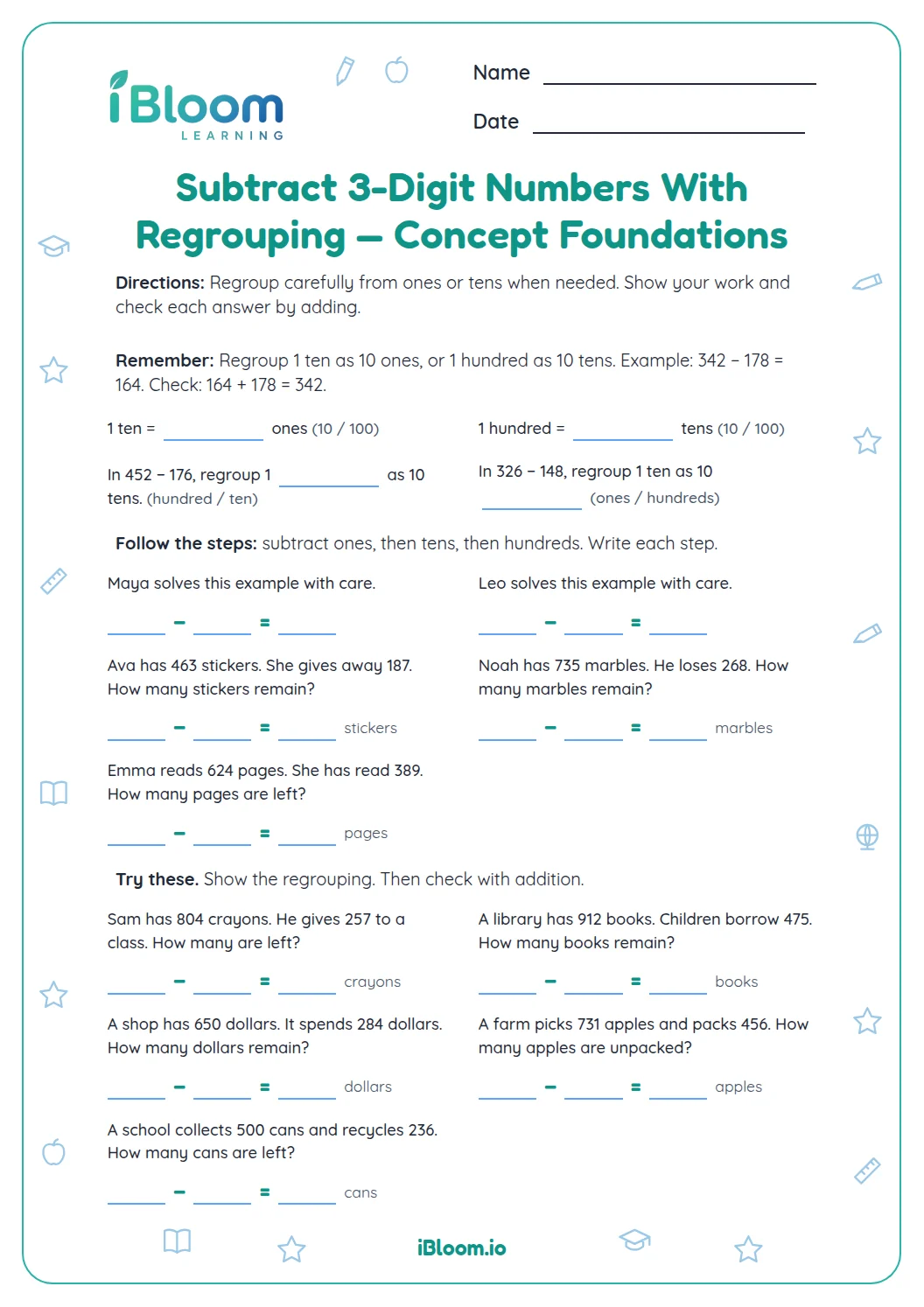
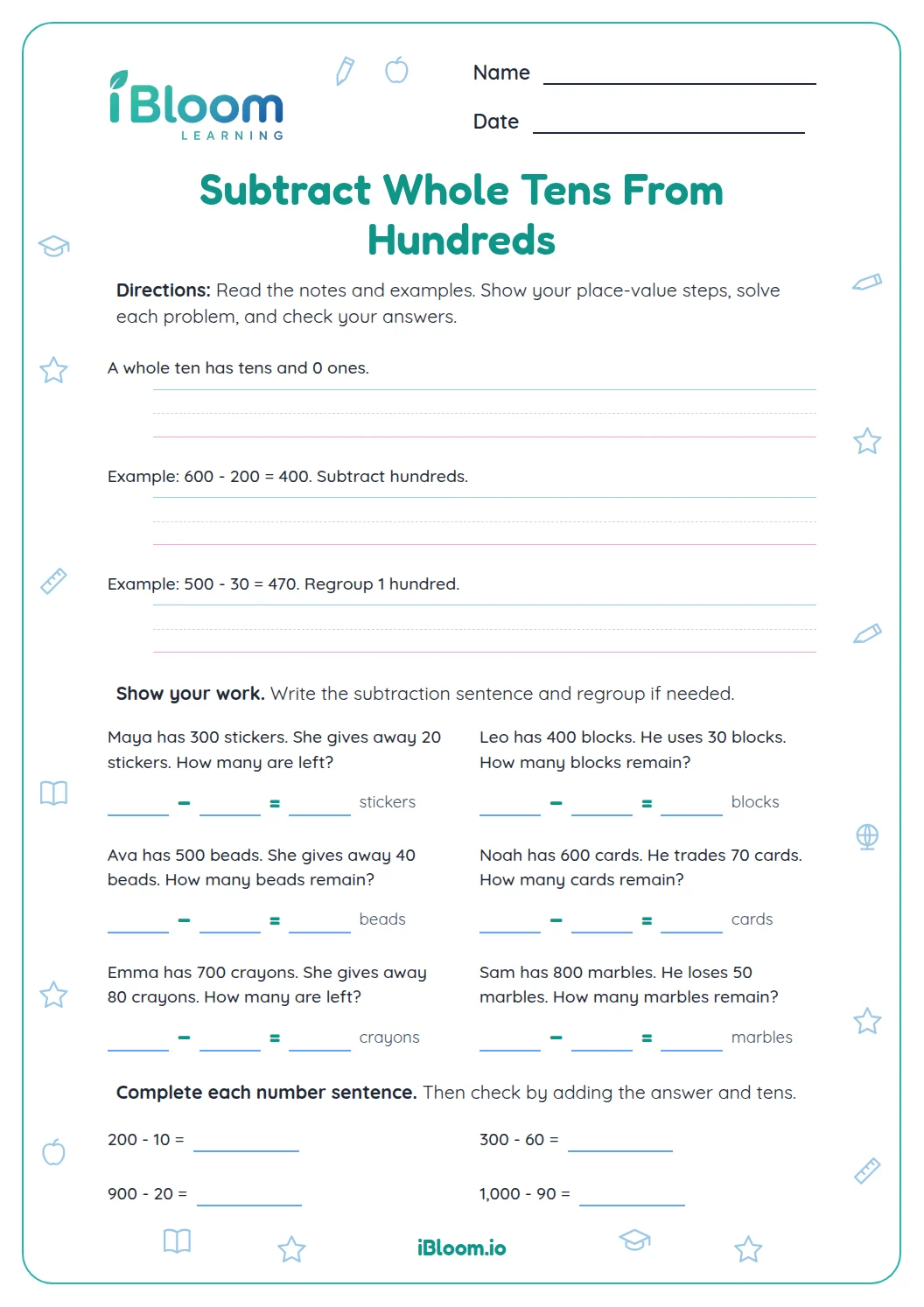
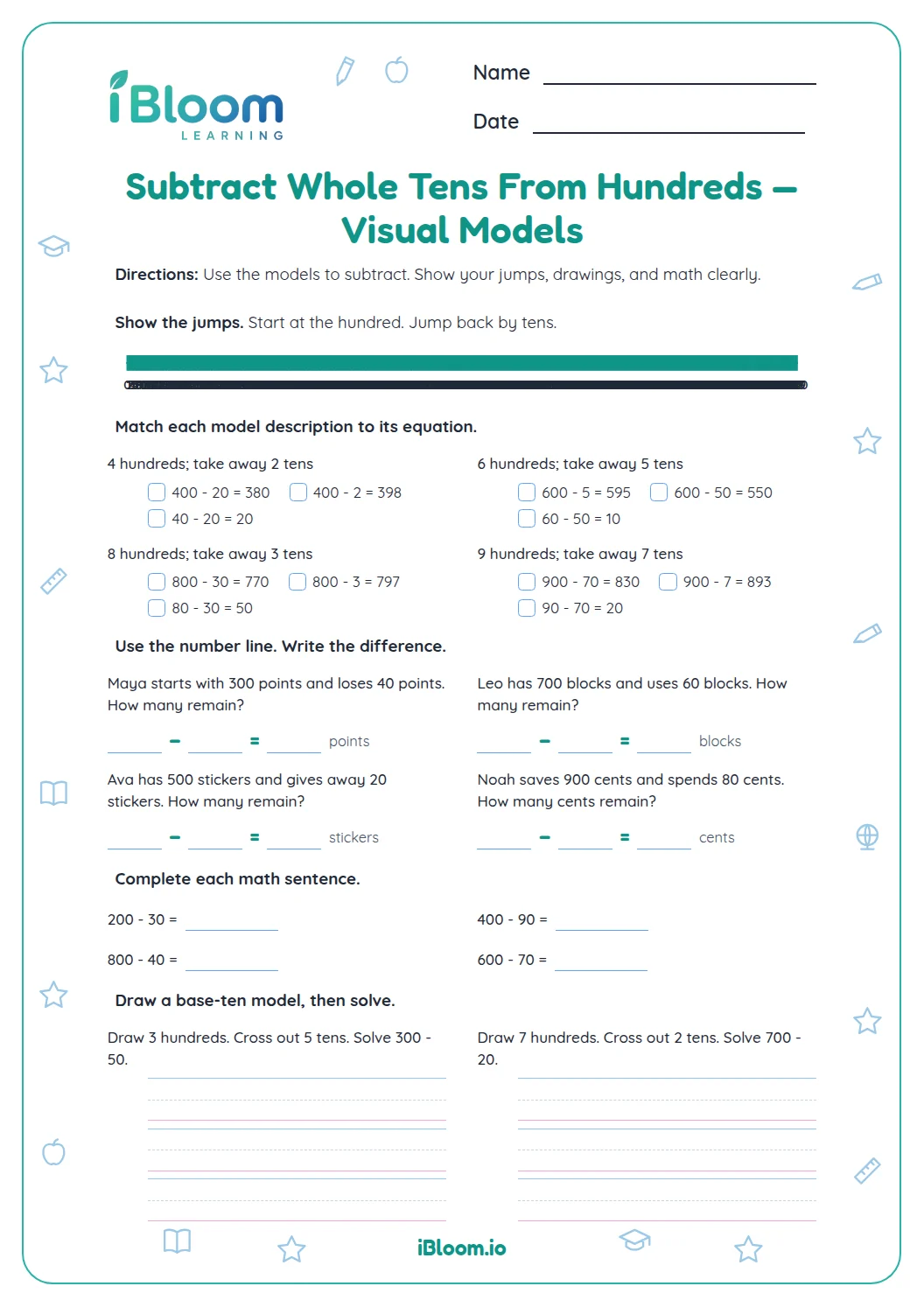
This free Grade 2 printable practices subtracting a two-digit number from a whole hundred. Its stories keep the original contexts: Maya’s stickers, Leo’s bike helmet, farm apples, library books, stadium seats, school pencils, Noah’s tablet case and store balloons. Fourteen questions use short stories, choices and number sentences, with regrouping across zero tens. A separate answer key shows each result.
Aligned to 2.NBT.B.7
How do the story problems become subtraction sentences?
Find the starting amount and what was given away, spent or lent. In question 1, Maya starts with 300 stickers and gives away 42, so write 300 − 42. Subtract 40, then 2, to get 258 stickers.
- 1300 − 42
- 2300 − 40 = 260
- 3260 − 2 = 258 stickers
- 4Check: 258 + 42 = 300
How do the quick choices build confidence?
Questions 5–9 keep the same subtraction skill with shorter responses. The stories ask about empty seats, pencils left, Noah’s savings, balloons remaining, and a subtraction check. Estimate, then add the difference to the amount removed.
What does a missing-number sentence ask?
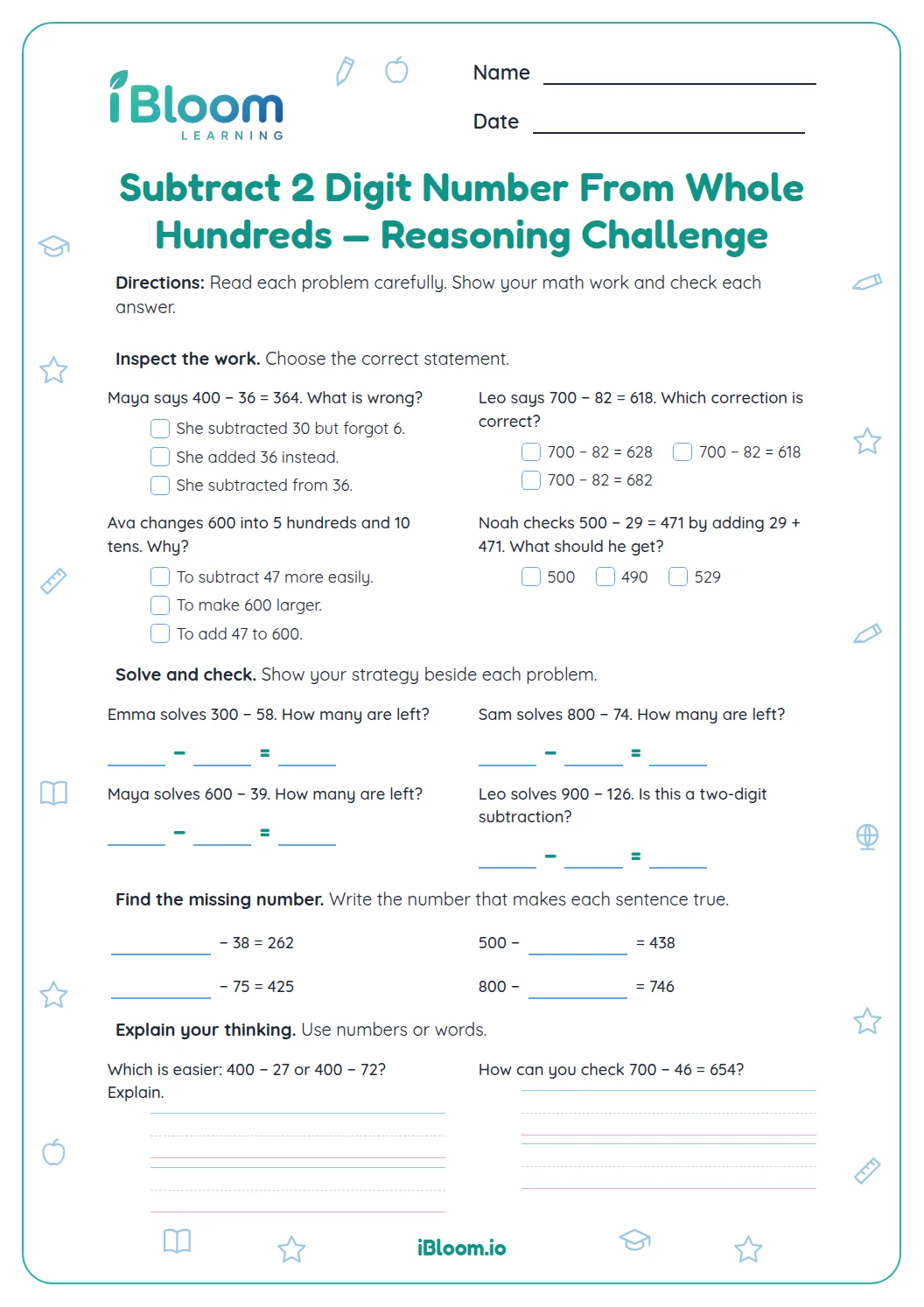
A blank may stand for the difference, the starting number, or the amount subtracted. In question 11, the start is hidden: ___ − 57 = 343. Add 343 + 57 to find 400, then check 400 − 57 = 343.
What is included in the printable?
The two-page worksheet has 14 questions in three parts, followed by a two-page answer key. The first part uses short stories; the later parts use choices and number sentences to make room for more practice.
How to use this worksheet
- 1Read the story and underline the starting amount.
- 2Decide what amount is being taken away.
- 3Write a subtraction sentence before calculating.
- 4Subtract tens, then ones; regroup a hundred when needed.
- 5Check by adding the difference and subtrahend.
Common mistakes and quick fixes
The mistake
Subtracting 4 tens as 4 ones
The fix
Break 42 into 40 and 2, then subtract each part.
The mistake
Forgetting to regroup when subtracting from a zero tens place
The fix
Rename one hundred as 10 tens before subtracting the tens.
The mistake
Giving the amount removed instead of the amount left
The fix
Reread the question and check that the answer is what remains.
Common Core alignment
This sheet practices the standard below through focused examples and independent practice.
Subtract two-digit amounts from whole hundreds and use addition to check.
On this sheet:
Show the official wordingHide the official wording
Add and subtract within 1000, using concrete models or drawings and strategies based on place value, properties of operations, and/or the relationship between addition and subtraction; relate the strategy to a written method. Understand that in adding or subtracting three-digit numbers, one adds or subtracts hundreds and hundreds, tens and tens, ones and ones; and sometimes it is necessary to compose or decompose tens or hundreds.
What to practice next
Make more practice
Further reading
Questions parents and teachers ask
What does this worksheet practice?
It practices subtracting a two-digit number from a whole hundred, such as 300 − 42. The stories, choices and blanks all ask students to find a difference or a missing part in that same relationship. Name what the difference counts, then add it to the amount removed to check the original whole hundred.
How many questions are on the printable?
There are 14 questions across three parts. Four are short stories, five use answer choices, and five are missing-number sentences. A separate answer key is provided for checking the work. Name what the difference counts, then add it to the amount removed to check the original whole hundred.
How can a child check 300 − 42?
Add the difference to 42. If the subtraction gives 258, then 258 + 42 = 300, so the answer checks. This reverse addition check works for the story problems and the missing-number sentences. Name what the difference counts, then add it to the amount removed to check the original whole hundred.
Does this worksheet include regrouping?
Yes. Several problems require regrouping because a whole hundred has zero tens and ones, while the amount subtracted has both. Children can rename one hundred as ten tens and continue subtracting by place value. Name what the difference counts, then add it to the amount removed to check the original whole hundred.
How long should the worksheet take?
Plan for about 20 minutes, depending on whether the student writes out each subtraction method. The four stories invite a written equation, while the later questions use shorter answers to keep the practice focused. Name what the difference counts, then add it to the amount removed to check the original whole hundred.