



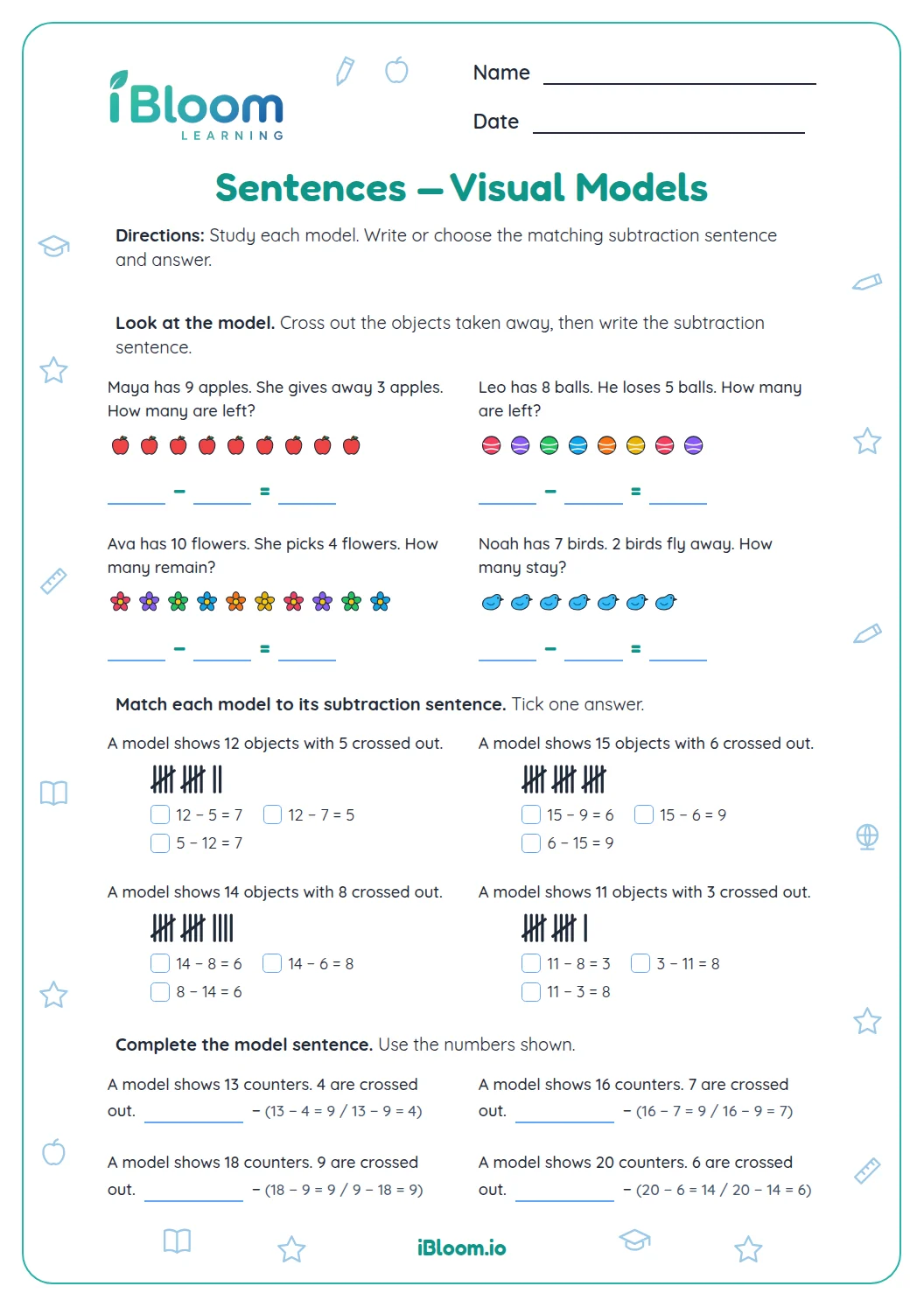
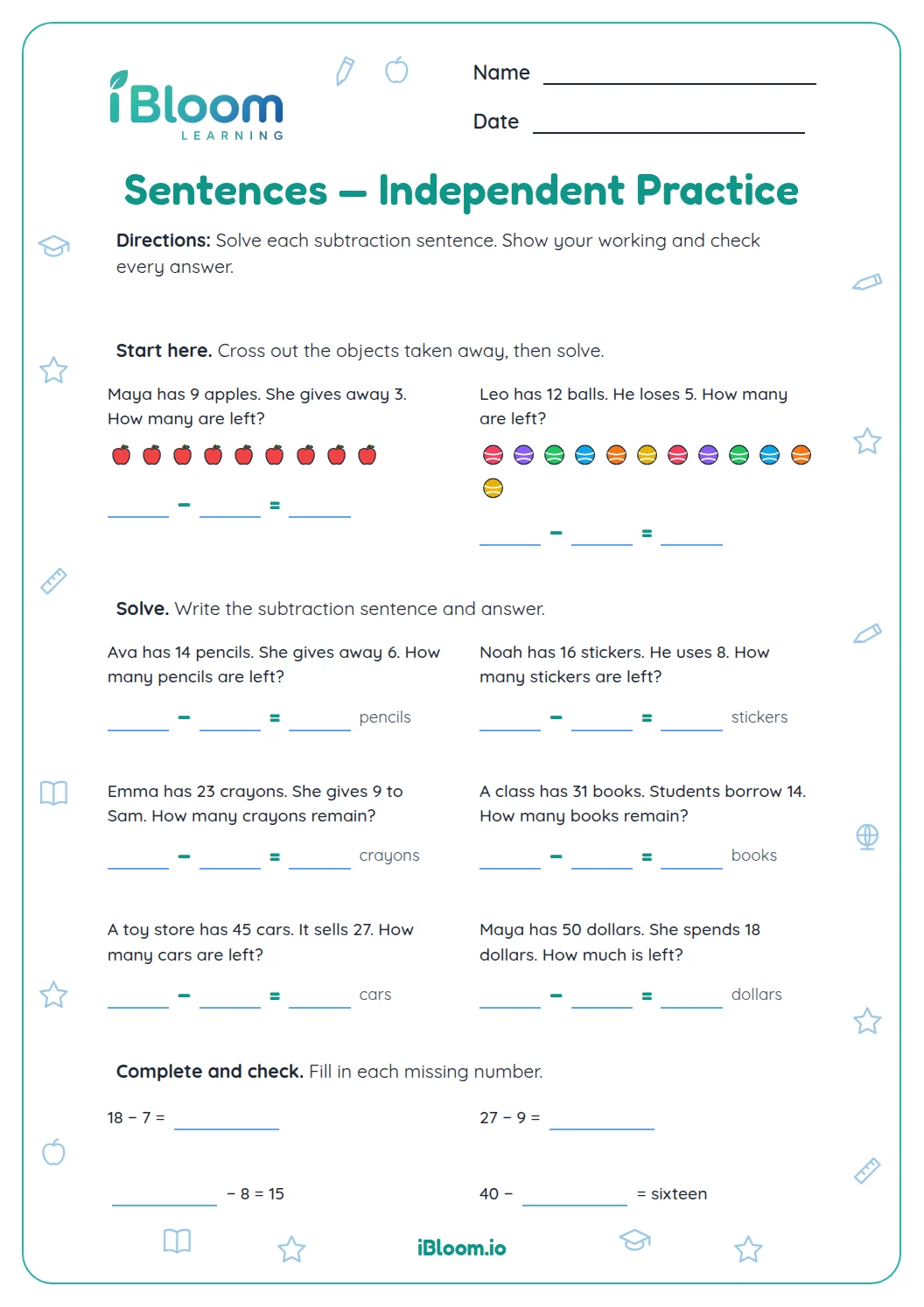
About this worksheet
This Grade 2 worksheet practices missing numbers in three-digit subtraction when the amount taken away is one digit. Number lines and base-ten blocks connect the equations to distance and place value. The 14 questions include missing minuends, subtrahends, and differences, plus two model-matching choices and four story problems. A separate answer key is included. The page aligns its subtraction work with CCSS 2.NBT.B.7.
Aligned to 2.NBT.B.7
What does the blank stand for?
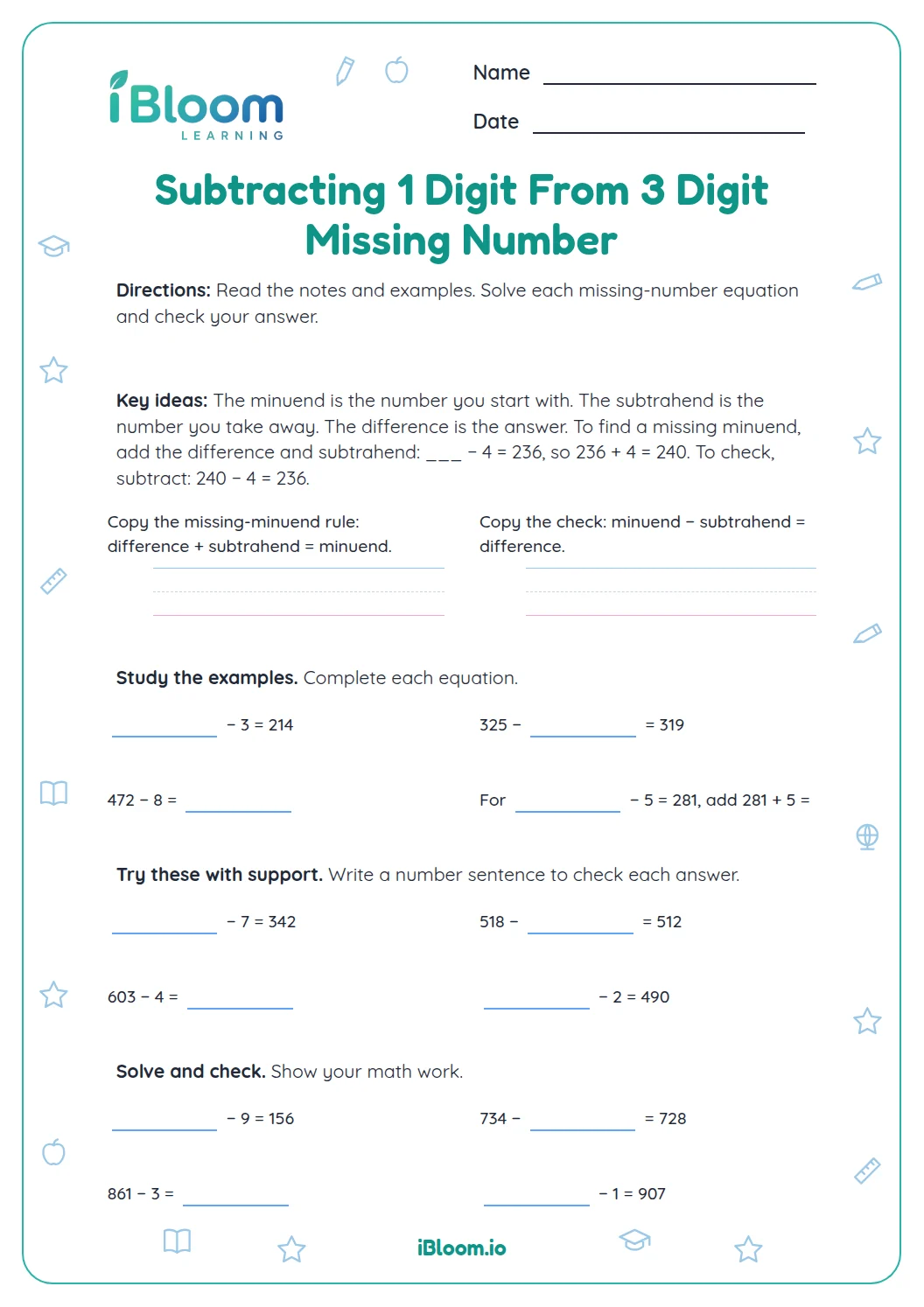
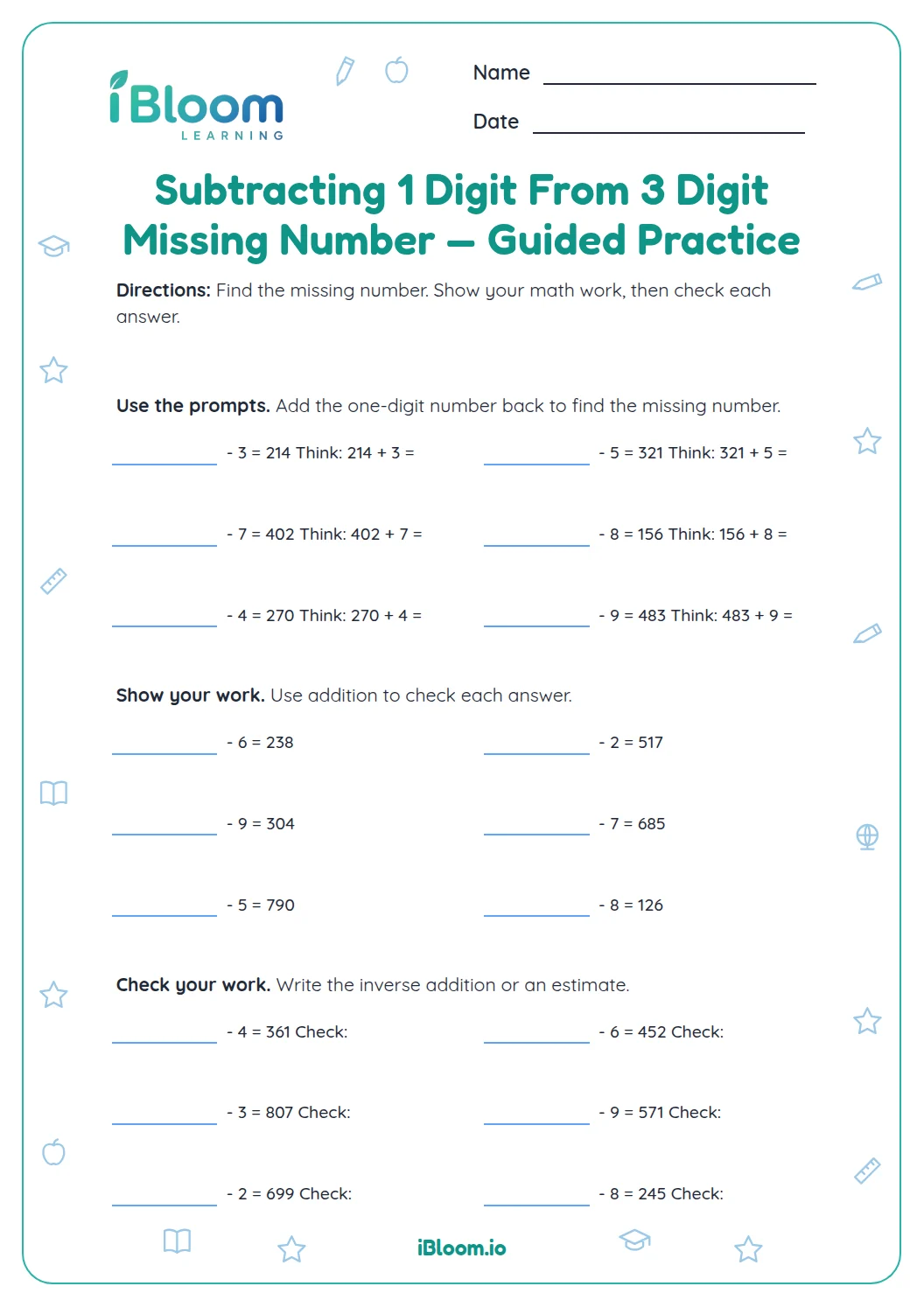
A blank before the minus sign is the starting amount. A blank after it is the amount taken away. A blank after the equal sign is the difference. In ___ − 7 = 352, add 352 and 7 to find 359.
- 1___ − 7 = 352
- 2352 + 7 = 359
- 3The missing starting number is 359.
How do the models support subtraction?
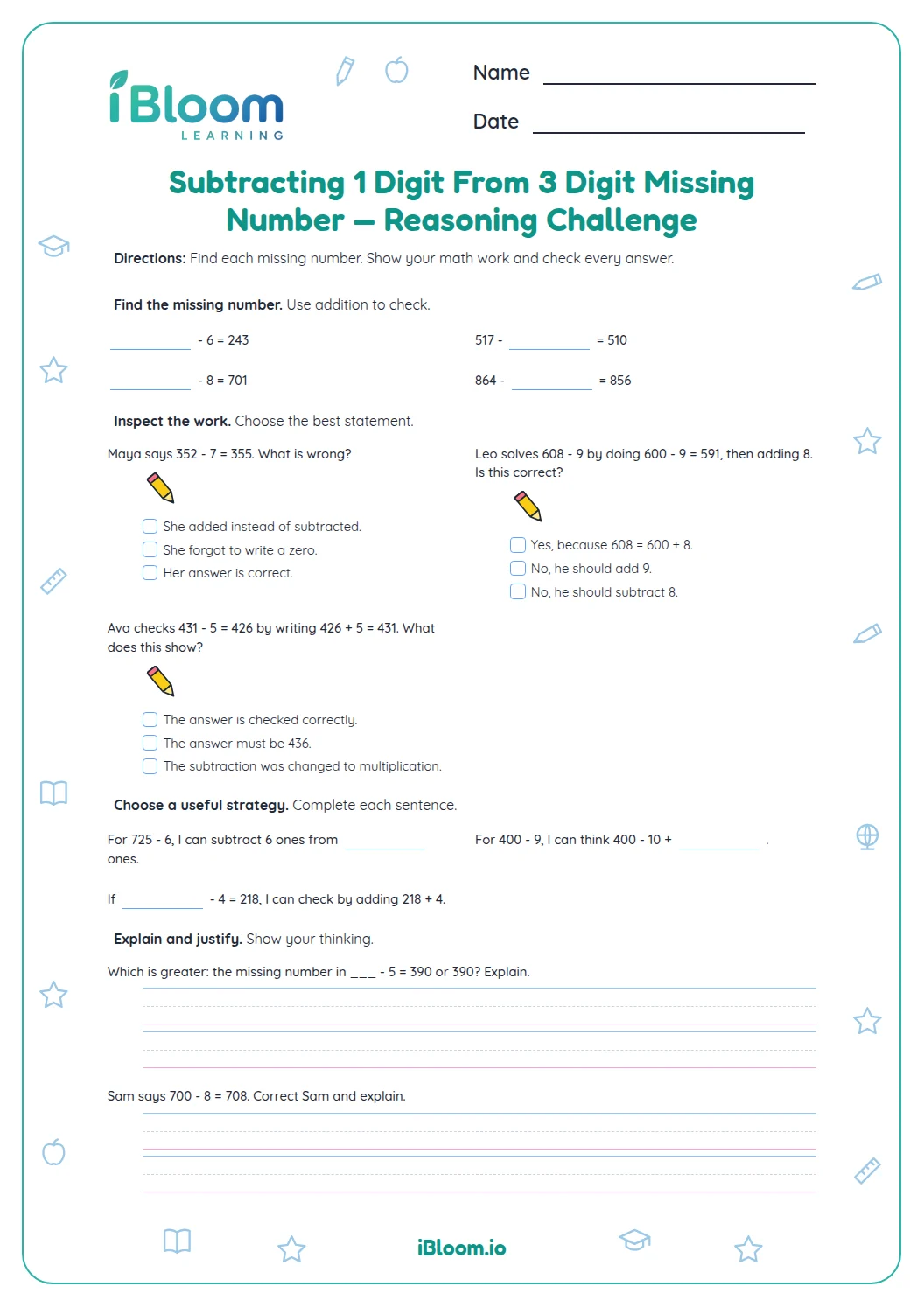
A number line shows the distance from 352 to 359 as seven jumps. Base-ten blocks show hundreds, tens, and ones, helping connect the written number to its digits. The choice questions ask which true equation matches the shown values.
- Part A: solve equations with one missing number
- Part B: match models to true subtraction sentences
- Part C: solve four subtraction stories
How can addition check the answer?
For 486 − ___ = 480, the difference between 486 and 480 is 6. Add 480 + 6 to check that the total returns to 486.
How to use this worksheet
- 1Locate the blank in the equation.
- 2Name whether it is the starting number, amount removed, or difference.
- 3Use the known numbers to add or subtract.
- 4Read the number line or base-ten model before choosing.
- 5Check by adding the difference and amount removed.
Common mistakes and quick fixes
The mistake
Treating every blank as the difference.
The fix
Check its position before calculating.
The mistake
Subtracting a smaller amount from the difference for a missing starting number.
The fix
Add the amount removed to what remains: 352 + 7 = 359.
The mistake
Choosing an equation with a false answer.
The fix
Calculate both sides and confirm the subtraction sentence is true.
Common Core alignment
This page practices model subtraction with hundreds, tens, and ones, then connect it to an equation..
Model subtraction with hundreds, tens, and ones, then connect it to an equation.
On this sheet: Base-ten drawings support three-digit subtraction and regrouping.
Show the official wordingHide the official wording
Add and subtract within 1000, using concrete models or drawings and strategies based on place value, properties of operations, and/or the relationship between addition and subtraction; relate the strategy to a written method. Understand that in adding or subtracting three-digit numbers, one adds or subtracts hundreds and hundreds, tens and tens, ones and ones; and sometimes it is necessary to compose or decompose tens or hundreds.
What to practice next
Make more practice
Further reading
Questions parents and teachers ask
What can the missing number represent?
It can be the starting number, the amount taken away, or the difference. In 615 − ___ = 606, the blank is the amount removed, 9. In ___ − 7 = 352, it is the starting number, 359. Read the blank’s position before solving.
How does the number line help?
A number line makes the difference between two values visible. The model in question 8 starts at 528 and moves back four one-unit jumps to 524. That matches 528 − 4 = 524, the true subtraction sentence shown in the choices.
How can addition check a missing number?
Add the difference and the amount removed. For 486 − 6 = 480, calculate 480 + 6; it returns to 486. The same check works when the starting number is missing: 352 + 7 = 359, so 359 − 7 = 352.
What do the base-ten blocks show?
The blocks represent the value of each digit. Three hundreds, six tens, and one one make 361. Taking away 8 gives 353, so the matching true sentence is 361 − 8 = 353. The model question helps connect the written number to its place values.
How many questions are on the sheet?
There are 14 questions across three parts: seven equations, three model-matching choices, and four story problems. Each subtraction removes a one-digit number from a three-digit starting value, or asks for one of those values. The separate answer key lists each solution.