
About this worksheet
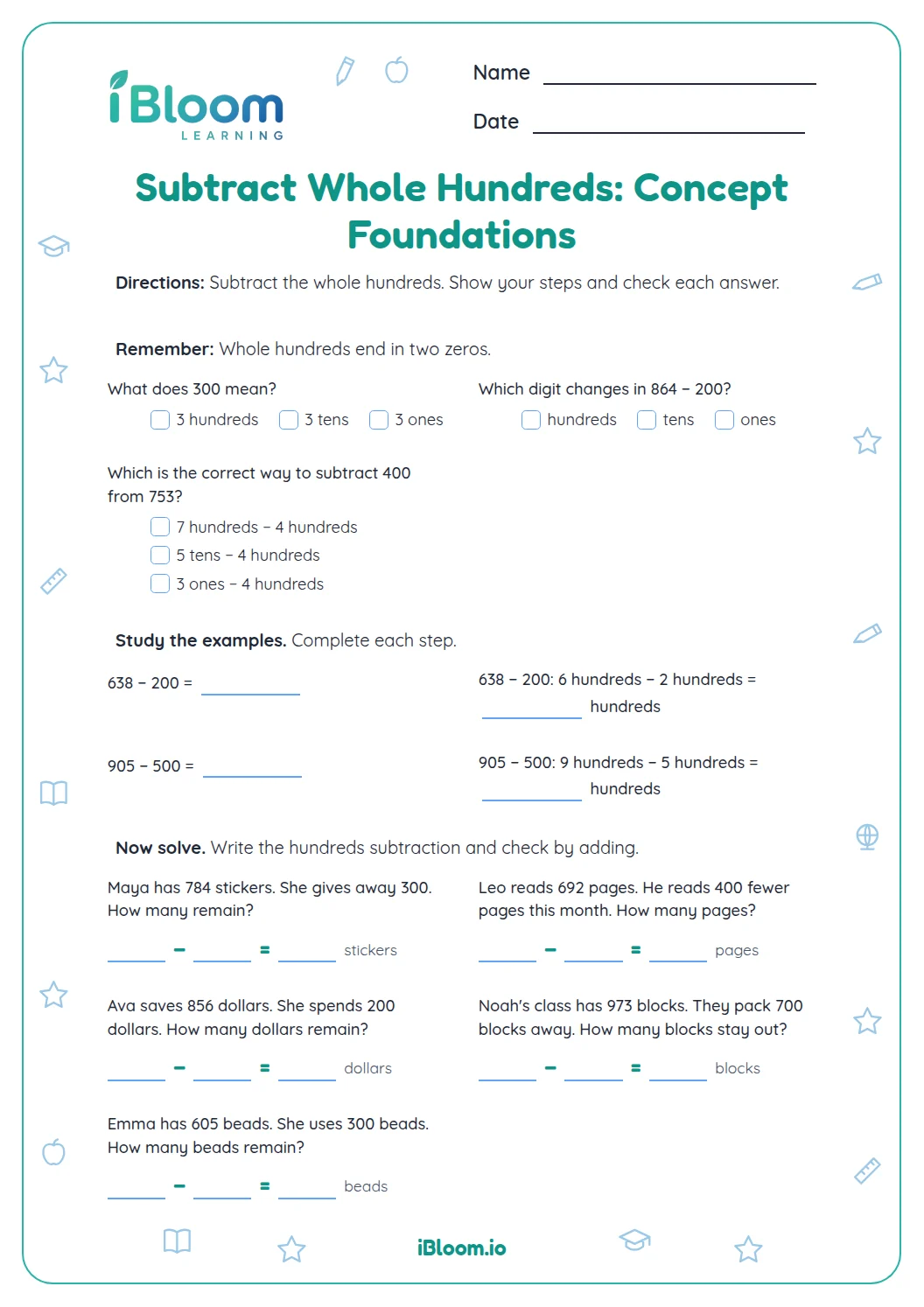
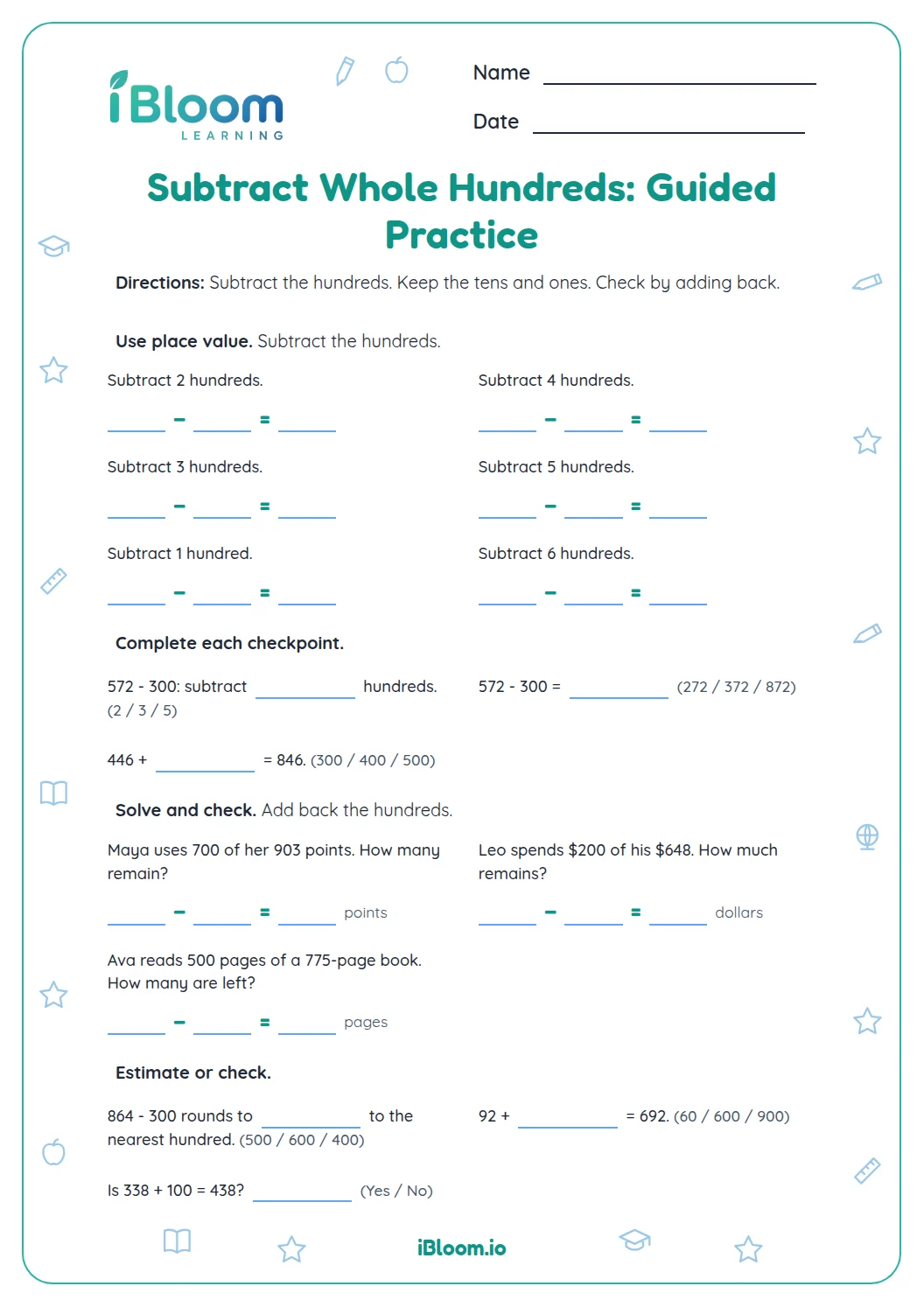
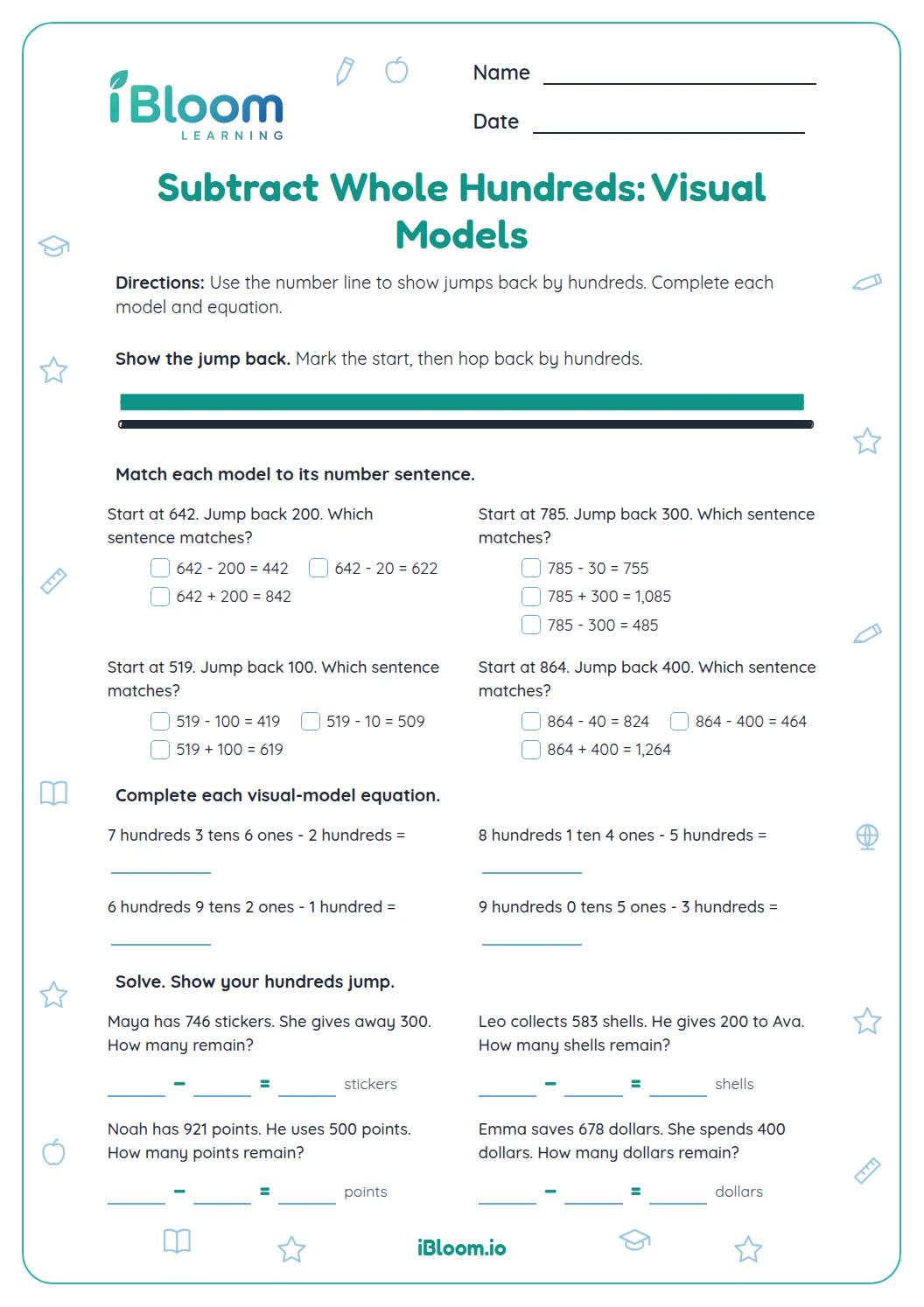
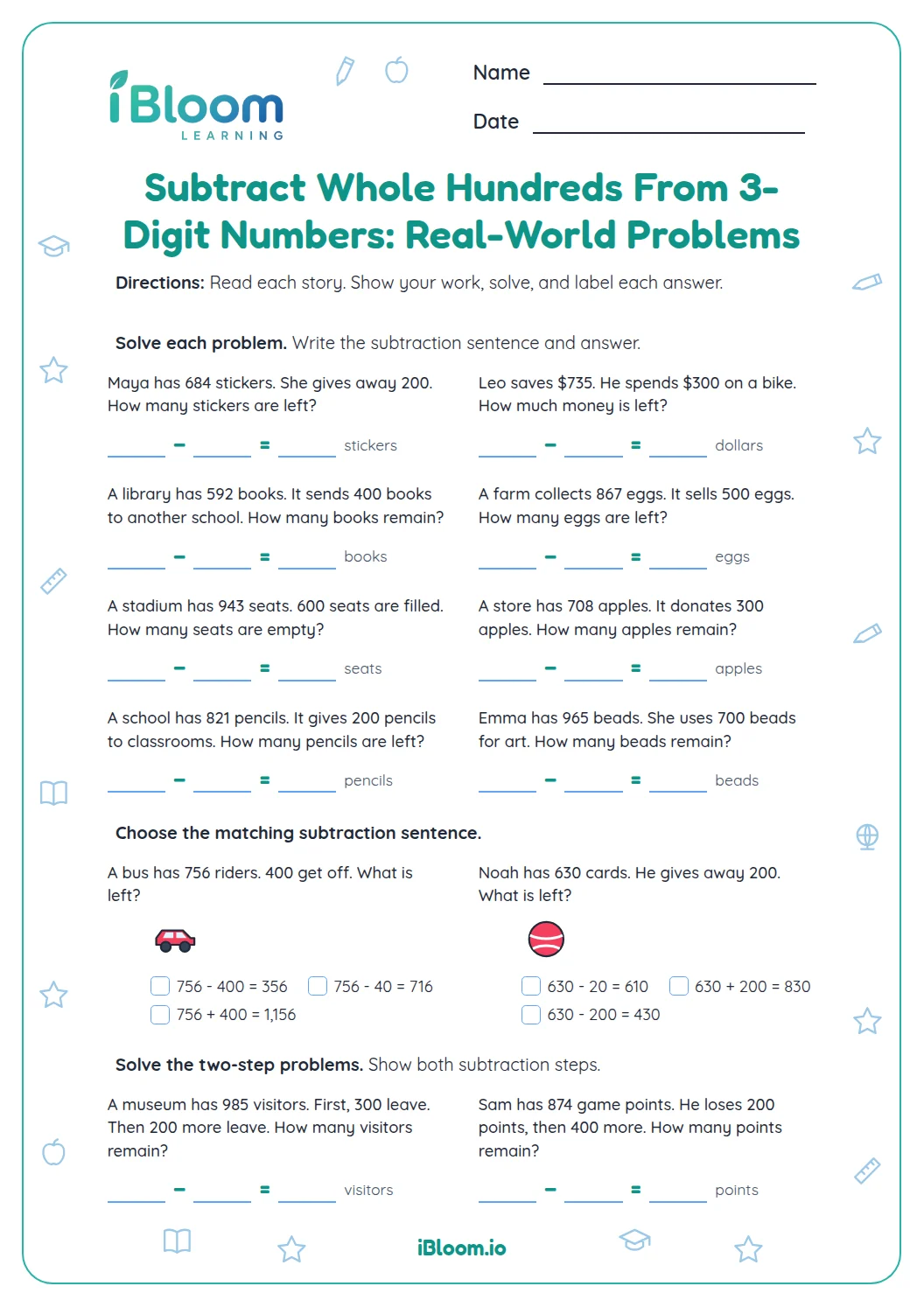
This Grade 2 subtraction worksheet gives students 16 opportunities to subtract whole hundreds from three-digit numbers. The first twelve items are direct equations; the last four use books, apples, cans, and distance to connect the same place-value reasoning to stories. Students may sketch hundreds, tens, and ones before recording each answer. A separate two-page answer key is included. The practice aligns with Common Core 2.NBT.B.7.
Aligned to 2.NBT.B.7
What changes when we subtract whole hundreds?
A three-digit number has hundreds, tens, and ones. When you subtract a whole number of hundreds, you take away groups from the hundreds place and keep track of the tens and ones. For example, 684 is 6 hundreds, 8 tens, and 4 ones.
A quick place-value sketch or base-ten blocks can show what remains before writing the difference.
How can place value show the difference?
Name the hundreds in the starting number and remove the hundreds being subtracted. Keep the remaining tens and ones with the new hundreds count.
- 1684 − 300
- 26 hundreds − 3 hundreds = 3 hundreds
- 3Keep 8 tens and 4 ones
- 4Answer: 384
How do story problems show subtraction?
Look for the starting amount and how many are taken away. Subtract the amount removed, then label the answer with the same unit as the story. Part C gives room to write an equation and solve.
How to use this subtracting hundreds worksheet
- 1Read the three-digit starting number and name its hundreds, tens, and ones.
- 2Find how many whole hundreds are being taken away.
- 3Subtract those hundreds and keep track of the remaining tens and ones.
- 4Write the three-digit difference.
- 5For a story, include the unit named in the question.
Common mistakes and quick fixes
The mistake
Subtracting the hundreds digit from the tens digit.
The fix
Line up the place values mentally: only the hundreds are being removed.
The mistake
Changing the tens or ones even though no tens or ones are taken away.
The fix
Keep those place-value amounts with the remaining hundreds.
The mistake
Leaving off the unit in a word problem.
The fix
Reread the question and label the result in books, cans, meters, or the unit given.
Common Core alignment
This worksheet practices a specific Common Core skill through short, grade-level tasks.
Subtract hundreds by tracking the hundreds, tens, and ones in each number.
On this sheet: Items subtract whole hundreds from three-digit numbers and preserve the tens and ones.
Show the official wordingHide the official wording
Add and subtract within 1000, using concrete models or drawings and strategies based on place value, properties of operations, and/or the relationship between addition and subtraction; relate the strategy to a written method. Understand that in adding or subtracting three-digit numbers, one adds or subtracts hundreds and hundreds, tens and tens, ones and ones; and sometimes it is necessary to compose or decompose tens or hundreds.
What to practice next
Make more practice
Further reading
Questions parents and teachers ask
What does subtracting whole hundreds mean?
The number being taken away ends in two zeros, such as 300 or 500. Students subtract those hundreds from a three-digit number while keeping track of the tens and ones that remain. The page includes number sentences and short everyday situations.
How many practice problems are included?
There are 16 questions across two worksheet pages. Twelve are direct subtraction equations and four are short story problems that ask students to write an equation and find the remaining amount. The answer key has two pages. For 684 minus 300, the tens and ones remain 84.
How can place value help with 684 minus 300?
Think of 684 as 6 hundreds, 8 tens, and 4 ones. Taking away 3 hundreds leaves 3 hundreds, 8 tens, and 4 ones, or 384. The tens and ones stay the same because only whole hundreds are subtracted. Each starting number is at least as large as the hundreds removed.
Do any problems require regrouping?
The practice focuses on subtracting whole hundreds, so the tens and ones digits stay unchanged. Some questions have fewer hundreds than the number being subtracted, which helps students attend carefully to the hundreds place. The first twelve items are equations, and the last four are stories.
Can students use blocks or drawings?
Yes. Students may sketch hundreds, tens, and ones or use base-ten blocks to show the number before taking away hundreds. They can then write the resulting three-digit number in the blank. A quick sketch can show the hundreds removed and the amount left.
What comes with the printable?
The printable includes two pages of subtraction practice and a separate two-page answer key. It has twelve number sentences and four word problems, all centered on subtracting a whole number of hundreds from a three-digit amount. The two-page key lists the numerical differences and story units.