
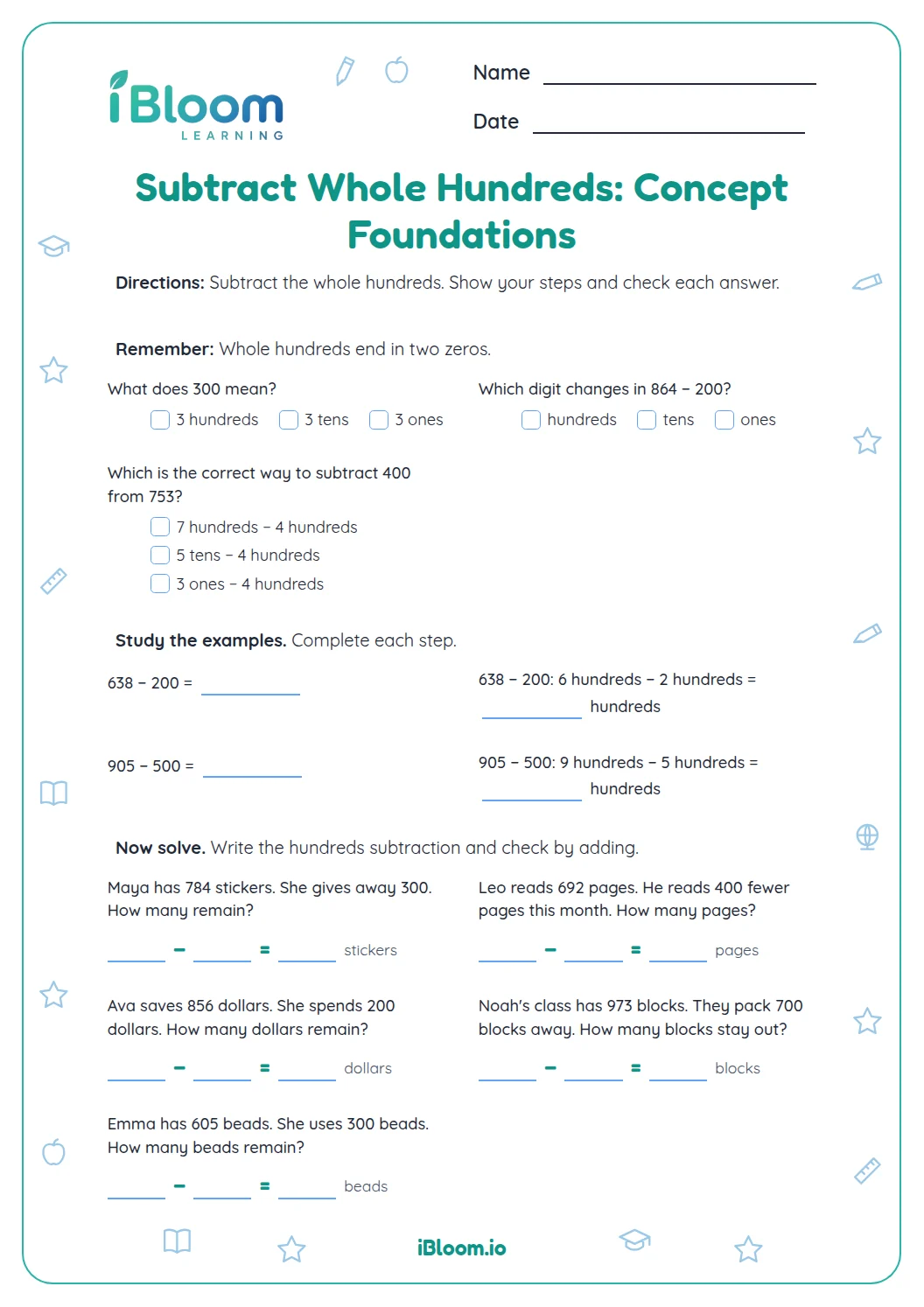
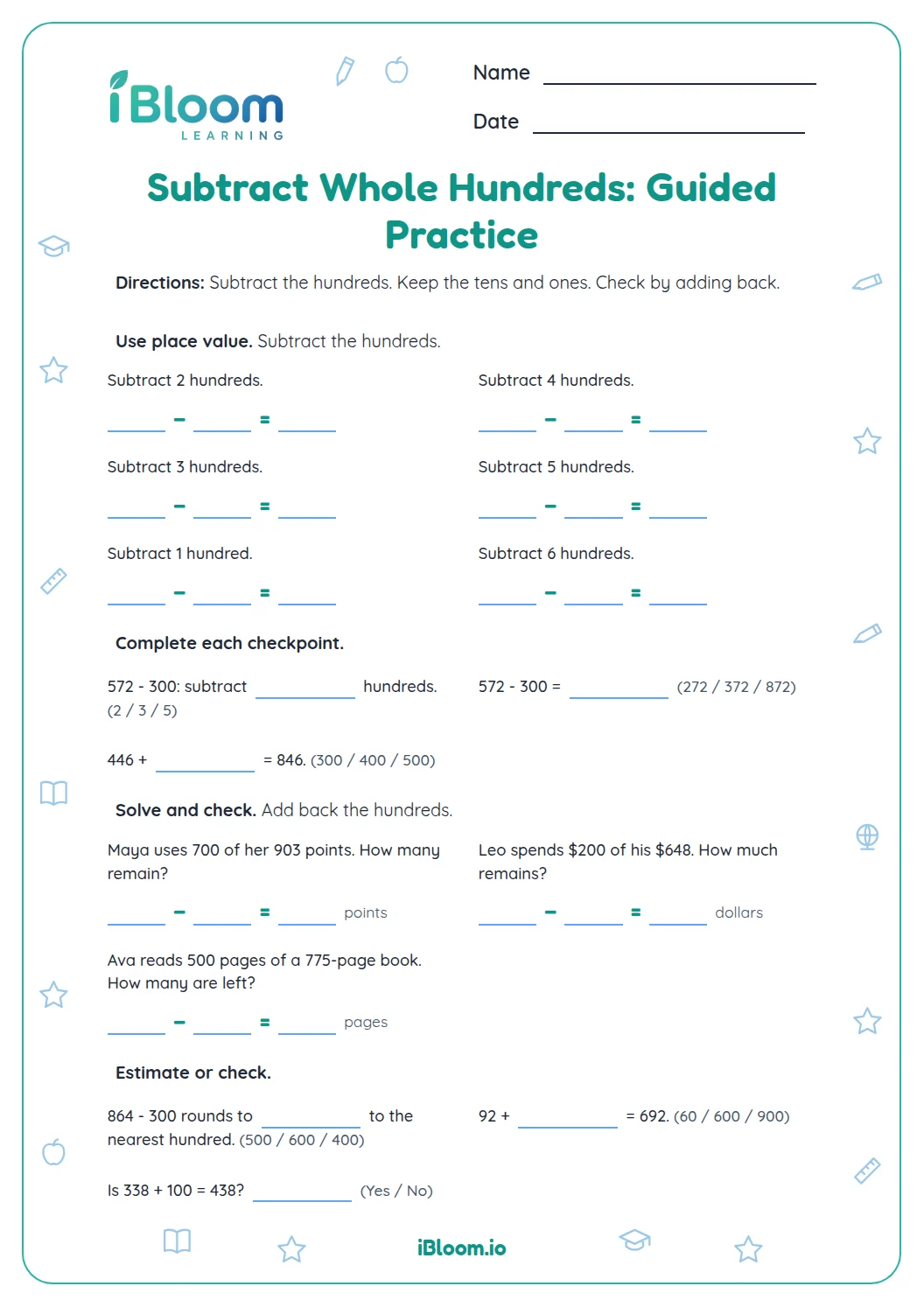
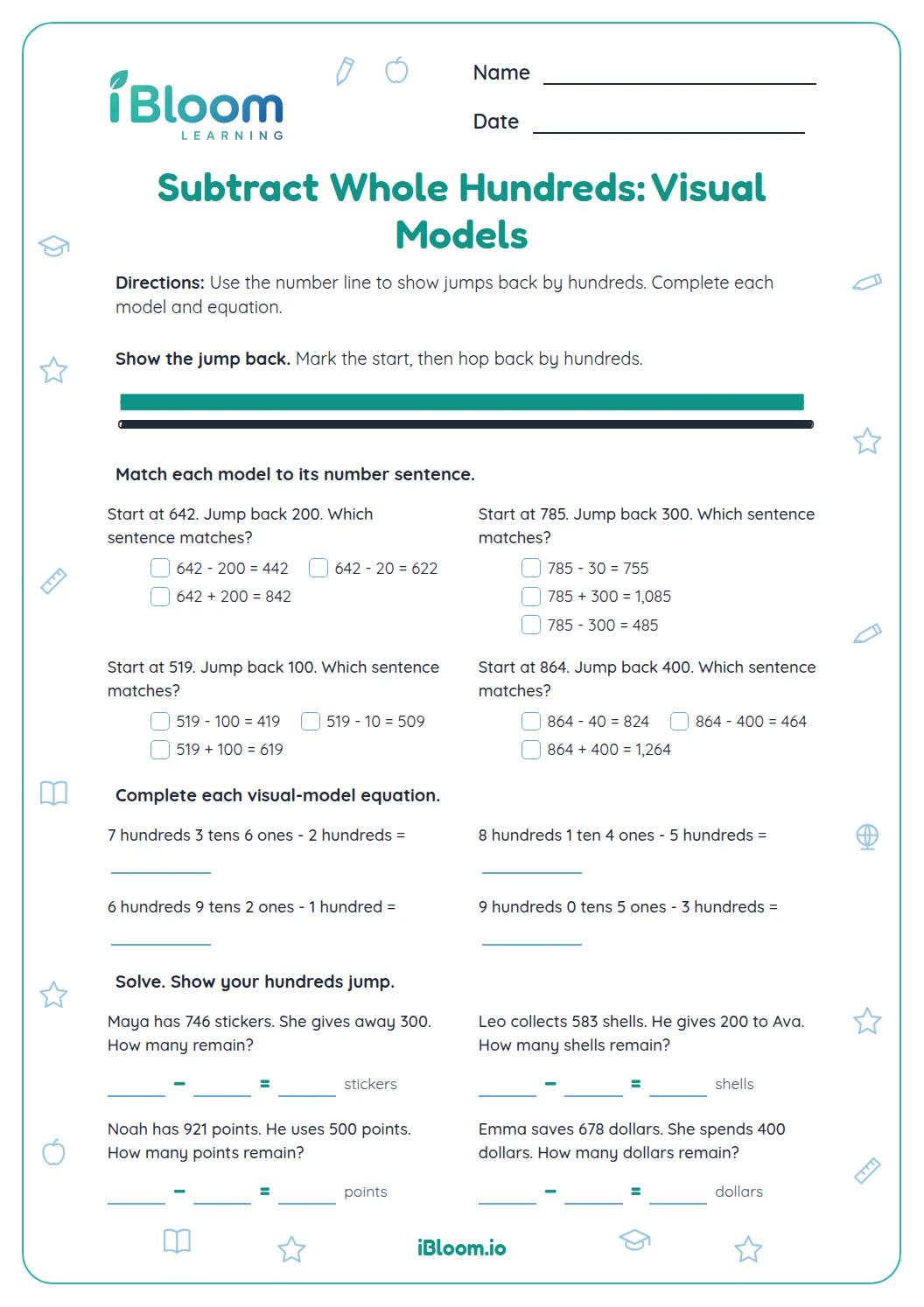
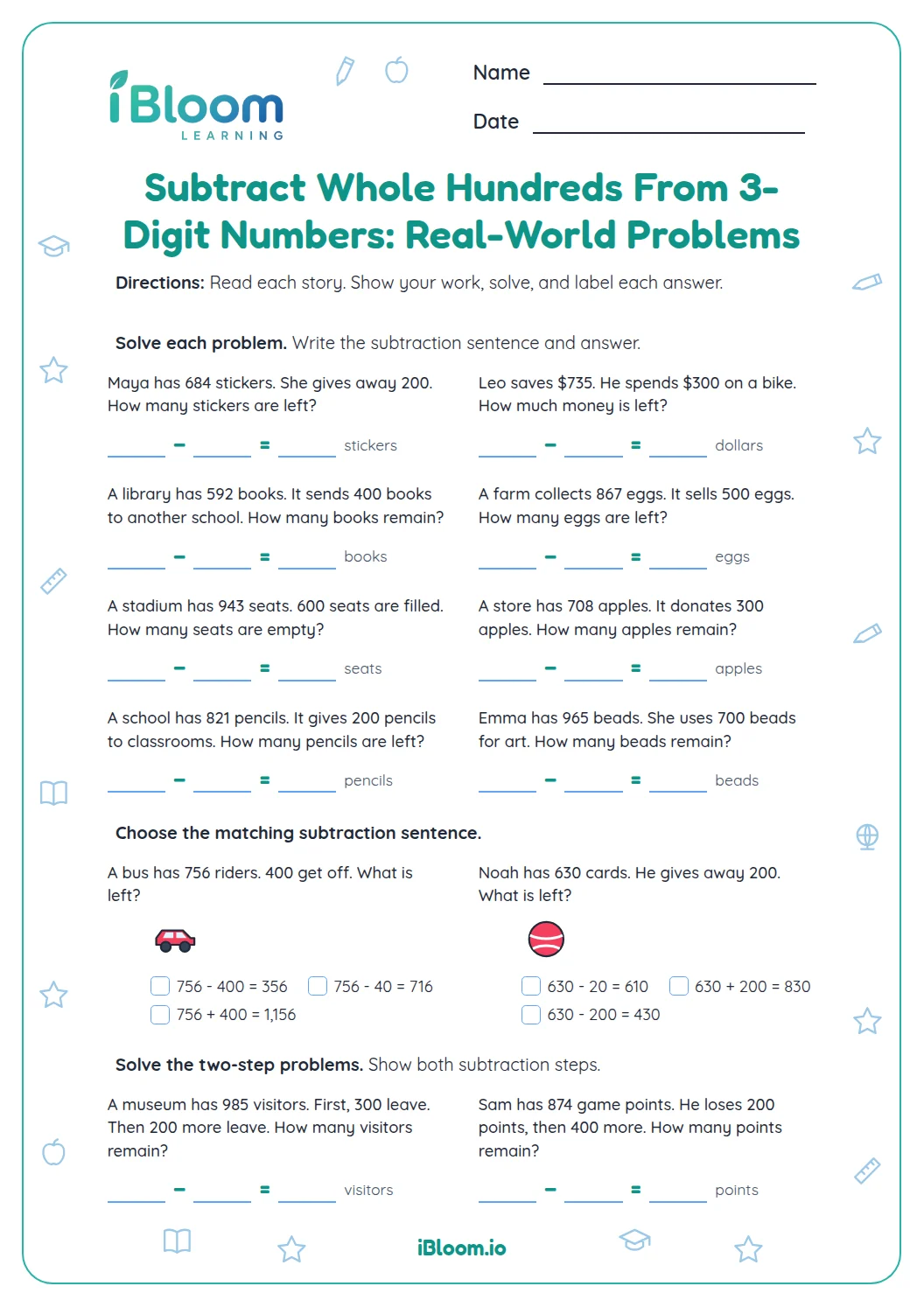

About this worksheet
This free printable Grade 2 worksheet helps students subtract whole hundreds from three-digit numbers and check a difference with addition. It has 15 questions in three parts: five subtraction equations, five checks of subtraction reasoning, and five library-book stories. A separate two-page answer key gives the results. The practice connects place value with the relationship between addition and subtraction in CCSS 2.NBT.B.7.
Aligned to 2.NBT.B.7
How can you subtract a whole hundred?
A whole hundred changes the hundreds digit while the tens and ones stay the same. For example, subtracting 300 means taking away three groups of 100.
In question 1, 642 − 300 = 342. Check by adding 300 back: 342 + 300 = 642. The check returns to the starting number.
- 1642 − 300
- 26 hundreds − 3 hundreds = 3 hundreds
- 3Keep 4 tens and 2 ones
- 4Answer: 342
- 5Check: 342 + 300 = 642
How does the sheet ask children to reason?
Part B asks students to choose a valid addition check for a subtraction claim. Part C uses library stories, so the student identifies the starting amount and books lent before finding the number that remains.
What is on the two pages?
There are 15 questions in three parts: five subtraction equations, five reasoning checks, and five library stories. The answer key follows on two pages.
How to use this worksheet
- 1Read the hundreds digit and identify how many hundreds are taken away.
- 2Subtract the hundreds; keep the tens and ones unchanged.
- 3Use addition to check by combining the difference and the amount subtracted.
- 4For each story, write the starting amount minus the amount taken away.
- 5Use the key to review the equation and the answer together.
Common mistakes and quick fixes
The mistake
Subtracting the smaller digit from the larger digit without keeping place value.
The fix
Think of 642 as 6 hundreds, 4 tens and 2 ones; taking 3 hundreds leaves 3 hundreds, 4 tens and 2 ones.
The mistake
Changing the tens or ones when subtracting a whole hundred.
The fix
Check that the tens and ones digits stay the same when no regrouping is needed.
The mistake
Adding instead of subtracting in a story about books lent out.
The fix
Ask whether the library has more or fewer books after lending some; fewer means subtract.
Common Core alignment
This worksheet gives practice with the following Common Core standard.
Subtract hundreds and other three-digit numbers using place-value strategies.
On this sheet: The questions repeatedly ask students to subtract hundreds from three-digit numbers and check by adding the difference back to the amount taken away.
Show the official wordingHide the official wording
Add and subtract within 1000, using concrete models or drawings and strategies based on place value, properties of operations, and/or the relationship between addition and subtraction; relate the strategy to a written method. Understand that in adding or subtracting three-digit numbers, one adds or subtracts hundreds and hundreds, tens and tens, ones and ones; and sometimes it is necessary to compose or decompose tens or hundreds.
What to practice next
Make more practice
Further reading
Questions parents and teachers ask
What is a good way to check 875 − 500?
The difference is 375. Add back the 500: 375 + 500 = 875, which matches the starting number. This check uses the relationship between subtraction and addition. If the sum does not return to 875, revisit the hundreds digit and try the subtraction again.
Do the tens and ones change when subtracting a whole hundred?
They stay the same when subtracting an exact number of hundreds without regrouping. In 642 − 300, the 4 tens and 2 ones remain while 6 hundreds become 3 hundreds. This makes place value easy to see in the answer.
What should a student write for a story problem?
Write the starting amount, subtract the amount taken away, and label the result. For example, 728 books minus 300 books equals 428 books remaining. The equation shows why subtraction fits the story and the unit identifies what the answer counts.
How many questions are on the sheet?
There are 15 questions across three parts: five subtraction equations, five reasoning checks, and five short story problems. The separate answer key includes the results and the addition checks, so an adult can review both the answer and the strategy.
Is regrouping needed in these examples?
No regrouping is needed because each problem subtracts a whole hundred from a three-digit amount. That keeps attention on place value: hundreds change while tens and ones stay fixed. Students can use that pattern to check whether an answer is reasonable.