
About this worksheet
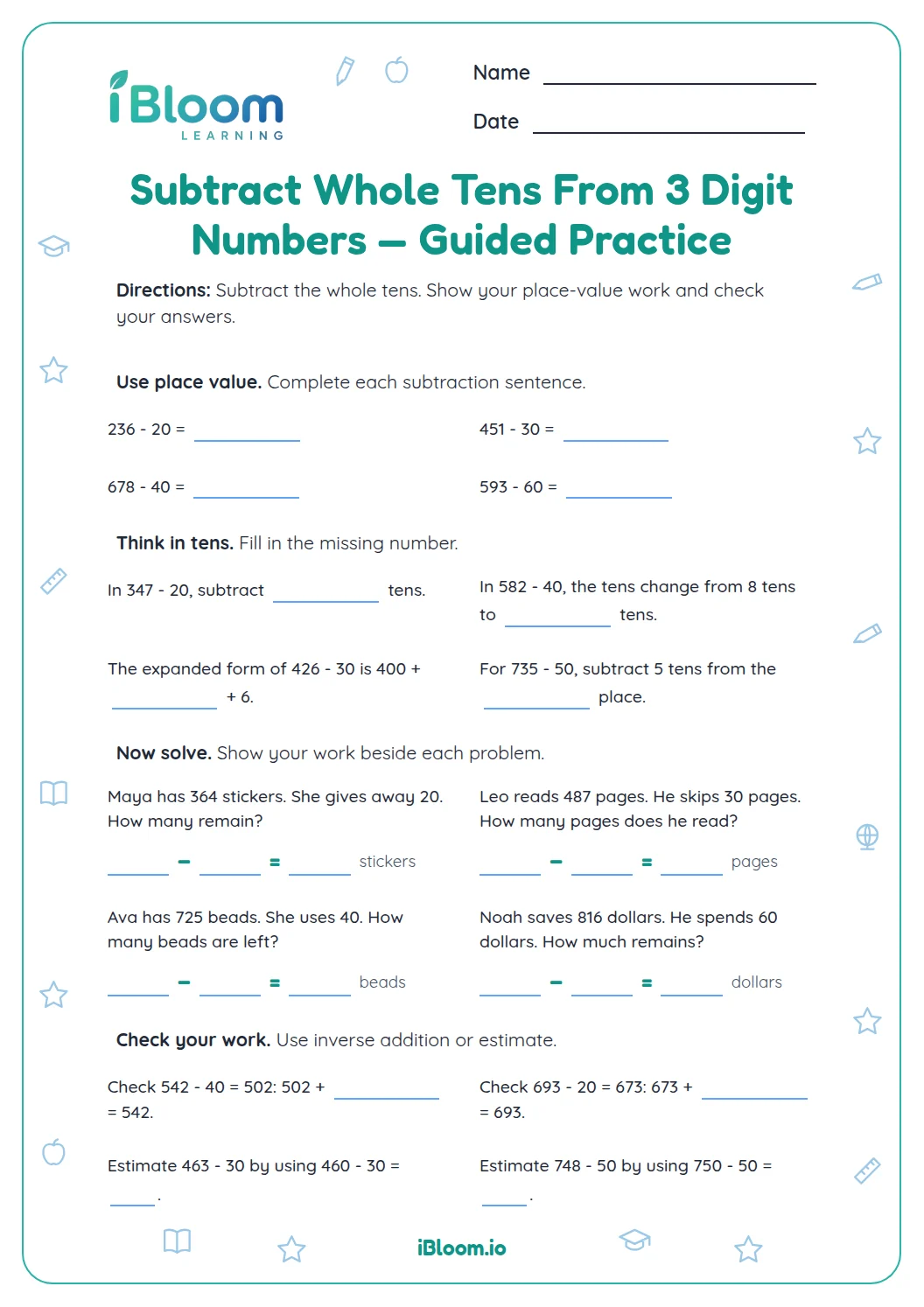
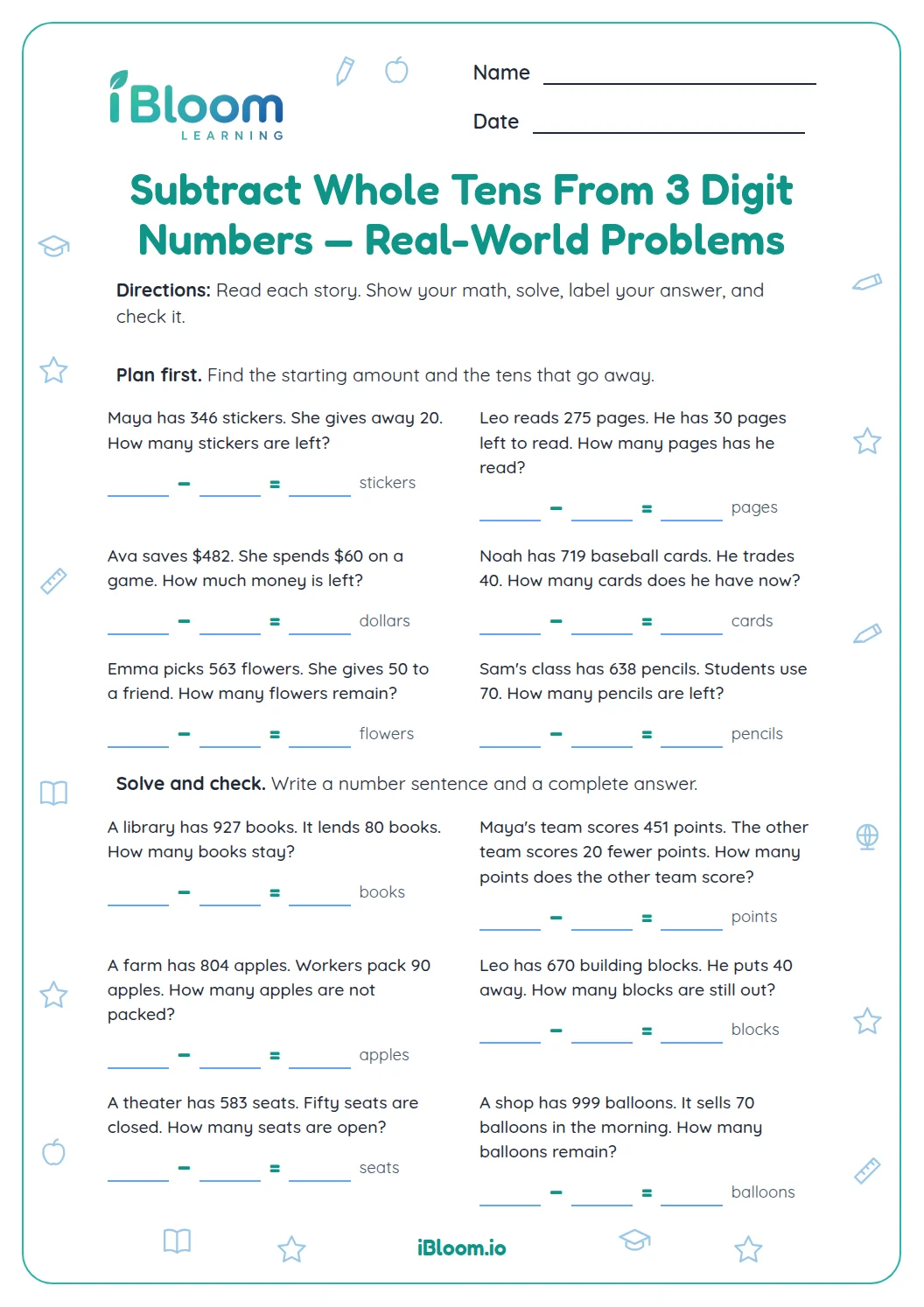
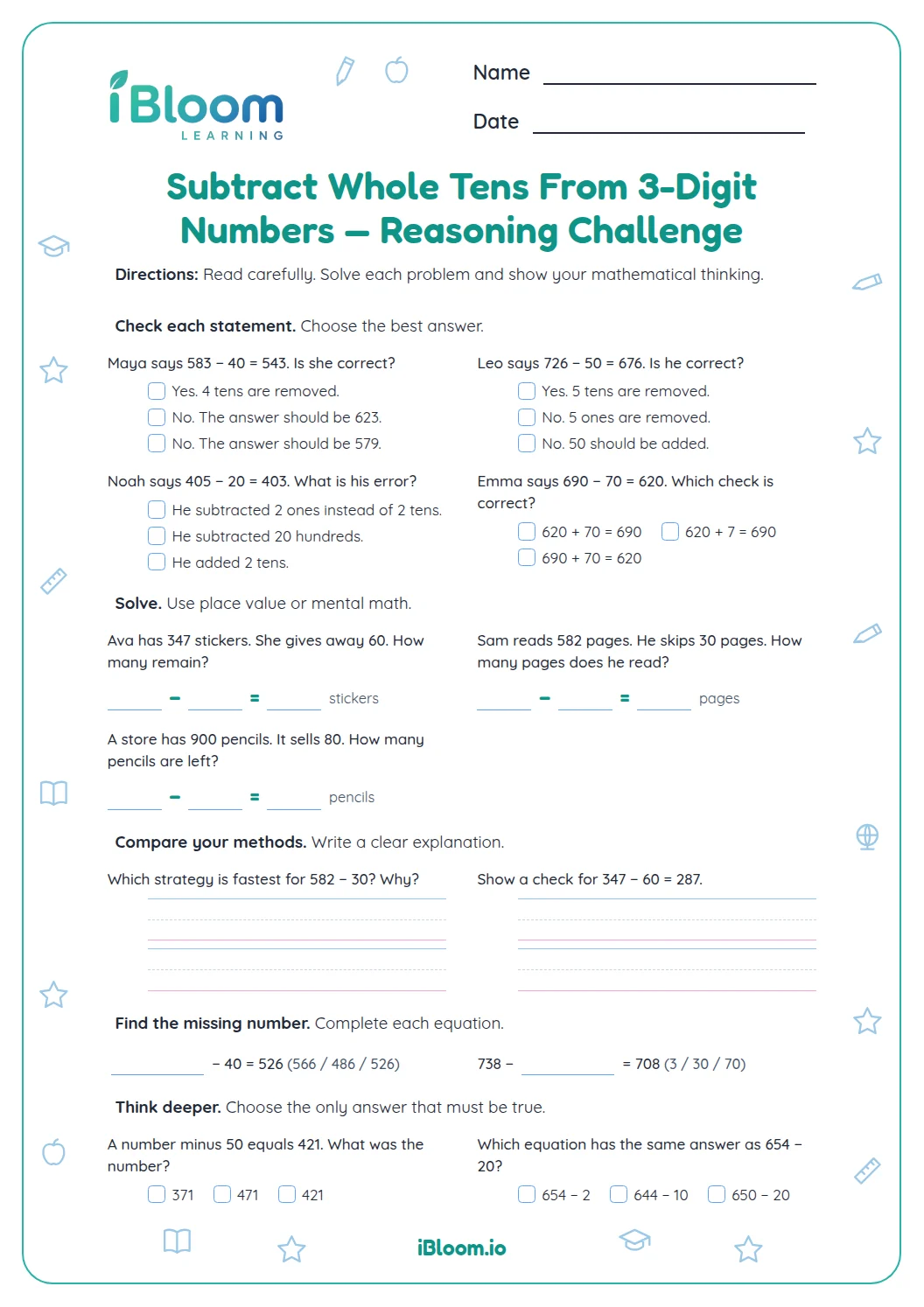
This Grade 2 worksheet practices subtracting whole tens from three-digit numbers. Six items pair a base-ten block model with an equation, followed by eight short story problems using the same place-value strategy. The answer key shows the differences and equations.
Aligned to 2.NBT.B.7
What do the base-ten blocks represent?
Each large flat represents 100, each rod represents 10, and each small cube represents 1. In 234 − 20, the model starts with 2 hundreds, 3 tens, and 4 ones. Taking away 2 tens leaves 2 hundreds, 1 ten, and 4 ones: 214.
- 1Each large flat represents 100, each rod represents 10, and each small cube represents 1.
How can you subtract tens from a three-digit number?
Subtract the number of tens from the tens place. For 352 − 30, subtract 3 tens from 5 tens; the hundreds and ones stay the same. The answer is 322.
- 1Subtract the number of tens from the tens place.
How does the strategy work in a story?
Identify the starting amount and how many tens are removed. A library with 462 bookmarks that gives away 30 has 432 left. Write 462 − 30 = 432 to connect the story to the place-value strategy.
- 1Identify the starting amount and how many tens are removed.
How to work through the page
- 1Read the three-digit starting amount and the tens being removed.
- 2In a block model, count hundreds, tens, and ones.
- 3Subtract the tens; keep the hundreds and ones in place.
- 4For a story, write the subtraction equation before solving.
- 5Check by adding the tens back to your difference.
Common errors to check
The mistake
Mistake: subtracting 3 ones in 352 − 30.
The fix
30 is 3 tens, so change the tens place.
The mistake
Mistake: changing the hundreds or ones when no regrouping is needed.
The fix
Compare each place-value part.
The mistake
Mistake: reporting how many were removed instead of how many remain.
The fix
Reread the question after subtracting.
Common Core alignment
Use place-value models and strategies to subtract three-digit numbers.
On this sheet: The block models and story problems subtract tens from three-digit numbers using place value.
Show the official wordingHide the official wording
Add and subtract within 1000, using concrete models or drawings and strategies based on place value, properties of operations, and/or the relationship between addition and subtraction; relate the strategy to a written method. Understand that in adding or subtracting three-digit numbers, one adds or subtracts hundreds and hundreds, tens and tens, ones and ones; and sometimes it is necessary to compose or decompose tens or hundreds.
What to practice next
Make more practice
Further reading
Questions parents and teachers ask
What is shown in a base-ten model?
The model uses flats for hundreds, rods for tens, and cubes for ones. In 234, two flats, three rods, and four cubes show the starting number. Subtracting 20 removes two tens rods, leaving 214. Ask the student to explain one answer using the sentence or number relationship that supports it.
How many questions are included?
The worksheet has 14 questions: six equations paired with base-ten block models and eight subtraction stories. The first section uses the drawings directly; the story section asks students to apply the same place-value idea. Ask the student to explain one answer using the sentence or number relationship that supports it.
Does the answer key show equations for the stories?
The key gives each story’s difference. Students can also write the subtraction equation as the section direction requests. For example, 462 bookmarks minus 30 given away leaves 432 bookmarks. Ask the student to explain one answer using the sentence or number relationship that supports it.
Why do the hundreds and ones stay the same?
Each problem subtracts whole tens, and the examples do not require regrouping. That means only the tens amount changes. Looking at the place values separately helps students see why 352 − 30 equals 322. Ask the student to explain one answer using the sentence or number relationship that supports it.
How can students check a subtraction answer?
Add the tens that were removed back to the difference. For example, 214 + 20 returns to 234. This inverse check helps confirm that the subtraction changed the tens amount correctly. Ask the student to explain one answer using the sentence or number relationship that supports it.