
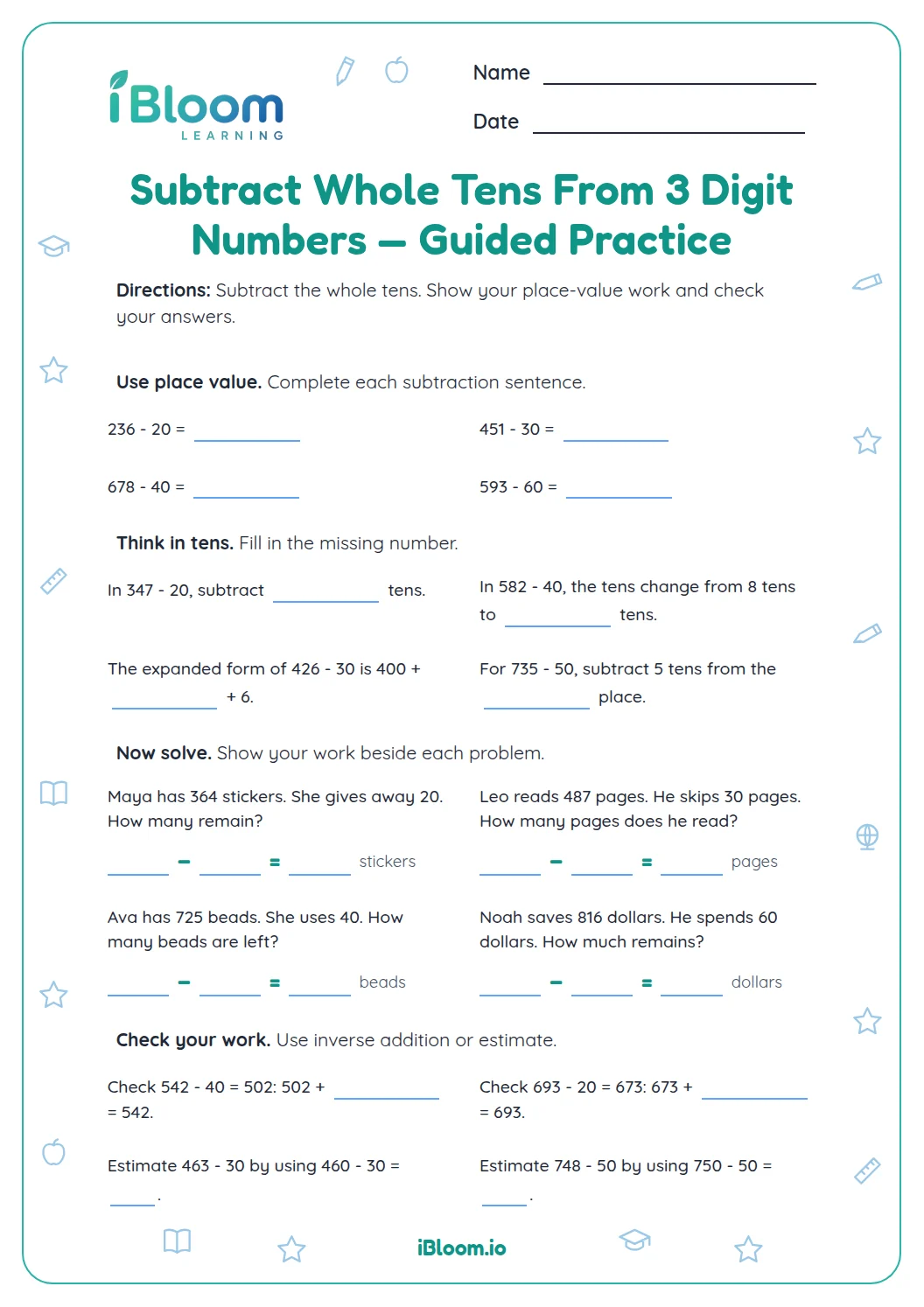
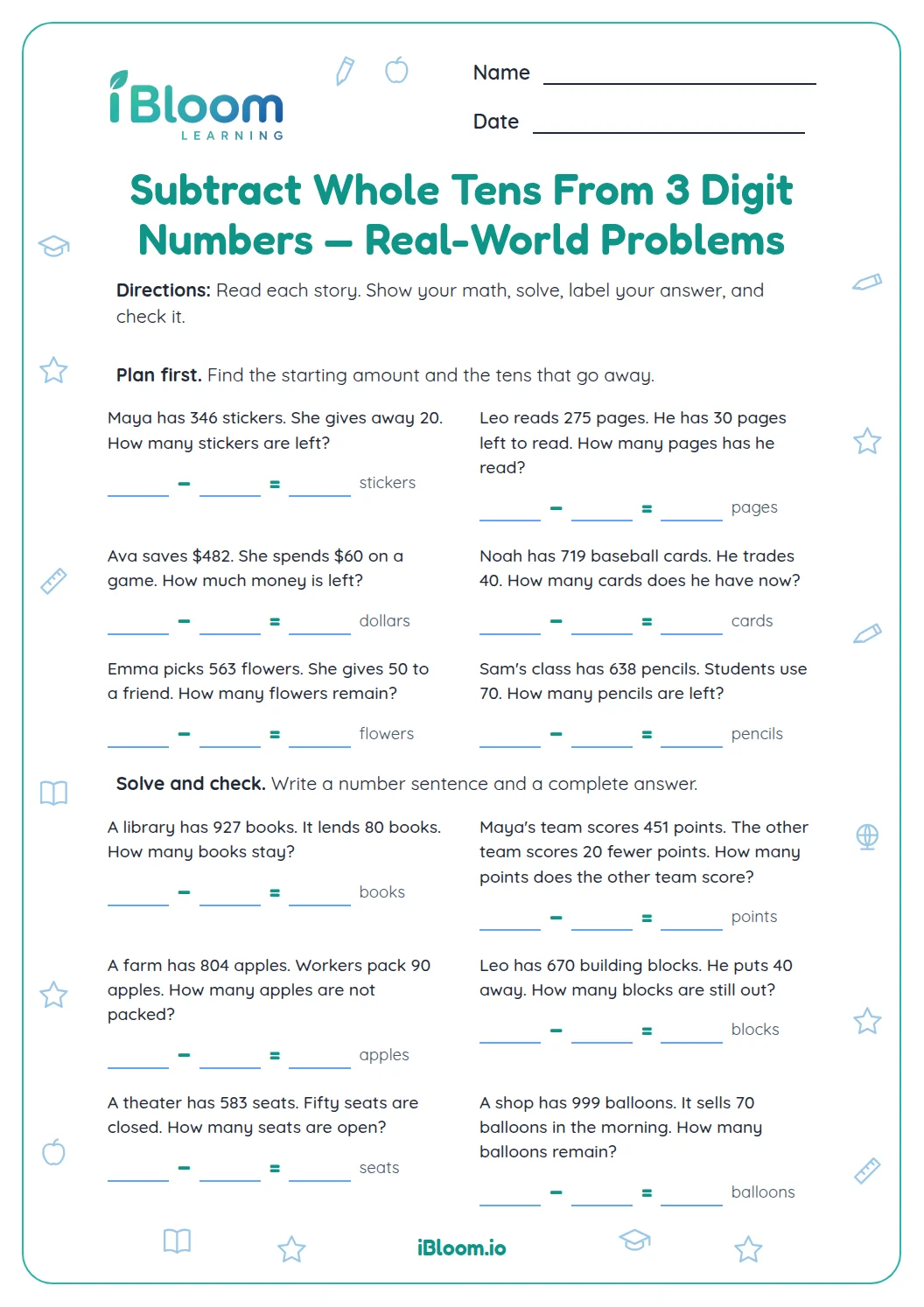
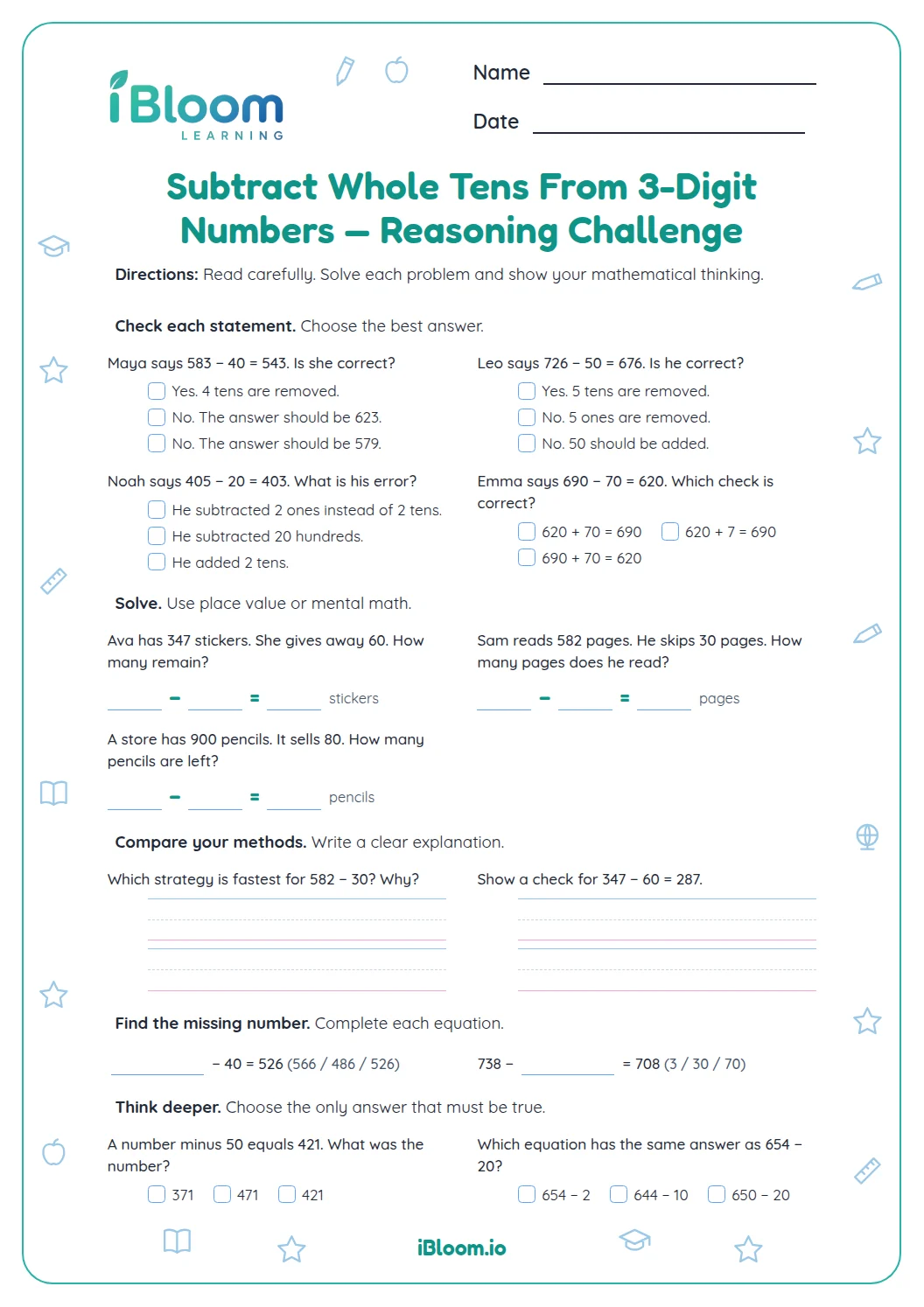


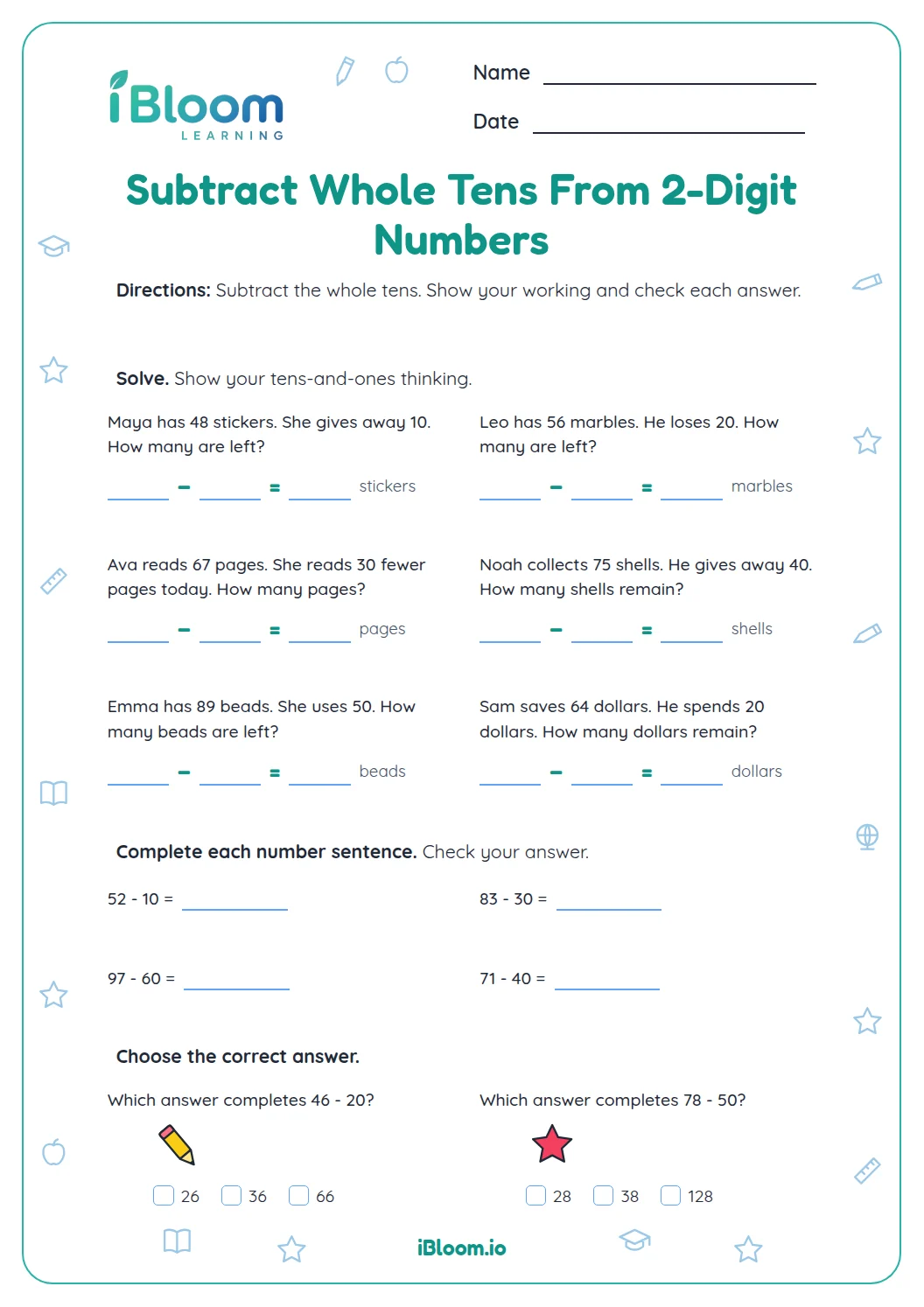



About this worksheet
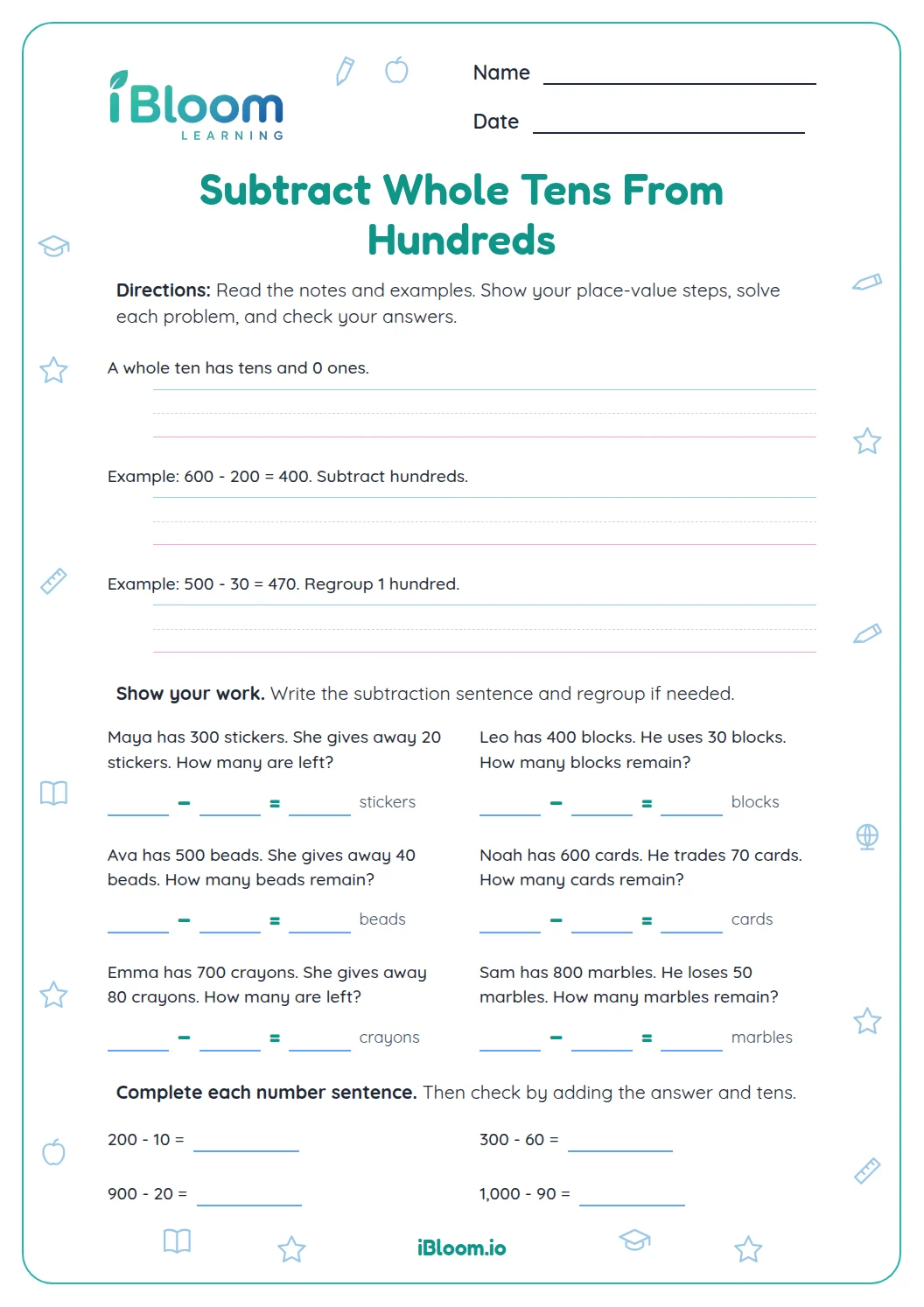
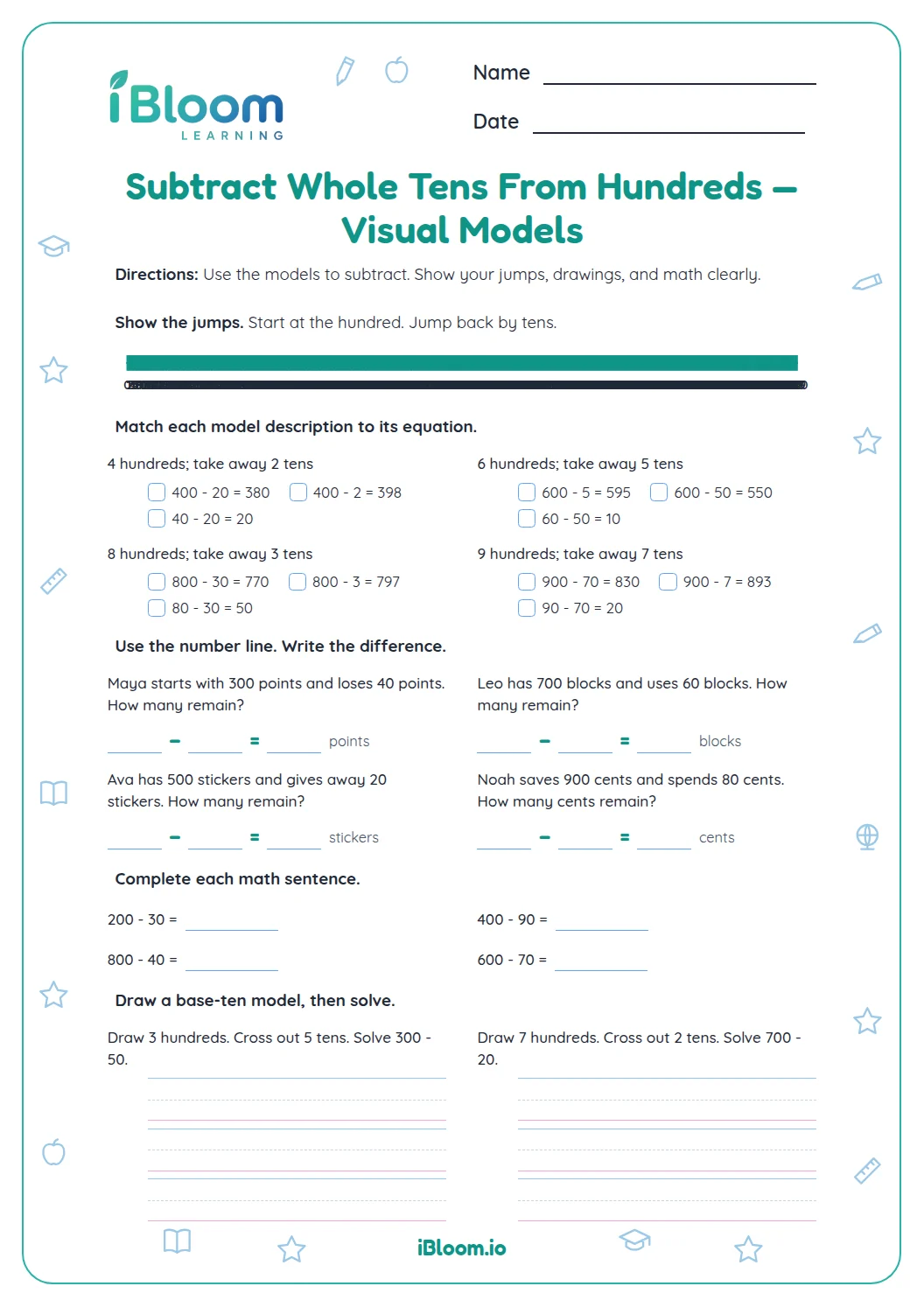
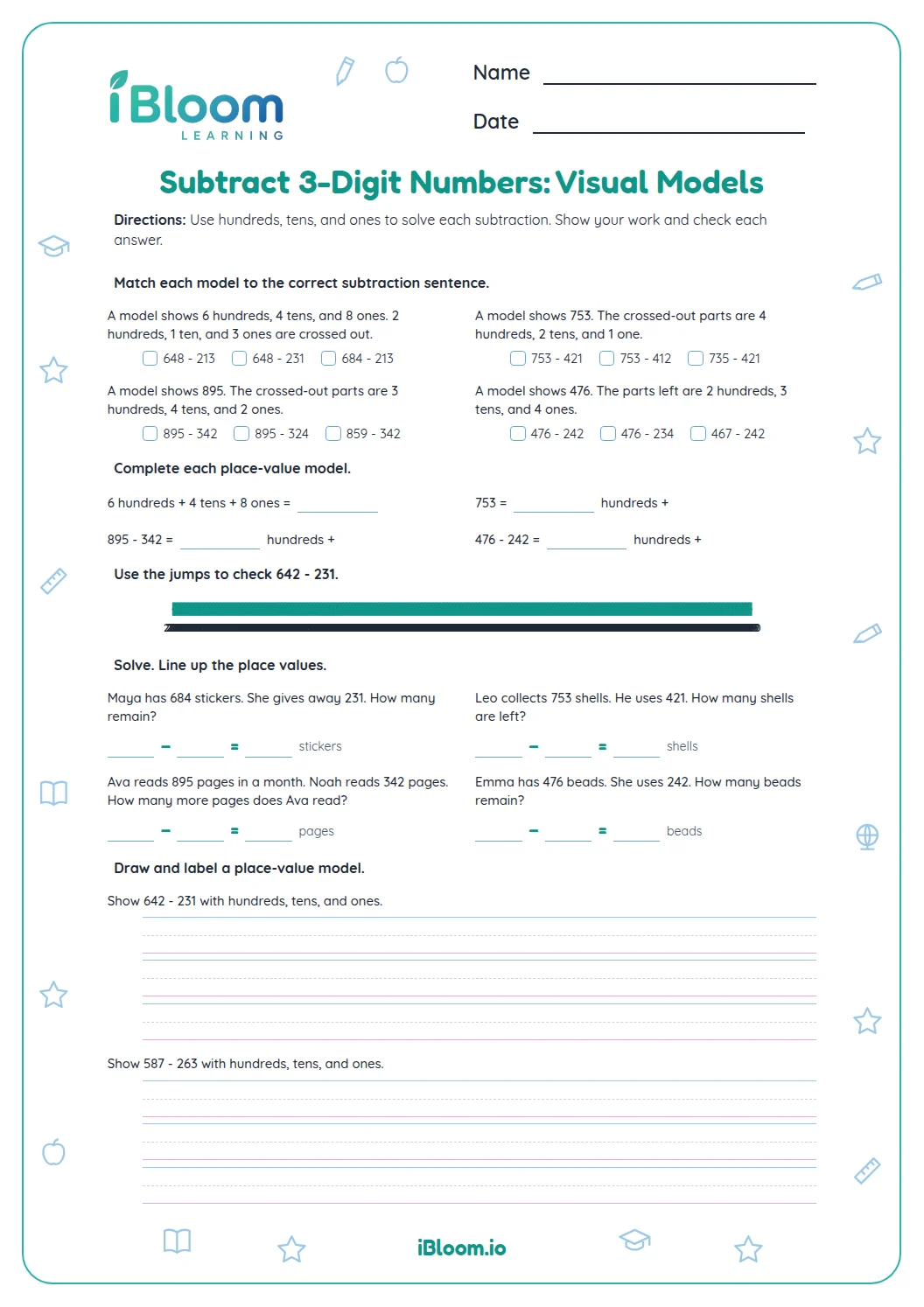
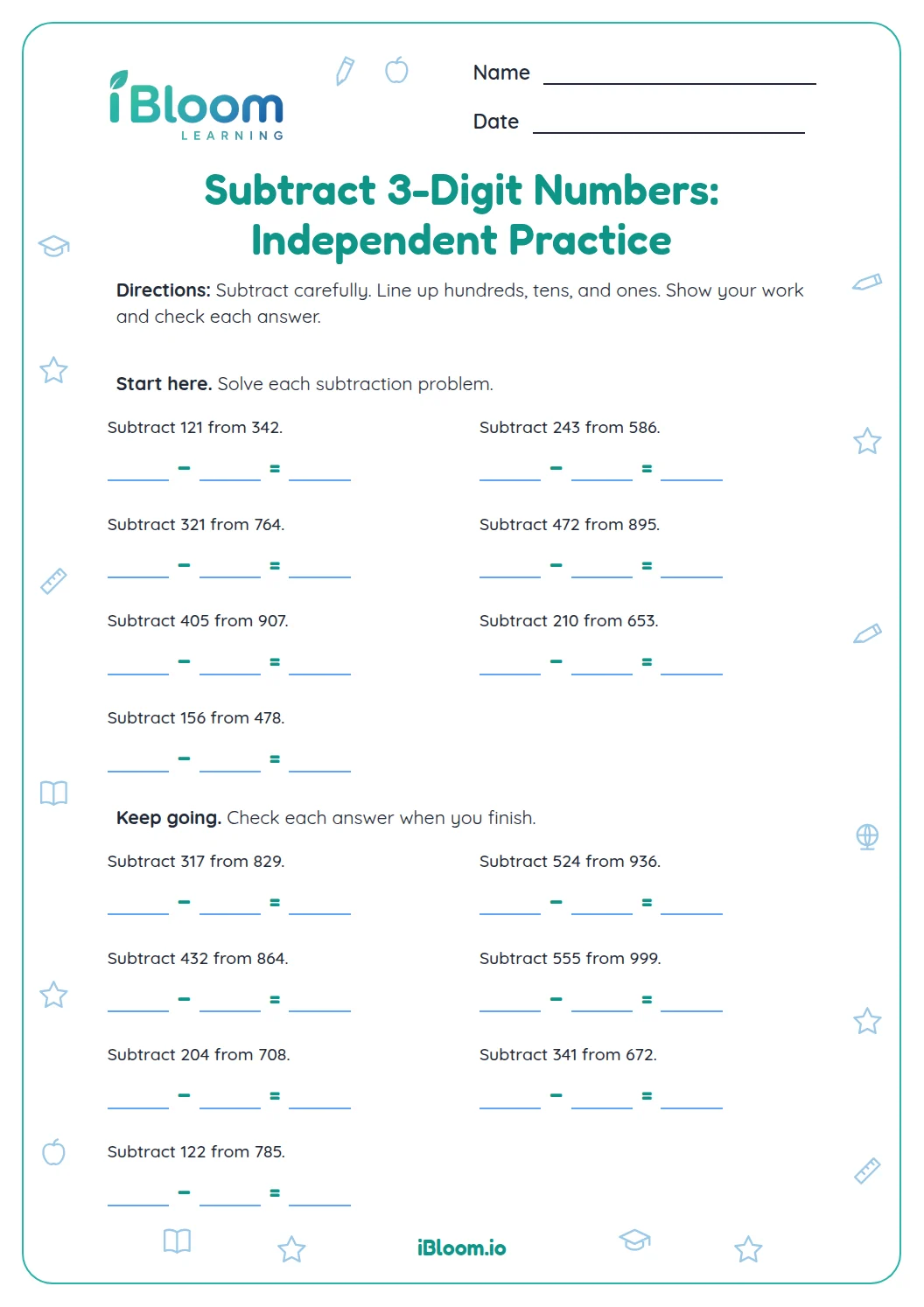
This free Grade 2 worksheet gives children independent practice subtracting whole tens from three-digit numbers. Part A has eight equations with enough tens already available. Part B has eight more that cross a hundred, including 304 − 70. Part C applies the same skill to books and tickets, with room for a number sentence. The 18 questions practice Common Core 2.NBT.B.7 through subtraction based on place value. A separate answer key lets an adult check both the arithmetic and the units in the story problems.
Aligned to 2.NBT.B.7
What changes when you subtract whole tens?
A whole ten is a multiple of 10, such as 20, 50 or 90. Subtracting 50 removes five tens. Since it removes zero ones, the ones digit stays the same. In question 1, 476 − 30, seven tens become four tens, giving 446.
The hundreds digit can change too. When the starting number has too few tens, exchange one hundred for ten tens before subtracting.
How does 304 − 70 work?
Question 9 begins with zero tens in the tens place. One of the three hundreds can become ten tens. There are then enough tens to take away seven.
- 1304 = 200 + 100 + 4
- 210 tens − 7 tens = 3 tens
- 3200 + 30 + 4 = 234
- 4Check: 234 + 70 = 304
How are the three parts arranged?
Part A includes eight calculations such as 582 − 40 and 697 − 90. Part B changes the challenge: all eight calculations require crossing a hundred. Children can use place value or count backward in tens, then write each result.
Part C asks how many books or tickets remain. Children sketch hundreds and tens, then write a subtraction sentence and the answer with its unit. Check each result by adding back the number removed.
How to use this worksheet
- 1Read the directions and remind your child that 60 means six tens.
- 2Let your child complete Part A independently, keeping track of the ones digit.
- 3For Part B, allow a quick place-value sketch or backward jumps of ten on scrap paper.
- 4Have your child sketch hundreds and tens, then write and solve a number sentence for each Part C problem.
- 5Check with the key, then add the subtracted tens back to each corrected answer.
Mistakes to notice and ways to help
The mistake
Writing 476 − 30 = 473 by taking 3 from the ones.
The fix
Name 30 as three tens; change the tens, leaving the 6 ones.
The mistake
Writing 304 − 70 = 374 by reversing 0 and 7.
The fix
Exchange one hundred for ten tens; 10 tens minus 7 tens leaves 3 tens.
The mistake
Writing 304 − 70 = 334 after regrouping.
The fix
Cross out one hundred when it becomes ten tens, so only two hundreds remain.
Common Core alignment
Subtract whole tens within 1,000 using place value and regrouping.
On this sheet: Children subtract tens with and without regrouping, then connect place-value sketches to equations in Part C.
Show the official wordingHide the official wording
Add and subtract within 1000, using concrete models or drawings and strategies based on place value, properties of operations, and/or the relationship between addition and subtraction; relate the strategy to a written method. Understand that in adding or subtracting three-digit numbers, one adds or subtracts hundreds and hundreds, tens and tens, ones and ones; and sometimes it is necessary to compose or decompose tens or hundreds.
What to practice next
Make more practice
Further reading
Questions parents and teachers ask
Does every question need regrouping?
No. The eight questions in Part A have enough tens to subtract directly. The eight in Part B cross a hundred, so children exchange one hundred for ten tens or count backward in tens. The two story problems give one example of each situation.
Why does the ones digit stay the same?
Every number being subtracted ends in zero, so zero ones are removed. In 304 − 70, the four ones remain even though the hundreds and tens change. Have your child compare the ones digit in each starting number with the ones digit in its answer.
Can my child count backward by tens?
Yes. Counting backward in tens is a useful way to solve or check these questions. For 304 − 70, make seven jumps of ten: 294, 284, 274, 264, 254, 244, 234. Count the jumps as well as the numbers to avoid stopping too soon.
How should children answer the book and ticket problems?
Write a subtraction sentence, then give the result with its unit. The book problem is 265 − 40, so 225 books remain. The ticket problem is 402 − 60, so 342 tickets remain. The working space allows children to record how they used the tens.
What does the answer key include?
The separate answer key gives all 16 equation answers and both story answers with units. Use it after your child finishes a part or the whole worksheet. If an answer differs, ask your child to add the removed tens back before showing the correct result.