





About this worksheet
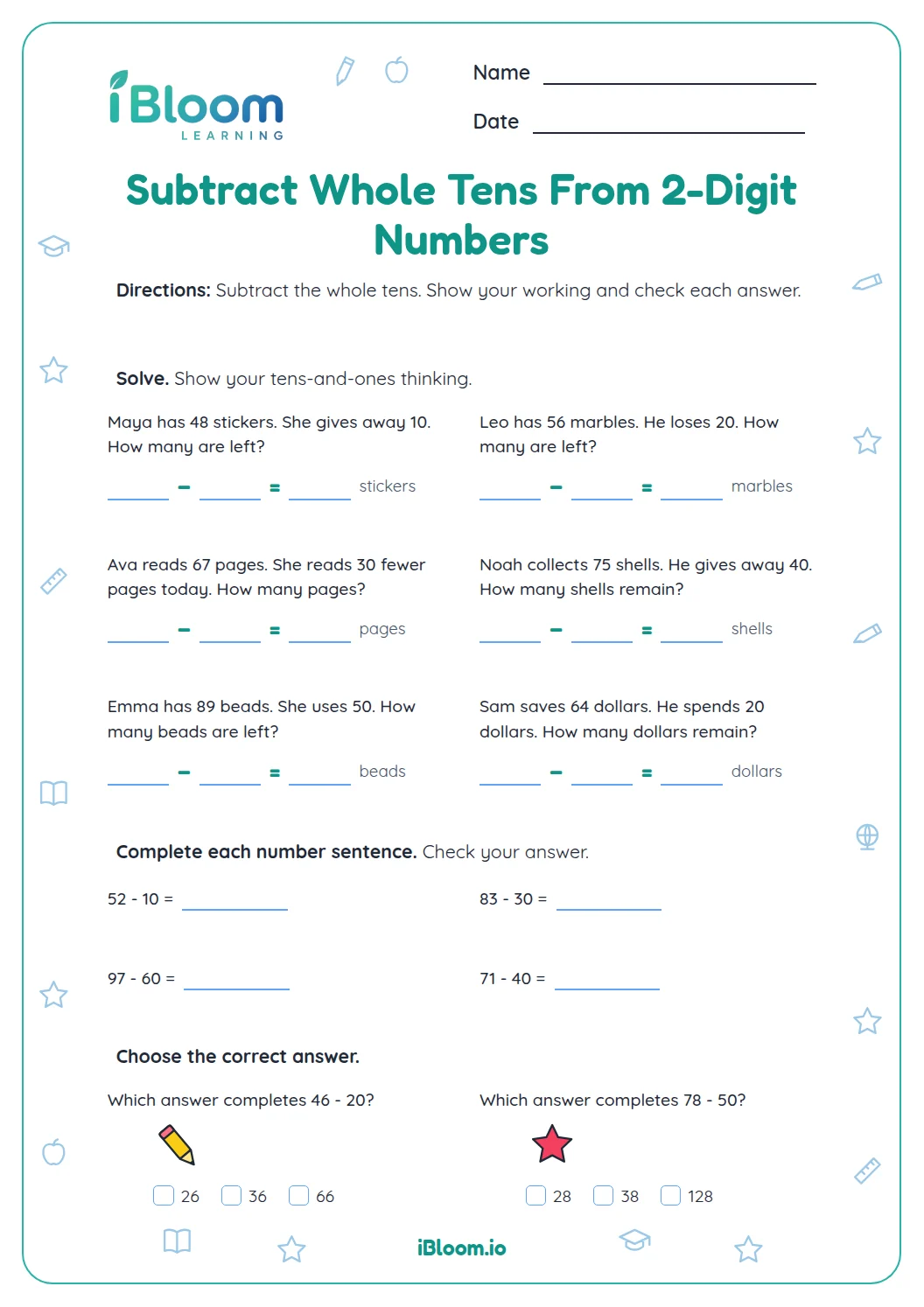
This Grade 2 printable introduces subtracting whole tens from two-digit numbers. Children begin by identifying tens and the digit that changes, then solve subtraction equations such as 75 − 30 and apply the pattern to points, money and stickers. There are 16 questions in four parts, with a separate answer key. The practice supports Common Core 2.NBT.B.5, adding and subtracting within 100 using place value strategies.
Aligned to 2.NBT.B.5
Why does the ones digit stay the same?
A whole ten has zero ones. Subtracting 20 means taking away two tens, so the tens digit changes while the ones remain. In question 4, 42 has 4 tens and 2 ones; removing 1 ten leaves 3 tens and 2 ones, or 32.
A quick check is to compare the ones digits before and after. When the amount taken away is a whole ten and the subtraction stays within the number, those ones match.
- 142 − 10 = 32
- 24 tens − 1 ten = 3 tens
- 32 ones stay 2 ones
How does the practice build from place value to stories?
The first part names tens and identifies which place changes. Next, students subtract one or more tens in number sentences. The final questions put the same action into short situations about points and stickers.
- Part A: identify tens and the changing digit
- Part B: subtract whole tens in equations
- Part C: find missing differences
- Part D: solve three take-away stories about points and stickers
How to use this worksheet
- 1Read the tens being subtracted.
- 2Think of each tens digit as a number of groups of ten.
- 3Subtract those groups and keep the ones count.
- 4Write the two-digit difference.
- 5Check by adding the tens back to the answer.
Common mistakes and quick fixes
The mistake
Subtracting ones instead of tens.
The fix
In 42 − 10, the 1 means one ten, or 10.
The mistake
Changing the ones digit though no ones were removed.
The fix
Check that the answer keeps the starting number’s ones digit.
The mistake
Taking away tens but forgetting the remaining tens.
The fix
Use a tens count: 4 tens minus 1 ten leaves 3 tens.
Common Core alignment
This worksheet practices the following Common Core skill.
Use place value and strategies to subtract within 100.
On this sheet: Use place value and strategies to subtract within 100.
Show the official wordingHide the official wording
Fluently add and subtract within 100 using strategies based on place value, properties of operations, and/or the relationship between addition and subtraction.
What to practice next
Make more practice
Further reading
Questions parents and teachers ask
How many questions are in the printable?
A whole ten is a multiple of ten, such as 10, 20, 30 or 50. In these problems it represents one or more groups of ten being taken away. For example, subtracting 30 means removing three tens. The remaining tens and ones make the difference.
What is a whole ten?
The number being subtracted has zero ones, so no single ones are removed. In 42 − 10, the two ones remain while the four tens become three tens, making 32. This is why the ones digit stays fixed in these examples.
Why does the ones digit stay the same?
Think of 75 as 7 tens and 5 ones. Remove 3 tens, leaving 4 tens and the same 5 ones. The difference is 45, and adding 30 back checks it. This place value strategy works for each whole-ten equation.
How can place value help with 75 − 30?
Students identify tens, choose which digit changes, solve whole-ten subtraction equations, fill differences and solve short stories about points and stickers. The contexts keep the same action: take away a multiple of ten. The answer key provides the result for each item.
What types of problems are on the page?
There are 16 questions in four parts across two worksheet pages, followed by two answer key pages. The item types include multiple choice, number sentences and three short word problems with working space. The questions move from place value ideas to independent application.
How many questions are in the printable?
The worksheet supports Common Core 2.NBT.B.5. Students subtract within 100 by reasoning about place value, including taking groups of ten from two-digit numbers and checking the result. Each equation removes a whole number of tens and leaves a nonnegative difference.
Which standard does this practice support?
The worksheet supports Common Core 2.NBT.B.5. Students subtract within 100 by reasoning about place value, including taking groups of ten from two-digit numbers and checking the result. Each equation removes whole tens and leaves a nonnegative difference for children to verify.