

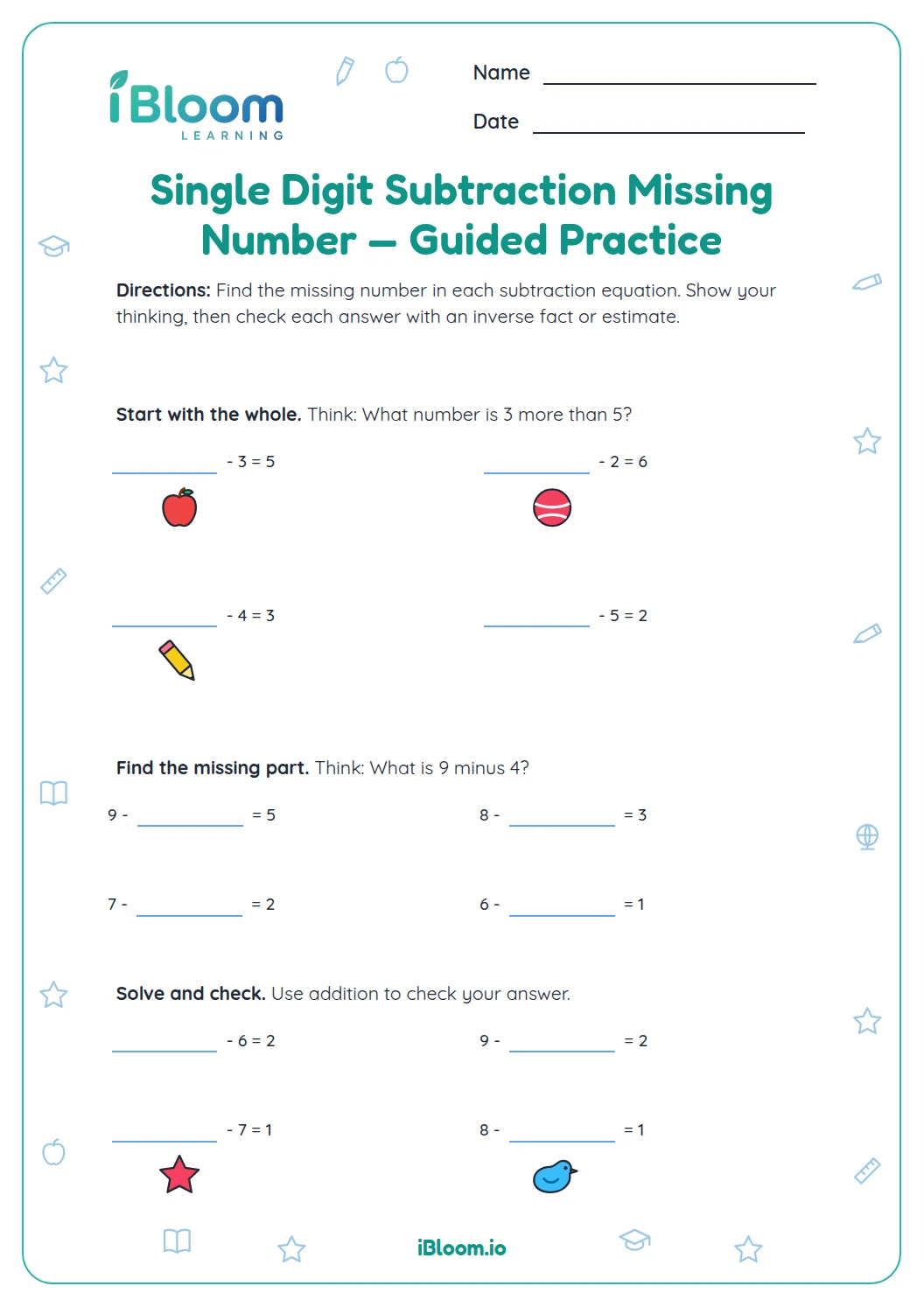
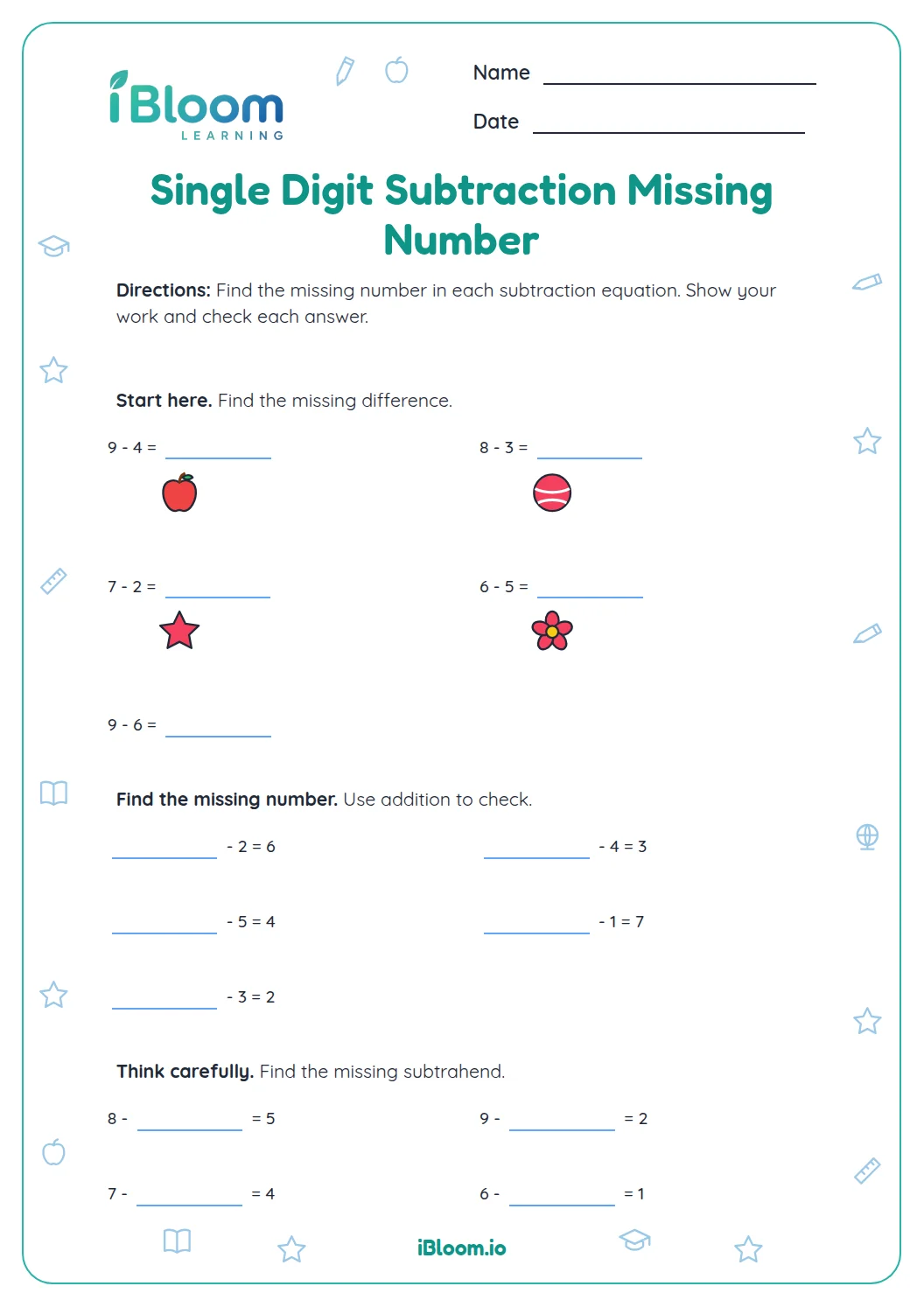
About this worksheet
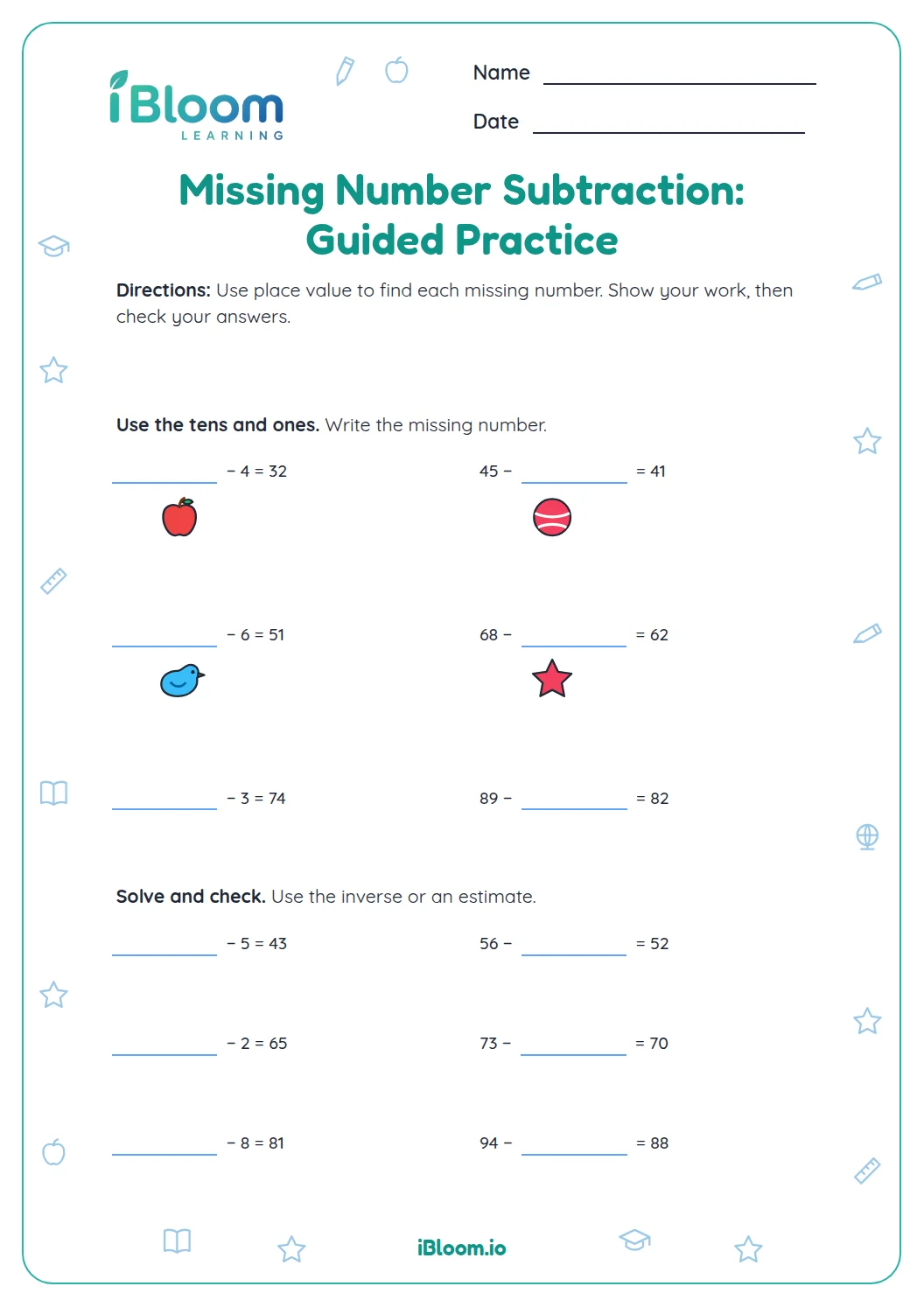
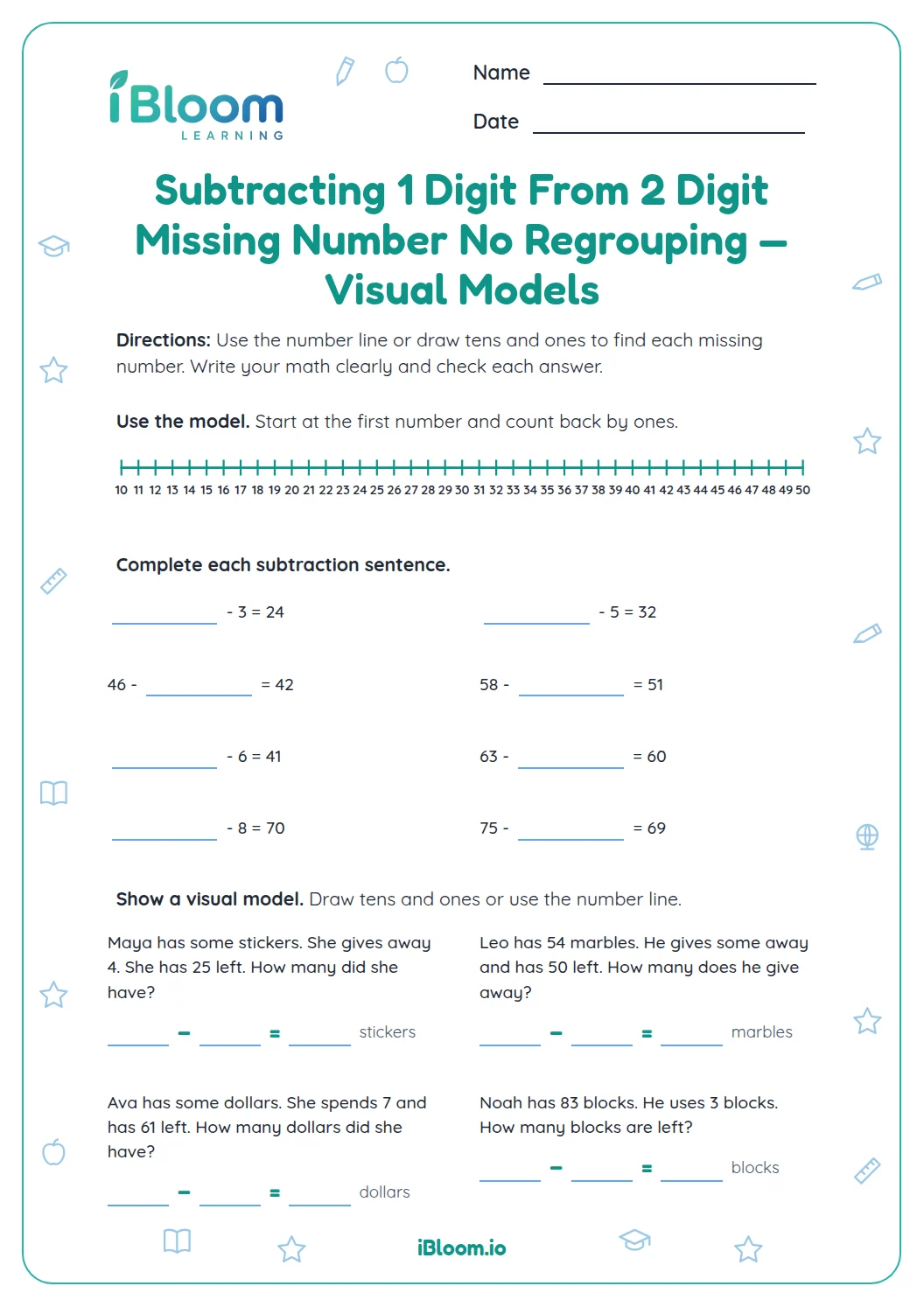
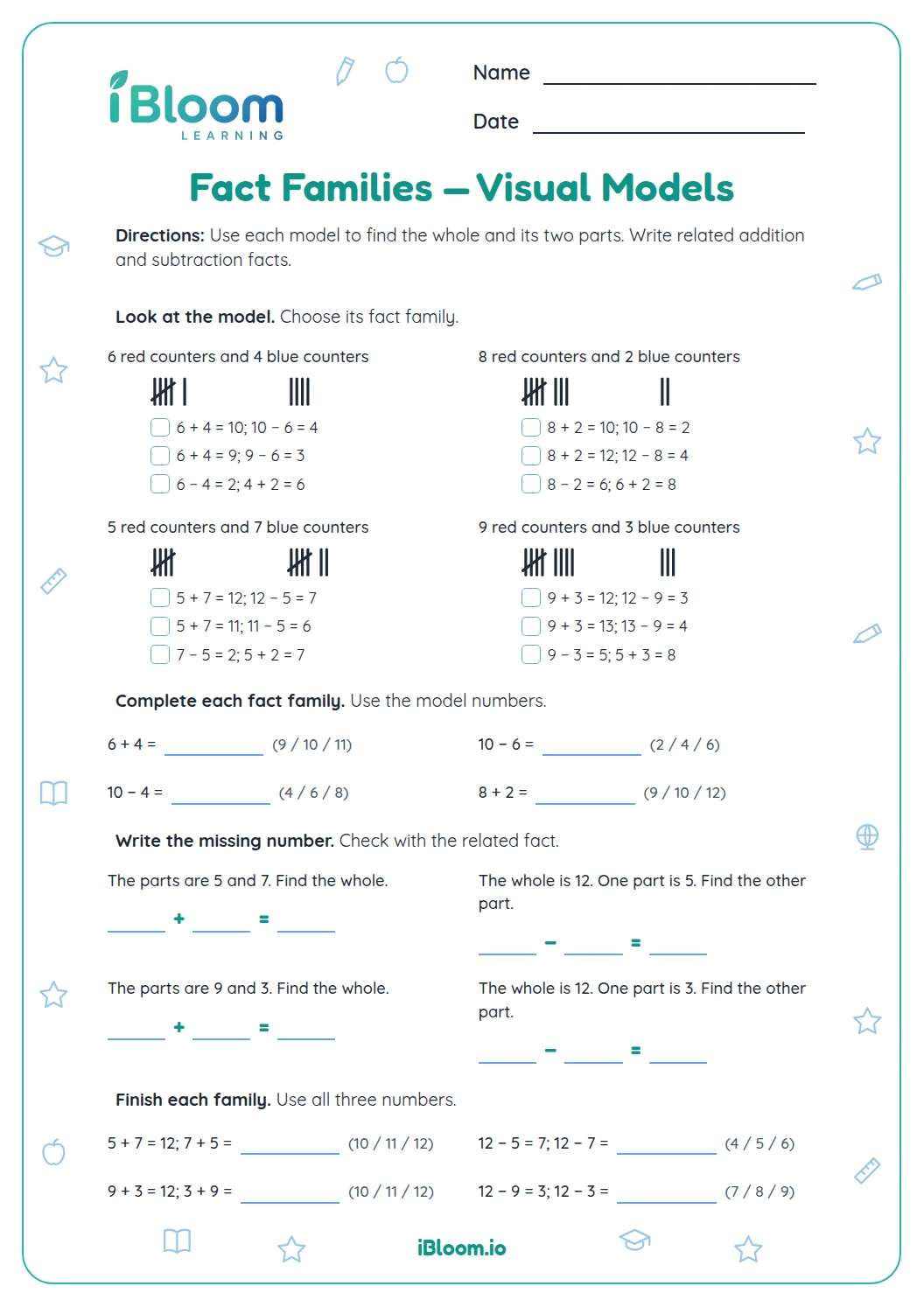
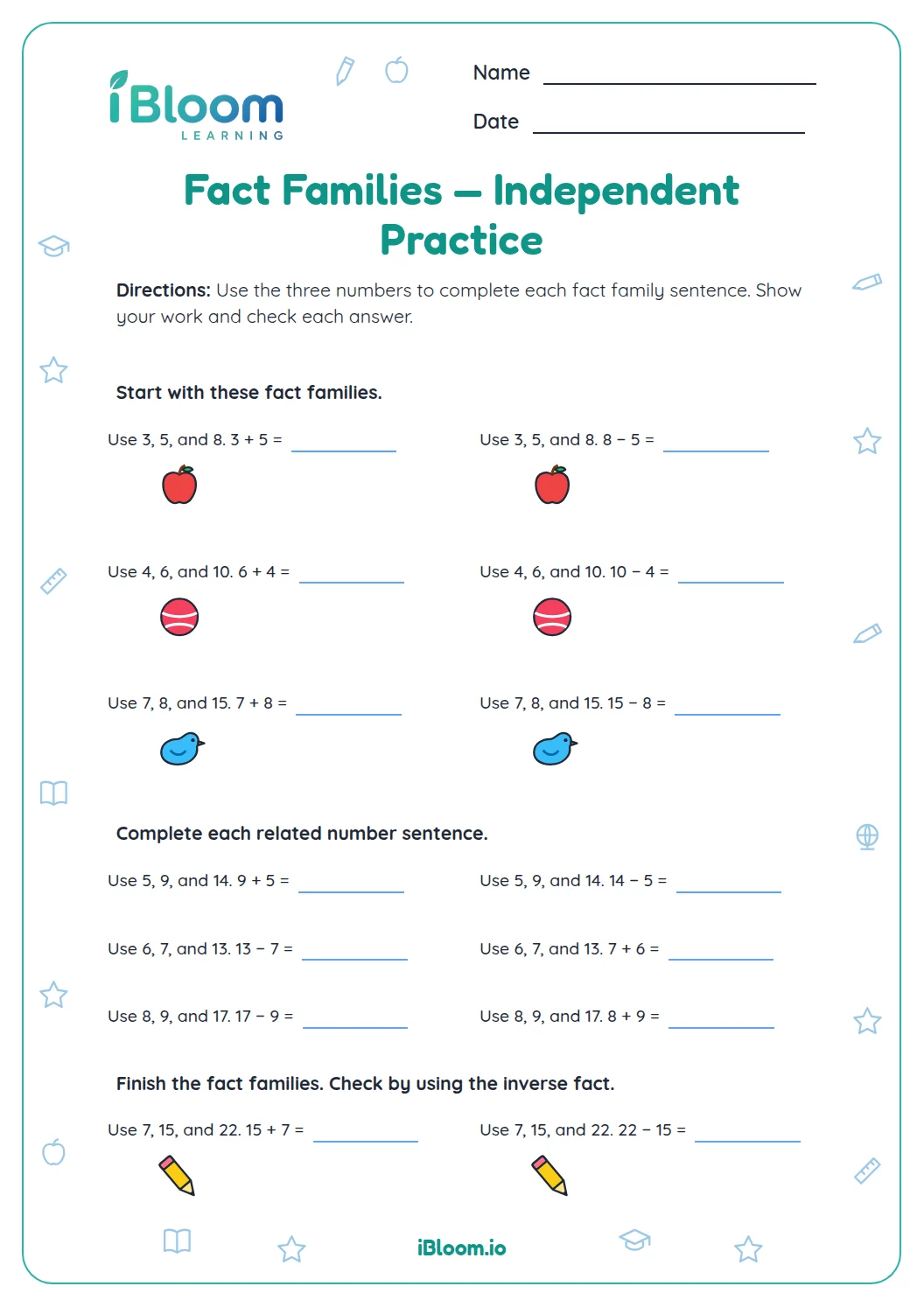
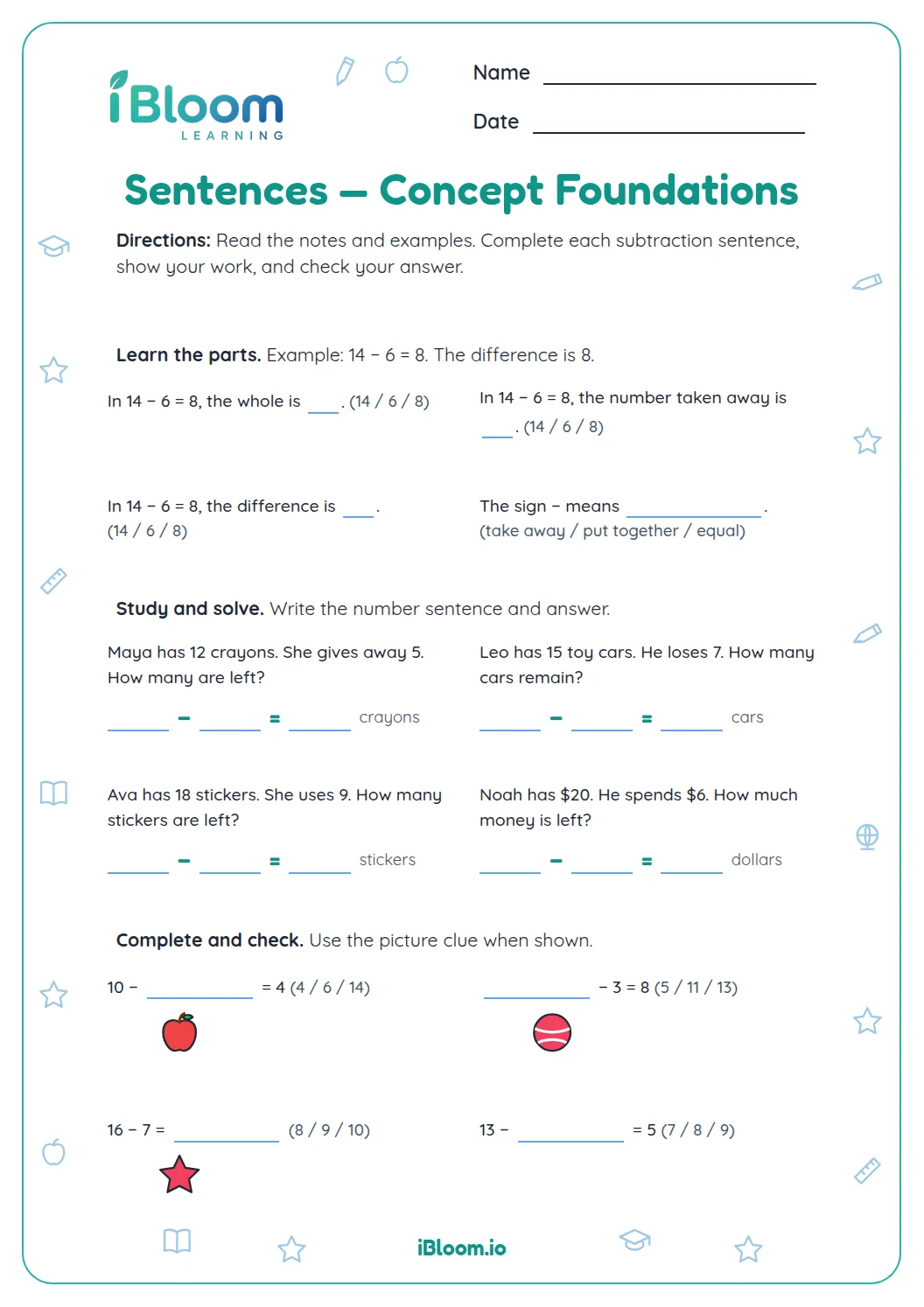
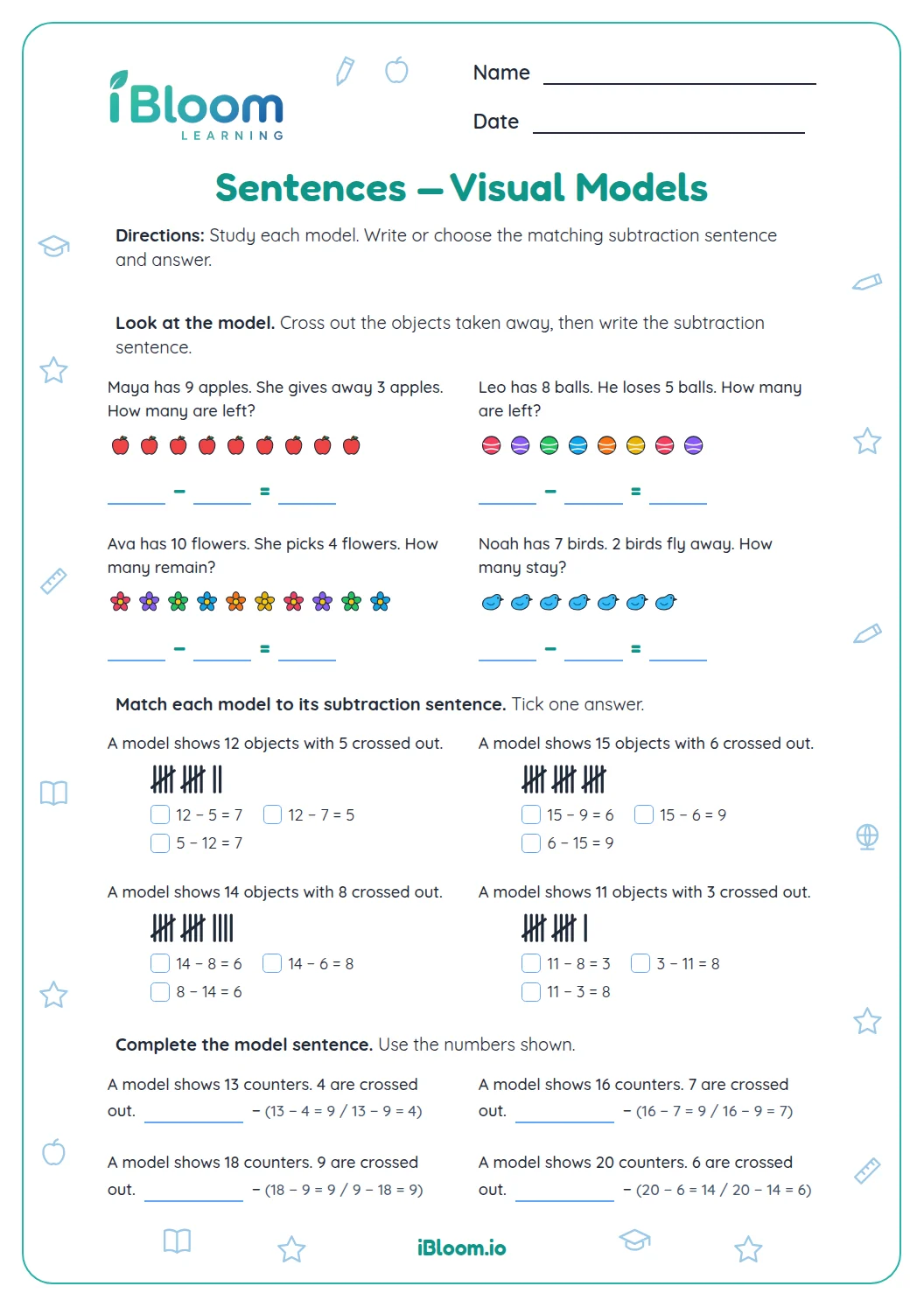
This Grade 2 independent practice sheet focuses on subtracting a one-digit number from a two-digit number without regrouping. Students find a missing subtrahend or difference, then solve short situations with the same number relationship. Addition provides a quick check: the amount taken away plus the amount left equals the starting number. A separate answer key is included.
How can I find the number that was taken away?
Think of subtraction as a missing-part question. In question 1, 34 − ___ = 27. Since 34 − 7 = 27, the missing one-digit subtrahend is 7.
How do I check without subtracting again?
Add the missing number and the difference to check the starting number. For question 1, 7 + 27 = 34, so 34 − 7 = 27 is correct.
What changes in the last part?
Part C describes counters being put away and asks for the missing one-digit amount. Students write a subtraction equation and check by adding the amount removed to the amount remaining.
How can I use this sheet?
- 1Read the starting number and the known number.
- 2Decide whether the blank is the subtrahend or the difference.
- 3Subtract to find the missing number.
- 4Add the subtrahend and difference to check the starting number.
Mistakes to watch for
The mistake
Subtracting the starting number from the difference.
The fix
Keep the starting amount first, then subtract the missing amount.
The mistake
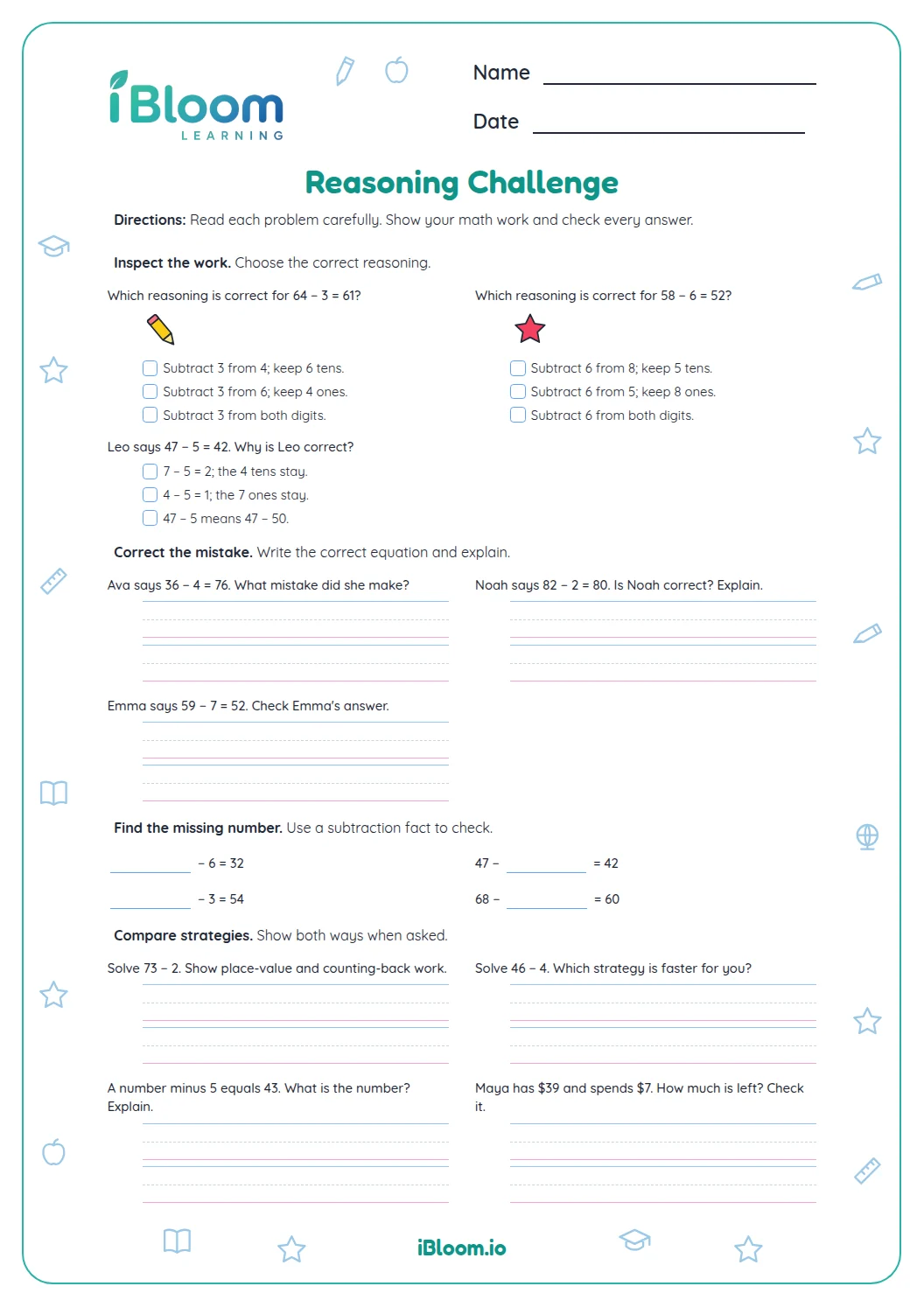
Regrouping even though the ones digit is large enough.
The fix
Compare the ones digits before subtracting; these problems need no trade.
The mistake
Leaving a missing difference unchecked.
The fix
Add the difference and the subtrahend to recover the starting number.
What to practice next
Make more practice
Questions parents and teachers ask
What is a missing subtrahend?
The subtrahend is the number being subtracted. In 34 − ___ = 27, the missing subtrahend is 7 because 34 − 7 leaves 27. Students can check by adding 7 and 27 to return to the starting number, 34. Here, the blank is the one-digit number taken away.
Why use addition to check subtraction?
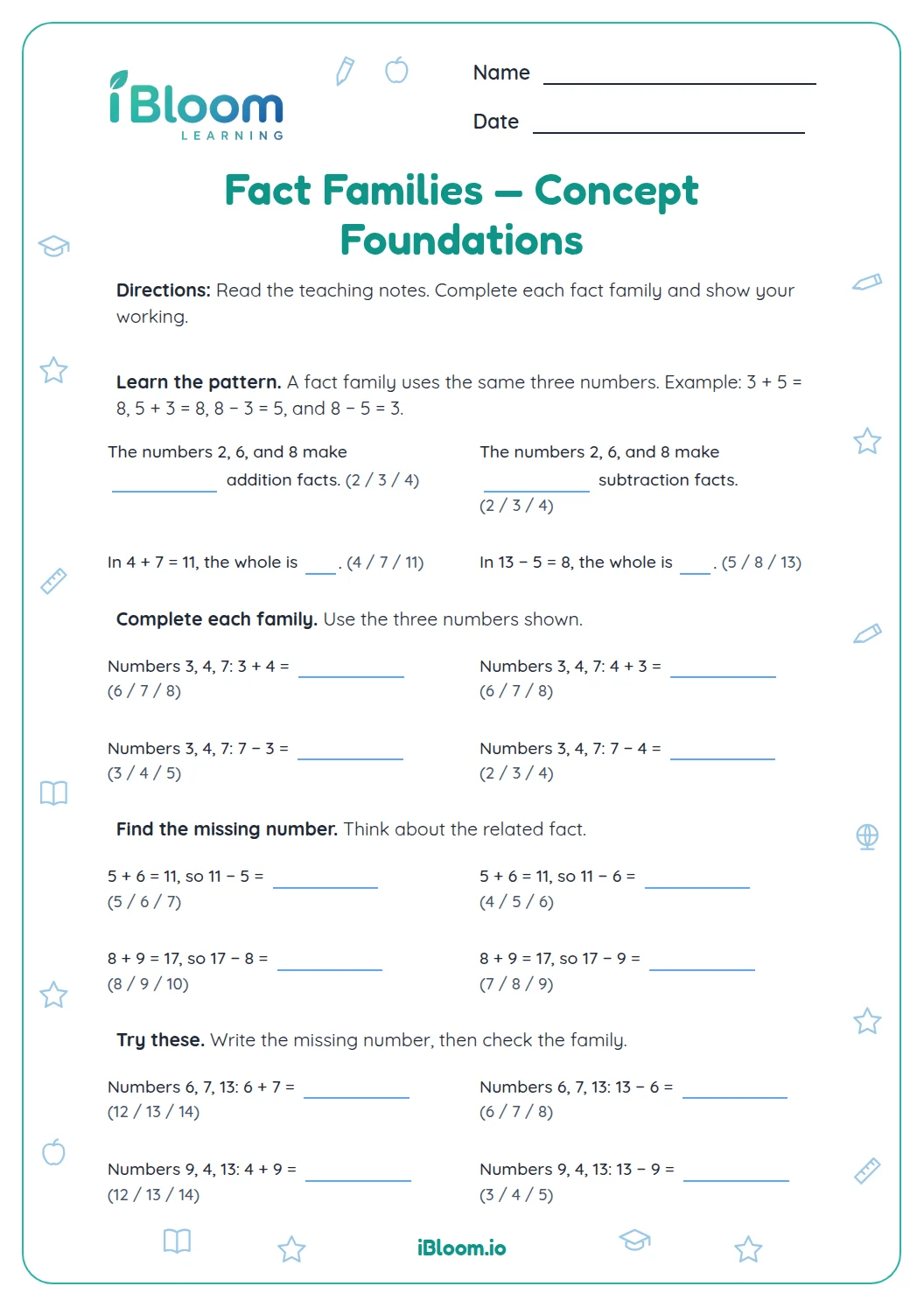
Addition reverses subtraction. If the subtrahend and difference add to the starting number, the equation balances. For 34 − 7 = 27, calculate 7 + 27 = 34. The worksheet directions invite students to use this check after solving. It also works for a missing difference.
Do these problems require regrouping?
No. The subtraction questions use two-digit starting numbers and one-digit subtrahends that can be taken from the ones without trading a ten. Students can focus on identifying the missing number and checking the relationship with addition. The missing numbers stay within the stated subtraction skill.
How should a child solve the story problems?
Write an equation with the starting number first. For example, if 38 counters began on the table and 34 remain, write 38 − ___ = 34. The missing amount is 4; adding 4 and 34 checks the starting total. Each story uses counters.
Does the worksheet include an answer key?
Yes. A separate key lists answers for all 12 number sentences and four story problems. Students can substitute a missing value into its equation and use addition to confirm that the starting number is recovered. It covers both missing-subtrahend equations and story problems.